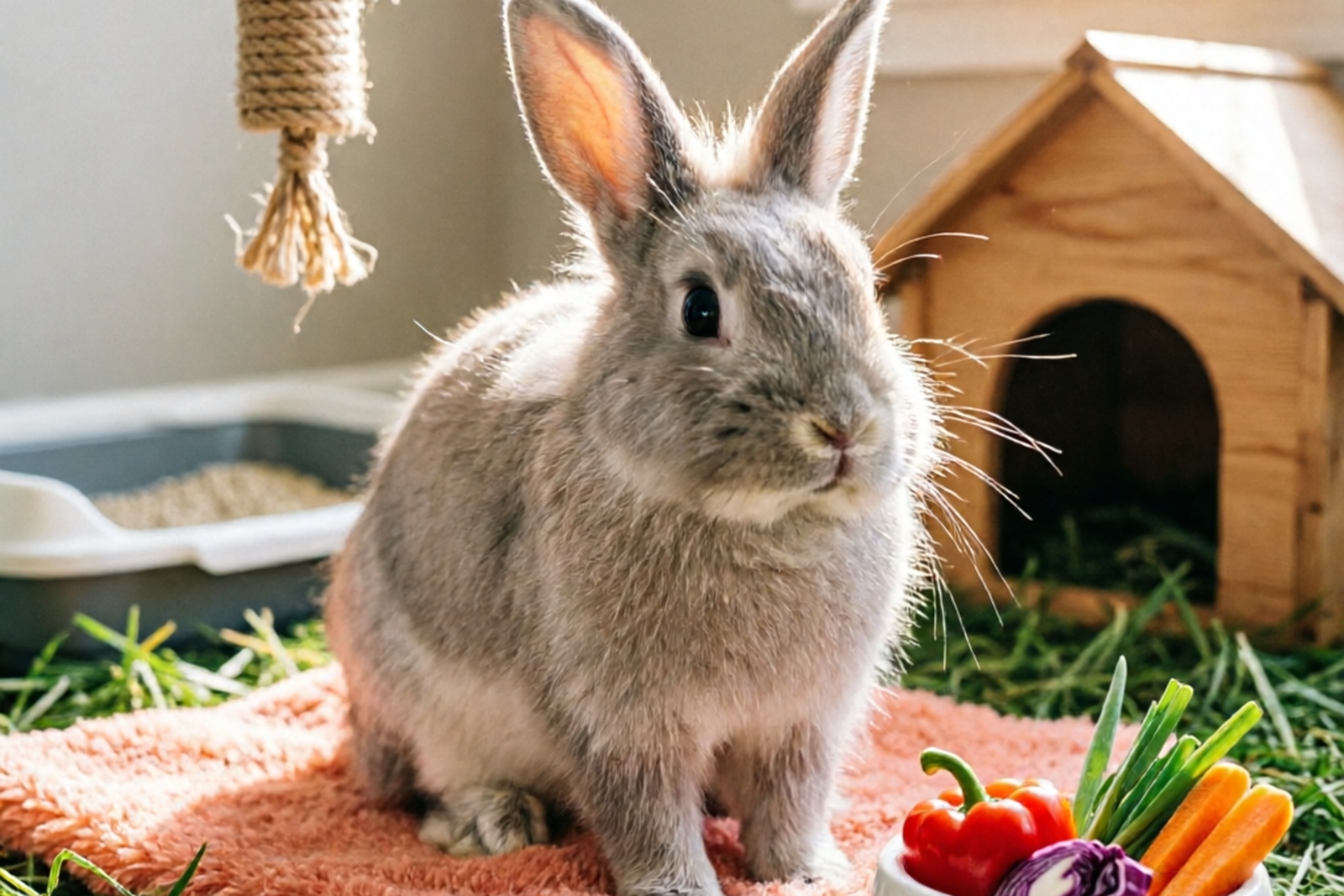
Rabbits make wonderful indoor pets — they are intelligent, social, and can be litter-box trained. A solid indoor rabbit care guide helps you meet their needs. But rabbits have specific needs that differ significantly from more common pets like cats and dogs, and understanding those needs before bringing one home is the single most important thing you can do as a new owner.
This rabbit care guide covers everything from day-one setup to daily care routines, diet, housing, health monitoring, grooming, behavior, and cost expectations. Whether you’re learning how to take care of a rabbit for the first time or looking to improve your current pet rabbit care routine, this guide gives you a complete, actionable reference.
Quick navigation: Setup → Daily Routine → Diet → Housing → Health → Behavior → Grooming → Litter Training → Breed Selection → Care Chart → Costs → FAQ — this rabbit care guide covers it all.
Getting Started — First-Time Rabbit Owner Quick Start
Every good rabbit care guide for beginners starts with preparation. Bringing a rabbit home without the right supplies ready leads to stress for both you and your pet. Here is exactly what you need before day one in this rabbit care guide. Following a structured rabbit care guide from the start makes the transition smoother for both you and your new pet.
Pre-arrival checklist:
- ✅ Cage or exercise pen — minimum 8 square feet of floor space, larger is always better. The House Rabbit Society recommends this as the absolute minimum, with more space always being better for the rabbit’s physical and mental health. See our minimum size requirements for specific dimensions.
- ✅ Litter box — a large corner or rectangular box with rabbit-safe litter
- ✅ Unlimited timothy hay — this should make up 80% of your rabbit’s diet, available 24/7
- ✅ High-quality pellets — approximately 1/4 cup daily for a 6 lb rabbit. See our detailed setup guide for recommended brands.
- ✅ Water bowl or bottle — heavy ceramic bowls are preferred since they are harder to tip over
- ✅ Hideout or house — an enclosed space where the rabbit can feel secure
- ✅ Chew toys and enrichment — essential for dental health and mental stimulation
- ✅ Nail trimmer — small animal nail clippers for monthly trims
- ✅ Carrier — for safe transport to veterinary appointments
First week timeline — what to do each day:
Day 1: Set up the enclosure completely. This first time rabbit owner guide walks you through each step. Place food, water, hay, and hideout inside. Let your rabbit explore the new space without any handling. This is critical — the rabbit needs time to establish its territory and feel safe.
Day 2-3: Sit near the enclosure and talk softly so your rabbit gets used to your voice and scent. Offer treats from your hand through the pen bars. Do not attempt to pick up the rabbit yet.
Day 4-5: Begin gently petting your rabbit while it eats. Start litter training by placing some soiled bedding in the litter box to establish the scent association.
Day 6-7: Begin supervised free-roam time in a rabbit-proofed room for about 30 minutes. Start your daily health check routine. See our comprehensive diet guide for detailed feeding instructions during this transition period.
Rabbit Housing — Cage, Exercise Pen, or Free Roam?
Choosing the right housing setup is one of the most impactful decisions in your rabbit care guide. The wrong enclosure leads to stress, obesity, and behavioral problems. Here’s how the main options compare in this rabbit care guide:
| Option | Minimum Size | Pros | Cons | Best For |
|---|---|---|---|---|
| Exercise Pen | 8-16 sq ft | Affordable, flexible, good ventilation | No top cover, thin wire | Most owners |
| Large Cage | 8+ sq ft | Secure, easy to clean | Expensive, can feel cramped | Single rabbit, small space |
| Free Roam | 1+ room | Maximum space, natural behavior | Requires rabbit-proofing | Experienced owners |
| DIY Hutch | Custom | Can be very spacious | Outdoor only, predator risk | Multiple rabbits, outdoor |
The MidWest Homes for Pets 42-Inch Exercise Pen — recommended in this rabbit care guide — provides 16 square feet of play area and is a popular choice for supervised free-roam sessions. For a more permanent setup, the Amazon Basics Top Access Small Animal Habitat works as a starter cage with a balcony and ramp, though keep in mind that its usable floor space is smaller than the stated dimensions. For more housing recommendations, see our guide to the best rabbit cages, an essential resource in any rabbit care guide.
Rabbit-proofing checklist — essential if your rabbit will have any free-roam time:
- Cover or block all electrical cords — rabbits chew through wires, which can be fatal. Use split-loom tubing or cord covers.
- Remove toxic plants — lilies, ivy, azaleas, rhododendrons, and many houseplants are poisonous to rabbits.
- Block access under furniture — rabbits hide in tight spaces and may get stuck or chew on furniture springs.
- Protect baseboards and wooden furniture — use bitter apple spray or plastic guards to prevent chewing.
- Keep houseplants out of reach — even non-toxic plants can cause digestive upset.
- Secure low cabinets — rabbits can open latches and get into cleaning supplies or food.
Rabbit-proofing is not optional — as this rabbit care guide stresses, even if your rabbit lives primarily in an exercise pen, it will need supervised free-roam time, and an unproofed room is a genuine hazard. Electrical cord chewing is the single most common cause of emergency vet visits for house rabbits. Take the time to thoroughly rabbit-proof any room your rabbit will access before allowing free roam — a step this rabbit care guide cannot overemphasize.
For outdoor housing options, see our DIY rabbit hutch guide.
Rabbit Daily Care Routine — What to Do Every Day
A consistent daily routine is the backbone of effective pet rabbit care. The good news is that daily tasks take only 10 to 15 minutes total. Here is the complete rabbit daily care routine:
Morning (5 minutes) — your rabbit care guide daily routine starts here:
- Check water supply — refill the bowl or bottle, and verify there are no blockages
- Ensure unlimited fresh timothy hay — this is 80% of the diet and must always be available
- Remove uneaten pellets from the night before to prevent selective eating
- Quick health scan — eyes clear, nose dry, fur clean, bottom dry and free of stool. This 30-second check catches problems early.
Evening (5-10 minutes):
- Offer daily pellet portion — approximately 1/4 cup per 6 lbs of body weight. See recommended pellet brands for quality options.
- Add fresh vegetables — 1 to 2 cups per 6 lbs of body weight, rotating 3 to 5 types
- Spot-clean litter box — remove soiled areas to maintain hygiene
- Provide supervised free-roam time — minimum 2 to 4 hours daily for exercise and enrichment
Crepuscular: Rabbits are crepuscular animals, meaning they are naturally most active during dawn and dusk. This biological rhythm comes from their wild ancestry — dawn and dusk are the safest times for prey animals to forage. In practice, this means your rabbit will be most energetic, social, and hungry in the early morning and early evening. Midday and late night are their primary sleep periods, and disturbing a sleeping rabbit causes unnecessary stress. Schedule feeding and interaction around these peak activity windows for the best results.
A note on routine consistency: As this rabbit care guide recommends, rabbits are creatures of habit and become stressed when their feeding or exercise schedule changes unexpectedly. Try to feed and interact with your rabbit at roughly the same times each day. If you need to change your schedule, do so gradually over several days. This consistency extends to cage cleaning — avoid rearranging the entire enclosure at once, as this can be disorienting for a rabbit that relies on scent markers and familiar layouts for security.
Rabbit Diet — The Complete Feeding Guide
Diet is the most critical component of any rabbit care guide. A wrong diet causes dental disease, GI stasis, obesity, and shortened lifespan. Here is the complete feeding breakdown for a 6 lb (2.7 kg) adult rabbit in this rabbit care guide:
| Food Category | Daily Amount | Percentage | Notes |
|---|---|---|---|
| Timothy hay | Unlimited | 80% | Always available, 24/7. Essential for digestion and teeth |
| Fresh vegetables | 1-2 cups | 15% | Rotate 3-5 types for nutrient variety |
| Pellets | 1/4 cup | 4% | High-quality timothy-based pellets only |
| Treats | 1-2 tbsp | 1% | Fruit maximum 1-2x per week |
| Fresh water | 8-12 oz | Always | Heavy ceramic bowl preferred |
According to the House Rabbit Society (rabbit.org) — a key reference in this rabbit care guide — timothy hay should comprise approximately 80% of an adult rabbit’s daily food intake. This is not a suggestion — it is a biological necessity. Hay provides the long-stem fiber that keeps a rabbit’s digestive system moving and grinds down their continuously growing teeth. A rabbit that does not eat enough hay will develop dental disease and is at high risk for GI stasis — a fact emphasized in every rabbit care guide.

Safe vegetables for daily feeding: romaine lettuce, cilantro, parsley, basil, bell pepper, broccoli, carrot tops, and endive. Rotate at least 3 to 5 types per week to provide a broad nutrient profile. For detailed safe food lists, see our comprehensive rabbit food guide.
Treats (occasional only): small pieces of apple (no seeds), blueberry, strawberry, banana, and small carrot pieces. These should never exceed 1 to 2 tablespoons per serving and should be offered no more than once or twice per week.
Dangerous foods to avoid entirely: chocolate, avocado, onion, garlic, potato, rhubarb, iceberg lettuce, bread, crackers, and any processed human food. Even small amounts of these can cause serious health problems — chocolate and avocado are toxic, while high-carbohydrate foods like bread and crackers disrupt the delicate balance of bacteria in a rabbit’s gut.
Understanding hay quality: Not all hay is equal. Look for hay that is green, smells fresh, and is free of mold or dust. Avoid hay that appears brown, yellow, or has a musty smell — these are signs of poor quality or improper storage. Store hay in a cool, dry place in a breathable bag or container. Most rabbits prefer timothy hay, but orchard grass or oat hay can be offered as alternatives if your rabbit is a picky eater.
For specific vegetable safety questions, check our guides on can rabbits eat carrots, can rabbits eat bell peppers, and can rabbits eat celery.
Recommended pellet brands (from this rabbit care guide):
Oxbow Garden Select Rabbit Food is a vet-recommended premium option made with three hay varieties — timothy, orchard grass, and oat hay — with no artificial colors, soy, or wheat. For owners on a tighter budget, Kaytee Supreme Rabbit Food is a more affordable seed-and-grain mix that rabbits generally enjoy, though be aware it contains fillers like corn that vets consider less ideal for long-term digestive health. Plain pellets are always healthier than mixed muesli-style feeds, since rabbits pick out the tasty pieces and leave the nutritious ones.
Disclaimer: This article provides general care information only and is not a substitute for professional veterinary advice. If your rabbit shows any signs of illness, contact an exotic animal veterinarian immediately.
Rabbit Health Monitoring — What to Check and When
Proactive health monitoring separates good rabbit owners from great ones. A comprehensive rabbit care guide always emphasizes prevention over treatment. Rabbits hide illness instinctively — in the wild, showing weakness attracts predators — so by the time symptoms are obvious, the condition may already be serious. This rabbit health check routine should be performed weekly as part of your overall rabbit care guide.
GI stasis (gastrointestinal stasis) is a life-threatening slowdown or complete stoppage of the digestive tract in rabbits. According to the House Rabbit Society, it is one of the leading causes of death in pet rabbits. It occurs when gut motility decreases, often triggered by stress, dehydration, insufficient hay intake, pain, or an underlying condition. Symptoms include loss of appetite, reduced or absent fecal output (or very small, dry droppings), abdominal bloating, lethargy, and a hunched posture. Without prompt veterinary treatment — typically fluid therapy, pain medication, and gut motility drugs — GI stasis can be fatal within 12 to 24 hours. This is a veterinary emergency: if your rabbit stops eating or producing droppings, call your exotic vet immediately.
Weekly health check (5 minutes):
- Eyes — should be bright, clear, and free of discharge or cloudiness
- Nose — should be clean and dry, with no sneezing or nasal discharge
- Ears — check for mites, indicated by head shaking or excessive scratching. Clean interior with a damp cloth if needed.
- Teeth — check alignment. Overgrown teeth cause drooling, difficulty eating, and weight loss. Provide wooden chew toys daily to maintain natural wear.
- Fur and skin — look for bald patches, dandruff, scabs, or excessive scratching, which may indicate mites or fungal infection
- Bottom and rear area — must be clean and dry. A wet or soiled bottom is a warning sign of GI stasis or diarrhea and requires immediate veterinary attention.
- Nails — trim every 4 to 6 weeks if not worn down naturally during free-roam time
- Weight — monitor monthly using a kitchen scale. Sudden weight loss or gain warrants a vet visit.
For comprehensive health information, see our comprehensive rabbit health guide — a critical companion to this rabbit care guide. With good care following this rabbit care guide, a healthy rabbit lifespan typically ranges from 8 to 12 years. Keeping your rabbit at a healthy weight through proper diet and regular exercise is one of the most impactful things you can do to maximize those years.
Rabbit Behavior — Understanding Your Pet
Understanding rabbit behavior transforms your relationship with your pet, and this rabbit care guide covers the essentials. This section of our rabbit care guide covers the signals your rabbit uses to communicate, an essential part of pet rabbit care. Rabbits communicate primarily through body language and a few vocalizations — learning to read these signals makes how to take care of a rabbit much more intuitive.
Common rabbit behaviors and what they mean:
- Binky (happy jump with a twist in the air) — the most joyful rabbit behavior. Your rabbit is happy, comfortable, and feeling safe in its environment.
- Flop (throwing themselves dramatically onto their side) — complete relaxation and trust. A rabbit will only flop in an environment where it feels entirely secure.
- Soft tooth grinding — contentment, similar to a cat’s purr. You may feel it when petting your rabbit.
- Thumping (loud foot stamp) — a warning signal. Your rabbit senses danger or is annoyed about something.
- Nudging or headbutting — wants attention or wants you to move out of its way.
- Licking — affection and bonding. A rabbit that licks you trusts you deeply.
- Growling or hissing — fear or aggression. Give the rabbit space immediately.
- Screaming — extreme pain or fear. Rare but serious — investigate immediately.
Key behavioral needs in any rabbit care guide:
- Minimum 2 to 4 hours of supervised free-roam time daily for exercise and mental stimulation
- Social interaction — rabbits are social animals and thrive with a bonded partner or daily human interaction
- Mental enrichment — foraging toys, tunnels, cardboard boxes, and puzzle feeders prevent boredom
- Consistent routine — rabbits thrive on predictability and can become stressed by sudden changes
- Floor-level interaction — rabbits are ground dwellers and feel insecure when picked up. Interact at their level whenever possible.
For a deeper understanding of rabbit communication, see our detailed behavior guide — this rabbit care guide provides the overview, while the behavior guide goes deeper. and our guide to rabbit vocalizations.
Rabbit Grooming Essentials
Grooming is an essential but often overlooked part of pet rabbit care that every rabbit care guide should address. Unlike cats, rabbits cannot vomit, which means hairballs from self-grooming can cause fatal intestinal blockages. Regular brushing during shedding seasons prevents this dangerous complication — a rabbit care guide essential.
Grooming tasks by frequency:
- Daily during shedding season (spring and fall): Brush thoroughly to remove loose fur. Short-haired breeds need less frequent brushing outside of shedding periods.
- Weekly: Check nails and trim every 4 to 6 weeks. Inspect ears for debris or signs of mites.
- Monthly: Full body check and light brushing for non-shedding breeds.
- As needed: Spot-clean with a damp cloth if your rabbit gets soiled. Full baths are dangerous for rabbits — they can cause hypothermia, stress, and even shock. Never submerge a rabbit in water.
For detailed grooming techniques, see our detailed grooming guide — another essential rabbit care guide resource.
Litter Training Your Rabbit
Rabbits are naturally clean animals that tend to use the same corner as their bathroom, which makes litter training surprisingly straightforward. This is one of the most rewarding aspects covered in this rabbit care guide for anyone learning rabbit care. Most rabbits can be trained within a few weeks using a consistent approach outlined in this rabbit care guide.
Litter training in 5 steps:
Step 1: Place a large litter box in the corner your rabbit already uses as a bathroom. Rabbits almost always choose a corner, so observe your rabbit for the first day or two to identify the preferred spot.
Step 2: Add a generous handful of hay to one end of the litter box. Rabbits like to eat while they eliminate, so combining food and bathroom areas encourages consistent use.
Step 3: Place some soiled bedding and a few droppings into the new litter box to establish the scent association that tells your rabbit this is the correct bathroom area.
Step 4: When your rabbit uses the box correctly, offer verbal praise or a small treat as positive reinforcement. Never punish for accidents — rabbits do not respond to punishment and it damages trust.
Step 5: Clean the litter box every 1 to 3 days. Always leave a small amount of soiled litter in the box when cleaning to maintain the scent marker that keeps your rabbit coming back.
Carefresh 99% Dust-Free White Paper Bedding is the most popular rabbit bedding — it is 99% dust-free, highly absorbent, and provides 10-day odor control. For the litter box specifically, Kaytee Premium Potty Training Critter Litter is designed for potty training small animals and absorbs 10 times its weight in liquid. Avoid clumping clay litter and cedar or pine shavings, which are harmful to rabbits.
For a complete training walkthrough, see our detailed litter training guide — a must-read companion to this rabbit care guide.
Common litter training problems: If your rabbit repeatedly uses a spot outside the litter box, move the litter box to that location — it is easier to adapt to your rabbit’s preference than to change it. If your rabbit sits in the litter box but does not use it, try a different type of litter since some rabbits have strong texture preferences. Male rabbits that are not neutered may spray urine to mark territory, which makes litter training much more difficult. Having your rabbit spayed or neutered generally resolves this issue and also provides important health benefits.
Choosing the Right Rabbit Breed
The best rabbit breed for you depends on your living space, experience level, family situation, and how much time you can dedicate to grooming and interaction. A thorough rabbit care guide accounts for breed-specific differences. Here are the five most popular breeds for pet owners:
| Breed | Size | Lifespan | Temperament | Best For |
|---|---|---|---|---|
| Holland Lop | 3-4 lbs | 7-14 years | Friendly, calm, easy to handle | Families with children |
| Mini Lop | 4.5-6 lbs | 7-14 years | Gentle, social, playful | First-time owners |
| Netherland Dwarf | 1.5-2.5 lbs | 7-12 years | Energetic, can be skittish | Experienced owners |
| Flemish Giant | 12-15 lbs | 5-8 years | Docile, gentle giant | Owners with space |
| Lionhead | 2.5-3.5 lbs | 7-10 years | Friendly, needs grooming | Owners who enjoy grooming |
Smaller breeds need less enclosure space but may be more nervous and harder to handle — Netherland Dwarfs, for example, are adorable but can be skittish around children. Larger breeds are calmer and more docile but need bigger cages, more food, and are harder to transport for vet visits. The Flemish Giant, while wonderfully gentle, requires a significantly larger enclosure and may need a second person to help lift during health checks. The key principle is to match the breed to your lifestyle rather than choosing based on appearance alone. If you have young children, a calm breed like the Holland Lop or Mini Lop is generally the safest choice. Our Holland Lop breed guide provides detailed temperament information that complements this rabbit care guide.
No rabbit care guide is complete without breed-specific advice. For detailed breed profiles, see our guides to the Holland Lop, Mini Lop, Netherland Dwarf, Flemish Giant, and Lionhead.
Rabbit Care Chart — Quick Reference
Having a rabbit care checklist you can reference daily makes your routine consistent and ensures nothing gets missed. Here is the complete care schedule for your rabbit care guide reference:
| Task | Frequency | Time Needed |
|---|---|---|
| Check water | Daily | 30 seconds |
| Refill hay | Daily | 1 minute |
| Feed pellets + vegetables | Daily | 2 minutes |
| Spot-clean litter box | Daily | 2 minutes |
| Quick health scan | Daily | 30 seconds |
| Supervised free-roam | Daily | 2-4 hours |
| Clean litter box fully | Every 2-3 days | 5 minutes |
| Weekly health check | Weekly | 5 minutes |
| Trim nails | Every 4-6 weeks | 10 minutes |
| Clean enclosure | Weekly | 15-20 minutes |
| Replace bedding | Weekly | 10 minutes |
| Weight check | Monthly | 1 minute |
| Vet wellness check | Every 6 months | 30-60 minutes |
Making the routine stick: The easiest way to maintain a consistent care schedule is to tie tasks to your existing daily habits. Refill hay and water when you make your morning coffee. Feed vegetables in the evening when you prepare your own dinner. Weekly cage cleaning can be scheduled for the same day each week. When care becomes part of your routine rather than an additional task, it feels effortless. This is the core philosophy behind every effective rabbit care guide.
How Much Does a Rabbit Cost?
Understanding the financial commitment is an important part of responsible rabbit care for beginners. A complete rabbit care guide covers both daily and long-term costs. Many new owners underestimate the long-term cost of rabbit ownership.
| Expense | Initial Cost | Monthly Cost |
|---|---|---|
| Rabbit (adoption) | $25-75 | — |
| Rabbit (breeder) | $50-200 | — |
| Cage or exercise pen | $50-150 | — |
| Litter box + litter | $15-25 | $10-15 |
| Hay (monthly) | — | $10-20 |
| Pellets (monthly) | — | $8-15 |
| Fresh vegetables (weekly) | — | $10-15 |
| Chew toys + enrichment | $15-30 | $5-10 |
| Vet wellness check | $50-100 | — |
| Emergency vet fund | $200-500+ | — |
| Total first year | $350-700 | $45-80/month |
As noted throughout this rabbit care guide, over a typical 8 to 12 year lifespan, total cost of ownership ranges from approximately $3,000 to $6,000 or more when including veterinary expenses for illness and emergency care. The single most important thing you can do to control long-term costs is to find an experienced exotic animal veterinarian before you need one — emergency vet visits for rabbits are significantly more expensive than planned wellness exams, and not all small animal clinics treat rabbits. Budget for at least one wellness exam per year and set aside a dedicated emergency fund of $200 to $500 from day one. A comprehensive rabbit care guide will always stress the importance of financial preparedness — and this rabbit care guide is no exception. for your pet’s health needs.
For recommended enrichment options, see our guide to the best rabbit toys — a key resource in any rabbit care guide. The Bissap Bunny Chew Toy — Hanging Grapevine Wreath is a popular hanging chew toy made from natural grapevine, willow, and timothy hay cakes that provides hours of enrichment. The andwe Small Animals Play & Activity Balls come in a pack of 8 natural material balls that are perfect for foraging games — hide treats inside them to keep your rabbit mentally stimulated.
Rabbit Care Quick-Check — Your Rabbit Care Guide Summary
- ✅ Cage: 8+ sq ft floor space minimum
- ✅ Housing: One rabbit or bonded pair per enclosure
- ✅ Hay: Unlimited timothy hay, 80% of diet, available 24/7
- ✅ Vegetables: 1-2 cups daily, rotating 3-5 types
- ✅ Water: Fresh daily in heavy ceramic bowl
- ✅ Exercise: 2-4 hours supervised free-roam daily
- ✅ Health check: Weekly 8-step body check
- ✅ Litter box: Cleaned every 1-3 days
- ✅ Grooming: Brush during shedding, trim nails every 4-6 weeks
- ✅ Vet: Wellness exam every 6 months + emergency fund
- ❌ Never: Use wire-bottom flooring (causes sore hocks)
- ❌ Never: Use clumping clay litter or pine/cedar shavings
- ❌ Never: Feed chocolate, avocado, onion, garlic, or iceberg lettuce
- ❌ Never: Submerge a rabbit in water for a bath
Bookmark this rabbit care guide for quick reference whenever you need it.
FAQ — Rabbit Care Guide Questions
Is it hard to take care of a rabbit?
Rabbits require moderate care — more than a hamster or fish, but less than a dog. The biggest time commitment is daily fresh food preparation (vegetables), daily hay replenishment, and providing 2-4 hours of supervised free-roam time. Weekly health checks and cage cleaning add another 30 minutes. The learning curve is manageable for most new owners, but rabbits do have specific needs — particularly around diet and digestive health — that require some education upfront. The most challenging aspect for most new owners is finding a qualified exotic animal veterinarian, since not all clinics treat rabbits.
What do rabbits need to survive?
Rabbits need five essentials: unlimited timothy hay (80% of diet), fresh water daily, a safe enclosure with at least 8 square feet of floor space, daily fresh vegetables (1-2 cups), and at least 2-4 hours of supervised exercise time outside their enclosure. They also need a litter box, hideout, chew toys, and regular veterinary care from an exotic pet vet.
How much does it cost to care for a rabbit?
Expect $45 to $80 per month for ongoing costs including hay ($10-20), pellets ($8-15), fresh vegetables ($10-15), litter ($10-15), and toys ($5-10). Initial setup costs $350 to $700 including the rabbit, cage, supplies, and first vet visit. Over an 8-12 year lifespan, total cost ranges from approximately $3,000 to $6,000 or more including veterinary care.
How many hours a day do rabbits need attention?
Rabbits need at least 2-4 hours of supervised free-roam time outside their enclosure every day for exercise and mental stimulation. Beyond that, they need daily feeding (10 minutes), health monitoring (1 minute), and social interaction. They are social animals and benefit from companionship — either from their owner or a bonded rabbit partner.
Can rabbits be left alone for a weekend?
Healthy adult rabbits can be left alone for a 2-day weekend with extra food, water, and hay. However, they should never be left for more than 48 hours. Rabbits are susceptible to GI stasis, which can become fatal within 12-24 hours. If you have any concerns about your rabbit’s health, arrange for someone to check on them daily.