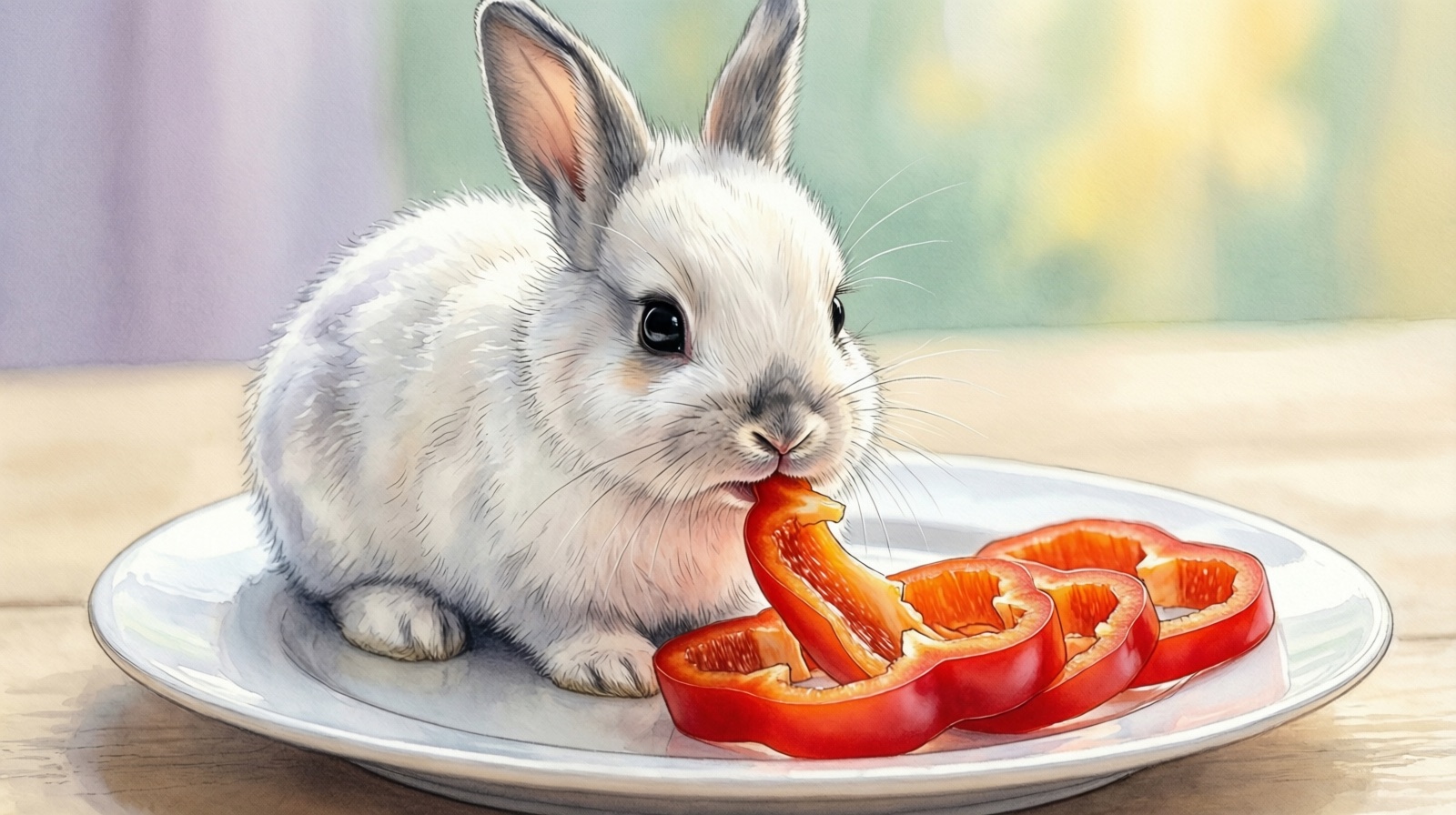
Can Rabbits Eat Bell Peppers?
Yes — bell peppers are one of the safest and healthiest daily vegetables for rabbits.
When asking can rabbits eat bell peppers, they occupy a rare category in rabbit nutrition: a vegetable that can be fed every single day. Unlike carrots (4.7g sugar per 100g) and bananas (12.2g sugar), bell peppers — particularly green ones — are low enough in sugar to be a daily dietary staple.
Can rabbits eat bell peppers? Absolutely — bell peppers are one of the safest daily vegetables. Do rabbits eat bell peppers? Most rabbits enjoy them — can rabbits eat bell peppers? Yes, though individual preferences vary. Can rabbits eat sweet peppers? Yes — sweet peppers and bell peppers are the same vegetable. The four common colors (green, red, yellow, orange) are all the same species, just harvested at different stages of ripeness.
| Part | Safe? | Notes |
|---|---|---|
| Flesh (all colors) | ✅ Safe | Daily feeding OK (green especially) |
| Seeds | ⚠️ Not recommended | Non-toxic but no nutritional value |
| Stem | ❌ No | Too tough, choking hazard |
| White membrane | ⚠️ Remove | Bitter, harder to digest |
| Leaves | ⚠️ Not toxic but skip | Low nutrition, pesticide risk |
| Cooked | ❌ No | Always raw, never cooked |
For can rabbits eat bell peppers, the key rules: remove seeds and stems, wash thoroughly, serve raw only. For the complete dietary framework, see our rabbit food guide.
Bell Pepper Nutrition Facts for Rabbits
USDA nutritional data — raw bell pepper, per 100g by color USDA FoodData Central FDC ID 169383:
| Nutrient | Yellow | Red | Orange | Green |
|---|---|---|---|---|
| Vitamin C | 184mg | 128mg | 158mg | 80.4mg |
| Sugar | 5.0g | 4.2g | 4.6g | 2.4g |
| Fiber | 0.9g | 2.1g | 1.0g | 1.7g |
| Calories | 27 kcal | 26 kcal | 32 kcal | 20 kcal |
| Beta-Carotene | Low | 2,110µg | Medium | Very low |
| Water | 92% | 92% | 92% | 94% |
The Four-Color Breakdown
Green bell peppers are the best choice for daily feeding. At just 2.4g sugar per 100g, they have less than half the sugar of can rabbits eat carrots (4.7g) and roughly one-fifth the sugar of bananas (12.2g). The tradeoff is less vitamin C (80.4mg) and almost no beta-carotene, but for a daily vegetable, low sugar matters more.
Red bell peppers lead in beta-carotene (2,110µg per 100g), which converts to vitamin A — supporting eye health, immune function, and skin condition. Their sugar content (4.2g) is moderate, making them a 2-3 times per week vegetable rather than a daily staple.
Yellow bell peppers are the vitamin C champion at 184mg per 100g — more than any other color. While rabbits synthesize their own vitamin C (unlike guinea pigs), additional vitamin C still supports immune function and acts as an antioxidant. The 5.0g sugar is the highest among the four colors.
Orange bell peppers offer a balanced profile — 158mg vitamin C, moderate beta-carotene, and 4.6g sugar. They’re a solid choice for 2-3 times per week variety.
Why Hay Still Comes First
Even the best vegetables cannot replace hay — can rabbits eat bell peppers as a main food? No, hay must remain 80-90%. Oxbow Orchard Grass Hay ($9.99) provides the long-strand fiber that drives gut motility and grinds teeth down to proper length. Bell peppers — and all vegetables — are supplementary. A rabbit’s diet should be 80-90% hay.
For safe store-bought treat variety, Kaytee Country Harvest Treat Blend ($14.39) offers a mixed fruit and vegetable option for days when you want to offer something different from fresh vegetables. Use sparingly — a few pieces per week at most.
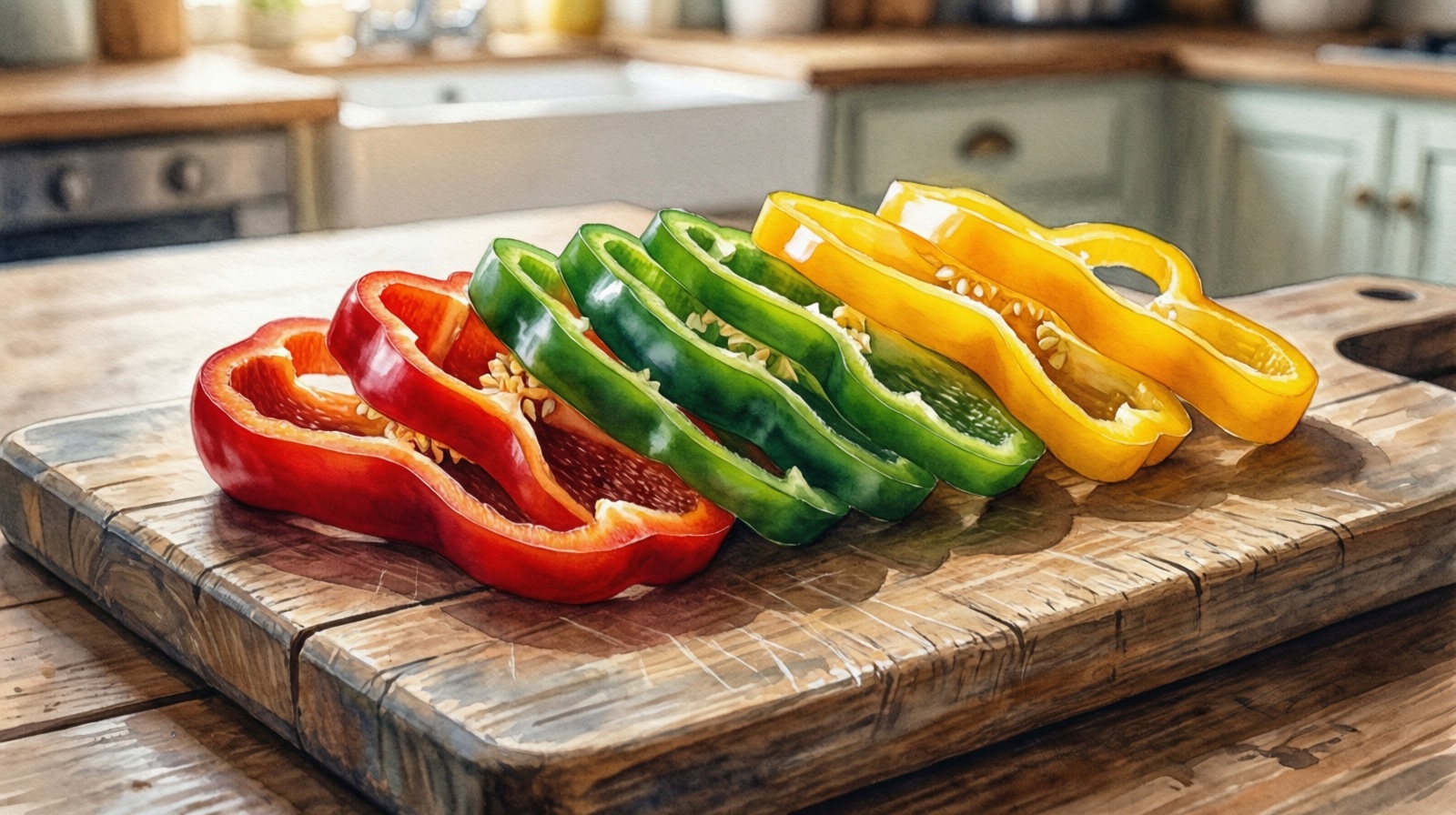
Which Color Bell Pepper Is Best for Rabbits?
Can rabbits eat bell peppers daily? Green bell peppers are the clear winner. Their low sugar (2.4g per 100g) and low calorie (20 kcal per 100g) profile makes them the safest option for everyday inclusion in a rabbit’s diet.
Here’s how to think about the four colors:
| Color | Best Use | Frequency | Key Benefit |
|---|---|---|---|
| Green | Daily staple | Every day | Lowest sugar (2.4g), low calorie |
| Red | Immune support | 2-3x/week | Highest beta-carotene (2,110µg) |
| Yellow | Vitamin C boost | 2-3x/week | Highest vitamin C (184mg) |
| Orange | Balanced nutrition | 2-3x/week | Good mix of vitamins |
Can Rabbits Eat Green Bell Peppers?
Yes — green bell peppers are the recommended daily choice. Their 2.4g sugar — for can rabbits eat bell peppers, green is lowest — is lower than romaine lettuce’s effective sugar load when accounting for water content. Most rabbits accept green peppers readily — can rabbits eat bell peppers in different colors? Yes, though some initially prefer the sweeter taste of red or yellow. If your rabbit is picky, try mixing a small piece of green with a preferred color and gradually shifting the ratio.
Can Rabbits Eat Yellow Bell Peppers?
Yes — yellow bell peppers are safe and offer the highest vitamin C content (184mg per 100g). However, their higher sugar (5.0g per 100g) means they’re best as a 2-3 times per week rotation rather than a daily food. I’d recommend yellow peppers as a mid-week variety addition to the daily green pepper routine.
Can Rabbits Eat Red Peppers?
Yes — red bell peppers are safe and provide the most beta-carotene of any color (2,110µg per 100g). This supports eye health and immune function. The 4.2g sugar is moderate — fine for 2-3 times per week. Many rabbit owners find their rabbits prefer red peppers over green, which makes them excellent as a training reward or bonding treat.
Can Rabbits Eat Bell Peppers Every Day?
Can rabbits eat bell peppers every day? Yes — green bell peppers are one of the few vegetables safe for daily feeding. This is a key distinction — can rabbits eat bell peppers daily unlike most vegetables that rabbits enjoy.
| Rabbit Weight | Daily Serving (Green) | Notes |
|---|---|---|
| Under 4 lbs (dwarf/mini) | 1-2 tbsp chopped | Start with 1 tsp |
| 4-8 lbs (standard) | 2-3 tbsp chopped | Green preferred daily |
| 8-12 lbs (large, including Angora Rabbits) | 3-4 tbsp chopped | Can mix colors |
| Over 12 lbs (giant) | 4-5 tbsp chopped | Daily rotation OK |
Rules for Daily Feeding
- Remove seeds: While not toxic, seeds offer no benefit and can cause minor digestive irritation in large amounts
- Remove the white membrane: The spongy white pith inside the pepper is bitter and harder to digest
- Wash thoroughly: Bell peppers rank moderately high for pesticide residue — organic is preferred
- Introduce gradually: Start with 1 teaspoon for the first 3 days, then double every 3 days until reaching the full serving
- Stop if stool changes: Loose or reduced droppings mean cut back or pause for a few days
- Serve at room temperature: Cold pepper straight from the refrigerator can cause temporary digestive slowdown
How Bell Peppers Compare to Other Daily Vegetables
| Vegetable | Sugar (per 100g) | Can Feed Daily? |
|---|---|---|
| Green bell pepper | 2.4g ✅ | ✅ Yes — recommended |
| Romaine lettuce | 1.2g ✅ | ✅ Yes |
| Cilantro | 0.9g ✅ | ✅ Yes |
| Celery | 1.3g ✅ | ✅ Yes |
| Can rabbits eat cucumber | 1.7g ✅ | ✅ Yes — in moderation |
| Carrot | 4.7g ⚠️ | ❌ No — treat only |
| Can rabbits eat tomatoes | 2.6g ⚠️ | ❌ No — treat only (nightshade acidity) |
Green bell peppers sit comfortably in the “daily safe” category alongside the standard leafy greens. For a comprehensive list of safe daily vegetables, see our rabbit food guide.
How to Prepare Bell Peppers for Rabbits
Step-by-Step Preparation Guide
- Wash thoroughly under cool running water — rub the surface to remove wax coating and pesticide residue. Organic peppers still need washing for soil and handling bacteria.
- Cut off the stem — the stem end is tough, woody, and can splinter. Remove the entire top 1/2 inch.
- Slice in half lengthwise — this exposes the seed cavity for easy removal.
- Scoop out seeds and white membrane — use a spoon or your fingers. The white pith is bitter and harder to digest.
- Cut into strips or small pieces — approximately 1-inch strips for larger rabbits, 1/2-inch pieces for dwarf breeds like the Polish Rabbit.
- Serve immediately — bell peppers retain their crunch best when fresh. If storing pre-cut pieces, refrigerate in an airtight container for up to 24 hours.
- Remove uneaten portions after 2 hours — bell peppers dry out and can grow bacteria at room temperature.
Can Rabbits Eat Bell Pepper Stems?
No. Bell pepper stems are tough, fibrous, and pose a choking hazard. The stem can also splinter into sharp pieces that could injure a rabbit’s mouth or throat. Always remove the entire stem before feeding.
Can Rabbits Eat Bell Pepper Tops?
The “top” of a bell pepper — where the stem meets the flesh — is too dense and fibrous for safe rabbit consumption. Cut well below the stem-to-flesh junction to ensure only the crisp, fleshy part is served.
Can Rabbits Eat Bell Peppers and Tomatoes Together?
Yes, but with caution. Both are safe on the same day in separate servings. However, both belong to the nightshade family (Solanaceae). While the ripe fruits of both plants are safe for rabbits, some veterinarians recommend rotating nightshade vegetables rather than feeding them on the same day. If you do serve both, use smaller portions of each.
Can Rabbits Eat Bell Pepper Leaves and Plants?
This question requires careful distinction because bell peppers belong to the nightshade family — the same family as tomatoes, potatoes, and eggplants.
The Nightshade Confusion
When considering can rabbits eat bell peppers, many owners worry about the nightshade family because tomato leaves and potato greens are toxic. But here’s the critical distinction: the leaves and stems of pepper plants (Capsicum annuum) are non-toxic, unlike tomato leaves (Solanum lycopersicum) and potato greens (Solanum tuberosum).
Can Rabbits Eat Bell Pepper Leaves?
Can rabbits eat bell pepper leaves? Technically non-toxic, but not recommended. Bell pepper leaves are safe in the sense that they won’t poison your rabbit. However, they offer minimal nutritional value, are tough and fibrous, and may carry pesticide residue if from a commercial source. If you grow your own peppers organically and want to offer a leaf or two as enrichment, it’s safe — but it shouldn’t replace proper leafy greens like romaine or cilantro.
Can Rabbits Eat Bell Pepper Plants?
The fruit (pepper itself) is the only part worth feeding. While the leaves and stems of the pepper plant are non-toxic, they don’t provide meaningful nutrition for rabbits. The plant’s leaves are coarse, low in the nutrients rabbits need, and may cause mild digestive upset if eaten in quantity. Stick with the bell pepper fruit itself — that’s where the nutritional value is.
Can Rabbits Eat Bell Pepper Plant Leaves?
This is the same question as bell pepper leaves — yes, they are non-toxic, but no, they’re not a worthwhile food for rabbits. If your rabbit has access to a garden with pepper plants, the occasional nibbled leaf won’t cause harm, but don’t intentionally harvest pepper leaves as a food source.
For more on recognizing safe vs toxic plants, see our rabbit health guide.
Frequently Asked Questions
Can rabbits eat bell pepper seeds? Not toxic, but remove them. Seeds offer no nutritional benefit and can cause digestive irritation in large amounts. Cut the pepper, scoop out seeds and white membrane, feed only the flesh.
Can rabbits eat sweet pepper seeds? Sweet peppers and bell peppers are the same vegetable — same rule applies. Remove seeds before feeding. A few accidental seeds won’t cause harm, but don’t make it routine.
Can baby rabbits eat bell peppers? Wait until at least 12 weeks. Introduce dark leafy greens at 8-12 weeks first, then add green bell peppers in tiny portions (1 tsp). Gradually increase to the standard serving over 2-3 weeks.
Can rabbits eat red peppers seeds? Non-toxic, but remove regardless of color. All bell pepper seeds follow the same rule — the fleshy part provides the nutrition, not the seeds.
Are bell peppers safe for rabbits every day? Yes — green bell peppers are safe daily. Colored peppers (red, yellow, orange) have higher sugar and are better at 2-3 times per week. Always introduce gradually over 5-7 days.
How much bell pepper can rabbits eat? 1-2 tbsp for dwarf rabbits (under 4 lbs), 2-3 tbsp for standard (4-8 lbs), 3-4 tbsp for large (8-12 lbs), 4-5 tbsp for giant breeds (over 12 lbs).
Can rabbits eat frozen bell peppers? Thaw completely to room temperature first. Never serve cold or frozen vegetables — temperature shock can cause digestive upset. Thaw in the fridge, then let sit at room temperature for 30 minutes.
Conclusion
Can rabbits eat bell peppers? They’re one of the best vegetables you can offer — and one of the few that’s safe for daily feeding. Green peppers lead as the everyday staple with the lowest sugar (2.4g per 100g), while red, yellow, and orange peppers provide variety and specific nutritional benefits (beta-carotene, vitamin C) when rotated 2-3 times per week.
Three rules to remember:
- Green daily, colored in rotation — green peppers are the lowest-sugar daily option; colored peppers for 2-3x/week variety
- Always remove seeds and membrane — non-toxic but no nutritional value and harder to digest
- Hay remains 80-90% of the diet — bell peppers are an excellent supplement, not a replacement for long-strand fiber
For the complete dietary framework, see our rabbit food guide. For recognizing and preventing diet-related health issues, our rabbit health guide covers GI stasis, dental disease, and bladder sludge.