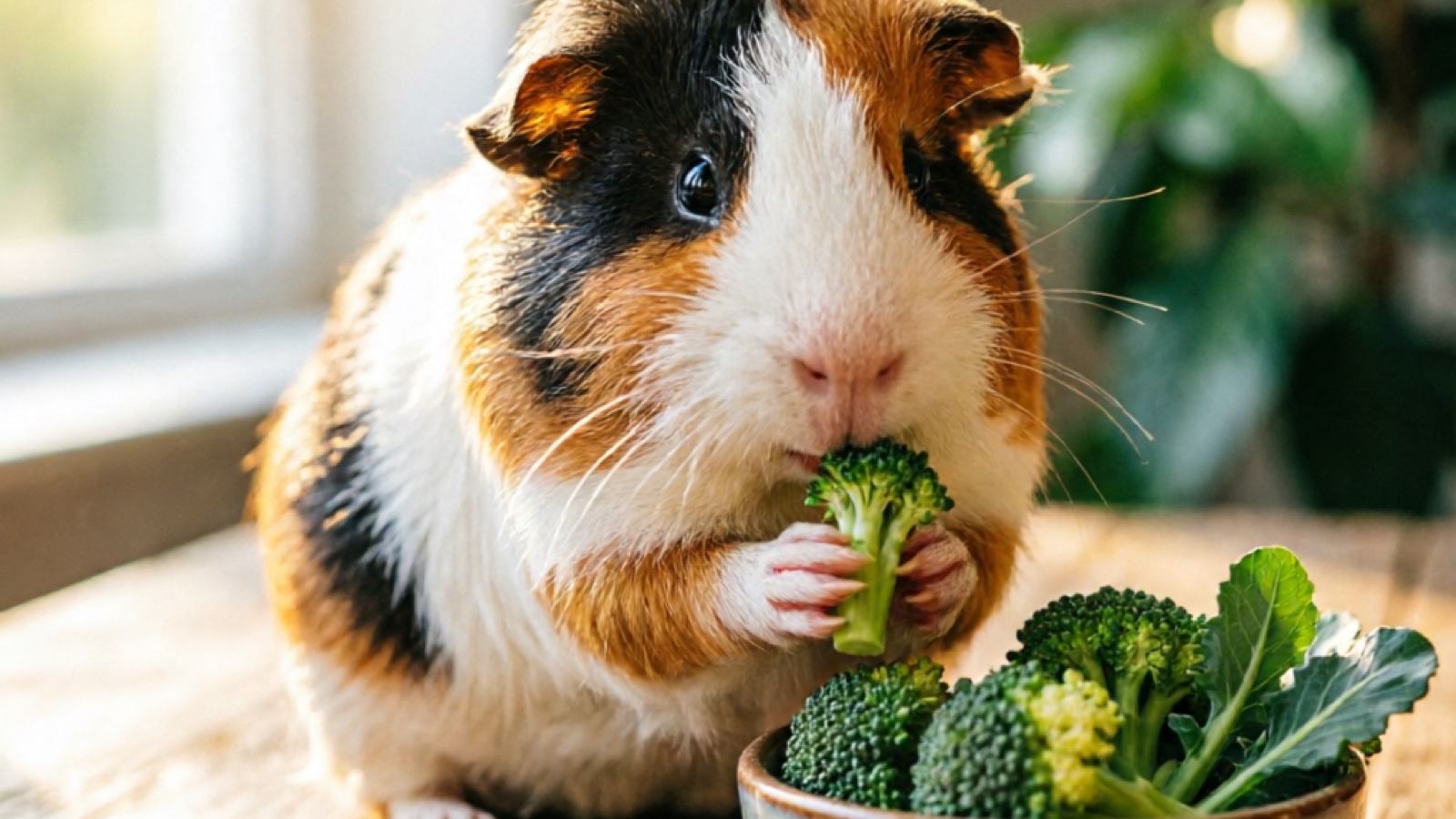
Quick Answer: Can Guinea Pigs Eat Broccoli?
Yes, guinea pigs can eat broccoli — and it’s one of the most nutritionally valuable vegetables you can offer. At 89.2mg of vitamin C per 100g, broccoli delivers nearly double a guinea pig’s daily requirement in a single serving. The catch? It’s also high in calcium (47mg per 100g), which means it shouldn’t be fed daily due to bladder stone risk.
💡 TL;DR: Feed 1-2 small florets plus a leaf or two, 3-4 times per week. Always serve raw. Cut stems into thin slices. Start with small amounts and monitor for gas. Rotate with lower-calcium vegetables like bell peppers and cucumber on off days.
⚠️ Medical Disclaimer: This article is not a substitute for professional veterinary care. If your guinea pig is showing signs of illness, consult a qualified exotic veterinarian.
I’ve been feeding broccoli to my guinea pigs for years, and it consistently ranks as one of their favorite vegetables — right up there with bell peppers and strawberries. But I’ve also learned that broccoli demands more nuance than most vegetables. The vitamin C content is extraordinary, but the calcium is a real concern if you’re not paying attention. Can guinea pigs eat broccoli every day? I’d argue no — the calcium risk isn’t worth it when there are so many good alternatives to rotate through.
For a complete dietary framework, see our guinea pig diet guide.
Nutritional Value of Broccoli for Guinea Pigs
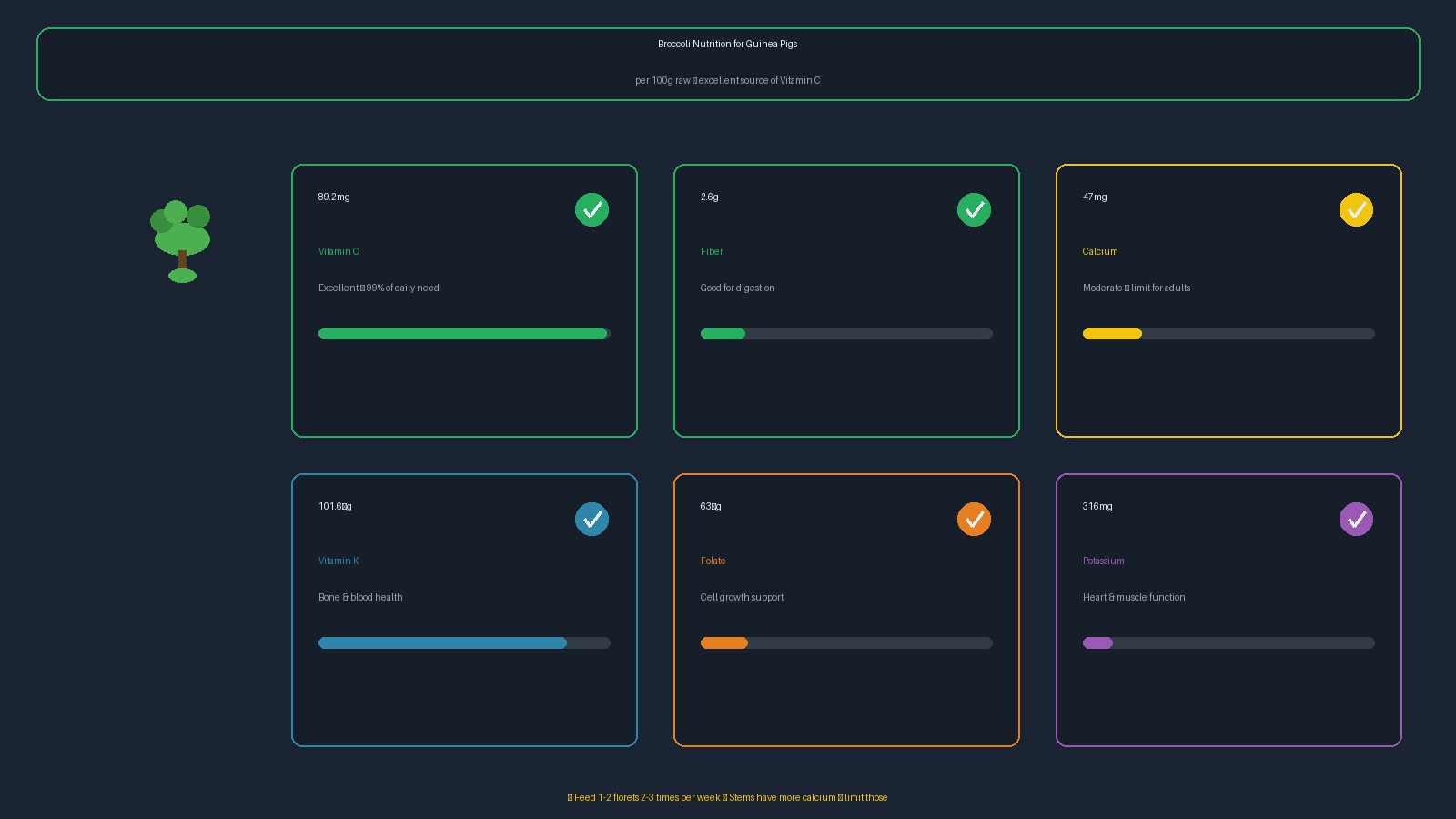
USDA nutritional data — raw broccoli, per 100g USDA FoodData Central FDC ID 11090:
| Nutrient | Per 100g | Per Small Floret (~10g) | Relevance to Guinea Pigs |
|---|---|---|---|
| Calories | 34 kcal | ~3.4 kcal | ✅ Low — safe calorie range |
| Vitamin C | 89.2mg | ~8.9mg | ✅ Outstanding — 18-30% of daily 30-50mg need |
| Sugar | 1.7g | ~0.17g | ✅ Very low — minimal sugar concern |
| Fiber | 2.6g | ~0.26g | ✅ Supports gut motility |
| Calcium | 47mg | ~4.7mg | ⚠️ High — bladder stone risk with daily feeding |
| Potassium | 316mg | ~31.6mg | ✅ Supports heart and muscle function |
| Vitamin A | 31µg | ~3.1µg | ✅ Supports vision and immune function |
| Vitamin K | 101.6µg | ~10.2µg | ✅ Supports blood clotting |
| Water | 89.3g (89.3%) | ~8.9g | ✅ Good hydration support |
| Protein | 2.82g | ~0.28g | ✅ Moderate for a vegetable |
| Fat | 0.37g | ~0.04g | Negligible |
The Numbers That Matter Most
89.2mg vitamin C and 47mg calcium. Those two figures define broccoli’s role in a guinea pig’s diet — and they pull in opposite directions.
The vitamin C is extraordinary. At 89.2mg per 100g, broccoli is one of the highest vitamin C vegetables available. A single small floret delivers about 8.9mg — that’s 18-30% of a guinea pig’s daily 30-50mg requirement. This matters enormously because guinea pigs cannot synthesize their own vitamin C. They lack the L-gulonolactone oxidase enzyme that most mammals produce naturally. Without adequate dietary vitamin C, they develop scurvy — a serious condition causing joint pain, lethargy, rough coat, and in severe cases, death. For the full picture on this critical nutrient, see our vitamin C guide.
The calcium, however, is the constraint. At 47mg per 100g, broccoli is higher in calcium than most guinea pig vegetables. Guinea pigs absorb calcium inefficiently through their urine, and excess calcium can crystallize into bladder stones (uroliths). These stones often require surgical removal and can be life-threatening if they cause urinary blockage. This is why broccoli belongs in the rotation — not in the daily lineup.
Broccoli vs Other Vegetables — Vitamin C & Calcium
| Vegetable | Vitamin C (mg/100g) | Calcium (mg/100g) | Sugar (g/100g) | How Often |
|---|---|---|---|---|
| Broccoli | 89.2 | 47 | 1.7 | 3-4x/week |
| Bell Pepper | 80.4 | 7 | 2.4 | Daily ✅ |
| Spinach | 28.1 | 99 | 0.42 | Rarely (very high Ca) |
| Carrot | 5.9 | 33 | 4.74 | 2-3x/week |
| Celery | 3.1 | 40 | 1.6 | 2-3x/week |
| Cucumber | 2.8 | 16 | 1.67 | Daily ✅ |
| Lettuce | 9.2 | 36 | 0.78 | Daily ✅ |
| Strawberry | 58.8 | 16 | 4.89 | 1-2x/week |
Broccoli is the vitamin C champion among vegetables — even beating bell peppers slightly. But bell peppers have only 7mg of calcium per 100g compared to broccoli’s 47mg, which is why bell peppers earn “daily” status while broccoli stays at 3-4 times per week.
Benefits of Broccoli for Guinea Pigs
Vitamin C Powerhouse
This is broccoli’s standout benefit. One small floret provides nearly a third of a guinea pig’s daily vitamin C need. Vitamin C supports immune function, wound healing, iron absorption, and collagen production. A guinea pig deficient in vitamin C will show rough coat, lethargy, swollen joints, and reluctance to move — symptoms that progress rapidly without intervention.
If you want to ensure your guinea pig gets consistent vitamin C even on days when fresh produce is limited, a liquid supplement like Oasis Vita Drops Pure C added to their water bottle provides a reliable baseline alongside fresh vegetables.
Low Sugar
At only 1.7g of sugar per 100g, broccoli is one of the lowest-sugar vegetables you can feed. This is a significant advantage over fruit treats. A guinea pig could eat a large serving of broccoli without the sugar spike risks associated with bananas (12.2g sugar) or grapes (15.48g sugar). For guinea pigs prone to obesity or diabetes-like symptoms, broccoli is an excellent regular vegetable.
Fiber for Digestive Health
The 2.6g of fiber per 100g supports healthy gut motility. Guinea pig digestive systems require constant fiber to prevent GI stasis — a potentially fatal condition. While hay should always be the primary fiber source, the additional fiber from vegetables like broccoli supports a diverse gut microbiome.
Antioxidant Support
Broccoli contains sulforaphane, a compound studied for its antioxidant and anti-inflammatory properties. While guinea pig-specific research on sulforaphane is limited, the general antioxidant benefits of vitamin C-rich vegetables are well-established for small animal health.
Risks of Feeding Broccoli to Guinea Pigs
⚠️ Calcium and Bladder Stones
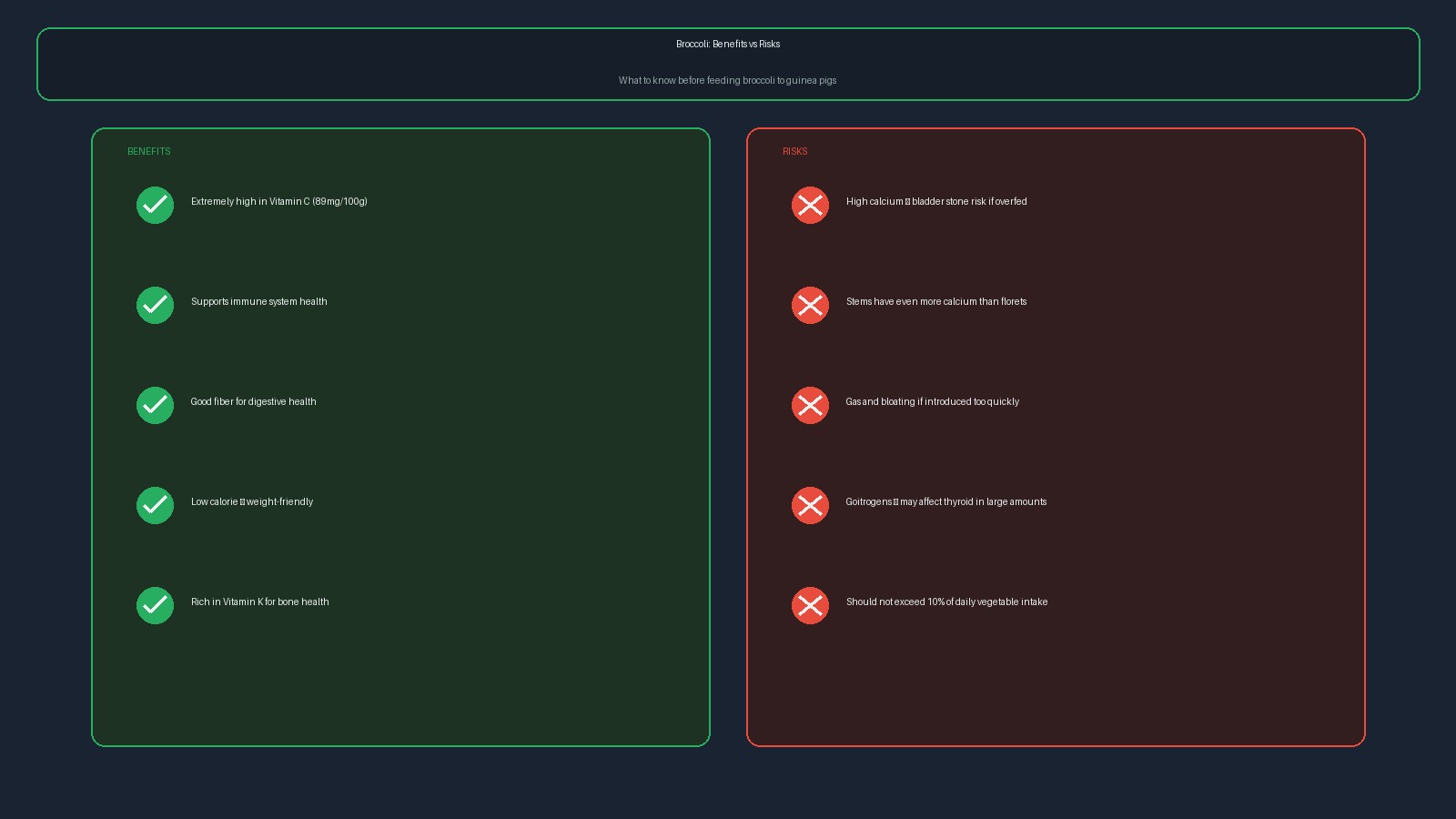
This is the primary concern with broccoli. At 47mg of calcium per 100g, regular daily feeding can contribute to calcium buildup in the urinary tract. Guinea pigs excrete excess calcium through urine, and when calcium concentrations get too high, it crystallizes into stones or sludge.
Signs of bladder stones: blood in urine, straining to urinate, frequent urination in small amounts, hunched posture, loss of appetite. If you notice any of these symptoms, contact your exotic vet immediately.
The risk is cumulative and long-term — a few days of extra broccoli won’t cause stones, but months of daily feeding can. This is why I limit broccoli to 3-4 times per week and rotate with lower-calcium vegetables.
Gas and Bloating
Broccoli belongs to the cruciferous (brassica) family, which contains raffinose — a complex sugar that produces gas during digestion. The critical difference: guinea pigs cannot burp. They lack the ability to release gas through the mouth, so any gas produced in the digestive tract has only one exit. In most guinea pigs, small amounts of broccoli cause no issues. But sensitive individuals may experience uncomfortable bloating.
Signs of gas pain: distended belly, reduced appetite, teeth grinding (a pain signal), reluctance to move, hunched posture. If your guinea pig shows these signs after eating broccoli, reduce or eliminate it from the diet.
In my experience, most guinea pigs tolerate broccoli well, but I’ve had one or two over the years that got noticeably bloated. It’s individual — start small and observe.
Goitrogenic Compounds
Broccoli contains goitrogens — compounds that can interfere with thyroid function by inhibiting iodine uptake. In humans, this is mostly a concern with raw cruciferous vegetables consumed in large quantities. In guinea pigs, the risk is theoretical at normal serving sizes, but it’s another reason not to feed broccoli daily. Cooking destroys goitrogens, but guinea pigs should only eat raw vegetables — and cooking destroys the vitamin C anyway.
Pesticide Residue
Broccoli is not on the EWG’s Dirty Dozen list (unlike apples), but it still benefits from thorough washing. The tight floret heads can trap dirt and insects. Wash under running water for 15-20 seconds, separating the florets to clean between them.
How Much Broccoli Can a Guinea Pig Eat?
Serving Guide
| Guinea Pig Type | Serving Size | Max per Week |
|---|---|---|
| Adult (standard, 2-3 lbs) | 1-2 small florets + 1 leaf (~15-25g) | 3-4 times |
| Small breed (under 2 lbs) | 1 small floret (~10g) | 2-3 times |
| Large breed (3+ lbs) | 2-3 small florets + leaves (~25-35g) | 3-4 times |
| Baby (under 12 weeks) | Pea-sized piece | Once as test |
| Pig with bladder stone history | Avoid or very rare | Consult vet |
| Skinny pig | Same as standard | 3-4 times |
Step-by-Step First Feeding Guide
- Start with a pea-sized floret piece — roughly 2g for first introduction
- Wait 24 hours — monitor stool, energy level, and belly size
- If no gas or digestive upset, increase to one small floret at next feeding
- Maintain 3-4x per week maximum — rotate with other vegetables on off days
Serving Rules at a Glance
- ✅ 1-2 small florets, 3-4x per week
- ✅ Raw only — cooking destroys vitamin C
- ✅ Room temperature — never chilled from the fridge
- ✅ Cut into bite-sized pieces — floret pieces no larger than a marble
- ✅ Leaves are safe — wash and include
- ✅ Stems are safe if sliced thin — no thicker than a pencil
- ✅ Remove uneaten pieces after 2 hours
- ❌ No daily feeding — calcium accumulation risk
- ❌ No frozen or cooked broccoli
- ❌ No broccoli with cheese, butter, or seasoning
Building a Balanced Rotation
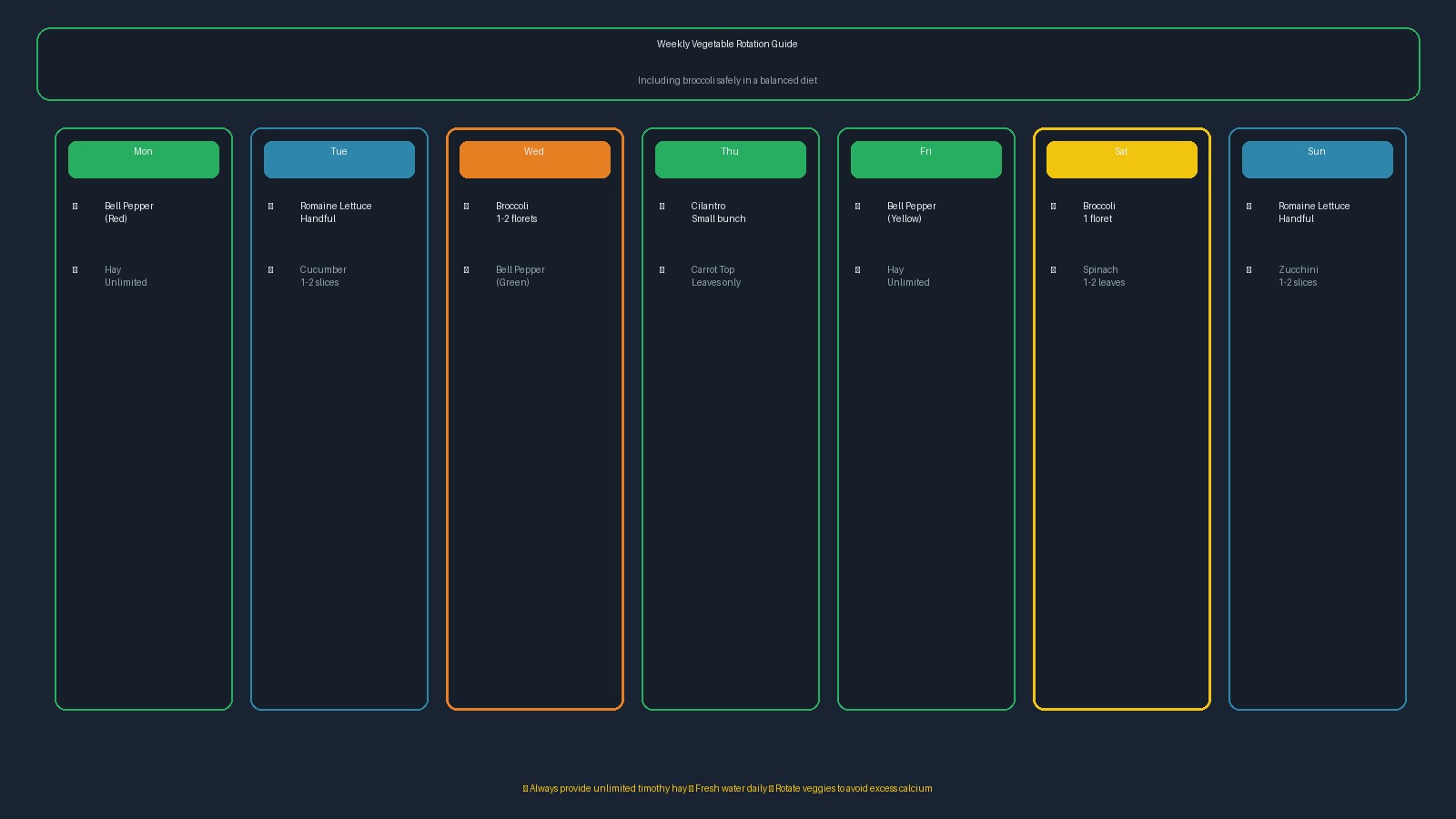
A good weekly vegetable rotation keeps calcium in check while maximizing vitamin C:
| Day | Vegetable | Why |
|---|---|---|
| Mon | Bell pepper | Daily vitamin C, low calcium |
| Tue | Broccoli | High vitamin C boost |
| Wed | Cucumber | Hydration, very low calcium |
| Thu | Broccoli | Second vitamin C boost |
| Fri | Lettuce | Low calcium daily staple |
| Sat | Carrot | Variety, moderate calcium |
| Sun | Broccoli + Bell pepper | Weekend vitamin C double |
Which Parts of the Broccoli Plant Are Safe?
| Part | Safe? | Notes |
|---|---|---|
| Florets (tops) | ✅ Safe | Best part — highest vitamin C, moderate calcium |
| Leaves | ✅ Safe | Slightly less calcium than florets, good texture |
| Stems | ✅ Safe | Must be sliced thin; good crunch, slightly less calcium |
| Roots | ❌ Avoid | No nutritional value, potential soil contamination |
| Seeds | ❌ Not applicable | Broccoli is harvested before seeding |
Can Guinea Pigs Eat Broccoli Leaves?
Yes, and I’d recommend including them. Broccoli leaves have a slightly milder flavor than florets and contain somewhat less calcium. Many guinea pigs enjoy the leaf texture — it’s closer to the leafy greens they’d naturally forage. Wash thoroughly and offer alongside florets.
Can Guinea Pigs Eat Broccoli Stems?
Yes, with preparation. Raw broccoli stems are very fibrous and tough — feeding a thick chunk is a choking hazard. Slice stems into thin rounds, no thicker than a pencil. The crunch is excellent for dental health, and stems actually contain slightly less calcium than the florets. In my experience, some guinea pigs prefer stems over florets, which is perfectly fine.
Can Guinea Pigs Eat Cooked Broccoli?
No. Cooking destroys a significant portion of the vitamin C — the primary reason for feeding broccoli in the first place. Cooking also softens the fiber, reducing its dental benefits and altering the digestive texture. Guinea pigs should only eat raw vegetables at room temperature.
Can Baby Guinea Pigs and Skinny Pigs Eat Broccoli?
Baby Guinea Pigs
| Age | Broccoli? | Reasoning |
|---|---|---|
| 0-3 weeks | ❌ No | Mother’s milk + alfalfa hay + pellets only |
| 3-4 weeks | ⚠️ Pea-sized piece, once | First test — monitor 24 hours |
| 4-12 weeks | ⚠️ 1 small floret, 2-3x/week | Young pigs need calcium for bone growth |
| 12+ weeks | ✅ Full adult portions | Standard guidelines apply |
Here’s an interesting nuance: baby guinea pigs actually need more calcium than adults for bone development. Their growing skeletons benefit from calcium-rich vegetables like broccoli. The calcium concern is primarily an adult issue. Once a guinea pig reaches 6-12 months, calcium requirements drop and the stone risk increases. For more on raising young pigs, see our care guide.
Skinny Pigs
Skinny pigs (hairless guinea pigs) can eat the same broccoli portions as regular guinea pigs. Their digestive systems are identical. The 89.3% water content provides a small hydration benefit, which is helpful since hairless pigs lose moisture through their skin faster. This doesn’t change portion sizes.
What to Avoid When Feeding Broccoli
- Cooked broccoli: Destroys vitamin C, alters texture for worse digestion. Raw only.
- Frozen broccoli: Often blanched before freezing, which reduces vitamin C. Fresh is always better.
- Broccoli with cheese, butter, or sauce: Dairy and fats are unsafe for guinea pigs. Plain raw only.
- Broccoli soup or puree: Contains unsafe ingredients and wrong texture.
- Pickled broccoli: Extremely high in sodium. Toxic to guinea pigs.
- Feeding only broccoli: No single vegetable should dominate the diet. Rotate with at least 3-4 different vegetables per week.
Healthy Diet Foundations for Guinea Pigs
Broccoli is a valuable part of the vegetable rotation, but it works best as part of a complete dietary framework:
Pellets and Hay First
Quality pellets provide the nutritional baseline. A fortified pellet like Vitakraft Menu Premium Guinea Pig Food delivers consistent vitamins and minerals alongside fresh vegetables. But pellets should supplement — never replace — unlimited hay, which should make up 80% of the diet. A good hay feeder keeps hay accessible and clean throughout the day.
Treat Rotation
For variety beyond fresh vegetables, Kaytee Natural Snack Superfoods offer an apple and carrot blend that complements the vegetable rotation nicely. These work well as occasional training rewards — not a daily food.
For our complete dietary recommendations, see the best guinea pig food guide and our best hay guide.
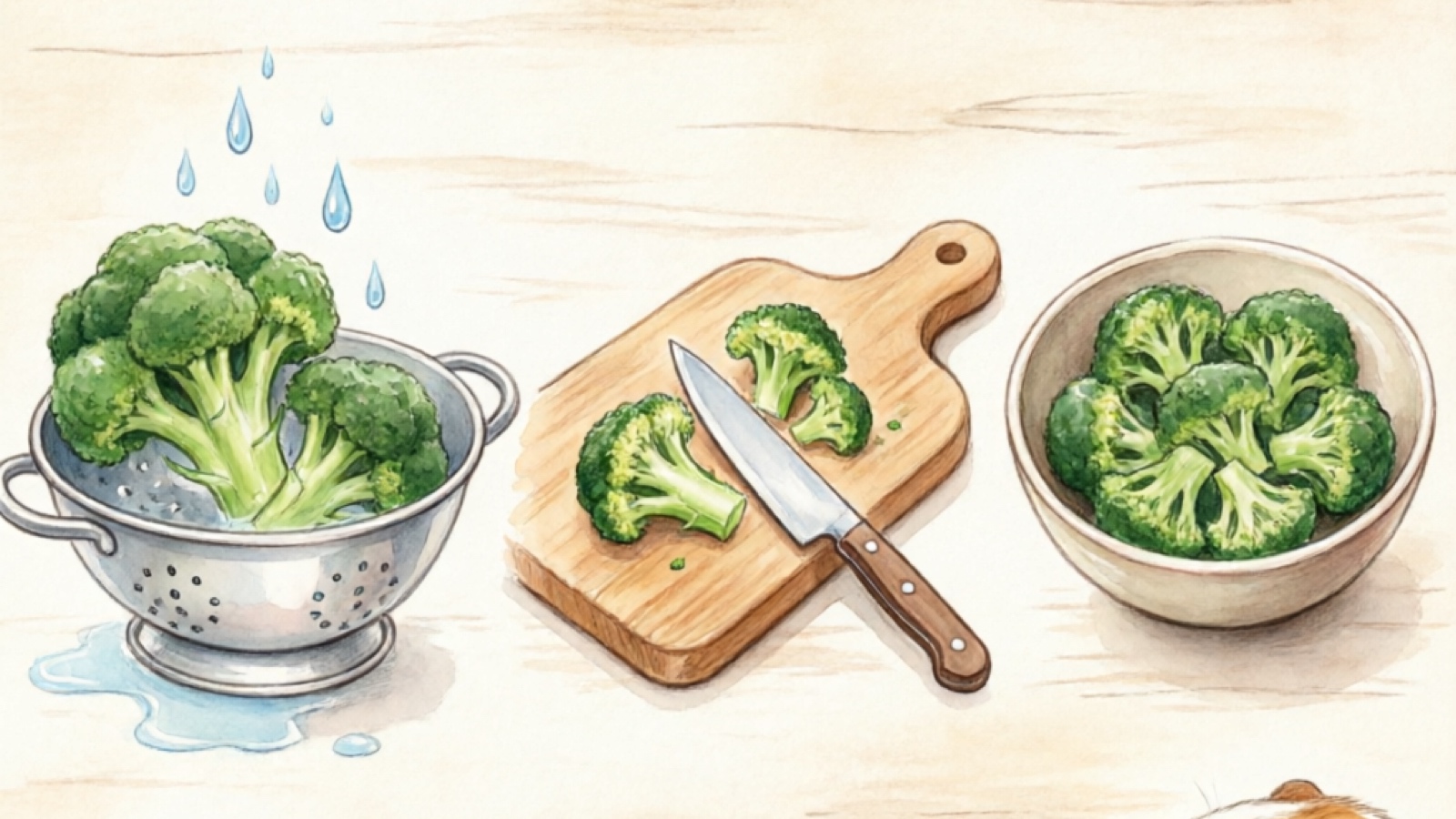
How to Prepare Broccoli for Your Guinea Pig
- Choose fresh, dark green broccoli — vibrant color indicates high nutrient content. Avoid yellowing or limp florets.
- Wash thoroughly — 15-20 seconds under running water, separating florets to clean between them
- Separate florets — break or cut into small pieces, marble-sized or smaller
- Prepare stems — slice into thin rounds (pencil thickness or thinner)
- Wash leaves — if included, rinse individually
- Serve at room temperature on a clean dish
- Remove uneaten pieces after 2 hours
Other Foods Your Guinea Pig Can Eat
Vegetables: Bell Peppers | Carrots | Cucumbers | Celery | Lettuce | Spinach | Tomatoes
Fruits: Bananas | Blueberries | Grapes | Strawberries | Apples
Other: Eggs
Further Reading
- Guinea Pig Diet Guide | Vitamin C Guide
- Best Guinea Pig Food | Best Guinea Pig Cage
- Guinea Pig Health | Care Guide
- Guinea Pig Breeds | Best Treats
- Best Hay | Sounds & Meanings
- Bedding Guide | Abyssinian Guinea Pig
Frequently Asked Questions
Can guinea pigs eat broccoli?
Yes — 1-2 small florets 3-4 times per week. Broccoli is a vitamin C powerhouse (89.2mg/100g) but also high in calcium (47mg/100g), which means it should be rotated rather than fed daily.
Can guinea pigs eat broccoli every day?
No. The calcium content makes daily feeding risky long-term. Stick to 3-4 times per week and rotate with lower-calcium vegetables like bell peppers and cucumber.
Can guinea pigs eat broccoli leaves?
Yes. Leaves are safe, slightly lower in calcium than florets, and many guinea pigs enjoy the texture. Wash thoroughly and include with the serving.
Can guinea pigs eat broccoli stems?
Yes, but slice into thin rounds. Thick stems are a choking hazard. Thin slices are safe and provide good crunch for dental health.
Does broccoli cause gas in guinea pigs?
It can, due to raffinose in cruciferous vegetables. Guinea pigs cannot burp, so gas can be uncomfortable. Start with small amounts and monitor for bloating.
How much broccoli can a guinea pig eat?
1-2 small florets (~15-25g) plus a leaf or two, 3-4 times per week for adults. Smaller breeds get less. Always introduce gradually.
Can baby guinea pigs eat broccoli?
From 3-4 weeks, offer a pea-sized test piece. Young pigs actually benefit from broccoli’s calcium for bone development, so it’s less of a concern for them than for adults.
Can guinea pigs eat cooked broccoli?
No. Cooking destroys vitamin C (the main benefit) and alters texture for worse digestion. Raw and room temperature only.
This guide is based on USDA nutritional data (FDC ID 11090), veterinary guidance, and established guinea pig care standards. Individual guinea pigs may have different tolerances — always introduce new foods gradually.
Last Updated: April 30, 2026