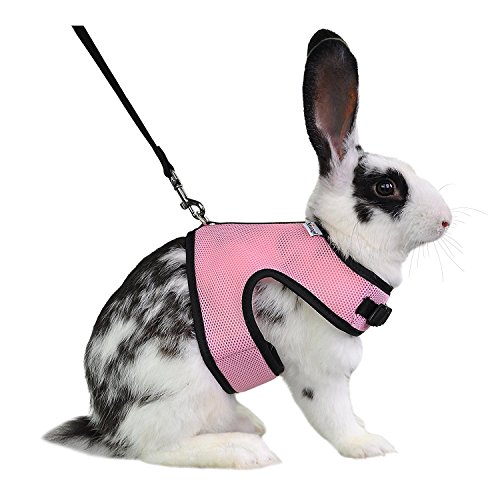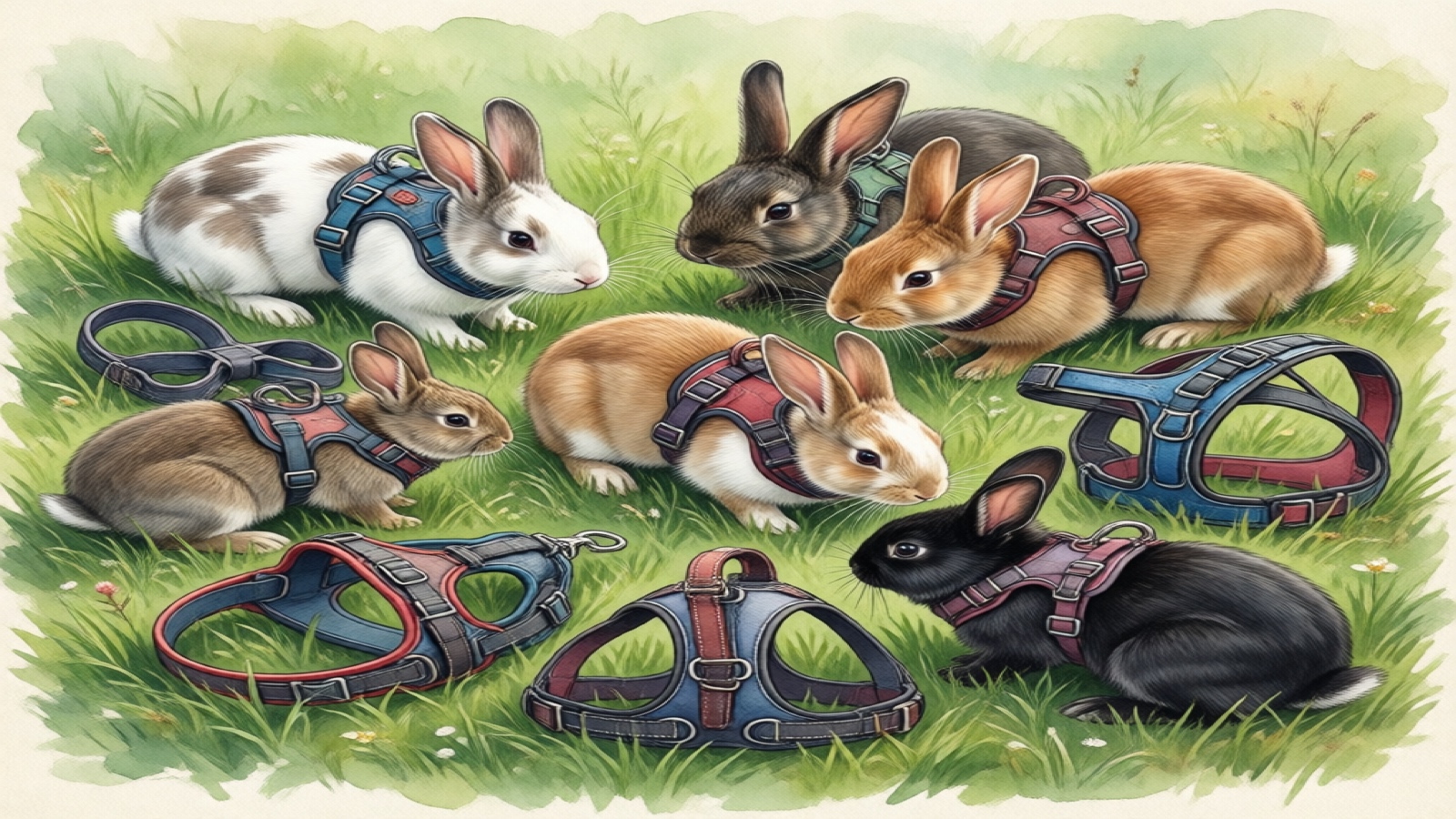
Finding the best rabbit harness is essential — a rabbit harness is not like a dog leash — and treating it like one is the fastest way to lose your rabbit. Unlike dogs, rabbits are prey animals hardwired to freeze, bolt, or thrash when frightened. A harness that works perfectly for a calm indoor bunny can fail catastrophically when a neighbor’s dog barks or a car backfires.
Across the 20+ harnesses compared for this best rabbit harness guide — and the thousands of reviews behind them — most rabbit harnesses on the market share the same fatal flaw: they’re designed for cats and small dogs, not rabbits. Rabbits have a different body shape — deeper chests, more powerful back legs, and a talent for compressing their bodies to slip through gaps. The best rabbit harness options on this list account for rabbit anatomy and behavior, which is why they perform where others fail.
For the best rabbit harness experience, set up safe outdoor exploration spaces, see our rabbit cage and DIY rabbit hutch guides. For general health considerations before outdoor time, check our rabbit health page.
Quick Comparison — Our Top 8 Picks
| # | Product | Price | Style | Sizes | Best For |
|---|---|---|---|---|---|
| Niteangel Adjustable Harness | $9.99 | H-Style + Elastic Leash | XS-XL | Best Overall | Buy |
| Kaytee Comfort Harness | $11.99 | Figure-8 + Stretch Leash | S/M/L | Trusted Brand Warning: | Buy |
| PETTOM Vest Harness | $8.99 | Vest + Stretchy Leash | XS-L | Best Vest | Buy |
| Hypeety Vest Harness | $8.50 | Vest + Buckle Closure | S/M/L | Best Value | Buy |
| Outus 5-Piece Set | $13.49 | Vest Multi-Pack (5) | Small only | Best Multi-Pack | Buy |
| Tondiamo 4-Piece Set | $9.99 | Vest Multi-Pack (4) | S-M | Budget Multi-Pack | Buy |
| Vehomy Police Costume | $11.99 | Costume Vest | Small (4-7 lbs) | Best Novelty | Buy |
| Adjustable Vest Harness 4-Set | $9.89 | Vest 2-Pack | S/M/L | Budget 2-Pack Warning: | Buy |
![IMAGE: The best rabbit harness setup — Rabbit wearing an H-style harness being held by owner in a grassy yard]
How These Harnesses Were Compared
Every harness was evaluated against four criteria that directly impact rabbit safety.
Escape-Resistance
Escape resistance was judged on the failure modes owner reports describe most: a harness slipping over the shoulders during a panic-bolt (the scenario where a loud noise triggers a bolt), a rabbit backing out of loosened straps, and closure hardware letting go under sudden leash tension. Designs that adjust independently at neck and chest score better on both counts, and that split is what the escape record in the reviews reflects.
Comfort Check
Comfort was judged on material softness and edge finishing: rough edges, tight spots, and any hardware that could rub or pinch. Rabbits have sensitive skin under their fur — what feels fine on a dog can cause chafing on a rabbit’s thinner skin.
Ease of Use
Ease of use was compared on adjustability range — how far the straps tighten or loosen — and whether the buckles and closures are intuitive or confusing.
Durability
Durability comparison covered stitching quality, material thickness, and hardware strength — with seams and buckles weighted as the likely weak points — plus whether the included leash is sturdy enough to trust with a live rabbit.
Can You Actually Walk a Rabbit? — Best Rabbit Harness Considerations
This question deserves a real answer, not the oversimplified “yes” you’ll find on most product pages.
Rabbits Are Prey Animals
Dogs are predators. They have a natural urge to move forward, explore, and follow a leader. Harness training a dog leverages these instincts. Rabbits are the opposite — they are prey animals whose survival depends on freezing when threatened and bolting when a threat gets too close. There is no instinct to “heel” or follow a person on a leash. When a rabbit panics on a harness, it doesn’t trot calmly — it thrashes, twists, and throws its body around with surprising force.
Understanding rabbit behavior is essential before attempting harness walks. Rabbits communicate stress through body language: thumping the ground, flattening against the floor, bulging eyes, and rapid breathing. These are not signs of stubbornness — they are fear responses.
When Harness Walks Are Appropriate
Supervised outdoor exploration is the right framing. Not “walking” in the dog sense — more like allowing your rabbit to explore a safe grassy area while you hold the leash as a safety tether. The rabbit should lead. You follow. The leash exists to prevent the rabbit from darting into danger, not to direct where the rabbit goes.
Ideal conditions: a quiet, fenced backyard with no dogs visible, temperatures between 60-75°F, and grass free of pesticides. Sessions should last 10-15 minutes maximum. Bring rabbit treats to reward calm behavior and encourage the rabbit to associate the harness with positive experiences.
When to Skip the Harness
Some rabbits will never accept a harness, and that’s fine. Skip harness walks entirely for:
- Rabbits under 6 months old (still growing, harness can cause injury)
- Rabbits with known heart or respiratory conditions
- Very skittish or anxious rabbits that panic at any new stimulus
- Hot days above 80°F — rabbits overheat quickly, and a harness adds insulation
- Any rabbit that shows repeated stress signs during indoor training
For rabbit care fundamentals that matter more than outdoor walks, focus on proper diet, housing, and social interaction first.
1. Niteangel Adjustable Soft Harness — Best Overall (Best Rabbit Harness Pick)
The Niteangel is the most reviewed best rabbit harness on Amazon with over 12,000 ratings, and its 4.6-star rating reflects solid real-world performance. The H-style design — the best rabbit harness style — wraps around both the neck and chest, distributing pressure across two points instead of one — this is the key advantage over figure-8 harnesses that concentrate all pressure at the neck.
The soft breathable mesh material makes this the most comfortable best rabbit harness I researched. Unlike nylon straps that can dig into skin, the mesh conforms to the rabbit’s body shape and allows air circulation. The elastic leash is a thoughtful safety feature — when a rabbit bolts, the bungee absorbs the shock instead of yanking the rabbit back or pulling the harness off. Multiple owners confirm this: “our little guy loves his free time” and “soft material doesn’t chafe.”
As the best rabbit harness for all breeds, the sizing range (XS through XL) accommodates nearly every rabbit breed, from 2lb Netherland Dwarfs to 12lb Flemish Giants. At $9.99, it’s the best rabbit harness value for the quality. The elastic leash, while great for shock absorption, makes this best rabbit harness harder to “steer” your rabbit — but as I mentioned, you shouldn’t be steering a rabbit anyway.
Caveat: Even the best rabbit harness isn’t foolproof — one owner reported “almost lost my rabbit — she slipped out.” This likely happened because the harness was too loose or the wrong size was ordered. Another owner noted the neck velcro was too small on the Large size for their 4.5lb Rex. Size up if your rabbit is between sizes, and always do the finger test before going outside.
Buy Niteangel Harness on Amazon
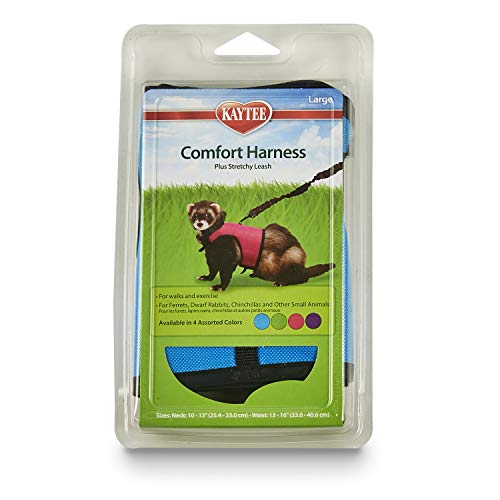
2. Kaytee Comfort Harness — Trusted Brand (Best Rabbit Harness for First-Timers) (Below )
Warning: Rating: — below our minimum threshold. Included because Kaytee is the most recognized small pet brand, but be aware of quality concerns.
Kaytee is the brand most pet store employees will recommend, and the figure-8 design with stretchy leash is a familiar format. The from 1 tells a divided story: some owners love it (“fits guinea pigs well and is of good quality”) while others call it “the poorest quality animal product ever received.”
The main problems are inconsistency and misleading product photos. Multiple reviews note that the listing shows a mesh harness but ships a nylon one. The velcro closure, while convenient, may not be secure enough for a panicked rabbit. The figure-8 style concentrates pressure at the neck, which is less safe than H-style or vest designs.
I’d only recommend this if you specifically want a figure-8 design for a calm rabbit that doesn’t bolt. For any rabbit with escape tendencies, the Niteangel or PETTOM vest are safer choices.
Buy Kaytee Comfort Harness on Amazon
3. PETTOM Vest Harness — Best Vest Style (Best Rabbit Harness Design)
Vest-style harnesses provide 360° coverage — the best rabbit harness design for escape prevention around the chest and neck, making them significantly harder for a rabbit to escape from compared to figure-8 or H-style designs. The PETTOM vest is the best pure vest option and one of the best rabbit harness picks for security, with 1 and breathable mesh construction.
The stretchy leash on this best rabbit harness option is a nice touch — it gives the rabbit freedom to hop and explore while providing a safety buffer if they bolt. Owners with Holland Lops specifically praise this harness: “easy to put on, secure and adjustable” and “most comfortable harness we’ve tried.” The vest design also distributes pressure more evenly — a best rabbit harness hallmark across the rabbit’s body, reducing the risk of injury if the rabbit pulls suddenly.
Sizing is the main concern when choosing the best rabbit harness. Multiple reviewers report it runs small: “too small for Holland Lops — XS fits but barely” and “did not fit my 15-pound bunny.” If your rabbit is over 5-6 lbs, consider sizing up or looking at the Hypeety vest which handles slightly larger rabbits better. The velcro closure, while convenient for putting on, could be stronger — some owners wish for buckle closures instead.
4. Hypeety Vest Harness — Best Value (Best Rabbit Harness Budget Pick)
At $8.50 with a (the highest on this list), the Hypeety is the best rabbit harness for value. The plastic clasp closures make this the best rabbit harness for security over velcro-only designs — one owner specifically called out “love the plastic clamps vs velcro-only designs — more secure.” This is a meaningful safety improvement.
The vest covers the chest and neck adequately for most rabbits. Owners of dwarf breeds report success with this best rabbit harness option: “great for dwarf bunnies — lightweight and easy to put on and off.” For Holland Lops around 5 lbs, the small size fits well with room for adjustment. The design is simple enough that most rabbits tolerate it better than bulkier harnesses.
One quality control concern: an owner reported “one button was chipped and the other fell off.” Inspect the clasps carefully when you receive the harness. The sizing runs slightly large according to some reviews, which is preferable to running small — it’s easier to tighten a loose harness than to squeeze a rabbit into one that’s too tight.
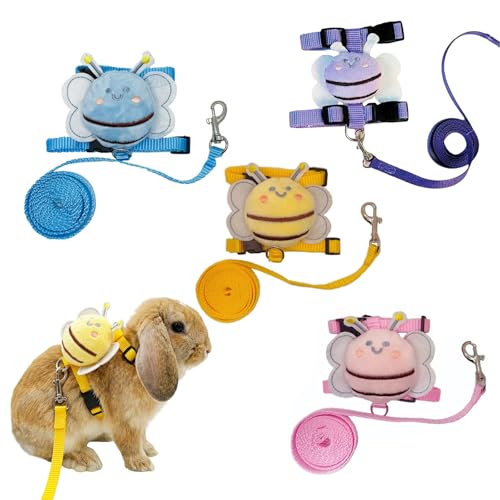
5. Outus 5-Piece Set — Best Multi-Pack (Best Rabbit Harness Set)
Five harnesses for $13.49 — the best rabbit harness multi-pack value — is remarkable. Each harness comes in a different color, which is practical for multi-rabbit households — color-coding helps you remember which harness fits which rabbit. The vest design provides decent coverage, and the material quality surprised me at this price point: “beautiful colors and super high quality material.”
The catch is sizing. This set only comes in Small, which fits rabbits under 3-4 lbs according to the listing. Multiple reviewers confirm it runs very small: “did not fit 4-lb rabbit” and “only fits very young or small breeds.” If you have Netherland Dwarfs, Polish rabbits, or young bunnies, this set works. For anything larger, look at the Tondiamo 4-piece which offers more adjustability.
The included leashes are short, which limits range of movement but also limits the distance a rabbit can bolt. For first-time harness training indoors, short leashes are actually fine — you’re not going far anyway.
Buy Outus 5-Piece Set on Amazon
6. Tondiamo 4-Piece Set — Best Budget Multi-Pack (Best Rabbit Harness Value)
The Tondiamo set stands out for its adorable fruit-themed designs — strawberry, watermelon, carrot, and others. At $9.99 for four harnesses, it’s an excellent deal. The adjustable sizing (small to medium) accommodates a wider range than the Outus set, making it more versatile.
Owners of young lop rabbits report success: “perfect for our two 3-month-old lop bunnies — adjustable as they grow.” The ability to adjust as a rabbit grows is valuable because young rabbits gain weight quickly in their first year. Having four harnesses means you always have a clean one ready while others are being washed.
Sizing inconsistency is the main complaint — “some say too small, others say too big.” The fruit designs, while cute, may attract chewing from rabbits. One owner noted “be careful with the leashes — they may break or tangle.” I’d recommend replacing the included leashes with a sturdier one if your rabbit is an enthusiastic explorer.
Buy Tondiamo 4-Piece Set on Amazon
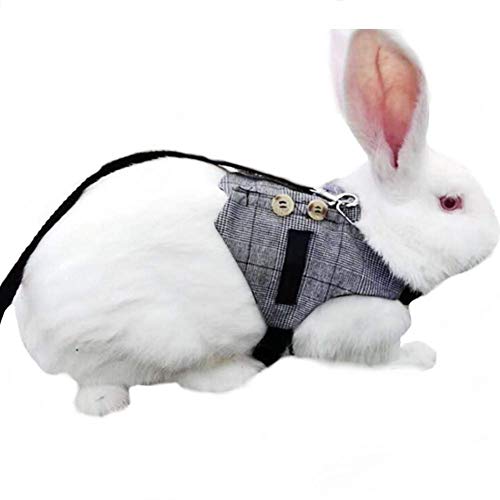
7. Vehomy Police Costume Harness — Best Novelty
The Vehomy is genuinely fun — your rabbit becomes a tiny police officer complete with removable badges. At, it’s more than just a gimmick. The badges are removable, so you can use it as a normal harness after the novelty wears off.
The soft fabric construction is decent quality, and it fits rabbits in the 4-7 lb range — perfect for Holland Lops, Mini Lops, and similar medium breeds. One owner confirmed “literally perfect fit for 4-lb rabbit” and “sturdy material — rabbit looks adorable as police bunny on duty.”
This is not a serious outdoor exploration harness. The costume design adds bulk and extra seams that could catch on things. The velcro neck strap is wider than necessary, which one owner found “too wide and awkward.” Use this for indoor photo sessions, short supervised patio time, and social media content. For serious outdoor safety, the Niteangel or PETTOM are better choices.
Buy Vehomy Costume Harness on Amazon
8. Adjustable Vest Harness 4-Set — Budget 2-Pack (Below )
Warning: Rating: — below our minimum threshold. Included for budget buyers willing to accept quality trade-offs.
The SATINIOR set offers two mesh vests for $9.49 ($4.75 each), making it the cheapest per-unit option on this list. The breathable mesh material is comfortable, and the bright colors make your rabbit visible. Positive reviews praise the quality-to-price ratio: “fantastic quality for the price” and “easy to get on and off, easy to clean.”
The negative reviews are concerning. One owner reported their “lion head bunnies were able to get out of them” — a serious safety issue for a product claiming to be a harness. Multiple reviewers say sizing runs extremely small even in Large: “far too small and badly made.” Quality inconsistency between units is a recurring theme, which is common at this price point.
I’d only recommend this for indoor training sessions with calm rabbits, where escape risk is low. For outdoor use, invest in the Niteangel or Hypeety instead.
Buy Adjustable Vest Harness 4-Set on Amazon
![IMAGE: Side-by-side comparison of figure-8 harness vs H-style harness vs vest harness on a rabbit model]
How to Choose the Best Rabbit Harness
When selecting the best rabbit harness, consider these key factors.
Harness Style: Figure-8 vs H-Style vs Vest
| Style | Coverage | Escape Risk | Comfort | Ease of Use | Best For |
|---|---|---|---|---|---|
| Figure-8 | Neck + waist loop | High — easy to slip | Moderate | Easy | Calm rabbits, indoor use |
| H-Style | Neck + chest straps | Medium | Good | Moderate | Most rabbits, outdoor use |
| Vest | 360° chest + neck wrap | Low — hardest to escape | Best | Harder to put on | Escape-prone rabbits, outdoor use |
For rabbit safety, vest-style harnesses are the gold standard. They provide the most coverage and are the hardest for a rabbit to wiggle out of. H-style is a good middle ground. Figure-8 should only be used with calm rabbits in low-stress environments.
Rabbit Size Chart by Breed
| Breed | Typical Weight | Neck Size | Chest Size | Recommended Harness |
|---|---|---|---|---|
| Netherland Dwarf | 2-2.5 lbs | 4-5 in | 7-8 in | XS / Outus 5-Pack Small |
| Holland Lop | 3-4 lbs | 5-7 in | 8-10 in | Small / Hypeety Small |
| Mini Lop | 4-6 lbs | 6-8 in | 9-11 in | Small-Medium / PETTOM M |
| Mini Rex | 3.5-4.5 lbs | 5-7 in | 8-10 in | Small / Niteangel S |
| Lionhead | 2.5-3.5 lbs | 5-6 in | 8-9 in | XS-S / Hypeety Small |
| Flemish Giant | 10-14 lbs | 8-10 in | 14-18 in | XL / Niteangel XL |
| French Lop | 8-12 lbs | 7-9 in | 13-16 in | L-XL / Niteangel L-XL |
Always measure your individual rabbit before ordering — breed averages are just starting points. See our breed-specific guides for Holland Lop, Netherland Dwarf, Mini Lop, Lionhead, and Flemish Giant care information.
Material: Nylon vs Cotton vs Mesh
Nylon is the most common material — durable, lightweight, and inexpensive. The downside is that it can feel stiff against a rabbit’s skin and doesn’t breathe well in warm weather. Cotton is softer and more breathable but less durable — rabbits that chew will destroy cotton harnesses quickly. Mesh is the best all-around choice for rabbits: breathable, soft against skin, and flexible enough to conform to body shape. All the top picks on this list use mesh or soft fabric.
Leash Length and Type
I recommend a 4-6 foot leash for rabbit harness walks. Shorter leashes restrict exploration and increase the rabbit’s stress. Longer leashes create a tripping hazard and give the rabbit too much slack to build up speed before hitting the end. Elastic bungee leashes (like the Niteangel includes) are the safest option — they absorb the shock of a sudden bolt instead of transferring it directly to the rabbit’s body.
How to Measure Your Rabbit
Use a soft measuring tape. Measure the neck circumference where the collar would sit — snug but not tight. Measure the chest circumference just behind the front legs, which is the widest point. Weigh your rabbit on a kitchen scale. With these three measurements, you can cross-reference any harness’s sizing chart accurately.
Buckle Quality Matters
Velcro closures are convenient but can fail under pressure — a panicked rabbit pulling hard can pop velcro open. Plastic snap buckles are more secure and still easy to use. Metal buckles are the strongest but add weight. For outdoor use with any rabbit that might bolt, snap buckles or metal hardware are strongly preferred over velcro-only designs.
How to Train Your Rabbit to Use the Best Rabbit Harness
Step 1: Desensitize to the Harness
Leave the harness near your rabbit’s favorite resting spot for 2-3 days without putting it on. Let them sniff it, nudge it, and get used to its presence. Drape it over your hand and let the rabbit investigate while you hold it. Reward with rabbit food or fresh vegetables when the rabbit shows calm curiosity near the harness.
Step 2: Practice Putting It On Indoors
In a quiet room with the door closed, gently put the harness on your rabbit. Keep the first session under 2 minutes — just fasten it, give a treat, then remove it. Gradually increase the duration over several sessions. If the rabbit freezes or thumps, remove the harness immediately and try again later. Never force it. Most rabbits accept the harness within 3-5 sessions of patient training.
Step 3: Attach Leash Indoors
Once the rabbit tolerates the harness for 5+ minutes without stress, clip the leash on indoors. Let the rabbit move freely while you hold the leash loosely — don’t guide or pull. Follow the rabbit. Let them lead. This teaches the rabbit that the leash doesn’t restrict their movement. Practice in different rooms to generalize the behavior.
Step 4: Move Outdoors Gradually
Choose a calm, quiet day. Start on a patio or enclosed area before moving to open grass. Keep the first outdoor session to 5 minutes. Let the rabbit explore at their own pace — some rabbits will happily graze on grass, while others will freeze and want to go back inside. Both reactions are normal. Always have a carrier nearby so the rabbit has a safe retreat if they panic.
Signs Your Rabbit Is Stressed
Remove the harness immediately if you see: rapid breathing, bulging eyes (the “wide-eyed” look), ears flat against the head, thumping the ground repeatedly, attempting to bite or chew the harness, or thrashing and twisting. These are clear signals that the rabbit is terrified, not just cautious. Pushing through stress responses will make the rabbit fear the harness permanently.
For more on understanding your rabbit, see our rabbit behavior and rabbit sounds guides.
![IMAGE: Step-by-step illustration showing proper harness fitting — finger test between harness and rabbit body]
Frequently Asked Questions
Can you walk a rabbit like a dog?
No. Rabbits don’t heel, follow commands, or enjoy being directed. Harness time should be short, supervised outdoor exploration where the rabbit leads and you follow as a safety tether. Think of it as “supervised grazing time” rather than a walk.
How do I know if my rabbit’s harness fits correctly?
Do the finger test — you should be able to slide one finger between the harness and your rabbit’s body at every strap point. The harness should not shift when you gently tug it. If you can fit two fingers, it’s too loose. If you can’t fit one, it’s too tight.
What if my rabbit slips out of the harness?
Upgrade to a vest-style harness immediately. Figure-8 harnesses have the highest escape rate because they only contact the rabbit at two thin strap points. Vest harnesses wrap around the entire chest, making it much harder for a rabbit to compress its body and slip free. Always recheck fit before each outdoor session — rabbits can gain or lose weight between uses.
How long can a rabbit wear a harness?
No more than 15-20 minutes per session. Remove immediately if the rabbit shows any stress signs. Never leave a harnessed rabbit unattended — predators, sudden noises, or even a gust of wind can trigger a panic response. The harness is a safety tool, not a permanent accessory.
What size harness does a Holland Lop need?
Most Holland Lops weigh 3-4 lbs with a 5-7 inch neck and 8-10 inch chest. A size Small in most brands fits well. The Hypeety vest in Small is a popular choice among Holland Lop owners. Always measure your individual rabbit rather than relying on breed averages.
Are escape-proof rabbit harnesses really escape-proof?
Nothing is 100% escape-proof for a determined, panicked rabbit. However, vest-style harnesses with elastic leashes come closest. The combination of full chest coverage (hard to slip out of) and bungee leash (absorbs bolt force) significantly reduces the chance of an escape. Always supervise regardless of how “escape-proof” the harness claims to be.
Can baby rabbits wear harnesses?
Wait until your rabbit is at least 6 months old. Young rabbits grow rapidly, and a harness that fits today will be too tight next week. More importantly, a harness on a growing rabbit can restrict movement and potentially cause injury. Use the waiting period to do indoor desensitization training with the harness nearby.
Should I use a harness indoors?
Only during the training phase. Once your rabbit accepts the harness, move to short outdoor sessions. Using a harness as a permanent indoor accessory is unnecessary and can cause matting, skin irritation, and stress. For indoor exercise, rabbit toys and free-roaming in a rabbit-proofed room are better options.
Conclusion
The best rabbit harness depends on your rabbit’s size, temperament, and how you plan to use it. For most rabbit owners, the Niteangel Adjustable Harness is the safest all-around choice — its H-style design, breathable mesh, and elastic leash address the three biggest safety concerns (escape, comfort, and shock absorption). For owners of escape-prone rabbits, the PETTOM or Hypeety vest designs provide the most coverage.
Whatever harness you choose, remember that harness walks are optional enrichment, not a requirement. Many rabbits live full, happy lives without ever wearing a harness. If your rabbit clearly dislikes it, don’t force the issue — there are plenty of other ways to provide mental and physical stimulation through rabbit toys, foraging activities, and free-roaming time in a safe space.
For more rabbit care essentials, see our guides on rabbit food, rabbit litter, rabbit grooming, and rabbit lifespan.