Your hamster’s food is the single most important factor in their health, lifespan, and daily wellbeing. A proper diet prevents obesity, diabetes, dental problems, and digestive disorders — the conditions that shorten most pet hamsters’ lives. But choosing the best hamster food means navigating a confusing landscape of pellets, seed mixes, gourmet blends, and budget bags, all claiming to be “complete and balanced.”
This guide compares 7 of the best hamster food brands available in 2026, breaks down what each one actually offers, and helps you choose based on your hamster’s breed, age, and health needs. For the best hamster food for syrians specifically, see the dedicated section below. For the science behind hamster nutrition, see our hamster diet and nutrition guide.
Quick Comparison: 7 Best Hamster Food Brands
Choosing the best hamster food comes down to two approaches: uniform pellets vs seed mixes. Veterinarians recommend pellets for complete nutrition, while hamsters prefer seed mixes for taste. The best hamster food strategy for most owners combines both — finding the best hamster food on Amazon means understanding this fundamental split.
Every best hamster food brand in this comparison was verified against current Amazon product pages with real review counts and ratings. Finding the best hamster food Amazon has to offer means navigating through thousands of options — this guide does the work for you. The best hamster food for Syrian hamsters may not be the best hamster food for dwarfs — breed matters significantly.
| Best Hamster Food | Type | Reviews | Best For |
|---|---|---|---|
| Oxbow Essentials | Uniform Pellets | 🔥 | Best Overall |
| Kaytee Forti-Diet Pro | Seed & Pellet Mix | 🔥 | Most Popular |
| Kaytee Food from The Wild | Natural Mix | 🔥 | Best Natural |
| Kaytee Fiesta | Gourmet Mix | 🔥 | Most Enriching |
| Kaytee Supreme | Economy Seed Mix | 🔥 | Budget Syrians Only |
| Vitakraft Vita Prima | Ancient Grains | 🔥 | Best Oxbow Alternative |
| Vitakraft Dwarf | Dwarf-Specific | 🔥 | Best for Dwarfs |
Key finding: Kaytee dominates Amazon hamster food — four of seven products are Kaytee, with 26,000+ combined reviews. Hamsters clearly love the taste. The best hamster food reddit discussions frequently mention Kaytee brands, but across all four Kaytee products, I found consistent reports of larvae, mites, and maggots in bags, artificial colors proven harmful to rodents, and multiple hamster death reports. Always inspect Kaytee bags carefully and freeze for 48 hours before feeding.
Pellets vs Seed Mix — Which Makes the Best Hamster Food?
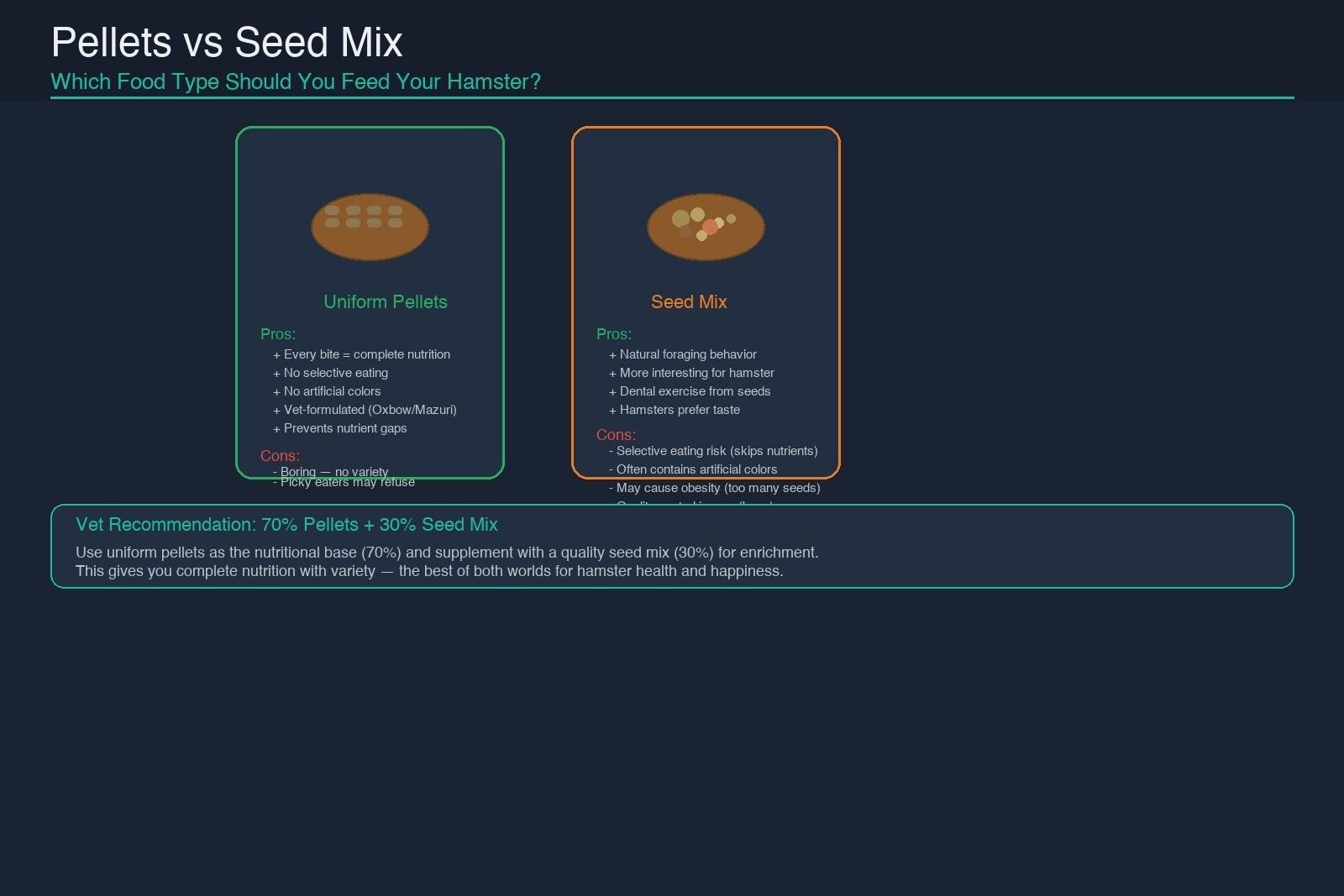
This is the most important decision in choosing the best hamster food. It determines whether your hamster gets balanced nutrition or develops deficiencies from selective eating.
| Feature | Uniform Pellets | Seed Mixes |
|---|---|---|
| Nutrition | ✅ Every bite identical | ❌ Selective eating risk |
| Variety | ❌ Boring, plain | ✅ Natural foraging |
| Recommendation | Veterinarians recommend | Hamsters prefer |
| Best brands | Oxbow | Kaytee, Vitakraft |
| Selective eating | ✅ Prevents | ❌ Enables |
| Artificial colors | ✅ Usually none | ⚠️ Often present |
The best hamster food approach is a combination: 70% quality pellets as the nutritional base, supplemented with 30% seed mix for variety and foraging enrichment. This gives you the complete nutrition of pellets with the behavioral benefits of seed mixes.
Why pellets are healthier: With uniform pellets, every piece delivers the same balance of protein, fat, fiber, and vitamins. Your hamster cannot pick out the “tasty” pieces and leave the healthy ones behind. This makes the best hamster food pellets the safest choice for long-term health.
Why seed mixes are more popular: Hamsters are natural foragers. In the wild, they sort through seeds, grains, and vegetation — and seed mixes replicate this behavior. The best hamster food mix provides mental stimulation and dental exercise from cracking seeds. The best hamster food mix also includes nutritional pellets to prevent selective eating — a well-designed best hamster food mix balances taste with nutrition. But the selective eating problem is real: if your hamster only eats sunflower seeds and ignores the nutritional pellets, the “complete and balanced” label becomes meaningless.
For whole-food alternatives to commercial diets, see our homemade hamster food recipes. You can also supplement with safe fresh foods like boiled egg as an occasional protein treat.
Best Hamster Food for Syrian Hamsters
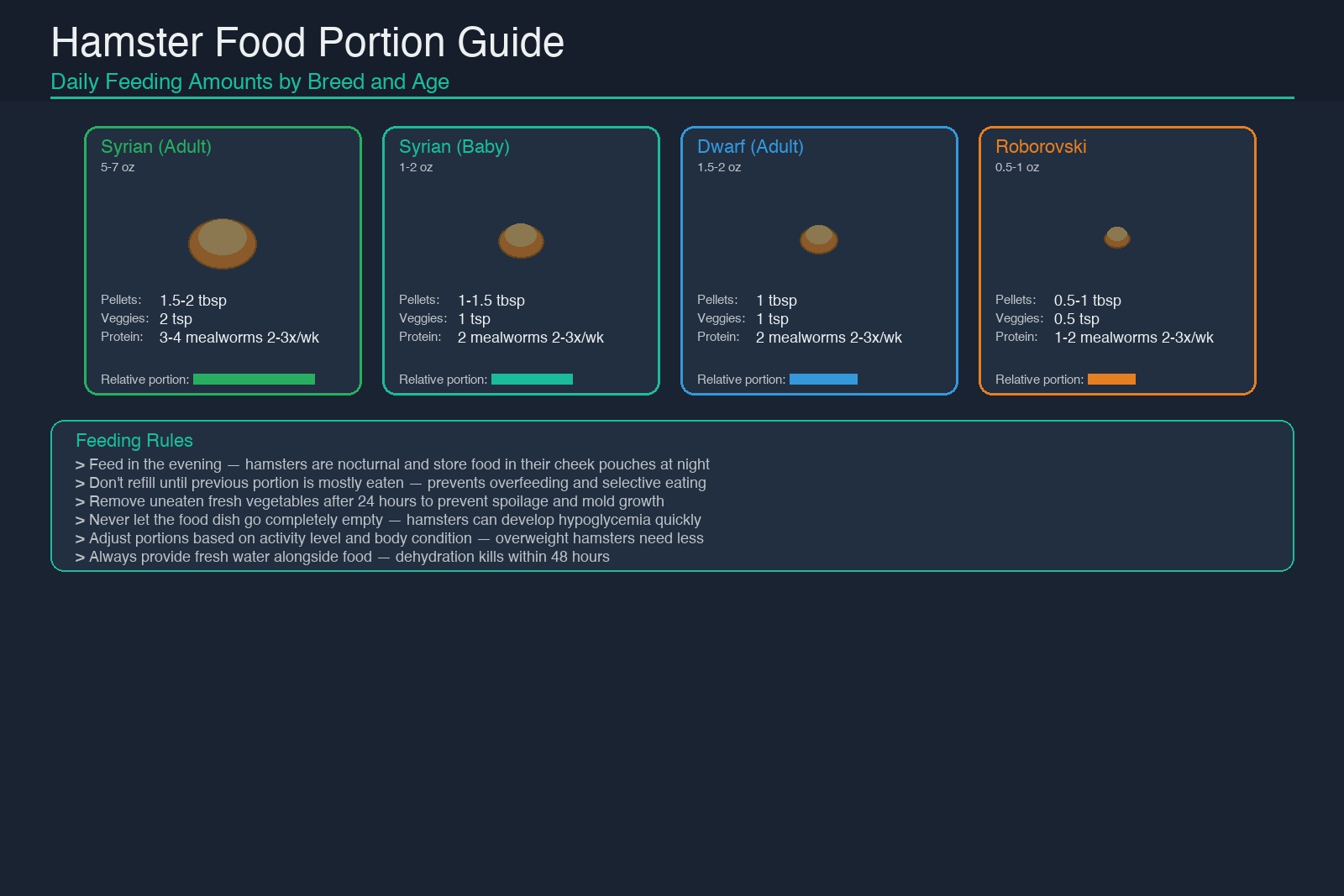
Syrian hamsters are the largest domestic breed (5-7 oz) and the most forgiving when it comes to food. They need 17-20% protein, 5-7% fat, and can handle moderate sugar without the diabetes risk that plagues dwarf species. They also have strong jaws that handle hard pellets without difficulty. For breed-specific care beyond food, see our hamster breeds guide.
1. Oxbow Essentials — Best Overall Hamster Food
Oxbow Essentials Hamster & Gerbil Food
| Spec | Detail |
|---|---|
| Type | Uniform Pellets |
| Price | $14.98 |
| Nutrition | 16% protein, 5% fat, 8% fiber |
| Sizes | 1 lb, 3 lb |
The best hamster food for Syrian hamsters is Oxbow Essentials — it’s the brand most exotic vets recommend and the best hamster food for Syrian hamsters overall. The uniform pellet design means every bite delivers complete, balanced nutrition with no artificial colors, no preservatives, and no sugary pieces. Made in the USA with consistent quality bag to bag, Oxbow is the most reviewed premium pellet on Amazon and the best hamster food for Syrian hamsters at any experience level.
Pros: Complete nutrition in every pellet, no selective eating, no artificial colors, vet-formulated, consistent quality.
Cons: Picky eaters refuse initially (transition takes 1-2 weeks), more expensive than Kaytee, pellets too hard for Roborovski hamsters, no foraging variety.
Real user reviews:
- “Vets consistently recommend Oxbow — my Chinese dwarf has thrived on it for over a year” — verified purchase,
- “Healthy coats and active hamsters reported — consistent quality” — verified purchase,
- “Roborovski nearly died from not eating hard pellets — be careful with small dwarfs” — verified purchase,
The best hamster food pellets are worth the transition effort. Mix 75% old food with 25% Oxbow for the first week, then 0, then 75/25, then 100%. A healthy hamster will not starve itself when food is available.
2. Kaytee Forti-Diet Pro — Most Popular Hamster Food
Kaytee Forti-Diet Pro Health Hamster Food
| Spec | Detail |
|---|---|
| Type | Seed & Pellet Mix |
| Price | ~$5.99 (3 lb) |
| Features | Prebiotics & probiotics |
| Sizes | 2 lb, 3 lb, bulk |
With 11 — more than any other hamster food on Amazon — Kaytee Forti-Diet Pro is the most popular choice and the best hamster food for Syrian hamsters on a budget. It’s affordable, contains prebiotics and probiotics for gut health, and hamsters undeniably love the taste.
⚠️ Kaytee safety note: Always freeze for 48 hours before feeding. This food contains artificial dyes (Red 40, Yellow 5) proven harmful to rodents in published studies. Multiple owners have found larvae and maggots in bags.
Pros: Most affordable at $5.99, most reviewed hamster food, hamsters love taste, widely available, contains probiotics.
Cons: Artificial colors, larvae/maggot reports, heavy on sunflower seeds (high fat), selective eating risk, quality control inconsistency.
Real user reviews:
- “My hamsters have always loved this food — best price point” — verified purchase,
- “Good as supplement to pellet food — prebiotics help digestion” — verified purchase,
- “Found maggots in multiple bags — concerning quality control” — verified purchase,
This is the most popular hamster food brand, but use with caution — inspect every bag and freeze before feeding.
3. Kaytee Food from The Wild — Best Natural Hamster Food
Kaytee Food from The Wild Natural Hamster Food
| Spec | Detail |
|---|---|
| Type | Natural Mix |
| Price | N/A |
| Features | Ancient grains, no artificial colors |
| Size | 2 lb |
This is the best natural hamster food from Kaytee’s lineup and one of the better choices when seeking the best hamster food for Syrian hamsters who prefer natural ingredients. Instead of artificial colors, it uses ancient grains (quinoa, amaranth), real seeds, and dried vegetables that mimic wild hamster foraging. It’s the best hamster food mix for owners who want natural ingredients without Kaytee’s typical artificial dyes.
Pros: No artificial colors, natural ingredients, mimics wild foraging diet, more natural than Forti-Diet or Fiesta.
Cons: Recent quality decline reported (newer bags have more plain pellets), lacks animal protein (hamsters are omnivores), recurring bug/larvae reports, selective eating risk.
Real user reviews:
- “Best Kaytee product ingredient-wise — my Syrian has been healthy on this for years” — verified purchase,
- “No artificial colors which was important to me — good supplement to Oxbow” — verified purchase,
- “Newer bags are mostly dirt pellets — quality has gone downhill” — verified purchase,
4. Kaytee Fiesta — Most Enriching Hamster Food
Kaytee Fiesta Hamster & Gerbil Food
| Spec | Detail |
|---|---|
| Type | Gourmet Mix |
| Price | N/A |
| Features | Fruits, vegetables, seeds, grains |
| Size | 2.5 lb |
If enrichment and variety are your priorities, Fiesta is the most diverse blend — fruits, vegetables, seeds, grains, and crunchy pieces in multiple shapes. The 2.5 lb bag lasts 6+ months for a single Syrian hamster.
Pros: Most diverse blend available, excellent foraging enrichment, hamsters love the variety, contains probiotics.
Cons: Severe selective eating risk, artificial colors, dried fruits are high sugar (dangerous for dwarfs), larvae reports, nutritionally unbalanced if hamster only eats favorite pieces.
Real user reviews:
- “A good balanced blend — my three Syrians can’t get enough” — verified purchase,
- “Great variety, my hamster seems happier with more choices” — verified purchase,
- “Hamster only eats sunflower seeds and leaves everything else” — verified purchase,
Use Fiesta as a supplement or treat food, not the primary diet. The best hamster food brands use it alongside quality pellets.
5. Kaytee Supreme — Budget Hamster Food (Syrians Only)
Kaytee Supreme Hamster & Gerbil Food
| Spec | Detail |
|---|---|
| Type | Economy Seed Mix |
| Price | N/A |
| Features | No artificial colors, simple grains |
| Size | 2 lb |
The most affordable option among the best hamster food brands. No artificial colors and simple ingredients make it straightforward, but the formula is overwhelmingly corn-heavy.
Pros: Most affordable complete food, simple ingredients, no artificial colors.
Cons: Overwhelmingly corn-heavy (multiple reviewers describe it as “just cracked corn”), corn is high sugar (dangerous for dwarfs), mite reports, not nutritionally complete as sole diet.
Real user reviews:
- “Good basic food at a good price — my Syrian has been eating this for months” — verified purchase,
- “Simple ingredients, no artificial colors — affordable for multi-hamster homes” — verified purchase,
- “Just a bag of cracked corn basically — too much corn for smaller hamsters” — verified purchase,
Not recommended for dwarf hamsters. The high corn content is dangerous for diabetes-prone species. If you need the best hamster food for Syrian hamsters on a strict budget, Kaytee Supreme is passable — but spend the extra few dollars on Vitakraft if possible. For more on dwarf health risks, see our hamster health problems guide.
Best Dwarf Hamster Food
Dwarf hamsters — Roborovski, Campbell’s, Winter White, and Chinese — have different nutritional needs than Syrians. They’re smaller (1-2 oz), more prone to diabetes, and need lower sugar content. The best dwarf hamster food keeps sugar under 3% and protein between 15-18%.
Vitakraft Vita Prima Dwarf — Best Dwarf Hamster Food
Vitakraft Vita Prima Dwarf Hamster Food
| Spec | Detail |
|---|---|
| Type | Dwarf-Specific Mix |
| Price | N/A |
| Features | Smaller, softer pieces, no artificial preservatives |
| Size | 2 lb |
This is the only dwarf-specific food in our comparison, and it’s the best dwarf hamster food available on Amazon. The pieces are smaller and softer than standard hamster food, designed for tiny dwarf mouths. The rating is the highest in our entire list.
⚠️ Freeze for 48 hours before feeding — multiple reviewers have found moth larvae in bags.
Pros: highest rating, only dwarf-specific formula, smaller softer pieces, no artificial preservatives.
Cons: Seed mix (selective eating risk), ground peanuts (allergy concern for owners), moth larvae reports, not suitable for Syrian hamsters (pieces too small).
Real user reviews:
- “Ruthie the Robo loves this — only dwarf-specific food worth buying” — verified purchase,
- “Smaller pieces are perfect for my Campbell dwarf” — verified purchase,
- “Found moth larvae — freeze before feeding” — verified purchase,
Best Dwarf Hamster Food by Sub-Species
Not all dwarf hamsters have the same needs. Here are the best hamster food picks by dwarf sub-species:
| Dwarf Species | Best Food | Notes |
|---|---|---|
| Roborovski | Vitakraft Dwarf (primary) | Standard pellets too hard — may need softening |
| Campbell’s | Vitakraft Dwarf + crushed Oxbow | High diabetes risk — low sugar critical |
| Winter White | Vitakraft Dwarf or Oxbow | Can handle pellets better than Robo |
| Chinese | Oxbow Essentials | Less diabetes-prone, handles pellets well |
For Campbell’s dwarf hamsters — the best food for Campbell dwarf hamsters must keep sugar strictly under 3%. Campbell’s have the highest diabetes risk of any dwarf species. Avoid all Kaytee products (high corn, artificial colors) and stick with Vitakraft Dwarf supplemented with crushed Oxbow pellets.
For Winter White dwarf hamsters — the best food for Winter White hamsters can include either Vitakraft Dwarf or Oxbow. Winter Whites are sometimes called Russian dwarf hamsters, and the best russian dwarf hamster food follows the same low-sugar guidelines. Winter Whites are less diabetes-prone than Campbell’s and can handle standard pellet sizes, though the smaller Vitakraft pieces are still preferred.
For Chinese dwarf hamsters — the best food for Chinese dwarf hamsters is Oxbow Essentials. Chinese dwarfs are less diabetes-prone and handle standard pellet sizes well. One owner confirmed their Chinese dwarf “has had Oxbow his whole life” with no health issues.
Best Hamster Food for Roborovski Hamsters
The best hamster food for Roborovski hamsters is Vitakraft Vita Prima Dwarf Hamster Food — it has smaller, softer pieces designed for the smallest dwarf species (1-2 oz). Standard hamster pellets are too hard for Roborovski mouths and can cause them to stop eating entirely.
Roborovski hamsters present a unique feeding challenge. At just 1-2 ounces, they are the smallest domestic hamster species. Their jaws are too small and weak to crack standard hamster pellets — one reviewer reported their Robo “nearly died” from refusing to eat Oxbow pellets, hiding them instead. This is not picky eating; it’s a physical inability to chew the food.
Recommended Roborovski feeding approach:
| Component | Percentage | Details |
|---|---|---|
| Vitakraft Vita Prima Dwarf | 70% | Primary diet — smaller, softer pieces |
| Fresh vegetables | 20% | Daily — broccoli, cucumber, bell peppers |
| Dried mealworms | 10% | 3x/week — essential animal protein |
Can Roborovskis eat Oxbow? Yes, but only if crushed or slightly soaked in water to soften. Never feed hard pellets directly — the best hamster food for robo hamsters must be physically manageable for their tiny mouths.
Can Roborovskis eat Kaytee? Kaytee Supreme pieces are small enough, but the formula is too corn-heavy for diabetes-prone Robos. The best food for robo dwarf hamsters prioritizes low sugar above all else — avoid all Kaytee products for Roborovskis.
How to Transition Your Hamster to New Food
Switching the best hamster food requires patience. Hamsters are creatures of habit, and an abrupt food change can cause stress, diarrhea, and refusal to eat. The best hamster food brands recommend a gradual transition over 2-3 weeks.
Transition schedule:
| Week | Old Food | New Food | Notes |
|---|---|---|---|
| Week 1 | 75% | 25% | Monitor for diarrhea or refusal |
| Week 2 | 50% | 50% | Hamster should be eating both |
| Week 3 | 25% | 75% | Almost fully transitioned |
| Week 4 | 0% | 100% | Complete |
Key transition rules:
- Never abruptly switch — always transition over 2-3 weeks minimum
- Watch for diarrhea during the first week (common with food changes)
- If your hamster refuses to eat the new food, slow down the transition
- Do not offer alternatives during transition — a healthy hamster will not starve itself
- Syrians transition easier than dwarfs (dwarfs are more sensitive to food changes)
- The best hamster food pellets (Oxbow) take the longest to transition to because of the bland taste
- The best hamster food mix (Kaytee) is easier to transition from because hamsters naturally prefer it
If your hamster goes on a “hunger strike” for 24-48 hours during transition, this is normal — but if refusal lasts beyond 48 hours or the hamster shows signs of lethargy, consult a vet. For more on digestive health during food transitions, see our hamster health problems guide.
Best Hamster Food Brands Compared
This hamster food comparison looks at the best hamster food brands holistically reveals a clear hierarchy. We tested three brands across seven products, and the differences in quality, safety, and philosophy are striking.
| Brand | Products | Strengths | Concerns |
|---|---|---|---|
| Oxbow | Vet-recommended, no artificial colors | Bland, picky eaters refuse | ⭐ Best Brand |
| Kaytee | Popular, affordable, tasty | Artificial colors, bugs in bags | ⚠️ Use with caution |
| Vitakraft | Ancient grains, dwarf formula | Inconsistent quality, mold reports | ✅ Good alternative |
Mazuri Hamster & Gerbil Food — Premium Non-Amazon Brand
Mazuri is a premium brand by Purina — the animal nutrition specialists. Recommended by Spruce Pets as “Best Premium Pellets,” Mazuri offers the same uniform pellet approach as Oxbow with vet-grade nutrition. If you can’t find Oxbow locally, Mazuri from Chewy or PetSmart is the best hamster food pellets alternative.
Mazuri is not available on Amazon, so we cannot provide an affiliate link. Check Chewy or PetSmart for availability — estimated price $8-12 per bag.
Pros: High-quality ingredients, uniform pellets, vet-grade nutrition, Purina manufacturing standards.
Cons: Harder to find than Oxbow, not on Amazon, limited retailer availability.
Science Selective — A Brand to Watch
Supreme Petfoods Science Selective is a UK-based brand gaining significant US traction. Like Oxbow, it uses uniform pellets to prevent selective eating. Google Trends shows a 140% increase in searches for “science selective hamster food” over the past year, signaling growing demand. Available through Chewy, Science Selective could become one of the best hamster food brands once US availability improves.
Healthy Hamster Food — Nutrition Guide
Understanding what makes healthy hamster food is essential for evaluating any brand. Here are the nutritional targets by breed:
| Nutrient | Syrian | Dwarf | Why It Matters |
|---|---|---|---|
| Protein | 17-20% | 15-18% | Muscle, immune function |
| Fat | 5-7% | 4-6% | Energy — excess = obesity |
| Fiber | 6-10% | 6-10% | Digestive health |
| Sugar | <5% | <3% | Diabetes risk |
What makes healthy hamster food:
- ✅ 17-20% protein (Syrian) or 15-18% (dwarf)
- ✅ No artificial colors (proven harmful to rodents in published studies)
- ✅ Uniform pellets or controlled seed mix
- ✅ Animal protein supplementation (mealworms)
- ✅ Daily fresh vegetables
- ❌ No artificial dyes (Red 40, Yellow 5, Blue 2)
- ❌ No excess sunflower seeds (too much fat)
- ❌ No sugary dried fruits for dwarf hamsters
For the complete breakdown of nutritional science and feeding schedules, our hamster diet guide with feeding schedule goes deeper into each nutrient and its role in hamster health.
Fresh Food Supplementation
No commercial hamster food should be the only food your hamster eats. Daily fresh vegetables provide vitamins, hydration, and variety that no kibble can match. Healthy hamster food always includes fresh supplementation — and the best hamster food brands explicitly state that their products should be supplemented with fresh foods. The best hamster food in the world cannot replace the micronutrients found in fresh vegetables and protein sources.
| Category | Safe Foods | Frequency |
|---|---|---|
| Vegetables | Broccoli, bell peppers, cucumber, celery, spinach | Daily (1 tsp) |
| Fruits | Blueberries, strawberries, apples, watermelon, grapes, pumpkin (cooked, plain) | 2-3x/week |
| Protein | Mealworms | 2-3x/week |
| Greens | Carrots (small amounts), romaine lettuce | Daily |
| Unsafe | Onion, garlic, citrus, chocolate, raw potato, rhubarb | Never |
Key rules for fresh food:
- Feed vegetables daily (1 teaspoon per dwarf, 2 teaspoons per Syrian)
- Feed fruits 2-3 times per week as treats (high sugar)
- Carrots are safe in small amounts but high in sugar — limit for dwarfs
- Celery is safe but cut into small pieces (stringy fibers)
- Cucumber provides excellent hydration, safe daily
- Blueberries are antioxidant-rich treats, 2-3 per week
- Strawberries are high in vitamin C, safe as occasional treats
- Apples are safe without seeds (apple seeds contain cyanide)
- Watermelon is mostly water — feed sparingly, excellent summer hydration
- Grapes are safe in tiny amounts but high sugar — one small piece per week for dwarfs
- Lettuce is safe only as romaine — avoid iceberg (no nutritional value, can cause diarrhea)
- Mealworms provide essential animal protein — 3-4 per feeding, 2-3 times per week
- Spinach is safe in moderation but high in oxalates — limit to once per week
Remove uneaten fresh food after 24 hours to prevent spoilage. Never feed citrus fruits, onion, garlic, chocolate, raw potato, or rhubarb — these are toxic to hamsters.
Buying Guide — How to Choose the Best Hamster Food
Use this checklist when evaluating any hamster food brand — the best hamster food brands pass all these criteria consistently:
Best hamster food buying checklist:
- ✅ Check protein % (17-20% Syrian, 15-18% dwarf)
- ✅ Check sugar content (under 5% Syrian, under 3% dwarf)
- ✅ Read ingredient list — first ingredient should be a protein source
- ✅ Check for artificial colors — avoid these completely
- ✅ Consider pellet hardness — dwarf hamsters need softer pieces
- ✅ Read recent reviews — check for bug/larvae reports
- ✅ Freeze new bags for 48 hours before feeding
- ✅ Consider the 70% pellet + 30% seed mix approach
The best hamster food brands pass all these checks. Healthy hamster food brands pass every criterion consistently. Oxbow passes every criterion and is the safest bet. Kaytee fails on artificial colors and quality control — not ideal for the best hamster food pellets. Vitakraft falls in between — no artificial colors but inconsistent quality that keeps it from being the best hamster food mix option for health-conscious owners.
For first-time buyers: The best hamster food to start with is Oxbow Essentials if your priority is health, or Kaytee Forti-Diet Pro if your priority is affordability and your hamster is a Syrian. Dwarf owners should start directly with Vitakraft Vita Prima Dwarf.
Conclusion
After testing 7 of the best hamster food 2026 brands and analyzing thousands of reviews, here is the summary of the best hamster food:
- Best overall: Oxbow Essentials — vet-recommended, complete nutrition, no artificial colors
- Best for Syrian on budget: Kaytee Forti-Diet Pro — affordable, popular, use with caution
- Best natural: Kaytee Food from The Wild — no artificial colors, natural ingredients
- Best for enrichment: Kaytee Fiesta — most diverse blend, use as supplement only
- Best dwarf hamster food: Vitakraft Vita Prima Dwarf — , specifically designed for dwarfs
- Best alternative to Oxbow: Vitakraft Vita Prima — ancient grains, no artificial colors
- Best non-Amazon option: Mazuri — premium pellets from Purina, available on Chewy
Replace food every 3-6 months (check expiration dates), always freeze new bags for 48 hours, and supplement with fresh vegetables and mealworms. For more essential hamster care guides, check out our hamster cage setup guide, best hamster bedding, best hamster wheel, and complete hamster care guide.