Medical Disclaimer: This article provides general dietary guidance for healthy pet hamsters and does not replace professional veterinary advice. If your hamster has diabetes, is pregnant, is recovering from illness, or shows any signs of digestive distress, consult an exotic animal veterinarian for a customized diet plan. Dietary needs vary by species, age, and individual health status.
A good hamster diet guide starts with understanding that feeding your hamster correctly is the single most impactful thing you can do for their health and lifespan. I’ve seen the difference a proper hamster diet guide makes in practice — hamsters on balanced diets have glossy coats, bright eyes, and consistent energy, while hamsters on seed-mix-only diets with too many treats become overweight, sluggish, and prone to diabetes. The challenge with most hamster diet advice online is often contradictory, vague (“a small amount”), or incomplete.
This hamster diet guide covers everything: what hamsters can eat, what they can’t, exact portion sizes in grams, a daily feeding schedule broken down by species, pellet recommendations with real data, treat guidelines, and the critical differences between Syrian and dwarf hamster diets. For the basic overview of hamster nutrition, see our original hamster diet page — this guide goes deeper with detailed food lists, precise portions, and product recommendations.
Quick Answer: What Should You Feed Your Hamster?
If you want the short version of this hamster diet guide before diving into the details, here’s the complete hamster food pyramid:
| Portion | Food Type | % of Diet |
|---|---|---|
| Base | Quality pellets | 70-80% |
| Daily | Fresh vegetables (1-2 tsp) | 10-15% |
| Weekly | Fresh fruit, protein treats (2-3x/week) | 5-10% |
| Occasional | Commercial treats (1-2x/week) | <5% |
| Always | Fresh water | Unlimited |
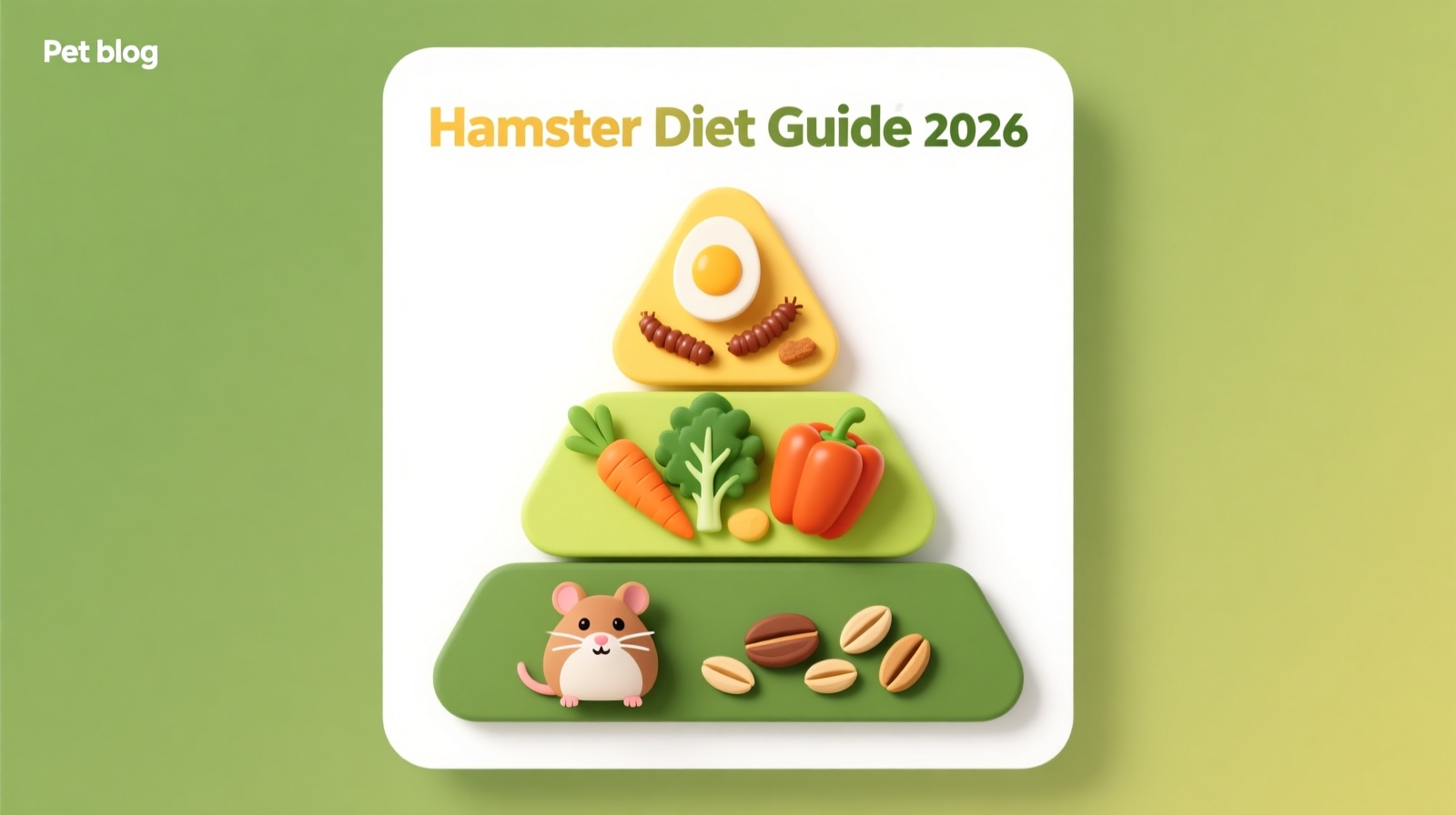 The 90/10 rule is the foundation of every good hamster diet and the most important principle in this hamster diet guide: 90% healthy staple food (pellets plus fresh vegetables), 10% treats (fruit, mealworms, commercial treats). Follow this consistently and your hamster will maintain a healthy weight throughout their life. If you’re tracking your hamster’s weight, our free hamster weight tracker makes it easy to log daily weights and spot trends over time.
The single most important thing to understand from this hamster diet guide about feeding hamsters is that overfeeding is the number one health problem in pet hamsters. A fat hamster is not a happy hamster — obesity leads to diabetes, heart disease, joint problems, and significantly shortened lifespan. I’ve seen too many overweight hamsters from well-meaning owners who thought a “handful” was a good portion size. A Syrian hamster needs about 10 grams of pellets per day — that’s roughly 2 tablespoons, not a handful.
What makes this hamster diet guide different from the basic feeding advice you’ll find elsewhere is the specificity. Instead of vague recommendations like “feed a small amount of vegetables,” you’ll find exact serving sizes, specific frequencies, and species-adjusted portions. This level of detail matters because the margin of error with a hamster’s diet is small — they weigh only 30-150 grams, so even a few extra grams of food per day adds up quickly.
Hamster Nutrition Basics
As any hamster diet guide will explain, hamsters are omnivores. In the wild, they eat a varied diet of seeds, grains, insects, small lizards, and occasional vegetation. Their digestive system is adapted to process both plant and animal matter, which is why a purely vegetarian diet isn’t ideal and why they thrive on quality commercial pellets supplemented with fresh foods.
The key nutritional targets that any hamster diet guide should cover are:
| Nutrient | Syrian Hamster | Dwarf Hamster | Why It Matters |
|---|---|---|---|
| Protein | 17-22% | 17-22% | Muscle maintenance, immune function |
| Fat | 4-7% | 4-7% | Energy, but excess causes obesity |
| Fiber | 5-10% | 5-10% | Digestive health, prevents diarrhea |
| Sugar | <4% | <4% (Campbell’s: <2%) | Diabetes prevention |
Protein should come primarily from animal sources in the pellet formulation — look for ingredients like chicken meal, fish meal, or dried egg. Plant protein (soy, pea) is acceptable but less bioavailable. As a supplemental protein source, you can offer small amounts of boiled egg once or twice a week. Fat content above 7% is a red flag on any pellet label — high-fat diets are the fastest route to an obese hamster.
Fiber is essential for healthy digestion. Hamsters on low-fiber diets are more prone to diarrhea and digestive upset. If your hamster has persistent soft stools, increasing fiber through more fresh vegetables (broccoli, cucumber) often helps.
The sugar guideline deserves special attention in any hamster diet guide. While all hamsters should have limited sugar, dwarf hamsters — particularly Campbell’s dwarfs — are genetically predisposed to diabetes. A Campbell’s dwarf hamster on a high-sugar diet (seed mixes, yogurt drops, fruit) is essentially a diabetes diagnosis waiting to happen. For more on managing this condition through diet, see our hamster diabetes guide.
Safe Food List
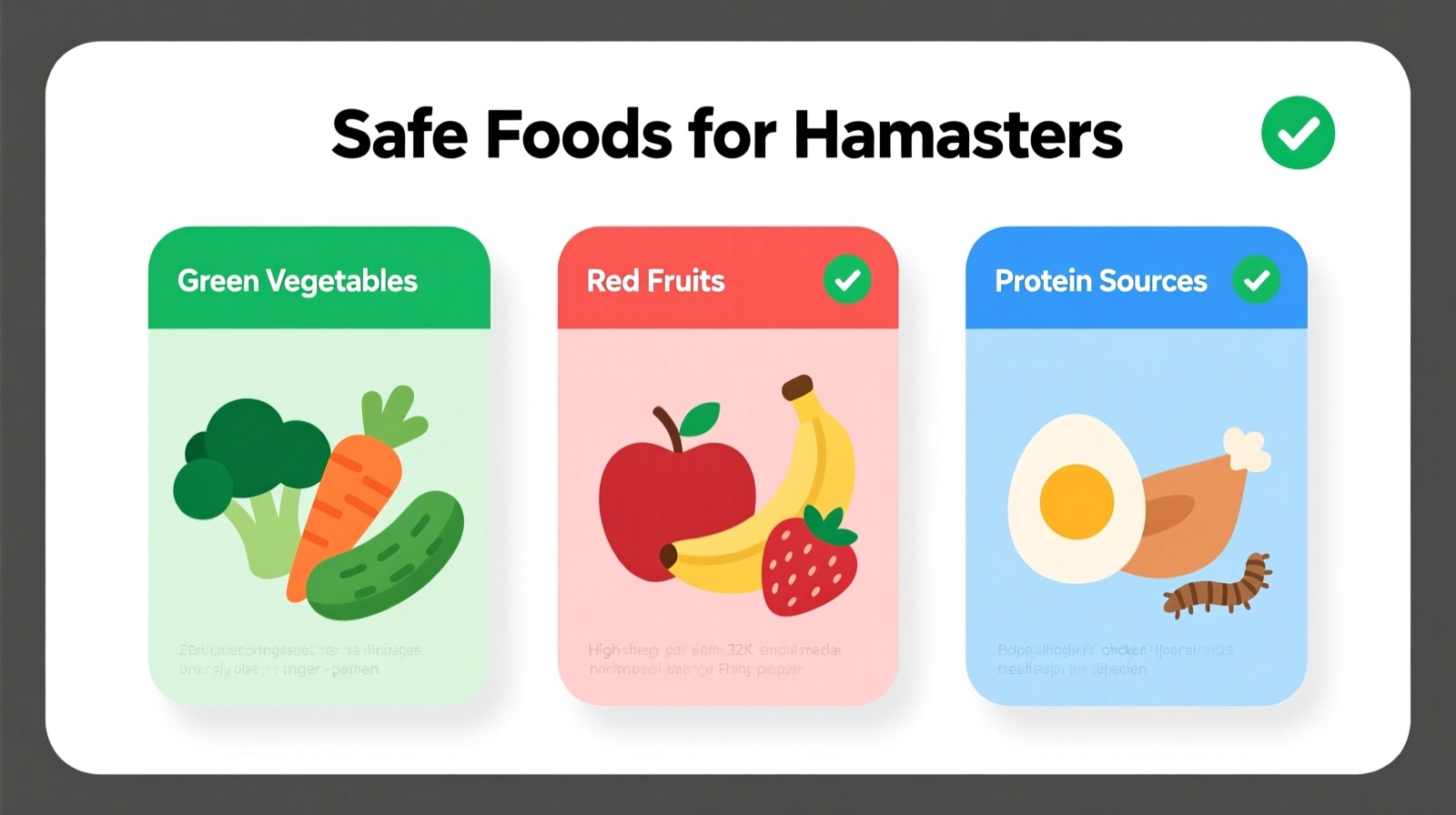
Knowing what hamsters can eat safely is the core of any hamster diet guide. The following tables cover vegetables, fruits, and proteins that are safe for healthy adult hamsters. All foods should be washed thoroughly — a basic safety step that every hamster diet guide should mention, cut into pea-sized pieces, and introduced gradually (one new food at a time to monitor for digestive upset).
Safe Vegetables
Vegetables form the daily fresh component of your hamster’s diet — a proper hamster diet guide always emphasizes their importance. They provide hydration, fiber, vitamins, and variety. The vegetables in this table are safe for regular feeding and should be offered daily alongside pellets.
| Vegetable | Serving Size | Frequency | Notes |
|---|---|---|---|
| Broccoli | 1 small floret | Daily | Rich in vitamin C, well-tolerated |
| Cucumber | 1-2 thin slices | Daily | High water content, very refreshing |
| Bell pepper | 1 small piece | Daily | Any color, remove seeds first |
| Zucchini | 1 thin slice | Daily | Mild flavor, most hamsters accept it readily |
| Celery | 1 small piece | 2-3x/week | Cut into short pieces — strings can be a choking risk |
| Carrot | 1 thin slice | 2-3x/week | Higher in sugar than most vegetables, moderate intake |
| Spinach | 1 small leaf | 2-3x/week | High oxalates — don’t feed daily |
| Lettuce (romaine only) | 1 small leaf | 2-3x/week | Romaine only — iceberg causes diarrhea in most hamsters |
| Tomato | Tiny piece | 2-3x/week | Cherry tomato, no leaves or stems |
| Sweet potato | Pea-sized, cooked | 1-2x/week | Must be cooked, never raw |
| Green beans | 1 small piece | 2-3x/week | Fresh or cooked, both fine |
Iceberg lettuce is the most common mistake I see — it has almost no nutritional value and causes diarrhea in most hamsters. Always use romaine or other dark leafy greens. For detailed breakdowns of individual vegetables, see our dedicated guides on can hamsters eat broccoli, can hamsters eat carrots, can hamsters eat cucumber, can hamsters eat spinach, can hamsters eat lettuce, can hamsters eat tomatoes, and can hamsters eat bell peppers.
Safe Fruits
Fruits are treats, not daily staples — this is a distinction every hamster diet guide should make clearly. They’re higher in sugar than vegetables and should be limited to 2-3 times per week. For dwarf hamsters, especially Campbell’s, reduce all fruit servings by half or eliminate fruit entirely.
| Fruit | Serving Size | Frequency | Notes |
|---|---|---|---|
| Blueberries | 1-2 berries | 2-3x/week | Lower sugar than most fruits, good antioxidant source |
| Strawberries | Half a small berry | 2-3x/week | Remove stem, cut into small pieces |
| Banana | Thin slice (1cm) | 1-2x/week | High sugar — dwarf hamsters should avoid |
| Apple | Pea-sized piece | 2-3x/week | Remove all seeds (trace cyanide compound) |
| Watermelon | Tiny piece | 1-2x/week | Very high water content, can cause loose stools |
| Raspberries | 1-2 berries | 2-3x/week | Good source of vitamins and antioxidants |
| Cranberries | 1 berry | 1-2x/week | Tart flavor, relatively low sugar |
| Cantaloupe | Tiny piece | 1-2x/week | Remove all seeds before serving |
For more detail on specific fruits, our can-eat series covers strawberries, blueberries, bananas, and grapes. Note that grapes and raisins are debated — some sources consider them safe in tiny amounts, but given the kidney damage risk and the availability of safer alternatives, I’d recommend avoiding them entirely.
Safe Proteins
Protein supplementation is important for hamsters and often overlooked in a basic hamster diet guide, especially young, pregnant, or recovering individuals. In the wild, hamsters regularly eat insects, so animal protein is a natural part of their diet.
| Protein Source | Serving Size | Frequency | Notes |
|---|---|---|---|
| Mealworms (dried) | 1-2 worms | 2-3x/week | Excellent protein source, most hamsters love them |
| Cooked chicken breast | Pea-sized piece | 2-3x/week | Plain boiled, absolutely no seasoning or oil |
| Hard-boiled egg | Pea-sized piece | 1-2x/week | Very rich, don’t overfeed — can cause loose stool |
| Tofu | Pea-sized piece | 1-2x/week | Plain firm tofu only, no marinades or sauces |
| Plain cottage cheese | Tiny lick | 1x/week | Lactose-free preferred if available |
For more on protein foods, see our guides on can hamsters eat cheese and can hamsters eat mealworms.
Foods to Avoid
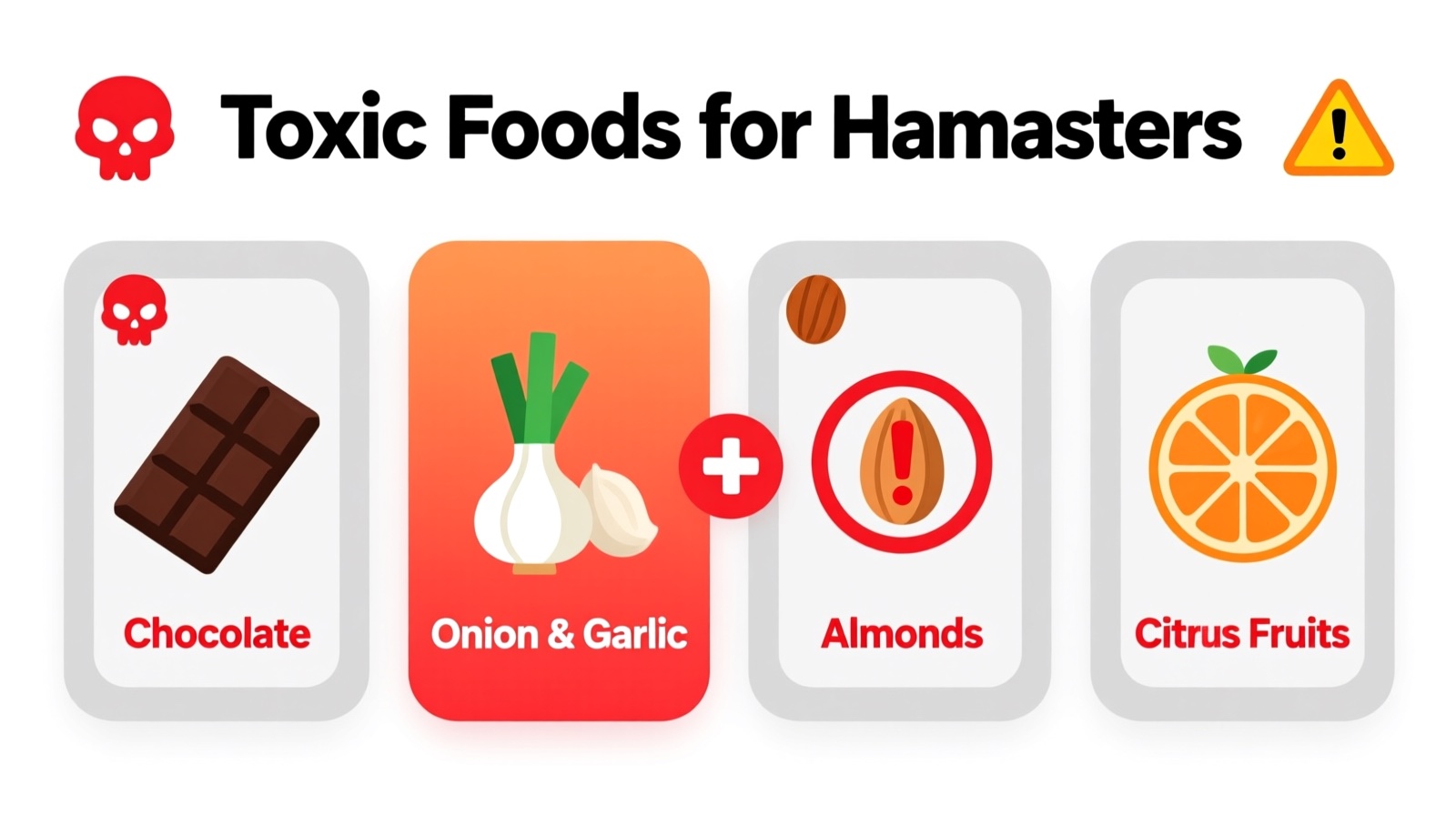
Knowing what not to feed is just as important as knowing what’s safe. Some foods are outright toxic, others cause long-term health problems through excess sugar or fat. This list covers the most common dangerous foods that hamster owners encounter.
| Category | Food | Why It’s Dangerous |
|---|---|---|
| Toxic | Chocolate | Theobromine is lethal to hamsters even in small amounts |
| Toxic | Onions and garlic | Destroy red blood cells, cause anemia |
| Toxic | Raw potatoes | Solanine poisoning — can be fatal |
| Toxic | Almonds | Contain cyanogenic compounds |
| Toxic | Apple seeds | Trace amounts of cyanide |
| Toxic | Rhubarb | High oxalates, toxic to small animals |
| Toxic | Avocado | Persin is toxic to most small pets |
| Toxic | Tomato leaves and stems | Solanine, same family as nightshade |
| High sugar | Yogurt drops | Dangerous for dwarf hamsters, promotes diabetes |
| High sugar | Honey and syrup | Pure sugar with no nutritional value for hamsters |
| High sugar | Store-bought dried fruit | Often coated in added sugar or sulfites |
| High fat | Peanuts and sunflower seeds | Fine as very occasional treats, not daily food |
| High fat | Fried or processed human food | Salt, oil, preservatives — all harmful |
| Choking | Whole unshelled nuts | Shell fragments can cause internal injuries |
| Choking | Sticky peanut butter | Can block the airway — if used, thin with water |
| Acidic | Citrus fruits (oranges, lemons) | Too acidic, can cause mouth sores and digestive upset |
| Human food | Bread, pasta, crackers | Empty carbohydrates leading to obesity |
If your hamster has accidentally eaten chocolate, onions, or any other toxic food, contact an exotic veterinarian immediately. Theobromine poisoning from chocolate progresses quickly in small animals — don’t wait to see if symptoms develop.
Daily Feeding Schedule
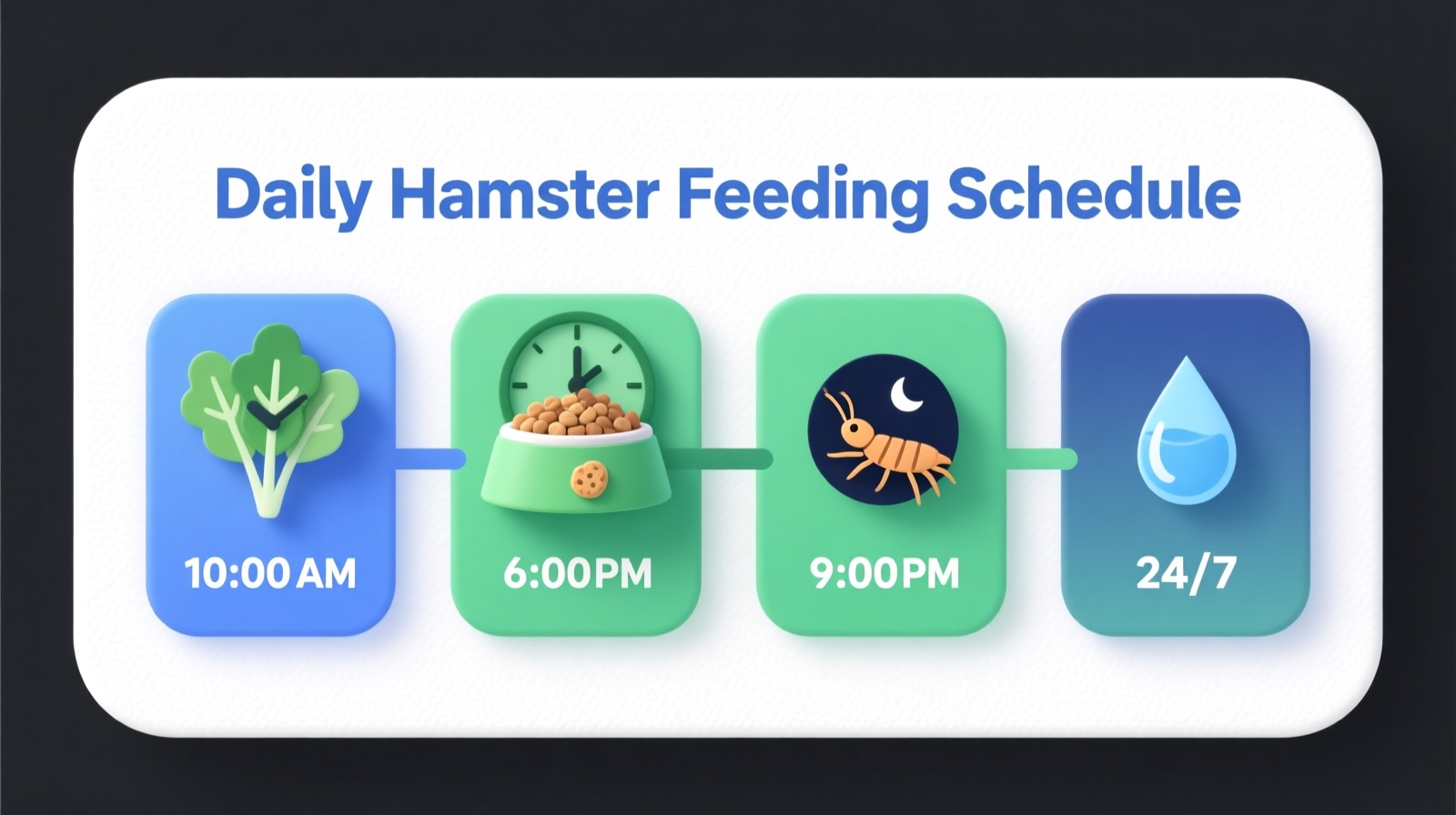
A consistent feeding routine is better for hamsters than random feeding times. Since hamsters are crepuscular (most active at dawn and dusk), the ideal feeding time is in the early evening when they’re naturally waking up and beginning to forage.
Syrian Hamster Feeding Schedule
| Meal | What | Amount |
|---|---|---|
| Daily (evening) | Quality pellets | 2 tablespoons (10-12g) |
| Daily (evening) | Fresh vegetables | 1-2 teaspoons |
| 2-3x/week | Fresh fruit or protein treat | Pea-sized portion |
| 1-2x/week | Commercial treat | 1 small piece |
| Always | Fresh water | Refill daily |
Dwarf Hamster Feeding Schedule
| Meal | What | Amount |
|---|---|---|
| Daily (evening) | Quality pellets | 1 tablespoon (6-8g) |
| Daily (evening) | Fresh vegetables | 1 teaspoon |
| 1-2x/week | Protein treat (mealworm or egg) | Pea-sized portion |
| Rarely | Fruit | Tiny piece, or avoid entirely for Campbell’s |
| Always | Fresh water | Refill daily |
Feeding Equipment and Tips
A good feeding setup matters more than most owners realize. A lightweight plastic bowl gets tipped over — most hamster diet guide recommendations include upgrading to ceramic, scattered, and chewed. A SPOT ceramic crock dish is the standard for good reason — ceramic construction means it can’t be chewed, the weighted base prevents tipping, and the high walls keep food contained. At $7 with over 7, it’s the most cost-effective upgrade you can make to your hamster’s feeding setup, and a recommendation that appears in virtually every serious hamster diet guide.
For portion control, a digital kitchen scale is genuinely useful. It’s precise to 1 gram, which matters when the difference between a healthy portion and overfeeding is just a few grams. I’ve used one for years and it takes the guesswork out of feeding completely.
Additional hamster diet guide feeding tips: always place fresh food in the bowl rather than scattering it (this makes it easier to monitor how much your hamster actually eats), remove uneaten fresh food after 24 hours to prevent spoilage, don’t refill the pellet bowl until it’s nearly empty (this prevents selective eating and overfeeding), and check hoard stashes during weekly cage cleaning to remove any hidden rotting food.
Best Hamster Pellets
The most important recommendation in any hamster diet guide is that pellets should form 70-80% of your hamster’s diet, so choosing the right one matters. The most important distinction is between uniform pellets and mixed seed diets. Seed mixes allow selective eating — hamsters pick out the tasty seeds (high in fat and sugar) and leave the healthier components, leading to nutritional imbalance over time. Uniform pellets ensure every bite has complete nutrition, which is why they’re recommended by exotic veterinarians.
| Product | Price | Reviews | Best For |
|---|---|---|---|
| Oxbow Essentials | $17 | 9,103 | Best overall — veterinarian-formulated, uniform pellets prevent selective eating |
| Kaytee Forti-Diet Pro | $9 | 13,959 | Best budget — most popular hamster food, contains probiotics for digestion |
| Kaytee Natural | $10 | 2,958 | Natural option — no artificial colors or preservatives |
| Wild Harvest Advanced | $11 | 5,581 | Mixed option — seeds plus pellets for variety-seeking hamsters |
Oxbow Essentials is the most consistently recommended pellet by exotic vets, and for good reason — it’s uniformly formulated so selective eating is impossible, the protein and fat ratios are well-balanced, and it has no artificial colors or preservatives. The main downside is price at $17 for a 2.5 lb bag. Kaytee Forti-Diet Pro at $9 is the best value option with the highest review count of any hamster food on Amazon, plus it includes probiotics that support digestive health.
For dwarf hamsters, the hamster diet guide recommendation is to always check the label: choose any pellet with fat content below 7% and minimal added sugar. Avoid pellets with visible seeds, dried fruit pieces, or colorful shapes — these are marketing, not nutrition. For the full comparison with more pellet options than this hamster diet guide covers, see our best hamster food guide.
Treat Guidelines: The 90/10 Rule
Treats are where most hamster diets go wrong, and this hamster diet guide takes a stricter approach than most. It’s tempting to offer multiple treats per day — hamsters get excited, they beg, and it feels like bonding. But treats should make up no more than 10% of total caloric intake. For a Syrian hamster, that means roughly 2-3 small treats per week, not per day. For dwarf hamsters, even less.
Commercial Treat Options
| Product | Price | Reviews | Best For |
|---|---|---|---|
| Oxbow Baked Treats | $13 | 2,696 | Healthiest option — baked with real apple and banana, no artificial additives |
| Vitakraft Mini Drops | $13 | 3,070 | Hamster favorite — creamy yogurt drops, easy to break into tiny pieces |
| Kaytee Fiesta Papaya | $13 | 9,903 | Natural fruit treat — real dried papaya pieces with no added sugar |
| Vitakraft Carrot Slims | $13 | 11,159 | Low-calorie option — crunchy carrot sticks, great for training and hand-feeding |
Oxbow Baked Treats are the healthiest commercial option — they’re baked rather than sugar-coated, made with real fruit, and have the highest rating at. The Vitakraft Mini Drops are the most popular treat on the market and hamsters genuinely love them, but they’re higher in sugar and should be given sparingly, especially to dwarf hamsters. Kaytee Fiesta Papaya is a good natural alternative — real dried fruit without the added sugar found in many commercial treats.
Treat Schedule
The practical way to implement the 90/10 rule from this hamster diet guide: offer treats 2-3 times per week, one treat per session. Break larger treats into tiny pieces — a whole Vitakraft Slim is too much for one sitting. Cut it into thirds. Use treats primarily as a bonding tool during taming sessions or as a reward for positive behavior, not as a daily food item.
For dwarf hamsters, this guide recommends avoiding yogurt drops entirely due to the sugar content. Stick with Oxbow Baked Treats or dried papaya as the safest options. For a comprehensive review of more treat options beyond what this hamster diet guide covers, see our best hamster treats guide.
Syrian vs Dwarf Hamster Diet Differences
The dietary needs between Syrian and dwarf hamsters are more significant than most new owners realize. While the basic structure (pellets as the base, supplemented with fresh foods) is the same, the portion sizes, sugar limits, and risk profiles differ substantially.
| Factor | Syrian | Winter White | Campbell’s Dwarf | Roborovski | Chinese |
|---|---|---|---|---|---|
| Daily pellets | 10-12g | 6-8g | 6-8g | 5-7g | 7-9g |
| Daily vegetables | 1-2 tsp | 1 tsp | 1 tsp | 0.5-1 tsp | 1 tsp |
| Fruit frequency | 2-3x/week | 1x/week | Avoid entirely | 1x/week max | 1-2x/week |
| Sugar limit | <4% | <3% | <2% | <3% | <4% |
| Protein need | Standard | Slightly higher | Slightly higher | Standard | Standard |
| Primary diet risk | Obesity | Diabetes | Diabetes (high risk) | Obesity | Standard |
| Treat limit | 2-3x/week | 1-2x/week | 1x/week max | 1x/week | 2x/week |
The Campbell’s dwarf hamster occupies a special category because of their genetic predisposition to diabetes. If you have a Campbell’s dwarf, their diet should essentially follow diabetic guidelines: minimal sugar, no fruit, no yogurt drops or honey-coated treats, and only low-sugar pellets. This isn’t optional advice — it’s the difference between a hamster that lives a full 2-3 year lifespan and one that develops diabetes at 6 months.
Roborovski hamsters are the smallest species and need the smallest portions. Their 5-7g daily pellet allocation is roughly half a tablespoon — easy to overfeed if you’re not using a scale. Winter Whites fall between Syrians and Campbell’s in terms of diabetes risk — they’re not as susceptible as Campbell’s but should still have limited sugar compared to Syrians.
Chinese hamsters are sometimes classified differently but have different dietary needs — they tolerate slightly more sugar than Campbell’s and Winter Whites and have portion needs closer to a small Syrian. Regardless of species, the core principle of this hamster diet guide is the same: when in doubt, feed less rather than more.
Related Articles: For detailed breakdowns of individual foods, see our complete can hamsters eat series: grapes, strawberries, carrots, cheese, blueberries, bananas, tomatoes, lettuce, spinach, bell peppers, broccoli, cucumber, and mealworms. For product recommendations, see our best hamster food and best hamster treats guides. For health concerns related to diet, see our hamster diabetes guide.