What Is a Chinese Hamster?
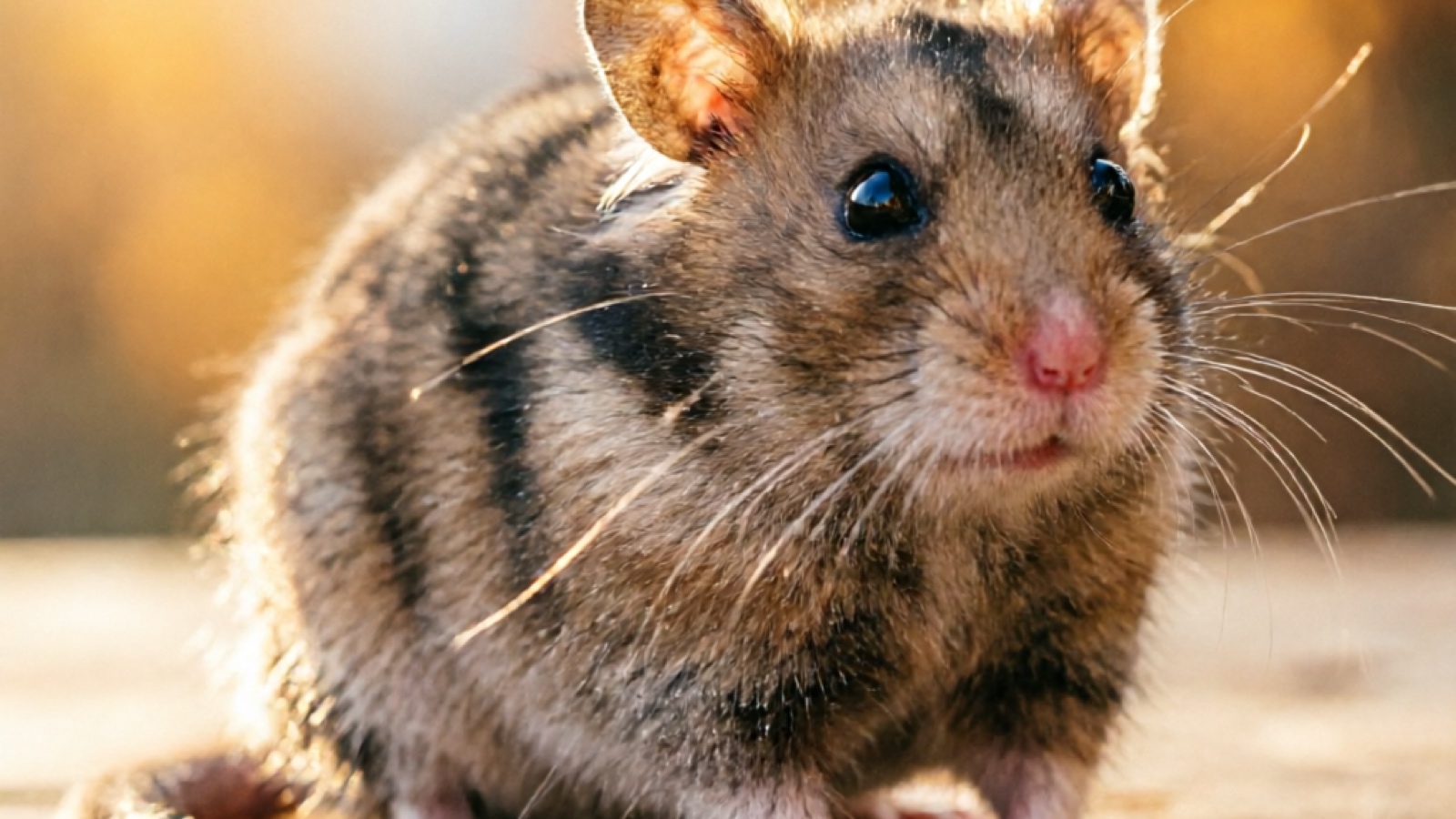
The Chinese hamster (Cricetulus griseus) is one of the most distinctive and misunderstood hamster species in the pet trade. If you’ve never seen one, picture something that looks more like a small mouse or a tiny gerbil than a typical round hamster — with an elongated body, a longer tail, and a narrow, pointed face. They’re not dwarf hamsters at all, despite being commonly grouped with them. They belong to a completely different genus (Cricetulus) from both Syrian hamsters (Mesocricetus) and true dwarf hamsters (Phodopus). For the full breed profile, see our Chinese Hamster breed guide.
Chinese hamsters originate from northern China and Mongolia, where they live in arid steppes and desert margins. They were first introduced to the pet trade in the 1960s and have maintained a small but dedicated following ever since. One thing that sets them apart from other hamster species is their legal status — they’re restricted or illegal to keep as pets in California and parts of Hawaii due to concerns about agricultural impact. Always check your local regulations before seeking one out. In my experience, Chinese hamsters are the “quiet introverts” of the hamster world. They won’t demand your attention the way a Syrian might, but if you put in the time and patience, they can become remarkably attached to their person. I’ve had Chinese hamsters that would come to the cage door to greet me and sit calmly in my hand — something even some Syrians wouldn’t do. For a complete overview of all hamster species, see our hamster breeds guide. If you’re wondering are chinese hamsters good pets, the short answer is yes — for the right owner who appreciates their calm, observant nature and is willing to invest time in bonding.
Quick Facts
| Attribute | Details |
|---|---|
| Scientific Name | Cricetulus griseus |
| Other Names | Chinese striped hamster, striped-back hamster |
| Adult Size | 3-5 inches (10-12 cm) |
| Weight | 1.2-1.6 oz (35-45 g) |
| Lifespan | 2-3 years |
| Activity Cycle | Crepuscular / nocturnal |
| Temperament | Calm, shy, bonds closely with one person |
| Difficulty Level | Intermediate |
| Solitary | Yes — must be housed alone |
Chinese Hamster Size & Weight
When it comes to chinese hamster size, adults reach 3-5 inches in length and weigh 1.2-1.6 ounces. They have an elongated, mouse-like body with a distinctive long tail of about 1 inch. This makes them slightly larger than most dwarf hamsters but smaller than Syrians.
The Chinese hamster lifespan of 2-3 years puts them on par with Syrians and ahead of most dwarf species. Their moderate difficulty level reflects their initial shyness and specific housing needs rather than any complex care requirements. Once you understand their personality and preferences, Chinese hamster care is straightforward.
Appearance & Colors
Chinese hamsters look quite different from all other commonly kept hamster species. Their most distinctive features are their elongated body shape, relatively long tail (about an inch — much longer than any other pet hamster), and narrow, pointed snout. They’re often mistaken for mice at first glance, which is understandable given their slender build and long tail.
The natural (wild-type) coloration is an attractive grayish-brown on the back with a distinct black dorsal stripe running from the head to the tail, and an off-white to cream-colored belly. The contrast between the dorsal stripe and the body color is more pronounced than in dwarf hamsters, giving them a very clean, elegant appearance.
Color Varieties
The chinese hamster colors available are fewer than Syrians or dwarf hamsters, but the ones that exist are attractive. This limited color palette is partly why they’re less popular in the commercial pet trade — breeders have fewer options to work with, and buyers looking for variety tend to gravitate toward Syrian or dwarf species.
- Normal (Wild Type): Grayish-brown with a black dorsal stripe and white belly. The most common color and, in my opinion, the most attractive. The dorsal stripe is sharper and more defined than in Campbell’s or Winter White dwarves, running cleanly from the base of the skull to the tail. The overall effect is sleek and elegant.
- White-spotted (Dominant Spot): The normal coloration with irregular white patches across the body. This is a relatively rare mutation and can produce striking patterns — some specimens are almost entirely white with just a few dark patches.
- Cinnamon: A warm, reddish-brown version of the normal color with a brownish dorsal stripe instead of black. Less common in the pet trade but sought after by breeders for its unique warmth.
Sexing Differences
One unique feature of Chinese hamsters is that mature males have a noticeably larger scrotum compared to other hamster species. This actually makes them one of the easiest hamster species to sex accurately — the difference between males and females becomes obvious at around 4-5 weeks of age. With Syrian and dwarf hamsters, sexing can be tricky even for experienced owners, but Chinese hamsters leave little room for confusion.
Physical Features Summary
- Longer tail (~1 inch / 2.5 cm) — the most distinctive feature compared to other hamsters, giving them a mouse-like silhouette
- Elongated body — more slender and streamlined than the round body of Syrians or dwarves
- Prominent black dorsal stripe — more defined than in Winter Whites or Campbell’s
- Large, dark eyes — slightly protruding, giving them an alert, inquisitive expression
- Narrow, pointed snout — distinctly mouse-like in profile
- Prehensile-like paws — they use their front paws with surprising dexterity, often holding food items while eating
Chinese Hamster Temperament & Behavior
Chinese hamsters have a chinese hamster temperament unlike any other hamster species I’ve worked with. Their chinese hamster personality is calm, thoughtful, and observant — not the frantic energy of a Roborovski or the bold friendliness of a Syrian hamster. They’re more like tiny, furry little cats in their personality.
Handling & Bonding
This is where Chinese hamsters really surprise people. They have a reputation for being shy and nervous, and they certainly start out that way. But with patience, they can become some of the most rewarding hamsters to interact with. For detailed handling advice, our hamster behavior guide covers taming techniques that work across all species.
They’re initially skittish and may take 1-2 weeks to adjust to a new home. Once settled, they can form a very close bond with one person — sometimes to the point of being nervous or territorial toward others. They don’t typically bite, even when nervous — they’re more likely to try to escape or freeze in place. Once bonded, many Chinese hamsters will sit calmly on their person’s shoulder or in their cupped hands.
I’ve found that the key with Chinese hamsters is patience. Don’t rush the taming process. Start by simply sitting near the cage and talking quietly, then progress to hand-feeding treats, and gradually move to handling. The bond is worth the wait — a tame Chinese hamster is a genuinely delightful companion.
Activity Patterns
Chinese hamsters are crepuscular with strong nocturnal tendencies. They’re most active in the evening and throughout the night, with some activity in the early morning. One behavior I find particularly endearing is their tendency to “periscope” — standing up on their hind legs to survey their surroundings with their ears perked up. They’re genuinely curious and observant animals.
They’re also excellent climbers and can scale surprisingly vertical surfaces. This is something to keep in mind when setting up their enclosure — they may climb up bars or tunnel tubes and could potentially escape from enclosures that would securely hold other hamster species. See our hamster care guide for general activity and enrichment tips.
Chinese Hamster Diet & Nutrition
Chinese hamsters have a relatively low diabetes risk compared to dwarf hamsters like Campbell’s, which gives you more flexibility in their chinese hamster diet. Their dietary needs are closer to a Syrian hamster’s than to the Phodopus dwarf species. For a complete dietary breakdown, our hamster diet guide covers everything in detail.
Staple Diet
If you’re wondering what do chinese hamsters eat, a quality commercial hamster food should make up 70-80% of daily intake. Oxbow Garden Select Hamster & Gerbil Food ($7.64) is an excellent choice — it’s a uniform non-GMO pellet formula, and it provides consistent nutrition without selective eating. A Syrian hamster mix works perfectly for Chinese hamsters — don’t feel you need to buy a specialized dwarf mix.
Safe Fresh Foods
Chinese hamsters enjoy a good variety of fresh foods, and their lower diabetes risk means you can be more generous than with dwarf species:
- Vegetables (daily): broccoli, carrots, cucumber, spinach, bell peppers, celery, zucchini, kale
- Fruits (2-3x per week): strawberries, blueberries, grapes, apple (seedless), banana (small amounts)
- Protein (2-3x per week): mealworms, cooked chicken, boiled egg, tofu
Foods to Avoid
Citrus fruits, onions, garlic, raw potatoes, rhubarb, chocolate, candy, processed human food, almonds, raw beans, and apple seeds. Excessively sugary treats and commercial yogurt drops should also be avoided — while Chinese hamsters have lower diabetes risk than Campbell’s dwarves, moderation is still important.
Feeding Schedule
Feed once daily in the evening when your Chinese hamster is waking up. A daily portion of roughly 1-2 tablespoons of mix plus a thumbnail-sized piece of fresh vegetable works well. Scatter-feeding is a great approach — Chinese hamsters enjoy foraging for their food, and it provides mental stimulation that a plain food bowl doesn’t.
Always provide fresh water in a sipper bottle, and remove uneaten fresh food after 24 hours to prevent spoilage. Chinese hamsters are less aggressive hoarders than Syrians, but they’ll still create small food caches in their favorite hiding spots — typically in or near their sleeping hide.
Housing Requirements
Chinese hamsters have specific housing needs that are sometimes overlooked because of their relatively uncommon status. The biggest factor is their climbing ability — a Chinese hamster can escape from cages that securely hold every other hamster species.
Cage Size & Type
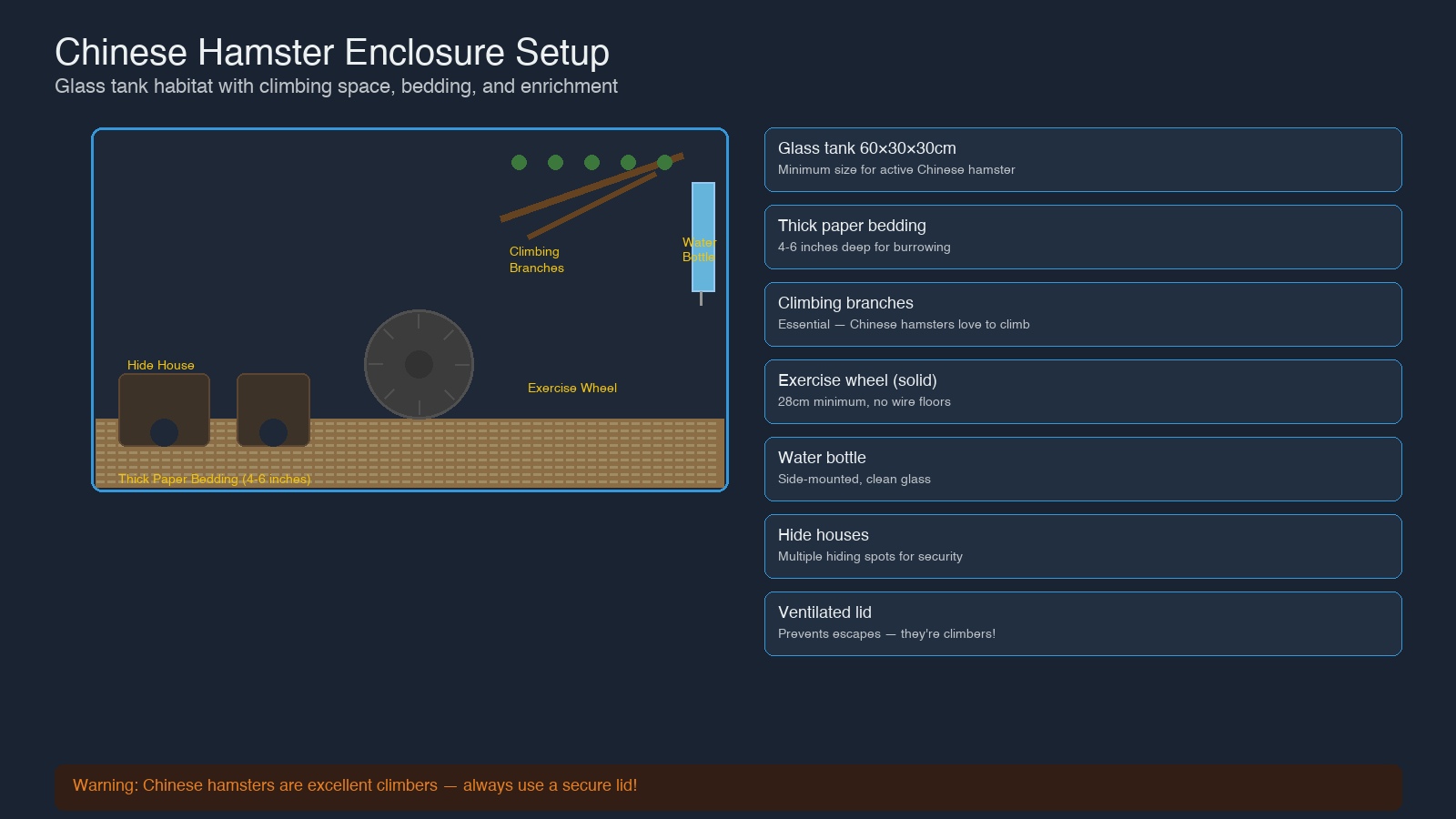
The chinese hamster cage size requires a minimum of 450 square inches of floor space, though 600+ square inches is strongly recommended. Because they’re excellent climbers, they can use vertical space well, but floor space should still be the priority. See our hamster cage setup guide for detailed setup instructions.
I’d recommend a glass tank or bin cage for Chinese hamsters specifically because they eliminate climbing-escape risks entirely. The Prolee Hamster Cage ($69.99) is a solid option — it’s a glass tank-style enclosure that prevents escapes, highly rated. For more cage options, our best hamster cage guide covers the full range.
If you do use a wire cage, bar spacing must be no wider than 0.4 inches — Chinese hamsters are slender and can squeeze through gaps that would stop a Syrian. A secure, weighted lid is also essential since they can climb to the top and push open lightweight covers.
Bedding & Enrichment
Use 6+ inches of paper-based or aspen bedding for burrowing. Chinese hamsters do enjoy burrowing, though not as intensely as Roborovskis. Avoid pine shavings and cedar entirely. Provide at least two hides — one for sleeping and one for food storage.
Because they’re natural climbers, add branches, cork logs, and multi-level platforms to their enclosure. This is one area where Chinese hamster care differs from most other species — they genuinely use and appreciate vertical space. Our cage enrichment guide has more ideas for creating a stimulating environment.
Exercise Wheel
A proper wheel is essential. For chinese hamster wheel size, a minimum of 6.5-7 inches in diameter with a solid running surface is required. Check our hamster wheel size guide for breed-specific recommendations. Because they have slightly longer bodies than dwarf hamsters, a slightly larger wheel is beneficial. The Niteangel Super Silent Hamster Wheel ($23.99) is an excellent choice — it comes in multiple sizes including 6.5-inch and 8-inch options, is whisper-quiet, and has a solid running surface that protects their feet. highly rated. For a full comparison, see our best hamster wheel guide.
Temperature
Ideal range is 65-75°F (18-24°C). Avoid temperatures below 60°F and above 80°F. Keep the enclosure away from direct sunlight, drafts, and heat sources.
Chinese Hamster vs Dwarf Hamsters
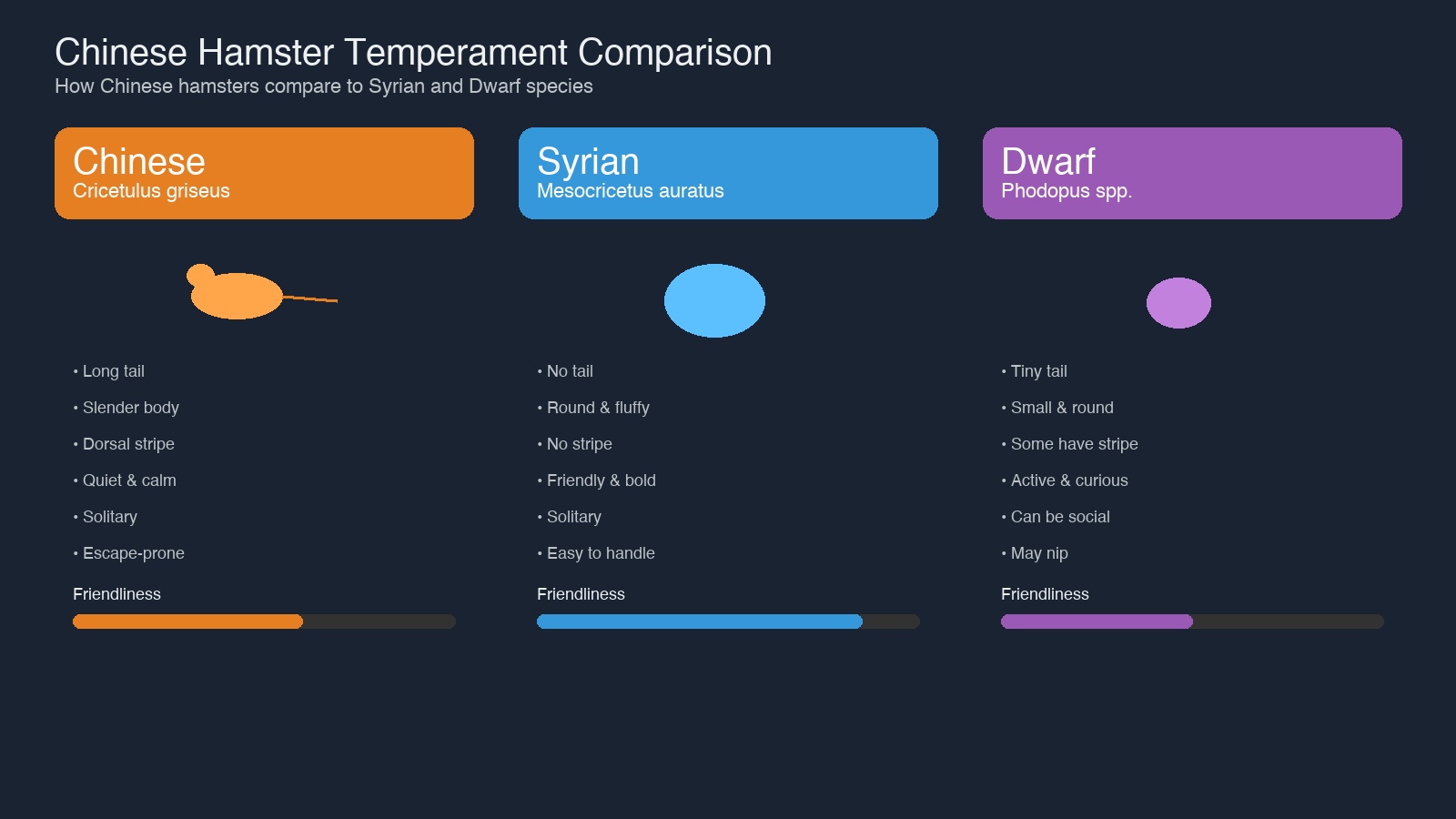
This is one of the most common sources of confusion. Chinese hamsters are frequently called “Chinese dwarf hamsters” in pet stores and online, and people searching for chinese dwarf hamster care often end up on the wrong care guides. They belong to a different genus entirely. For a detailed comparison across all species, our Syrian vs Dwarf hamster guide breaks down the differences.
| Feature | Chinese | Syrian | Winter White | Campbell’s | Roborovski |
|---|---|---|---|---|---|
| Genus | Cricetulus | Mesocricetus | Phodopus | Phodopus | Phodopus |
| Size | 3-5 in | 5-7 in | 3-4 in | 3-4 in | 1.5-2 in |
| Body shape | Elongated, mouse-like | Round, stocky | Round | Round | Round |
| Tail length | Long (~1 in) | Very short | Very short | Very short | Very short |
| Solitary | Yes (strictly) | Yes | Pairs possible | Pairs possible | Pairs possible |
| Handleable | Yes (with patience) | Yes | Yes | Somewhat | Rarely |
| Diabetes risk | Low-moderate | Low | Moderate | High | Low |
| Climbing ability | Excellent | Poor | Poor | Poor | Moderate |
The key distinction is taxonomic: true dwarf hamsters (Campbell’s Dwarf Hamster, Winter White, Roborovski) all belong to the genus Phodopus, while Chinese hamsters belong to Cricetulus. This isn’t just academic — it affects their care requirements, social behavior, and health predispositions. A Chinese hamster’s needs are closer to a Syrian’s than to a dwarf hamster’s in terms of diet and housing.
Health & Common Issues
Chinese hamsters are generally healthy and hardy, with relatively few breed-specific health problems. Their 2-3 year hamster lifespan is on par with Syrians. For common health concerns across species, our hamster health guide covers prevention and treatment.
Wet Tail
Chinese hamsters can develop wet tail, though it’s less common than in Syrians. This is a bacterial infection that causes severe diarrhea and is potentially fatal if untreated. Keep stress levels low, maintain a clean cage, and watch for signs: wetness around the tail area, lethargy, hunched posture, and loss of appetite. This is a medical emergency requiring immediate veterinary care. Our hamster wet tail guide covers symptoms and treatment in detail.
Diabetes
While Chinese hamsters have a lower diabetes risk than Campbell’s dwarves, they’re not entirely immune. Interestingly, Chinese hamsters are used in laboratory diabetes research because of their natural susceptibility to the condition, which suggests they may be more prone than commonly believed. A balanced diet without excessive sugar is still the best preventive approach.
Respiratory Infections
Dusty bedding and poor ventilation can cause respiratory issues in any hamster. Use paper-based bedding, ensure good airflow in the enclosure, and avoid scented substrates or bedding with added fragrance. If your Chinese hamster develops sneezing, wheezing, or nasal discharge, move them to a dust-free environment immediately and consult a vet if symptoms persist beyond 48 hours.
Tumors
Chinese hamsters may be slightly more prone to tumors than some other species, particularly as they age. If you notice any unusual lumps or growths, have your vet evaluate them promptly. Many tumors are benign and can be surgically removed if caught early.
Dental Problems
Like all hamsters, Chinese hamsters have continuously growing teeth that need to be worn down. Wooden chew toys, safe branches (apple, willow), and hard vegetables help keep their teeth at a healthy length. Monitor for overgrown teeth or difficulty eating.
Pros and Cons of Owning a Chinese Hamster
Every species has trade-offs, and the Chinese hamster is no exception. Here’s an honest assessment based on my experience keeping them over the years.
What I love about Chinese hamsters: Their calm, observant nature is genuinely unique among hamster species. Once bonded, they’re incredibly rewarding companions — more like tiny cats than the frantic pocket rockets that dwarf hamsters can be. They’re also less prone to nipping than dwarf species, which makes them more pleasant to handle once tamed. Their longer-than-average lifespan and elegant appearance are additional bonuses. I’ve found that a tame Chinese hamster sitting contentedly on your shoulder is one of the most enjoyable small pet experiences you can have.
What you should consider: They’re harder to find than Syrians or dwarf hamsters — many pet stores don’t carry them, and if you’re looking for a chinese hamster for sale, you may need to seek out a specialized breeder. Their climbing ability means you need a more secure enclosure than you would for other species. They’re initially shy and require patience during the taming process, which makes them less suitable for young children who might lose interest. Legal restrictions in some areas (notably California) also limit who can own them, and availability can be seasonal.
For most owners who are willing to invest time in the bonding process and provide a secure, appropriately sized enclosure, a Chinese hamster is a wonderful pet that offers a genuinely different experience from the more common hamster species. If you’re deciding between species, our best hamster food guide and best hamster cage guide will help you prepare regardless of which type you choose.