Quick Answer — How Big Do Axolotls Get?
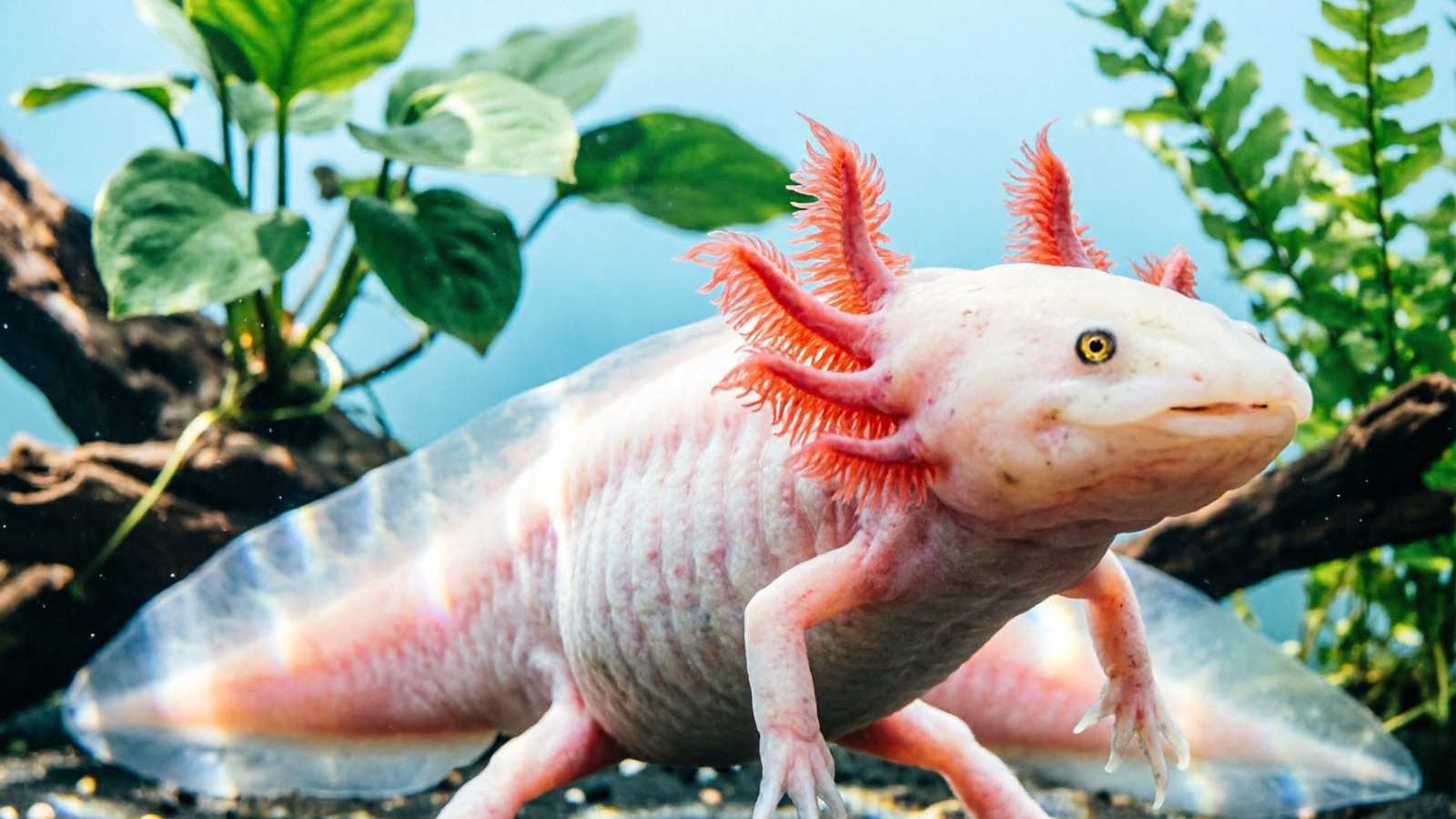
How big do axolotls get? Most pet axolotls reach 6–12 inches (15–30 cm), with the average adult measuring 9 inches (23 cm). Males tend to be 8–9 inches while females reach 9–10 inches. They typically reach full size by 12–18 months of age and need a minimum 20-gallon long tank.
Neoteny is a biological phenomenon where an amphibian retains its larval features — external gills, dorsal fin, and aquatic lifestyle — throughout its entire life, never undergoing metamorphosis into a land-dwelling adult. The axolotl (Ambystoma mexicanum) is the most famous example of neoteny. Unlike other amphibians that develop lungs and leave the water, axolotls remain fully aquatic because they evolved in the stable, predator-free environment of Lake Xochimilco’s canal system in central Mexico. According to the IUCN Amphibian Specialist Group, this permanent larval state means axolotls grow continuously but at a decelerating rate, unlike metamorphosed salamanders that stop growing after metamorphosis. Neoteny also means axolotls can regenerate lost limbs, spinal cord tissue, and even parts of their heart — making them one of the most studied model organisms in regenerative medicine [National Institutes of Health, 2024].
How big do axolotls get? Fully grown axolotls typically reach 6–12 inches (15–30 cm) in length, with an average of 9 inches (23 cm). They reach full size in 12–18 months. Females tend to be slightly wider and heavier than males. A minimum 20-gallon long tank is required for one adult axolotl.
Key numbers at a glance:
- Adult length: 6–12 inches (15–30 cm), average 9 inches (23 cm)
- Adult weight: 50–225g, average 100–150g
- Time to full size: 12–18 months
- Sexual maturity: 6–12 months
- Minimum tank: 20-gallon long (per adult)
- Record size claims: ~18 inches — unverified, extremely rare in captivity
Pet axolotls virtually never exceed 12 inches. When asking how big do axolotls get, it is important to set realistic expectations — claims of 18-inch axolotls come from unverifiable sources and are not representative of what pet owners should expect.
The typical healthy adult pet axolotl measures 8–10 inches.
How Big Are Fully Grown Axolotls?
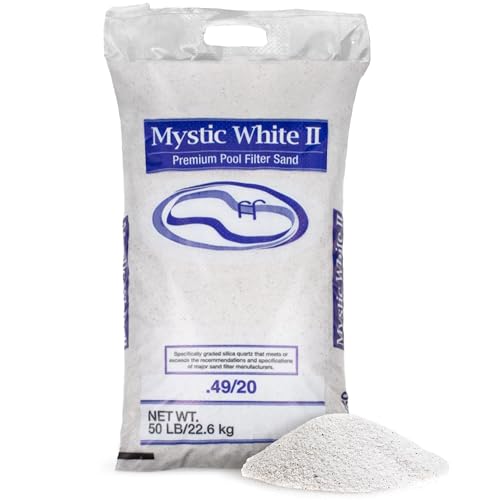
U.S. Silica Mystic White II is a quality option worth considering for your setup.
The axolotl full grown size depends on genetics, diet, water quality, and tank conditions. Most pet axolotls fall within a predictable range.
Average adult dimensions:
- Length: 8–10 inches (20–25 cm) for typical pets
- Weight: 100–150g for a healthy adult
- Body width: 1.5–2.5 inches across the midsection
Wild axolotls in Lake Xochimilco (Mexico City) tend to be smaller than captive-bred specimens, averaging 6–8 inches. Captive-bred axolotls benefit from consistent feeding and optimal water conditions, allowing them to reach their full genetic potential.
The 18-inch claim appears in some online sources but has never been reliably documented in a peer-reviewed context. Any axolotl exceeding 12 inches is exceptional — most healthy adults plateau at 9–10 inches regardless of how long you keep them.
For tank sizing based on adult dimensions, see our guide to the best axolotl tank.
Axolotl Size Chart by Age
Many owners find that Slate Tiles for Reptiles works well for their pet’s needs.
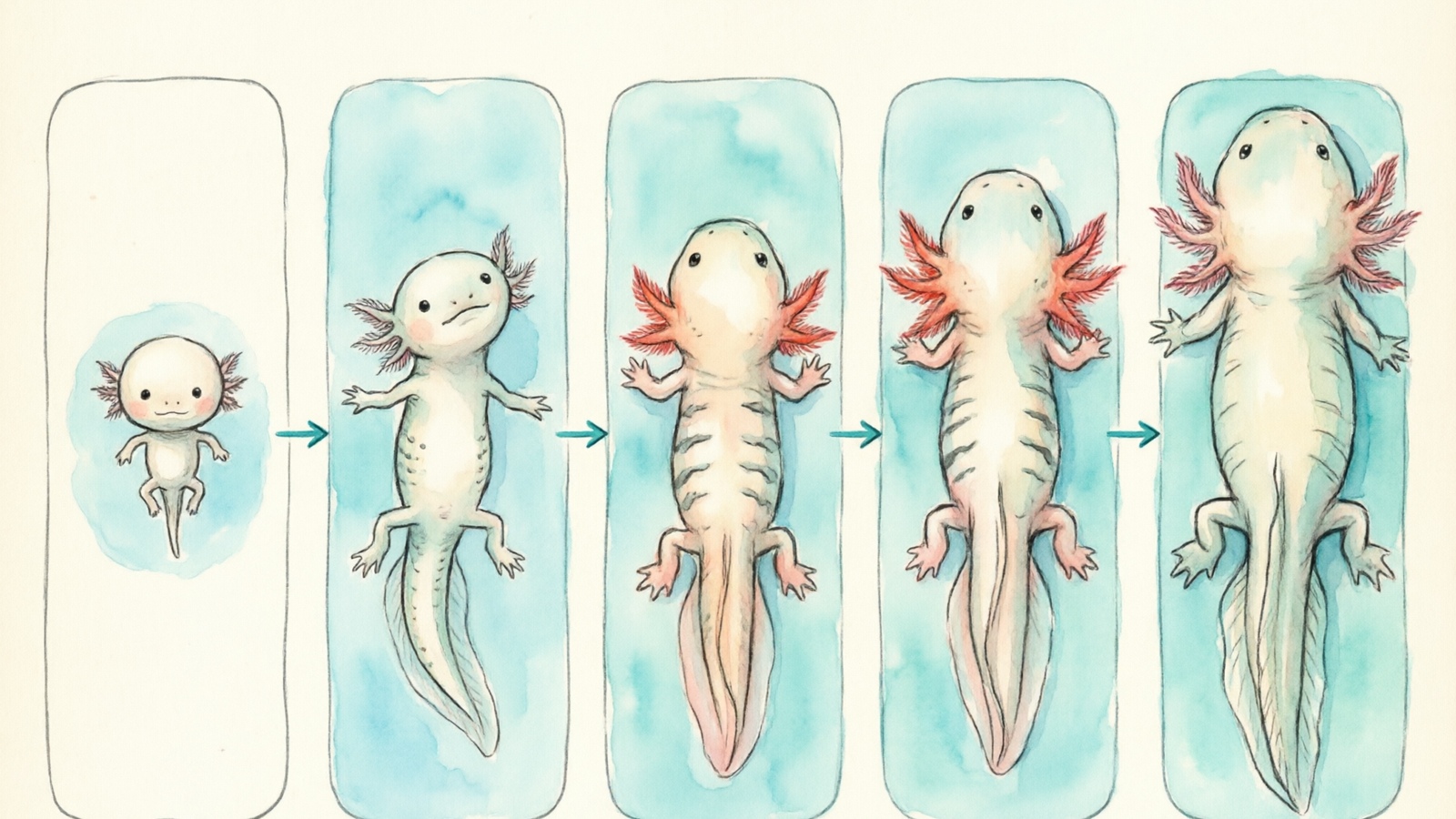
If you are wondering how big do axolotls get at each stage, tracking your axolotl’s growth against benchmarks helps catch problems early. The axolotl size chart below covers the full growth journey from hatching to full adult size.
| Age | Length (inches) | Length (cm) | Weight (approx) | Stage |
|---|---|---|---|---|
| Hatching | 0.5–1” | 1–2.5 cm | <1g | Larva |
| 1 month | 1.5–2” | 4–5 cm | 2–5g | Larva |
| 2 months | 2.5–3.5” | 6–9 cm | 8–15g | Juvenile |
| 3 months | 3.5–4.5” | 9–11 cm | 15–25g | Juvenile |
| 6 months | 6–7” | 15–18 cm | 40–60g | Sub-adult |
| 9 months | 7.5–9” | 19–23 cm | 70–100g | Sub-adult |
| 12 months | 8–10” | 20–25 cm | 90–140g | Adult |
| 18 months | 9–12” | 23–30 cm | 110–200g | Full adult |
These are averages — individual axolotls vary based on genetics, diet quality, water temperature, and tank size. Axolotl size by age follows a predictable curve: rapid early growth, a gradual slowdown around 6 months, and near-plateau by 12–18 months.
How to measure your axolotl: Use a soft measuring tape or place a ruler next to your axolotl during feeding when they are relatively still. Measure from the tip of the snout to the end of the tail.
Weigh using a small digital kitchen scale placed inside a container of tank water — never weigh a dry axolotl.
How Fast Do Axolotls Grow?
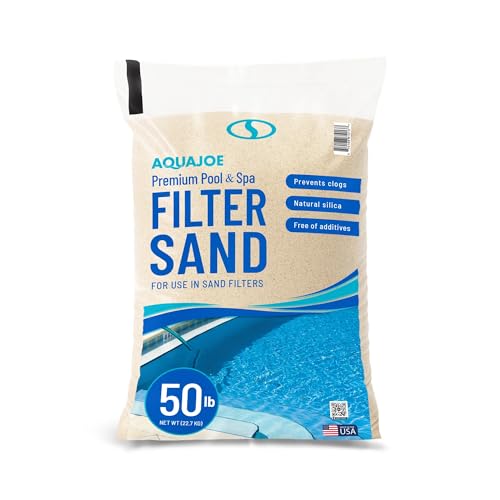
For this purpose, Aqua Joe Premium Pool Filter Sand is a popular choice among pet owners.
The axolotl growth rate follows a predictable pattern: explosive early growth that progressively slows as the axolotl approaches adult size.
Growth by life stage:
Larval stage (0–2 months): Fastest growth period. Axolotls can gain up to 1 cm per week.
They hatch at under 1 inch and reach 2.5–3.5 inches by month two.
At this stage, feeding frequency matters enormously — juveniles should be fed daily.
Juvenile stage (2–6 months): Rapid but slightly slower growth — approximately 0.5–1 cm per week. Your axolotl will roughly double in length during this period. This is when diet quality has the biggest impact on final adult size.
Sub-adult stage (6–12 months): Growth rate drops to 0.2–0.5 cm per week. Sexual maturity begins at 6–12 months.
You may notice the body thickening more than it lengthens.
Adult stage (12+ months): Minimal growth — less than 0.1 cm per week. Changes are mostly in body width and weight rather than length.
Growth technically never stops but becomes negligible after 2 years.
How to track your axolotl’s growth — 5-step monitoring routine:
Step 1: Measure at intake. Record your axolotl’s length (snout to tail tip) and weight on the day you bring them home. This establishes a baseline.
Step 2: Measure monthly. Gently place your axolotl in a shallow container on a scale, then measure length with a soft ruler against the container wall. Log the date, length, and weight.
Step 3: Compare to the size chart. At each check, compare your measurements to the size chart above (H2-3). Your axolotl should fall within the expected range for their age.
Step 4: Check environmental factors. If growth stalls, immediately test water temperature (target 60–68°F), water parameters (ammonia 0, nitrite 0, nitrate <20ppm), and review feeding frequency.
Step 5: Consult a vet if stalled 2+ months. If growth is zero for over 2 months despite optimal conditions — especially with appetite loss — schedule an exotic vet visit. Internal parasites are a common and treatable cause of growth failure in juvenile axolotls.
Diet plays a direct role in growth speed. A high-protein diet of earthworms, bloodworms, and quality pellets supports maximum growth potential. For specific feeding recommendations, see our axolotl diet guide.
What Affects Axolotl Growth Rate?
Six primary factors determine how quickly and how large your axolotl grows. If you want to know how big do axolotls get under ideal conditions, optimizing these factors is the answer. Understanding these helps you optimize conditions and identify problems early.
| Factor | Impact | Optimal Range | Stunting Risk |
|---|---|---|---|
| Water temperature | High | 60–68°F (15–20°C) | >74°F slows metabolism |
| Diet quality | High | High-protein (worms, pellets) | Poor diet = stunted growth |
| Feeding frequency | Medium | Juvenile: daily; Adult: 2–3x/week | Underfeeding slows growth |
| Tank size | Medium | 20+ gallons minimum | <10 gallons restricts growth |
| Water quality | Medium | Ammonia 0, Nitrite 0, Nitrate <20ppm | Poor water = stress + stunting |
| Genetics | Low-Medium | N/A | Some lines grow slower |
Water temperature is the single most controllable factor. Axolotls are cold-water amphibians adapted to Lake Xochimilco’s cool, spring-fed waters. Temperatures above 72°F (22°C) increase metabolic stress and suppress appetite.
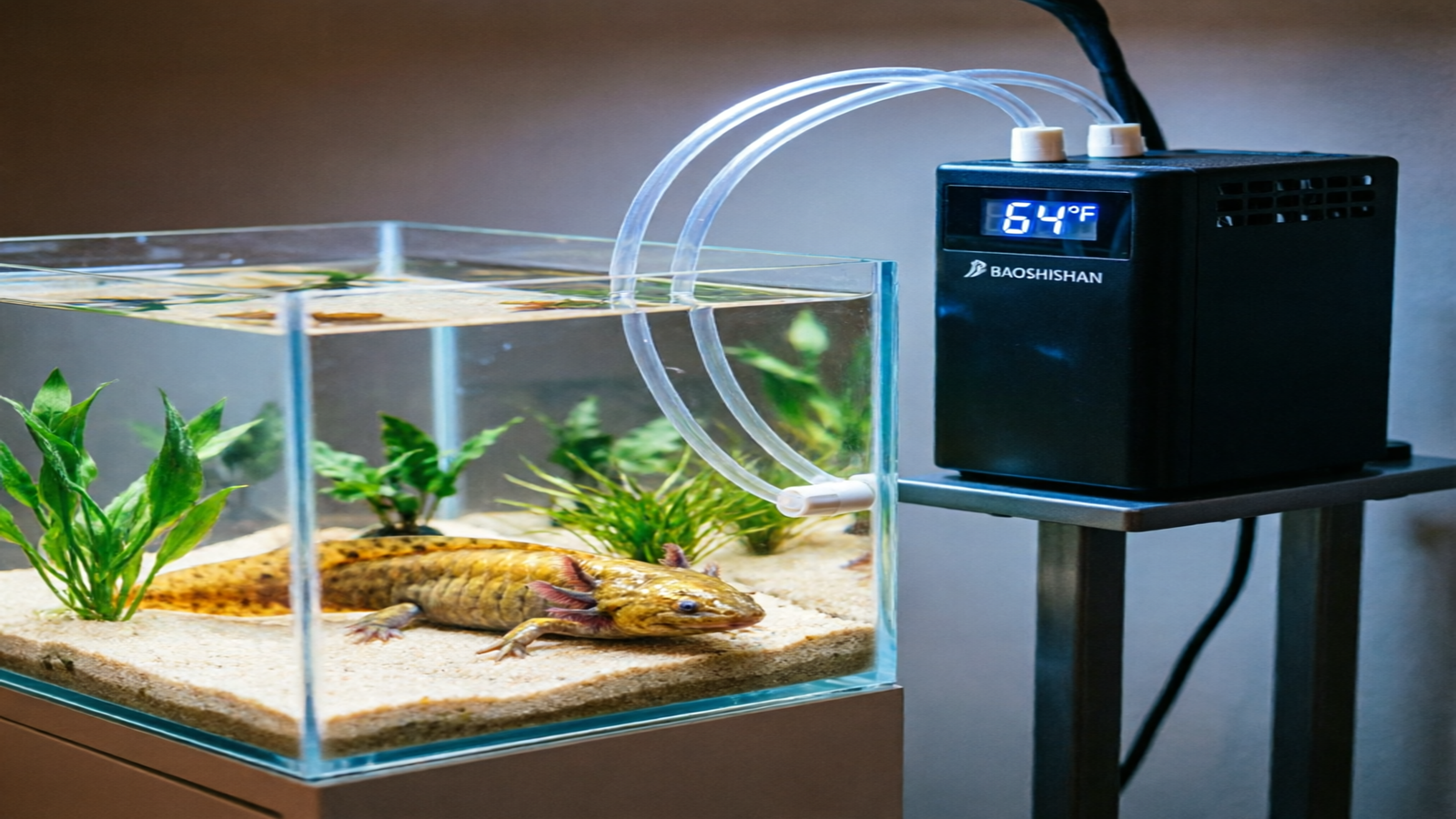
Above 74°F (23°C), the immune system weakens and growth stalls. Invest in an aquarium chiller if your room temperature regularly exceeds 70°F. For detailed temperature guidance, see our axolotl water temperature guide.
Tank size directly affects growth through physical restriction. An axolotl in a cramped tank has less swimming space, which limits exercise and muscle development.
Chronic space restriction causes measurable stunting compared to siblings in properly sized tanks. For setup guidance, see our axolotl tank setup guide.
Water quality matters because axolotls absorb chemicals directly through their skin. Ammonia and nitrite spikes cause chronic stress that redirects energy away from growth. Cycling your tank properly before adding an axolotl is non-negotiable.
Do Male and Female Axolotls Differ in Size?
Do female axolotls get bigger than males? Yes — but the difference is more about body shape and weight than length. Females are typically wider and heavier, while length differences are minimal.
| Trait | Male | Female |
|---|---|---|
| Average length | 8–9” (20–23 cm) | 9–10” (23–25 cm) |
| Body shape | Slender, narrower head | Wider, rounder body |
| Average weight | 80–130g | 110–200g |
| Cloaca | Swollen with papillae when mature | Smooth, wider opening |
The length difference of 1–2 inches is subtle and unreliable for sexing. The weight difference is more noticeable — a mature female carrying eggs can weigh nearly double a male of the same length.
Sexing is possible at 6+ months. Look at the cloaca (the vent between the hind legs): mature males develop a noticeable swollen bulge, while females have a wider but flat opening.
During breeding season, the difference becomes very obvious.
Why Is My Axolotl Not Growing?
If your axolotl seems stuck at the same size for months, one of these six factors is likely the cause. Why is my axolotl not growing is one of the most common concerns among new owners.
1. Water temperature too high (>72°F). This is the #1 cause of stunted growth. Warm water suppresses appetite and forces the axolotl’s metabolism into stress mode.
If your room is warm, invest in a chiller or fan.
2. Underfeeding or poor diet. Juveniles need daily feeding with high-protein foods.
An adult fed only 1–2 times per week on low-quality food will grow slowly or plateau early.
3. Tank too small. Axolotls in tanks under 20 gallons show measurably slower growth. The restricted swimming space limits physical development.
4. Poor water quality. Even sub-lethal ammonia or nitrite levels cause chronic stress that stunts growth. Test your water weekly and maintain 0 ammonia, 0 nitrite, and nitrate below 20ppm.
5. Illness or parasites. Internal parasites or bacterial infections redirect energy from growth to immune response.
Look for other symptoms: lethargy, curled tail tip, loss of appetite.
6. Genetics. Some bloodlines are simply smaller. If your axolotl’s parents were small, your axolotl may top out at 7–8 inches regardless of care quality.
This is normal.
When to see a vet: If your axolotl shows zero growth over 2+ months despite proper temperature, diet, and water quality — and especially if combined with appetite loss — schedule a vet visit.
Loss of appetite is often the first visible sign of illness. For troubleshooting appetite issues, see our guide to axolotl not eating.
Growth troubleshooting checklist:
- Water temperature 60–68°F (15–20°C) — above 72°F suppresses appetite
- Feeding frequency correct — juveniles daily, adults 2–3×/week
- Diet high-protein — earthworms, bloodworms, quality pellets
- Tank 20+ gallons — smaller tanks restrict growth
- Water quality good — ammonia 0, nitrite 0, nitrate <20ppm
- No signs of illness — lethargy, curled tail tip, fuzzy patches
- Growth stalled 2+ months despite all above → see exotic vet
How Big of a Tank Does Your Axolotl Need?
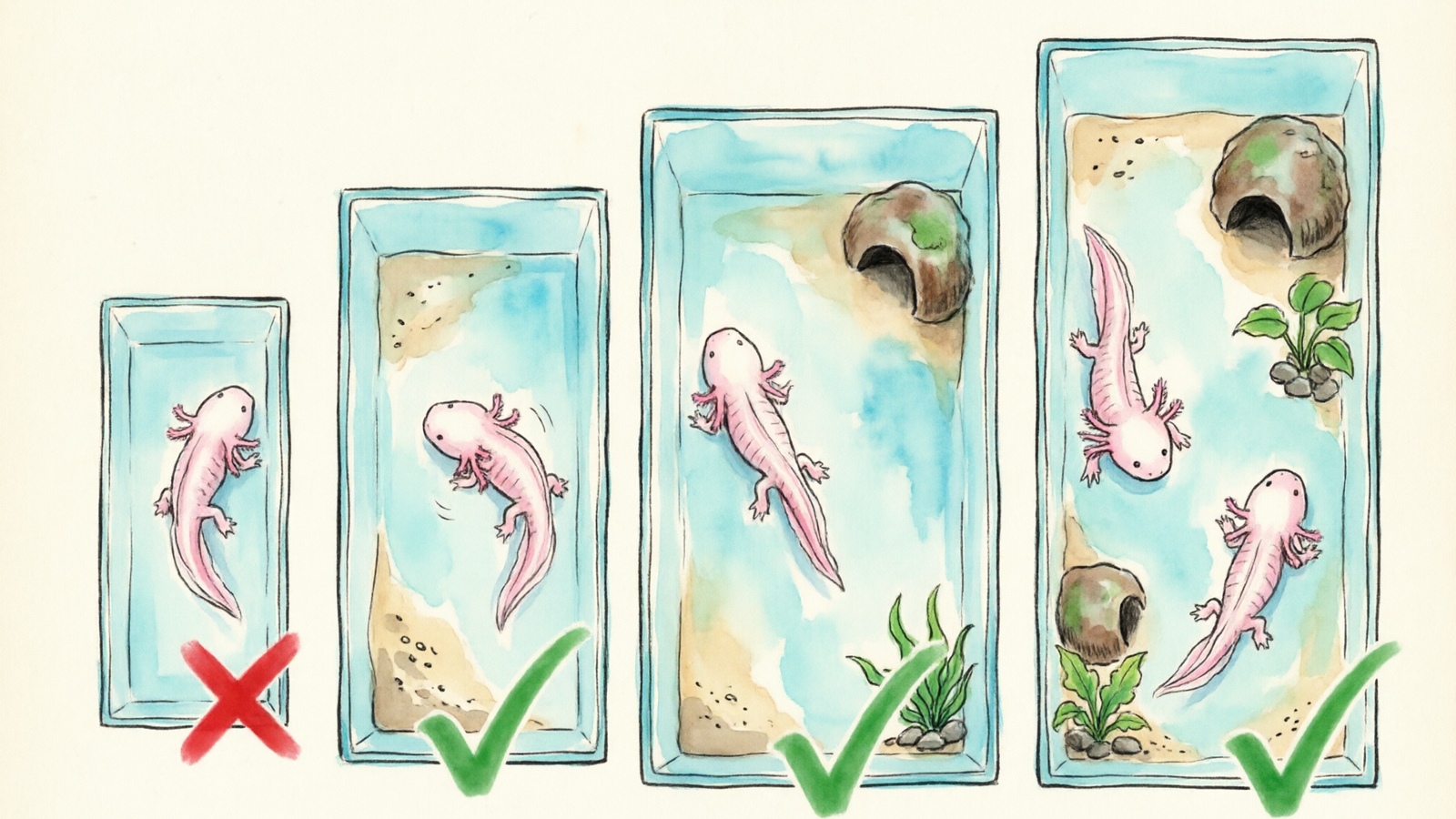
Axolotl size and tank size are directly correlated. Understanding how big do axolotls get helps you choose the right enclosure from the start. A tank that’s too small restricts both physical growth and long-term health.
| Tank Size | Axolotls | Suitability | Notes |
|---|---|---|---|
| 10 gallon | 0 | Never | Too small, stunts growth |
| 20 gallon (long) | 1 | Minimum | Floor space matters more than height |
| 29 gallon | 1–2 | Recommended | Good balance of space and maintenance |
| 40+ gallon | 2–3 | Ideal | Best for adults, easier water quality |
Key principle: floor space over height. Axolotls are bottom-dwellers that spend 95% of their time on the substrate.
A 20-gallon long tank (30” × 12” footprint) is far better than a 20-gallon tall tank (24” × 12” × 16” height) because it provides more swimming distance.
Juvenile housing: Axolotls under 4 inches can temporarily live in a 10-gallon tank, but you must upgrade to at least 20 gallons by 4–6 months.
Keeping a sub-adult in a 10-gallon tank is the most common cause of stunted growth.
For detailed tank recommendations, see our best axolotl tank guide. To maximize usable space inside the tank, see our guide to axolotl tank decor.
Product Recommendations
Here are some products mentioned in this guide:
Frequently Asked Questions About Axolotl Size
Can axolotls live in a 10-gallon tank? No. While juveniles under 4 inches can temporarily live in a 10-gallon tank, adults require at minimum a 20-gallon long tank.
A 10-gallon tank restricts movement and can stunt growth. Plan to upgrade by 4–6 months of age.
If you’re wondering how big do axolotls get in a 10 gallon tank, the answer is: they won’t reach full size. Axolotls kept in 10-gallon tanks typically plateau at 6–7 inches — 2–3 inches below their genetic potential.
Do female axolotls get bigger than males? Females tend to be slightly longer (by 1–2 inches) and noticeably wider and heavier than males.
However, the length difference is subtle and not always reliable for sexing. Females average 9–10 inches while males average 8–9 inches.
How big is a 6-month-old axolotl? A healthy 6-month-old axolotl typically measures 6–7 inches (15–18 cm) and weighs approximately 40–60 grams. At this stage they are sub-adults and still growing, though at a slower rate than juveniles.
What affects axolotl growth rate the most? Water temperature and diet quality have the greatest impact.
Keep temperature between 60–68°F (15–20°C) and feed a high-protein diet of earthworms, bloodworms, and quality pellets. Avoid warm water (>72°F) which slows metabolism and reduces appetite.
How long does it take for an axolotl to reach full size? Most axolotls reach their full adult size (8–10 inches) by 12–18 months of age.
They reach sexual maturity earlier at 6–12 months. Growth continues very slowly after 2 years but is negligible.