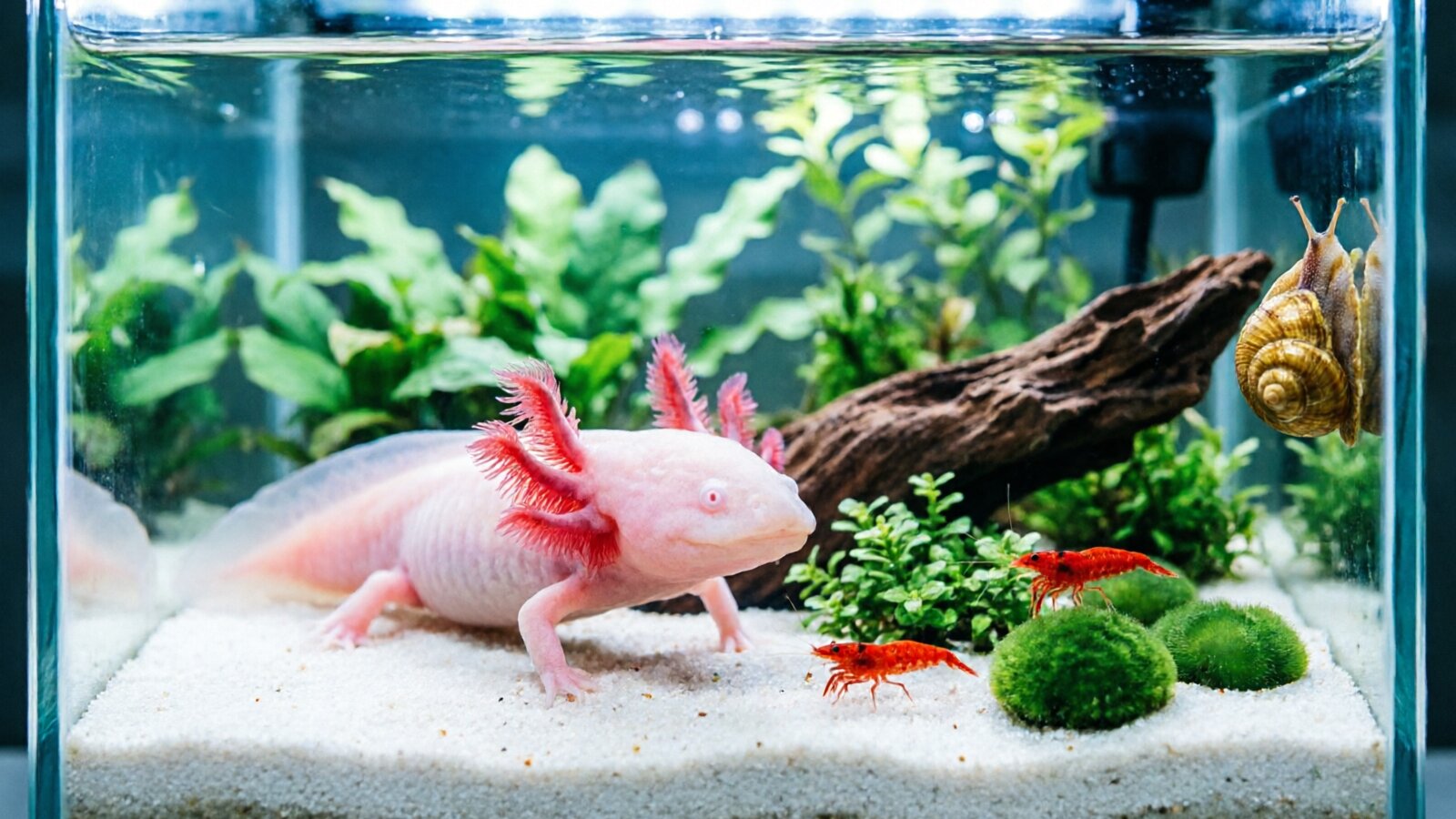
Your axolotl looks lonely in that big 40-gallon tank — but here’s the truth: axolotls don’t get lonely. They’re solitary ambush predators that spend most of their time sitting at the bottom, waiting for food to wander by. They don’t need companions.
That said, many axolotl owners (myself included) still want a more active, visually interesting tank. The problem? Most “axolotl tank mates” guides get it dangerously wrong by recommending fish that will stress, injure, or even kill your axolotl.
Axolotls have poor eyesight and snap at anything that moves — and their feathery external gills look like wriggling worms to curious fish. The wrong tank mate can cost your axolotl its gills, its health, or its life.
This guide covers the genuinely safe options (shrimp, snails, moss balls), the risky-but-possible choices (white cloud minnows), the species you must never mix with axolotls, and how to set up a community tank if you decide to try. Everything here is based on professional breeder advice and experienced keeper consensus — not generic pet store suggestions.
For foundational axolotl care information, see our complete axolotl care guide.
Why Most Fish Make Terrible Axolotl Tank Mates
Before we get to what works, you need to understand why so few species are compatible with axolotls. Professional breeders at Axolotl Planet put it bluntly: most tank mates are a bad idea, and here’s the biology behind that.
Ambush predator instincts. Axolotls have terrible eyesight. They detect food by movement and suction-feed anything that fits in their mouth. A small fish swimming past triggers the same feeding response as a bloodworm.
External gills look like worms. Those beautiful feathery gills sticking out from your axolotl’s head? To many fish, they look like a buffet. Nipping at gills causes tearing, infections, and permanent damage.
Fish bones cause impaction. If your axolotl swallows a fish, the bones can cause a life-threatening intestinal blockage called impaction. This is one of the most common causes of death in axolotls kept with fish.
Disease transmission. Pet store fish often carry parasites and bacteria that can devastate an axolotl. Amphibians have permeable skin that makes them especially vulnerable to fish-borne pathogens.
Temperature incompatibility. Axolotls need cold water (60-68°F / 16-20°C). Most popular aquarium fish are tropical and need 72°F or warmer. Keeping an axolotl at tropical temperatures suppresses its immune system and leads to stress, fungal infections, and early death.
Any tank mate candidate must pass these four rules:
- Must tolerate cold water (60-68°F / 16-20°C)
- Must be too large to be eaten — or expendable, like shrimp
- Must not nip at gills or suck on the axolotl’s slime coat
- Must not produce excessive waste that degrades water quality
Very few species check all four boxes. Let’s look at the ones that do.
Safe Axolotl Tank Mates (The Short List)
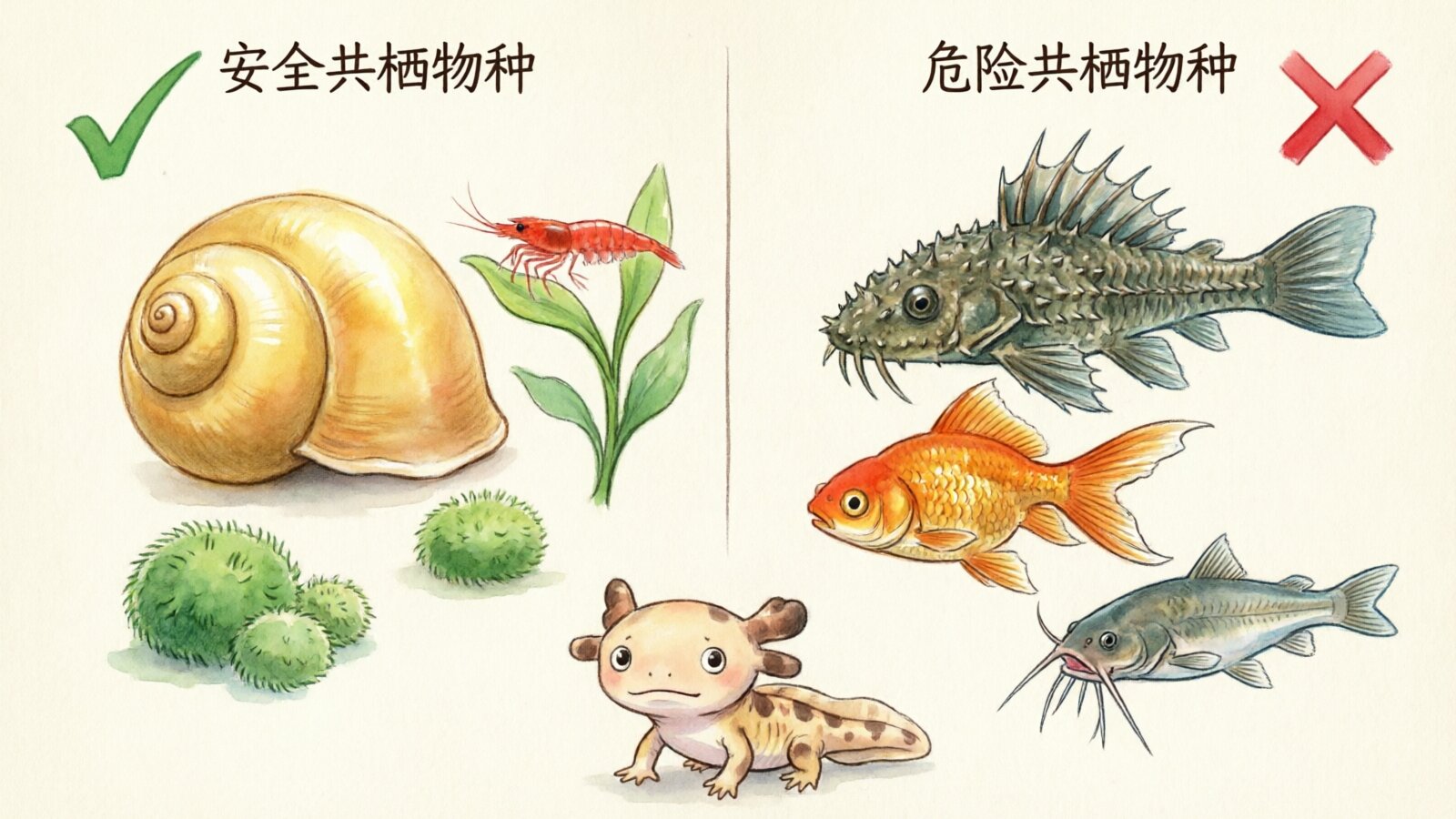
The number of genuinely safe axolotl tank mates is surprisingly small. Here’s the complete list, ranked by safety:
| Species | Safety | Gets Eaten? | Harms Axolotl? | Temp Range | Our Verdict |
|---|
| Ghost Shrimp | Safe | Yes (snack) | No | 65-80°F | Best clean-up crew — treat as expendable | | Cherry Shrimp | Safe | Yes (snack) | No | 65-80°F | Colorful + cleans — colony may sustain itself | | Mystery Snails (>1.5”) | Safe | No (too big) | No | 68-82°F | Best permanent tank mate — too big to eat | | Marimo Moss Balls | Safe | No | No | Any temp | Zero-risk “tank mate” — absorbs nitrates | | Other Axolotls (same size) | Warning: Moderate | No | Can nip gills | Same | Natural but needs 40+ gal + monitoring |
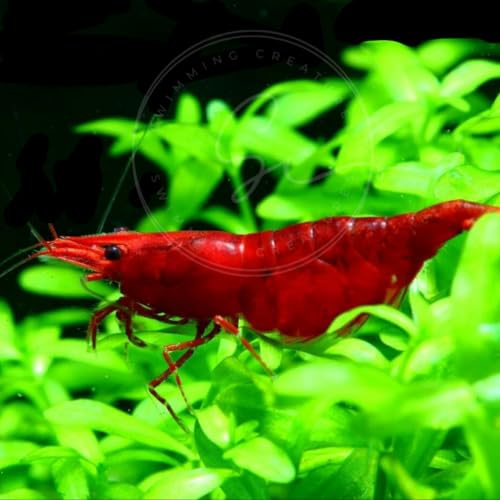
Cherry Shrimp (Neocaridina davidi)
Cherry shrimp are one of the most popular axolotl tank mates, and for good reason. They’re harmless to axolotls, they eat leftover food and algae, and they tolerate the cool water temperatures axolotls prefer.
The catch? Your axolotl will eat them. Not might — will. Think of cherry shrimp as self-replenishing snacks that also clean your tank. Adult shrimp are fast enough to escape most of the time, and if you provide plenty of hiding spots with live plants and Java moss, a breeding colony can sustain itself despite occasional losses.
Starting with at least 10 adults is recommended to establish a viable colony.
The Swimming Creatures 10 Premium Fire Red Shrimp (around $37) are a solid choice — they’re adult breeding-size (0.75-1 inch), arrive alive with a guarantee, and often include a couple bonus shrimp.
Mystery Snails (Pomacea bridgesii)
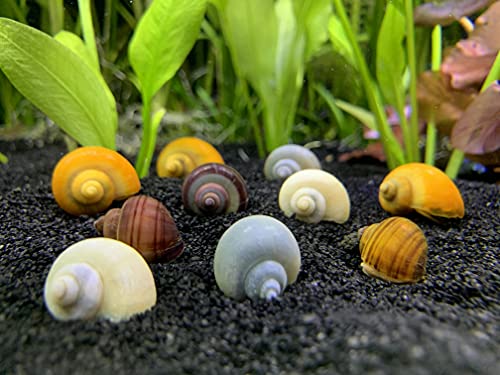
If there’s a single “best” axolotl tank mate, this is it. Mystery snails grow to golf-ball size — far too large for any axolotl to swallow. They’re peaceful herbivores that won’t compete for your axolotl’s food, won’t harm its slime coat (unlike plecos), and actively clean algae from tank walls and decorations.
The key rule: only add mystery snails with shells larger than 1.5 inches in diameter. Smaller snails can be swallowed whole, and the shell can cause fatal impaction. Once they’re golf-ball sized, they’re essentially invulnerable to your axolotl.
Mystery snails come in gold, blue, ivory, purple, and magenta — they add welcome color to an otherwise monochrome axolotl tank. The Shore Aquatic Mystery Snail 10 Pack (around $50) gives you an assortment of colors plus bonus Java moss.
Marimo Moss Balls
Not technically an “axolotl tank mate,” but marimo moss balls deserve mention as the only zero-risk addition to any axolotl setup. They absorb nitrates, provide surface area for beneficial bacteria, and some axolotls enjoy resting on them or pushing them around.
Your axolotl cannot harm them, and they cannot harm your axolotl. Add as many as you like.
Other Axolotls
Keeping multiple axolotls together is the most “natural” axolotl tank mates option, but it comes with caveats. Axolotls housed together must be the same size — a size difference of more than 1 inch means the larger one may try to eat the smaller one. They should also ideally be the same sex to prevent accidental breeding (which produces hundreds of eggs you’ll need to care for).
Even same-size axolotls occasionally nip at each other’s gills, especially during feeding. You’ll need a minimum 40-gallon tank for two axolotls, and you should monitor them closely during the first few weeks. For more on housing requirements, see our guide to the best axolotl tanks.
Risky Tank Mates: Can Work but Proceed With Caution
These species show up on many “axolotl tank mates” lists, but experienced keepers disagree about their safety. I’d only recommend trying these if you’re an experienced aquarist willing to monitor closely and remove the fish at the first sign of trouble.
White Cloud Mountain Minnows
These are the most commonly recommended fish tank mate for axolotls, and for understandable reasons: they prefer cool water (64-72°F), they’re fast swimmers, and they stay small (about 1.5 inches). In theory, they can work.
In practice, the risks are real. Your axolotl will catch one eventually — probably when it’s resting near the bottom at night. One swallowed minnow means fish bones in your axolotl’s digestive tract and a potential impaction emergency. Pet store minnows also carry disease risk.
The community is split: Reddit and Caudata forum veterans generally say avoid. Some experienced keepers report success with quarantined, breeder-sourced fish. If you try it, quarantine for at least 2-4 weeks first and watch your axolotl like a hawk.
Zebra Danios
Zebra danios are active schooling fish that tolerate cooler water and are fast enough to avoid most predation attempts. The downside is that their constant rapid swimming can stress some axolotls, and they have a reputation for occasional fin nipping. I’d rank these as slightly riskier than white cloud minnows.
Guppies and Other Livebearers
Guppies may work at the warmer end of the axolotl temperature range (65-68°F), and they reproduce quickly enough to sustain a colony despite losses. But they’ll likely become lunch one by one, they carry the standard pet store disease risk, and they multiply far faster than your axolotl can eat them — you may end up with a guppy population explosion.
Dangerous Tank Mates — NEVER Keep These With Axolotls
This section could save your axolotl’s life. The following species are commonly (and dangerously) recommended as axolotl tank mates by outdated or uninformed sources. Do not put any of these in your axolotl tank.
| Species | Why It’s Dangerous | Risk Level |
|---|
| Plecostomus | Latches onto axolotl body, eats slime coat and skin — can cause fatal wounds. Barbed spines cause internal injury if swallowed | Warning: EXTREME | | Goldfish | Heavy waste producers, parasite carriers, spiny fin rays cause injury if ingested, compete for space and food | Warning: HIGH | | Betta Fish | Aggressive, will attack axolotl gills, requires tropical temps (76-82°F) — temperature incompatible | Warning: HIGH | | Cichlids | Aggressive and territorial, will attack axolotl, completely incompatible temperature range | Warning: HIGH | | Crayfish & Crabs | Pincers can severely injure or kill axolotl. Predatory instinct, especially at night when axolotls are most active | Warning: EXTREME | | African Dwarf Frogs | Transmit chytrid fungus and amphibian diseases, warmer water requirements, compete for food and floor space | Warning: HIGH | | Dojo Loaches | Grow to 12 inches, massive waste production degrades water quality fast. Some guides recommend these — I strongly disagree | 🟡 MODERATE | | Any Tropical Fish | Temperature stress suppresses axolotl immune function, making them vulnerable to infections | Warning: HIGH |
Let me call out the most common dangerous recommendations:
Plecos are the worst possible choice. Multiple documented cases show plecos latching onto axolotls overnight, eating through the slime coat and into the skin underneath. The wounds get infected, and the axolotl often doesn’t survive. Despite this, plecos still appear on some “compatible species” lists because they’re also bottom-dwellers.
Goldfish seem like a natural match since both species are cold-water, but they’re actually one of the worst combinations. Goldfish produce enormous amounts of waste (far more than axolotls), they carry parasites that can transfer to your axolotl, and their spiny fin rays can cause internal injuries if swallowed.
Dojo loaches are recommended by at least one prominent axolotl website, but this is poor advice. They grow to 12 inches, produce massive waste, and will outcompete your axolotl for food while degrading the water quality both species depend on.
How to Set Up a Community Tank for Axolotls
If you’ve decided to add axolotl tank mates to your aquarium, the setup matters as much as the species choice. Here’s a step-by-step approach that minimizes risk.
Step 1: Choose the Right Tank Size
A single axolotl needs a minimum 20-gallon tank. If you’re adding any tank mates beyond snails and shrimp, you need at least 40 gallons — preferably 55 gallons or larger.
More water volume means more dilution of waste and more swimming room to reduce encounters. For help choosing the right setup, see our guide to the best axolotl tanks.
Step 2: Upgrade Your Filtration
Community tanks have a higher bio-load than species-only setups. Your filter needs to handle the combined waste of your axolotl plus all its tank mates. Use a canister filter rated for 1.5 to 2 times your actual tank volume. A filter rated for 40 gallons on a 20-gallon tank is the bare minimum. For filter recommendations, see our best axolotl filter guide.
Step 3: Add Hiding Spots
This is critical. Shrimp, snails, and any fish need escape routes from your axolotl. Dense live plants (Java fern, Anubias, Java moss), PVC pipes, ceramic caves, and driftwood all provide cover. More hiding spots means fewer predation events and less stress for everyone. See our axolotl tank decor guide for setup ideas.
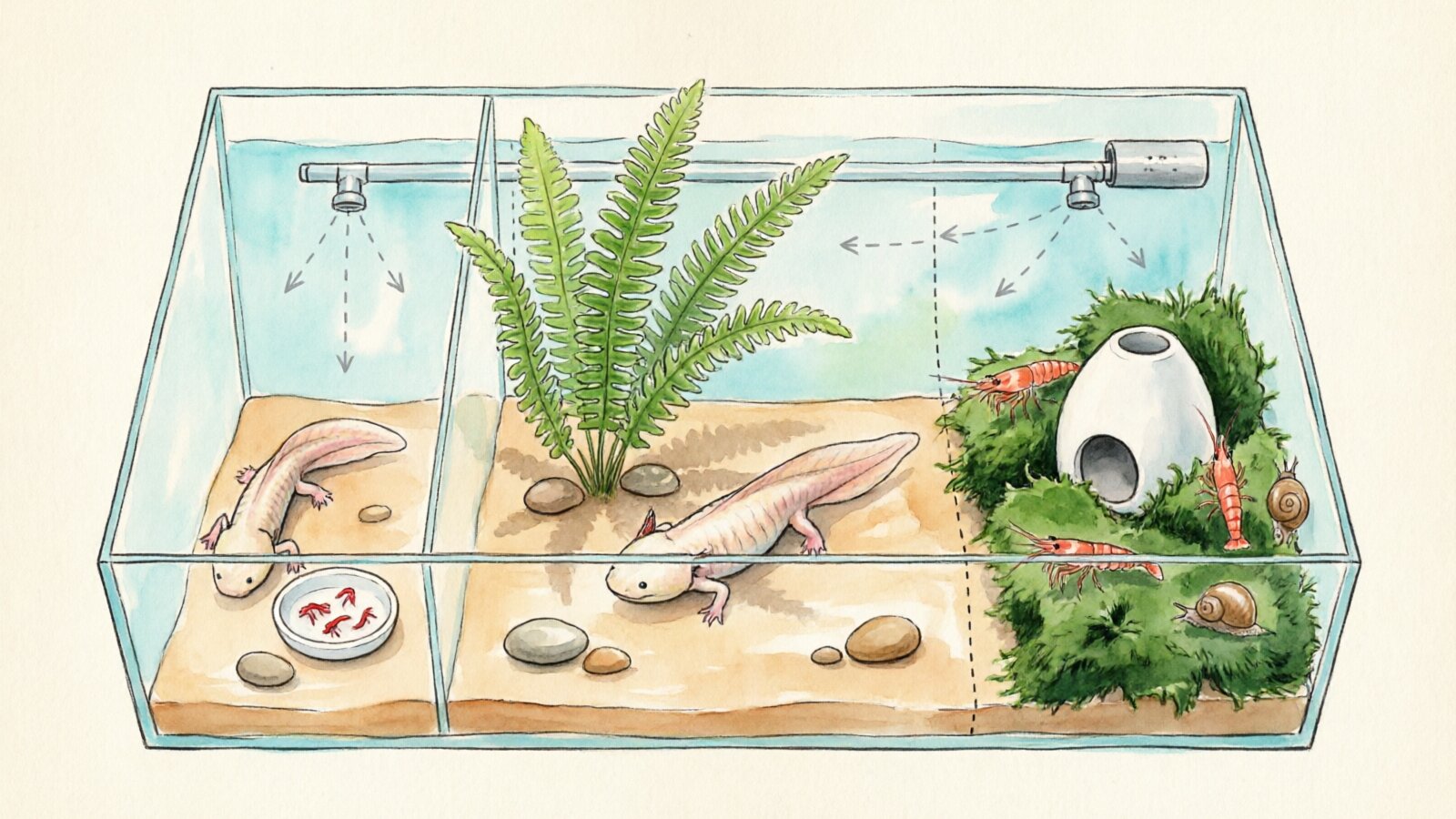
Step 4: Consider a Tank Divider
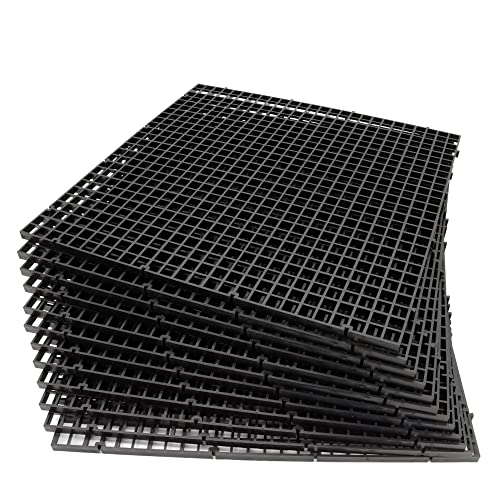
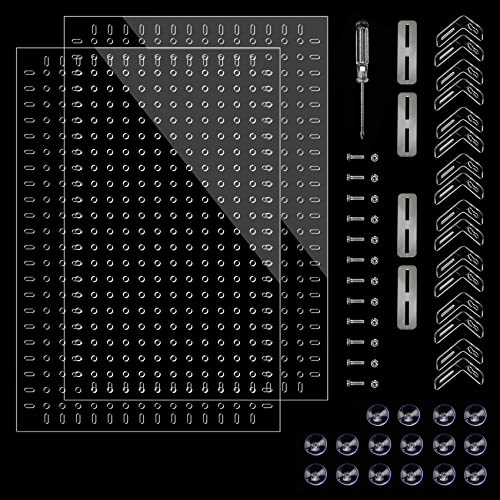
A tank divider lets you separate your axolotl from tank mates during the introduction period, or permanently house incompatible species in the same tank. This is especially useful if you want to try white cloud minnows but aren’t sure how your axolotl will react.
For a budget option, the ALEGI 12 Pcs Aquarium Fish Tank Divider (around $20) uses egg-crate panels you can cut and snap together to fit any tank shape. It’s functional but not the most attractive.
For a cleaner look, the LYL LEYOULAND Clear Acrylic Fish Tank Divider (around $44) is nearly invisible in the tank with 92% light transmittance. It comes with suction cups and clips for easy installation. The main downside is that small shrimp can pass through the 0.2-inch aperture holes.
Step 5: Match the Temperature
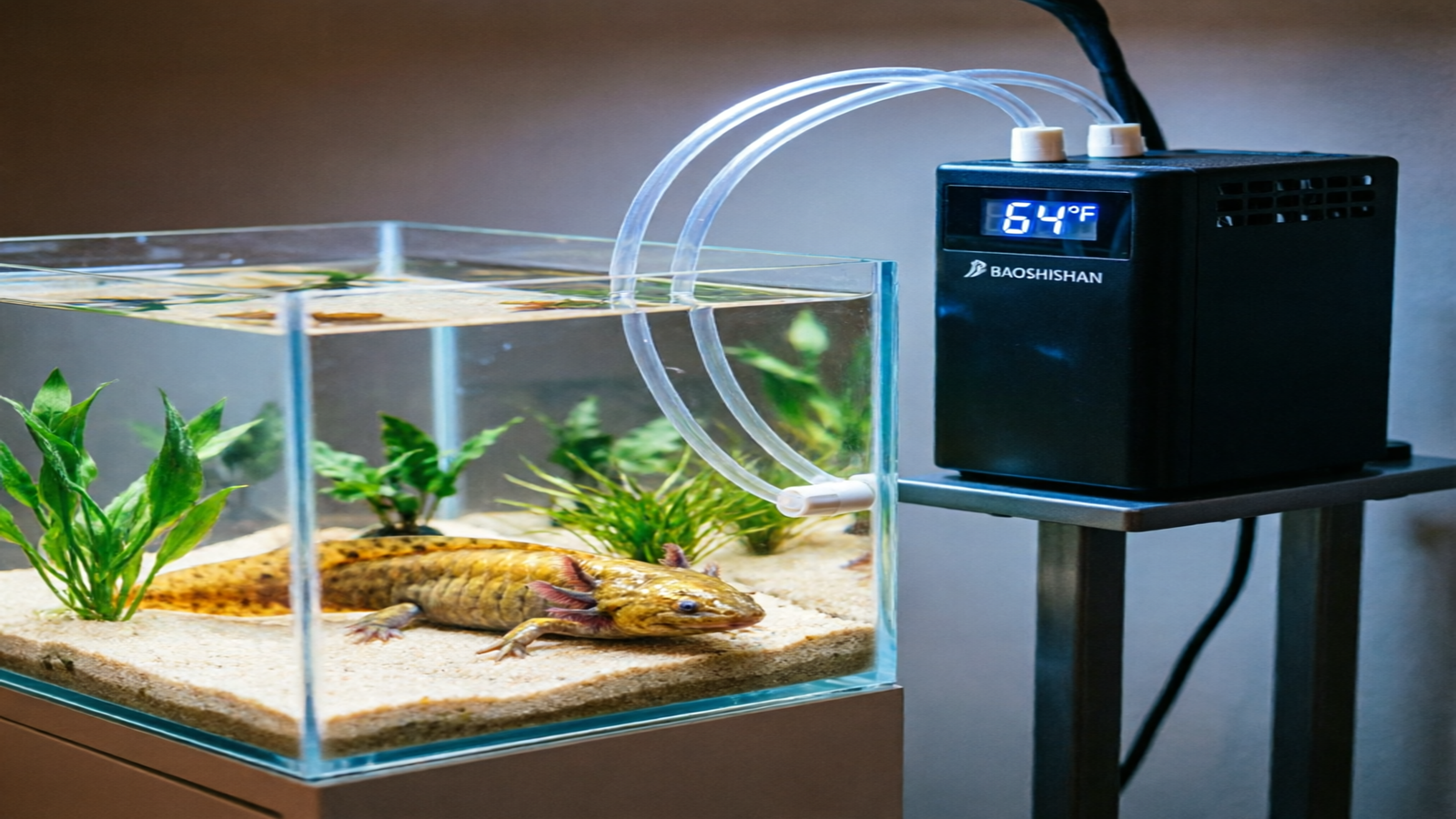
For a community tank, you’ll need a compromise temperature. 64-68°F (18-20°C) is the sweet spot — warm enough for cold-water species like white cloud minnows, cool enough to keep your axolotl healthy. Never exceed 70°F. For temperature management tips, see our axolotl tank temperature guide.
Step 6: Quarantine Everything First
Never add new animals directly to your axolotl tank. Quarantine all new arrivals in a separate tank for at least 2-4 weeks. Watch for disease, parasites, and unusual behavior. This is non-negotiable — a single sick fish from the pet store can wipe out your axolotl. Treat the quarantine tank with aquarium salt if you see any signs of illness, and only transfer healthy animals to the main display.
Signs Your Axolotl Is Stressed by a Tank Mate
Even with the safest axolotl tank mates, things can go wrong. Watch for these warning signs:
| Sign | What It Means | What to Do |
|---|
| Curled gill filaments | Early stress — gills curl forward and flatten against the head | Check water parameters first, then observe tank mate interactions | | Loss of appetite | Refusing food for 3+ days is abnormal | Remove tank mate immediately | | Frantic swimming | Darting, hitting walls, trying to escape | Extreme stress — remove tank mate now | | Visible injuries | Nipped gills, bite marks, torn tail tip | Separate animals, treat wounds with methylene blue baths | | Excessive hiding | Never emerges, even at feeding time | Tank mate may be aggressive or intimidating — remove it |
If you notice any of these signs, remove the tank mate first and check your water parameters second. The tank mate is almost always the trigger. For related reading, see our guides on why your axolotl might be floating and why your axolotl may not be eating — both can be caused by tank mate stress.
Frequently Asked Questions
Can axolotls live with fish?
Most fish cannot live with axolotls safely. Axolotls need cold water (60-68°F) while most aquarium fish are tropical and require 72°F or warmer. Fish may nip at axolotl gills, and if an axolotl swallows a small fish, the bones can cause dangerous impaction. White cloud mountain minnows are the only fish occasionally kept with axolotls, but even they carry disease risk and may be eaten.
What is the best tank mate for an axolotl?
Mystery snails (Pomacea bridgesii) with shells over 1.5 inches in diameter are the safest permanent tank mate for axolotls. They grow too large to be eaten, they’re peaceful herbivores that won’t harm your axolotl, and they help keep the tank clean by eating algae. Cherry shrimp are also safe but should be considered expendable since axolotls will hunt them.
Can axolotls live with shrimp?
Yes, ghost shrimp and cherry shrimp are safe to keep with axolotls. They won’t harm your axolotl and actively help clean the tank by eating leftover food and algae. The trade-off is that your axolotl will likely hunt and eat them over time. With plenty of live plants and hiding spots, a cherry shrimp colony can sustain itself through breeding despite losses.
Can axolotls live with snails?
Large mystery snails with shell diameters over 1.5 inches are safe and actually excellent tank mates for axolotls. They’re too big to be swallowed, peaceful, and helpful algae cleaners. Avoid small snails or snail species that can fit in your axolotl’s mouth — swallowed snail shells cause life-threatening impaction.
Can axolotls live with goldfish?
No, absolutely not. Despite both being cold-water species, goldfish are one of the worst possible tank mates for axolotls. They produce enormous amounts of waste that degrades water quality, they carry parasites that can infect your axolotl, and their spiny fin rays cause internal injuries if swallowed. This combination fails reliably enough that it cannot be recommended.
Can axolotls live with betta fish?
No. Betta fish are aggressive and territorial, and they require warm tropical water (76-82°F) that would be fatal to an axolotl long-term. Even at a compromise temperature, a betta will attack your axolotl’s feathery external gills — which look like a worm to them — causing serious injury and infection risk. These two species are completely incompatible.