Choosing the best axolotl filter starts with understanding why. Axolotls absorb water directly through their skin and gills — they literally live inside their filtration system. The wrong filter means ammonia burns, fungal infections, and chronic stress.
The catch: axolotls need still or barely moving water. A filter that’s too powerful is more harmful than helpful. Finding the balance between filtration power and gentle flow is the single most important decision in axolotl husbandry.
I’ve compared eight filters across three types — sponge, hang-on-back (HOB), and canister — to find the best option for every tank size and budget. This guide covers filter size matching, flow reduction techniques, and the most common mistakes new axolotl owners make.
For the full picture on axolotl husbandry, see our axolotl care guide.
Quick Answer: The 3 Best Axolotl Filters
| Pick | Product | Type | Price | Best For |
|---|---|---|---|---|
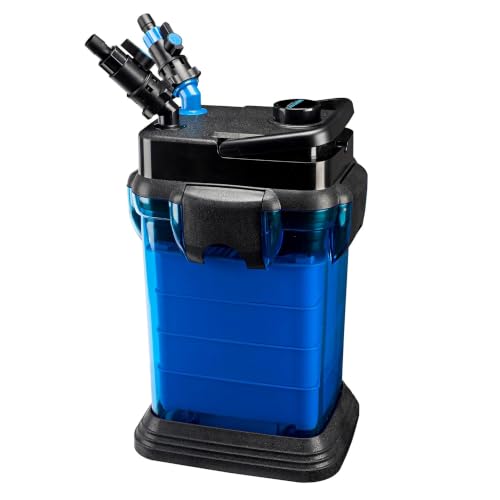
| Best Overall | Fluval 307 Canister{target=“_blank” rel=“noopener noreferrer”} | Canister | $159.99 | 40-70 gal tanks, adjustable flow |
| Best Budget | AQUANEAT Bio Sponge{target=“_blank” rel=“noopener noreferrer”} | Sponge | $12.99 | Any tank, zero current |
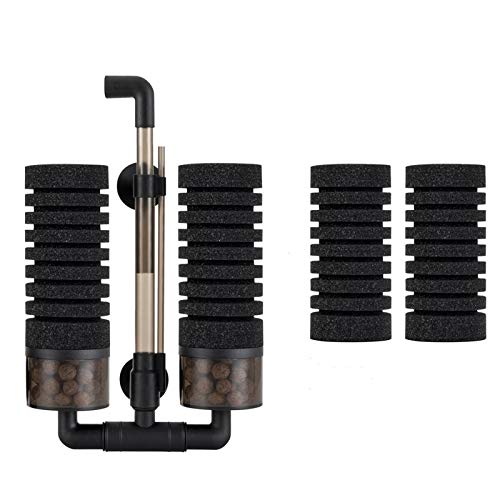
| Quietest | hygger Double Sponge{target=“_blank” rel=“noopener noreferrer”} | Sponge | $15.99 | Bedroom tanks, silent operation |
Why Axolotls Need a Special Filter
Neotenic salamanders retain larval features throughout their entire lives, never undergoing metamorphosis to a terrestrial adult form. Axolotls (Ambystoma mexicanum) are the most well-known neotenic species — they keep their external feathery gills and remain fully aquatic. According to the International Union for Conservation of Nature (IUCN), axolotls are critically endangered in the wild (native only to Lake Xochimilco, Mexico), but are among the most popular aquatic pets worldwide. Because axolotls absorb water and dissolved substances directly through their permeable skin and gill filaments, water quality impacts them more severely than scaled fish — ammonia and nitrite are absorbed into the bloodstream, not just irritating external tissue. The National Institutes of Health (NIH) notes this extraordinary permeability is also what makes axolotls invaluable for regenerative medicine research, but it means filtration must process high bio-loads while keeping water movement minimal, as strong current damages delicate gill structures.
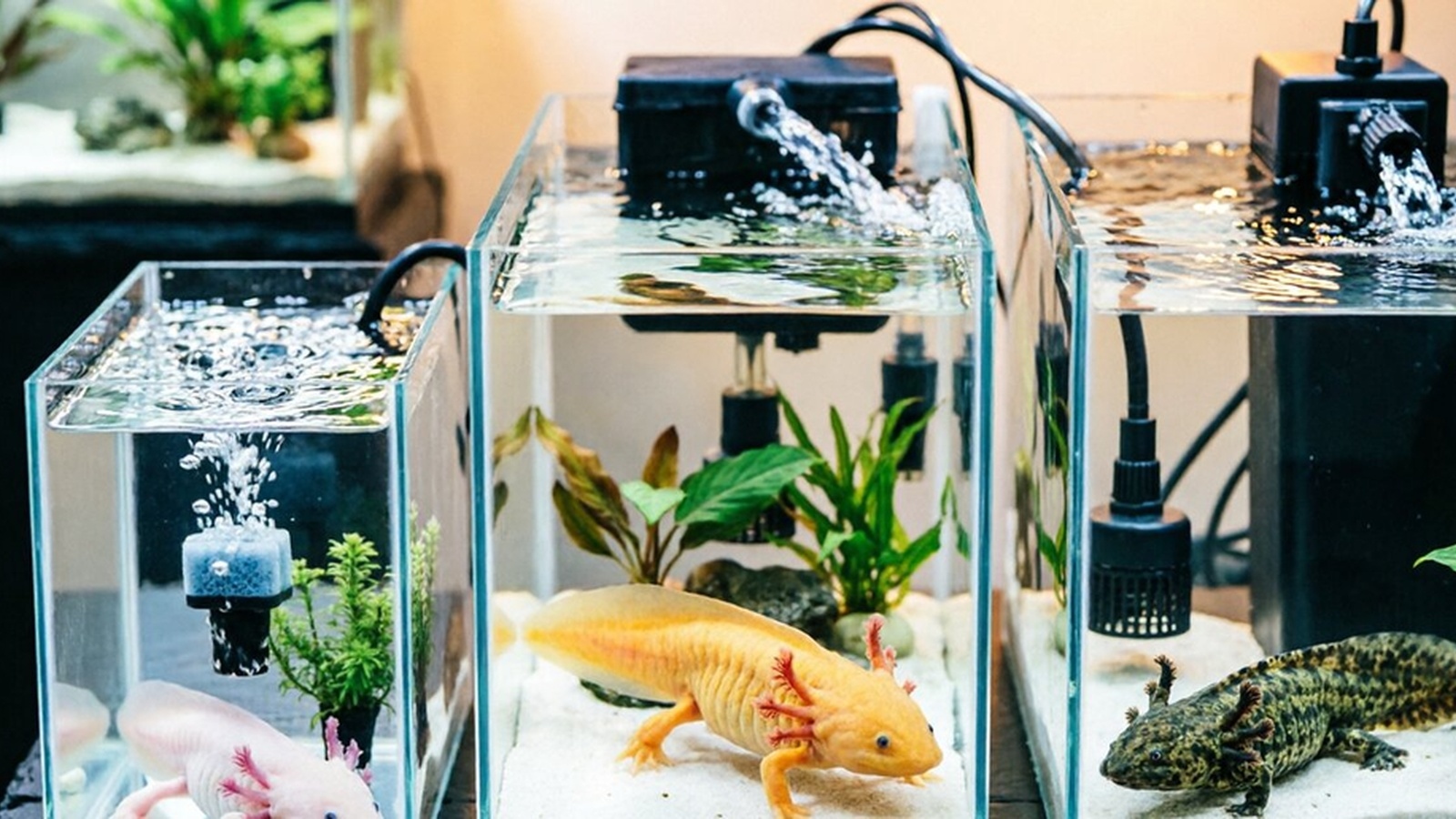
Choosing the best axolotl filter is the most important equipment decision you’ll make for your tank. An axolotl filter is an aquarium filtration system designed to process high ammonia waste — while producing minimal water current, since axolotls are neotenic salamanders that absorb water and oxygen directly through their skin and feathery external gills.
Axolotls produce significantly more waste than most aquarium fish of comparable size. Their high-protein diet generates heavy ammonia loads. Because axolotls absorb water through their skin, poor quality doesn’t just stress them — it enters their body directly.
Without the best axolotl filter for your tank size, ammonia spikes burn gills and skin, gill curling appears as the first stress sign, and fungal infections take hold when immunity drops.
Standard fish filters create their own problem — they’re rarely the right choice for axolotls. Most produce too much water flow, which are adapted to still, cool lake environments. A filter blasting current at full GPH will cause your axolotl to hide, stop eating, and develop curled gills within days.
The target: processing 5 times the tank volume per hour, delivered with minimal water movement. Temperature also affects the beneficial bacteria in your filter — see our axolotl tank temperature guide for the full picture.
Sponge vs HOB vs Canister: Which Filter Type?
Each filter type has distinct advantages — and the right choice depends on your tank size, budget, and maintenance preferences. Here’s how they compare:
| Feature | Sponge Filter | HOB Filter | Canister Filter |
|---|---|---|---|
| How it works | Air pump pushes water through foam | Water pumped over back via impeller | Pressurized external canister with media trays |
| Water flow | Zero current (air-driven) | Adjustable via dial | Adjustable via valve |
| Filtration stages | Biological only | Mechanical + chemical + bio | Mechanical + chemical + bio |
| Best tank size | 10-40 gallons | 20-75 gallons | 20-100+ gallons |
| Noise | Near-silent (air pump hum) | Moderate (waterfall sound) | Quiet (motor hum) |
| Maintenance | Squeeze in tank water every 2 weeks | Replace cartridge monthly | Clean media every 6 weeks |
| Price range | $7-20 | $25-70 | $80-160 |
| Axolotl safety rating | Safest — no moving parts | Safe if flow is reduced | Safe if flow is reduced |
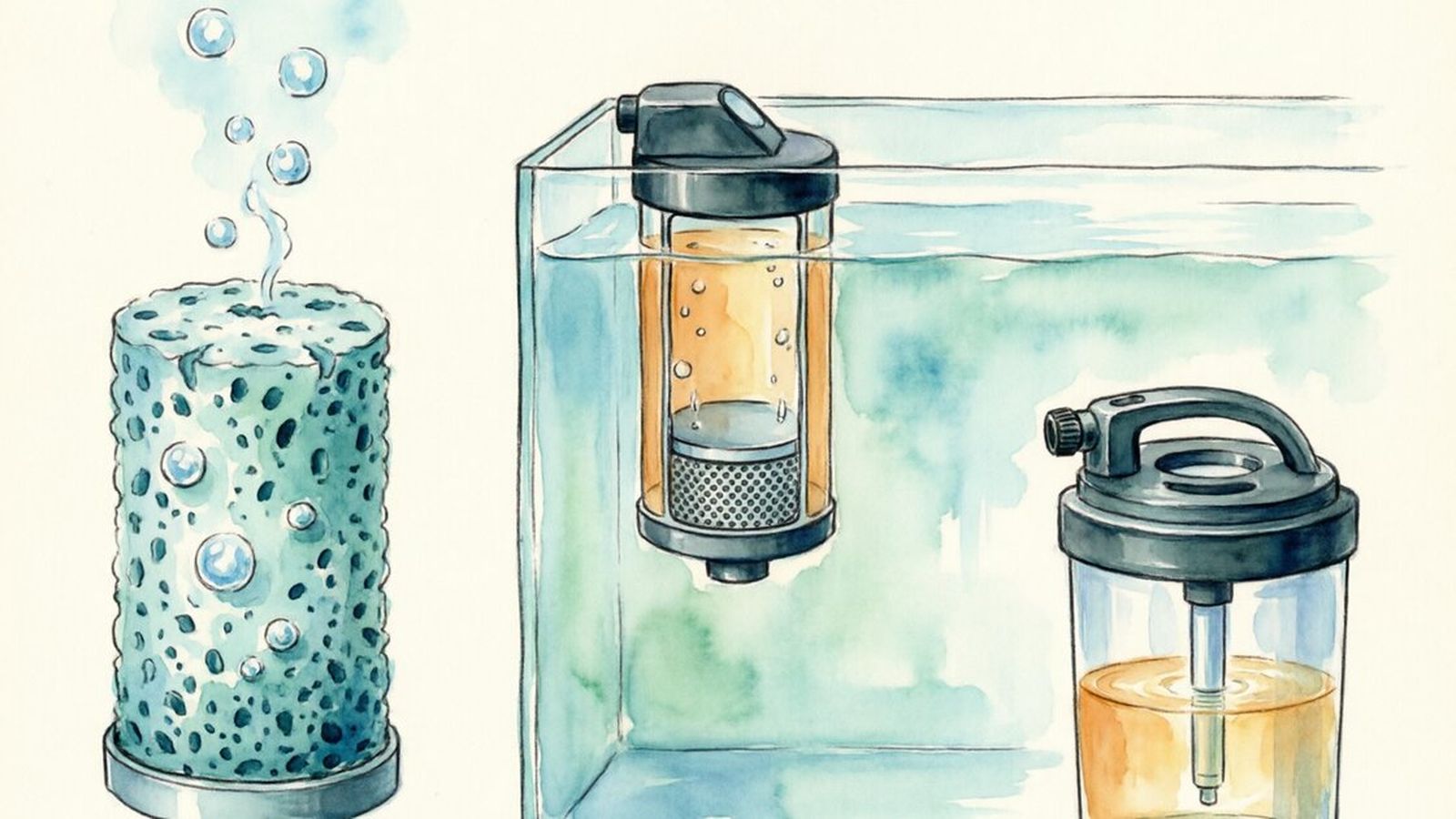
Sponge filters are the safest option for axolotls because they produce zero water current. They provide biological filtration only. They won’t remove debris or discoloration.
An axolotl sponge filter is ideal for juvenile tanks under 30 gallons, or as supplementary bio-filtration alongside a canister in larger setups.
HOB filters provide all three filtration stages and are easier to maintain than canisters. Choose an HOB with adjustable flow. The AquaClear and Seachem Tidal lines are the best options because they use customizable media baskets instead of proprietary cartridges.
Canister filters provide the most powerful filtration and are the gold standard for adult axolotl tanks 40 gallons and above. You must use the flow valve, spray bar, or aim the output at the tank wall to diffuse current.
What to avoid: Under-gravel and substrate filters. Axolotls swallow small gravel, which causes fatal intestinal impaction.
The 8 Best Axolotl Filters Reviewed
Sponge Filters
| Product | Tank Size | Price | Best For |
|---|---|---|---|
| hygger Double Sponge{target=“_blank” rel=“noopener noreferrer”} | Up to 55 gal | $15.99 | Double filtration with spare sponges |
| AQUANEAT Bio Sponge Large{target=“_blank” rel=“noopener noreferrer”} | Up to 60 gal | $12.99 | Most reviewed sponge, under $13 |
hygger Double Sponge — One of the best axolotl filter options for budget setups. The double-sponge design provides twice the surface area for beneficial bacteria compared to single-sponge filters. Based on thousands of verified owner reviews, owners appreciate the included spare sponges — you can swap one out for cleaning without losing your bio-colony.
The air-driven design produces zero measurable water current, making it completely safe for axolotls of any size. Setup requires a separate air pump (not included).
I’ve found that running the air pump at its lowest setting works best for axolotls. This provides gentle biological filtration without disturbing your axolotl or creating surface turbulence.
AQUANEAT Bio Sponge Large — The top budget pick for small tanks. With the most verified reviews of any sponge filter on Amazon, the AQUANEAT is the budget champion. The weighted base keeps it firmly planted, keeping it firmly on the tank floor, even with active axolotls bulldozing around it.
The large cylinder design provides adequate surface area for biological filtration in tanks up to 60 gallons. The sponge material is thinner than premium options, which means less bio-media capacity per cubic inch. At $12.99, it’s the cheapest reliable entry point into axolotl filtration.
HOB Filters
| Product | Tank Size | GPH | Price | Best For |
|---|---|---|---|---|
| Tetra Whisper IQ 20{target=“_blank” rel=“noopener noreferrer”} | 20 gal | 130 | $29.99 | Small tanks, most reviewed |
| AquaClear 70{target=“_blank” rel=“noopener noreferrer”} | 40-70 gal | 300 | $54.99 | Medium-large tanks, custom media |
| Seachem Tidal 75{target=“_blank” rel=“noopener noreferrer”} | Up to 75 gal | 350 | $69.82 | Premium HOB with skimmer |
Tetra Whisper IQ 20 — The most widely reviewed aquarium filter on the market. The adjustable flow dial lets you reduce output for axolotl-safe current levels in small tanks.
The proprietary cartridge system is the main drawback — you’re locked into Tetra’s replacement cartridges. The filter also gets loud when water drops below the output. For axolotl tanks, keep the water level high. I’d recommend this for small tanks (10-20 gallons) where a canister would be overkill.
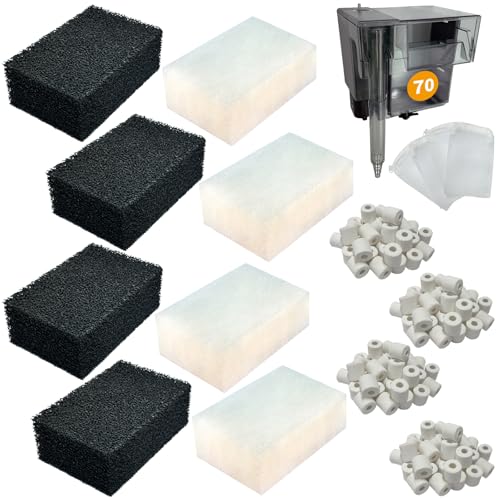
AquaClear 70 — The AquaClear line has been a trusted HOB filter for decades. The refillable media basket is the biggest advantage — pack it with ceramic rings, filter sponge, and bio-media of your choice. No proprietary cartridges.
The adjustable flow slider on the intake lets you dial down the current significantly. At 300 GPH with adjustable flow, this is the best HOB option for 40 to 70-gallon axolotl tanks.
The lid rattle is a known issue. Based on thousands of verified owner reviews, roughly 25 percent report vibration noise. A small piece of foam under the lid resolves it. The AquaClear also won’t fit rimmed tanks over 29 gallons — check your tank rim before purchasing.
Seachem Tidal 75 — The premium HOB option. Two features set it apart: a built-in surface skimmer that removes protein film from the water surface, and a filter clog indicator that alerts you when maintenance is needed.
The included Seachem Matrix bio-media is genuinely high quality — porous volcanic rock with massive surface area for beneficial bacteria.
In my experience, the Sicce-made pump in the Tidal is more reliable than the motors in competing HOB filters. The trade-off: like all HOB filters, it gets loud when the water level drops.
Canister Filters
| Product | Tank Size | GPH | Price | Best For |
|---|---|---|---|---|
| Fluval 207{target=“_blank” rel=“noopener noreferrer”} | Up to 45 gal | 206 | $168.42 | Mid-size tanks, instant prime |
| Fluval 307{target=“_blank” rel=“noopener noreferrer”} | Up to 70 gal | 303 | $159.99 | Best overall, large tanks |
| Penn-Plax Cascade 1200{target=“_blank” rel=“noopener noreferrer”} | Up to 150 gal | 315 | $199.84 | Best budget canister |
The Fluval 207 handles tanks up to 45 gallons with 206 GPH of 3-stage filtration. The instant-prime system is a genuine improvement — press the button once and the canister fills and starts automatically.
The flow adjustment valve lets you reduce output to axolotl-safe levels. Attach the included spray bar and aim it at the back wall for the gentlest flow pattern.
The known issue with the Fluval 07 series: motor head reliability. Some units require motor head replacement within the first year. Buy from a retailer with a strong return policy.
The Fluval 307 is our top overall pick. At 303 GPH, it handles 40 to 70-gallon axolotl tanks with power to spare. The extra headroom means you can run the flow valve at 50 to 60 percent and still get excellent filtration — ideal for axolotls.
It shares the same instant-prime system, adjustable flow, and 3-stage media trays as the 207. The only difference is higher flow capacity. For most setups needing an axolotl canister filter, the 307 is the right choice.
The same motor head reliability concern applies. Buy from an authorized retailer.
At $199.84, the Cascade 1200 is the best value canister on the market — and one of the best axolotl filter choices for tanks over 70 gallons. Based on thousands of verified owner reviews, some units have run for over 13 years.
The 360-degree rotating valve makes positioning input and output tubes easy. It ships with filter pads, bio-sponge, and activated carbon included — no extra media purchase needed.
The trade-off versus Fluval: more reported water bypass, and Penn-Plax customer service has a mixed reputation. For budget-conscious keepers with large tanks, the Cascade 1200 is still a strong value option.
For help choosing the right tank to pair with these filters, see our best axolotl tanks guide.
Best Axolotl Filter Size by Tank
Use this chart to find the right GPH rating for your specific tank.
Finding the best filter for axolotl tank setups starts with tank size and your axolotl’s life stage:
| Tank Size | Axolotl Stage | Min GPH | Recommended Filter | Backup Option |
|---|---|---|---|---|
| 10-20 gal | Juvenile | 100 | AQUANEAT Sponge + Tetra Whisper IQ 20 | hygger Double Sponge |
| 20-40 gal | Sub-adult | 200 | Fluval 207 Canister | AquaClear 70 HOB |
| 40-70 gal | Adult (single) | 300 | Fluval 307 Canister | Seachem Tidal 75 HOB |
| 70-100 gal | Multiple adults | 350 | Penn-Plax Cascade 1200 | Dual sponge + HOB combo |
The Reddit community consensus for axolotl filtration: get a filter rated for twice your tank size. Axolotls produce 2 to 3 times more waste, so your filter must handle heavy bio-loads than comparable-sized fish. Oversizing the filter gives you headroom.
GPH rule of thumb: Divide your filter’s GPH by 5. If the result equals or exceeds your tank size, the filter is sufficient. Example: Fluval 307 = 303 GPH ÷ 5 = 60.6 gallons — perfect for a 55 to 60-gallon tank.
Oversizing is always fine because you can reduce flow. Undersizing leads to ammonia spikes, which are dangerous for axolotls.
For the complete setup beyond filtration, see our axolotl tank setup guide.
How to Reduce Filter Flow for Axolotls
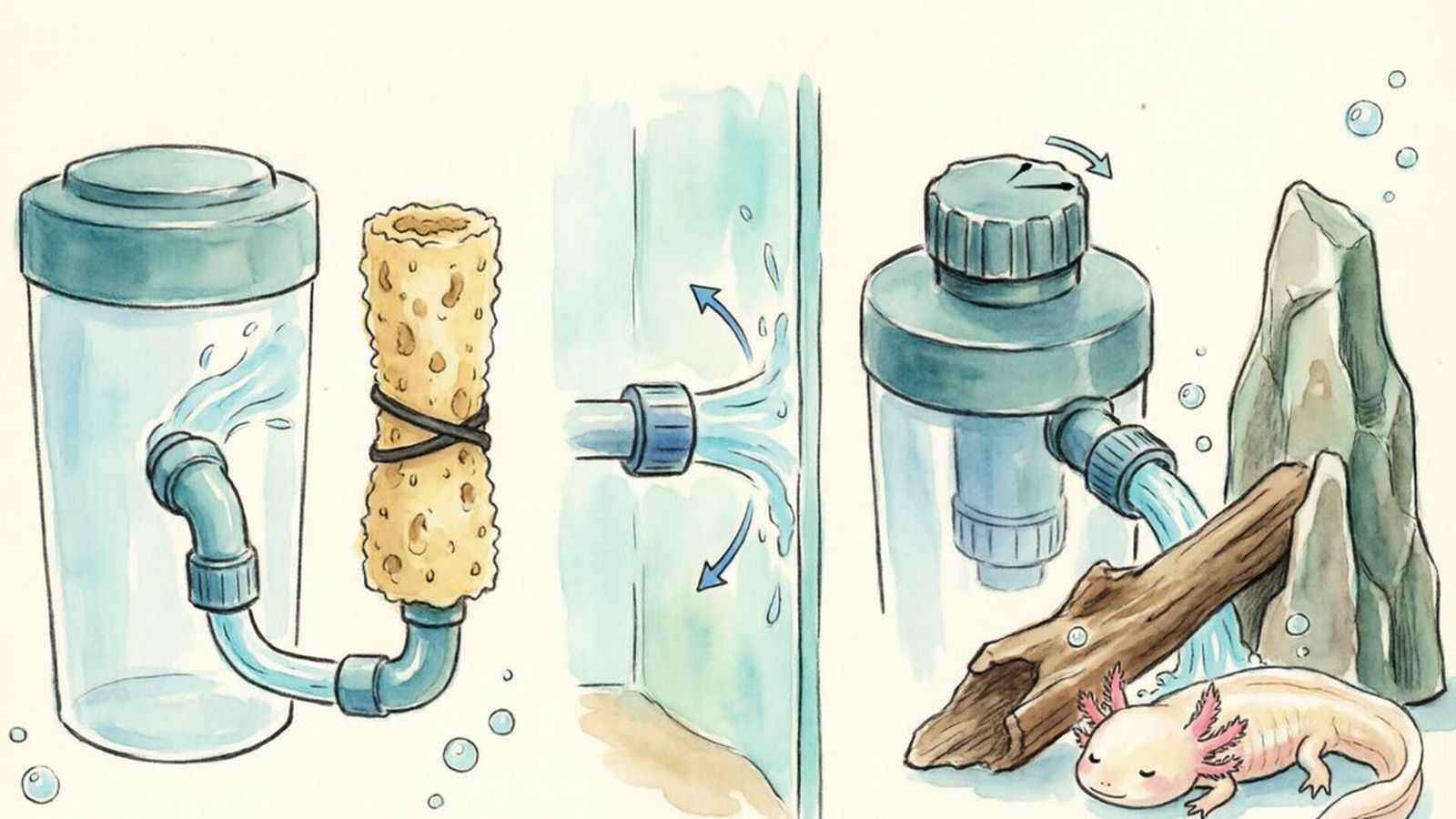
Even the best axolotl filter can create problems if the flow rate is too high for your axolotl. Here are five proven methods to fix it.
Step 1: Attach a spray bar (best for canister filters — the preferred type for large tanks). The spray bar diffuses the output across a wide area instead of a single concentrated stream.
Aim it at the back wall of the tank for the gentlest possible flow.
Step 2: Add a sponge baffle. Rubber-band a piece of filter sponge over the HOB or canister output.
This reduces water velocity while maintaining the same GPH through the filter media.
Step 3: Aim the output at the wall. Point the filter return directly at the glass. The water energy dissipates against the wall — a quick trick before reaching your axolotl.
Step 4: Adjust the flow valve. Most canister filters (Fluval, Cascade) have a dial on top. Start at 50 percent and observe your axolotl’s behavior over 24 hours.
Step 5: Use hardscape as a flow break. Place tall rocks, driftwood, or dense plants between the filter output and your axolotl’s preferred resting spot.
These natural baffles look great and protect your axolotl from direct current.
How to tell if the flow is still too strong: your axolotl is being pushed around, constantly hides behind objects, refuses food, or has curled gills. Any of these signs mean you need to reduce the flow further.
Finding the right balance means these five flow-reduction techniques until your axolotl is calm and comfortable — the axolotl filter flow rate is now appropriate.
For hiding spot ideas that double as flow breaks, see our axolotl tank decor guide.
Common Mistakes When Choosing the Best Axolotl Filter
Using a filter that’s too small. Even a top-rated filter won’t work if undersized. Axolotls produce 2 to 3 times more waste than similar-sized fish. Always choose a filter rated for 1.5 to 2 times your tank volume.
Running the filter at full power. A canister or HOB at full GPH will stress your axolotl. Always reduce flow with a valve, spray bar, or baffle.
Replacing all filter media at once. This kills your filter’s beneficial bacteria colony and crashes the nitrogen cycle. Replace media in rotation — never all at once.
Using under-gravel filters. Axolotls swallow gravel, causing intestinal impaction. These filters require gravel — a dangerous combination.
Cleaning sponge media with tap water. Chlorine kills beneficial bacteria on contact. Always squeeze sponges in tank water only.
Axolotl filter checklist:
- Filter rated for 1.5–2× tank volume — handles heavy bio-load
- Flow rate keeps axolotl calm — no pushing, hiding, or gill curl
- Pre-filter sponge on intake — prevents axolotl from being sucked in
- Spray bar or baffle on output — diffuses water current
- GPH turns tank volume 5× per hour — adequate biological filtration
- Clean media in tank water only — preserves beneficial bacteria
- Cycle tank before adding axolotl — ammonia and nitrite must read zero
- Never use under-gravel filters — axolotls swallow gravel → impaction
- Never replace all media at once — crashes nitrogen cycle
- Never clean media in tap water — chlorine kills bacteria
- Never use filters without flow adjustment — axolotls need still water
Best Axolotl Filter FAQ
Should axolotls have a filter?
Yes, axolotls absolutely need a filter. They produce high ammonia waste from their protein-rich diet, and since they absorb water through their skin and gills, poor water quality directly harms them. A filter provides the biological filtration that converts toxic ammonia into safer nitrate. Without one, you would need 50 percent or larger daily water changes.
Can a filter be too strong for an axolotl?
Yes. Axolotls are lake-dwelling animals adapted to still water. A strong current causes stress, appetite loss, and gill curling.
Signs of too much flow: being pushed around, constant hiding, and food refusal. Reduce flow immediately using a spray bar, flow valve, or sponge baffle.
What is the best filter for an axolotl tank?
For most adult axolotl tanks (40-70 gallons), a canister filter like the Fluval 307 is the best choice. It provides powerful 3-stage filtration with adjustable flow. For juvenile tanks under 20 gallons, a sponge filter like the AQUANEAT Bio Sponge provides gentle biological filtration for under $15.
Do axolotls need a canister filter or sponge filter?
Adult axolotls in tanks 40 gallons or larger need a canister or HOB filter because sponge filters alone cannot handle the bio-load. Sponge filters work well for juveniles, small tanks, or as supplementary bio-filtration alongside a canister filter.
What size filter do I need for my axolotl tank?
Divide your filter’s GPH by 5 — if the result equals or exceeds your tank size, the filter is sufficient. For a 40-gallon tank, you need at least 200 GPH. Always choose a filter rated for 1.5 to 2 times your tank volume because axolotls produce more waste than typical aquarium fish.
How do I reduce filter flow for my axolotl?
Use a spray bar on canister filters, add a sponge baffle over the output, aim the return at the tank wall, or adjust the flow valve to 50 percent. Observe your axolotl — if it stops hiding and resumes normal activity, the flow is acceptable.