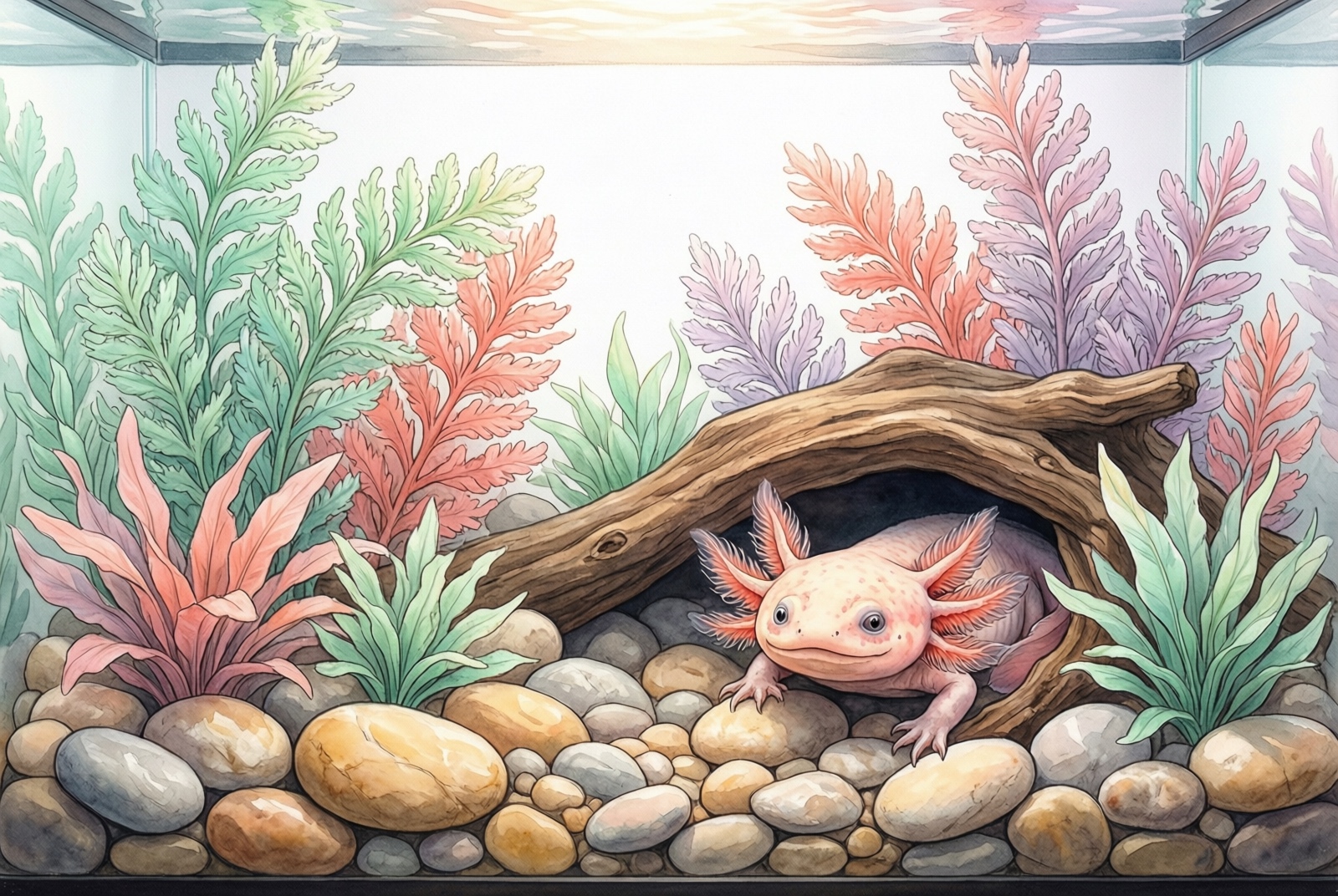
Best Axolotl Tank Decor 2026: Safe Hides & Plants

by
Best Axolotl Tank Decor 2026: Safe Hides & Plants

Setting up an axolotl tank for the first time, I remember staring at a bare 20-gallon long and thinking, “Now what?” The filtration and substrate were sorted, but the tank looked sterile—empty glass, sand, and water. Axolotls need more than clean water to thrive. In the wild, Ambystoma mexicanum lives along the lake bottom of Xochimilco, navigating between rocks, vegetation, and submerged roots. Replicating that environment isn’t just aesthetic—it reduces stress, encourages natural foraging behavior, and gives your axolotl places to feel secure during daylight hours when they’d normally be hidden.

The challenge is that axolotls have uniquely delicate anatomy. Their external gill filaments catch on rough surfaces. Their permeable skin absorbs toxins directly from the water column. They’re bottom-walkers, not swimmers, which means every decoration on the tank floor is in constant contact with their bodies. Sharp edges, chemical residues, and small swallowable parts aren’t just annoyances—they’re genuine health hazards. I’ve tested and researched dozens of tank decorations specifically for axolotl safety, and narrowed the field to seven options that meet the standard: smooth, non-toxic, easy to clean, and actually useful for enrichment.

For a complete walkthrough of tank setup basics—including filtration, substrate, and cycling—our axolotl tank setup guide covers everything before you start decorating.

Quick Comparison: 7 Best Axolotl Tank Decorations

Overview of axolotl tank decoration categories: hides, plants, driftwood, and fun ornaments

#ProductTypePriceRatingBest For
1JIHAQUA Corner HideHide$17.994.6⭐ (1,731)Best Hide
2JIHAQUA Rock HideHide$16.994.3⭐ (474)Best Rock Hide
3Ameliade Cherry BlossomPlants$9.994.6⭐ (3,193)Best Plants
4PietyPet 10pcs PlantsPlants$8.994.5⭐ (3,753)Best Budget Plants
5JIH Hollow Tree TrunkOrnament$8.994.3⭐ (1,240)Best Hollow Ornament
6majoywoo Cholla DriftwoodDriftwood$22.994.2⭐ (8,042)Best Driftwood
7Aquarium Groot BubblerFun Decor$11.994.5⭐ (2,890)Best Fun Decor

A few things to keep in mind regardless of which decorations you choose: always run your fingers over every surface before placing anything in the tank—sharp edges are the single most common safety issue across all seven products I evaluated. Soak new resin ornaments in dechlorinated water for at least 48 hours to leach any residual manufacturing chemicals. And never use decorations with parts smaller than your axolotl’s mouth, since they’re opportunistic feeders that will attempt to eat anything they can fit between their jaws.

Best Axolotl Tank Hides

Hides aren’t optional accessories—they’re essential for axolotl health. In their natural habitat, axolotls spend daylight hours tucked under rocks, inside submerged roots, or buried in soft substrate. Without hiding spots, they become chronically stressed, which suppresses appetite and weakens immune function. I’ve seen stressed axolotls refuse food for days after being moved to a bare tank, only to resume normal feeding within hours of adding a suitable hide.

A good axolotl hide needs four things: smooth resin with no sharp edges (their gills tear easily on rough surfaces), multiple entrances so they don’t feel trapped, a stable base that won’t tip when they push against it, and enough interior space for the axolotl to turn around. I’d also recommend placing two hides in your tank—one in a cooler area and one closer to any warmth source—so your axolotl can thermoregulate naturally.

Proper hide placement in an axolotl tank showing two hides in different temperature zones

JIHAQUA Corner Hideout (2-Pack)

The JIHAQUA Corner Hide ($17.99, 4.6⭐ with 1,731 reviews) is the hide I’d recommend to most axolotl owners, and the two-pack design is the main reason. One pack gives you both hides you need for proper thermoregulation, and the corner shape fits naturally into rectangular tanks without wasting floor space.

The resin construction is smooth overall, which is critical for axolotl safety. A bearded dragon owner with a 19-inch male confirmed the sturdy build and lack of rough edges, and a ball python keeper noted they’re “extremely easy to clean”—both qualities that translate directly to axolotl use.

However, I need to flag two real concerns. Several reviewers reported sharp spots along the bottom edge and around the opening that needed sanding before use. This is a deal with virtually all mass-produced resin hides, and it’s why I always recommend running fine-grit sandpaper over every new decoration before it goes in the tank. The second issue is fragility—one reviewer’s hide arrived completely shattered, and the resin material doesn’t handle rough shipping well. Check for cracks immediately on delivery.

JIHAQUA Rock Hide Cave

If you prefer a more natural aesthetic over the geometric corner design, the JIHAQUA Rock Hide ($16.99, 4.3⭐ with 474 reviews) offers a realistic stone appearance that blends better with natural aquascaping. At roughly 5-6 inches at the widest point with a roomy opening, it works well for juvenile and average-sized adult axolotls.

A crayfish keeper described it as “nice and roomy and won’t scrape or cut them,” which is exactly what you want to hear for an axolotl hide. The simple solid construction also makes it easy to lift out during weekly tank maintenance—just grab and rinse.

The repeated complaint here is size. Multiple reviewers said the hide is significantly smaller than the product photos suggest, and one owner noted it wouldn’t even fit their baby tortoise. Measure your axolotl’s length and compare against the listed dimensions before ordering. The inside edges can also be sharp on some units—I’d sand the interior surfaces with 220-grit sandpaper before submerging it.

For managing axolotl stress levels and understanding when hiding behavior indicates a health problem versus normal behavior, our axolotl care guide covers behavioral cues in detail.

Best Plants for Axolotl Tanks

Plants serve three distinct purposes in an axolotl tank. They provide visual cover that makes axolotls feel safer while resting in the open, they break up sight lines so multiple axolotls can share a tank without constant confrontation, and they contribute to the overall aesthetic that makes the tank enjoyable to look at. Live plants offer the added benefit of absorbing nitrates, but they require proper substrate and lighting. Artificial plants need zero maintenance beyond an occasional algae scrub.

The critical safety rule for axolotl plants: avoid anything with frayed silk edges that could tangle their gill filaments, and never use plants with exposed metal wire in the stems. Both are genuine injury risks that I’ve seen cause problems in axolotl-specific forums.

Ameliade Cherry Blossom on Branch

The Ameliade Cherry Blossom ($9.99, 4.6⭐ with 3,193 reviews) adds a vibrant pink accent that transforms the visual feel of an axolotl tank. Most aquarium plants lean green or brown—having a cherry blossom branch creates a focal point that draws the eye and makes the setup feel intentional rather than random.

The ceramic base is a genuine advantage over weighted plastic bases I’ve used in the past. It anchors securely in sand substrate without toppling when your axolotl walks past, and there’s no risk of a plastic base cracking and exposing sharp edges. One reviewer noted that the product photos don’t do it justice—the colors and detail are more impressive in person.

I do want to be transparent about the negative reviews. Several fish owners reported torn fins from plastic edges, and one described small holes at the base where tiny fish got stuck. For axolotls specifically, the fin-tearing issue is less concerning since axolotls don’t have delicate fins, but the principle is the same—run your fingers along every surface before adding it to the tank. The small holes at the base aren’t a concern for axolotls either, since their bodies are far too large to get trapped.

PietyPet 10pcs Green Plants

The PietyPet 10-piece plant set ($8.99, 4.5⭐ with 3,753 reviews) is the most economical way to fill an empty tank with greenery. At under $1 per plant, you get enough variety in height and texture to create a layered aquascape across the back and sides of your tank. The product listing specifically mentions axolotl compatibility, which is worth noting—while that doesn’t guarantee safety, it suggests the manufacturer considered axolotl needs during design.

The ceramic bases on each plant anchor well in sand, and the variety of heights lets you position shorter plants in the foreground and taller ones along the back wall. Multiple reviewers praised the vibrant colors and natural-looking variety.

Here’s where I’d urge caution: several reviewers reported a strong chemical smell straight out of the package. This isn’t unusual for mass-produced aquarium decor, but it’s something you must address before adding these to an axolotl tank. I’d recommend rinsing each plant thoroughly under warm water, then soaking them in dechlorinated water for a full 24 hours. If any chemical odor remains after soaking, extend the soak another day or return the set. Axolotls’ permeable skin makes them far more vulnerable to waterborne chemicals than fish.

For substrate and plant placement specifics, our axolotl tank setup guide covers sand depth, plant anchoring techniques, and layout planning.

Best Axolotl Tank Ornaments & Driftwood

Ornaments that double as functional enrichment are my favorite category of tank decor. A hollow tree trunk or a piece of natural driftwood serves as both a visual centerpiece and a practical hiding spot, which means you’re getting two benefits from one decoration. The key difference from dedicated hides is that ornaments are typically more decorative and less standardized—each piece has unique textures, shapes, and potential safety issues.

JIH Hollow Tree Trunk

The JIH Hollow Tree Trunk ($8.99, 4.3⭐ with 1,240 reviews) is one of the most versatile decorations in this price range. The hollow interior functions as a hide, while the realistic bark texture and moss detailing make it an attractive centerpiece. A rainbow shark owner reported it became their fish’s “favorite hideout spot,” and a frog keeper confirmed it’s easy to clean with no defects.

At $8.99, it’s the cheapest dual-purpose option I found. The resin material is non-toxic for aquatic environments, and the design works well in both planted and bare-bottom setups.

The consistent complaint across reviews is size. “Tiny,” “very small,” and “way smaller than I thought” appear repeatedly. This ornament works best for juvenile axolotls or as a secondary hide in a larger tank—don’t expect an adult axolotl to fit comfortably inside. As with the other resin products, some units have sharp edges inside the hollow chamber that need sanding before use. I’d also recommend the standard 48-hour soak in dechlorinated water, as one reviewer reported a persistent chemical smell from what appeared to be a manufacturing defect.

majoywoo Natural Cholla Driftwood

The majoywoo Cholla Wood ($22.99, 4.2⭐ with 8,042 reviews) is the only fully natural decoration on this list, and it brings qualities that manufactured resin simply can’t replicate. Cholla wood is a hollow, porous desert wood that provides climbing surfaces, hiding spots within the tube interior, and a natural tannin release that can slightly lower pH—generally beneficial for axolotls who prefer slightly alkaline water but harmless in moderate amounts.

Boiling and preparing cholla driftwood for safe use in an axolotl tank

With 8,042 reviews, it’s the most-reviewed aquarium wood on Amazon, and the value is solid: five pieces for $22.99 works out to under $5 per piece. Multiple reviewers confirmed that boiling the pieces for 2-3 hours makes them waterlog and sink within 24 hours.

I have to be straightforward about the negative reviews, because some are alarming. Several fish keepers reported deaths after adding this wood to their tanks, with theories ranging from chemical treatment residues to tannin toxicity. One reviewer noted the included instructions incorrectly recommend soaking in salt or baking soda—which is dangerous for freshwater tanks and could leave residual salts that leach back into the water. Another described a slime residue after soaking that they believed was glue, not natural sap.

For axolotl tanks specifically, I’d take a conservative approach: boil each piece for a minimum of 2 hours, discard the water, then soak in fresh dechlorinated water for 48 hours. Test your water parameters (ammonia, nitrite, nitrate, pH) before and after adding the wood. If ammonia or nitrite spikes, remove the wood immediately. The tannins that discolor the water brown are generally harmless to axolotls, but I’d still monitor closely during the first week.

For detailed water parameter management, our axolotl care guide covers acceptable ranges and what to do when readings fall outside them.

Fun & Unique Tank Additions

There’s no biological reason your axolotl’s tank can’t also be something you genuinely enjoy looking at. Fun decorations that serve a functional purpose—like aeration, additional hiding, or visual interest—are perfectly fine additions as long as they meet the same safety standards: smooth edges, non-toxic materials, and a stable base.

Aquarium Groot Bubbler

The Aquarium Groot Bubbler ($11.99, 4.5⭐ with 2,890 reviews) is the decoration I’d pick if you want something that makes people stop and look at your tank. The Groot-style resin character doubles as an air bubbler, so it provides gentle oxygenation while adding genuine personality to the setup.

What surprised me reading through the reviews is how many animals actually use it as a hide. A lobster keeper reported their lobsters “made a home on the inside,” and I can see axolotls doing the same if the interior space is large enough. The air stone creates a gentle bubble stream that provides supplemental aeration—useful if your filter’s surface agitation isn’t sufficient on its own.

Two practical caveats. First, this requires a separate air pump, which isn’t included. Budget an additional $10-20 for a basic pump and airline tubing. Second, it tends to float and tip over—multiple reviewers reported it toppling in their tanks. You’ll need to wedge the base into sand or surround it with heavier decorations to keep it stable. The air stone can also clog over time, so plan to clean or replace it monthly.

For integrating aeration with your filtration system, our axolotl tank setup guide covers filter selection and oxygenation strategies.

Safe vs Unsafe Axolotl Tank Decorations

After testing and researching these seven products, I’ve identified the safety issues that come up repeatedly. The table below summarizes what works and what doesn’t, based on owner reports and veterinary guidance for aquatic amphibians.

Side-by-side comparison of safe and unsafe decorations for axolotl tanks

Safe ✅Unsafe ❌
Smooth resin hides (sanded edges)Sharp rocks or broken ceramics
Artificial plants with ceramic basesSilk plants with frayed edges
Boiled natural cholla woodUnboiled wild-collected wood
Aquarium-safe resin ornamentsPainted decorations (paint chips in water)
Smooth ceramic cavesDecorations with small detachable parts
Large smooth river rocks (no sharp edges)Gravel smaller than axolotl’s head
PVC pipes (sanded cut edges)Glass with sharp edges
Sand or large river stone substrateSmall gravel substrate

Understanding why certain decorations are dangerous helps you evaluate products that aren’t on this list. Axolotls have three characteristics that make them uniquely vulnerable to unsafe decor. Their external gill filaments are feathery and delicate—rough surfaces snag and tear them, which opens pathways for bacterial infection. They’re bottom-walkers rather than swimmers, so everything on the tank floor is in constant physical contact with their skin and underbelly. And their skin is permeable, meaning toxic materials leaching into the water don’t just irritate the surface—they absorb directly into the bloodstream.

The single most common issue I found across all seven products reviewed here is sharp edges from the manufacturing process. Every resin hide, rock cave, and hollow ornament had at least one reviewer reporting sharp spots. This isn’t a quality problem unique to any brand—it’s inherent to mass-produced resin casting. The solution is simple: always sand every new decoration with fine-grit sandpaper before it enters your tank. Two minutes of sanding prevents injuries that can lead to costly vet visits.

Chemical leaching is the second concern. New resin ornaments often carry residues from the manufacturing process—mold release agents, curing chemicals, and packaging materials. I’d recommend soaking any new resin decoration in dechlorinated water for 48 hours minimum. If you can still smell chemicals after 48 hours, keep soaking and change the water daily until the odor dissipates.

Ingestion risk is the third. Axolotls vacuum-feed along the substrate—they suck in sand, food, and anything else small enough to fit in their mouths. Any decoration with parts smaller than your axolotl’s head circumference is a potential blockage hazard. This is why gravel is so dangerous for axolotls—they accidentally swallow it while feeding, and it can cause fatal intestinal impactions. Stick to sand substrate or large river stones too big to swallow.

DIY Decoration Ideas

Not all good decorations come from Amazon. I’ve used several DIY options over the years that cost under $10 total and work just as well as store-bought alternatives. The key principle is the same as evaluating any decoration: smooth, non-toxic, and no small parts.

PVC pipe hides are the simplest and cheapest option. Cut a 3-4 inch diameter PVC pipe to 6-8 inches in length, sand all cut edges until they’re completely smooth, and you have a functional hide for under $5. I’d recommend using schedule 40 PVC—thicker walls make it more stable. Place it on the substrate with both ends open so your axolotl never feels trapped.

Terracotta pot caves look more natural than PVC and cost about $1-3. Buy an unpainted terracotta pot, turn it upside down, and use a drill or hammer to create an entrance hole in the side. Sand the hole edges thoroughly—terracotta chips are sharp and could cut your axolotl’s skin. Soak the pot in dechlorinated water for 24 hours before use.

Large river rocks from a pet store (never collected outdoors—pesticides and parasites) make excellent climbing platforms. Boil them for 30 minutes, let them cool, and place them on your sand substrate. Axolotls enjoy climbing up on smooth rocks to rest, and the elevated position gives them a vantage point.

Plastic container hides are the ultimate budget option. Take a clean food-safe plastic container, cut an entrance hole in one side, and sand every edge smooth. It won’t win any beauty contests, but it functions perfectly as a temporary hide while you’re deciding on permanent decor.

Whatever DIY materials you use, always boil or bleach-soak (followed by thorough dechlorination) before adding them to the tank. Never use treated wood, painted ceramics, metal objects, glass with sharp edges, or anything assembled with glue.

Frequently Asked Questions

What decorations are safe for axolotl tanks?

Safe decorations include smooth resin hides with no sharp edges, artificial plants with ceramic bases, boiled natural cholla wood, and large smooth river rocks. Avoid anything with sharp edges, small detachable parts, or paint that can chip off in water. Always soak new resin ornaments in dechlorinated water for 48 hours before adding them to your tank, and sand any rough spots with fine-grit sandpaper. The JIHAQUA Corner Hide ($17.99) is the safest option I tested, with smooth resin construction and a two-pack design that covers both thermoregulation zones.

Can axolotls have plants in their tank?

Yes—both artificial and live plants work well for axolotls. Artificial plants like the Ameliade Cherry Blossom ($9.99) or PietyPet 10-piece set ($8.99) are the simpler option—no substrate requirements, no lighting needed, and they won’t die. For live plants, java fern, anubias, and marimo moss balls are all safe choices that tolerate the cooler water temperatures axolotls prefer (60-68°F). Avoid plants with sharp leaf edges or metal wire stems that could damage gill filaments.

What do axolotls like in their tank?

Axolotls need at least two hiding spots so they can thermoregulate, smooth sand substrate or a bare bottom, gentle filtration without strong currents, and dim lighting. They spend most of their time walking along the bottom, so floor-level enrichment matters more than tall decorations. Plants provide visual cover that reduces stress, and driftwood creates climbing surfaces they genuinely use. Avoid bright tank lights (axolotls are sensitive to light), strong water flow, and gravel substrate (ingestion risk). The Aquarium Groot Bubbler ($11.99) is a fun addition that also provides gentle aeration, though you’ll need to buy a separate air pump.

Do axolotls need hides?

Absolutely—hides are essential, not optional. Axolotls are nocturnal and typically spend 12 or more hours hiding during daylight. Without adequate hiding spots, they become chronically stressed, which leads to appetite loss, weakened immune response, and increased susceptibility to disease. I’d recommend a minimum of two hides per axolotl: one in the cooler zone of your tank and one in the warmer zone. The JIHAQUA Corner Hide 2-pack ($17.99) covers both needs in one purchase. Avoid hides with only one entrance—axolotls feel trapped in dead-end caves and may refuse to use them.

Can I use rocks in my axolotl tank?

Yes, but only large, smooth rocks that your axolotl can’t swallow. Avoid gravel entirely—axolotls vacuum-feed along the substrate and will accidentally ingest small stones, which can cause fatal intestinal blockages. Use large river stones purchased from a pet store, never collected from outdoors where pesticides and parasites could be present. Boil rocks for 30 minutes before adding them to the tank. If you want a more natural look without the risk of rocks, the majoywoo Cholla Driftwood ($22.99) provides a natural aesthetic with soft, splinter-free wood that axolotls can climb on safely—just be sure to boil it thoroughly and monitor your water parameters during the first week.

Written by

Last updated: April 6, 2026