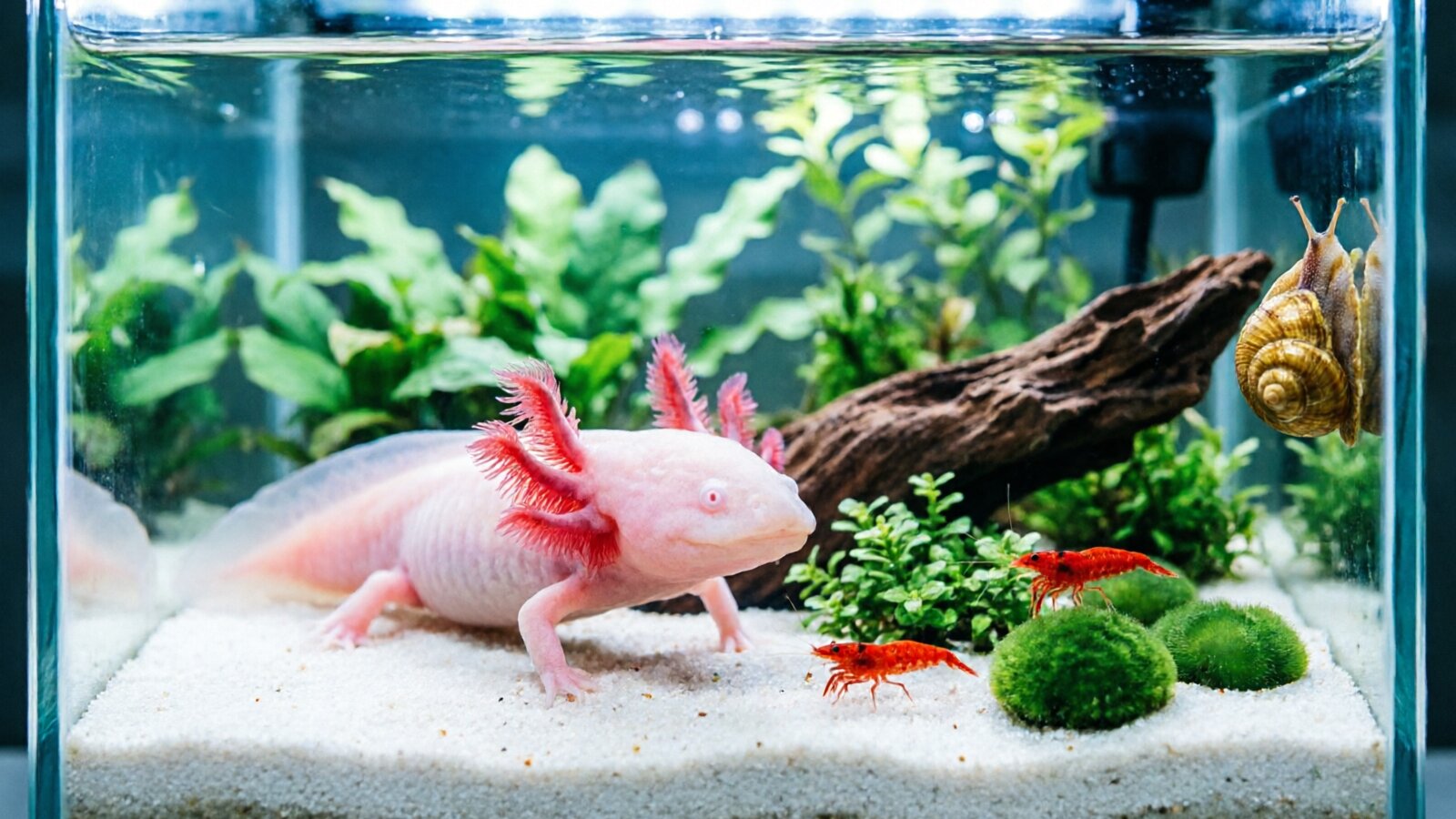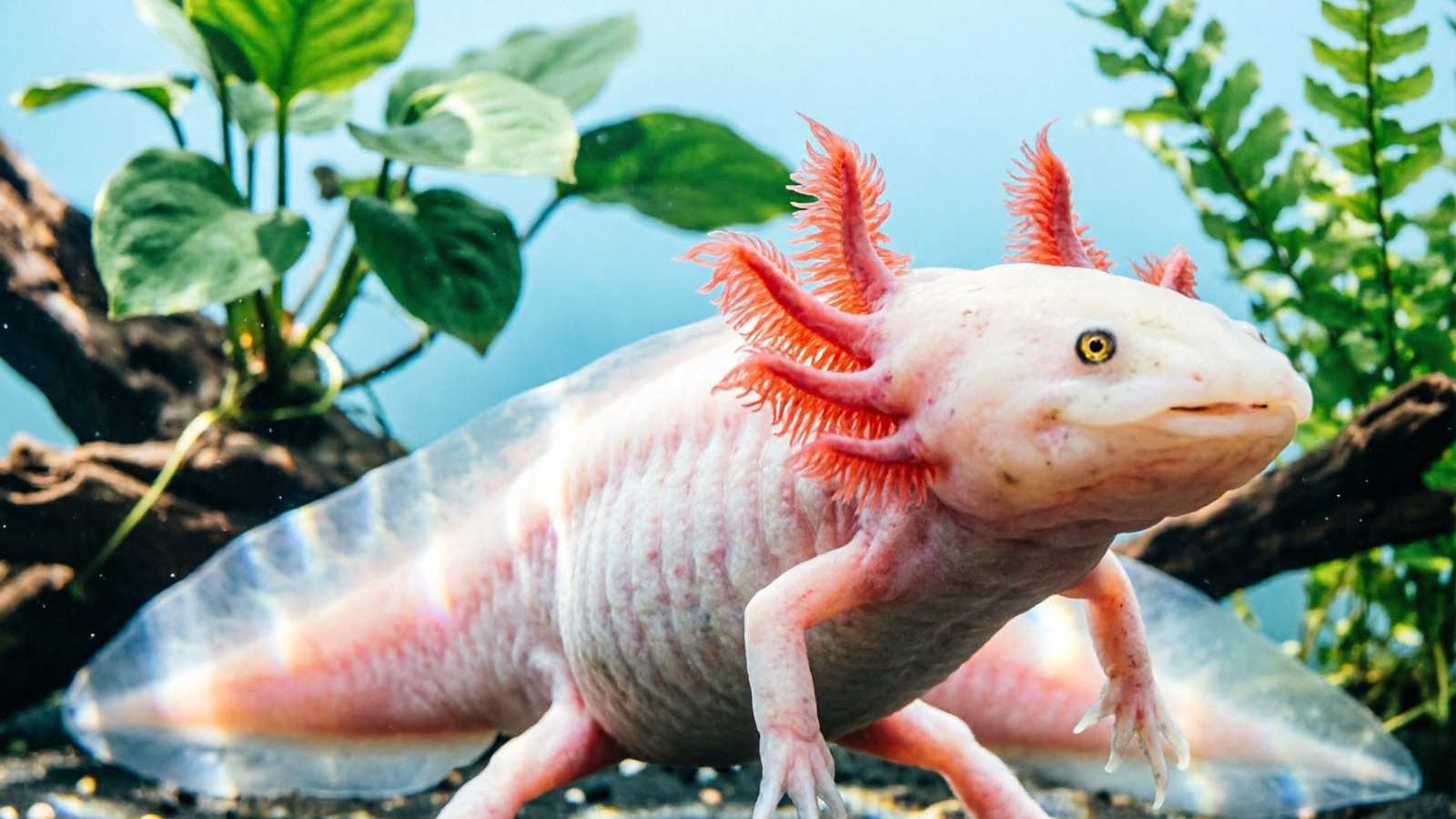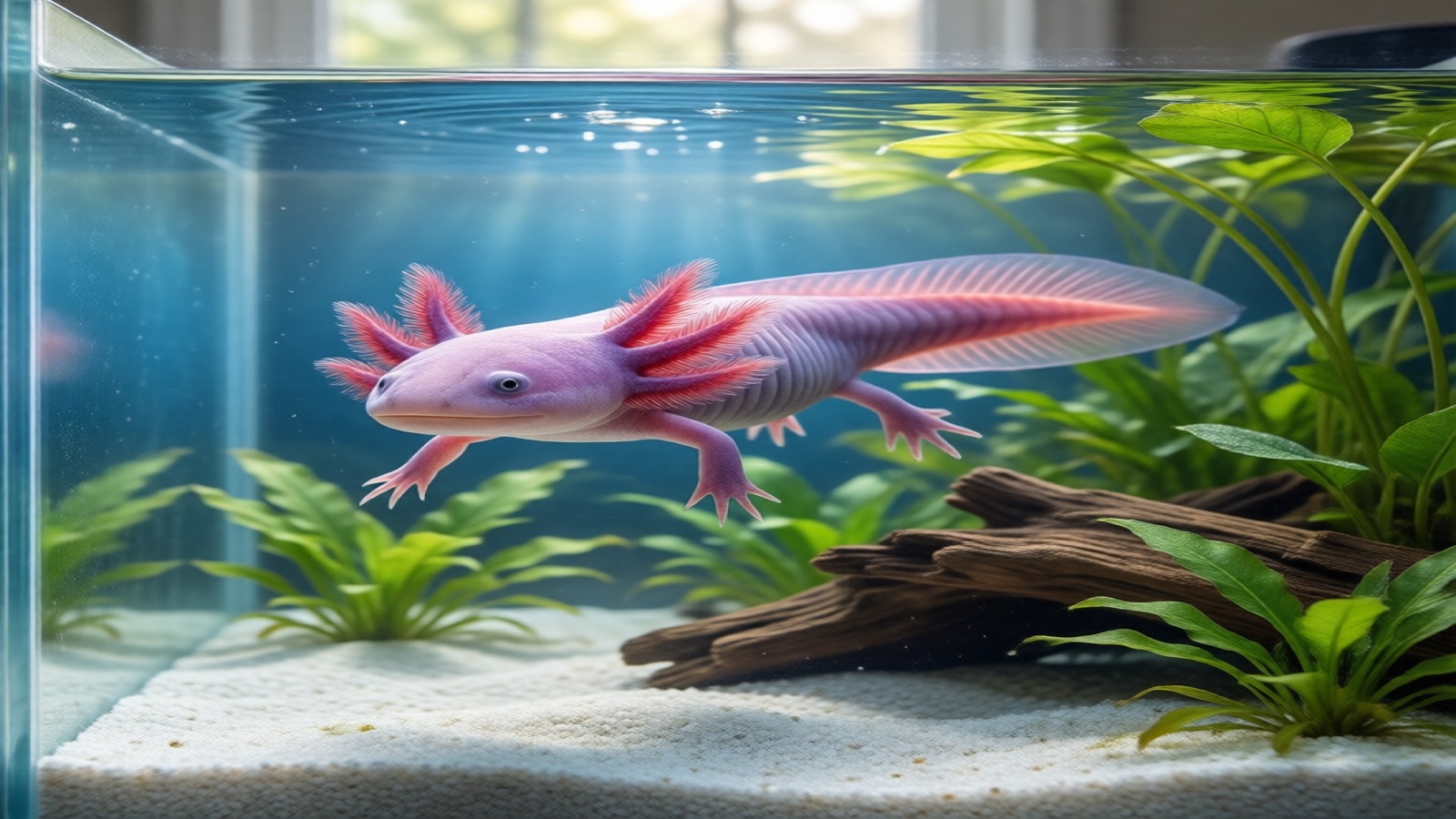
An axolotl tank is a fully aquatic habitat built specifically for cold-water salamanders — not a standard tropical-fish aquarium. Finding the best axolotl tank is critical — an axolotl tank is not just a glass box — it’s a life support system for one of the most sensitive aquatic pets you can own. Axolotls are fully aquatic salamanders, and they have very specific temperature, water quality, and space requirements. The best axolotl tank prevents problems — a poorly chosen tank leads to chronic stress, bacterial infections, stunted growth, and in severe cases, death.
Comparing 8 tanks for this 2026 best axolotl tank guide — alongside thousands of owner reviews — reveals one consistent beginner mistake: buying the wrong shape. Tall tanks look impressive but waste vertical space that axolotls never use. What matters is floor space — the horizontal area at the bottom where your axolotl actually lives. Every best axolotl tank on this list was chosen specifically for axolotl needs: low flow, adequate floor space, and safe materials.
For the best axolotl tank setup guidance, see our axolotl tank setup guide and axolotl care pages. For temperature management details, check our tank temperature guide.
What’s New for Axolotl Tanks in 2026
Two trends stand out this year. First, shallow rimless tanks like the LANDEN 75S and 90S have gotten more popular — they give axolotls maximum floor space with minimal water depth, which is exactly what they need. Second, all-in-one kits have improved. The Tetra 20-gallon kit now ships with better LED lighting and a more reliable filter than earlier versions, making it a stronger pick for beginners who don’t want to piece together a custom setup. If you’re shopping for your first axolotl tank in 2026, a quality kit or a shallow rimless tank are your two best routes.
Our Best Axolotl Tank Picks at a Glance
| # | Product | Price | Capacity |
|---|---|---|---|
| Tetra 20 Gallon Aquarium Kit | $173.01 | 20 gal | Best Overall Kit |
| Aqueon 10 Gallon Starter Kit | $129.99 | 10 gal | Juveniles Only |
| LANDEN 60P 16 Gallon | $149.99 | 16 gal | Mid-Range Rimless |
| LANDEN 75S 22 Gallon Shallow | $299.99 | 22 gal | Best Shallow Tank |
| LANDEN 90S 39 Gallon Shallow | $479.99 | 39 gal | Premium / Multi-Axolotl |
| Allcolor 10 Gallon Rimless | $79.00 | 10 gal | Budget Rimless |
| Seachem Tidal 75 HOB Filter | $70.25 | Up to 75 gal | Best Filter (HOB) |
| coospider UV Filter 200GPH | $35.99 | 20-75 gal | Best Budget Filter with UV |
Selection Criteria: How These Tanks Were Compared
Comparison Criteria
Every tank was evaluated for five axolotl-specific factors: floor space (length × width, not height), glass clarity and thickness, seal quality (no leaks), compatibility with low-flow filtration, and ease of maintenance — essential for the best axolotl tank (water changes, substrate cleaning). Tanks were scored on how well they met the needs of a single adult axolotl — approximately 8-10 inches long with a 6-inch tail.
Water Quality Factors
Axolotl health depends on stable water parameters rather than tank branding, so comparison focused on how each tank supports water quality: compatibility with gentle, low-flow filtration, adequate floor area for waste dilution, and open access for weekly water changes and substrate siphoning. These are the factors owner reviews most consistently link to a smooth nitrogen cycle in the critical first month.
Durability Assessment
Durability comparison covered glass thickness, silicone seal quality, and edge finishing — with corner stress cracks weighted as a commonly reported failure point. For kit tanks, the included accessories (hoods, lights, filters) were compared against axolotl safety needs.
Detailed Reviews — Best Axolotl Tank Breakdown
#1 Tetra 20 Gallon Aquarium Kit — Best Overall
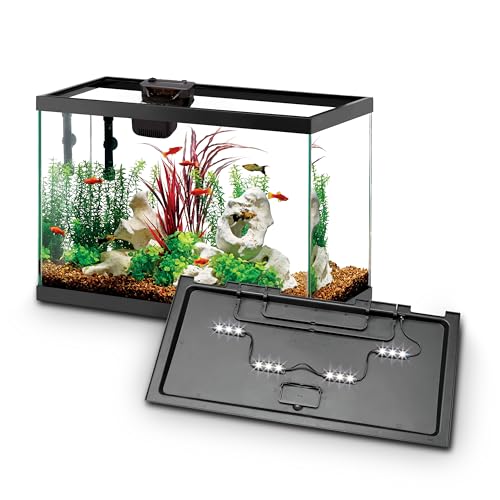
The Tetra 20-gallon kit is the best all-in-one axolotl tank kit — and our best axolotl tank pick for beginners. At 20 gallons, it meets the minimum size requirement for a single adult axolotl. The kit includes LED lighting, a filter, a heater (which axolotls don’t need — just leave it unplugged or remove it), water conditioner, and food samples, making it a true “everything you need” package at $173.01.
The 24 × 12 inch footprint provides decent floor space for an adult axolotl to walk along the bottom. The color-changing LED lighting is visually appealing — axolotls don’t need bright light, so you can keep it dimmed. Overall build quality is solid for a kit tank at this price point.
The main drawback is the tall design: at 16 inches high, most of the volume is in height rather than floor space. One owner noted they “wish it was longer instead of taller” — this is a common complaint for axolotl keepers. The included filter can be noisy; several owners had to replace it. For the best results, swap the included filter for the Seachem Tidal 75 on the lowest setting. The light strip also doesn’t fit perfectly under the hood, which is a minor quality control issue.
Despite these issues, the Tetra 20-gallon kit remains the best value all-in-one option and our top best axolotl tank recommendation for beginners who want a complete package.
Buy Tetra 20 Gallon Aquarium Kit on Amazon
#2 Aqueon 10 Gallon Starter Kit — Best for Juveniles
Warning: Juvenile only — adults need 20+ gallons.
The Aqueon 10-gallon starter kit is the best axolotl tank for juvenile axolotls under 6 inches. At $129.99, it’s a complete glass tank kit with Smart Clean filtration, LED lighting, a filter cartridge, water conditioner, and a setup guide. The sturdy glass construction and reliable filter make it a solid entry-level tank.
The 20.25 × 10.5 inch footprint works well for a young axolotl that hasn’t reached full size yet. The included filter is simple to set up and performs well for the 10-gallon volume. The LED lights are bright — you may want to dim them or add floating plants to reduce light intensity for your axolotl.
The included heater should be removed or left unplugged — axolotls need cool water, not heated water. The filter intake can be dangerous for very small aquatic animals; cover it with a pre-filter sponge to prevent your axolotl from getting sucked against it.
This is a temporary best axolotl tank home. Once your axolotl reaches 5-6 inches (usually around 6-8 months old), upgrade to a 20-gallon tank. A 10-gallon tank is only suitable for juveniles.
Buy Aqueon 10 Gallon Starter Kit on Amazon
#3 LANDEN 60P 16 Gallon — Best Mid-Range Rimless
The LANDEN 60P is the best axolotl tank in the mid-range category for keepers who want a rimless look without spending $300+. At 16 gallons, it’s slightly below the 20-gallon minimum for a full-grown adult, but it works well for smaller adults or as a grow-out tank for juveniles approaching full size.
The 23.6 × 11.8 inch footprint gives you more floor space than the 10-gallon tanks, and the low-iron glass provides crystal-clear viewing — no green tint. The 6mm glass thickness is standard for this size and feels solid. The rimless design is cleaner and more modern than kit tanks.
The downsides: 16 gallons is below the ideal minimum for the best axolotl tank, so you’ll need to be more diligent with water changes. A rimless tank also requires a separate lid purchase — there’s no hood included. The $149.99 price is good value for low-iron rimless glass, but you will need to budget for a filter and lid separately.
This tank pairs perfectly with the Seachem Tidal 75 filter and a custom mesh lid. See our axolotl tank setup guide for rimless tank installation tips.
#4 LANDEN 75S 22 Gallon Shallow — Best Shallow Tank
The LANDEN 75S is the best axolotl tank for owners who want optimal floor space to water depth ratio. At 22 gallons with a 29.5 × 17.7 inch footprint and only 11 inches tall, this tank gives your axolotl more usable living space than any standard 20-gallon kit tank.
This is the best tank shape for axolotls because their natural habitat is shallow, slow-moving water. The 11-inch water depth means less water pressure on the axolotl’s body and significantly better gas exchange at the surface. Maintenance is easier too — your arm reaches the bottom without struggle.
At $299.99, it’s expensive. You also need to purchase a lid and filter separately, which adds $100-150 to the total cost. The low-iron glass is absolutely stunning but also means you’ll see every imperfection. Pair with the Seachem Tidal 75 (see below) and a mesh lid for the complete setup.
#5 LANDEN 90S 39 Gallon Shallow — Premium Multi-Axolotl
The LANDEN 90S is the best axolotl tank for multi-axolotl setups or owners who want the absolute best habitat for a single axolotl. At 39 gallons with a 35.4 × 19.7 inch footprint, this tank provides 5.2 square feet of floor space — more than double the Tetra 20-gallon kit.
The 10mm glass is premium thickness for a tank this size, and the low-iron construction means absolutely pristine water clarity. The shallow profile (14.2 inches) means your axolotl gets the benefit of a large water volume with none of the drawbacks of a tall tank.
The $479.99 price is steep. You’re paying for premium materials, not features. But for serious axolotl keepers, this is a buy-it-for-life tank. Consider this if you have the budget and the space. Pair it with two Seachem Tidal 75 filters or a single canister filter rated for 75+ gallons.
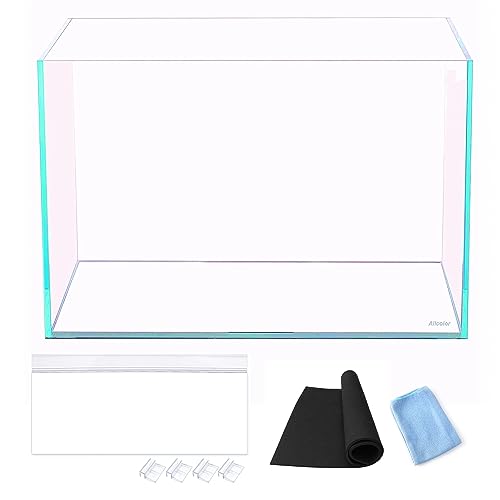
#6 Allcolor 10 Gallon Rimless — Budget Rimless
The Allcolor 10-gallon rimless tank is the best axolotl tank for keepers on a tight budget who still want the rimless aesthetic. At $79.00, it’s about half the price of the LANDEN 60P and gives you the same low-iron glass look.
The ultra-clear glass shows off your axolotl’s colors better than standard glass. The rimless design gives you full flexibility for lighting, lid, and filter placement. The 6-gallon version is too small for axolotls, but the 10-gallon option works for juveniles or smaller adults.
You’ll need to buy a lid and filter separately, which brings the total closer to $130-150 for a complete setup. The 10-gallon size means this is a temporary home for most axolotls — plan to upgrade within 6-8 months. A mesh lid is strongly recommended since this rimless tank has no built-in cover.
Buy Allcolor 10 Gallon on Amazon
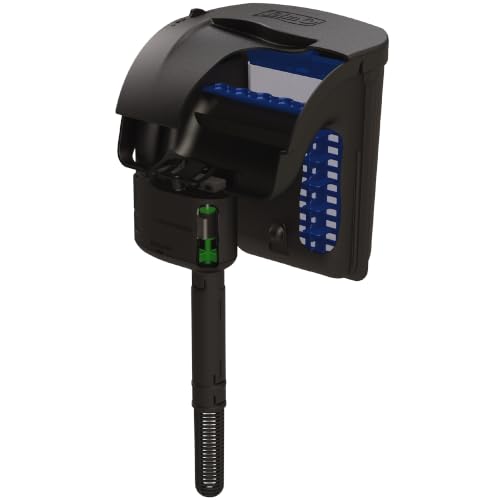
#7 Seachem Tidal 75 HOB Filter — Best Filter (HOB)
A filter is not optional for axolotl tanks. Axolotls produce significant waste, and without proper filtration, ammonia spikes can kill them within days. The Seachem Tidal 75 is the best hang-on-back filter for axolotl tanks because it offers adjustable flow control — the single most important feature for axolotl filtration.
At $70.25, it’s a significant additional cost on top of tank-only setups, but the Tidal 75 is rated for up to 75 gallons, meaning it’s overpowered for 20-gallon tanks — and that’s exactly what you want. Running an oversized filter on the lowest setting gives you excellent biological filtration with minimal water movement. The huge media basket holds Purigen, biomax, and custom media combinations that keep water crystal clear.
The self-priming motor means no manual priming after maintenance — a genuine convenience feature. The built-in surface skimmer keeps the water surface clean and prevents the protein film that can trap bacteria. The adjustable flow control is the killer feature: dial it down to the minimum setting and you get clean water without the current that stresses axolotls.
Pair this with any tank-only option on this list and you have a filtration system that will keep your axolotl tank stable for years. See our axolotl tank setup guide for filter installation details.
Buy Seachem Tidal 75 on Amazon
#8 coospider-repta UV Filter — Best Budget Filter with UV
The coospider-repta is a canister filter with built-in UV sterilization at $35.99 — less than half the price of the Tidal 75. The UV-C light kills free-floating algae, bacteria, and pathogens, which is genuinely useful for axolotl tanks that are prone to cloudy water and bacterial blooms. The 200GPH flow rate is sufficient for 20-75 gallon tanks.
Owners who received working units were impressed: “amazing product — saved my tank from severe algae bloom in 1 week” and “UV filter makes huge difference keeping smell to minimum.” The built-in UV sterilizer is the standout feature — it’s rare to find UV in a filter at this price.
The downsides are reliability and setup difficulty. Multiple owners reported the pump failing within months (“pump stopped working after only 4 months”) and intermittent operation (“runs 20 seconds then stops for 10 minutes”). Setup is also challenging — “hard to set up, took 3 hours.” If you’re patient with canister filter setup and willing to risk the reliability issues, the UV feature is worth the savings. For beginners, the Tidal 75 is the safer choice.
Buy coospider UV Filter on Amazon
Temperature Management for the Best Axolotl Tank
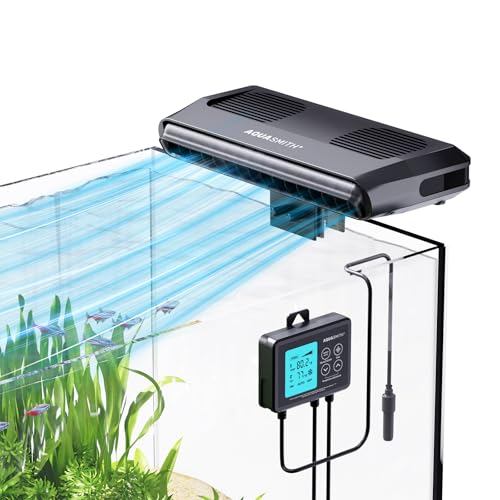
Axolotls need water between 60-68°F. Most homes stay within this range, but if your room temperature regularly exceeds 72°F, you need active cooling. Aquarium fans clip onto the tank edge and blow across the water surface; evaporative cooling can drop water temperature by 3-5°F. For rooms consistently above 78°F, a dedicated aquarium chiller is necessary — but they cost $200-400.
See our detailed tank temperature guide for year-round cooling strategies.
Substrate Options: Sand vs Bare Bottom
| Substrate | Pros |
|---|---|
| Fine sand | Natural look, allows burrowing, safe if ingested |
| Bare bottom | Easiest to clean, no ingestion risk |
| Gravel | Do NOT use — impaction risk |
Never use gravel. Axolotls inhale food and substrate simultaneously when eating. Gravel that gets swallowed can cause fatal impaction. Fine sand is the safest and most natural substrate — choose play sand or pool filter sand from a hardware store (rinse thoroughly before use).
Lighting Requirements
Axolotls don’t need bright light. In fact, bright light stresses them. They have no eyelids and cannot close their eyes, so prolonged bright light exposure is uncomfortable. Use dim LED lighting or provide plenty of hiding spots with caves and plants so your axolotl can escape the light. A light cycle of 8-10 hours per day is sufficient.
Lids and Covers
A lid is essential to prevent your axolotl from jumping out — yes, axolotls can and do jump. A mesh lid or glass cover works fine. The Tetra 20-gallon kit includes a hood, which is convenient. For rimless tanks like the LANDEN models, you’ll need to purchase a lid separately.
Best Axolotl Tank Quick Checklist
Use this checklist when comparing tanks against the picks above. Every ✅ reflects a spec or design choice the eight picks in this guide satisfy, and every ❌ flags a common beginner mistake that compromises axolotl health.
Choose a tank that hits these marks:
- ✅ 20+ gallon long footprint for one adult axolotl — Tetra 20 Gallon Aquarium Kit is the minimum-size pick
- ✅ Floor space prioritized over height — long, shallow tanks match axolotl bottom-dwelling behavior
- ✅ Rimless shallow tanks (LANDEN 75S / 90S) — maximum usable floor area with minimal water depth
- ✅ Adjustable-flow filter (sponge or HOB on low) — Seachem Tidal 75 is a strong match for adult tanks
- ✅ Fine sand or bare bottom substrate — never gravel (impaction risk)
- ✅ Mesh lid or glass cover included — axolotls can and do jump out of open tanks
- ✅ Cycle the tank 4-6 weeks before adding the axolotl — ammonia and nitrite both at 0 before stocking
Avoid these common tank-buying mistakes:
- ❌ Tall tanks prioritizing height over length — wastes vertical space axolotls never use
- ❌ Gravel substrate — axolotls swallow it and develop fatal impaction
- ❌ Strong-current filters — stresses gills and forces constant swimming against flow
- ❌ Stocking before cycling completes — ammonia burns gills and triggers bacterial infections
- ❌ Including the kit heater for axolotl use — unplug or remove; cold-water species do not need it
Best Axolotl Tank Setup Step-by-Step
Follow this setup sequence before adding your axolotl. Skipping any step risks ammonia spikes, stress, or escape.
- Choose the right tank footprint — long, shallow tanks (20+ gallons) outperform tall tanks for floor space
- Add a low-flow filter — sponge, HOB on low, or canister filter set to the lowest setting
- Cycle the tank for 4-6 weeks — establish the nitrogen cycle before stocking the axolotl
- Stock with fine sand and 2-3 hiding caves — never gravel; live plants help with water quality
Cycling Your Tank
Before adding your axolotl, you must cycle the tank — establish beneficial bacteria that convert toxic ammonia into less harmful nitrate. This process takes 4-6 weeks. Add a small amount of pure ammonia (no additives) to reach 2 ppm, then test daily. When ammonia and nitrite both read 0 and nitrate is present, the cycle is complete.
For a faster approach, use seeded filter media from an established tank or a commercial bacteria starter like Seachem Stability. Even with shortcuts, don’t rush — test water daily and don’t add your axolotl until ammonia and nitrite are both at 0.
For a full walkthrough, see our axolotl tank setup guide.
Adding Decorations
Axolotls need hiding spots. Provide at least 2-3 caves or tunnels where your axolotl can retreat. Live plants (anacharis, java fern, hornwort) provide cover and help with water quality. Avoid small decorations that could be swallowed. For decoration ideas, check our tank decor guide.
Water Parameters Guide
| Parameter | Ideal Range | Danger Zone |
|---|---|---|
| Temperature | 60-68°F (16-20°C) | Above 74°F |
| pH | 6.5-8.0 | Below 6.0 or above 8.5 |
| Ammonia | 0 ppm | Any reading above 0 |
| Nitrite | 0 ppm | Any reading above 0 |
| Nitrate | Below 20 ppm | Above 40 ppm |
| GH | 70-140 ppm | — |
| KH | 50-100 ppm | — |
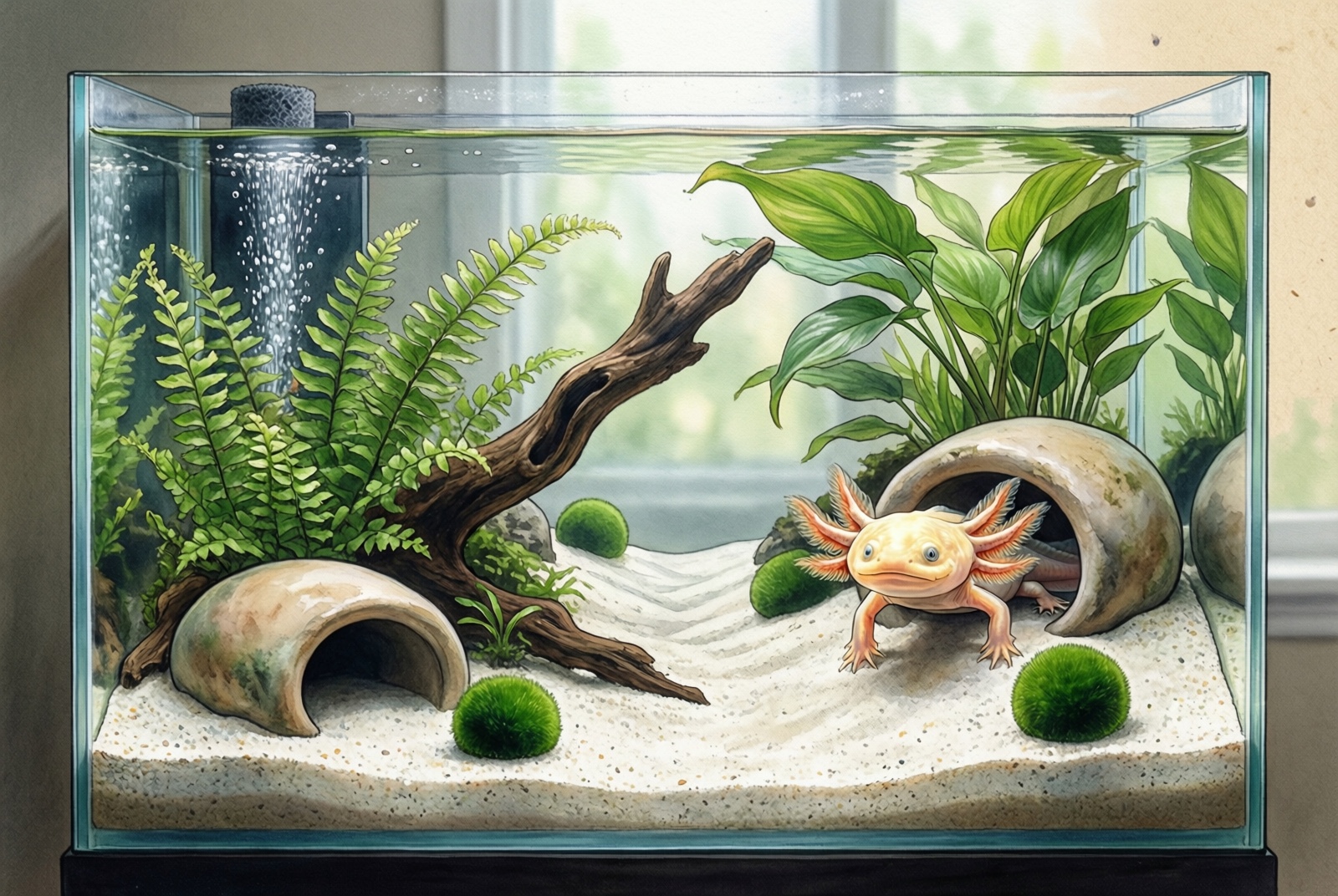
Introducing Your Axolotl
Float the transport bag in the tank water for 15 minutes to equalize temperature. Then gently net the axolotl out of the bag and into the tank — don’t pour the bag water into your tank, as it may contain stress hormones or contaminants. Leave the lights off for the first 24 hours to reduce stress. Offer food after 48 hours if the axolotl seems settled.
For nutrition guidance after setup, see our axolotl food guide.
Common Best Axolotl Tank Mistakes to Avoid
Tank Too Small
The most common beginner mistake is keeping an adult axolotl in a tank under 20 gallons. Stunted growth, chronic stress, and water quality crashes are the predictable results. If your axolotl has outgrown a 10-gallon tank, upgrade immediately — don’t wait.
Strong Water Flow
Running a filter at maximum flow in a small tank creates a current that exhausts and stresses axolotls. If your axolotl is constantly clinging to decorations or hiding and never exploring, the flow may be too strong. Dial it down or add baffles.
Gravel Substrate
This mistake can be fatal. Gravel ingestion causes impaction that often requires emergency veterinary intervention. Switch to fine sand or bare bottom immediately if you currently have gravel in your tank.
No Lid
Axolotls can jump, especially when startled. A tank without a lid is an open invitation for your axolotl to end up on the floor. Always use a lid, even if your axolotl has never jumped before.
Skipping the Cycle
Adding an axolotl to an uncycled tank exposes it to ammonia poisoning. Even if the water looks crystal clear, ammonia can be building up to lethal levels. Always cycle first.
Best Axolotl Tank Maintenance Schedule
Weekly Tasks
- 20-25% water change: Remove old water and replace with dechlorinated water at the same temperature
- Test water parameters: Check ammonia, nitrite, nitrate, and pH
- Clean glass: Use an aquarium-safe algae scraper on the front and side panels
- Check filter flow: Ensure the filter is running smoothly and hasn’t slowed down
Monthly Tasks
- Deep clean filter: Rinse filter media in tank water (not tap water — chlorine kills beneficial bacteria)
- Vacuum substrate: Siphon debris from sand surface
- Inspect silicone seals: Check for gaps or peeling at tank corners
- Test GH and KH: These parameters drift over time and affect pH stability
Water Testing Frequency
During the first month (cycling): test daily. After the cycle is established: test weekly. If you notice any changes in your axolotl’s behavior (not eating, floating at surface, lethargic), test immediately — water quality is the most common cause of health issues.
Best Axolotl Tank Budget Breakdown
Under $100 Setup
- Pre-filter sponge for intake: $5
- Play sand substrate: $8
- Small cave decoration: $7
- Note: Tank-only setups under $100 are limited. The Aqueon 10-gallon kit is now priced at $129.99. For budget builds, consider a secondhand 20-gallon tank from Facebook Marketplace ($30-50) and pair it with the Seachem Tidal 75 filter.
$100-$200 Setup
- Allcolor 10-gallon rimless tank: $79
- Seachem Tidal 75 filter: $70.25
- Play sand substrate: $8
- Basic LED hood light: $20
- Cave + plant decorations: $15
- Total: ~$192 (good starter setup, upgrade tank as axolotl grows)
$200+ Premium Setup
- LANDEN 75S 22-gallon shallow tank: $299.99
- Seachem Tidal 75 filter: $70.25
- Custom LED lighting: $40
- Mesh lid: $25
- Fine sand + live plants: $30
- Hiding caves + decor: $20
- Total: ~$485 (the best tank shape for axolotl welfare)
Honorable Mentions — Other Quality Axolotl Tanks Worth Considering
The eight picks above are the strongest options we verified for 2026, but several other axolotl-appropriate tanks also passed our floor-space and low-flow tests. If none of the top picks match your setup, these are reliable alternatives.
| Product | Price | Why it’s honorable |
|---|---|---|
| Aqueon 20 Gallon Long Tank | $99.99 | Bare long-form tank without the kit markup. Best for keepers who already own a filter and want just the glass. |
| Tetra Color Complete 20 Gallon Kit | $119.14 | A step up from the basic Tetra kit with colored LED hood. Good starter set for a planted axolotl display. |
| Aqueon 20 Gallon Starter Kit | $186.05 | Smart Clean filtration reduces maintenance frequency. Higher price than the basic Tetra kit but the filter media lasts longer. |
| AQUASMITH Aquarium Chiller Fan | $45.99 | Temperature-controlled cooling fan with 59°F minimum. Auto start/stop saves energy in summer. Best add-on if your room runs hot. |