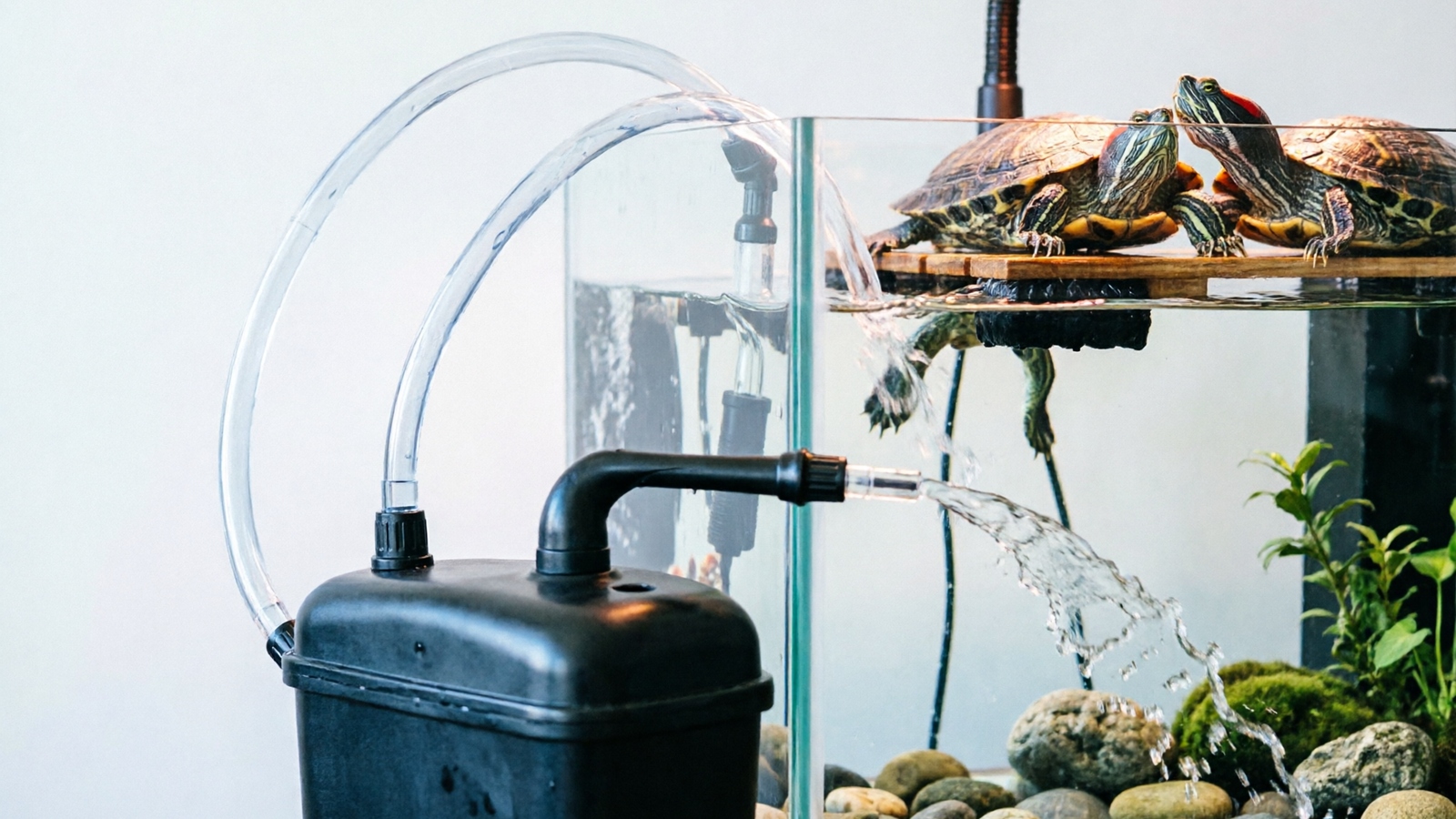
Why Turtle Tanks Need a Stronger Filter Than Fish Tanks
A turtle tank filter is a water filtration system rated to handle the heavy bioload that aquatic turtles produce. Turtles generate 5-10x more waste than fish of equivalent size — a single red-eared slider produces more ammonia via liquid and solid waste than an entire tank full of fish (redearslider.com forum: “A single RES produces more ammonia via liquid and solid waste than an entire tank full of fish”) — which means standard aquarium filters are almost always underpowered for turtle tanks.
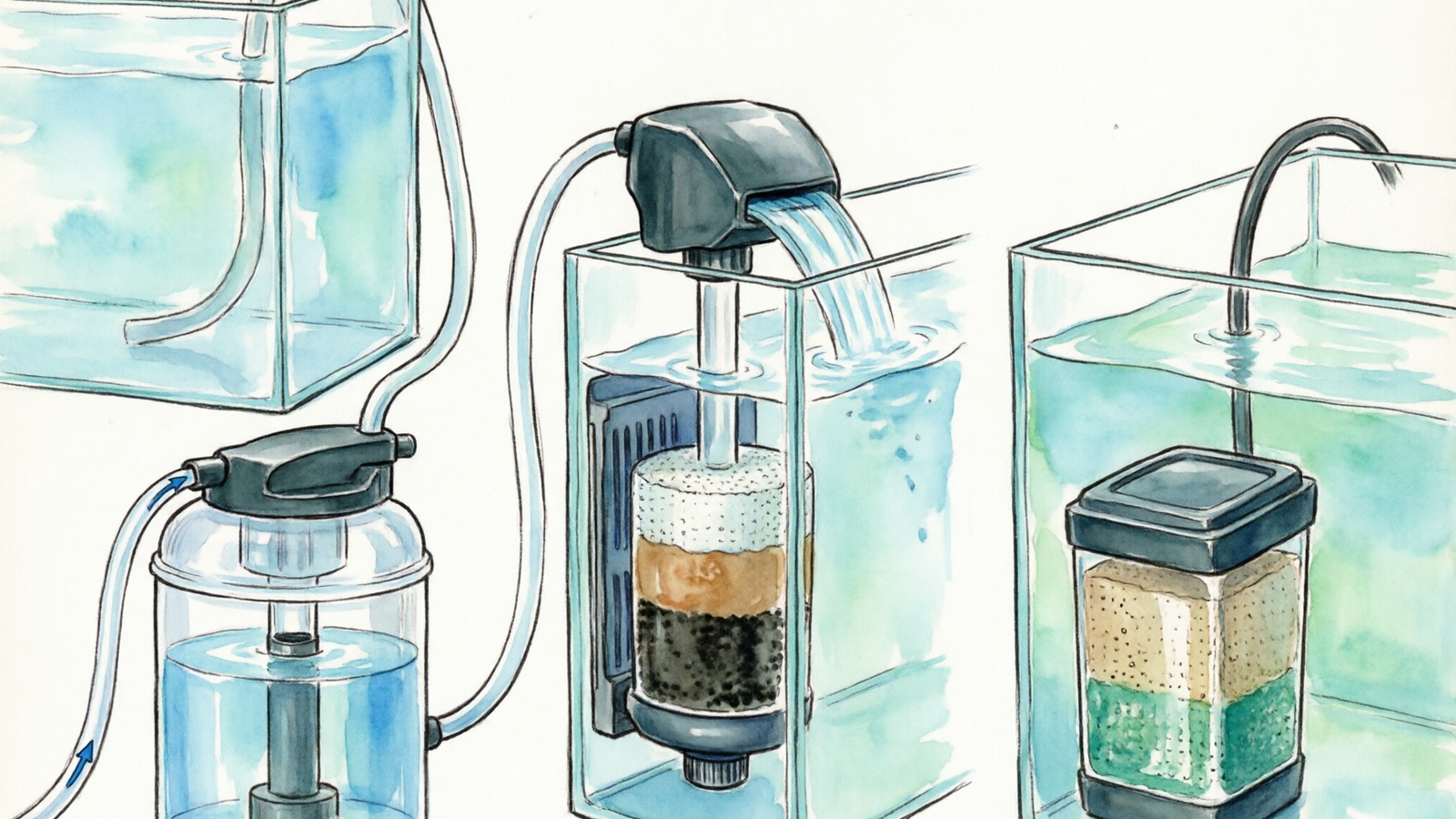
The golden rule for choosing choosing a turtle filter is to buy one rated for 2-3x your tank’s actual water volume. A 40-gallon turtle tank needs a filter rated for 80-120 gallons. There are three main filter types for turtle tanks: external canister filters (most powerful), hang-on-back power filters (mid-range), and internal submersible filters (best for small setups and low water levels).
Water quality is the number one turtle health issue. Your filter is the heart of any reptile habitat setup — without it, ammonia and bacteria build up fast. According to VCA Animal Hospitals, poor water quality is a primary cause of shell rot (SCUD) and respiratory infections in aquatic turtles, as dirty water allows gram-negative bacteria and fungi to colonize shell abrasions and trigger pneumonia. Poor filtration leads to shell rot, respiratory infections, eye infections, and fungal problems. According to a 2019 veterinary case study published in MedCrave, conjunctivitis in reptiles may be caused by dirty water and unhygienic environments (MedCrave — Therapeutic management of conjunctivitis and shell rot: “Conjunctivitis in reptiles may be due to foreign bodies, dirty water, air currents, nutritional imbalances, trauma or genetic predisposition”). Turtle keepers who invest in proper filtration from day one avoid 90% of common health problems.
Poor water quality from inadequate filtration is a leading cause of turtle shell rot — a 2017 peer-reviewed case study confirmed that shell rot (SCUD) in red-eared turtles is commonly caused by poor management practices and unhygienic environments (Society for Science and Nature — IJABR Shell Rot Infection in Red Eared Turtle2017/IJABR_V7(3)17-42SC1.pdf)). See our shell care guide for symptoms and treatment. This connection between filtration and shell health is one of the most overlooked aspects of turtle care.
Key Rule: Always size your filter for 2-3x your tank volume. Turtles are messy — there is no such thing as over-filtering a turtle tank.
Canister vs HOB vs Internal: Which Filter Type Is Best for Turtles?
Choosing the right turtle filter means understanding the three main filter types and how each handles turtle bio-load. Each has strengths and weaknesses depending on your tank size, water level, and budget.
| Filter Type | How It Works | GPH Range | Best Tank Size | Water Level | Maintenance | Long-Term Cost | Best For |
|---|---|---|---|---|---|---|---|
| External Canister | Sits outside tank; water pumped through sealed canister with media, returns via spray bar | 175-925 GPH | 40-100+ gal | Any level | Moderate (every 4-6 weeks) | Low (reusable media) | ✅ Primary for 20+ gal |
| Hang-On-Back (HOB) | Clips to tank rim; water enters intake, passes through media basket, returns via waterfall | 90-700 GPH | 20-70 gal | Near rim (within 2-3”) | Easy (swap cartridges) | Medium ($4-8 per cartridge) | Mid-range setups |
| Internal/Submersible | Sits inside tank; water passes through filter sponge and media inside the unit | 90-290 GPH | Under 20 gal | Low OK (as shallow as 2”) | Easy (rinse cartridges) | Low-Medium | ✅ Hatchlings, low-water setups |
| Sponge Filter | Air pump drives water through sponge; minimal flow | 10-100 GPH | Under 10 gal | Low OK | Very easy (rinse sponge) | Very low | Breeding/rearing only |
External canister filters are the community consensus — the top turtle filter for any tank over 20 gallons. They hold the most filter media and provide the strongest flow.
HOB power filters are a solid budget option for mid-range setups when a canister isn’t feasible. Internal filters are essential for hatchling setups and paludariums with low water levels.
The canister filter vs power filter turtle debate comes down to tank size and budget. Canisters win on power and media capacity.
HOB filters win on simplicity and upfront cost. Canisters are worth the investment for any serious turtle keeper.
All Turtle Filters Compared
| Filter | Type | GPH | Best Tank Size | Price |
|---|---|---|---|---|
| Fluval 307 | Canister | 303 | 40-55 gal | $189.99 |
| Penn-Plax Cascade 1200 | Canister | 315 | up to 150 gal | $199.84 |
| Zoo Med Turtle Clean 30 | Canister | 175 | 20-30 gal | $69.99 |
| Zoo Med Turtle Clean 15 | Canister | 100 | 10-15 gal | $49.99 |
| TARARIUM 290GPH | Internal | 290 (adj.) | 20-55 gal | $39.99 |
| Tetra ReptoFilter | Internal | 90 | 10 gal | $18.77 |
| Tetra Whisper 20-40 | Internal | 130 | 20-30 gal | $21.99 |
| AquaClear 70 | HOB | 300 | 20-40 gal | $72.80 |
Note: Tank size recommendations reflect turtle bio-load (2-3x rule), not fish tank ratings.
Best Canister Filters for Turtle Tanks
Canister filters are the gold standard — the best turtle filter for tanks over 20 gallons. They hold the most filter media, produce the strongest flow, and sit outside the tank — preserving valuable swimming space. We researched four canister options ranging from budget turtle-specific models to premium aquarium brands to find the top option in each category.
1. Zoo Med Turtle Clean 30 — Best Turtle-Specific Canister
The Zoo Med Turtle Clean 30 is the only canister filter designed specifically for aquatic turtles. At $69.99, it provides 175 GPH of three-stage filtration — the entry-level turtle filter canister — mechanical, chemical (carbon), and biological (ceramic rings) — all tuned for turtle bio-load.
What we like: The external design keeps the canister outside the tank, giving your turtle more swimming room — a key advantage of the canister filter type. The easy priming system means no manual siphoning to start the filter. Zoo Med is the most trusted reptile brand — the top choice for turtle-specific engineering.
What could be better: Only rated for 30 gallons — too small for most adult turtle setups. The priming button is a common failure point that breaks after 1-2 years. Proprietary filter cartridges cost $8-12 each and need replacing every 4-6 weeks.
Best for: Hatchlings and juvenile turtles in 10-30 gallon tanks. This is an ideal option if you want turtle-specific engineering without paying premium aquarium prices.
The Turtle Clean 30 is the strongest option in the Zoo Med Turtle Clean review — the top pick for small canister setups. However, most owners report outgrowing it within 6-12 months as their turtle reaches adult size.
“Perfect filter for my baby red-eared slider in a 20-gallon tank. Water stays crystal clear for 2-3 weeks between cartridge changes.”
“The priming button stopped working after 14 months. Had to manually prime it by sucking on the output hose — not ideal.”
Check current price for the Zoo Med Turtle Clean 30.
2. Zoo Med Turtle Clean 15 — Budget Turtle-Specific Canister
The Zoo Med Turtle Clean 15 is the most affordable turtle-specific external canister at $49.99. It delivers 100 GPH with the same three-stage filtration system as the TC30, just in a more compact package.
What we like: The compact canister is easy to hide behind small starter tanks. At under $50, it is the cheapest entry point into canister filtration for turtle keepers. The 100 GPH flow is gentle enough for tiny hatchlings.
What could be better: Only rated for 15 gallons — most turtles outgrow this within months. It has the lowest overall performance in our lineup. The same priming button reliability issues plague this model as the TC30. Three-foot hoses may be too short for custom setups.
Best for: Hatchling turtles in 10-15 gallon starter tanks. If your budget allows, consider the TC30 instead — the ideal upgrade path that avoids a second purchase.
“For a 30-gallon rating, it struggles with anything above 20 gallons if you have an adult turtle. I upgraded to a Fluval canister and the difference is night and day.”
The Turtle Clean 15 makes sense as a temporary starter filter. Most keepers will need to upgrade within a year.
3. Fluval 307 Performance Canister — Best Premium Canister
The Fluval 307 is the top canister filter for turtle tanks when budget is not the primary concern — the premium canister filter pick. At $189.99, it delivers 303 GPH — enough to handle the heavy waste output of adult red-eared sliders. A professional-grade pick for serious keepers. in 40-55 gallon tanks.
What we like: The self-priming system works with one button push — no more manual siphoning. Three large refillable media baskets let you use any generic bio-media like Seachem Matrix or ceramic rings. It is the most proven premium canister on Amazon and a standout option for serious keepers.
What could be better: At $189.99, it is the most expensive option in our lineup. Rated for 70 gallons for fish but realistically handles 40-55 gallons for turtles due to the heavier bio-load. The canister needs dedicated space below or beside your tank.
Best for: Serious turtle keepers with 40-55 gallon tanks investing in a long-term setup. This is a professional-grade canister filter that grows with your collection.
Fluval canisters consistently outperform cheaper alternatives — the top choice for flow consistency and quiet operation. The 307 handles two adult turtles in a 55-gallon tank with weekly 25% water changes.
“Best investment for my 55-gallon turtle tank. The Fluval 307 keeps water crystal clear even with two adult red-eared sliders. Worth every penny.”
“Used generic Seachem Matrix and bio-rings in the baskets — works perfectly. No need to buy Fluval brand media.”
The Fluval 307 is the best premium canister filter for serious turtle keepers.
4. Penn-Plax Cascade 1200 — Best Value Canister
The Penn-Plax Cascade 1200 delivers 315 GPH for $199.84 — the best value canister filter and the top value on a per-GPH basis. At $0.63 per GPH compared to the Fluval 307’s $0.63 per GPH, it matches Fluval on per-GPH cost while covering larger tanks. For keepers seeking the best turtle filter for 75+ gallon turtle tanks on a budget, the Cascade 1200 is a compelling choice.
What we like: The 360-degree rotating flow valves make hose routing easy in any direction. It includes poly fiber pads, bio-sponge, and activated carbon — everything needed to start immediately. It has a long track record of reliable performance.
What could be better: Self-priming is less reliable than Fluval — sometimes takes 2-3 attempts to start. Motor noise can increase after 8-12 months of continuous use. The plastic clamps that hold the canister together feel less sturdy than premium alternatives.
Best for: up to 150 gallon turtle tanks where you want strong canister filtration without paying $190. The Cascade 1200 is the best value canister filter — the best turtle filter for budget-conscious keepers with larger tanks.
“Best value canister filter. 315 GPH for under $210 is hard to beat. My 65-gallon turtle tank with two map turtles stays clean.”
“Priming is hit or miss — sometimes takes 5 attempts. The Fluval self-prime is much more reliable.”
The Penn-Plax Cascade 1200 is a practical choice — the best turtle filter value for keepers who want power without premium pricing.
Best Internal Filters for Small Turtle Tanks
Internal filters are the right choice for hatchlings — the ideal turtle filter type for tanks under 20 gallons. The ideal filter for small setups is almost always an internal model — they work in low water levels and require no external plumbing — they work in low water levels, require no external plumbing, and are easy to maintain. We researched three internal options covering different needs and budgets.
5. TARARIUM 290GPH Adjustable Internal — Best High-Flow Internal
The TARARIUM 290GPH is the most powerful internal filter available for turtle tanks. At 290 GPH with an adjustable flow dial, it covers a remarkable 20-75 gallon range — the most versatile internal option. — wider than any other internal filter we researched.
What we like: The adjustable flow dial lets you reduce output for small or shy turtles and increase as they grow. Three-stage filtration uses mechanical sponge, bio-sponge, and carbon — the best internal option for thorough cleaning. Works in shallow water as low as 6 inches — suitable for paludarium setups.
What could be better: The filter is bulky at roughly 8 by 4 inches, taking significant tank space in smaller setups. TARARIUM is a newer Chinese brand — long-term replacement media availability is uncertain. The 5-foot power cord may be too short for some tank stand configurations.
Best for: 20-55 gallon mid-range tanks where you want strong internal filtration without external canister plumbing. The adjustable flow means this filter grows with your turtle — the most adaptable internal option.
The TARARIUM is the top internal filter for keepers who want convenience with near-canister power at a mid-range price. At max flow, smaller turtles may get pushed around — reducing to 40% flow solves the problem completely.
“My 55-gallon turtle tank water went from cloudy to crystal clear in 48 hours. The 3-stage filtration handles my adult red-eared slider’s heavy waste output.”
“Easy to clean — just pull out the three filter trays and rinse. No proprietary cartridges needed.”
6. Tetra ReptoFilter — Best Budget Internal Filter
The Tetra ReptoFilter is the cheapest quality turtle filter available at just $18.77 — a solid budget starting point. It is a widely available turtle-specific filter on Amazon. Its decorative waterfall design doubles as a basking ramp for small turtles.
What we like: Works in water as shallow as 2 inches — unmatched by any other filter. The waterfall design provides enrichment as a climbing feature for small turtles. Tetra is an established brand since 1951 — a trusted budget brand with cartridges everywhere.
What could be better: Only 90 GPH — barely adequate for 10 gallons with turtles, despite being rated for 20 gallons for fish. No dedicated biological filtration stage — just a carbon cartridge with no bio-media chamber. The waterfall ramp can be an escape hazard for climbing species like red-eared sliders.
Best for: Hatchlings in 10-15 gallon tanks on a tight budget. The ReptoFilter is also the best turtle filter low water level option for shallow paludarium setups.
The ReptoFilter is a solid starter filter with a charming design. However, the escape risk is real — an owner reported their slider climbed out twice using the waterfall as a ladder.
“Best $19 I’ve spent on turtle supplies. My baby slider loves climbing on the waterfall.”
“90 GPH is way too weak for messy turtles. In my 20-gallon tank with a 4-inch slider, the water gets cloudy within 3 days.”
7. Tetra Whisper Internal Filter — Budget Air-Driven Option
The Tetra Whisper is the workhorse of aquarium internal filters — proven reliable across decades of use. At $21.99, it uses a quiet air-pump-driven design that has proven reliable since Tetra introduced the Whisper line decades ago.
What we like: Whisper-quiet operation makes it ideal for bedroom or office turtle setups. Bio-Bag cartridges are sold everywhere — ideal for keepers who value cartridge availability. The compact design fits easily in tank corners without taking much space.
What could be better: Air pump driven design requires a separate air pump if not included — adding $10-15 to the total cost. Only 130 GPH is marginal for turtle bio-load in 20-40 gallon tanks. The pump diaphragm wears out after roughly 10 months, requiring a $12-15 replacement.
Best for: Budget-conscious keepers with 20-30 gallon tanks who prioritize quiet operation. The Tetra Whisper is the cheapest name-brand internal filter — the top pick for quiet operation.
“Been running this on my 30-gallon turtle tank for 2 years. The Bio-Bag cartridges are cheap and easy to swap.”
“130 GPH is too low — water gets cloudy in 4-5 days. Need to supplement with weekly deep cleaning.”
Best HOB Power Filter for Turtle Tanks
Hang-on-back power filters offer a middle ground between canister power and internal simplicity. The ideal turtle filter for simplicity seekers is often an HOB model — no hoses, no canister, no priming. They clip to the tank rim and provide strong flow without requiring external plumbing.
8. AquaClear 70 — Best HOB for Turtle Tanks
The AquaClear 70 delivers 300 GPH — an impressive output for a hang-on-back design and the top HOB pick. At $72.80, it provides canister-level flow with the simplest installation — the top HOB under $100. Just hang it on the tank rim and plug it in.
What we like: The refillable media baskets accept any filter media — Seachem Matrix, Purigen, mechanical sponge, or whatever your tank needs. Adjustable flow rate lets you reduce output for smaller turtles or increase it during feeding time. No hoses, no canister, no priming required — the simplest turtle filter for simplicity.
What could be better: HOB design requires water level within 2-3 inches of the tank rim — not suitable for low-water paludarium setups. The large footprint blocks rear tank access. The foam inserts degrade after 4-5 months and need replacement.
Best for: 20-40 gallon turtle tanks where you want strong filtration without the complexity of canister plumbing. The AquaClear 70 is the best HOB power filter — the best turtle filter under $100 alongside the TARARIUM internal.
For turtle keepers who want canister-level power without external plumbing, the AquaClear 70 is the answer. Many beginners who find canister setup intimidating choose this option instead.
“The best HOB filter for turtle tanks. 300 GPH with refillable media baskets means I customize filtration for my turtle’s needs.”
“HOB filters don’t work well with low water levels. My turtle tank is only filled to 75% and the intake sometimes sucks air.”
What Size Filter Do You Need for Your Turtle Tank?
Choosing the right filter size depends on your turtle’s life stage and tank volume. The universal rule applies when choosing a turtle filter: always buy one rated for 2-3x your tank’s actual water volume. Turtles produce 5-10x more waste than fish, so standard ratings are meaningless.
Filter ratings assume a real swimming volume — buy the tank first by shell-inch gallons, then size the canister 2–3×.
| Turtle Size | Tank Size | Recommended Filter | Filter Type | Est. Price |
|---|---|---|---|---|
| Hatchling (1-2”) | 10-15 gal | Tetra ReptoFilter ($18.77) or Zoo Med TC15 ($49.99) | Internal/Canister | $19-50 |
| Juvenile (2-4”) | 20-30 gal | Zoo Med TC30 ($69.99) or TARARIUM 290GPH ($39.99) | Canister/Internal | $40-70 |
| Sub-adult (4-6”) | 40-55 gal | Fluval 307 ($189.99) or Penn-Plax Cascade 1200 ($199.84) | Canister | $190-200 |
| Adult (6”+“) | 55-100 gal | Penn-Plax Cascade 1200 × 2 or Fluval FX4 ($249) | Dual Canister | $235-249 |
When in doubt, go bigger. You can never over-filter a turtle tank. A filter that seems oversized will simply run cleaner and require less frequent maintenance.
Filter size depends on your turtle species and tank size — see our box turtle care guide for species-specific habitat requirements that affect filtration needs.
The question of what size filter for turtle tank setups comes up constantly in turtle keeping forums. The 2-3x rule eliminates most confusion — just multiply your tank gallons by 2 or 3 and buy a filter rated for that range.
How to Set Up a Turtle Tank Filter: Step-by-Step
Proper setup maximizes filter performance and extends equipment life. Follow these steps for any filter type.
Step 1: Choose the right filter type for your tank size. Under 20 gallons → internal filter — ideal for hatchlings. 20-55 gallons → canister or high-flow internal. 55+ gallons → large canister or dual canister setup.
Step 2: Position the filter for maximum circulation. Canister: place below or beside the tank. Route the intake at one end and output at the opposite end for full-tank water movement. Internal: place in the corner opposite the basking area. HOB: clip to the tank rim on the side away from the basking platform.
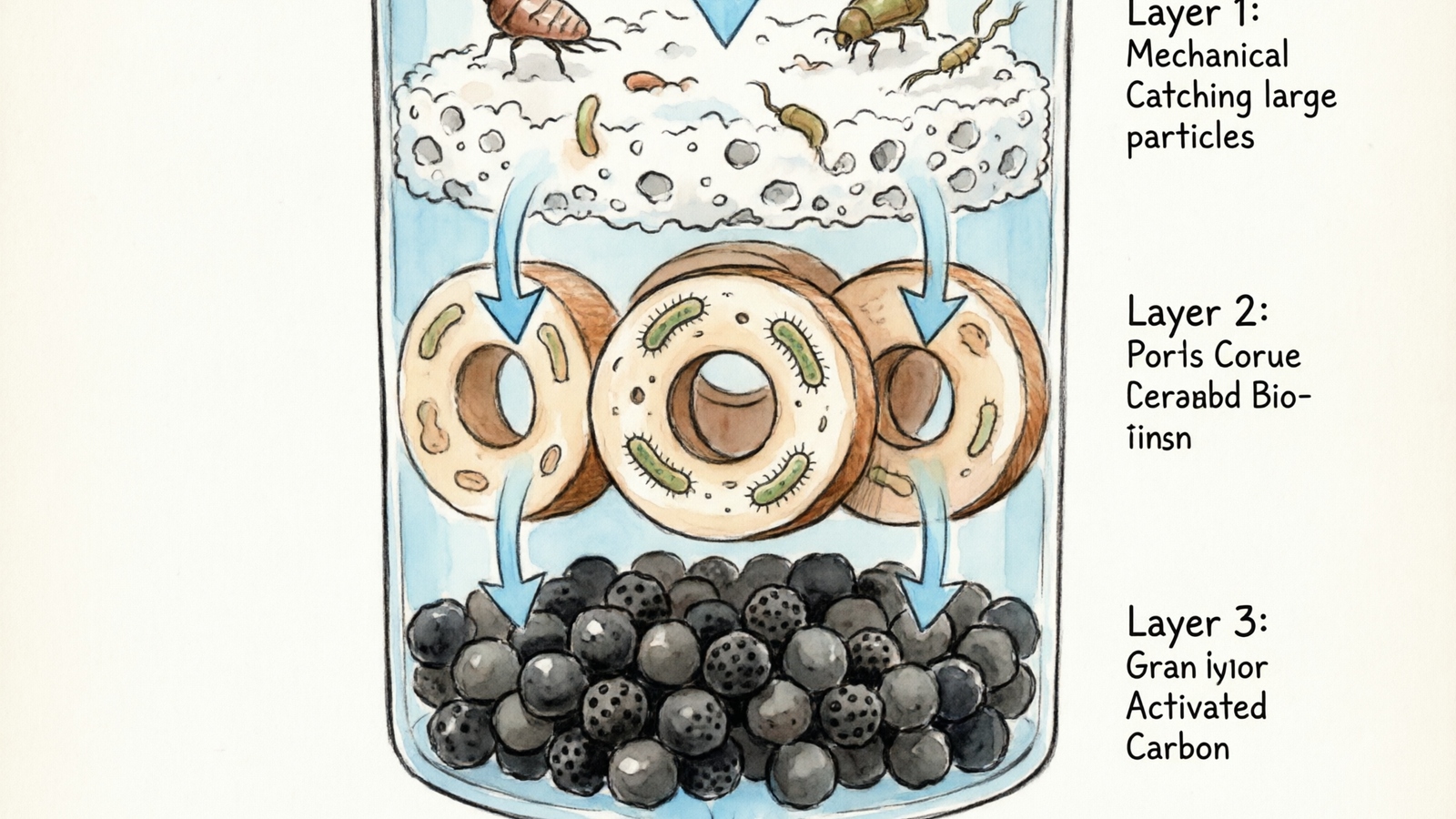
Step 3: Layer filter media correctly. Mechanical filtration first (catches debris and waste), then biological media (ceramic rings or Seachem Matrix), then chemical media (activated carbon) last. This order prevents bio-media from getting clogged — essential for optimal turtle filter performance. Coordinate your filter with a reptile thermostat if you use a submersible heater in the same tank.
Step 4: Prime and start the filter. Canister filters: use the priming button (Fluval) or fill the canister with tank water first (Penn-Plax). Internal and HOB filters self-start when plugged in.
Step 5: Cycle the filter for 2-4 weeks. New filters need time to develop beneficial bacteria colonies (nitrosomonas and nitrobacter) that convert toxic ammonia → nitrite → nitrate. Test water weekly for ammonia and nitrite using a liquid test kit. Do not add your turtle until both read 0 ppm. Even the best turtle filter is useless without proper cycling. Filter cycling principles are the same for all aquatic pets — see our best axolotl filter guide for detailed bio-media setup tips.
Step 6: Establish a maintenance schedule. Clean mechanical media every 2-4 weeks by rinsing in old tank water — never tap water, which kills beneficial bacteria. Replace carbon monthly. Clean the full canister every 6-8 weeks. Change 30% of tank water weekly.
Turtle Filter Do’s and Don’ts
✅ Correct Filter Practices
- ✅ Size up 2-3x your tank volume — A 40-gallon turtle tank needs a filter rated for 80-120 gallons.
- ✅ Rinse mechanical media in old tank water — Tap water contains chlorine that kills beneficial nitrifying bacteria colonies.
- ✅ Use refillable media baskets — Generic Seachem Matrix or ceramic rings cost less long-term than proprietary cartridges.
- ✅ Position intake and output at opposite ends — Creates full-tank water circulation instead of dead zones.
- ✅ Cycle the filter for 2-4 weeks before adding your turtle — Test ammonia and nitrite must both reach 0 ppm.
- ✅ Keep a spare filter or spare cartridges — Equipment failure without backup can become an emergency within hours.
❌ Dangerous Filter Mistakes
- ❌ Using a fish-rated filter without sizing up — Turtles produce 5-10x more waste than fish of equivalent size. (redearslider.com: “A single RES produces more ammonia via liquid and solid waste than an entire tank full of fish”)
- ❌ Cleaning bio-media with tap water — Chlorine destroys the nitrifying bacteria colony, resetting the nitrogen cycle and causing ammonia spikes.
- ❌ Skipping the cycling period — Adding a turtle to an uncycled filter leads to rapid ammonia buildup, stress, and potentially fatal water toxicity.
- ❌ Ignoring filter flow reduction — Decreased flow means clogged media. Delaying cleaning causes bacterial blooms and foul odors.
- ❌ Mixing electrical equipment with wet tanks without drip loops — Without proper drip loops and GFCI outlets, water contact with electrical connections creates shock and fire hazards.
- ❌ Assuming “rated for X gallons” applies to turtles — Filter ratings are based on fish bio-load. For turtles, always multiply by 2-3x — or more.
Proper habitat management impacts pet health across all species — whether maintaining turtle water quality or selecting the right hamster bedding, a clean environment prevents disease.
Proper media layering is the single most important setup step. Mechanical media protects your bio-media from clogging, which keeps the bacterial colony healthy and effective.
Turtle Filter FAQ
What type of filter is best for turtles?
The right turtle filter type depends on your tank size and budget. External canister filters are the top filter type overall for turtle tanks over 20 gallons. They hold the most filter media, produce the strongest flow, and sit outside the tank to maximize swimming space.
For tanks under 20 gallons, internal filters are more practical. HOB filters are a good mid-range compromise for 20-40 gallon setups. The universal rule: always buy a filter rated for 2-3x your tank’s water volume.
What is the top canister filter for turtle tanks?
For mid-size tanks (40-55 gal), the Fluval 307 ($189.99, 303 GPH) is the best premium canister and the Penn-Plax Cascade 1200 ($199.84, 315 GPH) is the best value.
For turtle-specific canisters under 30 gallons, the Zoo Med Turtle Clean 30 is the only canister designed specifically for turtles. The Fluval 307 offers self-priming and refillable media baskets — key advantages over the Penn-Plax.
Can I use a fish tank filter for turtles?
You can use a fish tank filter, but it must be rated for 2-3x your tank volume. Turtles produce 5-10x more waste than fish, so most fish filters rated for the same tank size will be underpowered.
Canister filters designed for fish work well for turtles as long as you size up significantly. Avoid small internal filters designed for bettas or goldfish — they cannot handle turtle waste output.
What size filter do I need for a 20-gallon turtle tank?
For a 20-gallon turtle tank, you need a filter rated for 40-60 gallons. The best turtle filter options include the TARARIUM 290GPH adjustable internal filter ($39.99, rated 20-75 gal) or the Zoo Med Turtle Clean 30 canister ($69.99, rated 30 gal).
Avoid the Tetra ReptoFilter (90 GPH) for 20-gallon tanks with turtles — it is only adequate for 10 gallons max. The TARARIUM offers the best value with adjustable flow that grows with your turtle.
Can turtle filters work in low water levels?
Yes, internal filters and turtle-specific filters work in low water levels. The Tetra ReptoFilter works in water as shallow as 2 inches. The TARARIUM 290GPH works in shallow paludarium setups with 6+ inches of water.
Canister filters use hoses so water level does not affect their operation. However, HOB filters like the AquaClear 70 require water within 2-3 inches of the tank rim. For paludarium or low-water turtle setups, internal filters are the best turtle filter option.
How often should I clean a turtle tank filter?
Clean mechanical filter media every 2-4 weeks by rinsing in tank water — not tap water, which kills beneficial bacteria. Replace activated carbon monthly. Deep-clean the entire canister filter every 6-8 weeks.
In addition to filter maintenance, perform 30% water changes weekly. Filters with refillable media baskets (Fluval 307, AquaClear 70, TARARIUM) are more cost-effective long-term than proprietary cartridge systems (Zoo Med Turtle Clean).
Key Takeaways
-
Size up, not down: Always buy a filter rated for 2-3x your tank volume. Turtles produce 5-10x more waste than fish.
-
Canister for 20+ gallons — the top turtle filter type: External canisters are the gold standard for any serious turtle setup. HOB for budget mid-range, internal for hatchlings.
-
Turtle-specific has limits: Zoo Med Turtle Clean filters are designed for turtles but are outgrown quickly. Plan for upgrades.
-
Refillable media saves money — the ideal option for long-term cost: Filters with refillable baskets (Fluval, AquaClear, TARARIUM) cost less long-term than proprietary cartridge systems.
-
Never use tap water to clean media: Always rinse filter media in old tank water to preserve beneficial bacteria colonies.