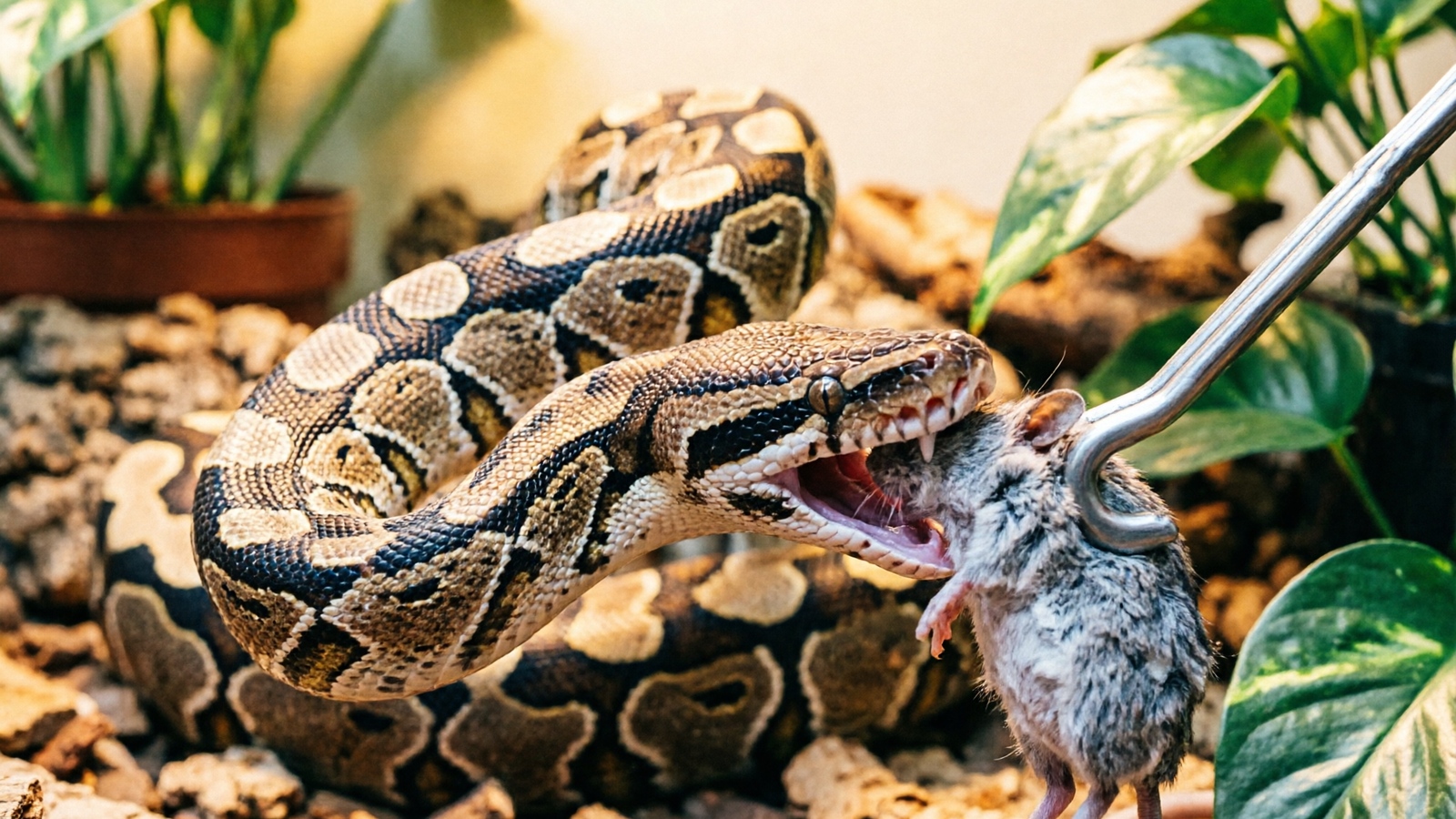
What Do Ball Pythons Eat in Captivity?
Ball pythons are obligate carnivores — their entire diet consists of whole vertebrate prey, primarily mice and rats of appropriate size (Merck Veterinary Manual — Pythonidae). In the wild, ball pythons are ambush predators found in West and Central Africa.
They prey on African soft-furred rats, shrews, and gerbils in their native range (Merck Veterinary Manual). Their name comes from their defensive behavior of curling into a tight ball, not from any aspect of their diet.
In captivity, frozen-thawed prey is the gold standard for ball python nutrition. Veterinarians and experienced keepers recommend frozen-thawed over live prey for safety, convenience, and parasite control. The ball python diet in captivity is simple but requires attention to prey size and feeding frequency.
Ball python food options are straightforward compared to many other reptile species. There is no plant matter, no supplements required for routine feeding, and no complex mixing of ingredients. The challenge lies in getting the details right — correct prey size, proper thawing technique, and appropriate feeding schedule.
If your ball python refuses food repeatedly, see our not eating troubleshooting guide for common causes and solutions.
Ball Python Feeding Schedule by Age and Weight
A balanced ball python diet depends on proper feeding frequency — one of the most important aspects of care. The table below provides a complete schedule based on age and weight.
| Age/Stage | Weight | Prey Type | Frequency | Notes |
|---|---|---|---|---|
| Hatchling (0-3 months) | 50-150g | Rat pup or crawler mouse | Every 5-7 days | Start 1-2 days after first shed |
| Juvenile (3-12 months) | 150-500g | Rat pup to weanling rat | Every 7 days | Increase prey size as snake grows |
| Sub-adult (1-2 years) | 500-1000g | Small to medium rat | Every 7-10 days | Switch to every 10 days if overweight |
| Adult male (2+ years) | 1000-1800g | Medium rat | Every 10-14 days | Males eat less than females |
| Adult female (2+ years) | 1500-2500g+ | Medium to large rat | Every 10-14 days | Females need more for egg production |
| Breeding female | 1800g+ | Large rat | Every 7-10 days | Increase during follicle development |
The ball python food item should weigh approximately 10-15% of the snake’s body weight (Merck Veterinary Manual). The prey’s widest point should be roughly equal to the snake’s widest point — this is called the girth match rule. This visual check is more reliable than weighing prey for beginners.
How often to feed ball python depends on the individual. Some snakes metabolize food faster than others. Monitor body condition rather than following a rigid schedule.
For complete husbandry beyond feeding, see our ball python care guide.
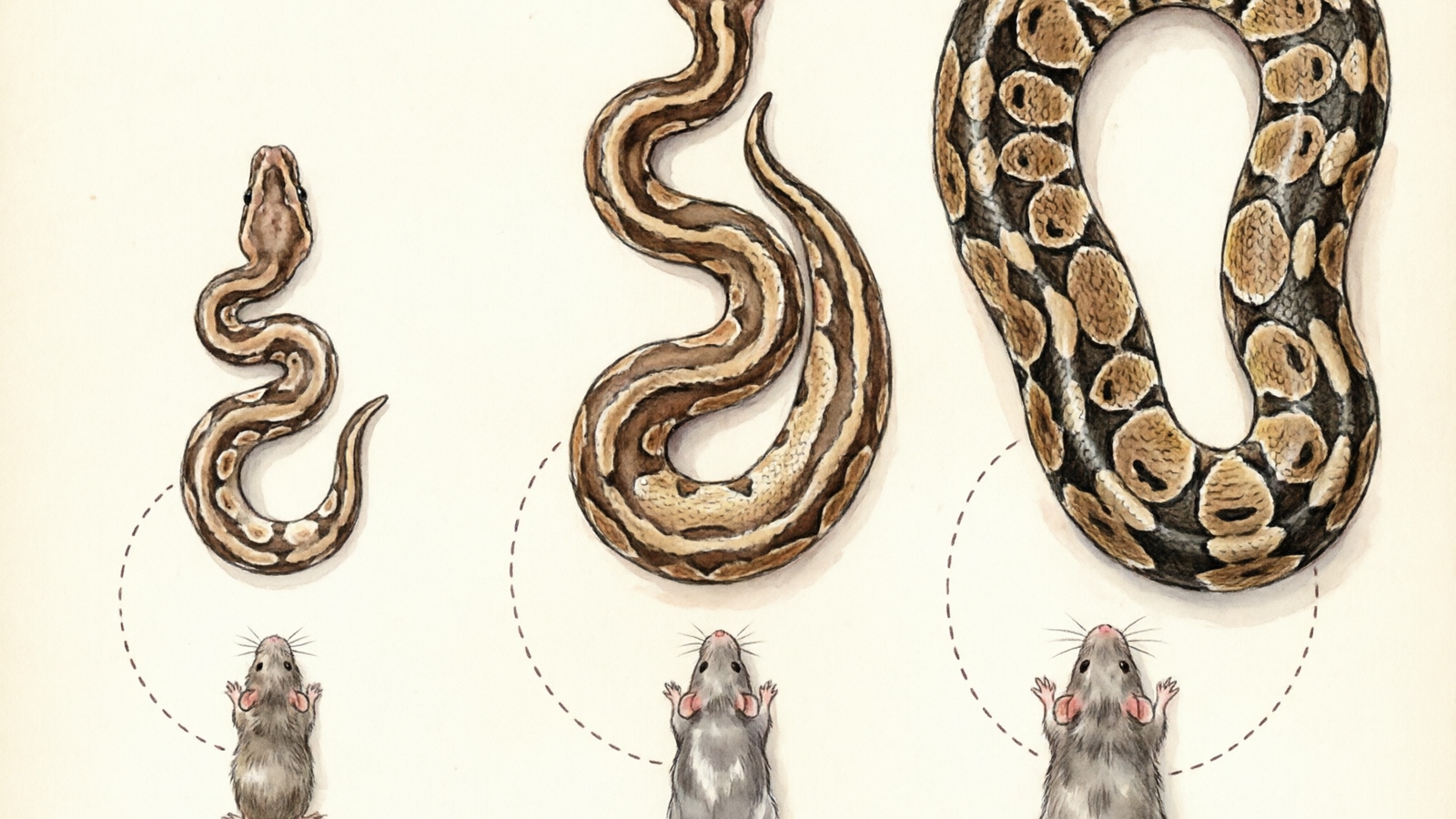
Prey Size Guide — From Pinkie to Jumbo Rat
Understanding prey size terminology is essential for anyone new to keeping ball pythons. Breeders and suppliers use standardized terms that refer to the age and size of the prey animal.
| Term | Species | Weight | Age | Fur Status | Best For |
|---|---|---|---|---|---|
| Pinkie | Mouse/Rat | 1-3g | 1-5 days | Hairless | Hatchling (50-100g) |
| Fuzzy | Mouse | 3-5g | 5-10 days | Developing fuzz | Small hatchling |
| Crawler | Mouse/Rat | 5-8g | 10-14 days | Short fuzz, mobile | Juvenile (150-200g) |
| Hopper | Mouse | 7-12g | 2-3 weeks | Full coat, weaning | Juvenile (200-400g) |
| Weanling | Rat | 15-30g | 3-4 weeks | Fully furred, weaned | Sub-adult (400-700g) |
| Small rat | Rat | 40-70g | 1-2 months | Adult fur, small build | Sub-adult/adult (700-1200g) |
| Medium rat | Rat | 80-150g | 2-3 months | Standard adult | Adult (1200-2000g) |
| Large rat | Rat | 150-250g | 3-4 months | Large adult | Large adult (2000g+) |
The girth rule is the most reliable visual check for ball python prey size. If you cannot see a slight bulge after feeding, the prey may be too small. If the bulge is extreme or the snake appears uncomfortable, the prey is too large.
Rats are preferred over mice for ball pythons once the snake reaches 500g or more. Rats provide better nutrition with higher protein content and a more favorable calcium-to-phosphorus ratio (Merck Veterinary Manual). Most adult ball pythons should be eating rats exclusively.
When in doubt between two prey sizes, choose the smaller option. An undersized meal is far less harmful than an oversized one that causes regurgitation.
Frozen-Thawed vs Live Prey
The choice between frozen thawed and live prey is one of the most debated topics in snake husbandry. Switching to frozen thawed ball python meals is widely recommended by veterinarians and experienced keepers.
The comparison below covers all major factors.
| Factor | Frozen-Thawed | Live |
|---|---|---|
| Safety | No risk of injury to snake | Rodents can bite and scratch — severe injuries common |
| Parasites | Freezing kills most parasites | May carry mites, bacteria, and internal parasites |
| Convenience | Store in freezer, thaw as needed | Must maintain live colony or buy per feeding |
| Availability | Order online, ship to door | Limited to local pet stores and breeders |
| Cost | Roughly one to three dollars per rat in bulk | Roughly five to ten dollars per rat at pet store |
| Snake acceptance | May need scenting or movement simulation | Usually accepted readily |
| Nutrition | Same as live — frozen at peak health | Fresh but varies by source |
Live rodent bites are the top preventable cause of injury in pet ball pythons. Rats and mice have powerful jaws that can inflict deep lacerations, infection, and permanent scarring (Merck Veterinary Manual). Even a quick live feeding can result in injury if the snake misses or takes too long to constrict.
How to switch a live-only snake to frozen-thawed prey:
Scent the thawed prey with live rodent bedding to transfer familiar smells. Wiggle it with tongs to simulate live movement.
Offer at night when the snake is naturally active. Be patient — some snakes need three to four attempts before accepting the switch.
The corn snake feeding guide at corn snake care covers similar frozen-thawed transition techniques that work across species.
How to Feed Your Ball Python — Techniques and Tips
Proper feeding technique prevents regurgitation, reduces stress, and keeps both snake and keeper safe. Follow these six steps for every feeding session.
Step 1: Thaw prey properly. Thaw in the refrigerator overnight or in a sealed bag in warm water. Never microwave or boil prey. The prey must be completely thawed and warmed to 85-95°F before offering. Cold prey is a common cause of regurgitation (Merck Veterinary Manual).
Step 2: Offer prey with tongs. Use feeding tongs or hemostats to hold the prey. Wiggle it gently to simulate live movement. This keeps your hands away from the strike range and triggers the ambush predator instinct.
Step 3: Feed in the evening. Ball pythons are nocturnal ambush predators. They are most responsive to food after lights out. If your snake ignores food during the day, try evening offerings.
Step 4: Feed inside the enclosure. Moving a ball python to a separate feeding tub causes unnecessary stress for this species. Unlike some aggressive feeders, ball pythons do not develop cage aggression from in-enclosure feeding.
Step 5: Leave the snake alone after feeding. Do not handle for 24-48 hours after a meal. Handling too soon can cause regurgitation, which burns the esophagus and requires healing time.
Step 6: Monitor for regurgitation. If your snake regurgitates, wait 10-14 days before the next feeding attempt. Regurgitation is a sign that something went wrong with temperature, prey size, or handling timing.
Digestion temperature matters. Temperature is the single most overlooked factor in successful digestion. Ball pythons need 85-90°F on the warm side to digest food properly (Merck Veterinary Manual).
Below 80°F, digestion slows significantly. Below 75°F, undigested food may rot in the stomach. Always verify warm-side temperature before feeding.
A reliable thermostat prevents dangerous temperature fluctuations. Temperature and humidity work together for proper digestion — see our humidity guide for maintaining the right environment.
A heating pad with proper gradient setup ensures the warm side stays in the correct range for digestion.
Can Ball Pythons Eat Other Foods?
Ball pythons are strict carnivores with specific dietary requirements. Understanding what they can and cannot eat prevents health problems.
What ball pythons can occasionally eat:
African soft-furred rats are their natural wild prey and make excellent feeders when available (Merck Veterinary Manual).
Gerbils and multimammate mice — owners asking can ball pythons eat alternative prey will find these work for picky eaters. Quail chicks are accepted by some individuals but are not a standard food item.
Hamsters can be used in emergencies but should not be a regular food source.
What ball pythons should never eat ❌:
- ❌ Fish — not natural prey, risk of thiamine deficiency from certain species (Merck Veterinary Manual)
- Insects — ball pythons cannot digest chitin effectively
- Eggs — not natural prey for this species
- Processed meat — hot dogs, chicken, or beef lack calcium and contain toxic additives
- Pre-killed but not frozen — fresh-killed prey may still carry active parasites
- Wild-caught rodents — high risk of parasites, pesticides, and diseases
- Prey with fur dye — some suppliers dye fur for identification, always avoid these
A properly set up enclosure makes feeding safer and more natural for your ball python.
Signs Your Ball Python Is Eating Too Much or Too Little
Monitoring body condition is as important as following a feeding schedule. Weigh your snake monthly at minimum. The checklist below helps you assess whether your feeding routine needs adjustment.
Healthy weight signs ✅:
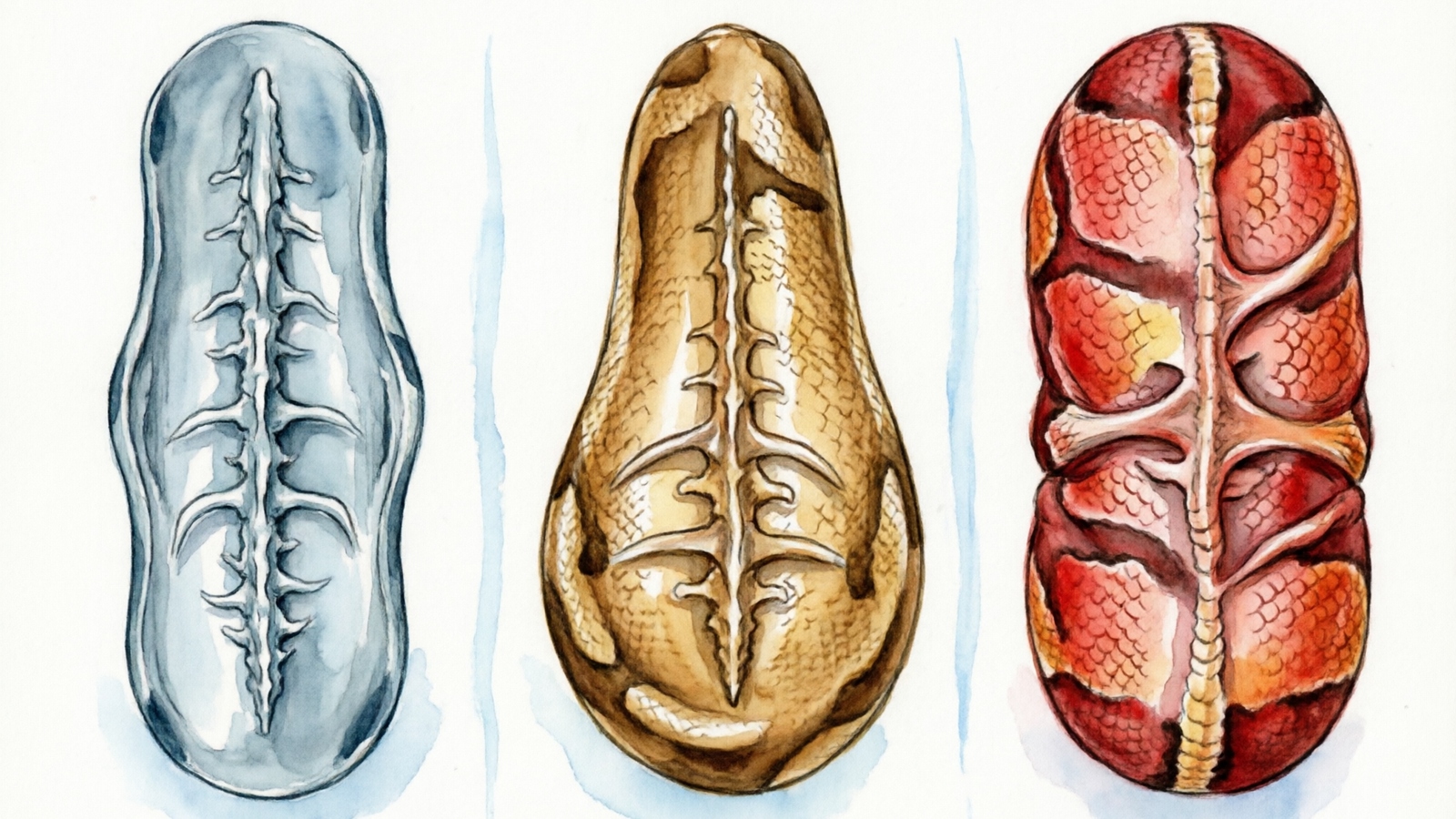
- ✅ Rounded triangular cross-section when viewed from above — not flat and not perfectly round
- ✅ Visible spine ridge but not protruding
- ✅ Smooth scales with no wrinkling
- ✅ Consistent weight on a digital scale with predictable trends
Overfeeding signs ❌:
- ❌ Round cross-section like a sausage rather than triangular
- ❌ Visible skin between scales resembling stretch marks
- ❌ Difficulty shedding in one piece
- ❌ Regurgitation after meals
- ❌ Lethargy and reduced movement
- ❌ Fatty deposits near the tail base
- ❌ Inability to coil tightly
Underfeeding signs ❌:
- ❌ Prominent spine and visible ribs
- ❌ Loose, wrinkled skin around the body
- ❌ Sunken eyes
- ❌ Head appearing oversized compared to body width
- ❌ Excessive hiding beyond normal ball python behavior
- ❌ Measurable weight loss on a digital scale
How to weigh your ball python:
Use a digital kitchen scale with a plastic container to prevent escape. Weigh at each feeding to track trends over time. Expected growth rate for juveniles is 50-100g per month during active feeding season (Merck Veterinary Manual).
Ball pythons naturally fast for several weeks, especially during winter months. This is normal behavior and not a cause for concern unless the snake is losing significant body weight (Merck Veterinary Manual).
Proper substrate allows burrowing and thermoregulation, which supports healthy metabolism and appetite. Security from quality hides is essential for feeding response — a stressed snake may refuse food entirely.
Ball Python Diet FAQ
How often should I feed my ball python?
Feeding frequency depends on age and size. Hatchlings from birth to three months need food every 5-7 days. Juveniles from three to twelve months eat every 7 days.
Sub-adults and adults over one year should eat every 10-14 days. Breeding females may need food every 7-10 days during the breeding season.
The prey item should be approximately 10-15% of the snake’s body weight at each feeding.
Can ball pythons go 2 weeks without eating?
Yes, this is completely normal for sub-adult and adult ball pythons. Adults can safely go 2-4 weeks between feedings.
Many fast voluntarily during winter months even when food is offered regularly. Hatchlings and juveniles should not go more than 10-14 days without food because they are still growing and need consistent nutrition.
Should I feed my ball python at night?
Yes. Ball pythons are nocturnal ambush predators and are most responsive to food after dark.
Offer prey in the evening or after turning off enclosure lights. If your snake seems uninterested during daytime offerings, switching to evening feeding often resolves reluctance in otherwise healthy snakes.
Do ball pythons need vitamin supplements?
For most ball pythons on a diet of whole frozen-thawed rats or mice, supplements are not necessary.
Whole prey contains bones for calcium, organs for vitamins, and fur for fiber. Occasional calcium dusting on prey every 2-4 feedings provides an extra safety margin, especially for breeding females and growing juveniles.
How long can a ball python go without eating?
Healthy adult ball pythons can go several months without food during voluntary fasting periods, typically in winter. Records exist of ball pythons fasting 6+ months without ill effect (Merck Veterinary Manual).
You should monitor weight throughout any fast. If the snake loses more than 10-15% of its body weight, consult a reptile veterinarian immediately. Hatchlings should not fast for more than 2-3 weeks without veterinary evaluation.