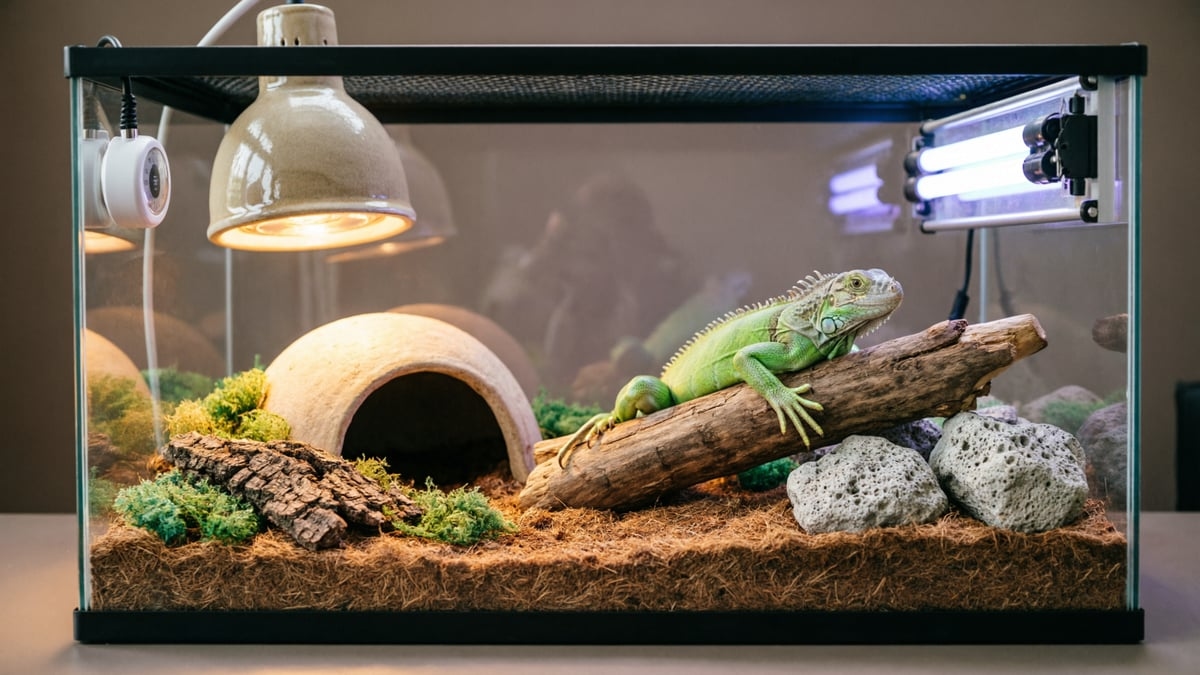
Creating the perfect reptile habitat requires understanding your specific pet’s needs. Unlike mammals, reptiles are ectothermic (cold-blooded) and rely on their environment to regulate body temperature. This guide covers the essential components of reptile habitat setup, from enclosure selection to heating, lighting, humidity, and decor.
Understanding Reptile Needs
Ectothermic Biology
Reptiles cannot generate their own body heat. They require:
- External heat sources (basking spots, heating pads)
- Temperature gradients (warm side, cool side)
- Proper lighting (UVB for vitamin D3 synthesis)
- Specific humidity levels (varies by species)
Species-Specific Requirements
Different reptiles have vastly different needs:
| Species Type | Temperature (Warm Side) | Humidity | UVB Needed? | Tank Size (Adult) |
|---|---|---|---|---|
| Bearded Dragon | 95-110°F | 30-40% | Yes (high) | 75+ gallons |
| Leopard Gecko | 88-95°F | 30-40% | Optional (low) | 20+ gallons |
| Ball Python | 88-92°F | 50-60% | Optional | 40+ gallons |
| Corn Snake | 80-85°F | 40-50% | Optional | 30+ gallons |
| Red-Eared Slider | 85-90°F (basking) | 60-80% | Yes | 75+ gallons (aquatic) |
| Crested Gecko | 72-80°F | 60-80% | Optional (low) | 20+ gallons (tall) |
Critical: Research your specific species before setup. Requirements vary dramatically.
Enclosure Selection
Types of Enclosures
1. Glass Terrariums ⭐⭐⭐⭐
Most common for beginners
Pros
- Widely available
- Good visibility
- Holds humidity well
- Easy to find in standard sizes
Cons
- Heavy
- Can be too humid for desert species
- Poor insulation (heat loss)
- Limited height for arboreal species
Best For
- Leopard geckos
- Ball pythons
- Corn snakes
- Semi-aquatic turtles
Recommended
- Exo Terra Glass Terrarium (18” x 18” x 18” to 36” x 18” x 18”)
- Price: $80-200
- Front-opening doors
- Built-in screen top
- Buy on Amazon
- Zoo Med Naturalistic Terrarium
- Price: $60-150
- Various sizes
- Good ventilation
- Buy on Amazon
2. PVC / Plastic Enclosures ⭐⭐⭐⭐⭐
Professional choice
Pros
- Excellent insulation (holds heat/humidity)
- Lightweight
- Durable
- Easy to clean
- Stackable
Cons
- More expensive
- Limited visibility (often front-opening only)
- Fewer size options
Best For
- Ball pythons
- Boas
- Monitor lizards
- Species requiring precise humidity
Recommended
- Animal Plastics T8 (various sizes)
- Price: $150-400
- Premium PVC
- Custom sizes available
- [Manufacturer Link Placeholder]
- Vision Cages
- Price: $100-300
- Stackable
- Excellent for breeders
- [Manufacturer Link Placeholder]
3. Screen Enclosures ⭐⭐⭐
For arboreal species
Pros
- Excellent ventilation
- Good for chameleons
- Lightweight
Cons
- Poor heat/humidity retention
- Hard to maintain tropical environments
- Not suitable for ground-dwelling species
Best For
- Chameleons
- Some geckos (day geckos)
- Anoles
Recommended
- Zoo Med Reptibreeze (16” x 16” x 20” to 24” x 24” x 48”)
- Price: $40-100
- Aluminum frame
- Good for chameleons
- Buy on Amazon - $129.99
4. Rack Systems ⭐⭐⭐
For breeders and large collections
Pros
- Space-efficient
- Easy temperature control
- Stackable
- Cost-effective for multiple animals
Cons
- Limited visibility
- Not for display
- Less natural environment
- Requires specialized heating
Best For
- Breeders
- Large snake collections
- Research facilities
Enclosure Size Guidelines
Minimum Tank Sizes (Adult)
| Species | Minimum Size | Better Option | Best Option |
|---|---|---|---|
| Leopard Gecko | 20 gal (30” x 12” x 12”) | 30 gal (36” x 12” x 12”) | 40 gal (36” x 18” x 16”) |
| Bearded Dragon | 40 gal (36” x 18” x 16”) | 75 gal (48” x 18” x 18”) | 120 gal (48” x 24” x 24”) |
| Ball Python | 40 gal (36” x 18” x 16”) | 60-80 gal | Custom PVC (4’ x 2’ x 2’) |
| Corn Snake | 20 gal (30” x 12” x 12”) | 30-40 gal | 40-60 gal |
| Crested Gecko | 20 gal tall (12” x 12” x 18”) | 30 gal tall | 18” x 18” x 24” or larger |
| Red-Eared Slider | 40 gal (aquatic) | 75-100 gal | 120+ gal or pond |
Rule of Thumb: The enclosure should allow the reptile to fully stretch out (for snakes) or have ample room to move and thermoregulate (for lizards).
Heating Systems
Why Heating Matters
Reptiles require specific temperatures for:
- Digestion (food processing)
- Immune function
- Activity levels
- Overall health
Creating a Temperature Gradient
Essential Setup: Provide a warm side and cool side
- Warm side: Basking spot + gradient down to mid-range
- Cool side: Lower temperature for thermoregulation
- Gradient: Allows reptile to choose preferred temperature
Example: Bearded Dragon
- Basking spot: 100-110°F
- Warm side: 85-95°F
- Cool side: 75-85°F
- Night: 65-75°F
Heating Options
1. Heat Mats / Under-Tank Heaters (UTH) ⭐⭐⭐⭐
Best for: Ground-dwelling species, belly heat
Pros
- Provides belly heat (good for digestion)
- Doesn’t affect air temperature much
- Good for nocturnal species
Cons
- Only heats substrate surface
- Can cause burns if too hot
- Not sufficient alone for many species
Recommended
- Zoo Med ReptiTherm Under Tank Heater
- Price: $15-30
- Various sizes
- Buy on Amazon
- Fluker’s Heat Mat
- Price: $12-25
- Good value
- Buy on Amazon - $29.99
Safety: Always use a thermostat with heat mats to prevent burns.
2. Ceramic Heat Emitters (CHE) ⭐⭐⭐⭐⭐
Best for: 24/7 heating, nighttime heat
Pros
- Provides ambient heat
- No light (won’t disturb day/night cycle)
- Long-lasting
- Good for raising overall enclosure temperature
Cons
- Requires ceramic socket fixture
- Can be expensive to run
- Hot to touch (keep away from reptile)
Recommended
- Ceramic Heat Emitter
- Price: $15-40 (60-150 watts)
- Lasts 5+ years
- Buy on Amazon
- Fluker’s Ceramic Heat Emitter
- Price: $15-35
- Good value
- Buy on Amazon
Safety: Use with a thermostat and ceramic socket fixture only.
3. Basking Bulbs (Incandescent/Halogen) ⭐⭐⭐⭐
Best for: Daytime basking spots
Pros
- Provides heat and light
- Creates focused basking spot
- Natural behavior (reptiles seek light + heat)
- Good for desert species
Cons
- Light can disturb if used at night
- Burns out frequently
- Only for daytime use
Recommended
- Zoo Med Basking Spot Lamp
- Price: $5-10 per bulb
- Various wattages
- Buy on Amazon - $19.96
- Exo Terra Sun-Glo Basking Spot
- Price: $6-12
- Good intensity
- Buy on Amazon - $21.99
Tip: Combine with UVB bulb for desert species (bearded dragons, uromastyx).
4. Deep Heat Projectors ⭐⭐⭐⭐⭐
Best for: Natural heat penetration, advanced setups
Pros
- Heats like sun (infrared A, B, C)
- Deep tissue penetration
- No visible light
- Energy-efficient
- Long-lasting
Cons
- Expensive
- Requires specific fixture
- Newer technology (less widely available)
Recommended
- Arcadia Deep Heat Projector
- Price: $50-80
- 50W, 80W, 100W options
- Premium choice
- Buy on Amazon - $30.99
Pro Tip: Deep heat projectors are the most natural heating method available.
Thermostats & Temperature Control ⭐⭐⭐⭐⭐
Essential for safe heating
Why You Need a Thermostat
- Prevents overheating
- Protects reptile from burns
- Maintains consistent temperatures
- Saves energy
Types of Thermostats
1. On/Off Thermostats (Basic)
- Price: $15-30
- Simple, affordable
- Good for heat mats
- Temperature fluctuates slightly
2. Pulse Thermostats (Better)
- Price: $40-80
- Maintains precise temperature
- Good for ceramic heat emitters
- More consistent
3. Dimming Thermostats (Best)
- Price: $60-120
- Precise control
- Extends bulb life
- Best for basking bulbs
Recommended
- Herpstat Thermostat (Dimming)
- Price: $80-150
- Premium, reliable
- [Manufacturer Link Placeholder]
- Jump Start Thermostat (On/Off)
- Price: $20-30
- Budget-friendly
- Buy on Amazon - $45.89
- Inkbird Temperature Controller (On/Off)
- Price: $30-40
- Good value
- Buy on Amazon
Critical: Never use heat sources without a thermostat. Burns are a common and serious injury.
Thermometers & Monitoring
Minimum: 2 thermometers (warm side, cool side)
Options
- Digital thermometer with probe ($10-20)
- Accurate
- Probe can be placed at reptile level
- Recommended
- Temp gun (infrared thermometer) ($15-30)
- Quick surface readings
- Check basking spot temperature
- Supplemental
- Stick-on analog thermometers ($3-5)
- Inexpensive
- Less accurate
- Better than nothing
Recommended
- Zoo Med Digital Terrarium Thermometer
- Price: $10-15
- Accurate, reliable
- Buy on Amazon - $9.98
- Etekcity Infrared Thermometer
- Price: $15-25
- Quick readings
- Buy on Amazon - $18.99
Lighting
UVB Lighting
Essential for many species
Why UVB Matters
- Vitamin D3 synthesis (calcium absorption)
- Prevents metabolic bone disease (MBD)
- Improves appetite and activity
- Natural behavior
Who Needs UVB?
High UVB Requirements:
- Bearded dragons
- Uromastyx
- Chuckwallas
- Turtles and tortoises
- Day geckos
- Iguanas
Low to Moderate UVB:
- Leopard geckos (optional but beneficial)
- Crested geckos (optional)
- Ball pythons (optional, low)
- Corn snakes (optional)
No UVB (nocturnal/burrowing):
- Leopard geckos (can thrive without)
- Ball pythons (can thrive without)
- Many snakes (nocturnal hunters)
Note: Recent research suggests most reptiles benefit from some UVB, even if not strictly required.
UVB Bulb Types
1. Linear Fluorescent Tubes ⭐⭐⭐⭐⭐
- Best coverage
- Long-lasting (6-12 months)
- Various strengths (5.0, 10.0, 12.0)
- Requires fixture
2. Compact Fluorescent ⭐⭐⭐
- Easy to use (screws in)
- Focused beam
- Good for small enclosures
- Lasts 6-12 months
3. Mercury Vapor Bulbs ⭐⭐⭐⭐
- UVB + heat in one
- Good for large enclosures
- Expensive
- Can’t be used with thermostat
Recommended UVB Bulbs
For Desert Species (High UVB):
- Arcadia T5 HO 12% or 14%
- Price: $30-50
- Best quality
- Buy on Amazon - $35.00
- Zoo Med Reptisun T5 HO 10.0
- Price: $25-40
- Widely available
- Buy on Amazon - $79.00
For Forest Species (Moderate UVB):
- Arcadia T5 HO 6%
- Price: $30-50
- Good for tropicals
- Buy on Amazon
- Zoo Med Reptisun T5 HO 5.0
- Price: $25-40
- Good value
- Buy on Amazon - $35.00
Replace UVB bulbs every 6-12 months (UVB output degrades even if bulb still lights up).
Photoperiod (Day/Night Cycle)
Provide 12-14 hours of light, 10-12 hours of darkness
- Use timer for consistency
- Mimics natural cycle
- Important for circadian rhythm
Humidity Control
Why Humidity Matters
- Hydration (especially for tropical species)
- Shedding (prevents stuck shed)
- Respiratory health
- Egg development (for breeding)
Measuring Humidity
Use a hygrometer (digital preferred)
- Analog hygrometers: $3-8 (less accurate)
- Digital hygrometers: $10-20 (more accurate)
Recommended
- Digital Hygrometer/Thermometer
- Price: $10-15
- Accurate
- Buy on Amazon - $6.92
Increasing Humidity
For Tropical Species (60-80% humidity):
- Misting (manual or automatic)
- Spray enclosure 1-2 times daily
- Use distilled or RO water
- Fogger / Humidifier
- Automatic humidity
- Use reptile-safe fogger
- $30-80
- Larger water bowl
- Evaporation increases humidity
- Moist hide
- Hide with damp moss (for shedding)
- Live plants
- Natural humidity boost
- Must be reptile-safe
- Reduce ventilation
- Cover part of screen top
- Use foil or acrylic
Recommended
- Zoo Med Repti Fogger
- Price: $40-60
- Automatic humidity
- Buy on Amazon - $35.00
- Exo Terra Monsoon
- Price: $80-120
- Programmable misting system
- Buy on Amazon
Decreasing Humidity
For Desert Species (20-40% humidity):
- Increase ventilation
- Use screen top
- Add fans (indirect)
- Use heat
- Heat dries air
- Reduce water bowl size
- Less evaporation
- Use low-humidity substrate
- Sand, paper towels
- Dehumidifier (in room)
- For very humid climates
Substrate Options
What to Consider
- Species requirements (desert vs. tropical)
- Safety (impaction risk)
- Ease of cleaning
- Aesthetics
Substrate Types
1. Paper Towels / Newspaper ⭐⭐⭐⭐⭐
Best for: Quarantine, medical issues, beginners
- Pros: Safe, cheap, easy to clean, monitor health (see poop)
- Cons: Not natural-looking, needs frequent changing
- Cost: $5-10/month
2. Reptile Carpet ⭐⭐⭐
Best for: Some lizards, beginners
- Pros: Reusable, safe, decent appearance
- Cons: Hard to clean thoroughly, can harbor bacteria
- Cost: $10-20 (lasts months)
3. Coconut Fiber (Coir) ⭐⭐⭐⭐
Best for: Tropical species, ball pythons, burrowers
- Pros: Holds humidity, natural, safe if ingested in small amounts
- Cons: Can be dusty, needs regular changing
- Cost: $10-20/month
Recommended
- Zoo Med Eco Earth
- Price: $5-10 per brick
- Expands when wet
- Buy on Amazon - $17.77
- Exo Terra Plantation Soil
- Price: $5-10 per brick
- Good quality
- Buy on Amazon
4. Cypress Mulch ⭐⭐⭐⭐
Best for: Humid species, snakes
- Pros: Holds humidity well, natural, less dusty than coir
- Cons: Can be messy, some brands have large pieces
- Cost: $15-25/bag
Recommended
- Zoo Med Forest Floor Bedding
- Price: $15-20 per bag
- Good for snakes
- Buy on Amazon - $17.70
5. Sand ⭐⭐⭐
Best for: Desert species (with caution)
- Pros: Natural for desert species, aesthetic
- Cons: Impaction risk (if ingested), dusty
- Cost: $10-20/bag
Caution: Sand impaction is a real risk, especially for juvenile reptiles. Use only with healthy adults who don’t typically ingest substrate. Avoid calcium sand (encourages ingestion).
Recommended (if using sand)
- Zoo Med ReptiSand
- Price: $10-15 per bag
- Natural desert sand
- Buy on Amazon - $35.00
6. Bioactive Substrate ⭐⭐⭐⭐⭐
Best for: Advanced keepers, natural setups
- Pros: Self-cleaning (with isopods/springtails), natural, low maintenance long-term
- Cons: Complex setup, expensive initially, learning curve
- Cost: $50-100 initial, low ongoing
Components
- Drainage layer (leca balls or gravel)
- Barrier layer (mesh)
- Soil layer (coco fiber + organic soil)
- Leaf litter
- Clean-up crew (isopods, springtails)
Advanced: Bioactive setups require research but are excellent for long-term housing.
Substrates to Avoid
- ❌ Cedar and pine shavings (toxic phenols, respiratory issues)
- ❌ Corn cob bedding (molds, impaction risk)
- ❌ Walnut shell (sharp, impaction risk)
- ❌ Calcium sand (encourages ingestion, impaction)
- ❌ Kitty litter (dusty, chemicals)
Decor & Enrichment
Hides & Shelters ⭐⭐⭐⭐⭐
Essential for all reptiles
- Minimum: 2-3 hides (warm side, cool side, humid hide for some species)
- Types: Commercial hides, cork bark, half logs, rock caves
Recommended
- Zoo Med Repti Shelter
- Price: $15-25
- Multiple sizes
- Buy on Amazon - $35.00
- Exo Terra Cave
- Price: $12-20
- Realistic rock appearance
- Buy on Amazon
Climbing Structures
For arboreal and semi-arboreal species
- Branches: Natural (sterilize) or commercial
- Vines: Artificial vines for climbing
- Ledges: Magnetic or mounted shelves
- Platforms: Basking platforms
Recommended
- Zoo Med Cork Bark
- Price: $10-25
- Natural, lightweight
- Buy on Amazon - $35.00
- Exo Terra Jungle Vine
- Price: $8-15
- Bendable, realistic
- Buy on Amazon - $35.00
Water Features
Essential for aquatic and semi-aquatic species
- Water bowl: Size appropriate for species
- Soaking area: For turtles, some snakes
- Waterfall/fountain: Aesthetic + humidity (optional)
Recommended
- Exo Terra Water Dish
- Price: $8-15
- Various sizes
- Buy on Amazon - $35.00
- Zoo Med Repti Ramp Bowl
- Price: $10-18
- Easy entry/exit
- Buy on Amazon - $35.00
Live vs. Artificial Plants
Live Plants:
- Pros: Natural, improve air quality, humidity
- Cons: Require care, some are toxic, can be eaten
Artificial Plants:
- Pros: Low maintenance, durable, safe
- Cons: Not natural, can look fake
If using live plants: Ensure they are reptile-safe. Avoid toxic varieties.
Reptile-Safe Plants
- Pothos (very hardy)
- Snake plant
- Spider plant
- Ficus
- Bromeliads
Habitat Setup by Species Type
Desert Species (Bearded Dragon, Uromastyx)
Enclosure: 40-120+ gallons Substrate: Sand (with caution), paper towels, tile Temperature: Basking 100-115°F, cool side 75-85°F Humidity: 20-40% Lighting: High UVB (10.0-12.0) Decor: Basking rock, hides, branches
Tropical Species (Crested Gecko, Day Gecko)
Enclosure: 20+ gallons (tall) Substrate: Coconut fiber, bioactive Temperature: 72-82°F (no hot basking spot for cresteds) Humidity: 60-80% Lighting: Low to moderate UVB (5.0-6.0) Decor: Plants (live or artificial), branches, vines, hides
Temperate Species (Corn Snake, King Snake)
Enclosure: 20-40+ gallons Substrate: Aspen shavings, coconut fiber, paper towels Temperature: Warm side 82-88°F, cool side 70-78°F Humidity: 40-60% Lighting: UVB optional (beneficial) Decor: Multiple hides, branches, water bowl
Semi-Aquatic Species (Turtles)
Enclosure: 40-120+ gallons (mostly water) Substrate: River rocks (large), bare bottom, or sand Temperature: Water 75-80°F, basking 85-95°F Humidity: 60-80% (in water area) Lighting: High UVB (10.0), basking light Decor: Basking platform, hiding spots, filter, heater
For box turtle owners, see our Box Turtle Care Guide for species-specific habitat requirements. For turtle owners, see our Shell Care Guide.
Safety Checklist
- ✅ Thermostat on all heat sources
- ✅ Temperature gradient (warm and cool sides)
- ✅ Appropriate tank size
- ✅ Secure lid (reptiles are escape artists)
- ✅ No sharp edges
- ✅ Non-toxic materials only
- ✅ Hides available
- ✅ Clean water source
- ✅ UVB bulb replaced within 6-12 months
- ✅ Thermometers and hygrometers in place
Common Mistakes
Mistake 1: Too Small Enclosure
Problem: Stress, health issues, inability to thermoregulate. Solution: Research minimum size, provide larger if possible.
Mistake 2: No Temperature Gradient
Problem: Reptile can’t choose preferred temperature. Solution: Heat only one side, provide cool side.
Mistake 3: No Thermostat
Problem: Burns, overheating, fire risk. Solution: Use thermostat on all heat sources.
Mistake 4: Wrong UVB Bulb or None
Problem: Metabolic bone disease, poor health. Solution: Provide appropriate UVB for species, replace regularly.
Mistake 5: Incorrect Humidity
Problem: Shedding issues, respiratory infections. Solution: Research species needs, monitor with hygrometer.
Mistake 6: Toxic Substrate
Problem: Cedar/pine cause respiratory issues. Solution: Use reptile-safe substrates only.
Mistake 7: No Hides
Problem: Stress, insecurity. Solution: Provide multiple hiding spots.
Mistake 8: Overheating at Night
Problem: Disrupted day/night cycle, stress. Solution: Allow temperature drop at night (use ceramic heat emitter if needed).
Maintenance Schedule
Daily
- Check temperatures (warm and cool sides)
- Check humidity
- Provide fresh water
- Remove waste (spot clean)
- Check reptile health (activity, eyes, breathing)
Weekly
- Clean water bowl (hot soapy water)
- Remove soiled substrate (spot clean deeper)
- Check UVB bulb (replace if over 6-12 months)
- Wipe down enclosure surfaces
Monthly
- Deep clean (remove all decor, clean thoroughly)
- Replace substrate (or refresh)
- Check all equipment (heaters, lights, thermostats)
- Inspect for damage
Budget Breakdown
Leopard Gecko Setup (Beginner)
| Item | Budget Option | Quality Option |
|---|---|---|
| Enclosure (20 gal) | $40 (glass tank) | $80 (front-opening) |
| Heat mat | $15 | $25 (with thermostat) |
| Thermostat | $20 | $50 (dimming) |
| Thermometer | $10 | $20 (digital with probe) |
| Substrate | $5 (paper towels) | $15 (reptile carpet) |
| Hides (3) | $15 (DIY) | $30 (commercial) |
| Water bowl | $5 | $10 |
| Total | $110 | $230 |
Bearded Dragon Setup (Intermediate)
| Item | Budget Option | Quality Option |
|---|---|---|
| Enclosure (40 gal kit) | $120 | $200 (75 gal) |
| Basking bulb | $5 | $10 |
| UVB bulb (T5 10.0) | $30 | $40 |
| Fixture for UVB | $15 | $25 |
| Thermostat | $25 | $80 (dimming) |
| Thermometers (2) | $15 | $30 |
| Substrate (tile/sand) | $15 | $25 |
| Hides & decor | $30 | $60 |
| Total | $255 | $470 |
Note: Initial setup is expensive, but ongoing costs are $20-50/month (electricity, substrate, food).
Summary: Key Takeaways
- ✅ Research species-specific needs before setup
- ✅ Temperature gradient is essential (warm side, cool side)
- ✅ Always use a thermostat with heat sources
- ✅ UVB lighting prevents metabolic bone disease (required for many species)
- ✅ Monitor temperature and humidity with digital gauges
- ✅ Provide appropriate-sized enclosure (larger is better)
- ✅ Multiple hides provide security
- ✅ Avoid toxic substrates (cedar, pine)
- ✅ Replace UVB bulbs every 6-12 months
- ✅ Safety first: Secure lid, no sharp edges, non-toxic materials
Frequently Asked Questions (FAQ)
1. What size tank do I need for a bearded dragon?
Minimum 40 gallons for juvenile, 75+ gallons for adult. Many commercial “bearded dragon kits” are too small.
2. Do snakes need UVB lighting?
Not strictly required for many species, but beneficial. Recent research suggests low-level UVB improves health even for nocturnal snakes.
3. Can I use a heat rock?
No. Heat rocks cause severe burns. Use under-tank heaters with thermostats instead.
4. How do I know if my reptile is too hot or cold?
Watch behavior: Too cold = lethargy, lack of appetite. Too hot = gaping mouth, trying to escape heat. Use thermometers to confirm.
5. What’s the best substrate for ball pythons?
Coconut fiber, cypress mulch, or aspen shavings. Avoid sand and cedar/pine. For detailed substrate recommendations and setup guidance, see our ball python care guide.
6. How often should I replace UVB bulbs?
Every 6-12 months, even if they still light up. UVB output degrades over time.
7. Do I need a thermostat for a heat mat?
Absolutely yes. Heat mats can reach dangerous temperatures without regulation.
8. What humidity does a crested gecko need?
60-80%. Mist daily and use a hygrometer to monitor.
9. Can I use sand for my leopard gecko?
Not recommended, especially for juveniles. Impaction risk is high. Use paper towels, reptile carpet, or tile.
10. How do I clean a reptile tank?
Daily: Remove waste. Weekly: Clean water bowl, spot clean. Monthly: Deep clean with reptile-safe disinfectant, replace substrate.
Recommended Products
Heating:
- Zoo Med ReptiTherm Heat Mat - Under-tank heater - Buy on Amazon
- Ceramic Heat Emitter - 24/7 heat - Buy on Amazon
- Herpstat Thermostat - Temperature control [Manufacturer Link Placeholder]
Lighting:
- Arcadia T5 UVB Kit - Best UVB lighting - Buy on Amazon - $114.99
- Zoo Med Reptisun T5 HO 10.0 - Desert species - Buy on Amazon - $79.00
Enclosures:
- Exo Terra Glass Terrarium - Front-opening - Buy on Amazon
- Animal Plastics PVC Cage - Premium [Manufacturer Link Placeholder]
Substrates:
- Zoo Med Eco Earth - Coconut fiber - Buy on Amazon - $17.77
- Zoo Med Forest Floor - Cypress mulch - Buy on Amazon - $17.70
Monitoring:
- Digital Thermometer - Temperature - Buy on Amazon
- Digital Hygrometer/Thermometer - Humidity - Buy on Amazon - $6.92