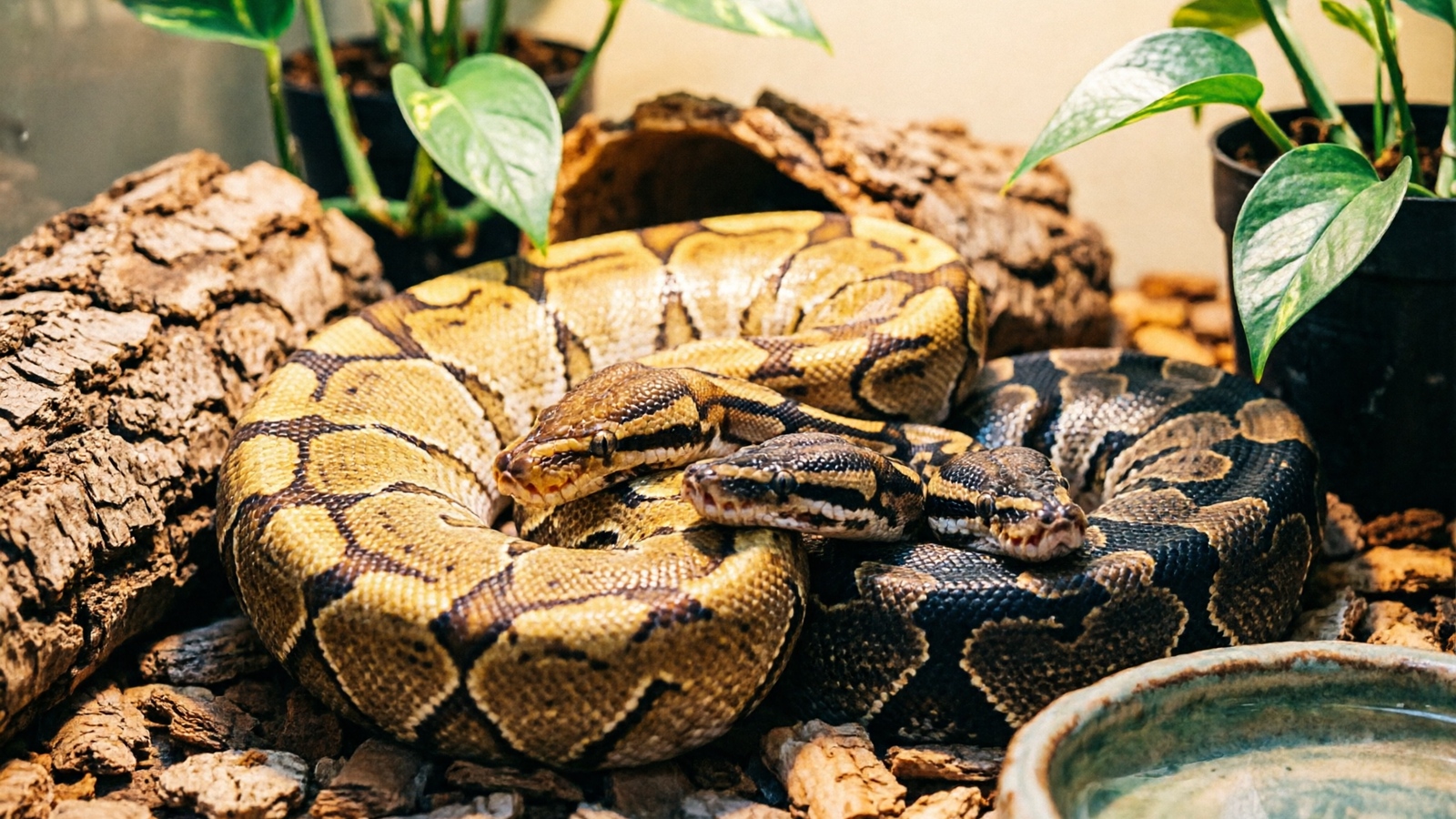
Is Your Ball Python Ready to Breed?
Breeding ball pythons requires careful preparation. Both snakes must meet specific age and weight thresholds before pairing. Rushing the process risks egg binding, yolk coelomitis, and death in females (Merck Veterinary Manual).
| Factor | Female | Male |
|---|---|---|
| Minimum weight | 1,500 grams | 600-800 grams |
| Recommended weight | 1,800-2,000+ grams | 700+ grams |
| Minimum age | 2.5-3 years | 1.5-2 years |
| Recommended age | 3+ years | 2+ years |
| Length at readiness | 3-4+ feet | 2-3 feet |
| Key indicator | Has ovulated at least once | Produces semen plug after pairing |
Weight matters more than age for breeding readiness. A 3-year-old female under 1,500 grams is not ready, regardless of her age (Merck Veterinary Manual).
The correct breeding age matters, but both snakes must be feeding consistently and at a healthy body weight. Review our ball python care guide for baseline health checks for at least three months prior to breeding. They should be free of respiratory infections, mites, and scale rot (Merck Veterinary Manual). A snake that is currently refusing food or recovering from illness should not be bred.
Proper nutrition is essential before breeding. See our feeding guide for weight management and diet recommendations.
Ball Python Breeding Season and Temperature Cycling
REPTI ZOO 18x18x36” Cage is a quality option worth considering for your setup.
In the wild, breeding season runs from October through March, when temperatures naturally drop in West and Central Africa (Merck Veterinary Manual). Breeding activity aligns with the dry season when prey is more available for gravid females.
Temperature cycling simulates this seasonal change in captivity. Lower nighttime temperatures to 75-78°F for 4-6 weeks while maintaining normal daytime temperatures of 85-90°F on the warm side and 80°F on the cool side.
Cycling is not strictly required — many breeders successfully produce clutches without it by simply introducing males during the natural breeding season. However, cycling increases pairing success rates and can trigger males that might otherwise show little interest.
Some males stop eating during the cycling period and focus entirely on finding females. This fasting response is normal and should not cause concern unless the male loses significant body weight (Merck Veterinary Manual).
After the cycling period ends, return to normal temperatures and begin pairing one to two weeks later. Temperature and humidity work together for breeding success — see our humidity guide for maintaining proper environmental conditions.
Keepers who track their cycling dates on a calendar have more predictable breeding outcomes than those who rely on memory alone.
Pairing Your Ball Pythons
Many owners find that Exo Terra Multi Vitamin 2.5 oz → works well for their pet’s needs.
Ball python breeding for beginners starts with understanding the pairing process. The following steps cover the complete introduction from first contact through confirmed mating.
Step 1: Introduce the male. Place the male into the female’s enclosure, never the reverse. Females are territorial and may become stressed if moved. Introduce in the evening when both snakes are naturally active and alert.
Step 2: Watch for courtship behavior. The male will spasm or twitch — often called the “male breeding response.” This twitching is caused by hemipene erection. He will follow the female and attempt to align their cloacas. Breeding behavior in receptive females during this phase includes raising the tail and remaining relatively still if receptive (Merck Veterinary Manual).
Step 3: Confirm the lock. When copulation occurs, the male inserts one hemipene into the female’s cloaca and they lock together. They may remain locked for 4-24 hours. Do not separate them during a lock — this can injure both snakes (Merck Veterinary Manual).
Step 4: Record the lock date. Mark your calendar. Ovulation typically occurs 30-45 days after the first successful lock. This date is critical for predicting egg-laying.
Step 5: Repeat pairing. Remove the male after the lock ends and re-introduce every 3-5 days until the female ovulates or shows clear signs of gravidity.
Step 6: Confirm success. After successful mating, the male may leave a visible semen plug in the female’s cloaca or on the enclosure substrate within 24-48 hours (Merck Veterinary Manual).
Non-receptive females may ball up, strike, or flee. Never leave unattended pairings for extended periods. If the female is aggressive and the male cannot escape, remove him and try again in a few days.
From Ovulation to Egg-Laying
For this purpose, GEGURI Tortoise Habitat with Pull-Out Tray is a popular choice among pet owners.
This breeding timeline chart from pairing through hatching. Tracking this timeline accurately helps you prepare for each phase.
| Phase | Timing | Signs | Action |
|---|---|---|---|
| Pairing | Oct-Mar | Male twitching, lock | Introduce male every 3-5 days |
| Ovulation | 30-45 days post-lock | Mid-body swelling | Day 0 — start counting |
| Pre-lay shed | 14-21 days post-ovulation | Full body shed | Prepare lay box |
| Egg-laying | 28-35 days post-ovulation | Restless, in lay box | Monitor closely |
| Incubation | 55-65 days | — | Move eggs to incubator |
| Hatching | 55-65 days post-laying | Pipping, slit in egg | Monitor hatchlings |
Ovulation is the most visible sign. The female’s mid-body swells dramatically as if she has swallowed a large egg (Merck Veterinary Manual). This swelling lasts 24-48 hours and marks Day 0 for your egg-laying countdown.
The pre-lay shed occurs 14-21 days after ovulation (Merck Veterinary Manual). When you see this shed, prepare a moist lay box immediately.
A plastic container filled with damp sphagnum moss or vermiculite works well. The female will spend most of her time in the lay box as egg-laying approaches.
Egg-laying typically occurs 28-35 days after ovulation, which is 14-18 days after the pre-lay shed (Merck Veterinary Manual). A proper lay box substrate is critical for egg health — see our substrate guide for egg-laying-safe materials.
Ball Python Egg Incubation
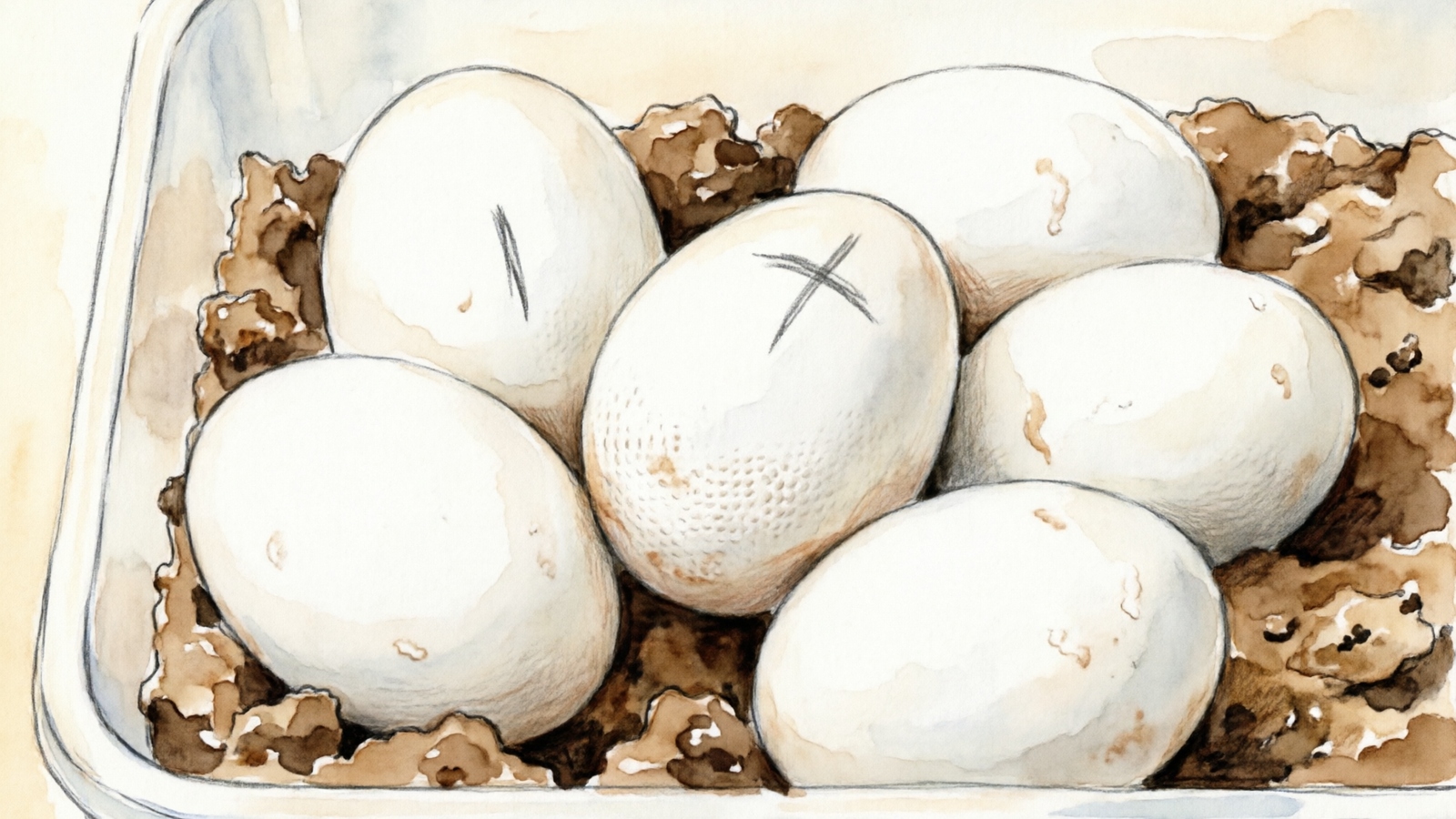
Ball python egg incubation requires precise temperature and humidity control — a reliable thermostat prevents dangerous fluctuations. The parameters below cover every critical factor.
| Parameter | Recommended Range | Notes |
|---|---|---|
| Temperature | 87-90°F | Below 85°F = mostly males, 90°F+ = deformities |
| Sex determination | 89-90°F = female, 85-87°F = male | Temperature-dependent sex determination |
| Humidity | 90-100% | Too dry = collapsed eggs, too wet = mold |
| Medium | Vermiculite or perlite, 1:1 ratio by weight | Should hold shape when squeezed, no dripping |
| Container | Plastic deli cups with small holes | Individual cups per clutch or per egg |
| Duration | 55-65 days | Never rotate eggs |
Ball pythons have temperature-dependent sex determination (Merck Veterinary Manual). Incubating at 89-90°F produces predominantly females, while 85-87°F produces predominantly males.
The intermediate range yields a mix of both sexes. This makes consistent temperature control essential for predicting your clutch’s sex ratio.
Critical rules for ball python egg incubation:
Never rotate eggs after laying. The embryo attaches to the top of the egg shell, and rotating can drown it (Merck Veterinary Manual). Mark the top of each egg with a pencil to maintain orientation if you need to move them.
If eggs stick together in a cluster, do not force them apart. Incubate the connected cluster as a single unit. Separation can damage the eggs and kill embryos.
Candling — shining a light through the egg after two weeks — reveals fertility status. Fertile eggs show reddish veining inside, while infertile eggs remain yellow or clear (Merck Veterinary Manual). Remove infertile eggs to prevent mold from spreading to the clutch.
Proper enclosure setup supports the entire breeding process. See our tank guide for housing recommendations.
Hatchling Care — First Weeks
Hatchling care begins the moment eggs start pipping. Patience during this stage prevents more problems than any other factor.
- ✅ Leave hatchlings in the egg until fully absorbed — stay inside 24-48 hours after first pip slit. Yolk sac still absorbing through umbilical area
- ✅ Leave hatchlings in the egg until fully absorbed. Hatchlings often stay inside the egg 24-48 hours after making their first pip slit. The yolk sac is still absorbing through the umbilical area during this time. Pulling a hatchling out prematurely can cause infection or death (Merck Veterinary Manual).
- ✅ Move to individual enclosures — after hatchling leaves the egg, place in a 6-quart shoebox tub. Use paper towel substrate initially, upgrade after first shed
- ✅ Move to individual enclosures. After the hatchling leaves the egg on its own, place it in a small individual tub — a 6-quart shoebox size works well. Use paper towel substrate initially and upgrade after the first shed.
- ✅ Wait for the first shed — occurs 7-14 days after hatching. Do not offer food until after this shed
- ✅ Wait for the first shed. Hatchlings shed for the first time 7-14 days after hatching. Do not offer food until after this shed (Merck Veterinary Manual). The hatchling is still absorbing internal yolk reserves during this period.
- ✅ Offer the first meal after the first shed — start with a live fuzzy mouse or small rat pup. Transition to frozen-thawed after 3-4 consistent meals
- ✅ Offer the first meal after the first shed. Start with a live fuzzy mouse or small rat pup. Many hatchlings prefer live prey for their first meal. Once the hatchling eats consistently for three to four meals, begin transitioning to frozen-thawed prey.
- ✅ Maintain proper heat and humidity — warm side 80-90°F, humidity 50-60%. Use a small, shallow water dish to prevent drowning
- ✅ Maintain proper heat and humidity. Hatchlings dehydrate faster than adults. Keep the warm side at 80-90°F and humidity at 50-60% (Merck Veterinary Manual). Use a small, shallow water dish to prevent drowning.
- ✅ Minimize handling — handle only for weight checks and enclosure cleaning during the first 2-3 months
- ✅ Minimize handling. Handle only for weight checks and enclosure cleaning during the first two to three months. Hatchlings are fragile and stress easily from excessive handling. Typical ball python clutch size is 3-11 eggs. First-time breeders usually produce smaller clutches of 3-6 eggs. Well-conditioned females can produce 8-11 eggs.
Hatchling feeding differs significantly from adult feeding. See our feeding guide for prey size and schedule recommendations for young snakes.
Some hatchlings are reluctant feeders. Our not eating troubleshooting guide covers techniques to start difficult hatchlings on food. Quality hides provide the security hatchlings need to begin feeding confidently.
Ethical Breeding Considerations
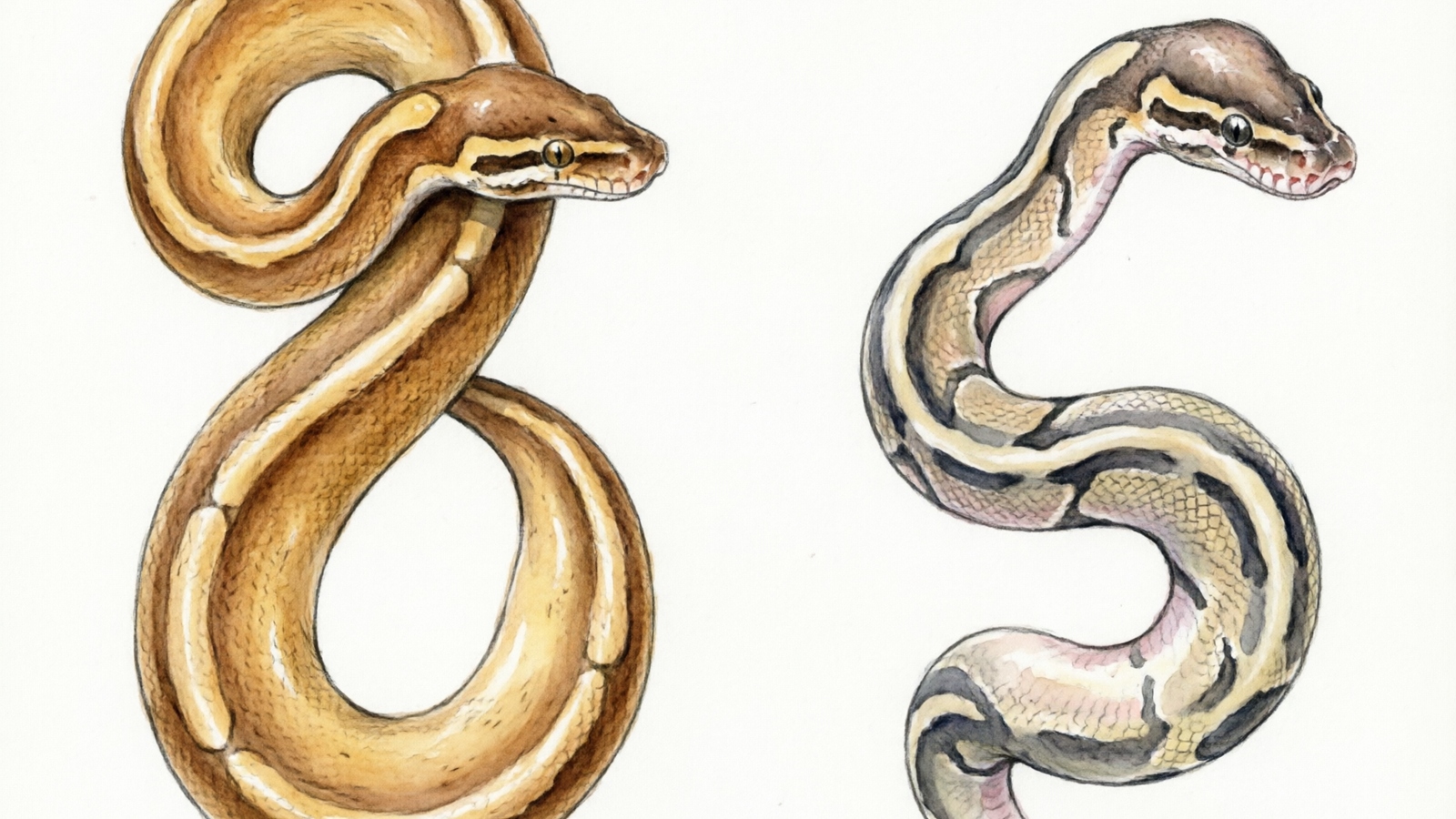
Responsible breeding goes beyond producing healthy hatchlings. Every breeder should consider the long-term impact of their decisions before pairing any snakes.
Before breeding, confirm the following:
Go through this checklist honestly — breeding without planning creates more problems than it solves.
- ✅ Have a plan for every hatchling — can you house 3-11 babies for 6-12 months if buyers do not materialize?
- ✅ Budget for emergency veterinary care — egg-binding treatment is expensive, and hatchling health issues are common in the first weeks
- ✅ Verify both parents are free of known genetic disorders — the spider morph causes a neurological condition that affects every animal carrying the gene
- ✅ Use reliable incubation equipment — temperature fluctuations from DIY setups can destroy entire clutches
- ✅ Research current market prices on MorphMarket — common morphs often sell below the cost of raising hatchlings
Practices to avoid ❌:
- ❌ Do not breed ball pythons carrying the spider gene — neurological disorder causes head wobbling, corkscrewing, and difficulty striking prey
- ❌ Do not breed related snakes without understanding morph genetics — inbreeding concentrates health problems and weakens offspring
- ❌ Do not breed females every consecutive year — annual breeding depletes calcium and fat reserves. Breed every other year
- ❌ Do not release unwanted hatchlings — released pythons cannot survive in non-native climates and damage local ecosystems
Breeding and Reproduction FAQ
How long do ball python eggs take to hatch?
Ball python eggs incubate for 55-65 days at 87-90°F. Higher temperatures within the safe range produce slightly faster development.
Eggs should begin pipping around day 55. The hatchling cuts a small slit in the shell using its egg tooth (Merck Veterinary Manual). Do not assist hatching unless the hatchling has been stuck in the same pip position for more than 48 hours.
What is the ideal age for breeding ball pythons?
Females must be at least 2.5-3 years old and weigh a minimum of 1,500 grams. Weight is more important than age — a small 3-year-old female should not be bred.
Males can breed at 1.5-2 years old and 600-800 grams. Breeding too young causes health problems, egg binding, and shortened lifespan in females (Merck Veterinary Manual).
How do you know if a ball python is gravid?
Signs of gravidity include noticeable mid-body swelling, constant basking on the warm side, refusing food, and spending time in a lay box near the end of the gravid period.
The most definitive sign is ovulation. This is a dramatic, temporary swelling in the lower third of the body that lasts 24-48 hours. Once you observe ovulation, count forward 30-35 days to predict egg-laying.
How many eggs does a ball python lay?
A typical clutch contains 3-11 eggs. First-time breeders usually lay 3-6 eggs.
Well-conditioned females can produce 8-11 eggs. Clutch size correlates with the female’s size and overall health. Double clutching within the same season is possible but not recommended because it severely depletes the female’s reserves (Merck Veterinary Manual).
What temperature produces male vs female ball pythons?
Ball pythons have temperature-dependent sex determination. Incubating eggs at 89-90°F produces predominantly females.
Incubating at 85-87°F produces predominantly males. The intermediate range of 87-89°F produces a mix of both sexes. Consistent temperature throughout incubation is critical — small fluctuations can shift the sex ratio of an entire clutch.