Warning: Medical Disclaimer: This article is not a substitute for professional veterinary care. If your crested gecko is showing signs of illness, dehydration, or persistent appetite loss, consult a qualified exotic veterinarian.
Quick Answer — Most Crested Gecko Fasting Is Normal
If you’re asking why is my crested gecko not eating, here’s the reassurance most new owners need: occasional fasting of 1-3 days is completely normal for crested geckos, especially during environmental changes, shedding, or temperature fluctuations.
The 2-Week Rule for crested geckos:
- Adults (over 12 months): Start troubleshooting after 1 week without eating. See a vet if nothing changes after 2 weeks.
- Babies (under 6 months / under 15g): See a vet if not eating for more than 5-7 days — babies decline fast.
The 3-layer troubleshooting approach:
- 🟢 First, check the environment: Temperature (72-78°F?), humidity (50-85%?), enclosure security, CGD freshness
- 🟡 Then, consider behavior: New home adjustment, shedding, seasonal slowdown, breeding season
- Warning: Last, rule out illness: Mouth rot, parasites, metabolic bone disease, impaction, respiratory infection
The single most useful fact I can give you: if your gecko is producing normal poop, it’s eating — even if you never see it at the food dish. I’ve kept crested geckos for years, and I still find myself checking the enclosure for feces before worrying about an empty food dish. For a complete care reference, see our crested gecko care guide.
Is It Normal? — When to Worry vs. When to Wait
Aiicioo 8W → is a quality option worth considering for your setup.
This is the question every crested gecko owner needs answered fast. Use this table to decide whether your situation is likely harmless or needs veterinary attention:
| Sign | 🟢 Normal Fasting | Warning: Needs a Vet |
|---|---|---|
| Duration | 1-7 days | >2 weeks (adults) / >1 week (babies) |
| Weight change | Stable or minor fluctuation | Continuous decline (>10% per week) |
| Activity level | Normal, climbing, active | Lethargic, staying on the ground |
| Skin condition | Normal | Wrinkled, sagging, retained shed |
| Eyes | Bright, protruding | Sunken (dehydration signal) |
| Poop | Normal (poop = eating) | No poop >1 week / diarrhea / abnormal color |
| Other symptoms | None | Open-mouth breathing, drooling, limping |
The golden rule: visible poop means your gecko is eating. You might never see it lick the CGD — crested geckos are nocturnal and most active when you’re asleep. Finding normal feces in the enclosure is the best indicator that everything is fine.
Common Non-Medical Reasons Your Crested Gecko Stopped Eating
Many owners find that Carib Sea Moonlight Sand works well for their pet’s needs.
Most crested gecko appetite loss has a straightforward environmental or behavioral cause. These six reasons account for the vast majority of cases I’ve encountered.
Shedding
Crested gecko not eating during shedding is one of the most common — and most harmless — reasons for a temporary appetite dip. Crested geckos typically reduce or stop eating 2-3 days before shedding and may not resume for another 1-2 days after. Adults shed every 4-6 weeks; juveniles shed more frequently as they grow.
What to do: Maintain humidity at 60-80% during the shed cycle. Provide a moist hide (a plastic container with damp paper towel). Don’t attempt to peel stuck shed — mist heavily and let it come off naturally. For detailed shedding guidance, see our crested gecko care guide.
Temperature Too Low or Too High
Temperature is the silent appetite killer. Crested geckos are native to New Caledonia, where temperatures stay moderate year-round. They don’t tolerate extremes well.
| Temperature Zone | Range | Effect on Appetite |
|---|---|---|
| Ideal daytime | 72-78°F (22-26°C) | Normal appetite |
| Acceptable nighttime | 65-72°F (18-22°C) | Normal |
| Too cold | Below 65°F (18°C) | Metabolism slows, appetite drops 🟨 |
| Dangerously cold | Below 60°F (15°C) | Hibernation attempt — emergency 🟥 |
| Too warm | Above 80°F (27°C) | Heat stress, appetite stops 🟨 |
| Lethal | Above 85°F (29°C) | Can be fatal — act immediately 🟥 |
Critical: Never use a heat mat with crested geckos. They’re arboreal and regulate temperature by moving up and down, not through belly heat. Use a low-wattage overhead bulb or heat cable on the back wall. A reliable thermostat is essential — see our best reptile thermostat.
Stress from Handling or Environment
A stressed crested gecko won’t eat. Period. The most common stressors:
- New home: Allow 1-2 weeks of adjustment with minimal handling. Some take up to 4 weeks.
- Enclosure too open: Crested geckos need cover. Bare glass with no plants or vines makes them feel exposed. Add vertical climbing surfaces and foliage.
- Enclosure too large for a baby: A hatchling in a 20-gallon tank may not find the food dish. Start with 5-10 gallons and upgrade as they grow.
- Tank mates: Never house crested geckos together unless you’re an experienced breeder.
Dehydration
Crested gecko won’t eat after moving often comes down to dehydration combined with stress. Crested geckos don’t typically drink from water bowls — they lap water droplets from leaves and cage walls after misting.
If humidity drops below 50% consistently, your gecko will become dehydrated, which suppresses appetite. Mist the enclosure once or twice daily in the evening (when geckos are most active), creating humidity cycles of 50-85%. The fluctuations matter — constant 100% humidity promotes bacterial growth, while constant 50% causes dehydration.
Seasonal Slowdown
During winter months, shorter daylight hours and cooler temperatures can trigger a natural reduction in appetite. Adults may drop to eating once a week. As long as weight remains stable and the gecko is otherwise healthy, this is normal — don’t force-feed. I’ve had geckos cut their intake to once a week every winter for years, and they’ve always bounced back in spring. For more on the species’ natural habits, see our crested gecko species profile.
Breeding Season
Female crested geckos may stop eating before ovulating or laying eggs — even without a male present (they can lay infertile eggs). Males may eat less during active breeding periods. Breeding season in the Northern Hemisphere typically runs March through October.
Crested Gecko Not Eating CGD — Brand, Texture, and Freshness
For this purpose, Exo Terra Multi Vitamin 2.5 oz → is a popular choice among pet owners.
Crested gecko not eating CGD is probably the most common feeding complaint in the community. CGD (Crested Gecko Diet) is the species’ primary food — a fruit-based powder mixed with water. Most geckos thrive on CGD alone, but some are remarkably picky.
CGD Brand Comparison
Not all CGD is equal, and geckos have strong opinions:
| Brand | Flavors | Acceptance Rate | Nutritionally Complete | Notes |
|---|---|---|---|---|
| Pangea | Fig, Insect, Watermelon, Papaya, Banana | ⭐⭐⭐⭐⭐ Highest | Complete | Most breeders recommend; best for picky eaters |
| Repashy CGD | Original, Strawberry, Mango | ⭐⭐⭐ Medium | Complete | Excellent ingredients, but many geckos dislike the texture |
| Lugarti | 2 flavors | ⭐⭐⭐⭐ High | Complete | Newer brand, good palatability |
| Blue River Herp | Multiple | ⭐⭐⭐⭐ High | Complete | Smaller brand, strong reputation |
| Fluker’s | — | ⭐⭐ Low | Incomplete | Not recommended as a staple |
| Zoo Med | — | ⭐⭐ Low | Incomplete | Not recommended as a staple |
If your gecko refuses its current CGD, switching to Pangea (fig or insect flavor) resolves the issue in the majority of cases. For a detailed brand breakdown, see our best crested gecko supplements guide.
Texture and Freshness Tips
- Some geckos prefer thicker CGD (ketchup consistency); others prefer it thinner. Experiment.
- Many geckos prefer “day-two” CGD — after sitting in the feeding dish overnight, the mixture ferments slightly and develops a stronger aroma that appeals to them. This is completely normal and safe.
- Mixed CGD at room temperature: discard after 24 hours. Refrigerated: discard after 72 hours. If it smells off or shows mold, throw it out immediately.
How to Tell If Your Crested Gecko Is Actually Eating
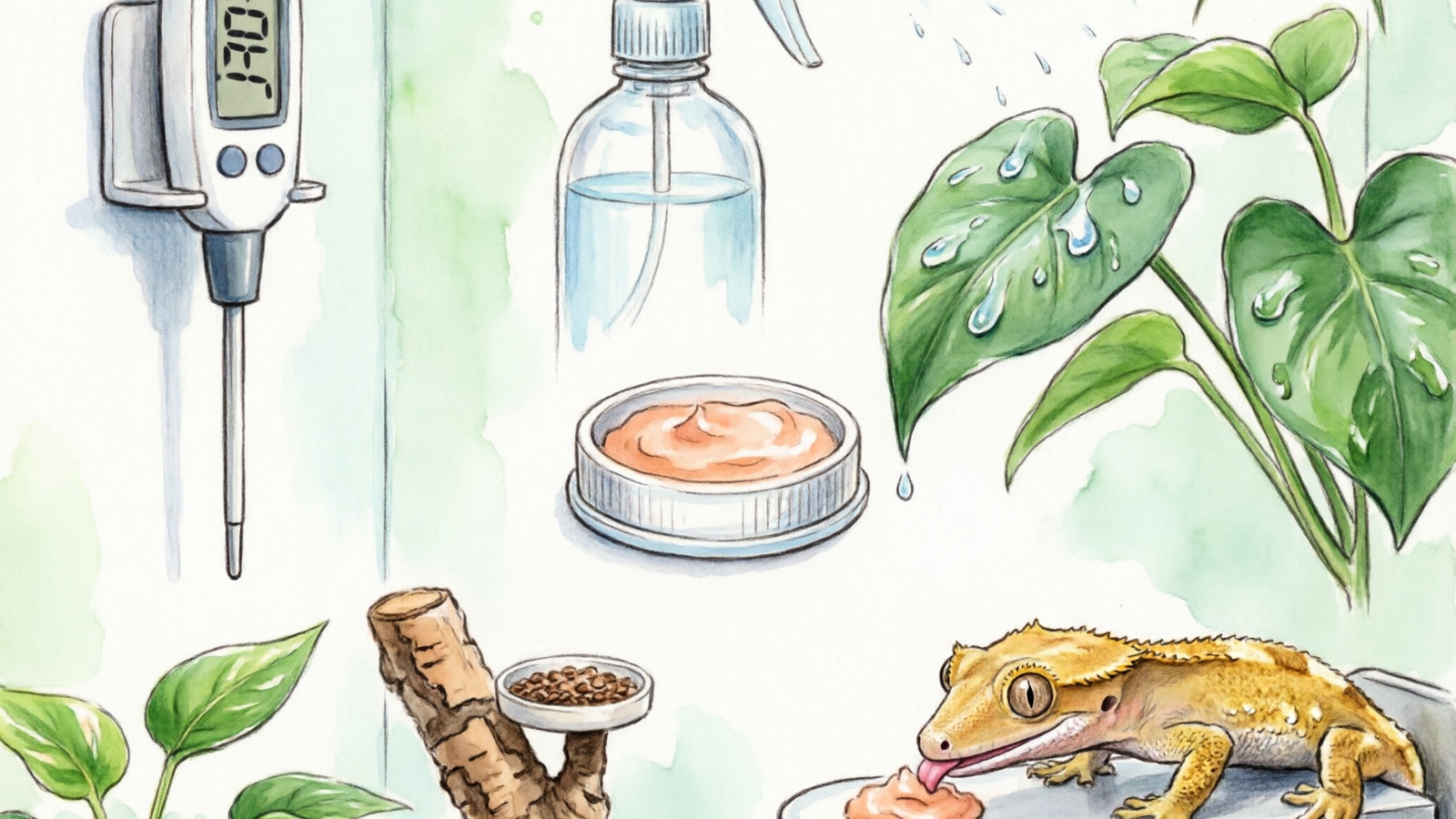
Not seeing your gecko eat doesn’t mean it’s not eating. Here are four ways to verify:
- Check for poop. Normal crested gecko poop is dark brown with a white urate tip. Finding poop 3-4 times per week means your gecko is eating — the most reliable indicator.
- Look for lick marks on the CGD dish. Thicken the CGD slightly — you’ll be able to see tongue tracks in the surface.
- Weigh your gecko weekly. A stable or increasing weight means the gecko is getting calories. A declining weight is the clearest sign of a problem.
- Place two feeding stations — one higher in the enclosure and one lower. This doubles the chance your gecko will find the food during its nighttime roaming.
Baby Crested Gecko Not Eating — Special Considerations
Baby crested gecko not eating is more urgent than adult fasting because babies have faster metabolisms and virtually no energy reserves. A baby that stops eating will decline much faster than an adult.
Feeding schedule by age:
| Age | Feeding Frequency | CGD Amount | Expected Weight | Weekly Growth |
|---|---|---|---|---|
| Hatchling (0-3 months) | Daily | Thin layer (bottle cap) | 2-5g | +0.5-1g |
| Juvenile (3-7 months) | 5x per week | Half bottle cap | 5-15g | +0.5-1g |
| Sub-adult (7-12 months) | 3-4x per week | Half to 1 bottle cap | 15-25g | +0.3-0.5g |
| Adult (>12 months) | 2-3x per week | 1 bottle cap | 30-55g | Stable |
Baby-specific issues that cause appetite loss:
- Enclosure too large — A hatchling in a 20-gallon tank may not find the food. Start with a 5-10 gallon enclosure.
- Adjustment period — Allow 1-2 weeks after arriving from a breeder. Keep handling to zero during this time.
- Temperature sensitivity — Babies are less tolerant of temperature fluctuations. Keep them at a stable 75-78°F.
- Never cohabitate babies — Different-sized geckos housed together leads to bullying, stress, and the smaller one being outcompeted for food.
Baby red flag: If a hatchling hasn’t eaten for more than 1 week and is losing weight, see an exotic vet immediately.
Medical Reasons That Need a Vet
If you’ve ruled out environmental and behavioral causes, these medical conditions may be responsible. Each of these requires professional veterinary treatment.
Stomatitis (mouth rot) is a bacterial infection of the oral cavity in reptiles, characterized by white or yellow plaques on the gums, excessive drooling, and difficulty eating. According to the Merck Veterinary Manual, stomatitis in lizards often develops secondary to poor husbandry — specifically inadequate temperature gradients and chronic stress — and can progress to osteomyelitis (bone infection) if untreated. Crested geckos are particularly susceptible because their calcium-rich diet from CGD creates oral conditions favorable to bacterial overgrowth when immune function is compromised.
Mouth Rot (Stomatitis)
White or yellow patches inside the mouth, excessive drooling, and difficulty eating. Mouth rot is a bacterial infection that can spread rapidly. If you notice your gecko rubbing its mouth or having trouble closing its jaw, this is a vet emergency.
Metabolic Bone Disease (MBD)
Caused by inadequate calcium or vitamin D3. Symptoms include a soft jaw, weak limbs, tremors, and difficulty climbing. MBD is preventable with proper CGD (all complete brands include calcium and D3) but irreversible once advanced.
Internal Parasites
Weight loss despite apparent eating, chronic diarrhea, and lethargy. Parasites are common in wild-caught geckos and can appear in captive-bred animals too. Diagnosis requires a fecal exam — treatment is straightforward with anti-parasitic medication.
Impaction (Intestinal Blockage)
Swollen belly, constipation, sudden weight gain without increased eating. Caused by swallowing loose substrate or inappropriate prey items. Never use loose substrate with baby crested geckos — use paper towels or tile.
Respiratory Infection
Open-mouth breathing, bubbles from the nose or mouth, clicking sounds when breathing. Usually caused by incorrect temperature (too cold) or poor ventilation combined with high humidity.
Egg-Binding (Dystocia)
In females: swollen abdomen, straining without producing eggs, loss of appetite. This is a life-threatening emergency.
Crested Gecko Not Eating and Losing Weight
Crested gecko not eating and losing weight together is the strongest indicator of an underlying medical problem. When fasting is accompanied by weight loss on the scale, it’s time to move from home troubleshooting to a vet visit. While environmental fasting doesn’t cause meaningful weight loss, any of the conditions above will. If weekly weigh-ins show a consistent downward trend for 2-3 consecutive weeks — even without other obvious symptoms — schedule a vet visit. In my experience, weight loss is often the first visible sign of parasites or mouth rot, sometimes appearing before any other symptom.
Crested Gecko Anorexia Causes
The term “anorexia” in crested geckos refers to prolonged, pathological food refusal — not the occasional skipped meal. The most common crested gecko anorexia causes are chronic stress (especially from poor housing), untreated mouth rot making eating painful, advanced MBD causing weakness, and internal parasites draining nutrients. Unlike environmental fasting, anorexia won’t resolve on its own and always requires veterinary diagnosis. For comparison with another common fasting reptile, see our guides on leopard gecko not eating and ball python not eating. For general reptile health principles, our ball python care guide covers diagnostic approaches that apply across species.
See a vet immediately if you notice any of these:
White or yellow patches inside the mouth, drooling, or difficulty closing the jaw (mouth rot)
Sunken eyes and wrinkled skin that doesn’t bounce back within 1 second (dehydration)
Weight loss exceeding 10% per week on consecutive weigh-ins
Open-mouth breathing, clicking sounds, or bubbles from the nose (respiratory infection)
Swollen abdomen with straining in females (egg-binding — life-threatening emergency)
Soft jaw, weak limbs, or tremors (advanced MBD — requires immediate calcium therapy)
Do not attempt to force-feed a crested gecko — improper technique can cause aspiration and death
How to Get Your Crested Gecko to Eat Again — Step-by-Step
Follow these five steps in order. Don’t skip ahead — each step builds on the previous one.
Step 1: Fix the Environment (Day 1-2)
- Verify temperature with a digital thermometer — 72-78°F daytime, no lower than 65°F at night
- Verify humidity — mist in the evening to create 50-85% fluctuation
- Add at least 3 hiding spots at different heights
- Remove any heat mat if present
- A reliable thermostat prevents temperature emergencies — see our best reptile thermostat guide
Step 2: Try a Different CGD (Day 3-5)
- Switch to Pangea if you’re currently using Repashy or a budget brand
- Try different flavors — fig and insect are the most popular
- Adjust consistency (thicker or thinner)
- Try offering “day-two” fermented CGD
Step 3: Add Enticements (Day 5-7)
- Mash a small amount of banana or blueberry into the CGD for extra aroma
- Offer 1-2 appropriately sized dubia roaches or crickets as a treat — but keep CGD as the staple
- Rule: Insect size must not exceed the space between the gecko’s eyes
Step 4: Adjust Feeding Setup (Day 7-10)
- Place two feeding stations at different heights
- Try offering food 30 minutes after lights out — geckos are boldest in complete darkness
- Use a shallow bottle cap or magnetic feeding ledge
Step 5: Monitor Weight and Poop (Ongoing)
- Weigh weekly (adults) or every 3-4 days (babies)
- Normal poop = eating — even without visible lick marks
- Weight stable = continue waiting patiently
- Weight declining for 2+ weeks = see a vet
Don’t do these things:
- Don’t force-feed — this causes extreme stress and can injure the gecko
- Don’t constantly check on or disturb the gecko — let it settle
- Don’t offer excessive insects to compensate for CGD refusal — this creates picky eaters that reject CGD entirely
How to Monitor Your Crested Gecko’s Weight
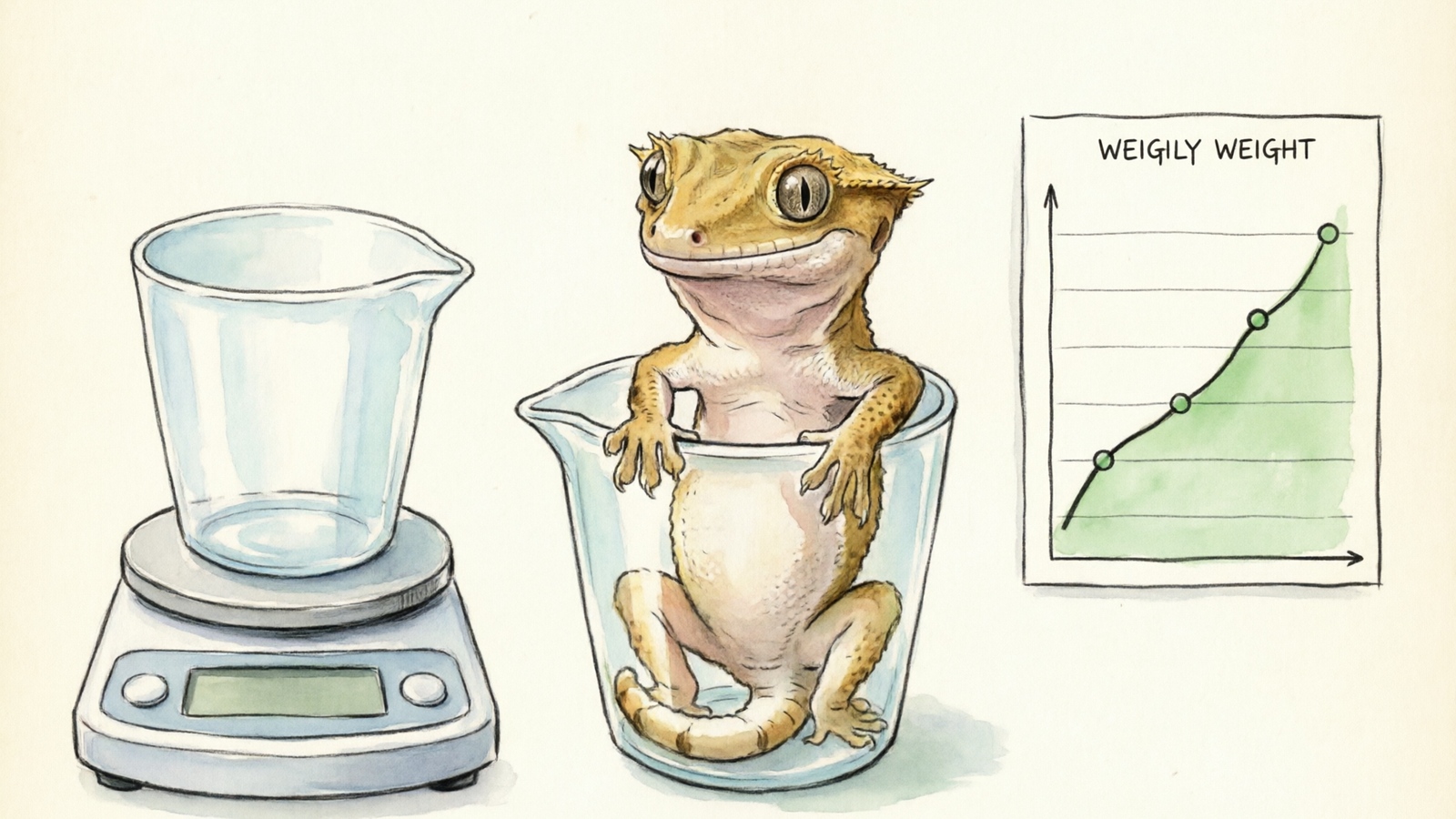
Weight tracking is the single most important tool for assessing whether your gecko’s appetite loss is harmless or serious. A cheap digital kitchen scale with 0.01g accuracy ($10-15) is all you need.
Weighing frequency:
- Adults: once per week, same day, same time (before evening feeding)
- Babies: every 3-4 days
What to track:
| Metric | Healthy Range | Warning Signal |
|---|---|---|
| Adult weight | 30-55g | Below 25g or continuous decline |
| Baby weekly growth | +0.5-1g per week | No growth for 2+ consecutive weeks |
| Skin elasticity | Bounces back within 1 second | Stays wrinkled = dehydration |
| Tail base | Rounded, full | Thinning = weight loss |
Skin turgor test: Gently pinch a fold of skin on the gecko’s back. If it snaps back immediately, hydration is fine. If it stays tented or returns slowly, your gecko is dehydrated — increase misting frequency and consider offering water from a dropper.
Important difference from leopard geckos: Leopard geckos store fat in their tails, making tail thickness a useful health indicator. Crested geckos do not store fat in their tails — their tail is thin and prehensile. This makes regular weigh-ins even more critical for crested geckos. For comparison, see our leopard gecko care guide.
Product Recommendations
Here are some products mentioned in this guide:
Frequently Asked Questions
Why is my crested gecko not eating?
The most common reasons are stress from a new environment, improper temperatures (below 72°F or above 80°F), shedding, dehydration, or CGD brand pickiness. If your gecko is still active, producing normal poop, and maintaining weight, the cause is likely environmental. Fix temperature and humidity first — this resolves most cases.
How long can a crested gecko go without eating?
A healthy adult can go 2-3 weeks without eating without serious harm, as long as it maintains weight and stays hydrated. Baby crested geckos under 15g should not go more than 5-7 days without food — they have minimal energy reserves and decline rapidly. Weight loss, not time alone, is the real danger indicator.
Why did my crested gecko stop eating CGD?
Brand preference is the number one reason. Many geckos dislike Repashy’s texture but will readily eat Pangea. Other causes include stale CGD (discard after 24 hours at room temperature), wrong consistency (try thicker or thinner), or stress suppressing appetite. Try switching to Pangea fig or insect flavor first — it has the highest acceptance rate in the community.
Is it normal for crested geckos to stop eating when shedding?
Yes, completely normal. Appetite typically drops 2-3 days before shedding and may take 1-2 days to return after the shed is complete. Keep humidity at 60-80% during this time to help the process. As long as your gecko is otherwise healthy and maintaining weight, there’s nothing to worry about.
When should I take my crested gecko to the vet for not eating?
See an exotic vet immediately if your gecko hasn’t eaten for over 2 weeks (1 week for babies), shows continuous weight loss on weekly weigh-ins, has sunken eyes (dehydration), is lethargic or staying on the ground, has difficulty breathing, or shows signs of mouth rot (white patches in the mouth, drooling). Weight loss combined with appetite loss is the strongest indicator that something medical is going on.