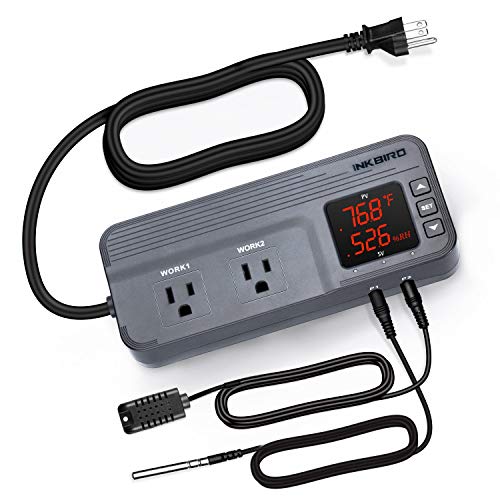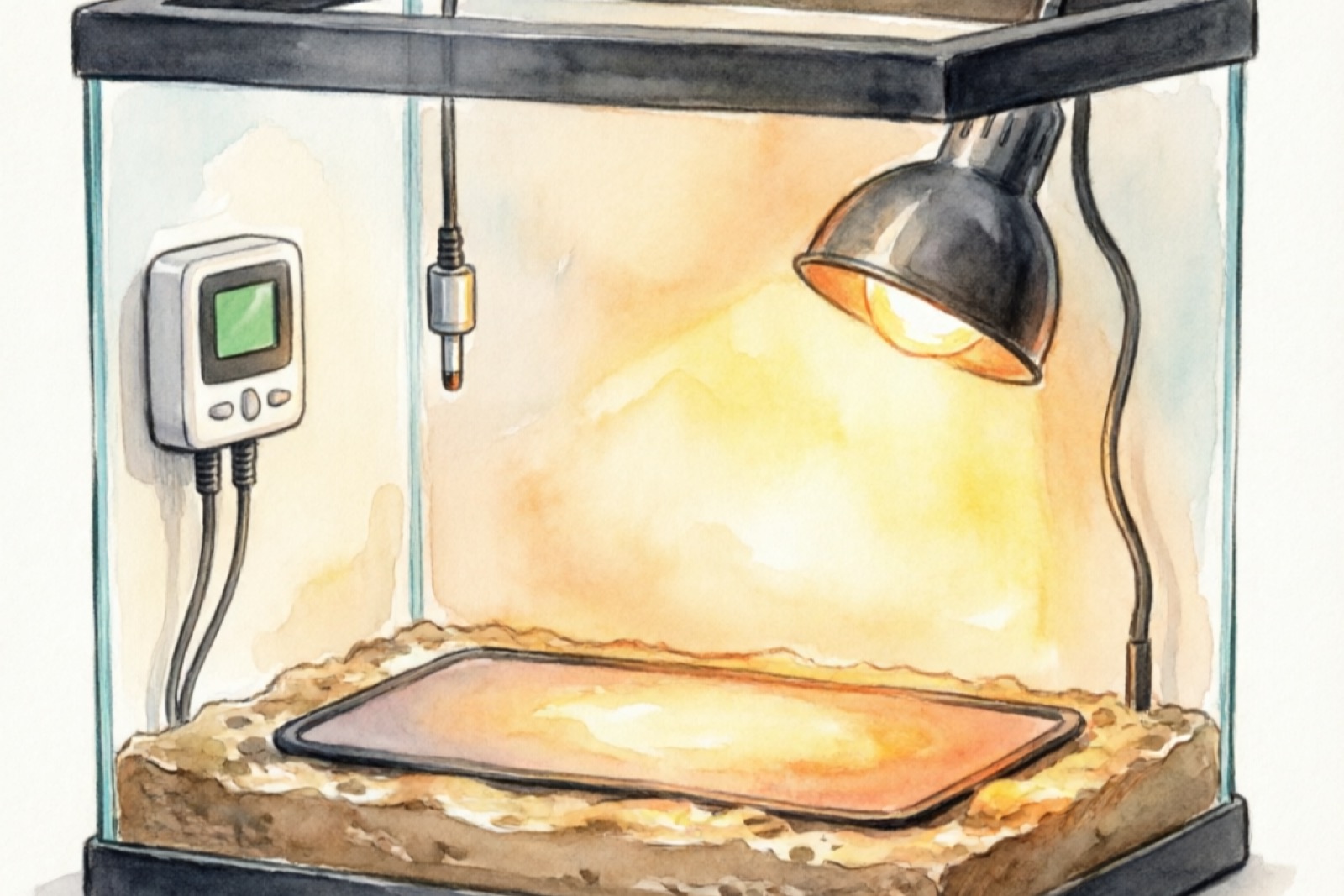
A reptile thermostat is a temperature control device that monitors enclosure heat via a probe and automatically adjusts the power to heating sources to maintain a set temperature range. Choosing the best reptile thermostat is essential. If you own a reptile and use any form of heating — heat mat, basking lamp, ceramic heat emitter, or heat panel — you need a thermostat. There are no exceptions.
Thermal burns from unregulated heat mats are the number one preventable injury — which is why the best reptile thermostat is non-negotiable in pet reptiles. The best reptile thermostat — even at $20 — prevents what can cost hundreds of dollars in vet bills and cause permanent tissue damage. Every reptile veterinarian, breeder, and experienced keeper will tell you the same thing: a thermostat is not optional, it is essential. Reptile thermostat safety should be your top priority when setting up any heated enclosure.
For a complete overview of heating and enclosure setup, see our reptile habitat setup guide.
Why Every Reptile Enclosure Needs a Thermostat
Thermostat safety is not negotiable. A thermostat for reptile tank setups is the single most important piece of equipment you will buy. Here are five reasons why every reptile enclosure must have a thermostat:
-
Prevents thermal burns — Unregulated heat mats reach surface temperatures of 120°F or higher. Reptiles have poor heat perception and will sit on a dangerously hot surface until they sustain third-degree burns. These burns are slow to heal and frequently become infected.
-
Maintains species-specific temperature gradients — A bearded dragon needs a 95-105°F basking spot, while a leopard gecko requires 90-95°F on the warm side. A thermostat maintains the exact temperature your species needs, not what the heater decides to produce.
-
Prevents fires — Heaters left running at full power without regulation can overheat and ignite nearby materials. This risk increases with glass terrariums and enclosed racks.
-
Reduces energy costs — A thermostat turns the heater off when the target temperature is reached, rather than running it continuously. This saves electricity and extends heater lifespan.
-
Enables night temperature drops — Many species benefit from cooler nighttime temperatures (5-10°F drop). A thermostat with a timer or dual-mode function handles this automatically.
On/Off vs Dimming vs Pulse Proportional — Which Type Do You Need

How Does Each Type Work?
If you’re wondering how does a reptile thermostat work, the answer depends on the type. The best reptile thermostat comes in three main categories, and understanding how does a reptile thermostat work is essential for choosing the right one for your setup.
On/Off thermostats are the simplest type. They switch the heater to full power until the target temperature is reached, then shut it off completely. When the temperature drops below the set point, full power resumes. This creates a temperature cycle of roughly ±3-5°F around your target. On/off thermostats work with any heater type, but they should never be used with light-emitting heaters — the constant cycling causes bulbs to flash on and off, which stresses reptiles and burns out bulbs fast.
Dimming thermostats work like a light dimmer. Instead of snapping between full-on and full-off, they smoothly reduce power as the temperature approaches the target. This maintains a tighter temperature range of ±1-2°F and eliminates the harsh cycling. Dimming thermostats are designed exclusively for light-emitting heaters: basking lamps, halogen bulbs, and some ceramic heat emitters that produce visible glow. They should never be used with heat mats, because heat mats don’t produce light and the gradual power reduction leads to underheating.
Pulse proportional thermostats send rapid on/off pulses (measured in seconds) rather than long on-off cycles. The pulse ratio adjusts based on how close the temperature is to the target — more pulses when cold, fewer when warm. This achieves the tightest control at ±0.5-1°F. Pulse proportional thermostats are designed for non-light heaters: heat mats, ceramic heat emitters (without visible glow), deep heat projectors, and radiant heat panels.
Choosing the best reptile thermostat — on/off vs dimming decision comes down to one question: does your heater produce visible light? If yes, use dimming. If no, use on/off or pulse proportional. This reptile thermostat dimmer distinction is the most important safety consideration when choosing a reptile thermostat controller.
Here’s how the three types of the best reptile thermostat compare:
| Feature | On/Off | Dimming | Pulse Proportional |
|---|---|---|---|
| Mechanism | Full power on/off | Smooth power reduction | Rapid on/off pulses |
| Accuracy | ±3-5°F | ±1-2°F | ±0.5-1°F |
| Best heater | Heat mats, cables | Basking lamps, halogen | CHE, DHP, heat panels |
| Worst heater | Light bulbs (causes flashing) | Heat mats (causes underheating) | Light bulbs (not designed for it) |
| Noise | Click on/off | Silent | Silent or faint hum |
| Price range | $20-60 | $70-130 | $120-440 |
Which Type for Your Heater
Matching the right thermostat to your heater is critical. The wrong combination wastes money at best and creates unsafe conditions at worst.
| Heater Type | Recommended Thermostat | Why |
|---|---|---|
| Heat mat / Under-tank heater | On/Off | Non-light, simple full-cycle control |
| Heat cable | On/Off or Pulse | Non-light, Pulse for tighter control |
| Basking lamp (incandescent) | Dimming | Light source — On/Off causes flashing |
| Halogen bulb | Dimming | Light source — same reason as basking lamp |
| Ceramic Heat Emitter (CHE) | Dimming or Pulse | Pulse if no visible glow; Dimming if orange glow visible |
| Deep Heat Projector (DHP) | Pulse Proportional | Non-light, needs precise control |
| Radiant Heat Panel | Pulse Proportional | Non-light, large enclosure needs stable output |
The critical safety rule: On/Off + light bulb = flashing + stress + dead bulb. Dimming + heat mat = underheating. Get the combination right.
Key Features of the Best Reptile Thermostat
Safety Relay / Safety Shutoff — the Most Important Feature in the Best Reptile Thermostat
A safety relay is what separates the best reptile thermostat from a dangerous one — it’s a mechanical backup that cuts power to the heater if the thermostat probe fails. Without it, a broken probe means the thermostat can’t read temperature, so the heater runs at full power indefinitely. This is the single most dangerous failure mode. Safety relays are found on premium units like Herpstat and VE-200, but are absent from most budget options. If you can only afford one upgrade, make it this.
Wattage Capacity
Match the thermostat’s wattage rating to your heater. Most heat mats draw 10-50W, ceramic heat emitters draw 100-250W, and a full basking setup with multiple fixtures can draw 200-500W. Budget thermostats typically handle 1000W, which covers almost any single-enclosure setup. Don’t confuse wattage with quality — a 1000W rating doesn’t mean the thermostat is better, just that it can handle more load.
Probe Quality and Length
The probe is the thermostat’s sensor. Waterproof probes last longer because humidity and condensation are constant in reptile enclosures. A probe cord of 6-10 feet gives you flexibility in placement, especially for larger tanks where the thermostat mounts on the outside. Short cords force awkward routing.
Display and Controls
Look for a clear, backlit display that shows both the current temperature and the set target. Controls should be intuitive — some budget units require confusing delta-temperature math to set up. Fahrenheit vs Celsius toggle is a nice-to-have if you’re used to one system.
Timer Function
The best reptile thermostat with timer capability lets you program day/night temperature cycles. Many reptiles benefit from a nighttime drop of 5-10°F, which mimics natural conditions and supports healthy circadian rhythms. Some thermostats have built-in timers, while others rely on an external outlet timer for day/night control.
Best Budget Reptile Thermostats ($20-$60)
For single-enclosure setups with heat mats or heat tape, the best reptile thermostat for budget setups is a straightforward on/off model. Here are the three best options for anyone looking for the best cheap reptile thermostat.
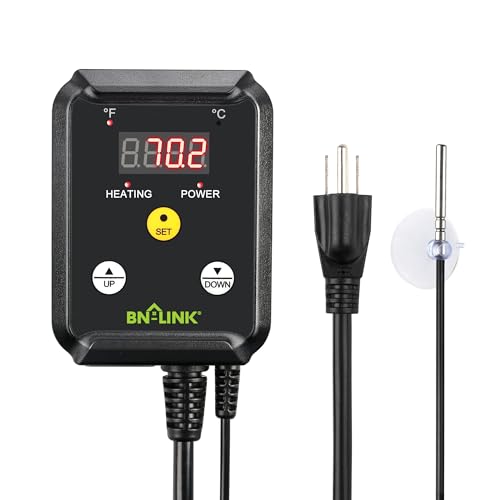
1. BN-LINK Digital Temperature Controller — Best Value On/Off and the Best Reptile Thermostat Under $25
Price: $18.99 | Capacity: 1000W
The BN-LINK is the cheapest reptile heat mat thermostat on this list that I’d actually trust with a reptile enclosure. It has a bright, easy-to-read display, dual outlets (so you can run two heaters from one unit), and a 1000W capacity that handles virtually any heat mat. I’ve used this controller for greenhouse applications for years, and the reptile use case is essentially identical — plug in, set temperature, walk away.
The main downside is the setup. BN-LINK uses a delta-temperature system where you set a target and a differential, rather than a simple “set to 90°F” approach. It works, but the instruction manual reads like it was written by an electrical engineer, and several reviewers mention spending 30+ minutes figuring it out. Once configured, it runs reliably.
Pros: Affordable, dual outlets, easy-to-read display, high wattage capacity Cons: Complex delta-temperature setup, no safety relay, some units failed after 7 months Best for: Single heat mat setups where budget is the primary concern
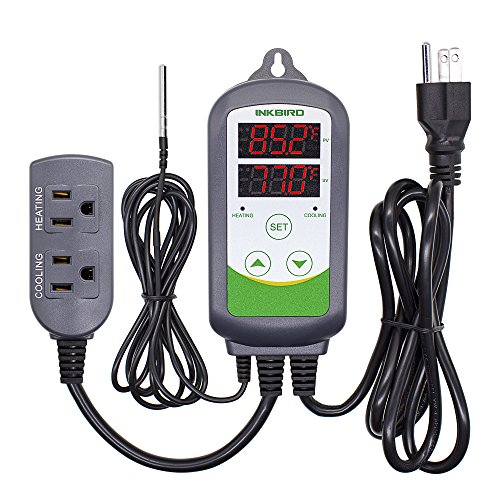
2. Inkbird ITC-308 — Community Favorite and the Best Reptile Thermostat for Beginners
Price: $29.00 | Capacity: 1000W
With over 10,000 ratings, the Inkbird ITC-308 is arguably the best reptile thermostat for most keepers in the hobby. The massive user base means you’ll find answers to any setup question in forums, and the track record of years of real-world use provides confidence that the unit is reliable. It supports both heating and cooling modes (dual-stage), switches between °F and °C, and has a simple three-button interface that’s much more intuitive than the BN-LINK.
The ITC-308 doesn’t have a safety relay, WiFi, or a waterproof probe — it’s a straightforward on/off thermostat that does one thing well. Some users report the alarm system can be finicky during initial setup, but once calibrated, the unit holds temperature steady. For a reptile thermostat for heat mat setups and heat cables in a single enclosure, this is the safe default choice.
Pros: Massive user base, simple interface, reliable long-term, °F/°C switchable, dual heating/cooling Cons: No safety relay, no WiFi, probe not waterproof Best for: Heat mats, heat cables, single enclosure — the “set it and forget it” option
3. Zilla Digital Temperature Controller — Best Brand-Name Budget and the Best Reptile Thermostat for Beginners
Price: $54.95 | Capacity: 1000W
Zilla is a reptile-specific brand, and this thermostat is designed from the ground up for reptile enclosures rather than adapted from greenhouse or homebrewing equipment. Multiple reviewers mention owning 4-5 of these units across different enclosures, which is about the strongest endorsement a thermostat can get — people who buy one keep buying more.
The accuracy is notably better than cheaper alternatives, holding within ±1°F of the set point. Programming is straightforward with a simple up/down interface, and pet stores frequently recommend this unit to new keepers. The main complaint is durability — some units fail after 1-2 years, right past the return window. Also, the outlets are 2-prong only, which is a problem if your heater has a 3-prong plug.
Pros: Reptile-specific design, accurate ±1°F, simple programming, widely recommended by pet stores Cons: Some units die after 1-2 years, 2-prong outlets, no safety relay Best for: Heat tape, heat mats, snake rack systems where brand trust matters
For setup guidance on pairing a thermostat with an under-tank heater, see our best leopard gecko terrarium guide.
Best WiFi Smart Thermostat
4. Inkbird WiFi Heat Mat Reptile Thermostat — Best Smart Option and the Best Reptile Thermostat for Remote Monitoring
Price: $36.89 | Capacity: 600W
A WiFi-enabled model is the best reptile thermostat for tech-savvy keepers — it fills a specific niche: monitoring your reptile’s enclosure temperature when you’re not home. The Inkbird WiFi thermostat connects to the Inkbird app (and Smart Life/Tuya), letting you check real-time temperatures, receive push notifications if temperature deviates from the set range, and adjust settings remotely. For keepers who travel or work long hours, this peace of mind is worth the price.
The thermostat itself is an on/off type — best used with heat mats only, not light-emitting heaters. It includes a dual-probe setup and a built-in timer for day/night cycling. Multiple reviewers with ball python rack systems report using three or more of these units, one per enclosure, with good results.
The caveats are real, though. Some users report temperature calibration drift of ±5°F over time, which is significant. The WiFi connection can become unreliable after several months, and the plugs lack a ground prong. If you go this route, verify accuracy regularly with a separate thermometer.
Pros: Remote monitoring and alerts, app control, timer function, affordable for a smart thermostat Cons: Temperature calibration can drift ±5°F, no ground prong, WiFi connectivity issues reported after months Best for: Owners who travel, multi-enclosure monitoring, tech-savvy keepers who want remote control
Best Dimming Thermostats — the Best Reptile Thermostat for Light-Emitting Heaters
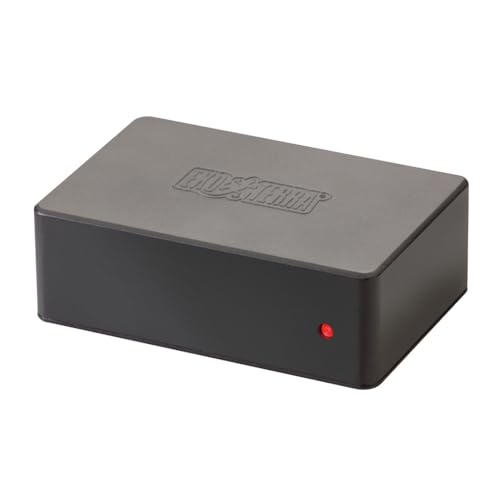
5. Exo Terra Dimming and Pulse Proportional Thermostat — Best Budget Dimming and the Best Reptile Thermostat for Light-Emitting Heaters
Price: $72.99 | Capacity: 300W
This is the best reptile dimming thermostat available on Amazon, and it doubles as a pulse proportional thermostat with a mode switch on the front panel. That dual-mode capability makes it the most versatile option on this list — use dimming mode for your basking lamp and pulse mode for your ceramic heat emitter, or switch between setups if your needs change.
With 300W capacity, this handles most single-fixture setups — the best reptile thermostat for standard enclosures but won’t cover a multi-fixture basking array. At the sample size is smaller than budget options, though the feedback is largely positive. One owner with multiple enclosures reports buying one for each and refusing to use anything else, which is a strong signal for a specialty product at this price point.
The downsides: controls are not intuitive (several reviewers mention the temperature scale being confusing), the display is Fahrenheit only, and a few units arrived appearing used or defective. Quality control seems less consistent than with higher-end options.
Pros: Only affordable dimming thermostat on Amazon, dual-mode (dimming + pulse), 300W capacity, works with both light and non-light heaters Cons: Only non-intuitive controls, Fahrenheit only, some quality control issues Best for: Basking lamps, ceramic heat emitters, single enclosures with light-emitting heaters
When You Need a Dimming Thermostat — and the Best Reptile Thermostat Type for Your Heater
You need a dimming thermostat in three situations:
- Any setup with a visible light heating source — basking bulbs, halogen bulbs, mercury vapor bulbs. On/off thermostats will cause these to flash. A reptile thermostat for heat lamp setups must use dimming control.
- Ceramic heat emitters that produce visible orange glow — some CHEs have a visible element. If you can see light from your CHE, use dimming mode. A reptile thermostat for ceramic heat emitter setups with visible glow should always use dimming rather than pulse mode.
- Species requiring precise basking temperatures — bearded dragons and similar desert species are sensitive to temperature fluctuations at the basking spot. The smooth power delivery of a reptile thermostat dimming system maintains a more stable surface temperature than on/off cycling.
For a full setup that coordinates heating with UVB lighting, see our best bearded dragon terrarium guide.
Best High-End Thermostats — the Best Reptile Thermostat for Serious Keepers ($100-$440)
6. Inkbird ITC-608T — Best Multi-Function and the Best Reptile Thermostat for Advanced Setups
Price: $69.99 | Capacity: 1800W (15A)
The Inkbird ITC-608T is a pre-wired dual-stage temperature and humidity controller. If you’re setting up a bearded dragon or chameleon enclosure that needs both heat control and humidity monitoring, this keeps those jobs on one ETL-listed box instead of two separate units.
At 1800W it has enough headroom for a basking lamp, a ceramic heat emitter, a heat mat, or a fogger — just stay inside the 15A rating. Day/night setpoints and dual-stage outlets cover heat plus humidity. Follow the wiring diagram on first setup; skipped steps are the usual source of “it won’t switch” tickets.
Pros: Temp + humidity on one unit, 1800W headroom, pre-wired, ETL listed, $69.99 Cons: Not a true dimming/proportional thermostat, greenhouse-style interface, no Zoo Med enclosure-specific presets Best for: Bearded dragon or chameleon setups that need heat and humidity control from one device
Herpstat 4 Pro — The Gold Standard and the Best Reptile Thermostat for Breeders (Not on Amazon)
I’m including this Herpstat thermostat even though it’s not available on Amazon because it’s the thermostat that every serious reptile keeper eventually upgrades to. At $399-439, the Herpstat 4 Pro controls four independent zones with true proportional output, built-in WiFi (via SpyderWeb interface), and — most importantly — a safety relay on every channel that cuts power if the probe fails.
This is the unit breeders use. If you’re running a rack system with 10-20 enclosures, two Herpstat 4 Pros give you eight independently controlled zones with the tightest temperature control available (±0.5°F) and the safety net of hardware-level overheat protection. Available only from spyderrobotics.com.
VE-200 — Breeder’s Choice and the Best Reptile Thermostat for Dual-Zone Control (Not on Amazon)
The VE-200 from Vivarium Electronics sits between budget Amazon options and the Herpstat line. At $119-130, it offers two independently controlled pulse proportional zones, stackable design for multi-unit installations, and a mechanical safety shutoff. It’s the most popular mid-range proportional thermostat among breeders — you’ll see it in nearly every serious rack system build. For keepers looking for a reptile thermostat for multiple enclosures, the VE-200 is the most cost-effective multi-zone option. Available from vivariumelectronics.com.
For species-specific temperature requirements, see our ball python care guide and corn snake care guide.
Best Reptile Thermostat by Species
Different reptiles have different heating needs, and the right thermostat depends on both the species and the heater type. Here’s a quick-reference table:
| Species | Primary Heater | Thermostat Type | Recommended Product | Target Temp |
|---|---|---|---|---|
| Bearded Dragon | Basking lamp + CHE | Dimming | Exo Terra Dimming ($72.99) | 95-105°F basking |
| Leopard Gecko | Heat mat (UTH) | On/Off | Inkbird ITC-308 ($29.00) | 90-95°F surface |
| Ball Python | CHE or heat tape | Pulse or On/Off | Herpstat 1 / Zilla ($54.95) | 88-92°F warm |
| Corn Snake | Heat mat or tape | On/Off | BN-LINK ($18.99) | 85-90°F warm |
| Crested Gecko | Usually none needed | N/A | N/A | Room temp 72-78°F |
For the best reptile thermostat bearded dragon setup, the basking spot temperature is critical — they need 95-105°F to properly digest food. A dimming thermostat paired with a quality basking bulb is the right setup. Coordinate this with proper UVB lighting by checking our best bearded dragon UVB light guide, and see our bearded dragon care guide for complete husbandry requirements.
Leopard geckos are ground-dwellers — the best reptile thermostat for them is a simple on/off model since they absorb belly heat from an under-tank heater. An on/off thermostat like the Inkbird ITC-308 is all you need — the simple on/off cycle works perfectly with a heat mat. For complete setup details, see our leopard gecko care guide.
Ball pythons are flexible with heat sources. A ceramic heat emitter controlled by a pulse proportional thermostat gives the most stable warm-side temperatures, but a good on/off unit like the Zilla works fine for single enclosures.
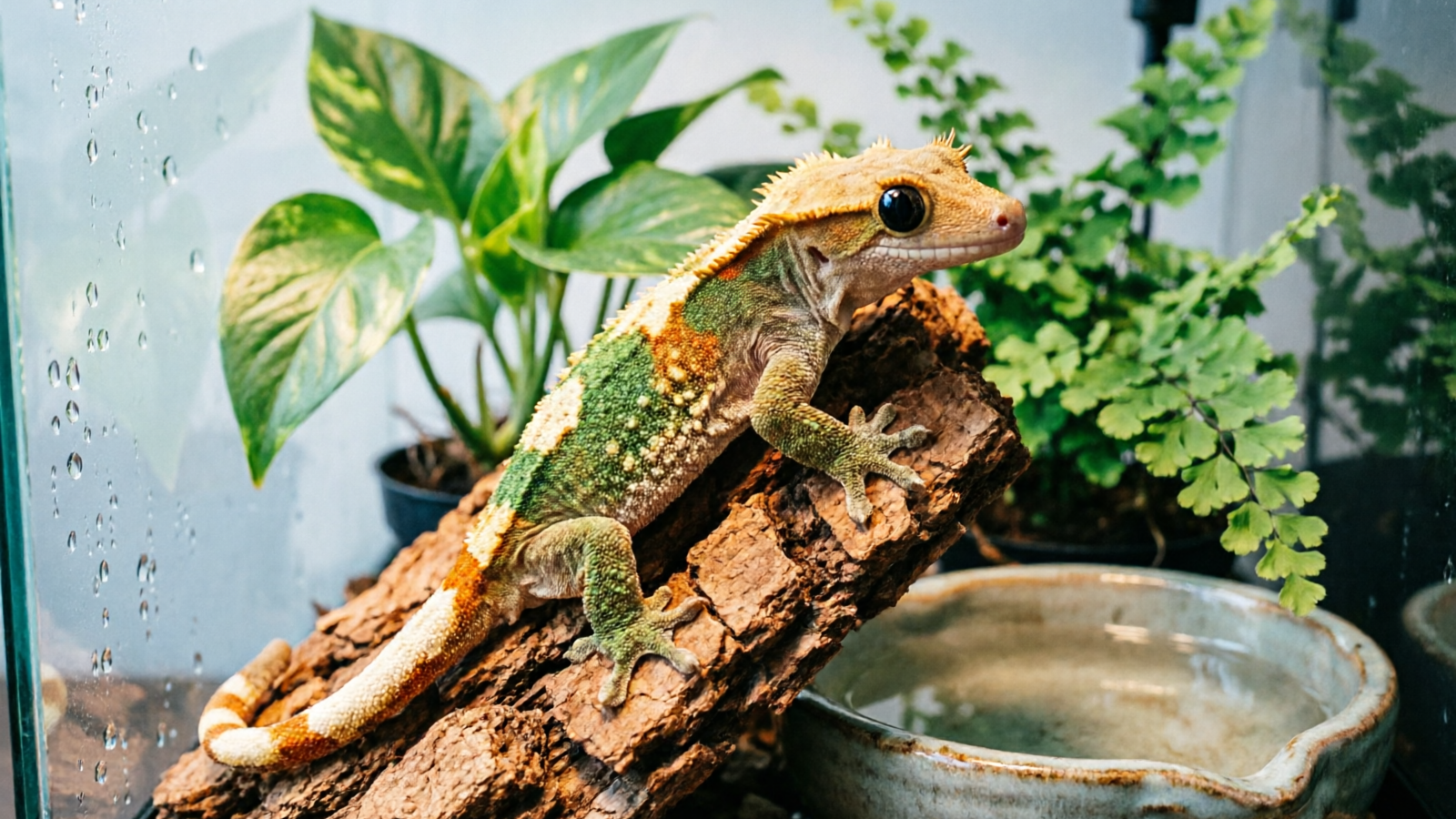
Crested geckos are the exception — they thrive at room temperature (72-78°F) and typically don’t need supplemental heating at all. If your home drops below 68°F in winter, a small heat mat on a thermostat is sufficient. See our crested gecko care guide for details. For outdoor species like box turtles, check our box turtle care guide — outdoor enclosures have different heating considerations than indoor terrariums.
How to Set Up and Place Your Thermostat Probe
Step-by-Step Setup Guide
If you’re wondering how to set up the best reptile thermostat, follow these six steps:
Step 1: Mount the thermostat outside the enclosure, never inside. Humidity can damage electronics, and your reptile may disturb or chew on wires.
Step 2: Route the temperature probe through a ventilation gap or cable management slot in the enclosure. Don’t drill holes or force wires through tight spaces that could pinch the cord.
Step 3: Place the probe at the basking surface or warm hide floor — wherever your reptile actually rests against the heated surface. This is where the temperature matters most.
Step 4: Secure the probe with heat-resistant tape. Position it so the probe tip touches the surface but isn’t buried under substrate.
Step 5: Set your target temperature. Start with the species-specific recommendation and adjust based on your reptile’s behavior — a reptile constantly hiding on the cool side may mean the warm side is too hot.
Step 6: Verify with an independent temperature gun. Point the infrared thermometer at the surface next to the probe and compare readings. If they differ by more than 2°F, recalibrate or reposition the probe.
Probe Placement by Setup Type
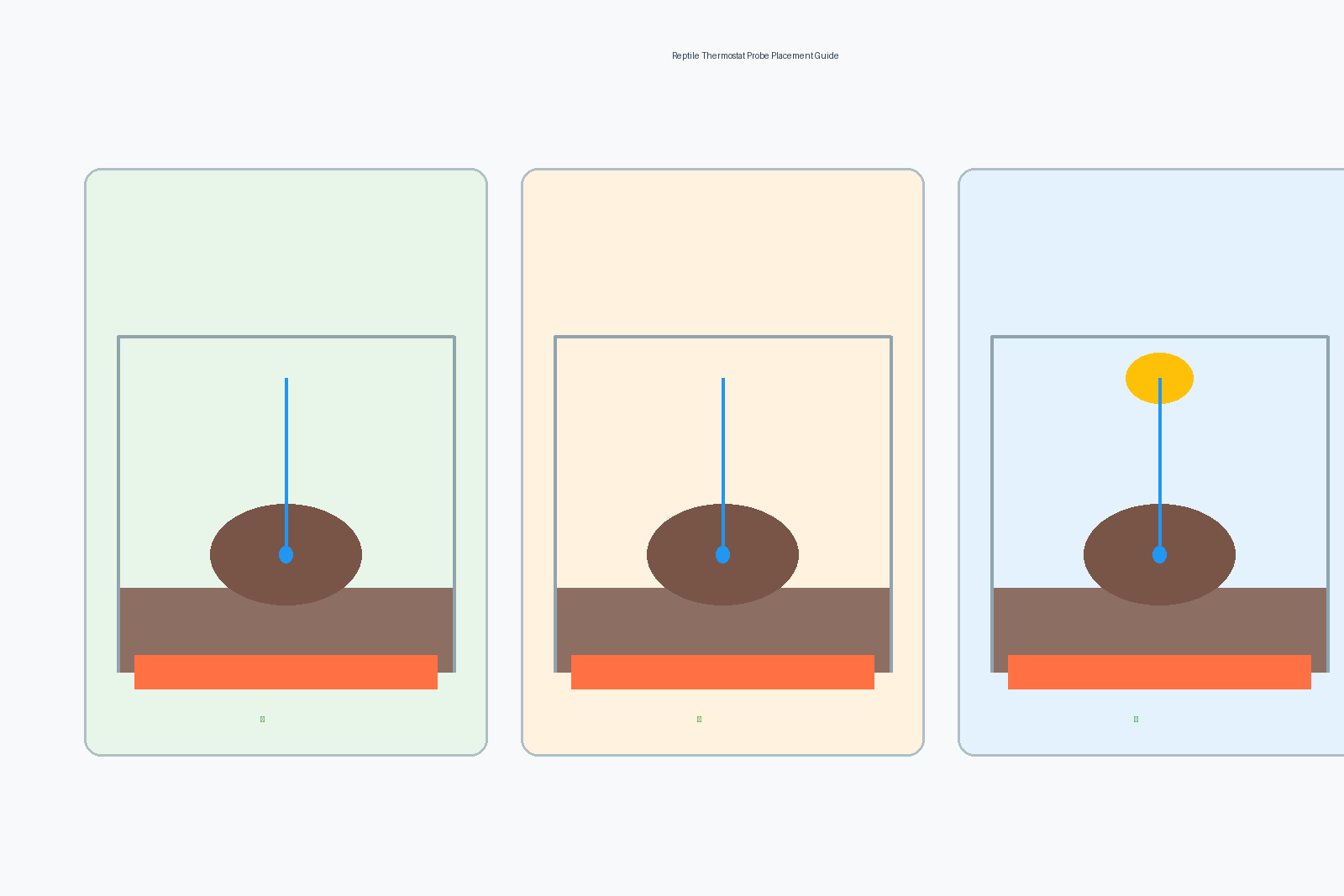 Proper probe placement is critical for getting the best reptile thermostat performance varies by heating method:
- Heat mat: Place the probe on the substrate surface directly above the hottest part of the mat. This is where your reptile’s belly will contact the heat.
- Basking spot: Place the probe on the basking surface (rock, branch, or platform) directly under the heat lamp. This reads the surface temperature your reptile experiences.
- Warm hide: Place the probe on the floor inside the hide, directly above the heat source. This ensures the hide stays within the correct range.
Common Probe Placement Mistakes — Getting the Best Reptile Thermostat Performance
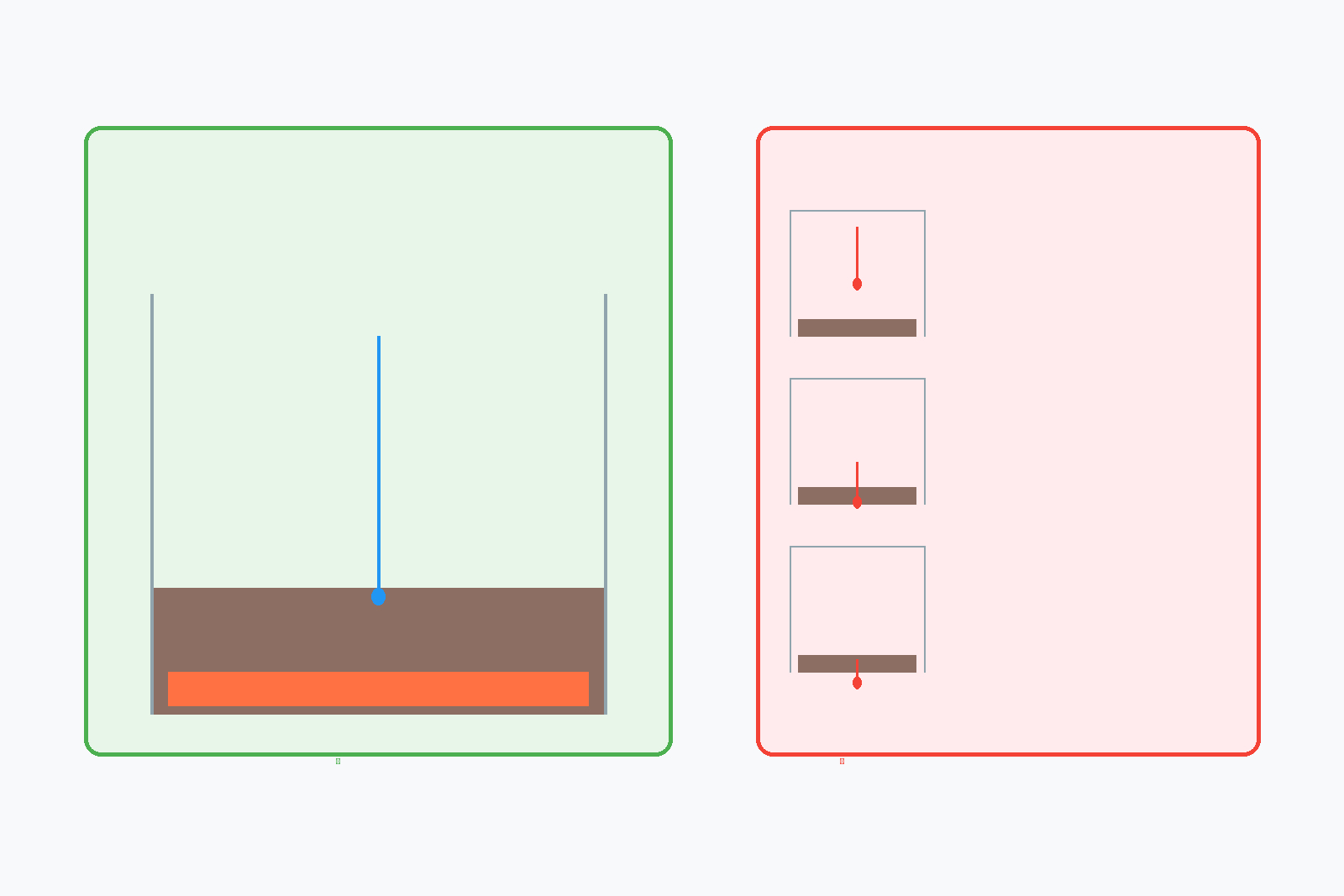
- Probe inside the heat mat — This reads the mat’s internal temperature (often 120°F+), not the surface temperature your reptile feels. The thermostat shuts off too early, and the surface stays too cool.
- Probe in ambient air — Air temperature is always lower than surface temperature. The thermostat keeps the heater running, and the basking surface overheats.
- Probe taped directly to glass under a heat mat — The tape and glass create thermal insulation. The probe reads a trapped pocket of heat, not the actual substrate surface. This can cause runaway heating on the substrate surface above.
Frequently Asked Questions
Do I really need a thermostat for a heat mat?
Yes. Unregulated heat mats reach surface temperatures of 120°F or higher. That’s hot enough to cause severe thermal burns — the number one preventable injury in captive reptiles. A thermostat is the single most important safety purchase for any reptile enclosure.
Can I use an on/off thermostat with a basking lamp?
No. On/off thermostats cause light bulbs to flash on and off, which stresses your reptile and burns out bulbs fast. Use a dimming thermostat for any light-emitting heat source.
What happens if the thermostat probe fails?
Without a safety relay, a failed probe means the heater runs at full power indefinitely. This can overheat the enclosure to lethal levels. A safety relay (found on Herpstat and VE-200) cuts power mechanically if the probe stops reporting.
Is Herpstat worth the money?
The best reptile thermostat for a single heat mat enclosure is a $35 Inkbird ITC-308 — sufficient for most keepers. For breeders and keepers with multiple enclosures, Herpstat’s proportional control, safety relay, and multi-zone capability justify the $100-440 price tag.
How accurate are cheap reptile thermostats?
Budget on/off units maintain ±3-5°F accuracy — the best reptile thermostat for simple heat mat setups. Dimming thermostats improve to ±1-2°F. Pulse proportional units like Herpstat achieve ±0.5-1°F. Always verify with a separate thermometer.
Can one thermostat control multiple enclosures?
Only if every enclosure needs the same target temperature, which is rare. Separate thermostats per enclosure is the standard approach. Multi-zone units like the Herpstat 4 Pro control 4 independent zones from one device.
Where should I place the thermostat probe?
On the surface where your reptile rests — the basking spot, warm hide floor, or substrate above the heat mat. Not in the air, not inside the heat mat, and not taped to glass under a heat mat.
Do I need a thermostat if my room is always warm?
Yes. Room temperature fluctuates daily and seasonally. Even in a warm room, an unregulated heat mat can still overheat and burn your reptile.
What’s the difference between a thermostat and a rheostat?
A thermostat uses a probe to maintain a specific temperature automatically. A rheostat simply reduces power by a fixed percentage — no feedback, no automatic adjustment. Thermostats are far more accurate and safer.
How long do reptile thermostats last?
Budget models typically last 2-5 years. Premium units (Herpstat, VE-200) often last 5-10+ years. The internal relay is the most common failure point. Replace any thermostat showing inaccurate readings.
Conclusion
Finding the best reptile thermostat depends on your heater type, species, and budget:
- Heat mat setups (leopard geckos, corn snakes): On/off thermostat — Inkbird ITC-308 ($35) is the safe, proven choice.
- Basking lamp setups (bearded dragons): Dimming thermostat — Exo Terra Dimming/Pulse ($73) prevents flashing and maintains stable basking temperatures.
- Multi-enclosure or breeder setups: Pulse proportional with safety relay — Herpstat or VE-200. Worth every penny for the safety features and tight temperature control.
Whatever you choose, the most important thing is choosing the best reptile thermostat and actually using it. No enclosure with a heater should ever run without the best reptile thermostat you can afford.
This guide represents current best practices in reptile husbandry as of 2026. Product availability and pricing may change. Always verify thermostat accuracy with an independent thermometer.