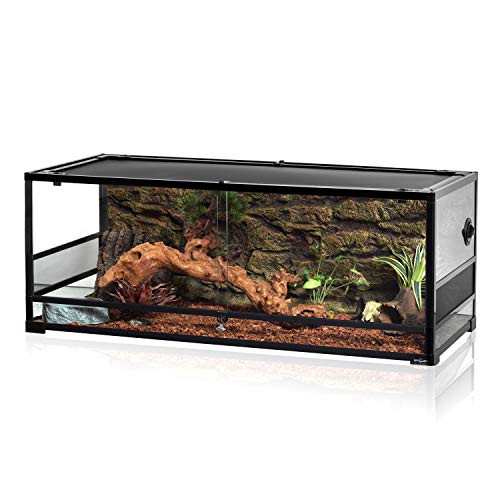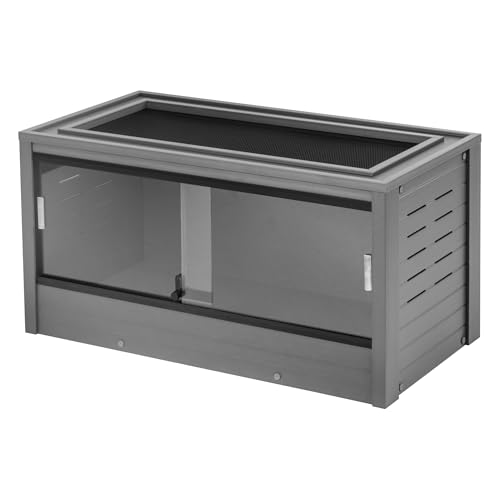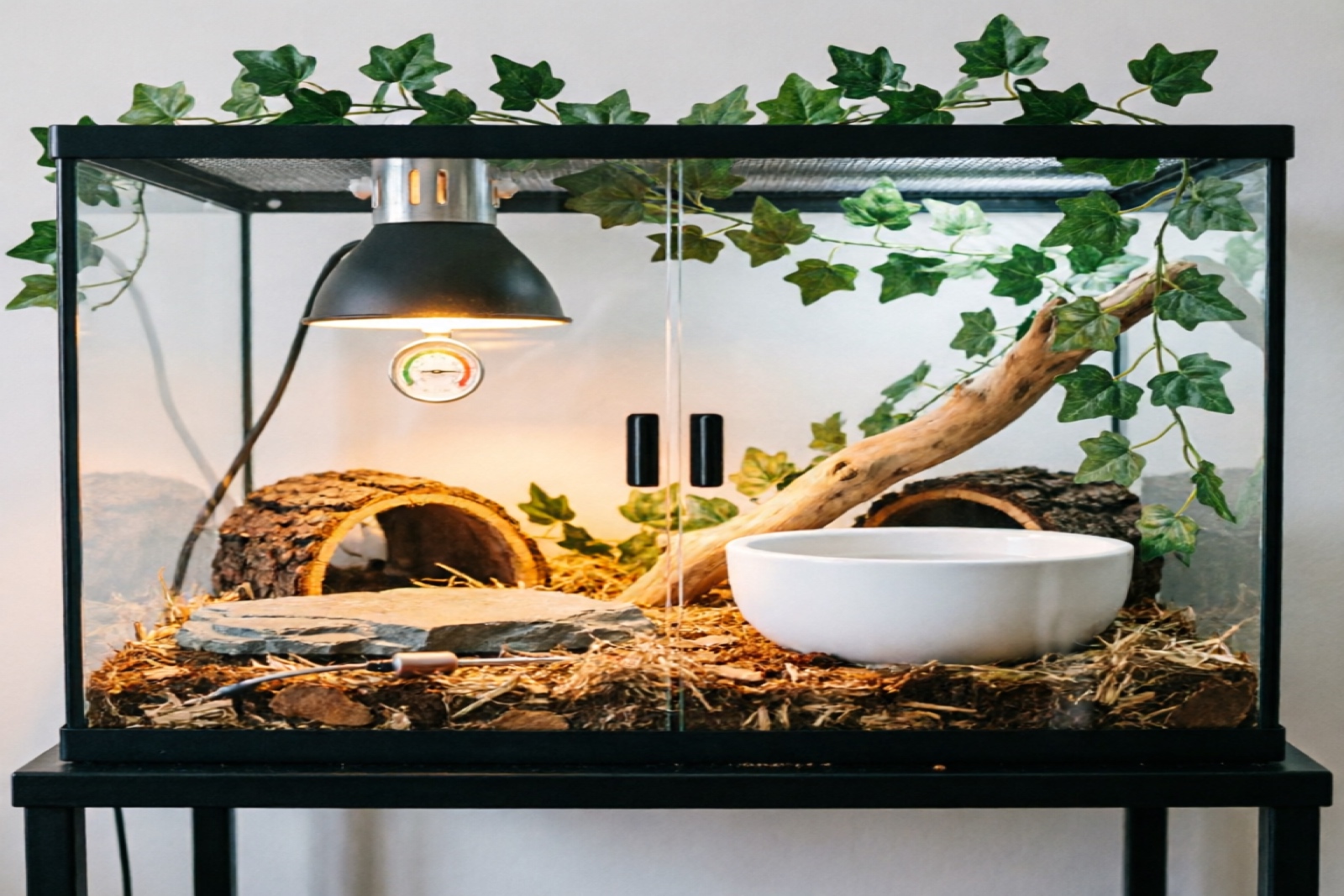
The right ball python tank gives your snake a secure, climate-controlled home. An adult ball python needs a minimum enclosure of 48″ × 24″ × 24″ (4x2x2, roughly 120 gallons) with front-opening doors, good ventilation, and adequate floor space. Hatchlings (under 300g) start in a smaller enclosure (20-30 gallons or a tub measuring 20″ × 11″ × 13″) to feel secure.
They upgrade to a 40-gallon ball python tank (36″ × 18″ × 18″) around 3-6 months, and finally to the adult 4x2x2 by 12-18 months. PVC ball python tank enclosures hold humidity best (ball pythons need 50-60%), glass ball python tank options offer the clearest viewing, and wood composite is the most budget-friendly ball python tank option.
Never use cedar or pine shavings as substrate in any ball python tank — the oils are toxic to snakes. Always use a thermostat with any heating device in your ball python tank to prevent burns. For complete ball python tank husbandry guidance, see our ball python care guide.
What Size Ball Python Tank Does a Ball Python Need?
Ball pythons (Python regius) are terrestrial, nocturnal snakes native to West and Central African grasslands and savannas. In the wild, they spend most of their time in rodent burrows, which provide shelter and moderate temperatures.
Every ball python tank needs floor space more than vertical height — a long, low enclosure is better than a tall one. For more on their natural history, see our ball python species guide.
| Age | Weight | Min Tank Size | Dimensions | Gallon Equiv | When to Upgrade |
|---|---|---|---|---|---|
| Hatchling (0-3 months) | 50-200g | 20-30 gallon / tub | 20″ × 11″ × 13″ | 10-20 gal | At 200-300g or 2/3 tank length |
| Juvenile (3-12 months) | 200-800g | 40 gallon | 36″ × 18″ × 18″ | 40 gal | At 800g-1000g or 3ft length |
| Sub-adult (12-18 months) | 800-1500g | 75-120 gallon | 48″ × 18″ × 18-24″ | 75-120 gal | When approaching 3ft |
| Adult (18+ months) | 1500-3000g+ | 120 gallon (4x2x2) | 48″ × 24″ × 24″ | 120 gal | Final enclosure |
Adult ball pythons reach 3-5 feet in length. A ball python tank at least as long as the snake allows it to stretch fully. How big of a tank for a ball python? What size tank for a ball python? The 48″ length plus 24″ width gives 8 square feet of floor space — the minimum for healthy movement and thermoregulation.
Some older care guides (pre-2020) recommended 40-gallon tanks as the minimum for adults. This is now considered outdated. Modern ball python tank consensus among herpetologists and the ARAV supports 4x2x2 as the minimum adult enclosure.
Can you skip straight to the adult ball python tank for a hatchling? Yes, if you provide abundant cover — three to four hides, plenty of fake plants, and cluttered floor space.
A baby in an empty 120-gallon tank will feel exposed and stop eating. But a baby in a well-decorated 120-gallon tank with multiple hides will do fine.
Can a Ball Python Live in a 20-Gallon Ball Python Tank?
Temporarily yes, permanently no. A 20-gallon ball python tank (approximately 24″ × 12″ × 16″) is appropriate only for hatchlings under 200g or as a temporary quarantine tank.
Problems with a 20-gallon ball python tank as permanent housing for adults:
- Too small for a 3-5 foot snake to stretch out
- Cannot establish a proper temperature gradient (basking 95°F + cool side 75-80°F)
- Humidity fluctuates rapidly in small volumes
- No room for multiple hides or enrichment
- Chronic stress from cramped space leads to appetite loss and immune suppression
A 20-gallon tank is fine for hatchlings (0-3 months), quarantine, or temporary transport. Upgrade when the snake’s body length exceeds two-thirds of the tank’s length, or weight exceeds 200-300g.
Chronic housing in an undersized ball python tank is one of several potential causes of ball python not eating. In my experience, ball python tank size is one of the first things to evaluate when a ball python refuses food.
PVC vs Glass vs Wood — Which Enclosure Material Is Best?
| Feature | PVC (Plastic) | Glass | Wood Composite (WPC) |
|---|---|---|---|
| Humidity retention | Excellent | Poor (mesh vents leak) | Very good |
| Heat retention | Excellent | Good | Very good |
| Visibility | Good (opaque panels) | Excellent (clear) | Fair (wood grain) |
| Durability | Very durable, lightweight | Fragile, heavy | Durable, can warp |
| Escape-proof | Sliding, secure latches | Screen tops can be pushed | Sliding glass doors |
| Stress reduction | Non-reflective | Reflective glass stresses snakes | Non-reflective |
| Price | $$$ ($200-400) | $$ ($150-320) | $ ($57-200) |
PVC ball python tank options offer the best humidity retention — critical for ball pythons that need 50-60% ambient humidity. The non-reflective surfaces reduce stress, and the material is lightweight yet durable. The downside is cost ($200-400) and opaque panels that limit viewing angles.
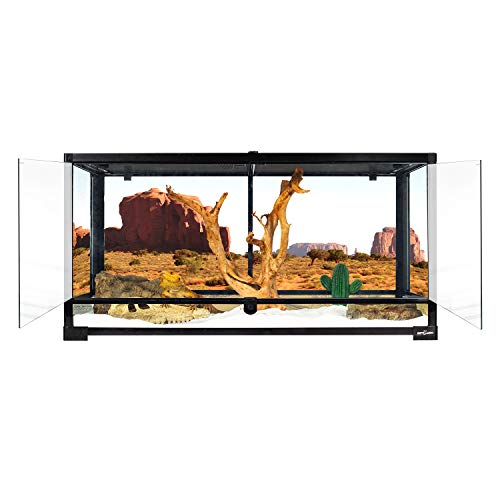
Glass ball python tank options provide crystal clear visibility and is readily available at pet stores. The main drawback for ball pythons is side mesh vents that leak humidity.
Reflective glass can also cause stress — snakes may strike at their own reflection. Screen tops are escape risks if not secured properly.
Wood composite (WPC) ball python tank enclosures are the best budget option that still holds humidity well. The furniture-style appearance blends with home decor.
WPC is not truly waterproof long-term and can warp or swell with persistent moisture. Shipping damage is common — multiple reviews report broken pieces on arrival.
Recommendation: A PVC ball python tank for serious keepers who prioritize snake health. A glass ball python tank for display-first setups (be prepared to work harder on humidity). A WPC ball python tank for budget-conscious keepers who need humidity retention without PVC prices. For detailed humidity management strategies, see our ball python humidity guide.
Best Ball Python Enclosures — Our Top Picks
| # | Product | Brand | Size | Price | Rating | Reviews | Best For |
|---|---|---|---|---|---|---|---|
| 1 | ECOFLEX 36” Mojave Lounge | New Age Pet | 36×18×24 | $56.99 | — | — | Budget juvenile |
| 2 | ECOFLEX 48” Mojave Lounge | New Age Pet | 48×24×24 | $199.99 | — | — | Budget adult |
| 3 | 34 Gallon w/ Foam Background | REPTI ZOO | 24×18×18 | $168.13 | — | — | Decorative juvenile |
| 4 | 50 Gallon Double Hinge | REPTI ZOO | 36×18×18 | $191.81 | — | — | Juvenile to sub-adult |
| 5 | 50 Gallon 2-in-1 | REPTI ZOO | 36×18×17.75 | $184.97 | — | — | Ventilation flexibility |
| 6 | 67 Gallon Upgrade | REPTI ZOO | 48×18×18 | $262.99 | — | — | Best 48” glass |
| 7 | 120 Gallon Tall & Wide | REPTI ZOO | 48×24×24 | $323.99 | — | — | Ideal 4x2x2 adult |
New Age Pet ECOFLEX 36” Mojave Lounge — the best budget ball python tank for juvenile ball pythons. Easy 20-minute assembly that one person can handle alone. The WPC construction holds humidity well, which is the main advantage over glass at this price point.
Shipping damage is the main drawback — broken pieces are reported frequently. The material is not truly waterproof long-term. Best for hatchlings and juveniles on a budget.
New Age Pet ECOFLEX 48” Mojave Lounge — a budget-friendly 48-inch ball python tank for adult ball pythons. Same WPC construction as the 36-inch with the same humidity benefits. The 48×24-inch footprint approaches the ideal 4x2x2 dimensions. Same shipping damage risk applies. Best for adults when PVC is out of budget.
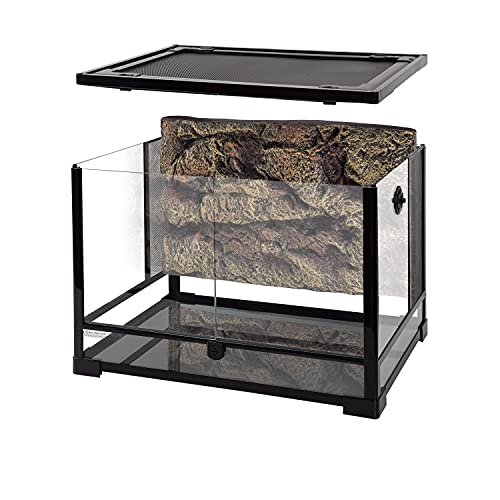
REPTI ZOO 34 Gallon with Foam Background — the built-in foam rock background looks impressive out of the box. It has held up for 4+ years per reviewer reports, and the deep substrate lip prevents spilling.
However, side mesh ventilation makes it difficult to maintain the 50-60% humidity ball pythons need. One reviewer states it is “impossible to hold humidity.” Best for a display-first juvenile setup.
REPTI ZOO 50 Gallon Double Hinge — thick glass with excellent packaging. Front-opening double hinge doors provide easy access. Assembly is straightforward if you follow the video instructions.
One concerning report: a cracked glass bottom led to a snake escape. Inspect the bottom carefully on arrival. Best for the juvenile to sub-adult transition.
REPTI ZOO 50 Gallon 2-in-1 — the standout feature is interchangeable mesh and glass side panels. This lets you control ventilation: glass sides in dry climates to hold humidity, mesh sides in humid climates for airflow.
The massive review count (1,526) provides confidence. Not water-tight — corners leak with water features. Best for keepers who want ventilation flexibility.
REPTI ZOO 67 Gallon Upgrade — the highest-rated enclosure in this lineup. The 48-inch length provides proper adult floor space. Lockable sliding doors add security.
Some units arrive without the side mesh vents shown in the product photo. Best for adult ball pythons that need 48 inches of floor space on a glass budget.
REPTI ZOO 120 Gallon Tall & Wide — the true 4x2x2 ball python tank that meets the modern expert consensus for minimum adult enclosure size. The full 48×24-inch footprint provides maximum floor space. Tempered glass with sliding doors and anti-escape lid.
Heavy and not water-tight, but acceptable trade-offs for the ideal size. Best for keepers who want the recommended adult ball python tank with glass visibility.
The best tank for a ball python balances size, material, and budget. Our top recommendation: the REPTI ZOO 120 Gallon for those with the budget ($324). The New Age Pet ECOFLEX 48” ($200) is the best budget alternative that still holds humidity. Whatever ball python tank you choose, a quality thermostat is non-negotiable — every heating device must be controlled by one.
Ball Python Tank Setup — Essential Equipment & Layout
| Equipment | Why Essential | Budget Option |
|---|---|---|
| Thermostat | Controls ALL heating — prevents burns and fire | Inkbird thermostat ($25-40) |
| Two thermometers | Monitor warm + cool side independently | Digital probe thermometers ($10 each) |
| Hygrometer | Monitor humidity (target 50-60%) | Digital hygrometer ($10) |
| Heat source | Basking 88-96°F, cool side 75-80°F | CHE or heat lamp + thermostat |
| Two hides (minimum) | Snake needs secure retreats on each side | Plastic hide boxes ($5-15 each) |
| Water dish | Large enough for snake to soak entire body | Ceramic crock ($10-15) |
| Substrate | Holds humidity, allows burrowing | Cypress mulch or coconut husk |
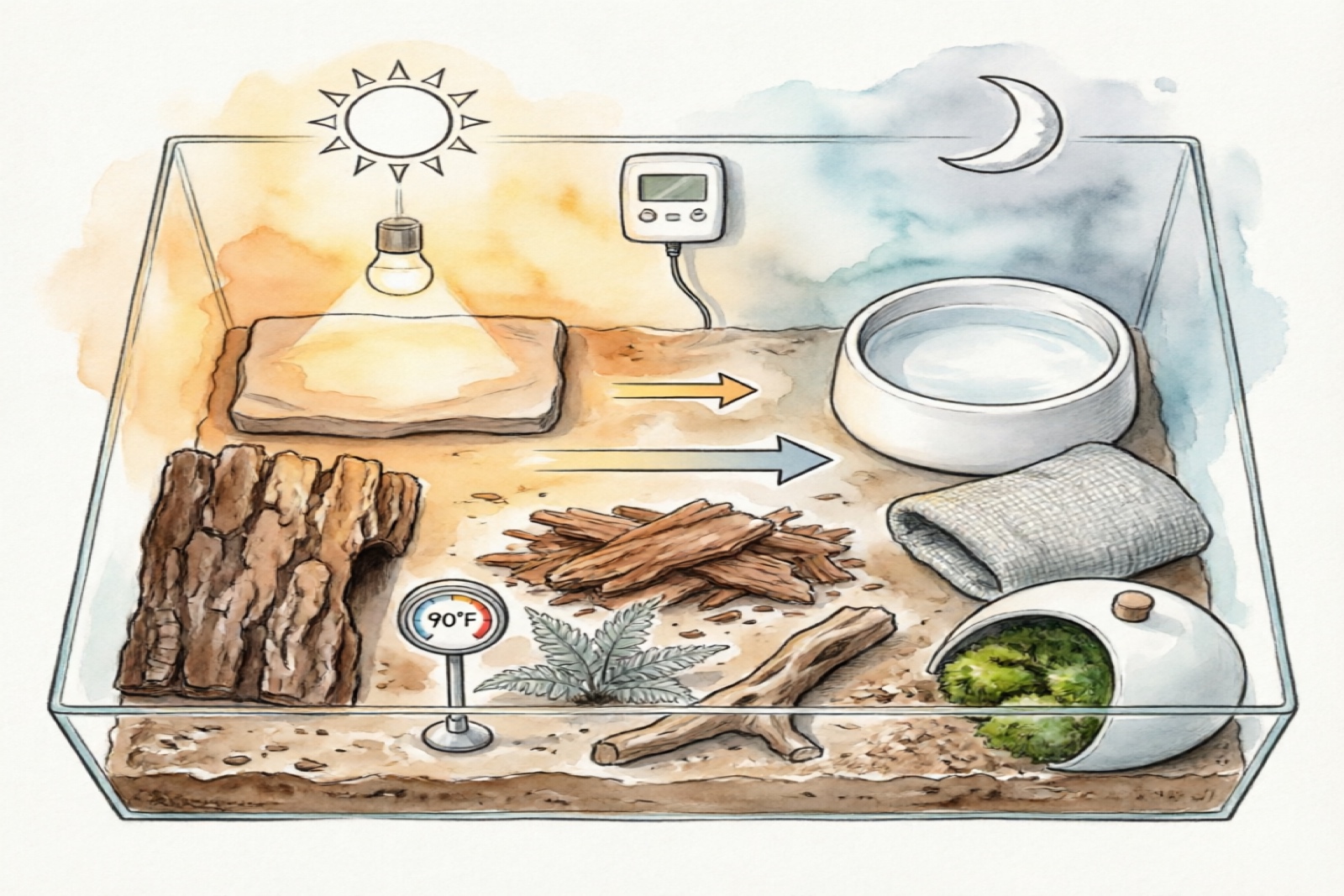
Ball python tank temperature gradient setup: Heat source on one end only. Ball python tank temperature: basking surface 88-96°F directly under the heat source.
| Equipment | Why Essential | Budget Option |
|---|---|---|
| Thermostat | Controls ALL heating — prevents burns and fire | Inkbird thermostat ($25-40) |
| Two thermometers | Monitor warm + cool side independently | Digital probe thermometers ($10 each) |
| Hygrometer | Monitor humidity (target 50-60%) | Digital hygrometer ($10) |
| Heat source | Basking 88-96°F, cool side 75-80°F | CHE or heat lamp + thermostat |
| Two hides (minimum) | Snake needs secure retreats on each side | Plastic hide boxes ($5-15 each) |
| Water dish | Large enough for snake to soak entire body | Ceramic crock ($10-15) |
| Substrate | Holds humidity, allows burrowing | Cypress mulch or coconut husk |
Ball python tank temperature gradient setup: Heat source on one end only. Ball python tank temperature: basking surface 88-96°F directly under the heat source.
Warm hide 85-88°F. Cool side ambient 75-80°F. Cool hide 75-80°F. Nighttime can drop to 72-75°F using a non-light-emitting heat source.
A ball python tank thermostat is non-negotiable. Every heating device — heat lamp, heat pad, ceramic heat emitter, radiant heat panel — must be connected to a thermostat.
Without one, ball python tank temperatures can reach 120°F+ and cause lethal burns. This is the number one cause of preventable injury in pet reptiles.
Ball python tank hide placement: One hide on the warm side, one on the cool side. A third humid hide filled with damp sphagnum moss helps during shedding cycles when humidity should reach 70-80%.
Ball python tank water dish: Large enough for the snake to soak its entire body. Place on the cool side to prevent evaporation from raising ambient humidity too high. Change water daily.
Ball python tank substrate: Safe options include cypress mulch, orchid bark, coconut husk or fiber, and newspaper or paper towels for quarantine. For substrate principles and comparisons, see our leopard gecko substrate guide — different species, but the safety principles overlap.
Never use cedar or pine shavings in any ball python tank — they contain phenols and aromatic oils that cause respiratory infections and neurological damage in reptiles.
One competitor actually recommends cedar shavings as ball python substrate, which is dangerous and contradicts veterinary guidance. Also avoid reptile carpet (harbors bacteria in seams), sand (impaction risk), and gravel. For general reptile habitat principles, see our reptile habitat setup guide.
Ball Python Tank Setup Ideas & Layout Tips
Naturalistic ball python tank setup: Start with a deep substrate layer of 3-4 inches of cypress mulch or coconut husk. Add cork bark rounds for hiding and minimal climbing.
Artificial plants like pothos and snake plants provide cover without being toxic if accidentally ingested. A large flat stone under the basking area creates a warm surface.
Minimalist bioactive ball python tank setup: Use coconut coir as a base with leaf litter on top. Add live plants that tolerate low light and moderate humidity — Sansevieria and Bromeliads work well.
Introduce a cleanup crew of isopods and springtails to break down waste. This approach requires more initial setup but reduces long-term maintenance.
Ball python tank layout principle: divide the enclosure into a warm half and a cool half. The warm half has the basking area plus the warm hide.
The cool half has the water dish plus the cool hide and humid hide. The middle is open exploration space with some clutter — plants, cork bark, leaf litter.
Common ball python tank setup mistakes to avoid:
- Too few hides — minimum two, ideally three to four. Ball pythons are secretive snakes that spend most of their time hiding.
- No humid hide — shedding problems follow. A plastic container with damp sphagnum moss and a entry hole costs under $10.
- Heat source in the middle — this destroys the temperature gradient. Heat goes on one end only.
- Over-decorating with heavy items — stacked rocks or heavy wood can crush a snake if they shift.
- Substrate too shallow — ball pythons burrow in the wild. Less than 2 inches prevents natural behavior and causes stress.
Frequently Asked Questions
What size ball python tank does a ball python need?
An adult ball python (18+ months, 1500g+) needs a minimum enclosure of 48″ × 24″ × 24″ (4x2x2, roughly 120 gallons). This meets ball python tank requirements — it provides 8 square feet of floor space — enough for the snake to stretch fully and thermoregulate between warm (88-96°F) and cool (75-80°F) zones. Hatchlings start smaller (20-30 gallons) and upgrade as they grow. A 40-gallon tank is acceptable for juveniles (3-12 months) but is too small for a full-grown 3-5 foot snake.
Can a ball python live in a 20-gallon ball python tank?
Only temporarily. A 20-gallon tank is appropriate for hatchlings under 200g for their first 2-3 months. After that, the snake will quickly outgrow the space. A 20-gallon cannot hold a proper temperature gradient and does not have room for two hides. Keeping an adult ball python in a 20-gallon long-term causes chronic stress, appetite loss, and immune suppression. Upgrade to at least a 40-gallon by 3-6 months, and to a 4x2x2 by 12-18 months.
Do ball pythons need a heat lamp in their ball python tank?
Ball pythons need heat, but not necessarily a light-producing heat lamp. Because they are nocturnal and spend most of the day in hides, overhead light can actually stress them. The best options are a ceramic heat emitter (produces heat without light), a deep heat projector, or a radiant heat panel. If you use a heat lamp, use a red or dark-colored bulb at night. Always connect any heating device to a thermostat — uncontrolled heat sources can reach lethal temperatures.
What do you put in a ball python tank setup?
At minimum: two hides (one warm, one cool), a large water dish, 3-4 inches of safe substrate (cypress mulch, orchid bark, or coconut husk), a thermostat-controlled heat source, and two thermometers plus one hygrometer. A third humid hide with damp sphagnum moss is strongly recommended for shedding. Avoid cedar or pine shavings (toxic to snakes), sand (impaction risk), and reptile carpet (harbors bacteria). Ball pythons are terrestrial — they need floor space and hiding spots, not climbing structures.