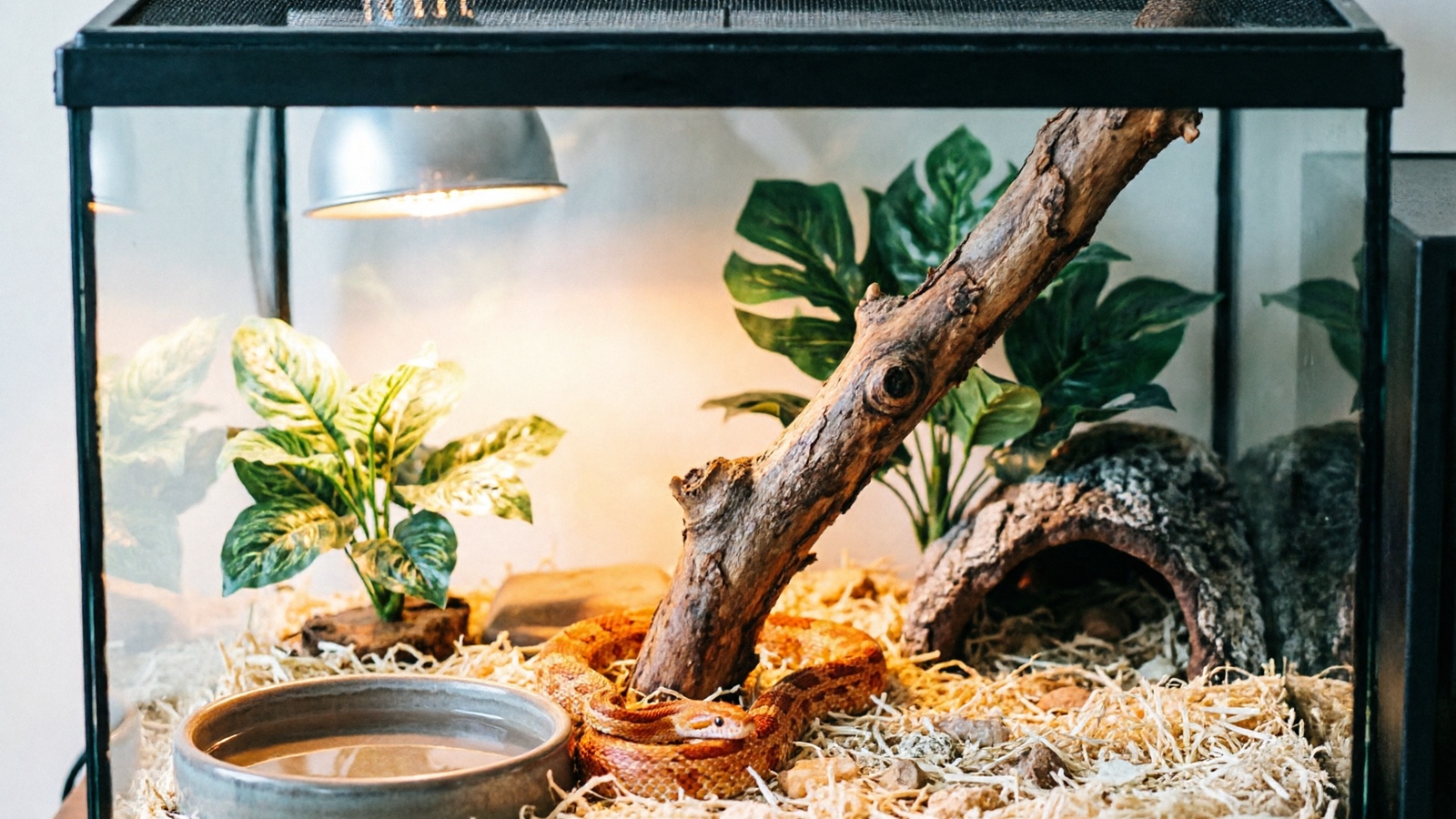
Corn snakes are North America’s most popular pet snake — docile, colorful, and genuinely beginner-friendly. But the wrong tank size or setup can cause stress, escape attempts, and health problems that take years to correct.
Search interest in corn snake tank setups has grown 21% year over year, reflecting a growing community of new owners looking for proper housing guidance. Yet many still buy the wrong corn snake tank or choose materials that don’t suit their climate.
The most common corn snake tank mistake is buying one tank expecting it to last the snake’s entire 15 to 20-year lifespan. Corn snakes grow from 8-inch hatchlings to 4 to 5-foot adults — no single tank works for every stage.
This corn snake tank guide covers a size-by-age breakdown, eight product recommendations across three price tiers, a glass vs PVC comparison, and a complete step-by-step setup walkthrough. For general husbandry beyond housing, see our corn snake care guide.
Corn Snake Tank Size Guide by Age
Ectothermic (cold-blooded) animals rely on external heat sources to regulate body temperature rather than generating metabolic heat internally. Corn snakes (Pantherophis guttatus), like all snakes, are ectotherms — their digestion, immune function, shedding cycle, and overall metabolism are directly governed by ambient temperature. According to the Association of Reptilian and Amphibian Veterinarians (ARAV), corn snakes require a thermal gradient in their enclosure: a warm-side basking zone of 85–88°F and a cool side of 75–78°F, allowing the snake to self-regulate by moving between zones. The ARAV warns that enclosures without a proper gradient — where the entire tank is one uniform temperature — cause chronic digestive failure, respiratory infections from inability to mount an effective immune response, and prolonged or incomplete shedding (dysecdysis).
The single biggest mistake is keeping a corn snake in a tank that’s too small — or too large for its current age. Both extremes cause problems.
Corn snakes grow fast in their first 18 months. A hatchling born at 8 to 10 inches can reach 36 to 48 inches by 18 months of age. Your corn snake tank strategy needs to account for this growth curve.
| Age/Size | Minimum Tank Length | Recommended Size | Gallons |
|---|---|---|---|
| Hatchling (<20”, <6 mo) | 20”+ | 15 gal (24×12×12) | 15 gal |
| Juvenile (20-30”, 6-12 mo) | 30”+ | 20 gal (30×12×12 or 24×18×12) | 20 gal |
| Sub-adult (30-36”, 12-18 mo) | 36”+ | 34-35 gal (24×18×18 or 36×18×12) | 34-35 gal |
| Adult (36”+, 18+ mo) | 36”+ (ideally 48”) | 50 gal (36×18×18) | 50 gal |
A good rule of thumb: the corn snake tank length should equal or exceed the snake’s body length. This gives your corn snake room to stretch out fully, which aids digestion and muscle tone.
Unlike crested geckos or chameleons, corn snakes are primarily terrestrial. They spend most of their time on the ground, though they do climb when given the opportunity.
This means Horizontal floor space matters far more than height. A 36×18×12 corn snake tank is better for an adult corn snake than a 24×18×36 tall tank, even though both hold roughly the same volume.
Start with a 15-gallon corn snake tank for a hatchling and upgrade as the snake grows. Signs your corn snake has outgrown its corn snake tank include frequent escape attempts (pushing at the lid), visible stress (refusing food, excessive hiding), and a cramped resting posture where the snake can’t fully stretch out.
For more on reading corn snake behavior and general care, see our corn snake care guide.
8 Best Corn Snake Tanks
Budget Tier ($60-185)
| Product | Size | Material | Price | Best For |
|---|---|---|---|---|
| REPTI ZOO 15gal Glass | 24×12×12” | Glass | $60.99 | Hatchlings — affordable starter |
| REPTI ZOO 20gal Long | 30×12×12” | Glass | $184.97 | Juveniles — long profile |
| REPTI ZOO 20gal Wide | 24×18×12” | Glass | $168.13 | Juveniles — wider floor |
| REPTI ZOO 34gal | 24×18×18” | Glass | $149.99 | Sub-adults — most reviewed |
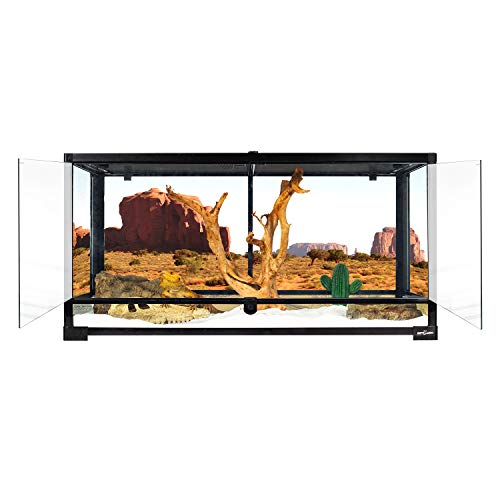
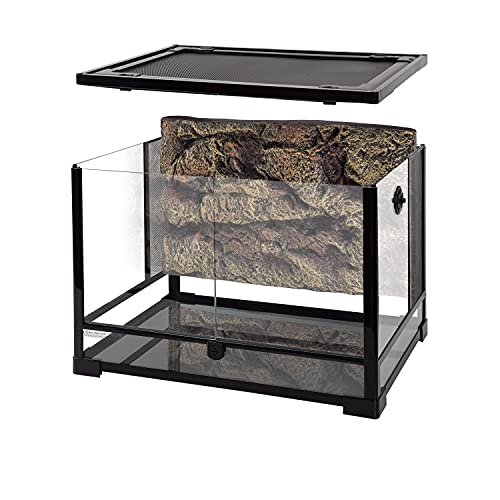
REPTI ZOO 15gal Full Glass is the most affordable starter corn snake tank for hatchling corn snakes. At $60.99 with a compact 24×12×12 footprint, it fits easily on a desk or shelf. The top screen provides ventilation and feeding access. It’s top-opening only — no front door — which is fine for small hatchlings that are easy to handle. Your snake will outgrow this corn snake tank within 6 months, so think of it as a starter investment.
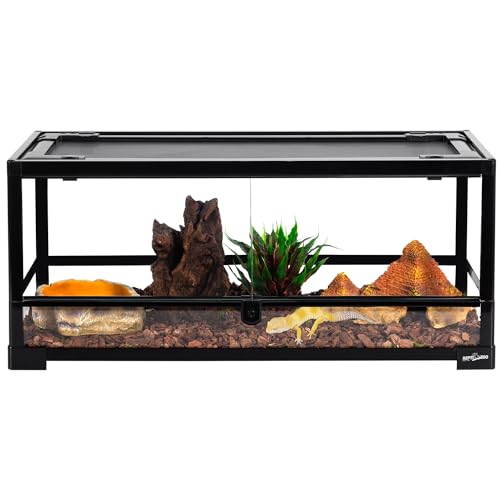
REPTI ZOO 20gal Long at 30×12×12 inches is the ideal corn snake tank for juvenile corn snakes. The 30-inch length gives growing snakes room in this corn snake tank to stretch and thermoregulate. Front-opening doors make maintenance and feeding significantly easier than top-access tanks.
REPTI ZOO 20gal Wide at 24×18×12 inches takes a different approach to the same 20-gallon volume. The wider 18-inch floor gives you more space for hides, water dishes, and decor. Double-hinged front doors provide full access.
REPTI ZOO 34gal at 24×18×18 inches is one of the most widely used corn snake tank options on the market on the market. This corn snake tank bridges the gap between juvenile and adult housing. The 18-inch height allows for climbing branches and vertical decor. At $149.99, it’s excellent value for the volume.
Mid & Premium Tier ($126-216)
| Product | Size | Material | Price | Best For |
|---|---|---|---|---|
| REPTI ZOO 35gal Long & Low | 36×18×12” | Glass | $184.97 | Adults — ideal corn snake shape |
| REPTI ZOO 50gal | 36×18×18” | Glass | $125.99 | Adults — best value large tank |
| Phailozoo 50gal PVC | 36×18×18” | PVC | $215.99 | Adults — lightweight PVC |
| unipaws 50gal PVC | 36×18×18” | PVC | $184.97 | Multi-snake setups |
REPTI ZOO 35gal Long & Low at 36×18×12 inches is the ideal corn snake tank shape for corn snakes. The 36-inch length matches the minimum adult body length, while the 18-inch width provides generous floor space for hides and a water dish. The 12-inch height keeps it appropriately terrestrial. If I had to pick one corn snake tank specifically designed for corn snakes, this would be it.
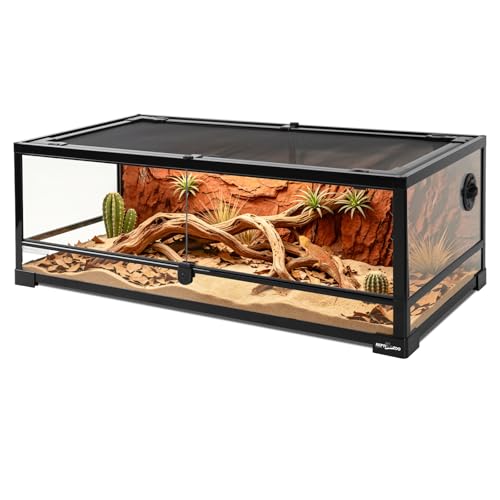
REPTI ZOO 50gal at 36×18×18 inches is the best-value large corn snake tank at $125.99. This corn snake tank adds 6 inches of height over the 35gal Long & Low, allowing for more elaborate climbing setups and taller decor. The double-hinge front doors are standard REPTI ZOO quality. It is a proven product with a solid track record.
Phailozoo 50gal PVC is the highest-rated PVC corn snake tank available. PVC is significantly lighter than glass — a fully assembled Phailozoo weighs roughly half what a glass tank of the same size does. It also retains heat and humidity better, which matters if your home runs cool or dry. The front-opening sliding glass door provides the viewing clarity that PVC enclosures are sometimes criticized for lacking.
unipaws 50gal PVC is stackable, making it the top multi-snake corn snake tank for breeders or keepers with multiple snakes. At $184.97, it’s priced competitively for a PVC enclosure.
The cable port for wire management is a practical touch that glass tanks don’t offer. Cable management is underrated — messy wires not only look bad but can create gaps that curious snakes exploit.
Glass vs PVC Tanks: Which Is Best for Corn Snakes?
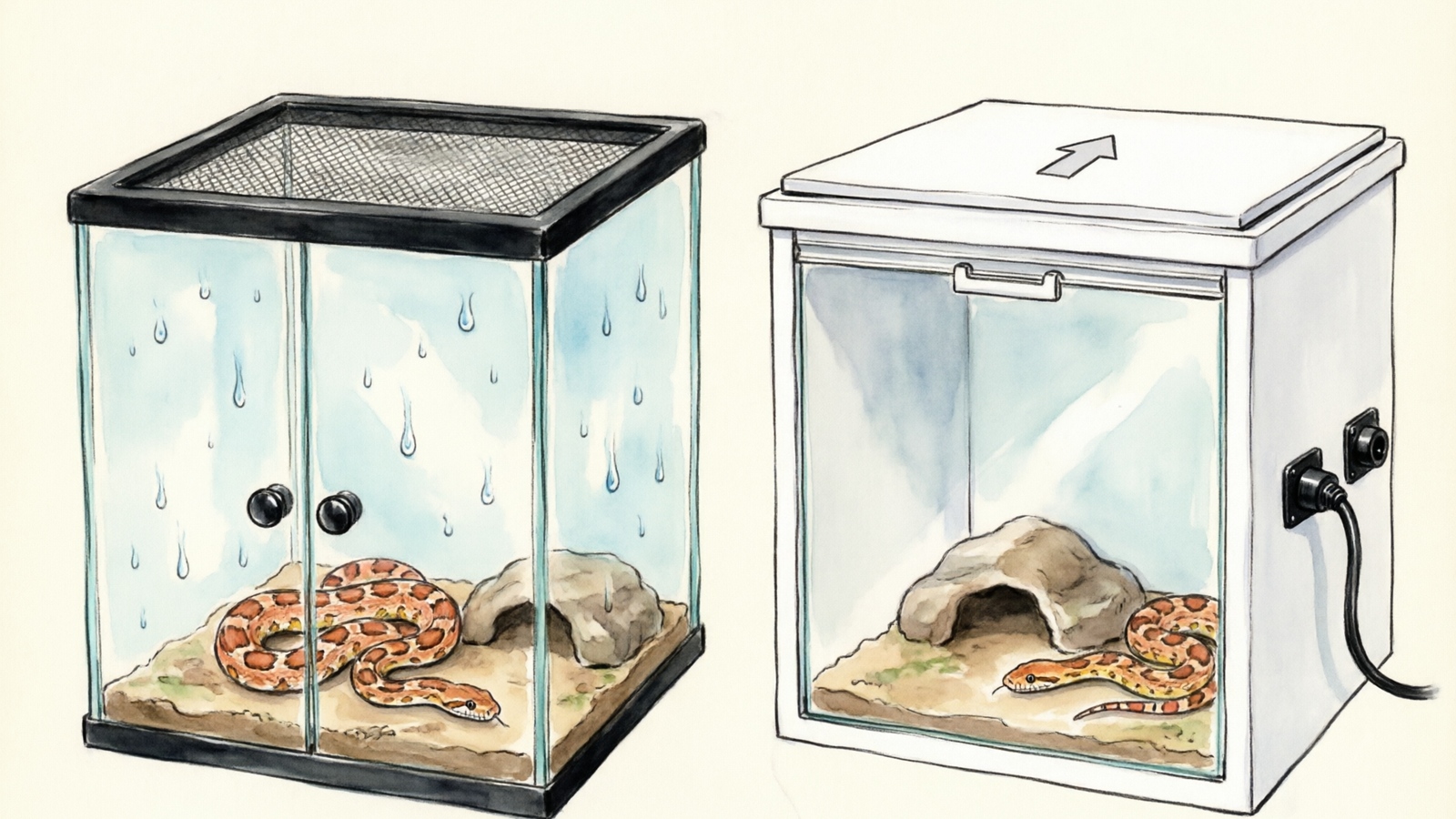
The material you choose affects visibility, weight, temperature management, and escape-proofing. Here’s how glass and PVC compare as corn snake tank materials:
| Factor | Glass | PVC |
|---|---|---|
| Visibility | Excellent (360° clear view) | Good (front panel only) |
| Weight | Heavy (30-50 lbs assembled) | Light (10-20 lbs) |
| Heat Retention | Moderate (screen top loses heat) | Excellent (solid top with vents) |
| Humidity Control | Moderate | Excellent |
| Price Range | $60-185 | $185-216 |
| Escape-Proof | Moderate (check gaps!) | Excellent (sealed design) |
| Stackable | No | Yes |
Glass wins for first-time owners who want full visibility of their snake. Being able to see your corn snake from every angle in a glass corn snake tank makes monitoring health, behavior, and feeding response much easier. Glass tanks are also more affordable at every size point.
The main drawback of a glass corn snake tank is weight and heat loss. The screen top that provides essential ventilation also allows heat to escape rapidly. In homes below 68°F, you may need a higher-wattage heat source to maintain the basking temperature.
PVC wins for keepers who prioritize practical considerations. It’s roughly half the weight of glass, holds heat and humidity more effectively, and the sealed panel design makes escape far less likely. PVC enclosures are also stackable — a major advantage if you keep multiple snakes.
The trade-off is reduced visibility. You can only see your snake through the front panel, which limits observation angles. PVC also costs 30 to 50% more than comparable glass tanks.
Corn snakes are terrestrial, so no corn snake tank needs to be particularly tall. For comparison with another terrestrial snake setup, see our ball python tank guide.
How to Set Up a Corn Snake Tank (Step-by-Step)
Once you’ve chosen the right tank, the corn snake tank setup process determines whether your snake thrives. Here’s a proven 7-step approach.
Step 1: Choose the Right Location
Place your corn snake tank on a stable surface away from direct sunlight, air conditioning vents, and high-traffic areas. Vibrations from speakers, washing machines, or foot traffic stress snakes. Ensure power outlets are nearby for heating equipment.
Step 2: Add Substrate
Add 1 to 2 inches of substrate to the corn snake tank for juveniles, 2 to 3 inches for adults. The depth allows corn snakes to exhibit natural burrowing behavior. Best options include aspen shavings (affordable, allows burrowing), coconut fiber (holds moisture for shed support), and cypress mulch (long-lasting, excellent humidity retention).
Avoid cedar and pine shavings entirely — the phenol oils are toxic to reptile respiratory systems. Sand is also unsuitable due to impaction risk if ingested during feeding. For more substrate safety principles, see our leopard gecko substrate guide.
Step 3: Create a Temperature Gradient
Setting up the corn snake tank temperature gradient is the most critical step. Corn snakes need a temperature gradient — a warm side and a cool side — so they can thermoregulate by moving between zones.
- Warm side: 82-86°F
- Basking spot: 88-90°F
- Cool side: 72-78°F
Use an overhead heat lamp (halogen or ceramic heat emitter) positioned over one end of the tank. Under-tank heaters work as supplementary heat but shouldn’t be the sole source, as they heat the glass rather than the air. Never use heat rocks — they cause severe burns through direct contact.
Always connect corn snake tank heating equipment to a thermostat. Unregulated heat sources are a leading cause of reptile injury. Our best reptile thermostat guide covers reliable options.
Step 4: Install Hides (Minimum 2)
In every corn snake tank, place one hide on the warm side and one on the cool side. Your snake should never have to choose between feeling secure and being at the right temperature. A third “moist hide” filled with damp sphagnum moss helps during shedding.
Each hide should be snug — just large enough for the snake to fit inside with minimal empty space. Overly large hides don’t provide the security that corn snakes seek.
Step 5: Add Water Dish
Place a water dish in the corn snake tank on the cool side to prevent rapid evaporation and bacterial growth. The dish should be large enough for the snake to soak its entire body, which corn snakes do during shedding. Change water every 1 to 2 days.
Step 6: Add Climbing and Enrichment
Despite being primarily terrestrial, corn snakes readily climb when given the opportunity. Add cork bark pieces, branches, and fake or safe live plants. Climbing enrichment reduces stress and encourages natural behavior.
For more on creating naturalistic reptile environments, see our reptile habitat basics guide.
Step 7: Seal Gaps and Escape-Proof
This corn snake tank escape-proofing step cannot be skipped. Multiple verified Amazon reviews report corn snakes escaping through cord holes, door gaps, and corner rod openings in REPTI ZOO enclosures. Inspect every seam, corner, and cable port.
Use aquarium-safe silicone to seal any gap wider than 1/8 inch. Test your work: place a feeder insect inside the closed tank. If it escapes within an hour, your corn snake will eventually find the same route.
Corn Snake Temperature & Humidity Requirements
Maintaining correct corn snake tank temperatures is non-negotiable for corn snake health. Improper temperatures cause digestion failure, respiratory infections, and immune suppression.
| Zone | Temperature | Equipment |
|---|---|---|
| Basking spot | 88-90°F | Heat lamp (halogen or CHE) |
| Warm side | 82-86°F | Under-tank heater or radiant panel |
| Cool side | 72-78°F | No additional heat needed |
| Night drop | 65-72°F | Turn off basking lamp |
| Parameter | Range | How to Monitor |
|---|---|---|
| Humidity | 40-60% (70% during shed) | Digital hygrometer |
| Light cycle | 12 hours on / 12 hours off | Timer on heat/light |
Invest in two digital thermometers for the corn snake tank — one on the warm side, one on the cool side. Analog stick-on thermometers for the corn snake tank are notoriously inaccurate, with deviations of 5 to 10°F. A $12 digital thermometer with a probe is more reliable than any analog gauge.
UVB lighting is not strictly required for corn snakes (they synthesize vitamin D3 from dietary sources), but a low-intensity UVB bulb supports circadian rhythm and natural behavior. Many experienced keepers report more active, alert snakes when UVB is provided.
During shedding, increase the corn snake tank humidity to 60 to 70% by misting the enclosure or adding a moist hide. When your corn snake’s eyes turn blue and cloudy (a pre-shed sign), it’s time to boost humidity. For humidity management principles that apply across species, see our ball python humidity guide.
Substrate Options for Corn Snake Tanks
Your corn snake tank substrate choice affects burrowing behavior, humidity management, and cleaning effort. Here’s how the common options compare:
| Substrate | Cost | Burrowing | Humidity | Safety |
|---|---|---|---|---|
| Aspen shavings | $ | Very Good | Fair | Safe (keep dry) |
| Coconut fiber | $$ | Excellent | Very Good | Safe |
| Cypress mulch | $$ | Good | Excellent | Safe |
| Paper towels | $ | Minimal | Minimal | Safe (quarantine) |
| Newspaper | $ | Minimal | Minimal | Safe (budget) |
| Cedar/Pine | $ | — | — | TOXIC |
| Sand | $$ | Fair | Minimal | Impaction risk |
Aspen shavings are the most popular corn snake tank substrate among breeders. They’re affordable, allow natural burrowing, and make spot-cleaning straightforward. The main limitation is poor moisture retention — if your snake needs humidity support during shedding, add a moist hide rather than wetting the aspen.
Coconut fiber holds moisture well and supports burrowing. It’s an excellent all-around choice if you want something that handles both dry and humid conditions.
Cypress mulch is the best option for humidity-retaining setups. It resists mold better than coconut fiber and lasts longer between changes. Avoid if you live in a region where cypress harvesting is an environmental concern.
Paper towels are the safest choice for hatchlings and quarantine situations. They let you easily monitor waste, parasites, and mites. They’re not suitable long-term because they don’t allow burrowing.
Tank Maintenance and Cleaning Schedule
A consistent corn snake tank cleaning routine prevents illness and keeps your corn snake’s environment healthy. Here’s a practical schedule:
| Task | Daily | Weekly | Monthly | Every 3-4 Months |
|---|---|---|---|---|
| Check temperatures | Yes | — | — | — |
| Remove waste/uneaten food | Yes | — | — | — |
| Fresh water | Yes | — | — | — |
| Spot clean substrate | — | Yes | — | — |
| Wipe glass (inside) | — | — | Yes | — |
| Inspect hides/accessories | — | — | Yes | — |
| Full substrate replacement | — | — | — | Yes |
| Deep clean and sterilize | — | — | — | Yes |
For routine corn snake tank cleaning, use equal parts water and white vinegar is as effective as commercial reptile cleaners. Spray, wait 5 minutes, wipe, and rinse thoroughly. Avoid bleach — even trace residues can harm reptile respiratory systems.
Deep clean procedure: remove the snake from the corn snake tank to a secure temporary container. Strip all decor and substrate.
Spray all interior surfaces with vinegar solution. Wipe, rinse with clean water, and dry completely before reassembling. Replace with fresh substrate.
For bioactive setups with a cleanup crew (springtails and isopods), skip the deep clean. Instead, add fresh leaf litter every 3 to 6 months and spot-clean large waste. Over-cleaning destroys the microorganism colony that makes bioactive setups work.

Common Corn Snake Tank Mistakes to Avoid
Tank too small (or too large) for the snake’s age. This is the number one corn snake tank mistake. A hatchling in a 50-gallon tank will be stressed by the open space and struggle to find food. An adult in a 20-gallon tank will be cramped and may develop health issues. Follow the size-by-age guide.
No temperature gradient. An entire corn snake tank at one temperature prevents thermoregulation. Corn snakes need to move between warm and cool zones to digest food properly and regulate their metabolism. If your warm side and cool side are within 5°F of each other, the gradient isn’t steep enough.
Heat rocks without a thermostat. Direct-contact heat sources cause severe burns. Reptiles don’t sense thermal pain the way mammals do — by the time a snake reacts to a hot rock, tissue damage has already occurred. Use overhead heating with a thermostat instead.
Unsealed gaps. Corn snakes are professional escape artists. Multiple verified Amazon reviews report escapes through cord holes, door gaps, and corner rod openings. A corn snake can squeeze through any gap wider than its skull — which is surprisingly small. Seal all gaps with aquarium-safe silicone before introducing your snake.
Using cedar or pine shavings. The phenol oils in cedar and pine are toxic to reptile respiratory systems. Even “kiln-dried” pine retains enough oils to cause chronic respiratory inflammation over time. Use aspen, coconut fiber, or cypress mulch instead.
Single hide. Every corn snake tank needs at minimum two hides — one on the warm side, one on the cool side. In a corn snake tank, a snake should never have to choose between feeling safe and being at the right temperature. A third moist hide during shedding is ideal.
Corn snake tank setup checklist:
- Tank length ≥ snake body length — room to stretch fully
- Warm side 85–88°F, cool side 75–78°F — proper thermal gradient
- Minimum 2 hides (warm side + cool side) — security at both temps
- Thermostat on all heat sources — prevents burns and overheating
- Substrate: aspen, coconut fiber, or cypress mulch — safe options
- Fresh water in heavy bowl — changed daily
- All gaps sealed — corn snakes escape through tiny openings
- Humidity 40–60%, bump to 60–70% during shed
- Never use cedar or pine shavings — phenol oils toxic to respiratory system
- Never use heat rocks — cause severe burns without pain warning
- Never use sand — impaction risk if ingested during feeding
- Never house multiple corn snakes together — stress, disease, cannibalism risk
FAQ
What size tank does a corn snake need?
A hatchling (under 20 inches) needs a minimum 15-gallon tank (24×12×12). A juvenile (20-30 inches) needs a 20-gallon tank. Sub-adults need 34-35 gallons, and full-grown adults (36+ inches) need at minimum a 50-gallon tank (36×18×18). The tank should be at least as long as the snake, ideally longer.
What do corn snakes need in their tank?
Every corn snake tank needs substrate (aspen shavings or coconut fiber), at least 2 hides (warm and cool side), a temperature gradient (72-90°F), a water dish for soaking, climbing branches or cork bark, and a secure escape-proof lid. Digital thermometers and a hygrometer are essential monitoring tools.
What is the best enclosure for a corn snake?
The best enclosure for an adult corn snake is a 50-gallon glass or PVC terrarium measuring 36×18×18 inches. Glass offers better visibility and starts around $126. PVC is lighter, retains heat better, and is escape-proof. Corn snakes are terrestrial, so horizontal floor space matters more than height.
How to set up a corn snake tank?
Set up in 7 steps: position the tank away from direct sunlight, add 2-3 inches of substrate, install heating on one side for a gradient (72-90°F), place hides on warm and cool sides, add a water dish on the cool side, add climbing branches, and seal all gaps with aquarium-safe silicone to prevent escapes.