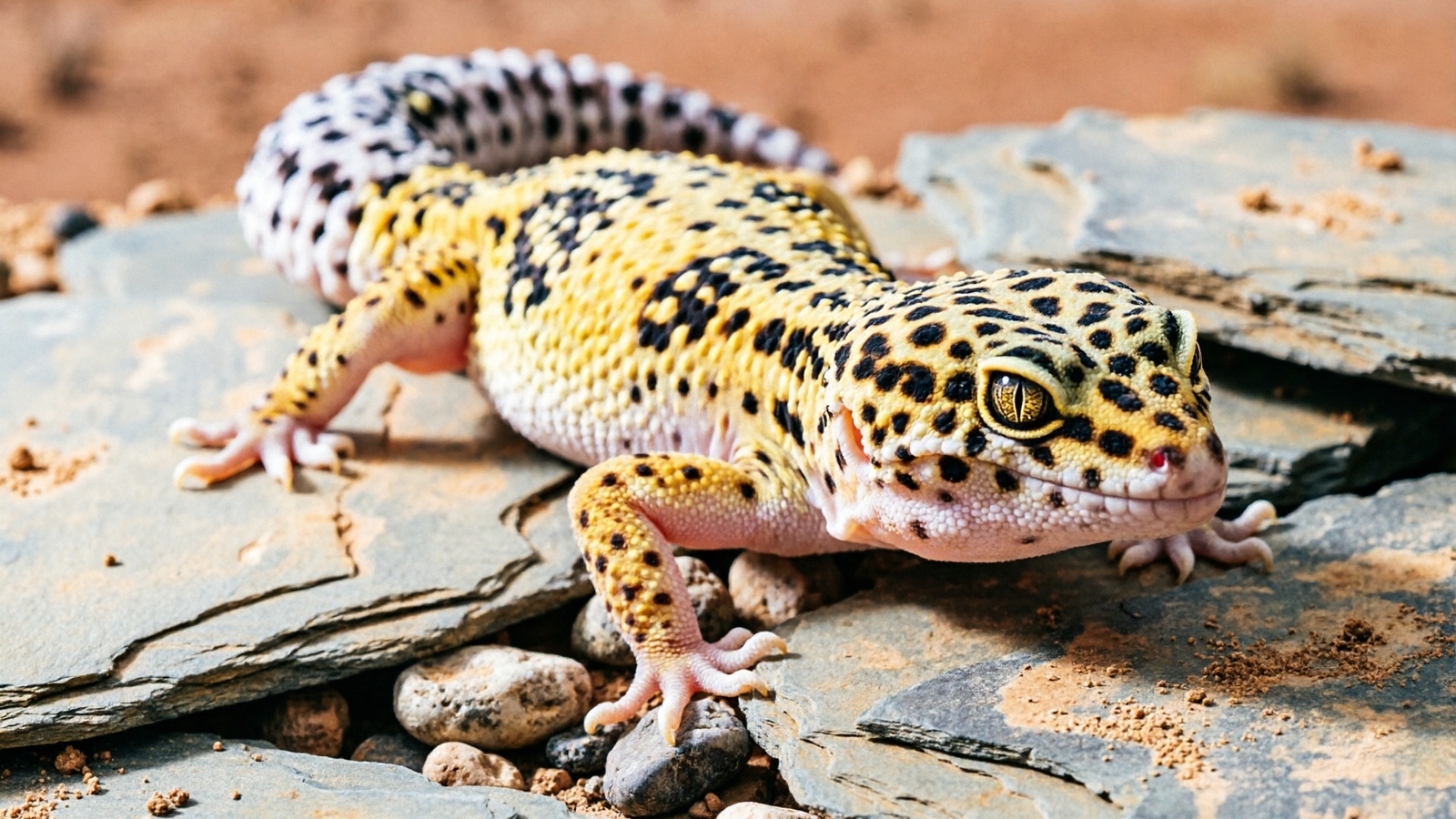
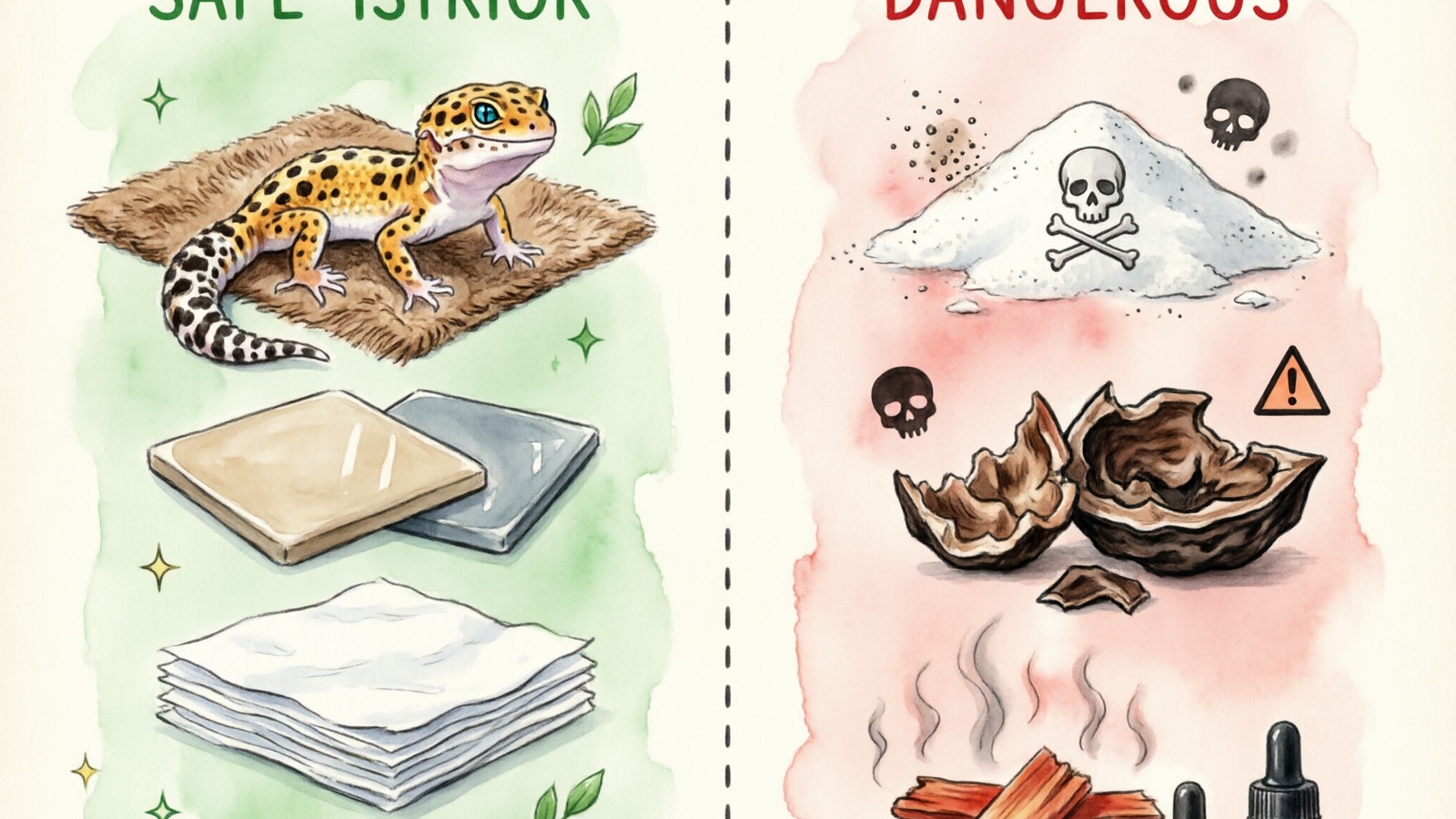
The safest leopard gecko substrates are reptile carpet, stone tile, and paper towels — these prevent impaction risk from accidental ingestion. For experienced keepers, a DIY semi-arid mix (60% organic topsoil, 30% play sand, 10% clay) or bioactive setup best mimics their natural rocky savanna habitat.
Avoid sand as a standalone leopard gecko substrate (especially for juveniles), wood shavings, walnut shells, and calcium sand — all pose serious impaction or respiratory risks. Baby leopard geckos should always be kept on paper towels or reptile carpet until at least 6 months old and 6+ inches long.
This guide covers every safe leopard gecko substrate option, dangerous materials to avoid, the sand debate with evidence from both sides, and step-by-step setup instructions for each substrate type.
For general care beyond substrate, see our leopard gecko care guide.
Best Leopard Gecko Substrates — Safe Options
Choosing the right leopard gecko substrate depends on your experience level, your gecko’s age, and how much maintenance you are willing to do. The best approach is to start simple — carpet or tile — and upgrade to bioactive only after keeping your gecko healthy for at least 6 months. The table below compares the six safe options across the factors that matter most.
| Substrate | Safety | Maintenance | Natural Look | Cost | Best For |
|---|---|---|---|---|---|
| Reptile carpet | ★★★★★ | Moderate (swap + wash) | Low | $-$$ | Beginners, juveniles |
| Stone or ceramic tile | ★★★★★ | Low (wipe clean) | Medium | $ | Easy maintenance lovers |
| Paper towels | ★★★★★ | High (daily change) | None | $ | Quarantine, babies, sick geckos |
| DIY semi-arid mix | ★★★★☆ | Low (spot clean) | ★★★★★ | $ | Experienced keepers |
| Bioactive substrate | ★★★★☆ | Low (self-cleaning) | ★★★★★ | $$$ | Advanced naturalistic setups |
| Excavator clay | ★★★★☆ | Low (spot clean) | ★★★★★ | $$ | Naturalistic, sculptable |
Reptile carpet is the most widely recommended leopard gecko substrate for beginners. It provides a soft, non-abrasive surface that cannot be ingested, making it completely impaction-proof. The main maintenance task is swapping the carpet for a clean one weekly and washing the soiled one.
Zilla Reptile Terrarium Floor Liner ($25.99) — a widely recommended reptile carpet.
It is enzyme-treated for odor reduction and non-abrasive on gecko skin. Available in brown and green to match your setup aesthetic.
MCLANZOO 2-Pack Reptile Carpet ($16.32) — a budget-friendly 2-pack that solves the biggest carpet inconvenience: having a clean spare ready while the other is being washed.
Swap the soiled carpet for the clean one and wash at your convenience. Includes feeding tongs.
Stone or ceramic tile is the lowest-maintenance solid leopard gecko substrate. Slate, ceramic, and porcelain tiles are all impaction-proof and can be cleaned with a damp cloth in seconds.
Tile also retains heat well, which helps maintain basking temperatures. The limitation is that it does not allow burrowing.
Non-adhesive liners are a newer alternative that combines the safety of solid leopard gecko substrate with easier cleaning than carpet. No fibers to snag on claws, no swapping required — just wipe clean.
Helidrago Reptile Substrate Floor Liner ($9.99) — a durable, rubber-like liner with a smooth wipe-clean surface.
No fiber snagging risk, easy to trim to fit tanks from 20 to 75 gallons — the most convenient option for keepers who want solid substrate without carpet maintenance.
Paper towels are not a long-term solution, but they are the correct choice for quarantine, sick geckos, and babies under 3 months. They allow you to monitor feces and detect health issues early.
Substrates to Avoid — Dangerous Options
Some substrates are marketed specifically for reptiles but are actually dangerous as leopard gecko substrate. The table below lists the materials that pose the highest risk.
| Substrate | Risk Level | Why It Is Dangerous |
|---|---|---|
| Calcium sand (Vita-Sand) | 🔴 Severe | Neutralizes stomach acid, causing digestive failure. Marketed as “digestible” but scientifically disproven |
| Walnut shells | 🔴 Severe | Sharp edges damage mouth and GI tract. Jagged particles cause impaction |
| Cedar or pine shavings | 🔴 Severe | Phenols and aromatic oils cause respiratory damage and liver toxicity |
| Wood chips and mulch | 🔴 High | Impaction risk plus splinters injure skin and mouth. Feeder insects hide underneath |
| Coconut fiber (standalone) | 🟡 Medium | Fine dust irritates respiratory system when dry. Impaction risk if ingested in quantity |
| Gravel or pebbles | 🟡 Medium | Can be swallowed during hunting. Impaction risk. Sharp edges possible |
| Reptile sand mat | 🟡 Medium | Hard to clean — feces gets trapped in the texture. Low-quality mats disintegrate into particles |
| Scented substrates | 🔴 Severe | Fragrances and chemicals are toxic through respiratory absorption |
Calcium sand is the most dangerous product on this list because it is specifically marketed for reptiles and labeled as “digestible.”
The claim is that because it is made of calcium, a gecko’s stomach acid will dissolve it. Research has shown this is false — the calcium carbonate in these products neutralizes the very stomach acid needed to break it down, creating a cycle of digestive failure.
Coconut fiber is a nuanced case. Some experienced keepers use it successfully as part of a mixed bioactive leopard gecko substrate.
The risk increases when coconut fiber is used as a deep, standalone leopard gecko substrate in a dry enclosure where the fine dust becomes airborne and irritates the respiratory system. Small amounts of moistened coconut fiber in a humid hide are generally considered safe.
The reptile carpet disagreement. There is genuine expert disagreement on reptile carpet. Reptile.Guide rates it as the best option, while ReptiFiles classifies it as bad because carpet fibers can snag on a gecko’s claws during hunting strikes.
If you notice your gecko’s claws catching on the carpet surface, switch to tile or a smooth liner.
The Sand Debate — Can Leopard Geckos Live on Sand?
This is the single most debated topic in leopard gecko care, and it generates strong opinions on both sides. Here is what the evidence actually says.
Impaction is a potentially fatal condition in reptiles where ingested substrate or foreign material accumulates in the gastrointestinal tract, creating a physical blockage that prevents normal digestion and defecation. According to the Association of Reptilian and Amphibian Veterinarians (ARAV), impaction is one of the most common preventable causes of death in captive leopard geckos (Eublepharis macularius), particularly in juveniles under 6 months of age. Clinical signs include regurgitation, progressive abdominal swelling, reduced or absent defecation, lethargy, and weight loss. The ARAV notes that impaction risk is significantly elevated by three compounding factors: low basking temperatures (which slow gut motility), chronic dehydration (which makes feces harder and more difficult to pass), and loose particle substrates ingested during feeding. Calcium sand products (marketed as “digestible”) are especially dangerous because calcium carbonate neutralizes stomach acid, creating a paradox where the very acid needed to dissolve the substrate is eliminated by the substrate itself.
Position A — Anti-Sand (majority of veterinarians, Reddit community, beginner guides):
Sand impaction is a documented cause of death in leopard geckos, especially juveniles. Leopard geckos do not actually live on sand dunes in the wild — they inhabit rocky, clay-hardened terrain including limestone outcrops in Afghanistan, Iran, and Pakistan.
Even “safe” sand like pre-washed play sand can cause impaction when combined with inadequate husbandry (low temperatures, dehydration). The risk is highest for babies under 6 months, sick geckos, and geckos fed directly on sand rather than from a dish.
Position B — Pro-Sand with Conditions (ReptiFiles, experienced keepers):
Impaction is typically caused by poor husbandry conditions, not leopard gecko substrate choice alone. Healthy, well-hydrated adult geckos maintained at correct temperatures rarely experience impaction.
Sand should never be used as a standalone leopard gecko substrate — it should always be mixed with topsoil and clay in a 60/30/10 ratio. Pre-washed, silica-free play sand or fine dune sand is safer than calcium sand. This approach should never be used with juveniles or quarantined geckos.
Our recommendation based on the evidence: For beginners, avoid sand entirely and use carpet, tile, or paper towels. For experienced keepers with healthy adult geckos, a properly mixed semi-arid leopard gecko substrate that includes sand as one component can work well.
“Experienced” here means not just months of ownership, but a genuine understanding of temperature gradients, hydration, and feeding practices that prevent the conditions where impaction becomes likely. Pure sand as a standalone substrate is not recommended for any leopard gecko at any age.
Zoo Med ReptiSand ($10.55) is included here for comparison only. If using sand as part of a mixed substrate, this is the safer option — fine-grain, pre-washed, and silica-free. It is not recommended as a standalone leopard gecko substrate.
Bad leopard gecko substrate choices can directly affect your gecko’s health. Impaction from ingested substrate is one of the causes covered in our guide to why leopard geckos stop eating.
Bioactive Substrate — Advanced Naturalistic Setup
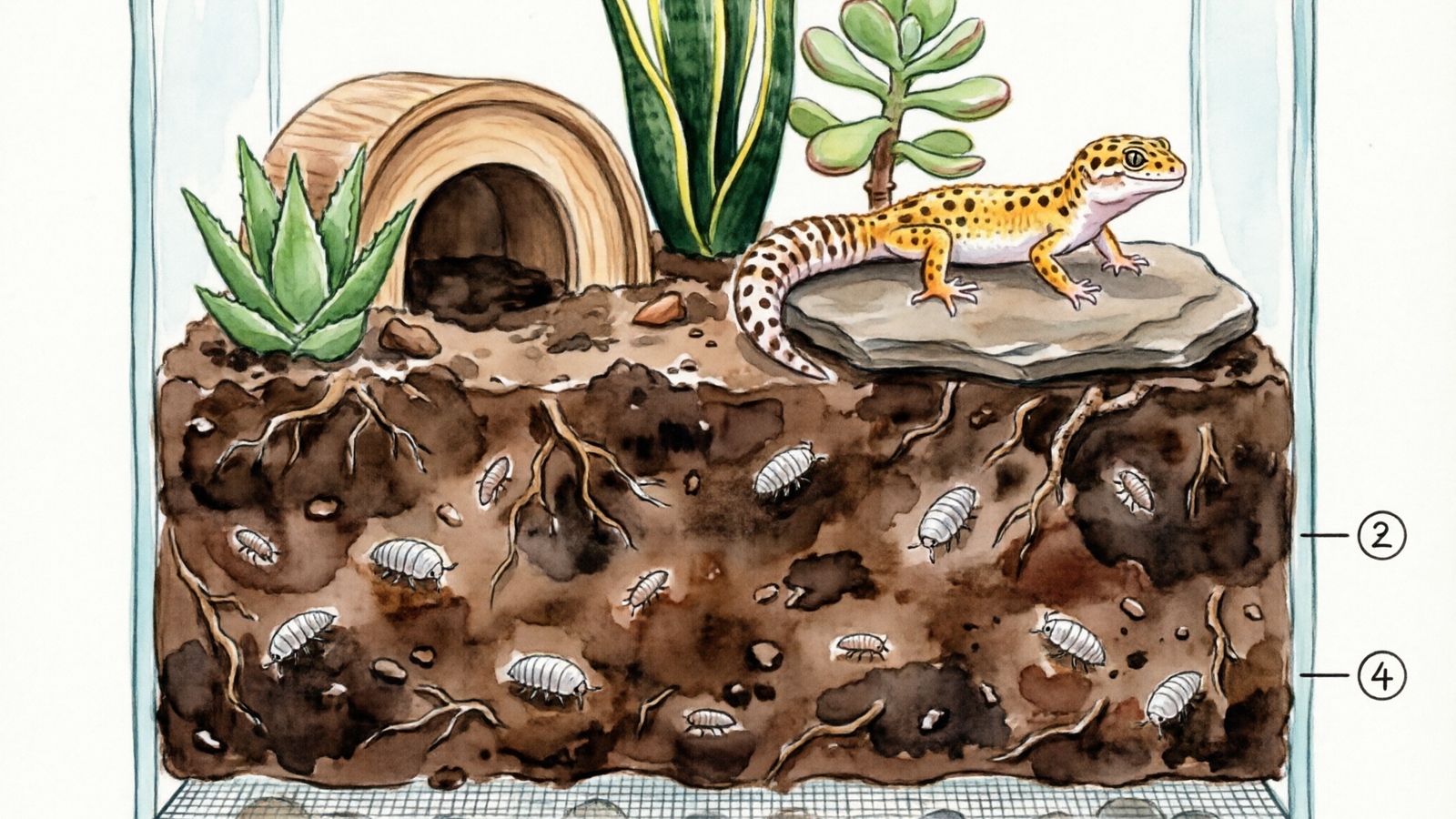
A bioactive enclosure is a self-sustaining mini-ecosystem with live plants, a cleanup crew of isopods and springtails, and organic leopard gecko substrate. It is the closest you can get to replicating a leopard gecko’s natural habitat in captivity.
Benefits of bioactive: The cleanup crew (isopods and springtails) breaks down waste, reducing the need for leopard gecko substrate replacement. Live plants provide hiding spots and climbing opportunities. The setup is the most visually appealing option and provides natural mental stimulation through environmental complexity.
Challenges: Higher upfront cost, requires research to set up correctly, needs 2–4 weeks to establish the ecosystem before adding the gecko, and ongoing monitoring of humidity and plant health.
Not recommended for first-time keepers.
Product recommendations for bioactive:
The Bio Dude Terra Sahara Bioactive Substrate ($10.95) — a pre-mixed desert bioactive formula designed specifically for leopard geckos and other arid species.
It supports live plants and isopod cleanup crews out of the box with no mixing required — just add it to your enclosure.
Zoo Med Eco Earth Coconut Fiber ($22.79) — loose coconut fiber that can be used as a component in bioactive mixes or on its own in humid hides.
All-natural, moisture-retaining, and ready to use without compression.
Zoo Med Eco Earth Compressed Bricks ($22.49) — the best-value bulk coconut fiber option.
Each brick expands to roughly 1.7 gallons when soaked — mix with sand and topsoil to create a custom bioactive desert substrate at lower cost.
Minimum leopard gecko substrate depth for bioactive: 4 inches (10 cm) to support plant roots and allow burrowing.
Cleanup crew: Dwarf white isopods (Trichorhina tomentosa) and temperate springtails. Start with at least 20 isopods for a standard 20-gallon enclosure.
Safe plants for leopard gecko bioactive enclosures: Snake plant (Sansevieria), aloe vera, jade plant, Christmas cactus, and spider plant. Avoid plants toxic to reptiles — pothos and ivy should not be used.
Bioactive setups work best in appropriately sized and ventilated enclosures. See our guide to the best leopard gecko terrarium for enclosure recommendations that support bioactive substrates.
Best Substrate for Baby Leopard Geckos
Juvenile leopard geckos require different leopard gecko substrate than adults. Their smaller size, less developed hunting accuracy, and less resilient digestive systems make them far more vulnerable to impaction.
| Age | Size | Recommended Substrate | Avoid |
|---|---|---|---|
| 0–3 months | Under 5 inches | Paper towels only | All loose substrates |
| 3–6 months | 5–6 inches | Paper towels or reptile carpet | All loose substrates |
| 6–12 months | 6–8 inches | Reptile carpet, tile, or paper towels | Sand, bioactive |
| 12+ months (healthy adult) | 8+ inches | Any safe option including bioactive | Calcium sand, walnut shells |
Why babies need solid leopard gecko substrate. Juveniles have poor aim when hunting crickets and mealworms. They frequently miss their prey, striking the ground surface and ingesting whatever material is there.
Their digestive systems are smaller and less capable of passing foreign material. Impaction in a baby gecko can become fatal within days — far faster than in an adult.
Paper towel setup for babies: A leopard gecko paper towel substrate is the safest option for hatchlings. Layer 3–4 sheets of plain white paper towels across the enclosure floor. Replace immediately when soiled. Provide at least two hides — one on the warm side and one on the cool side — plus a shallow water dish and a small calcium dish.
When to transition. Move to reptile carpet or tile at 6 months and 6+ inches. Consider bioactive or mixed leopard gecko substrates only at 12+ months, and only if you have experience with those setups.
There is no rush to switch — many keepers successfully keep adult geckos on carpet or tile for their entire lives.
Quarantine rule: Any new gecko of any age should start on paper towels for 2–4 weeks.
This allows you to monitor feces, detect parasites, and observe eating habits before moving to a permanent leopard gecko substrate.
How to Set Up Leopard Gecko Substrate
Setup method depends on which leopard gecko substrate type you choose. Below are instructions for the three main approaches.
For reptile carpet or tile (beginners):
- Measure your terrarium floor dimensions — use a tape measure for accuracy.
- Cut carpet or tile to fit, allowing slight overlap at edges to prevent gaps.
- Clean with hot water only — no soap — before first use.
- Place in terrarium and press flat to eliminate gaps where crickets can hide.
- Position hides and dishes — warm hide, cool hide, water dish, and calcium dish on top.
- Establish cleaning routine — spot-clean daily, swap carpet weekly, or wipe tile daily.
For DIY semi-arid mix (experienced keepers):
- Mix 60% organic topsoil (no fertilizers or perlite) + 30% pre-washed play sand + 10% Excavator Clay
- Add water gradually until the mixture holds its shape when squeezed, like damp garden soil
- Pack the mixture firmly into the terrarium at a minimum depth of 4 inches
- Create a slight slope from the cool side to the warm side
- Dry completely before adding the gecko — use a fan or heat lamp. Moist leopard gecko substrate combined with a leopard gecko creates respiratory infection risk
- Place rocks, slate pieces, and hides on top of the leopard gecko substrate
- Wait 24–48 hours to confirm the leopard gecko substrate is fully dry before introducing the gecko
For bioactive setup (advanced):
- Start with a 2-inch drainage layer of hydro balls or lava rock, separated from the leopard gecko substrate by a mesh screen
- Add 3–4 inches of Bio Dude Terra Sahara or equivalent bioactive leopard gecko substrate
- Plant reptile-safe plants directly in the leopard gecko substrate
- Add the cleanup crew — at least 20 dwarf white isopods and springtails
- Let the ecosystem establish for 2–4 weeks before adding the gecko
- Monitor humidity (target 20–40%), temperature gradients, and plant health weekly
Temperature control is critical regardless of leopard gecko substrate type. Incorrect temperatures can cause digestive issues that compound substrate-related risks.
See our guide to choosing a reptile thermostat for temperature control recommendations. For broader habitat planning, see our reptile habitat setup guide.
Leopard gecko substrate safety quick-check:
- ✅ Reptile carpet or stone tile — safest, zero impaction risk
- ✅ Paper towels — ideal for quarantine and sick geckos
- ✅ DIY semi-arid mix (60/30/10 soil/sand/clay) — adults only, 4+ inches deep
- ✅ Bioactive leopard gecko substrate with cleanup crew — advanced, self-maintaining
- ✅ Shelf liner — cheap, easy to replace, non-absorbent
- ❌ Calcium sand — neutralizes stomach acid, increases impaction risk
- ❌ Walnut shells — sharp edges cause intestinal lacerations
- ❌ Cedar or pine shavings — phenols toxic to reptiles
- ❌ Pure sand (standalone) — high impaction risk, especially for juveniles
- ❌ Gravel or aquarium pebbles — easily ingested, causes blockages
- ❌ Any loose leopard gecko substrate for geckos under 6 months — no exceptions
Frequently Asked Questions
What is the best substrate for a leopard gecko?
For beginners and juvenile geckos, reptile carpet or stone tile is the safest choice — zero impaction risk and easy to clean. For experienced keepers with healthy adult geckos, a DIY semi-arid mix (60% organic topsoil, 30% play sand, 10% clay) at 4+ inches deep best mimics their natural rocky savanna habitat and allows natural burrowing behavior. Avoid calcium sand, walnut shells, cedar or pine shavings, and any loose substrate for geckos under 6 months old.
Can you use sand as substrate for leopard geckos?
Pure sand as a standalone substrate is not recommended, especially for juveniles. Leopard geckos in the wild live on rocky, clay-hardened terrain — not sand dunes.
However, some experienced keepers successfully use a properly mixed substrate that includes sand (60% topsoil, 30% play sand, 10% clay). If you choose this route, never use calcium sand, always feed from a dish rather than directly on substrate, and never use with geckos under 12 months or geckos recovering from illness.
What substrate should I avoid for leopard geckos?
Avoid calcium sand (Vita-Sand and similar products — it neutralizes stomach acid and causes digestive failure), walnut shells (sharp edges damage the GI tract), cedar and pine shavings (phenols cause liver and respiratory damage), wood chips and mulch (impaction and splinter risk), and any scented substrate. Coconut fiber as a standalone deep substrate should also be avoided due to dust and impaction risk, though small amounts in humid hides are acceptable.
Is tile good for a leopard gecko enclosure?
Yes, ceramic or stone tile is one of the best substrate choices for leopard geckos. It is completely impaction-proof, easy to clean with a damp cloth, retains heat well for basking, and provides good traction.
Slate, ceramic, and porcelain tiles all work. The main downside is that it does not allow burrowing. For a more natural setup, you can place tile in the main areas and create a small bioactive or soil-filled digging zone in one corner.
{
  "@context": "https://schema.org",
  "@type": "FAQPage",
  "mainEntity": [
    {
      "@type": "Question",
      "name": "What is the best substrate for a leopard gecko?",
      "acceptedAnswer": {
        "@type": "Answer",
        "text": "For beginners and juvenile geckos, reptile carpet or stone tile is the safest choice — zero impaction risk and easy to clean. For experienced keepers with healthy adult geckos, a DIY semi-arid mix (60% organic topsoil, 30% play sand, 10% clay) at 4+ inches deep best mimics their natural rocky savanna habitat. Avoid calcium sand, walnut shells, cedar or pine shavings, and any loose substrate for geckos under 6 months old."
      }
    },
    {
      "@type": "Question",
      "name": "Can you use sand as substrate for leopard geckos?",
      "acceptedAnswer": {
        "@type": "Answer",
        "text": "Pure sand as a standalone substrate is not recommended, especially for juveniles. Leopard geckos in the wild live on rocky, clay-hardened terrain. Some experienced keepers use a mixed substrate (60% topsoil, 30% play sand, 10% clay). Never use calcium sand, always feed from a dish, and never use with geckos under 12 months."
      }
    },
    {
      "@type": "Question",
      "name": "What substrate should I avoid for leopard geckos?",
      "acceptedAnswer": {
        "@type": "Answer",
        "text": "Avoid calcium sand, walnut shells, cedar and pine shavings, wood chips and mulch, and any scented substrate. Coconut fiber as a standalone deep substrate should also be avoided due to dust and impaction risk."
      }
    },
    {
      "@type": "Question",
      "name": "Is tile good for a leopard gecko enclosure?",
      "acceptedAnswer": {
        "@type": "Answer",
        "text": "Yes, ceramic or stone tile is one of the best substrate choices. It is impaction-proof, easy to clean, retains heat well, and provides good traction. The main downside is it does not allow burrowing."
      }
    }
  ]
}