Quick Answer
The best bearded dragon substrate overall is Jurassic Natural Australian Desert Sand ($14). It is the only product sourced directly from Australia, matching what bearded dragons live on in the wild.
- Best for adults: Jurassic Natural or Zoo Med ReptiSand (fine-grain natural sand)
- Best for juveniles: Zilla Floor Liner or Duedusto Liner (zero impaction risk)
- Best bioactive: Bio Dude Terra Sahara ($25, self-cleaning ecosystem)
- Avoid: Calcium sand, walnut shells, and cedar — all carry impaction or toxicity risk
Why Choosing the Right Substrate Matters
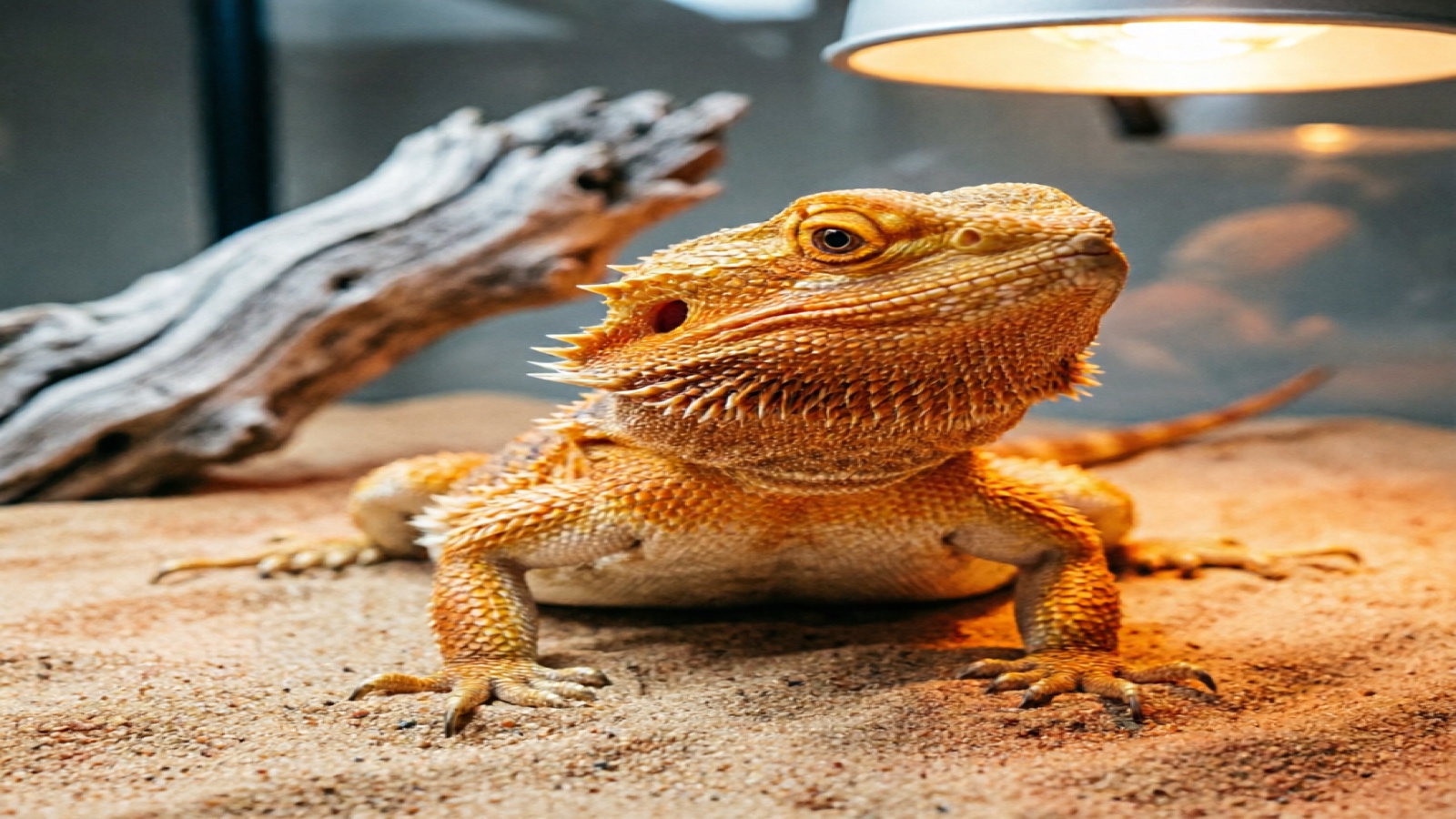
Bearded dragon substrate is the material that lines the bottom of a bearded dragon enclosure. It affects hygiene, natural behavior, and reptile health.
Choosing the best bearded dragon substrate is one of the most debated topics among owners. The wrong choice can lead to impaction — a life-threatening condition where swallowed particles block the digestive tract.
The right substrate supports natural behaviors like digging and burrowing. It also affects humidity levels, cleanliness, and overall enclosure aesthetics. A proper bearded dragon terrarium setup starts from the ground up.
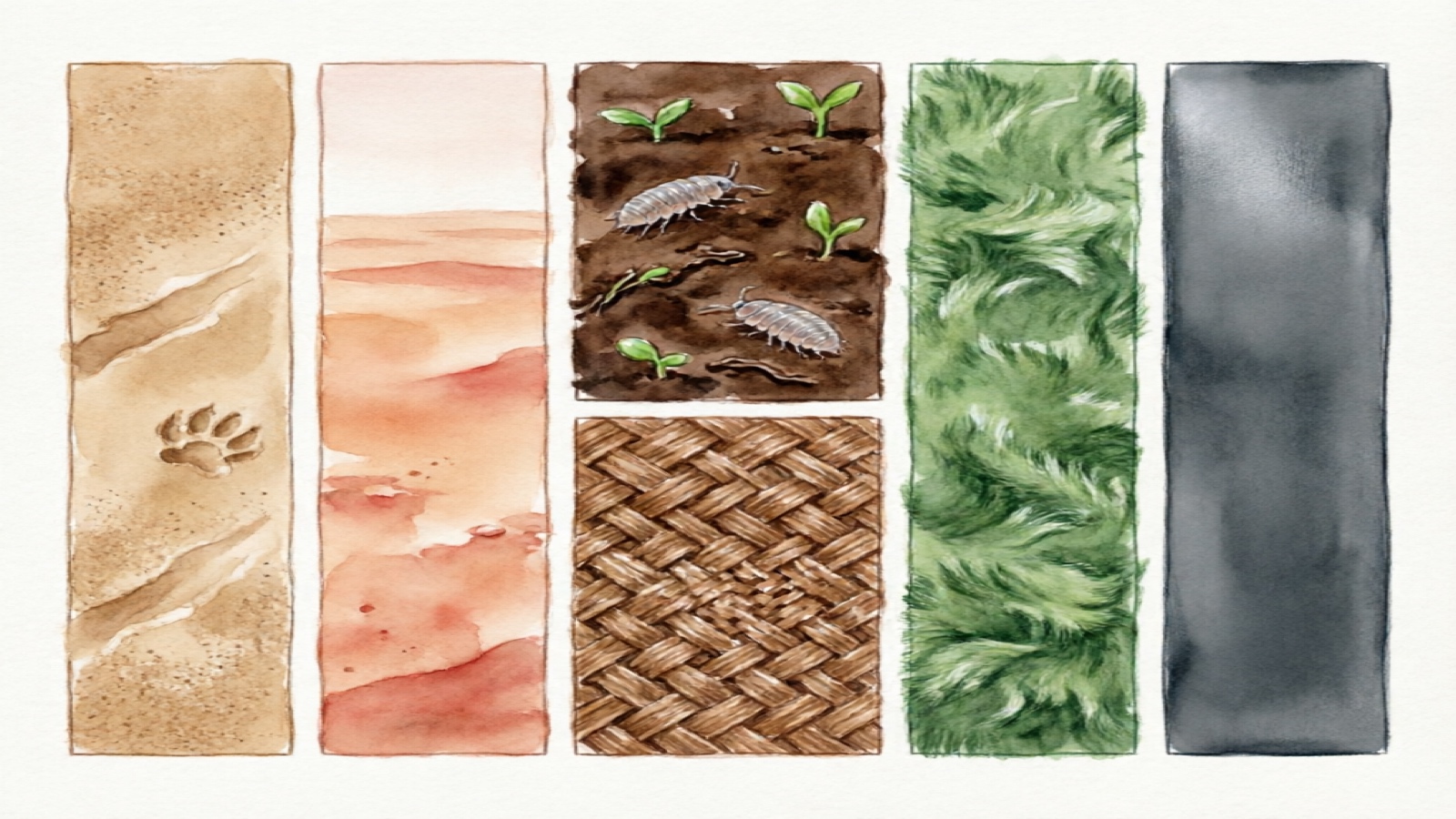
We researched 8 options to find the best bearded dragon substrate across 6 types: natural sand, desert sand, bioactive, floor liners, carpet, and vinyl mats. Each was evaluated for safety, ease of cleaning, and real owner feedback.
I’ve used most of these substrates with bearded dragons over the years, and the differences between them are significant. The “best” choice depends on your dragon’s age, your maintenance preferences, and your experience level.
What Makes a Safe Bearded Dragon Substrate?
Safety is the #1 priority when evaluating any bearded dragon tank substrate. The main risk is impaction — when a bearded dragon swallows substrate particles that block its digestive tract.
Safe substrate materials:
- Fine-grain natural sand (for healthy adults)
- Non-particle options: liners, mats, carpet, tile
- Bioactive soil mixes designed for desert species
Materials to avoid at all costs:
- Calcium sand — Marketed as “digestible” but clumps when wet, increasing impaction risk
- Cedar and pine shavings — Toxic oils cause respiratory damage
- Gravel and pebbles — Cannot pass through the digestive system
- Coconut fiber alone — Holds too much humidity for desert species
Age matters critically. Juvenile bearded dragons under 10 inches should never be on loose substrate. Their smaller digestive tracts make impaction much more likely. Stick to non-particle substrates for babies and juveniles.
| Material | Safe? | Reason |
|---|---|---|
| Fine natural sand | ✅ Adults only | Low impaction risk with fine grain |
| Floor liners | ✅ All ages | Zero impaction risk |
| Vinyl mats | ✅ All ages | Non-particle, wipe clean |
| Reptile carpet | ✅ All ages | Non-particle, washable |
| Bioactive mix | ✅ Adults only | Natural ecosystem, requires setup |
| Calcium sand | ❌ Never | Clumps when wet, high impaction |
| Cedar/pine | ❌ Never | Toxic oils, respiratory damage |
| Gravel | ❌ Never | Cannot pass through digestion |
| Coconut fiber | ⚠️ Mixed | Too humid for BDs alone |
Temperature control also plays a role in substrate safety. A proper reptile thermostat ensures basking temperatures stay in the correct range, which supports healthy digestion and reduces impaction risk.
Our Top 8 Bearded Dragon Substrates
1. Jurassic Natural Australian Desert Dragon Habitat Substrate — Best Overall
Price: $13.87 | ASIN: B0C37ZR252
Jurassic Natural Australian Desert Dragon Habitat Substrate on Amazon →
This is the only bearded dragon-specific sand sold on Amazon — and it comes directly from the Australian desert. That matters because it replicates the best bearded dragon substrate found in nature.
The sand has a natural, grainy texture that supports digging behavior. No dyes, no chemicals, no additives. Just Australian desert sand.
What owners say: “This is the best substrate for bearded dragons since it comes directly from their natural habitat. My guy loves digging in this.” Another owner: “Love it so far. The bag shows you exactly what region of Australia it’s from.”
Downside: You need several bags to fill a properly sized enclosure. One 10-pound bag covers a 40-gallon tank with about 1-2 inches of depth — most owners need 3-4 bags. The sand can also be tracked outside the enclosure on your dragon’s feet.
Check current price on Amazon →
2. Zoo Med ReptiSand®, 10 Pounds, Desert White — Best Sand
Price: $12.99 | ASIN: B0002DIZKC
Zoo Med ReptiSand®, 10 Pounds, Desert White on Amazon →
ReptiSand is a top contender for best bearded dragon substrate and one of the most widely used sands in the hobby. The ultra-fine grain is key — finer sand passes through the digestive system more easily if accidentally swallowed, reducing impaction risk.
No sifting or baking required. The sand comes ready to use straight from the bag.
What owners say: “It’s very nice sand. No sifting or baking required, which makes it easy. 10 pounds of sand is a LOT so I won’t need to repurchase anytime soon.”
Downside: The white color shows every bit of waste clearly. Some owners find this useful for monitoring health, but it means more frequent spot cleaning. The sand can also get dusty when pouring — do it slowly.
Check current price on Amazon →
3. Exo Terra Desert Sand — Best Value
Price: ~$14 | ASIN: B0017JG1IS
Exo Terra Desert Sand on Amazon →
Exo Terra’s desert sand offers the same natural desert look at a competitive price point. Available in multiple colors including red, black, and natural tones.
The fine texture supports natural digging behavior. Multiple color options let you customize the enclosure appearance.
What owners say: “The bearded dragon enjoys his sand and being able to move it around.” Another: “I ordered this because the usual Australian sand has become overpriced. Looks great and still natural.”
Honest warning: The red dye can stain your dragon’s belly and enclosure surfaces. I’d recommend the natural or black color variants to avoid staining issues. Some batches also clump when wet.
Check current price on Amazon →
4. Bio Dude Terra Sahara — Best Bioactive
Price: $24.95 | ASIN: B07Z5CJ573
Bio Dude Terra Sahara Bioactive Substrate on Amazon →
The Bio Dude Terra Sahara is the gold standard for bioactive bearded dragon setups. It creates a self-sustaining ecosystem where beneficial microorganisms break down waste naturally.
The 36-quart bag contains a proprietary blend designed specifically for desert species. Gold flakes in the mix add a natural aesthetic. The substrate holds its shape when you dig tunnels between hides.
What owners say: “Seriously the best substrate on the market and worth every penny. The gold flakes add such a great aesthetic.” Another: “Used this for my bearded dragon’s enclosure — works amazing and he is thriving.”
Downside: At $24.95, it is the most expensive option on our list. Bioactive setups also require more initial knowledge — you need to understand moisture levels, cleanup crews (isopods and springtails), and plant integration. It can mold if kept too wet.
Check current price on Amazon →
5. Zilla Reptile Terrarium Floor Liner — Best Floor Liner
Price: $11.99 | ASIN: B00HC9LIUS
Zilla Reptile Terrarium Floor Liner on Amazon →
The Zilla Floor Liner is one of the most popular substrate products for reptiles. It offers zero impaction risk — there are no particles to swallow.
The brown woven material cuts to fit any terrarium size. It is washable and reusable — just spray it down and let it dry.
What owners say: “This substrate liner has been very convenient. I am new to owning a reptile and after much research, most people agree that a substrate liner is the safest option for a baby.”
Best for: Juvenile bearded dragons. The zero impaction risk makes it the safest choice for babies and young dragons who are still developing their hunting accuracy.
Downside: The liner does not look natural. It can fray at the edges over time, and bacteria can build up in the fibers without regular cleaning.
Check current price on Amazon →
6. Duedusto Non-Adhesive Reptile Terrarium Liner — Best Budget
Price: $9.99 | ASIN: B0B8YMJXQB
Duedusto Non-Adhesive Reptile Terrarium Liner on Amazon →
At $9.99, the Duedusto liner is the cheapest safe option on our list. The non-adhesive backing means no sticky residue on your terrarium glass — a practical advantage over adhesive mats.
The black material provides good grip for your dragon’s claws. It is easy to cut to size and washable.
What owners say: “This liner has worked wonderfully for our 15-month-old bearded dragon. We use it in a 40-gallon enclosure and get two full cage liners out of each piece.” Another: “No worries about my beardie eating substrate. Gives great traction.”
Downside: The material is thin compared to the Zilla liner. It can curl at the edges over time and needs more frequent replacement — typically every 2-3 months.
Check current price on Amazon →
7. HERCOCCI 2 Pack Reptile Carpet — Best Carpet
Price: $13.99 | ASIN: B08HQNVWF2
HERCOCCI 2 Pack Reptile Carpet on Amazon →
The HERCOCCI carpet comes in a 2-pack at 39 x 20 inches each. Having two carpets means you can swap them out — while one is in the enclosure, the other is being washed.
The soft surface is gentle on your dragon’s belly. The carpet is fully washable and reusable.
What owners say: “I love these. I get 2 for the price of 1 and can pick different colors.” Another used it as “a temporary floor for my bearded dragon until I was able to buy him slate floors.”
Downside: This is the lowest-rated product on our list. Dragon claws can occasionally get caught in the carpet fibers. The carpet also needs frequent washing — at least once a week — to prevent bacteria buildup.
Check current price on Amazon →
8. Helidrago Reptile Substrate Floor Mat — Best Vinyl Mat
Price: $9.99 | ASIN: B0BYTB7B4S
Helidrago Reptile Substrate Floor Mat on Amazon →
The Helidrago vinyl mat is the highest-rated product on our list with strong owner feedback. The waterproof surface wipes clean in seconds — no washing machine needed.
Available in multiple sizes to fit different enclosures. The non-particle surface means zero impaction risk.
What owners say: “Easy to clean and great for the tank!” Another: “This mat works great for reptiles such as bearded dragons and geckos. As substrate for them can be unsafe due to accidentally digesting causing impaction.”
Best for: Owners who want the easiest possible cleaning routine. A quick wipe with a damp cloth and you are done.
Downside: The vinyl material does not look natural at all. Some owners also report the mat can slide on smooth glass terrarium bottoms — placing a few rocks on the corners solves this.
Check current price on Amazon →
Substrate Types Compared
| Type | Products | Pros | Cons | Best For | Price |
|---|---|---|---|---|---|
| Natural Sand | Jurassic Natural | Natural, diggable, authentic | Needs multiple bags | Adults | $14 |
| Desert Sand | Zoo Med, Exo Terra | Fine grain, trusted brands | Can be dusty, dye stains | Adults | $12.99 |
| Bioactive | Bio Dude Terra Sahara | Self-cleaning ecosystem | Expensive, complex setup | Experienced owners | $25 |
| Floor Liner | Zilla, Duedusto | Zero impaction risk | Not natural-looking | Juveniles | $10-12 |
| Carpet | HERCOCCI | Washable, reusable, 2-pack | Claws catch, bacteria | Multiple tanks | $14 |
| Vinyl Mat | Helidrago | Waterproof, wipe-clean | Not natural, can slide | Easy cleaning | $10 |
Quick recommendation:
- Adult dragon, natural look → Jurassic Natural Australian Sand
- Adult dragon, trusted brand → Zoo Med ReptiSand
- Juvenile dragon (any age) → Zilla Floor Liner
- Experienced, want self-cleaning → Bio Dude Terra Sahara
- Budget, maximum safety → Duedusto Liner
- Easiest cleaning → Helidrago Vinyl Mat
A balanced diet is just as important as safe substrate. Our bearded dragon food guide covers complete nutrition for all ages.
How to Choose the Right Substrate
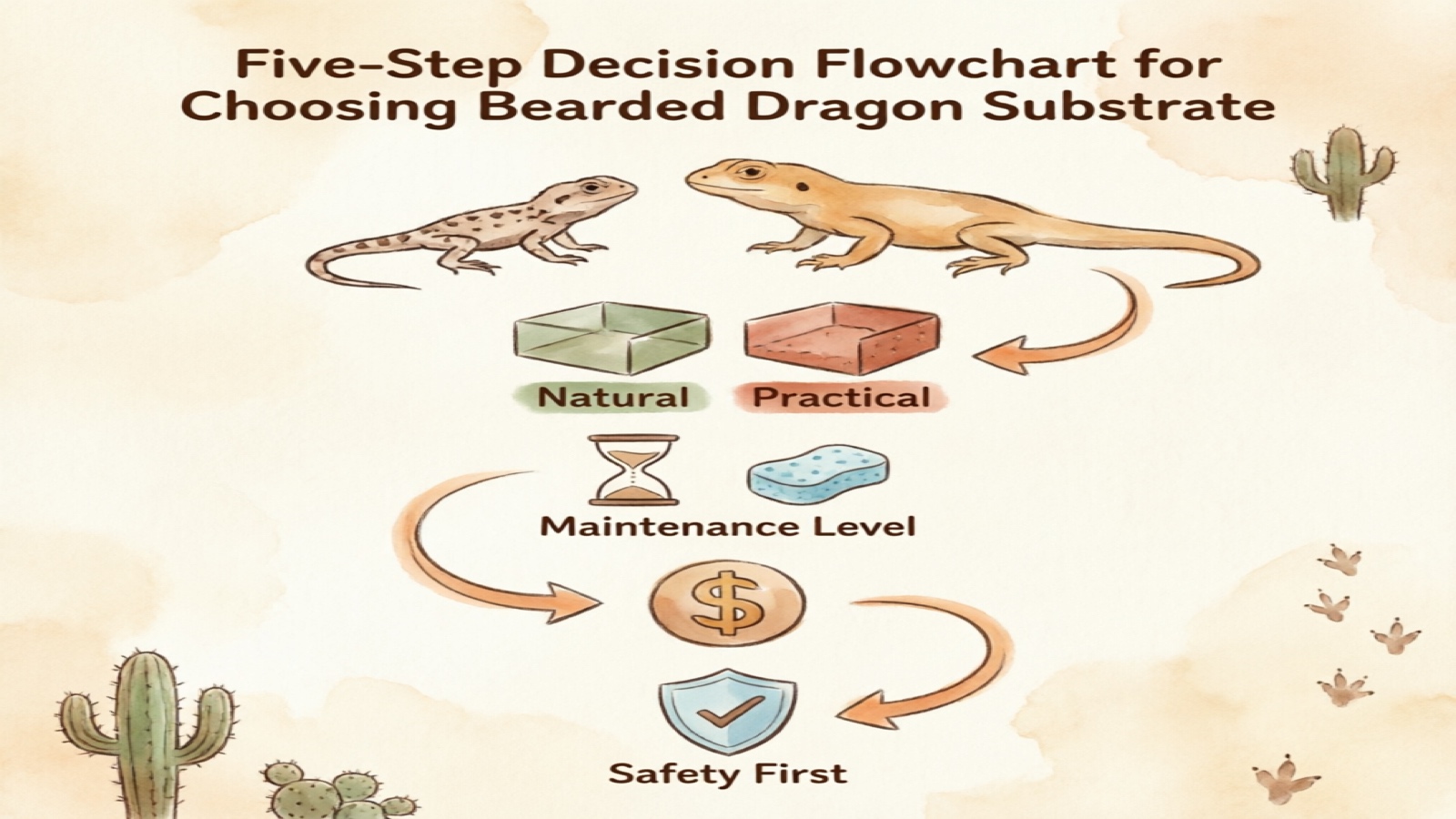
Follow these five steps to find the best bearded dragon substrate for your setup.
Step 1: Check your dragon’s age. Juveniles under 10 inches need non-particle substrates only. No exceptions. Floor liners, vinyl mats, or reptile carpet are the only safe choices for babies.
Step 2: Decide naturalistic vs practical. Do you want a natural-looking desert setup (sand, bioactive) or an easy-to-clean practical setup (liners, mats)? There is no wrong answer — both work well.
Step 3: Consider maintenance level. Sand requires daily spot cleaning and full replacement every 3-4 months. Liners need weekly washing. Bioactive is largely self-cleaning once established. Vinyl mats just need a quick wipe.
Step 4: Factor in budget. Substrates range from $10 to $25 for initial purchase. Sand needs periodic full replacement, so factor in recurring costs. Liners last 2-3 months before replacement. Bioactive is the most expensive upfront but cheapest long-term.
Step 5: Safety first. Regardless of your preference, never use calcium sand, pine or cedar shavings, gravel, or coconut fiber as a standalone substrate for bearded dragons.
Leopard gecko owners face similar substrate decisions. Our leopard gecko substrate guide covers safe options for that species.
Common Substrate Mistakes to Avoid
Even experienced owners make these errors. Proper habitat setup is critical across all small pets — from choosing the right guinea pig cage to selecting safe substrates.
Using calcium sand. Pet stores push this product hard because it is profitable. Despite marketing claims, calcium sand is never the best bearded dragon substrate. It clumps when wet — exactly like cement in your dragon’s gut.
Using coconut fiber for bearded dragons. Coconut fiber (Eco Earth, coir) is excellent for tropical species like crested geckos. But bearded dragons are desert animals. Coconut fiber holds moisture at levels that cause respiratory infections and bacterial growth in a desert setup.
Using gravel or pebbles. These cannot pass through the digestive system at all. If swallowed, they cause immediate blockage requiring emergency surgery.
Not replacing substrate often enough. Sand harbors bacteria over time. Even with daily spot cleaning, a full replacement every 3-4 months is essential. Liners and carpet need regular washing — skip a week and bacteria levels spike.
Mixing substrate types incorrectly. Some owners try to mix sand with coconut fiber. This creates a humidity level that is too high for bearded dragons while still posing impaction risk from the sand particles.
Finding the best bearded dragon substrate means balancing safety with natural behavior. Hamster owners deal with similar bedding safety concerns. Our hamster bedding guide covers which materials are safe for small mammals — the unsafe list overlaps significantly.
Bearded Dragon Substrate FAQ
What is the safest substrate for a bearded dragon?
Non-particle substrates like tile, reptile carpet, or vinyl mats are safest, especially for juveniles.
Fine-grain natural sand is acceptable for healthy adult bearded dragons with no history of digestive issues. The key is avoiding calcium sand, coarse sand, and any particle substrate for juveniles.
Can I use play sand for my bearded dragon?
Yes, washed and screened play sand can work for adult bearded dragons.
Avoid construction sand or sand with additives. Some owners sterilize play sand by baking it at 350°F for 30 minutes before use to kill any potential pathogens.
Is sand bad for bearded dragons?
Fine-grain natural sand is generally safe for healthy adults.
Calcium sand and coarse sand carry impaction risk and should be avoided. The key factor is grain size — ultra-fine sand like Zoo Med ReptiSand is much safer than coarse-grained alternatives.
What substrate do bearded dragons live on in the wild?
Australian desert sand and compacted earth.
This is exactly why Jurassic Natural (Australian desert origin) is our top sand pick. It replicates the natural substrate bearded dragons evolved to live on.
How often should I change bearded dragon substrate?
Sand requires spot cleaning daily and full replacement every 3-4 months.
Liners and carpet should be washed weekly and replaced every 2-3 months. Bioactive substrate is largely self-cleaning once the ecosystem is established — just top up as needed.
Can bearded dragons eat on sand?
Many owners use a feeding dish or separate feeding area to prevent sand ingestion.
If using sand, choose fine-grain varieties and feed on a flat rock or dish. This prevents accidental substrate swallowing during feeding.
What is bioactive substrate for bearded dragons?
A living ecosystem with beneficial microorganisms and sometimes live plants that break down waste naturally.
Bio Dude Terra Sahara is formulated specifically for desert species like bearded dragons. It requires adding cleanup crews (isopods and springtails) to maintain the ecosystem.
Is reptile carpet good for bearded dragons?
Reptile carpet is a safe non-particle option but requires regular washing.
Claws can occasionally get caught in the fibers. The HERCOCCI 2-pack makes it easy to swap carpets while one is being cleaned.