Ball pythons are the most popular pet snake in the world, and for good reason. They are docile, manageable in size, relatively low maintenance, and genuinely fascinating to observe. But popularity does not mean simple — proper ball python care requires getting several critical parameters right, particularly temperature, humidity, and enclosure setup.
This ball python care sheet covers everything a beginner needs: choosing the right enclosure, maintaining proper temperatures and humidity, establishing a feeding schedule, selecting safe substrate, understanding shedding, and recognizing common health problems before they become emergencies.
Is a Ball Python Right for You?
What Is a Ball Python?
Ball pythons (Python regius) are native to West and Central Africa, where they live in grasslands and savannas. They get their name from their defensive behavior — when threatened, they curl into a tight ball with their head protected in the center. In captivity, they reach 3 to 5 feet in length and live 20 to 30 years with proper care. The record is over 40 years.
They are the most popular pet snake for a reason: they tolerate handling well, have a calm temperament, and do not require the intense lighting or large enclosures that some other species demand. For comparison with another popular beginner reptile, see our leopard gecko care guide.
The Real Commitment
A ball python is a 20 to 30-year commitment. A hatchling costs $40 to $100 from a reputable breeder, with initial setup running $200 to $400. Monthly food costs are $15 to $30. You will also need access to an exotic reptile vet — standard veterinarians often do not treat snakes. I would recommend finding one in your area before bringing a snake home. This is not a weekend hobby — consistent ball python care is a decades-long responsibility comparable to owning a dog.
Ball Python Tank Setup & Size
Enclosure Type and Size
Glass terrariums and PVC enclosures both work. PVC is increasingly popular because it holds heat and humidity better than glass and is lighter. Wire cages do not work for ball pythons — they cannot retain heat or humidity, and the open design makes the snake feel exposed and stressed.
| Snake Age | Minimum Enclosure | Recommended |
|---|---|---|
| Hatchling | 10 gallon | 10-20 gallon |
| Juvenile (6-12 months) | 20 gallon | 20-30 gallon |
| Adult (1+ year) | 40 gallon (36”×18”×18”) | 75+ gallon |
One important note for ball python care: a cage that is too large can stress a hatchling. If you start with a large adult enclosure, pack it with hides and clutter so the young snake feels secure.
Front-opening doors are significantly better than top-opening lids for maintenance and feeding — you do not have to lift a heavy lid every time. The 25 Gallon PVC Reptile Enclosure is a solid option for juveniles and young adults — it has front-opening doors, holds humidity well, and the black back panel reduces stress by giving the snake a sense of security. At $95.99, it is competitively priced for a PVC enclosure.
Essential Setup Items
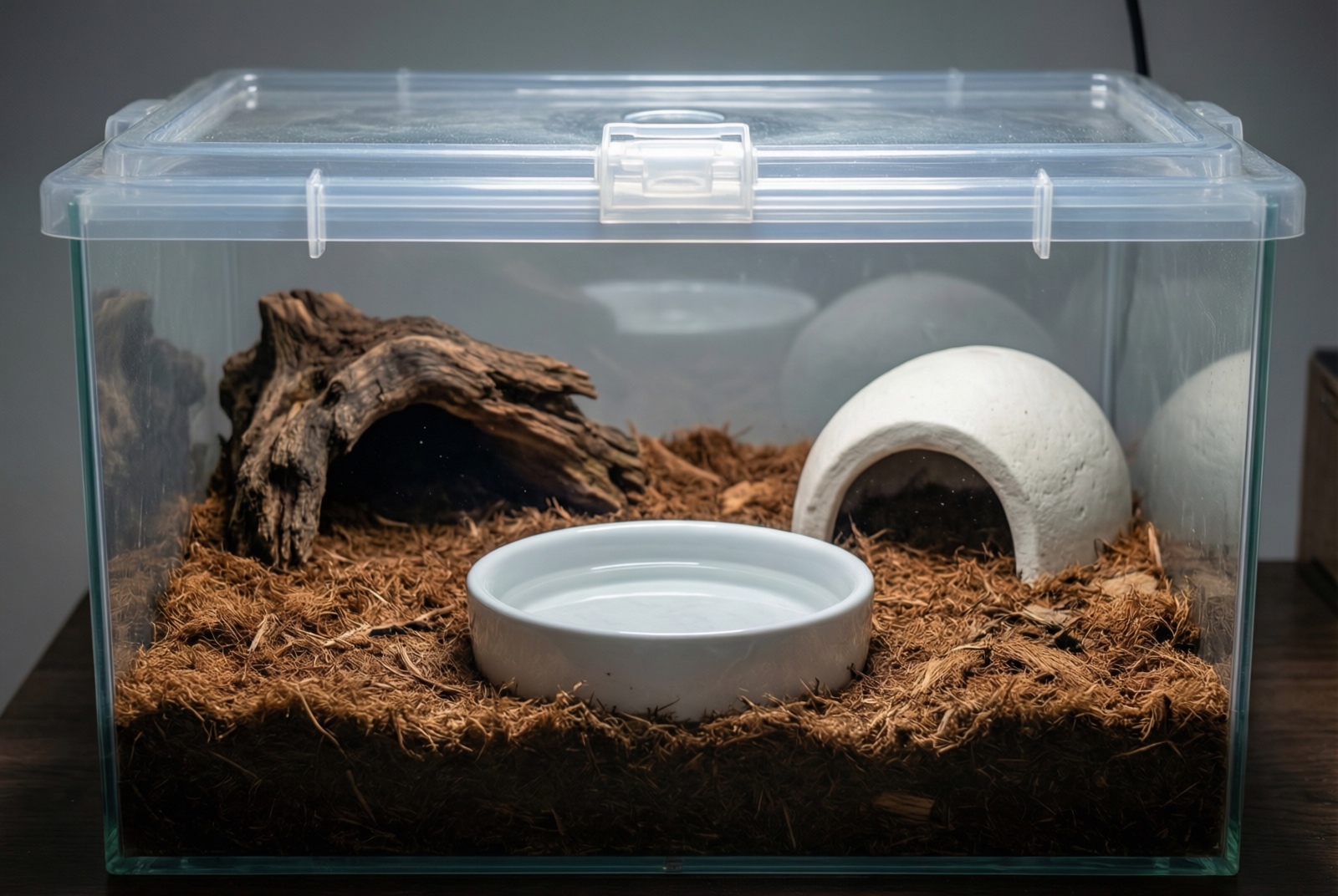
Every ball python enclosure needs at minimum:
- Warm hide on the heated side
- Cool hide on the unheated side
- Humid hide with damp sphagnum moss (especially during shedding)
- Water bowl large enough for the snake to soak in
The LEOTERRA Snake Hide is a resin hide with over 2,000 reviews and a 4.7-star rating. It comes in multiple sizes, retains heat well, and has a smooth interior that will not damage your snake’s scales. I would recommend getting two — one for each side of the enclosure.
Ball pythons are escape artists. Whatever enclosure you choose, make sure the latches are secure. They will push against every gap and test every lid. Place the enclosure in a quiet room away from direct sunlight and HVAC vents. For more on reptile habitats, see our reptile habitat setup guide.
Ball Python Care: Temperature & Humidity Requirements
Temperature and humidity are the two parameters that matter most for ball python health. Get your ball python temperature wrong and your snake will stop eating, develop respiratory infections, or have shedding problems.
Temperature Gradient
Ball pythons thermoregulate by moving between warm and cool areas. You must provide both:
| Zone | Temperature | Purpose |
|---|---|---|
| Warm side (basking) | 88–92°F (31–33°C) | Digestion, activity |
| Cool side | 75–80°F (24–27°C) | Resting, sleeping |
| Ambient | 80–85°F (27–29°C) | General comfort |
The most reliable heating method is an under-tank heat mat controlled by a thermostat. The heat mat should cover roughly one-third of the enclosure floor on the warm side. Never use heat rocks — they cause severe burns and are responsible for countless snake injuries.
The BN-LINK Heat Mat with Digital Thermostat is a convenient combo set — the 8” × 12” heat mat paired with a digital thermostat. At $27.19, it eliminates the need to buy components separately. One owner reported it maintaining stable 80°F temperatures even during -10°F winter conditions.
If you already have a heat mat and need a standalone thermostat, the BN-LINK Reptile Thermostat has earned over 21,000 reviews and is widely trusted by reptile keepers. It maintains temperature within ±1–2°F and is simple to set up. I consider a thermostat non-negotiable — running a heat mat without one is asking for trouble.
For quick temperature readings, an infrared temperature gun is invaluable. The Etekcity Infrared Thermometer gives instant surface readings with a point-and-shoot design. I use one to check basking spot temperatures and glass surface temps — it is faster and more accurate than placing probe thermometers everywhere.
Humidity
Proper ball python humidity levels should be 50–60% ambient. During shedding cycles, increase this to 60–70% by misting or using a humid hide with damp sphagnum moss. Too-low humidity causes stuck shed and respiratory problems. Too-high humidity leads to scale rot — blistering and discoloration on the belly scales.
Measure humidity with a digital hygrometer on each side of the enclosure. Unlike crested geckos, which need higher humidity, ball pythons do best in moderate conditions — see our crested gecko care guide for a comparison of humidity requirements between species.
Ball Python Care: Feeding Schedule & Diet
What to Feed
Ball pythons eat frozen-thawed rats or mice. Always use frozen-thawed prey — this is non-negotiable in proper ball python care. Live rodents can and will bite and scratch your snake, causing serious injuries and infections. Frozen-thawed is safer, more convenient, and equally nutritious.
The prey item should be slightly wider than the snake’s widest body part. This is the simplest and most reliable sizing rule.
Feeding Schedule by Age
| Age | Frequency | Prey Size |
|---|---|---|
| Hatchling | Every 5–7 days | Fuzzy mouse or rat pup |
| Juvenile (6-12 months) | Every 7–10 days | Small to medium rat |
| Adult (1+ year) | Every 10–14 days | Medium to large rat |
How to Feed
Thaw the frozen prey in the refrigerator overnight, then warm it in warm (not hot) water for 10 to 15 minutes before offering. The prey should feel warm to the touch — this triggers the snake’s feeding response. Use feeding tongs — do not offer prey with your fingers, as the snake may confuse fingers for food. Feed in a separate container if possible, which reduces the risk of the snake ingesting substrate.
Wait at least 48 hours after handling before feeding, and wait 48 hours after feeding before handling again. Handling too soon after a meal can cause regurgitation, which is stressful and potentially harmful. A proper ball python feeding schedule is the foundation of healthy feeding. I have found that establishing a consistent feeding day — say, every Saturday — helps both you and the snake settle into a routine.
Signs of Hunger
Hungry ball pythons become more active, often roaming the enclosure and tongue-flicking more frequently. They may strike at the enclosure walls when you walk by — not aggression, but food-seeking behavior. Some will sit near their feeding container. If your snake is hiding constantly and not moving, it is probably not hungry and may be preparing to shed or adjusting to a new environment.
Common Feeding Issues
Food refusal is common in ball python care and usually not a cause for concern. Ball pythons regularly refuse meals during shed cycles, breeding season, or when stressed by enclosure changes. A healthy adult ball python can safely go several weeks without food. I have seen snakes refuse food for 6 to 8 weeks and then resume eating normally.
Regurgitation, however, is a red flag. It usually means the temperature was too low for proper digestion, the snake was handled too soon after eating, or the prey was too large. After regurgitation, wait at least two weeks before offering the next meal, and verify your temperatures are correct.
Ball Python Substrate Options
Best Substrate Choices
Coconut fiber (sold as Eco Earth or similar) is the most popular ball python substrate. It holds humidity well, is safe if accidentally ingested, and allows the snake to burrow. Zoo Med Eco Earth Coconut Fiber comes in a 3-pack of compressed bricks — the best value I have found at $9.98. With over 5,000 reviews and a 4.8-star rating, it is the most widely used reptile substrate for good reason. Each brick expands significantly when soaked in water.
Cypress mulch is another solid option that holds humidity and has mild antimicrobial properties. Paper towels are best for quarantine or sick snakes — they make it easy to monitor droppings and spot problems early.
What to Avoid
Pine and cedar shavings contain aromatic oils that are toxic to reptiles and can cause respiratory and neurological problems. Sand and gravel pose impaction risks if ingested. Astroturf or carpet liners are harsh on belly scales and difficult to clean properly.
Maintenance
Provide 2 to 3 inches of substrate depth. Spot clean soiled areas daily. A full substrate change every 2 to 4 months is sufficient. When humidity drops below 50%, lightly mist the enclosure — do not soak the substrate.
Ball Python Shedding: What to Expect
The Shedding Cycle
Ball pythons shed every 4 to 6 weeks, with juveniles shedding more frequently as they grow. The entire process takes 1 to 2 weeks from start to finish.
Signs of an upcoming shed:
- Colors appear dull or darker than usual
- Eyes turn blue or cloudy (“in blue” phase)
- The snake may hide more and refuse food
The blue phase lasts 2 to 4 days, after which the eyes clear and the actual shed follows within a few days.
How to Help
Maintain 60–70% humidity during the shed cycle. A humid hide filled with damp sphagnum moss gives the snake a microclimate to help loosen the old skin. If your snake has trouble shedding, a soak in shallow, room-temperature water for 15 to 20 minutes can help.
Shedding Problems
A healthy shed comes off in one piece, like a sock turned inside out. Stuck shed — particularly retained eye caps or shed on the tail tip — usually means humidity was too low. Increase humidity and try the soaking method. Do not pull stuck shed off by hand — you can damage the new skin underneath, especially around the eyes. If retained eye caps persist after a second shed cycle, consult a reptile vet.
I have found that the most common shedding mistake is not providing a humid hide. A simple plastic container with a hole cut in the lid, filled with damp sphagnum moss, placed on the warm side of the enclosure, makes an enormous difference. Snakes will seek it out when they need the extra moisture.
Common Ball Python Health Problems
Good ball python care means recognizing health problems early. Snakes hide illness well, so by the time symptoms are obvious, the problem may be advanced.
Respiratory Infections
The most common health issue in ball pythons, usually caused by incorrect temperature or humidity. Signs include wheezing, mucus bubbles from the nostrils, open-mouth breathing, and clicking sounds when breathing. Maintaining proper temperatures is the best prevention — I have found that respiratory infections almost always trace back to the warm side dropping below 85°F or chronic high humidity without ventilation. An Aiicioo Reptile Heating Pad makes an affordable backup heat mat at $9.34 — always have a spare on hand so you are not caught without heating if your primary mat fails. Use it with a thermostat, never alone.
Mites
Snake mites appear as tiny black or red dots on the snake’s body, especially around the eyes and under the chin. Infested snakes often soak in their water bowl excessively. You may also see mites crawling on your hands after handling the snake. Mites require treatment — over-the-counter mite sprays, veterinary-prescribed medications, or environmental treatments like Provent-a-Mite. The entire enclosure must be treated, not just the snake, as mites live in the environment. I would recommend quarantining any new snake for at least 30 days and treating prophylactically to prevent introducing mites to your collection.
Mouth Rot and Scale Rot
Mouth rot (infectious stomatitis) appears as white or yellow plaque inside the mouth, making eating painful. Scale rot causes blistering, discoloration, and raw patches on the belly scales, usually from substrate that is too wet or dirty. Both require veterinary treatment.
When to See a Vet
The foundation of preventive ball python care is finding an exotic reptile vet before you need one. Seek veterinary care if your snake has respiratory symptoms, refuses food for more than 3 months (adults), has visible mites, shows signs of mouth rot or scale rot, or has not shed properly after two consecutive cycles.
Frequently Asked Questions
How Often to Feed a Ball Python?
Hatchlings every 5 to 7 days, juveniles every 7 to 10 days, and adults every 10 to 14 days. The prey item should be slightly wider than the snake’s widest body part. When asking how often to feed ball python, always use frozen-thawed prey, never live.
Do ball pythons need UVB?
Not strictly required. Ball pythons are primarily nocturnal and obtain vitamin D3 from their prey. However, low-level UVB (5.0 bulb) is increasingly recommended by reptile veterinarians for overall health benefits. If you add UVB, position it at the top of the enclosure where the snake can choose to bask or retreat to shade.
How long do ball pythons live?
20 to 30 years in captivity with proper care. The record is over 40 years. This is a long-term commitment that rivals adopting a dog. Make sure you are prepared for decades of care before bringing one home.
What humidity do ball pythons need?
50–60% ambient humidity under normal conditions, increasing to 60–70% during shedding cycles. Too-low humidity causes stuck shed and respiratory problems. Too-high humidity causes scale rot on the belly.
Can ball pythons be handled?
Yes — they are one of the most docile snake species and tolerate handling well once acclimated. Handle 2 to 3 times per week for 10 to 15 minutes. Always support the body fully, move slowly, and avoid handling for 48 hours after feeding.
What do ball pythons eat?
Frozen-thawed rats of appropriate size. Hatchlings start on fuzzy mice or rat pups, while adults eat medium to large rats. The prey should be slightly wider than the snake’s widest body part. Never feed live prey.
How big does a ball python tank need to be?
Hatchlings: 10 to 20 gallon. Adults: minimum 40 gallon (36” × 18” × 18”), with 75+ gallons preferred. Front-opening PVC enclosures are ideal because they retain heat and humidity better than glass. Avoid wire cages entirely.
What temperature do ball pythons need?
Warm side (basking area): 88–92°F. Cool side: 75–80°F. Use an under-tank heat mat on the warm side, controlled by a thermostat. Never use heat rocks. An infrared temperature gun is the best tool for verifying surface temperatures at the basking spot.