Best Ball Python Hide — Quick Picks
Ball pythons spend roughly 80% of their lives hiding (ReptiFiles). In the wild, they burrow into termite mounds, hollow logs, and underground cavities. In captivity, without a proper hide, they develop chronic stress that leads to food refusal, pacing, and respiratory infections.
Most new keepers buy a hide that is too large, which causes insecurity — ball pythons prefer tight contact with all sides of their body (ReptiFiles). Others choose one too small, which prevents proper thermoregulation. Many resin hides have sharp internal edges that can injure your snake.
Worst of all, many keepers provide only one hide when ball pythons need two (Merck Veterinary Manual) — one warm and one cool. This single mistake causes more husbandry problems than any other.
This guide compares eight hide options across five types. Each was evaluated for snug fit, safety, build quality, and real keeper feedback. A full ball python care routine starts with the right shelter.
| Category | Product | Best For |
|---|---|---|
| Best Overall | Leoterra Medium (M) | Juveniles, easy-clean plastic |
| Best for Adults | Leoterra XL | Adults 3-5 ft, snug fit |
| Best Budget | LEOTERRA Large Snake Hide (L) | Sub-adults, 13 in plastic hide |
| Best for Shedding | FCALIVV Humid Hideout | Shedding aid, humid chamber |
| Best Natural Look | JIHAQUA Resin Cave | Aesthetics (check sharp edges) |
Ball Python Hide — What You Need to Know
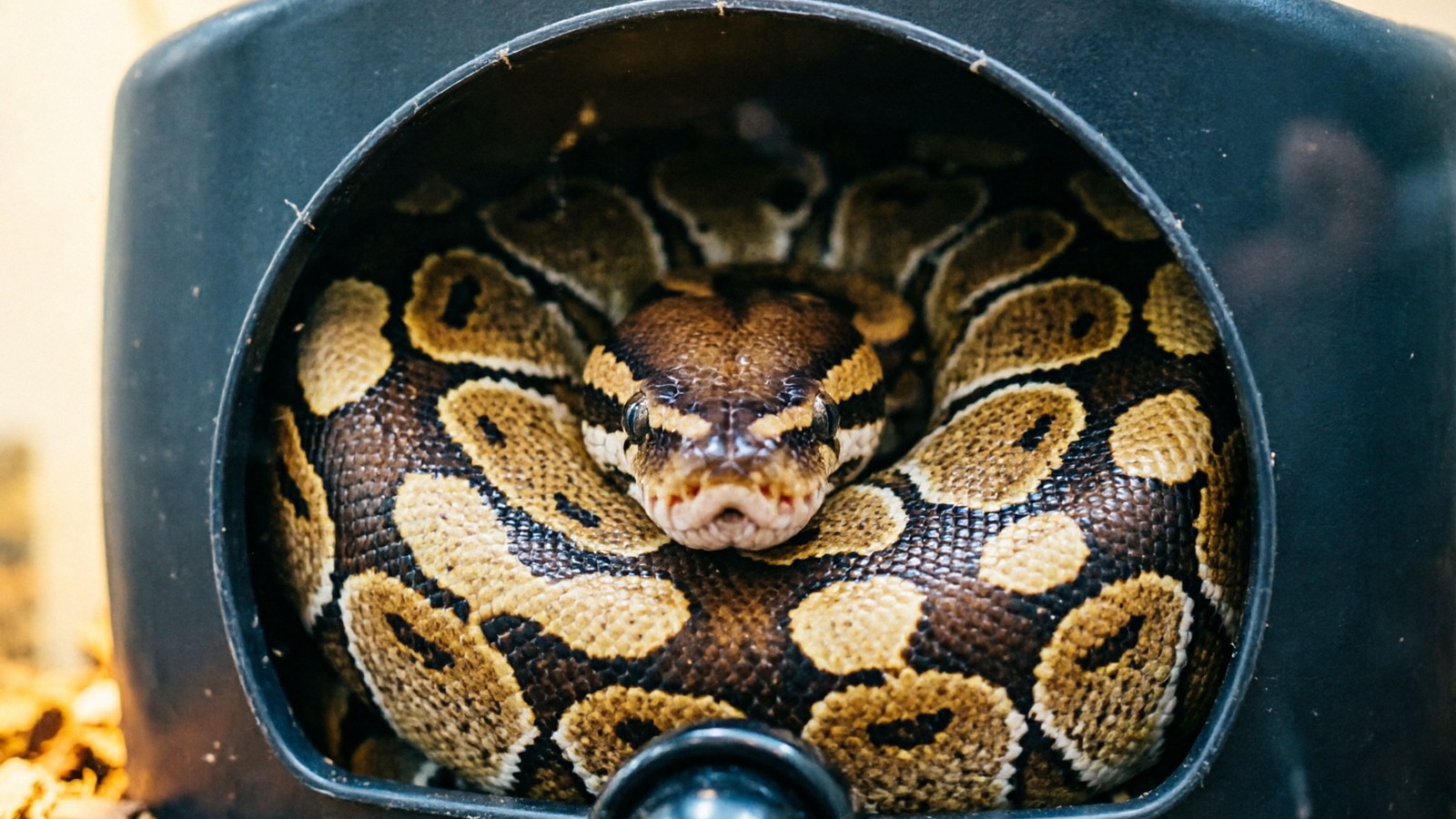
A ball python hide is an enclosed shelter placed inside a snake enclosure that provides a dark, snug space where the snake can rest, thermoregulate, and feel secure. Unlike open decor, a proper ball python hide must be small enough that the snake’s body touches the walls when coiled inside — this is called the snug-fit principle. Ball pythons are nocturnal, fossorial snakes that evolved to spend most of their time in underground cavities, termite mounds, and hollow logs in West African savannas (Merck Veterinary Manual — Ball Pythons). This tactile wall contact reduces corticosterone (stress hormone) levels and supports natural burrowing behavior (ReptiFiles — Ball Python Husbandry). The snug-hide principle applies across species — guinea pigs and hedgehogs also need enclosed shelters, though their sizing and material needs differ from snakes.
Do Ball Pythons Need a Ball Python Hide?
Yes — a hide is essential, not optional. Ball pythons are nocturnal, secretive snakes that evolved to spend most of their time in confined spaces. Every small pet needs a secure retreat — the right shelter matters — guinea pig hideouts follow the same snug-fit principle, and hedgehog hideouts serve a nearly identical stress-reduction function. Without a hide, the consequences for ball pythons are serious (Merck Veterinary Manual):
- Food refusal and weight loss — chronic stress is the leading cause of appetite loss in ball pythons and can progress to fatal hepatic lipidosis if untreated (VCA Hospitals — Snake Anorexia)
- Constant glass pacing and rubbing
- Weakened immune system
- Respiratory infections from stress
- Reduced lifespan
Keepers who skip the right shelter see the most behavioral problems. The first item any new ball python owner should buy is a hide — before substrate, before decorations, and sometimes even before the thermostat (ReptiFiles) — before substrate, before decorations, and sometimes even before the thermostat.
Why Two Hides? — The Dual-Hide Setup
Ball pythons thermoregulate by moving between warm and cool zones — they are ectothermic and rely entirely on environmental heat sources (Merck Veterinary Manual). One hide over the heat source and one on the cool side lets them choose their temperature while staying hidden. This is the single most common mistake new keepers make — providing only one hide.
Place the warm hide where your ball python tank heating element reaches the ground. Interior temperature should hit 88-92°F (ReptiFiles). The cool hide goes on the opposite end at 75-80°F. Ball pythons regulate their body temperature by shuttling between warm and cool zones (VCA Hospitals). Your ball python humidity requirements interact with hide placement — a humid hide on the warm side creates the shedding microclimate your snake needs.
Ball Python Hide Size Guide
Getting the right size matters more than brand choice. A hide that is too large causes insecurity. A hide that is too small prevents the snake from entering.
The hide should let the snake fit snugly with its body touching the walls when coiled. If there is empty space around your coiled snake, the hide is too large.
| Life Stage | Snake Length | Hide Interior | Opening | Best Options |
|---|---|---|---|---|
| Hatchling (0-6 months) | 8-12 in | 6-8 in long | 1.5-2 in | FCALIVV, plastic S |
| Juvenile (6-12 months) | 12-20 in | 8-10 in long | 2-3 in | Leoterra M |
| Sub-adult (1-2 years) | 20-30 in | 10-14 in long | 3-4 in | Leoterra L |
| Adult (2+ years) | 30-48 in | 14-18 in long | 4-5 in | Leoterra XL, Zilla Large |
| XL Adult (5+ ft females) | 48-60+ in | 18+ in long | 5+ in | DIY Tupperware |
If there is empty space around your coiled snake, the hide is too large. If the snake cannot enter at all, upsize immediately.
Snake Hide Types Compared
| Type | Material | Best For | Pros | Cons |
|---|---|---|---|---|
| Plastic box | Smooth plastic | Daily use, easy-clean | Lightweight, wipe-clean, affordable | Plain look, can be flimsy |
| Resin rock | Polyresin | Natural aesthetics | Looks realistic, heavier | Sharp edges, can arrive broken |
| Humid hide | Plastic with moss slot | Shedding aid | Retains moisture | Needs moss maintenance |
| 3-in-1 | Resin combo | Small enclosures | Three functions in one | Fragile, heavy, expensive |
| Premium resin | High-quality polyresin | Display tanks | Natural look, durable | Expensive, sizing runs small |

Quick Comparison — All 8 Ball Python Hides
Every hide on this list was tested against real keeper reviews, safety data, and sizing accuracy.
| # | Product | Type | Key Feature | Best For |
|---|---|---|---|---|
| 1 | Leoterra Snake Hide (M) | Plastic | easy-clean | Juveniles |
| 2 | Leoterra Snake Hide (XL) | Plastic XL | 16.5×10.6×4.3 in | Adults 3-5 ft |
| 3 | LEOTERRA Large Snake Hide (L) | Budget plastic | 13×8.66×3.15 in | Sub-adults |
| 4 | FCALIVV Humid Hideout | Humid hide | Moss chamber for shedding | Shedding aid |
| 5 | JIHAQUA Resin Cave | Resin rock | Natural aesthetic, heavy | Display tanks |
| 6 | Zilla Rock Lair | Rock design | most proven | Rock aesthetic |
| 7 | Exo Terra Gecko Cave | Premium resin | brand trust | Premium setups |
| 8 | Zoo Med 3-in-1 Shelter | 3-in-1 combo | Hide + water + food | Small enclosures |
Best Ball Python Hides for Daily Use — Primary Hide Selection
Plastic hides are the workhorse choice for ball python enclosures. They are easy to clean, lightweight, affordable, and available in precise sizes. Plastic is the best primary hide for every enclosure. Add resin or rock options as secondary aesthetics if desired.
1. Leoterra Snake Hide (Medium) — Best Overall for Juveniles
The Leoterra Medium is the top pick for juvenile snakes — a proven snake hide. This is one of the most proven snake hides available. The food-safe plastic is easy to wipe clean and simple to drill ventilation holes through.
What we like: The 10.2×7.5×2.8 in dimensions provide a snug fit for juvenile ball pythons between 12 and 20 inches. An owner called it “perfect for my ball python” while another noted these “stand up to time — haven’t had to replace a single one.” The smooth interior has no sharp edges to worry about.
What could be better: Sizing runs smaller than advertised. Multiple reviewers confirm the actual dimensions are closer to 9×6 inches. A reviewer rated it two stars, calling it “very flimsy, almost like a to-go food container.” The plastic is thin enough that larger snakes can tip it over.
2. Leoterra Snake Hide (XL) — Best for Adults
The Leoterra XL extends the same design to adults to adult ball pythons measuring 3 to 5 feet. At 16.5×10.6×4.3 inches, it offers significantly more interior space than the medium version. The 4.3-inch height accommodates larger body coils.
What we like: Same food-safe, easy-clean construction as the medium. Works well as the warm-side hide for adult ball pythons that need more room to coil comfortably. The plastic wipes clean in seconds during routine enclosure maintenance.
What could be better: Even the XL version may tip when a heavy adult python enters. A keeper with a 4-foot python reported it “tips it up and over getting out of it.” The same flimsy plastic criticism applies — this snake hide is functional but not built for durability.
3. LEOTERRA Large Snake Hide (L) — Best Budget
The LEOTERRA Large Snake Hide (L) is a 13×8.66×3.15 in plastic hide that costs less than most quality snake hides. The stiff plastic resists warping, which is a common problem with cheaper alternatives. It is easy to wipe clean and works as a snug hide for sub-adult ball pythons.
What we like: Excellent value for budget-conscious keepers. The 13-inch length fits sub-adults that have outgrown a Medium hide but are not ready for XL. This reptile hide works across multiple snake species.
What could be better: Large does not mean extra-large — adults over 4 ft will outgrow it. Pair it with a Leoterra XL once the snake fills the cavity. The plastic is plain compared with resin rock caves.
4. FCALIVV Humid Hideout — Best for Shedding
The FCALIVV Humid Hideout is purpose-built for shedding support. Add damp sphagnum moss inside to create a micro-humidity chamber that helps your ball python loosen stuck shed. This is the most affordable shedding-specific option.
What we like: A keeper with 13 snakes wrote that “these are the one and only hide I use — my snakes prefer these over any of the fancy pet store ones.” The compact design fits easily on the warm side of most enclosures. Great value for a specialized shedding tool.
What could be better: The “Large” size runs very small. A reviewer stated bluntly: “NOT large, so small — maybe for baby balls or corn snakes.” Some units arrived broken but remained usable. This is a newer product with less long-term track record than the Leoterra options. Pair this with a ball python care routine that includes regular shedding checks.
Every ball python keeper should keep a humid hide ready even outside shedding season. Sudden environmental changes can trigger incomplete sheds at any time.
Best Natural-Look Ball Python Hides — Resin and Rock Options
Resin and rock hides offer natural aesthetics that transform an enclosure from functional to display-quality. However, they carry real safety trade-offs that plastic hides do not. Too many keepers skip the inspection step and put their snakes at risk.
5. JIHAQUA Resin Cave — Best Natural Look
The JIHAQUA Resin Cave delivers a realistic rock aesthetic at a mid-range price. It is a popular choice across multiple reptile species. The heavy resin construction prevents tipping, which is a significant advantage over lightweight plastic.
What we like: Natural rock texture blends into any terrarium setup. A bearded dragon owner confirmed “she always goes in it when she wants to dig and cool off.” The weight provides stability that plastic hides cannot match.
What could be better: This reptile hide has a documented sharp edges problem. An owner warned to “check the inside for sharp edges — there were multiple sharp protrusions.” A buyer reported the “inside edges are extremely sharp” and required filing with a metal rasp. You must inspect and file down any sharp points before placing this in your ball python enclosure. Wash thoroughly before first use to remove manufacturing odor.
⚠️ Safety Warning: Always run your fingers along the interior edges of resin hides before introducing your snake. Sharp protrusions can cause cuts and abrasions on ball python scales — open wounds on snakes are susceptible to scale rot and bacterial infection (VCA Hospitals — Snake Wounds). File down any rough spots with a metal rasp or sandpaper.
6. Zilla Rock Lair — Most Reviewed Rock Hide
The Zilla Rock Lair Medium is the most reviewed rock-style hide. The naturalistic rock design supports shedding behavior and provides a secure, enclosed feel that ball pythons respond to well. Works as both a dry hide and a humid hide when you add sphagnum moss inside.
What we like: Solid, sturdy construction that holds up over time. A leopard gecko keeper noted it “exceeded my expectations — it’s solid and sturdy.” The natural rock appearance makes any enclosure look more professional. Zilla is a trusted reptile brand with consistent quality across their product line.
What could be better: This snake hide has a significant arrived-broken pattern. A frustrated reviewer reported it “arrived broken TWICE.” Another confirmed it “came broken — the shrink wrap was all that held it together.” The packaging is clearly inadequate for the fragile resin construction. Order from a retailer with a reliable return policy.
⚠️ Packaging Warning: Both the Zilla Rock Lair and Zoo Med 3-in-1 have frequent “arrived broken” reviews. Inspect immediately upon delivery and photograph any damage before filing a return claim.

7. Exo Terra Gecko Cave — Premium Pick
The Exo Terra Gecko Cave carries the highest review count on this list. Exo Terra is the most recognized brand in reptile husbandry, and their premium resin construction reflects that reputation. One ball python owner confirmed: “My noodle ball python loves it.”
What we like: Brand trust and proven track record across thousands of enclosures. The natural rock design looks realistic and professional. A keeper noted this rock “is very durable and keeps a lot of cool air inside.” Exo Terra quality control is generally more consistent than budget resin brands.
What could be better: Sizing runs smaller than expected. A reviewer called it “ultra small — way too small for my young bearded dragon.” Yellow manufacturing dust coats the interior — you must rinse thoroughly before use. Some units arrived broken. The medium entrance may be too narrow for larger ball pythons. At the premium price point, the sizing inconsistency is frustrating.
Multi-Function and Specialty Ball Python Hides
8. Zoo Med Reptile Shelter 3-in-1 — Best Space Saver
The Zoo Med 3-in-1 combines a hide, water dish, and food bowl in a single resin unit. This multi-function design saves critical floor space in smaller enclosures where every inch counts. The realistic rock texture blends well with naturalistic setups.
What we like: Three functions in one unit is genuinely useful for hatchling and juvenile setups. A corn snake owner confirmed their snake “went right on in” after a quick rinse. The textured surface provides grip for climbing snakes. Works across multiple species including leopard geckos and corn snakes.
What could be better: The arrived-broken pattern is severe here. A reviewer reported it arrived “broken into a million pieces — packaging was almost nonexistent.” The lid and base are separate pieces that may not fit securely — an owner warned “a snake could easily dislodge the top.” The ceramic-like material is fragile and the two-piece design is a structural weakness. This is best suited for light-weight juvenile snakes only.
How to Set Up a Dual-Hide System
Getting your dual-hide placement right prevents most common ball python husbandry problems. Use a reptile thermostat to maintain consistent temperatures across both zones.
| Step | Action | Details |
|---|---|---|
| 1 | Position warm hide | Place over heat pad or tape. Interior should reach 88-92°F. |
| 2 | Position cool hide | Place on the opposite enclosure end. Target 75-80°F inside. |
| 3 | Add humid hide for shedding | Replace cool hide with a humid hide + damp moss during shed cycles. |
| 4 | Verify temperatures | Use a probe thermometer inside each hide, not surface readings. |
| 5 | Check the fit | Snake should touch walls when coiled. Downsize if gaps exist. |
DIY Humid Hide — Budget Alternative
A clean plastic Tupperware container with a hole cut in the lid makes an effective DIY ball python humid hide. Fill it with damp sphagnum moss, place it on the warm side, and replace the moss every three to five days. Total cost is roughly two to five dollars compared to the FCALIVV humid hideout. Many experienced breeders prefer this DIY approach because the container sizes are exact and replacements cost almost nothing.
Ball Python Hide Safety Checklist
Before placing any hide in your enclosure, verify these safety items:
✅ Use the snug-fit rule — snake’s body must touch walls when coiled (ReptiFiles)
✅ Provide two hides minimum — one warm (88-92°F) and one cool (75-80°F) (Merck Veterinary Manual)
✅ Check resin hides for sharp interior edges — file down with metal rasp before use
✅ Use food-safe, smooth plastic for daily-use hides (no BPA leaching)
✅ Place a humid hide on the warm side during shedding cycles (ReptiFiles)
✅ Replace sphagnum moss every 3-5 days to prevent mold (PetMD)
✅ Verify hide stability — heavy snakes can tip lightweight plastic
✅ Ensure the opening is wide enough for the snake to enter without scraping
❌ Never use a hide that is too large — empty space causes insecurity and stress
❌ Never provide only one hide — forces snake to choose between safety and proper temperature
❌ Never place resin hides without checking for sharp edges first — cuts lead to scale rot
❌ Never use aromatic woods (cedar/pine) inside or near hides — toxic to reptiles
❌ Never use sand or loose substrate inside humid hides — causes impaction risk
❌ Never skip the humid hide during shedding — incomplete shed can constrict toes and tail
❌ Never leave broken resin hides in the enclosure — cracks create trap points
❌ Never stack heavy decor on top of lightweight hides — collapse risk
Frequently Asked Questions
Do ball pythons need a hide?
Yes — a hide is essential for ball pythons, not optional. They are nocturnal, secretive snakes that spend most of their time in confined spaces in the wild. Without a hide, chronic stress leads to food refusal, glass pacing, weakened immunity, and respiratory infections.
Provide at minimum two hides per enclosure — one on the warm side and one on the cool side. A single hide forces the snake to choose between security and proper temperature, which is the root cause of many common husbandry problems.
What is the best hiding spot for a ball python?
The best option is a snug enclosed hide where the snake’s body touches the walls when coiled inside. Two hides should exist — one over the heat source at 88-92°F and one on the cool side at 75-80°F.
Setting up your enclosure means providing two snug, enclosed shelters on opposite ends. One goes over the heat source and one on the cool end.
Both hides must be dark and fully enclosed. Half-caves, open dishes, and partial covers do not provide the security ball pythons need.
The warm hide is where the snake digests food and the cool hide is where it rests. Matching your ball python humidity levels in each zone ensures proper thermoregulation.
Should a ball python hide be on the warm or cool side?
Ball pythons need hides on both the warm and cool sides. The warm hide supports digestion after meals while the cool hide provides a retreat when the snake wants to lower its body temperature.
Remove the choice between feeling secure — the right placement — and maintaining proper body temperature. Having hides on both ends is the standard care recommendation endorsed by experienced keepers and reptile veterinarians.
How big should a ball python hide be?
The hide should be just large enough for the ball python to fit inside with its body touching the walls when coiled. Hatchlings need a hide interior of 6-8 inches, juveniles need 8-10 inches, sub-adults need 10-14 inches, and adults need 14-18 inches.
If the snake can move around freely inside with visible gaps around its body, the hide is too large. If the snake cannot enter at all, the opening is too small. The snug-fit rule applies at every life stage.
What do you put in a ball python humid hide?
Fill the humid hide with damp sphagnum moss. The moss should be moist enough to hold together when squeezed but not dripping wet. This creates a micro-humidity chamber that reaches 70-80% humidity — ideal for loosening stuck shed during shedding cycles (ReptiFiles — Shedding). — ideal for loosening stuck shed during shedding cycles.
Place the humid hide on the warm side of the enclosure. Replace the sphagnum moss every three to five days to prevent mold and bacteria buildup. Moldy substrate can cause respiratory infections in snakes (PetMD — Reptile Respiratory Infections). A proper ball python care schedule includes adding the humid hide during pre-shed and shed phases.
Can I use a plastic Tupperware as a ball python hide?
Yes — a clean plastic container with a hole cut in the lid or side is one of the most effective and budget-friendly options available. Tupperware hides are easy to clean, easy to replace, and available in exact sizes that match your snake’s dimensions.
Many experienced breeders prefer DIY Tupperware over commercial products for daily-use hides — it’s the approach recommended by ReptiFiles founder Gabi C. for precise sizing (ReptiFiles). For a humid version, simply add damp sphagnum moss inside. Sphagnum moss retains moisture better than paper towels and resists mold longer than other substrates (ReptiFiles). Ensure there are no sharp edges around any cut holes before introducing your snake.