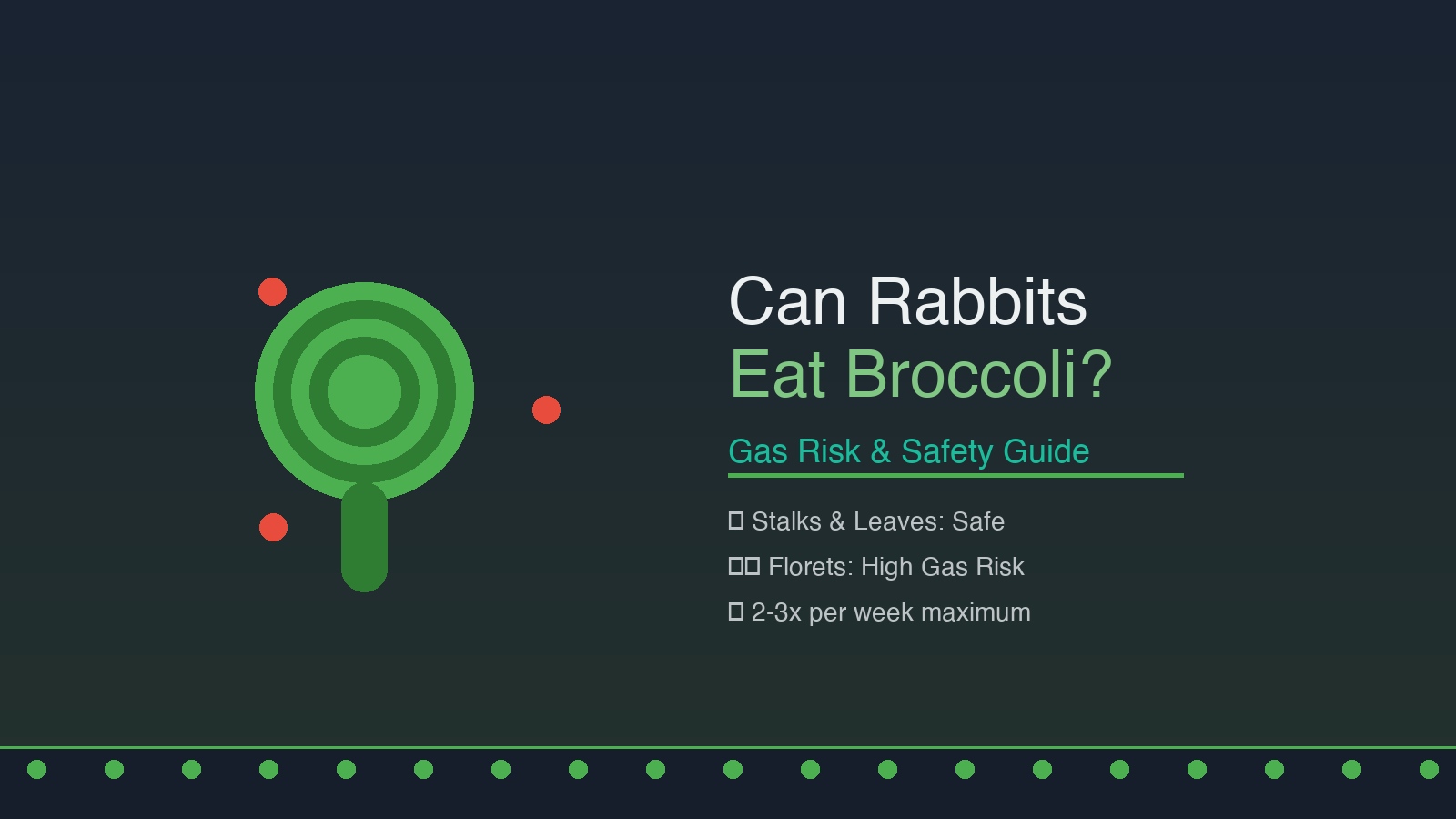
Can Rabbits Eat Broccoli?
Yes, rabbits can eat broccoli — but with an important caveat. All parts of broccoli are technically safe, yet it carries a real risk of gas and GI stasis that makes it more controversial than most vegetables in the rabbit-keeping community. If you are wondering “can bunnies eat broccoli?” — the answer is the same: yes, in moderation, with the same precautions about gas and GI stasis that apply to all rabbits.
⚠️ Medical Disclaimer: This article is not a substitute for professional veterinary care. If your rabbit is showing signs of illness, consult a qualified exotic veterinarian.
Unlike can rabbits eat bell peppers — which are broadly considered one of the safest daily vegetables — broccoli occupies a gray area. Most rabbits tolerate small amounts without issue, but a significant minority experience painful gas, bloating, or worse. The difference comes down to raffinose, a sugar compound found in all cruciferous vegetables.
The practical answer: yes, you can feed broccoli, but treat it as a conditional vegetable. Start with the safest parts (stalks), introduce it slowly, and watch your rabbit’s reaction. If your rabbit tolerates it well, broccoli becomes a nutritious 2-3x per week addition. If not, skip it entirely — there are plenty of safer alternatives.
A rabbit’s core diet should be 80% hay, supplemented with pellets and fresh vegetables. Broccoli, when included, fits into the vegetable portion — never as a replacement for hay.
The Gas Problem — Why Broccoli Is Controversial for Rabbits
Raffinose is a complex sugar (oligosaccharide) found in cruciferous vegetables — broccoli, cauliflower, cabbage, Brussels sprouts, and their relatives. Humans and many animals produce the enzyme alpha-galactosidase to break down raffinose in the digestive tract. Rabbits do not produce enough of this enzyme.
When raffinose reaches a rabbit’s hindgut undigested, it ferments. Fermentation produces gas — and rabbits are uniquely bad at dealing with intestinal gas. Unlike humans, rabbits cannot burp or easily pass gas through their digestive system. The gas builds up, causing discomfort, bloating, and in severe cases, GI stasis.
GI Stasis Warning Signs
GI stasis (gastrointestinal stasis) is the slowing or complete stoppage of gut motility. It is one of the most common and dangerous emergencies in rabbit medicine. Broccoli is not the only trigger, but it is a known one for sensitive rabbits.
Watch for these warning signs within 12-24 hours after feeding broccoli:
- ⚠️ Reduced or no fecal pellets — fewer, smaller, or completely absent droppings
- ⚠️ Bloated or hard abdomen — the belly feels tight when gently pressed
- ⚠️ Loud stomach gurgling — or the opposite: completely silent gut
- ⚠️ Loss of appetite for hay — a rabbit that stops eating hay is an emergency
- ⚠️ Hunched posture — sitting in a hunched, tense position
- ⚠️ Teeth grinding — a sign of pain in rabbits
If you observe any of these signs after feeding broccoli, stop all vegetables immediately and contact your vet. Do not wait. GI stasis can become fatal within 24-48 hours if untreated. For more detail on recognizing and responding to digestive emergencies, see our guide to rabbit GI stasis and digestive health.
The key takeaway: broccoli is safe for most rabbits, but you must introduce it slowly and watch for reactions. Is broccoli safe for rabbits? Yes — but broccoli gas rabbits should be monitored carefully, so it demands more caution than most greens. Some rabbits handle it fine; others are sensitive. You won’t know until you try — so start small.
Which Parts of Broccoli Are Safe?
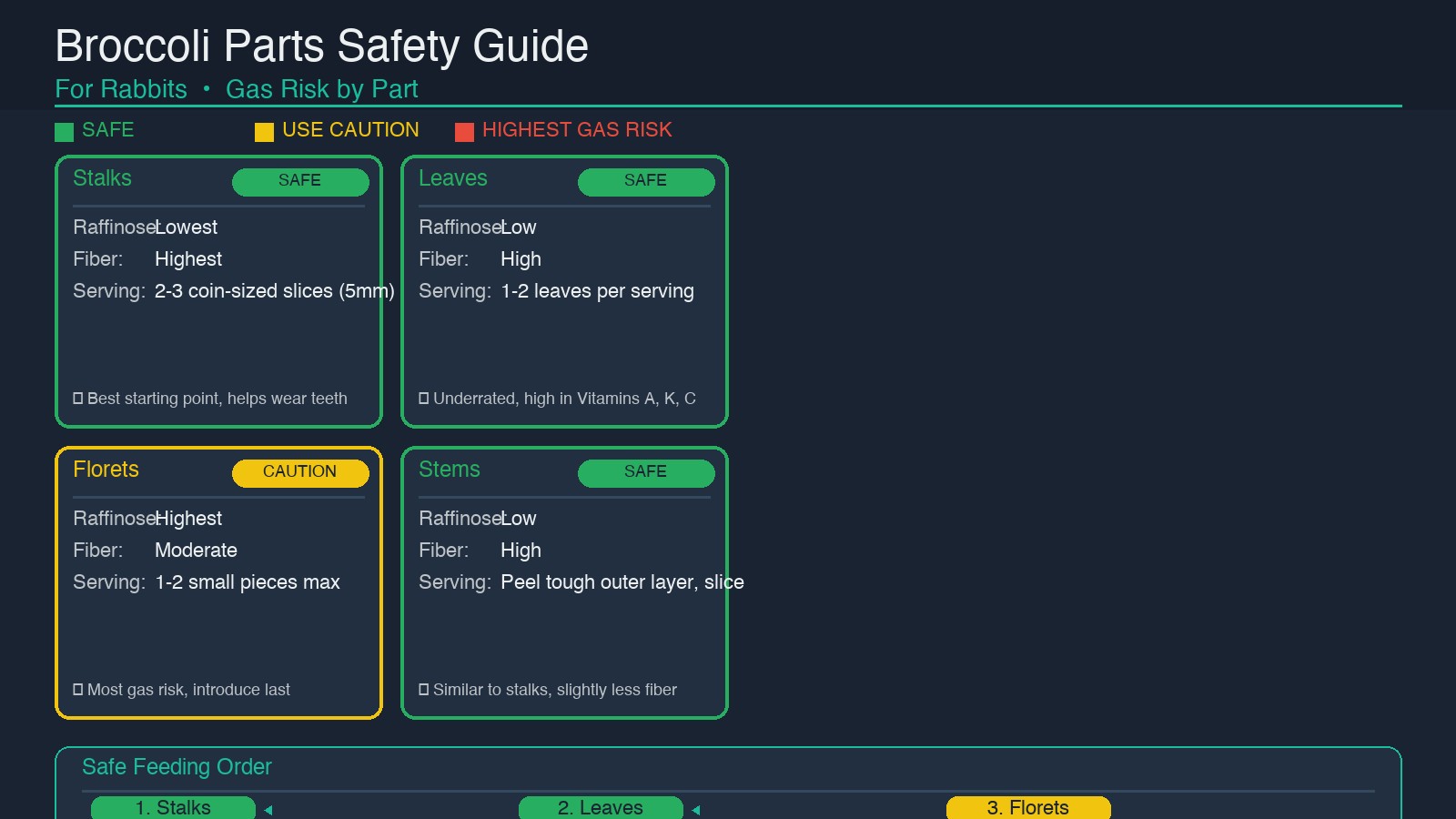
Not all parts of broccoli carry the same risk. The raffinose concentration varies significantly across the plant, which means some parts are much safer for rabbits than others.
| Part | Safe? | Gas Risk | Nutrition | Recommendation |
|---|---|---|---|---|
| Stalks | ✅ Yes | Low | High fiber, crunchy (good for teeth) | Best part — start here |
| Stems | ✅ Yes | Low | Similar to stalks, slightly less fiber | Good — peel if tough |
| Leaves | ✅ Yes | Low-Medium | High Vitamin A, K, and C | Excellent — often overlooked |
| Florets (tops) | ✅ Yes | High | Most nutritious, most raffinose | Feed sparingly |
| Heads | ✅ Yes | High | Same as florets | Same as florets |
Stalks and Stems
Broccoli stalks are the safest part of the plant for rabbits. When owners ask can rabbits eat broccoli stems, the answer is yes — they contain the lowest raffinose concentration and the highest fiber, making them the ideal starting point when introducing broccoli. The crunchiness also provides dental wear — rabbit teeth grow continuously and need abrasive foods to stay at a healthy length.
Peel the tough outer layer of thick stalks with a vegetable peeler before serving. Cut into coin-sized slices (about 5mm thick). For thinner stems, slicing is usually sufficient without peeling.
Leaves
Can rabbits eat broccoli leaves? Absolutely. Broccoli leaves are one of the most underrated rabbit vegetables. They are often discarded by humans but are actually lower in raffinose than florets while being high in vitamins A, K, and C. If you buy broccoli with leaves still attached, consider them a bonus for your rabbit. Feed 1-2 leaves per serving.
Florets and Heads
Can rabbits eat broccoli florets? Yes, but with caution — the bushy green tops that most people think of as “broccoli” — are the most nutritious part but also carry the highest gas risk. They contain the densest concentration of raffinose. Feed only 1-2 small floret pieces per serving, and never as a daily vegetable.
Practical Recommendation
Start with stalks (safest), then try leaves, then introduce florets last — only if your rabbit has tolerated the other parts without any gas issues. This gradual approach minimizes risk and lets you identify which parts your rabbit handles best.
How Much Broccoli Can a Rabbit Eat?
Portion control matters with broccoli more than with most vegetables because of the gas risk. Here is the safe range:
| Rabbit Size | Max Broccoli per Feeding | Max Frequency |
|---|---|---|
| Small (2-4 lbs) | 1 tablespoon chopped | 2x/week |
| Medium (4-8 lbs) | 1-2 tablespoons chopped | 2-3x/week |
| Large (8+ lbs) | 2 tablespoons chopped | 3x/week |
Step-by-Step Introduction Protocol
- Day 1: Offer 1 small piece of broccoli stalk (pea-sized). This is your test dose.
- Wait 24 hours: Monitor droppings, appetite, and behavior. Normal, well-formed pellets and active hay-eating mean a green light.
- Day 3: If no reaction, increase to 1 tablespoon of mixed broccoli parts (stalks and leaves, no florets yet).
- Day 5+: If still no issues, you can include 1-2 small floret pieces in the mix. Maintain 2-3x per week maximum.
- Ongoing: Never exceed 10% of daily vegetable intake from broccoli or any cruciferous vegetable.
What If Your Rabbit Has a Reaction?
If you notice smaller droppings, reduced appetite, or any of the GI stasis warning signs listed above, stop feeding broccoli immediately. Do not try again — some rabbits simply do not tolerate cruciferous vegetables. Switch to safer daily options like romaine lettuce, cilantro, or cucumber.
Quality hay is the foundation of digestive health. Oxbow Western Timothy Hay, Rabbit & Guinea Pig Hay, High Fiber, USA, 90 oz ($21.68) provides the long-stem fiber that keeps the gut moving and prevents stasis. Broccoli is a supplement — hay is non-negotiable.
Nutritional Benefits — What Broccoli Offers Rabbits
USDA nutritional data — raw broccoli, per 100g USDA FoodData Central FDC ID 11091:
| Nutrient | Amount per 100g | Per 1 tbsp (~15g) | Benefit for Rabbits |
|---|---|---|---|
| Calories | 34 kcal | 5.1 kcal | ✅ Low calorie |
| Water | 89.3g (89%) | 13.4g | ✅ Hydration support |
| Fiber | 2.6g | 0.39g | ✅ Gut motility |
| Sugar | 1.7g | 0.26g | ✅ Low sugar |
| Vitamin K | 101.6µg | 15.2µg | ✅ Blood clotting, bone health |
| Vitamin C | 89.2mg | 13.4mg | ✅ Immune support |
| Calcium | 47mg | 7.1mg | ⚠️ Adequate — excess causes bladder sludge |
| Vitamin A | 31µg | 4.7µg | ✅ Eye health, immune function |
| Raffinose | Present | Present | ⚠️ Gas risk factor |
Broccoli vs Other Common Rabbit Vegetables
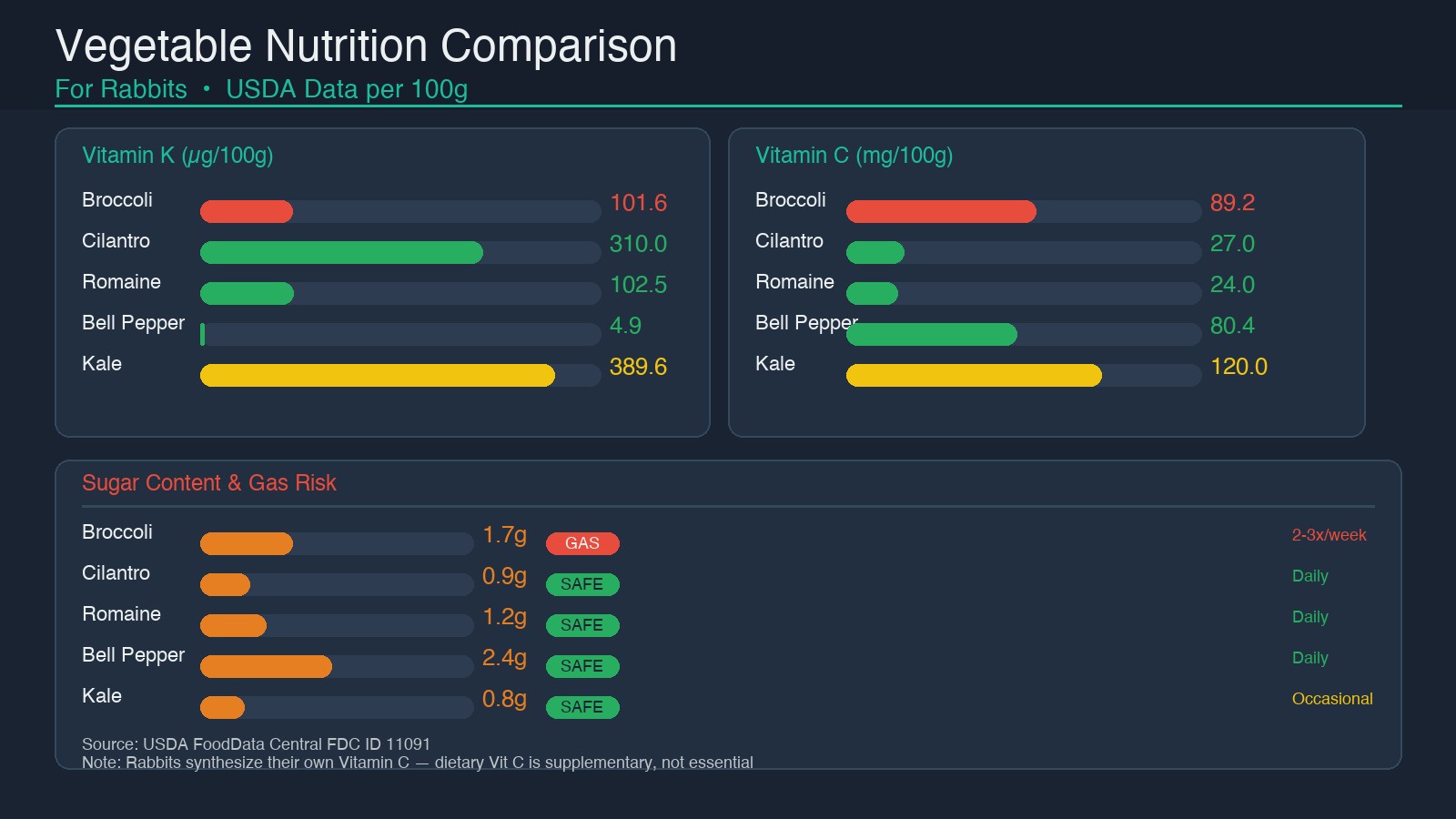
The table below puts broccoli’s nutrition in context alongside vegetables commonly fed to rabbits. The gas risk column is the differentiator — broccoli offers strong vitamin content but at a cost that romaine lettuce and cilantro do not impose.
| Vegetable | Vit K (µg/100g) | Vit C (mg/100g) | Sugar (g/100g) |
|---|---|---|---|
| Broccoli | 89.2 | ⚠️ High | 2-3x/week |
| Bell Peppers | 80.4 | Low | ✅ Daily |
| Romaine Lettuce | 2.8 | Low | ✅ Daily |
| Cilantro | 27.0 | Low | ✅ Daily |
| Carrot tops | 6.0 | Low | 2-3x/week |
| Cauliflower | 48.2 | ⚠️ High | 1-2x/week |
Two things stand out from this comparison:
First, broccoli is genuinely nutrient-dense. At 89.2mg of vitamin C and 101.6µg of vitamin K per 100g, it outperforms most daily staples on those metrics. If gas were not a factor, broccoli would rank among the best rabbit vegetables.
Second, the gas risk is the tradeoff. Cilantro offers 3x the vitamin K with zero gas risk. Romaine lettuce provides similar vitamin K with almost no sugar and no gas. Broccoli’s advantage is vitamin C — but unlike guinea pigs, rabbits synthesize their own vitamin C internally, so dietary vitamin C is supplementary rather than essential.
The honest assessment: broccoli is a “nice to have” vegetable for rabbits, not a “must have.” The nutrition is good, but the risk offsets the benefit for many owners who prefer to stick with safer daily greens.
Can Rabbits Eat Broccoli and Cauliflower Together?
Both broccoli and cauliflower belong to the Brassicaceae (cruciferous) family, which means they share the same gas-causing raffinose compound. Feeding them together is not inherently toxic, but it doubles the raffinose load in a single meal — a bad idea for an animal that cannot pass gas easily.
| Factor | Broccoli | Cauliflower |
|---|---|---|
| Gas Risk | ⚠️ High (raffinose) | ⚠️ High (raffinose) |
| Fiber | 2.6g/100g | 2.0g/100g |
| Vitamin C | 89.2 mg/100g | 48.2 mg/100g |
| Vitamin K | 101.6µg/100g | 15.5µg/100g |
| Calcium | 47mg/100g | 22mg/100g |
| Rabbit Preference | Generally higher | Mixed |
Broccoli wins on nutrition — significantly more vitamin K and nearly double the vitamin C. Cauliflower wins on calcium — at 22mg per 100g versus broccoli’s 47mg, cauliflower poses less risk of bladder sludge over time, which is a meaningful concern for rabbits prone to urinary issues.
Practical advice: Never feed both in the same meal. If your rabbit tolerates broccoli, you can rotate between broccoli one week and cauliflower the next, but keep cruciferous vegetables to 2-3 servings per week total regardless of which one you choose.
Can Rabbits Eat Broccolini?
Yes. Broccolini is a hybrid of broccoli and Chinese broccoli (gai lan). It has thinner, more tender stems and smaller florets. The same rules apply: stalks and leaves are safer than florets, introduce slowly, and monitor for gas. Broccolini stems are actually easier for rabbits to chew than thick broccoli stalks, which some owners find convenient — treat them like regular broccoli stems.
Can Rabbits Eat Broccoli Rabe?
Broccoli rabe (rapini) is a more distant relative with a distinctly bitter flavor. It contains higher calcium levels than regular broccoli and a stronger taste that many rabbits reject. If you want to try it, offer only the leaves and stalk in very small amounts. It is not a common rabbit food and offers no advantage over regular broccoli.
How to Prepare Broccoli for Your Rabbit
Proper preparation minimizes risk and maximizes the nutritional benefit your rabbit gets from broccoli.
- Choose fresh, organic broccoli when possible — organic reduces pesticide exposure, which is relevant because broccoli ranks high on the EWG’s Dirty Dozen list for conventional produce
- Wash thoroughly under running water for 30+ seconds — this removes surface pesticides, dirt, and bacteria
- Separate into parts — keep stalks, stems, leaves, and florets separate for portion control
- Peel the tough outer layer of thick stalks — a standard vegetable peeler works; the inner stalk is crisp and easier to digest
- Cut stalks into coin-sized slices (~5mm thick) and florets into small bite-sized pieces
- Serve raw only — never cook, steam, boil, or microwave broccoli for rabbits
- Remove uneaten pieces after 2-3 hours — raw vegetables spoil at room temperature
Preparation Rules at a Glance
- ✅ Always serve raw — cooking alters fiber structure and destroys heat-sensitive vitamins. Can rabbits eat broccoli stems raw? Yes, raw is the only safe way to feed any part of broccoli to rabbits.
- ✅ Wash thoroughly — pesticide residue concentrates on the floret surface
- ✅ Peel thick stalks — the outer layer is tough and hard to digest
- ✅ Cut into bite-sized pieces — prevents choking and aids portion control
- ✅ Start with stalks — lowest gas risk, highest fiber
- ❌ Never cook or steam — changes texture and destroys nutrients
- ❌ Never add oil, salt, butter, or seasonings
- ❌ Never feed frozen broccoli — thawed broccoli becomes mushy and can cause digestive issues
If your rabbit turns out to be sensitive to broccoli, a gas-free alternative for treat variety is Vitakraft Drops Rabbit Treats ($4.29). These use real vegetable ingredients without the cruciferous gas risk, making them a safe training reward for sensitive rabbits.
Special Considerations: Baby Rabbits and Seniors
Baby Rabbits (Under 12 Weeks)
No broccoli at all. Baby rabbits have immature digestive systems that cannot process raffinose. Even small amounts of gas can trigger GI stasis in a young rabbit, and their small body size means dehydration from diarrhea can become life-threatening within hours.
| Age | What to Feed | Broccoli? |
|---|---|---|
| 0-8 weeks | Mother’s milk + alfalfa hay + pellets | ❌ No vegetables |
| 8-12 weeks | Same + introduce leafy greens gradually (romaine, cilantro) | ❌ No cruciferous yet |
| 12-24 weeks | Transition to timothy hay + expanding vegetable variety | ⚠️ Stalk only, tiny pieces, 1x/week |
| 6+ months | Full adult diet | 1-2 tbsp, 2-3x/week |
Can baby rabbits eat broccoli? Not until at least 12 weeks, and even then only the stalk in minimal amounts. The priority for young rabbits is alfalfa hay (for calcium needed for bone growth), quality pellets, and safe leafy greens. For detailed guidance on raising young rabbits, see our rabbit setup and care guide.
Senior Rabbits
Senior rabbits (5+ years) often have reduced digestive resilience. If your senior rabbit has never eaten broccoli, this is not the time to start — the risk-to-reward ratio does not favor introducing a gas-causing vegetable late in life.
If your senior rabbit already tolerates broccoli well, keep portions on the smaller side. Senior rabbits are more susceptible to GI stasis in general, so any food that could potentially trigger it deserves extra caution. Diet plays a significant role in rabbit lifespan and how diet affects longevity — consistent, safe nutrition matters more than variety as rabbits age.
Frequently Asked Questions
Can rabbits eat broccoli heads?
Yes, broccoli heads (the same as florets) are safe but carry the highest gas risk. Feed only 1-2 small pieces and watch for any digestive reaction. Most of the raffinose concentrates in the tight floret clusters.
Can rabbits eat broccoli stalks everyday?
No — even stalks, which are the safest part, should not be fed daily. Cruciferous vegetables of any kind should be limited to 2-3 times per week. Daily feeding increases the cumulative risk of gas buildup and GI stasis. Can rabbits eat broccoli everyday? Absolutely not — the same restriction applies to all broccoli parts regardless of gas risk level.
Can rabbits eat broccolini stems?
Yes, broccolini stems are safe and follow the same rules as regular broccoli stems. They are thinner and more tender, which actually makes them easier for rabbits to chew and digest. Cut into small pieces before serving.
Can rabbits eat broccoli microgreens?
Can rabbits eat broccoli sprouts? Broccoli sprouts and microgreens are generally safe in very small amounts. Young shoots contain less raffinose than mature broccoli, making them less likely to cause gas. Still, introduce them gradually and treat them as an occasional garnish rather than a regular food.
Conclusion
Broccoli is one of the more nuanced vegetables in rabbit nutrition. It is safe, nutritionally impressive, and many rabbits enjoy it — but the raffinose-induced gas risk means it demands more caution than most greens.
Five key takeaways:
- All parts are safe, but not equal — stalks and leaves are the best choices; florets carry the highest gas risk
- Introduce slowly, starting with stalks — a pea-sized test piece on day one, then monitor for 24 hours
- Max 1-2 tablespoons, 2-3 times per week — never daily, and never combine with cauliflower in the same meal
- Know the GI stasis warning signs — reduced droppings, bloated abdomen, hunched posture, teeth grinding. Act immediately if you see them
- Every rabbit is different — some tolerate broccoli perfectly, others do not. Respect your individual rabbit’s tolerance
Hay remains the non-negotiable foundation of rabbit health. Small Pet Select Rabbit Food Pellets, 10 Lb. ($29.99) offers high-fiber low-protein nutrition with no fillers — the kind of quality that supports long-term digestive health.
For the complete dietary framework, see our complete rabbit food guide. For more vegetable safety guides, check out our articles on bell peppers, carrots, cucumber, and tomatoes.