Axolotls are cold-water amphibians native to the high-altitude canals of Lake Xochimilco in central Mexico. Their ideal water temperature sits between 60°F and 68°F. Most homes run 72°F to 78°F in summer — far too warm for an axolotl to thrive long-term. That gap between room temperature and safe axolotl temperature is where an axolotl chiller becomes essential.
Without active cooling, warm water suppresses appetite, weakens the immune system, and opens the door to fungal infections that are notoriously difficult to treat. A good axolotl chiller is the single most impactful investment you can make for a long-lived axolotl — even more than filtration upgrades. See our axolotl care guide for the full picture on environmental needs.
This axolotl chiller guide covers 7 compressor-based chillers and 2 budget cooling fans across tank sizes from 10 gallons to 110 gallons. Our top pick handles the standard 20-40 gallon range that most keepers use.
Why Axolotls Need a Chiller
The 60-68°F Sweet Spot
Axolotls evolved in cool, high-altitude freshwater systems where water temperatures rarely exceed 68°F — which is why an axolotl chiller is non-negotiable for most indoor setups. Their metabolism, immune function, and feeding behavior are all calibrated for this narrow range. According to veterinary amphibian specialists, prolonged exposure above 72°F triggers a cascade of physiological stress responses that suppresses immune function and increases susceptibility to opportunistic infections. (Merck Veterinary Manual / AI Overview: “Temperatures above 68°F (20°C) induce severe physiological stress, and anything above 75°F (24°C) is often fatal. This sustained heat alters their metabolism and suppresses their immune system, making them highly susceptible to Saprolegnia.”)
When water temperature climbs past the safe zone, you will notice behavioral changes first. Your axolotl may stop eating, spend more time floating near the surface, or develop curled gill tips — all early stress indicators. For detailed temperature monitoring, see our axolotl tank temperature guide.
What Happens Without Cooling
The consequences of warm water progress through three stages:
Stage 1 — Appetite Loss and Lethargy (72-74°F): Your axolotl feeds less often and moves less. Digestion slows down, and uneaten food fouls the water.
Stage 2 — Fungal Infections (74-76°F): Warm water suppresses the immune system. Fungal pathogens like Saprolegnia multiply rapidly on stressed axolotls. (Merck Veterinary Manual: “Saprolegnia is an opportunistic water mold that primarily attacks animals already weakened by temperature stress and poor water quality.”) Temperature control is critical for all cold-blooded pets — reptile keepers face similar challenges with thermostats. White cottony patches appear on the gills, toes, and body.
Stage 3 — Organ Failure and Death (76°F+): Prolonged heat stress damages internal organs. Mortality risk increases sharply the longer the axolotl remains above 75°F.
Room Temperature vs Tank Temperature
The gap between your room temperature and the axolotl’s needs determines what kind of cooling you require. Most homes stay around 74°F in summer — a full 6 degrees above the safe maximum for axolotls. Air conditioning helps but rarely cools the tank water fast enough on its own.
A small 10-gallon tank in a 74°F room might need only a fan. A 40-gallon tank in that same room needs an axolotl chiller for real refrigeration. Understanding your specific gap is the first step in choosing the right axolotl tank chiller.
Compressor Chiller vs Cooling Fan — Which Do You Need?
Compressor Chillers — Real Refrigeration
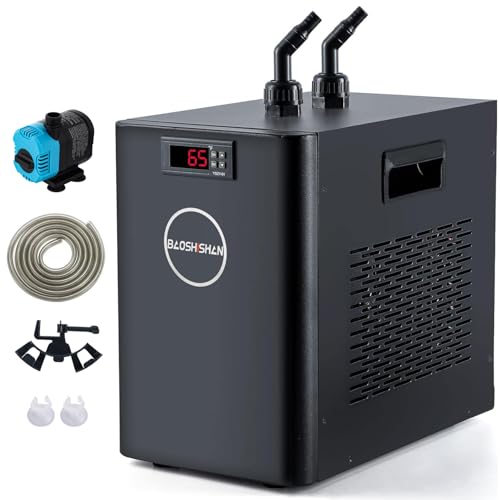
An axolotl chiller with compressor technology uses a refrigerant cycle — the same technology in a mini-fridge — to actively remove heat from tank water. They connect via tubing to your tank’s plumbing and can lower water temperature by 10 to 20°F below ambient room temperature.
An aquarium chiller axolotl setup with a compressor unit provides consistent, set-it-and-forget-it cooling. Once you dial in the target temperature, the thermostat cycles the compressor on and off as needed. This consistency is critical for any axolotl chiller because axolotls handle stable warm water better than fluctuating temperatures.
The trade-off is cost. The best axolotl chiller in compressor form ranges from $100 for small models to $400 for large tanks.
They also generate noise comparable to a refrigerator compressor and exhaust heat into the room. Flow rate matters too: most compressor chillers need 200-500 GPH. Check that your filter handles this demand, or see our axolotl filter guide for compatible options.
Cooling Fans — Budget Surface Cooling
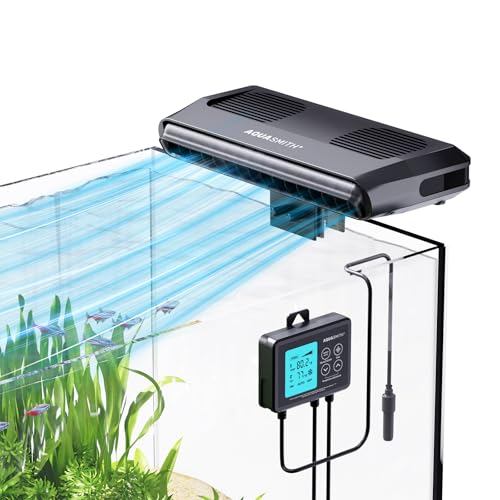
Cooling fans clip to the tank rim and blow air across the water surface. Evaporative cooling lowers the water temperature by 3 to 7°F below ambient. They cost $15 to $40 and draw almost no electricity.
An axolotl cooling fan works well if your room stays below 78°F and your tank is small — under 20 gallons. The cooling effect depends on humidity. In dry climates, fans work better because evaporation happens faster. In humid environments, the effect drops to 2-4°F at most.
Fans cannot compete with compressor chillers in hot rooms. They also increase evaporation, meaning more frequent top-offs. For a room that regularly hits 80°F, a fan alone will not keep an axolotl safe — you need an axolotl chiller.
Decision Matrix
| Room Temperature | Tank Size | Recommended Cooling |
|---|---|---|
| Under 72°F | Any | No cooling needed, but a budget fan provides insurance |
| 72-75°F | 10-20 gal | Cooling fan sufficient |
| 72-75°F | 20+ gal | Compressor chiller recommended |
| 75-80°F | Any size | Compressor chiller required |
| Above 80°F | Any size | Large compressor chiller (1/3 HP+) |
If you are unsure, I’d always recommend sizing up. A slightly oversized chiller runs less frequently and lasts longer than an undersized unit that struggles.
Best Axolotl Chillers by Tank Size## Best Axolotl Chillers by Tank Size
The following axolotl chiller products are ranked by the tank sizes they serve. Our top pick serves the most common axolotl enclosure range. For tank selection guidance, see our best axolotl tank guide.
BAOSHISHAN 26gal 1/13 HP — Best for Nano Tanks (10-20 Gallons)
This is the smallest true compressor chiller that makes sense for axolotl keeping. At 1/13 HP, it handles tanks up to 26 gallons — perfect for juvenile setups or the compact 15-20 gallon enclosures some keepers prefer.
What we like: The compact footprint fits under most desk setups. The $100-150 price range makes it the most affordable entry point into axolotl chiller ownership. LED temperature display gives you real-time monitoring without a separate thermometer.
What could be better: The 1/13 HP motor has limited cooling headroom. If your room runs above 78°F, this unit will struggle to reach the low 60s. It also lacks the titanium evaporator found on pricier models, so saltwater use is off the table — not a concern for axolotl keepers but worth noting.
Best for: Budget-conscious keepers with small axolotl tanks under 20 gallons.
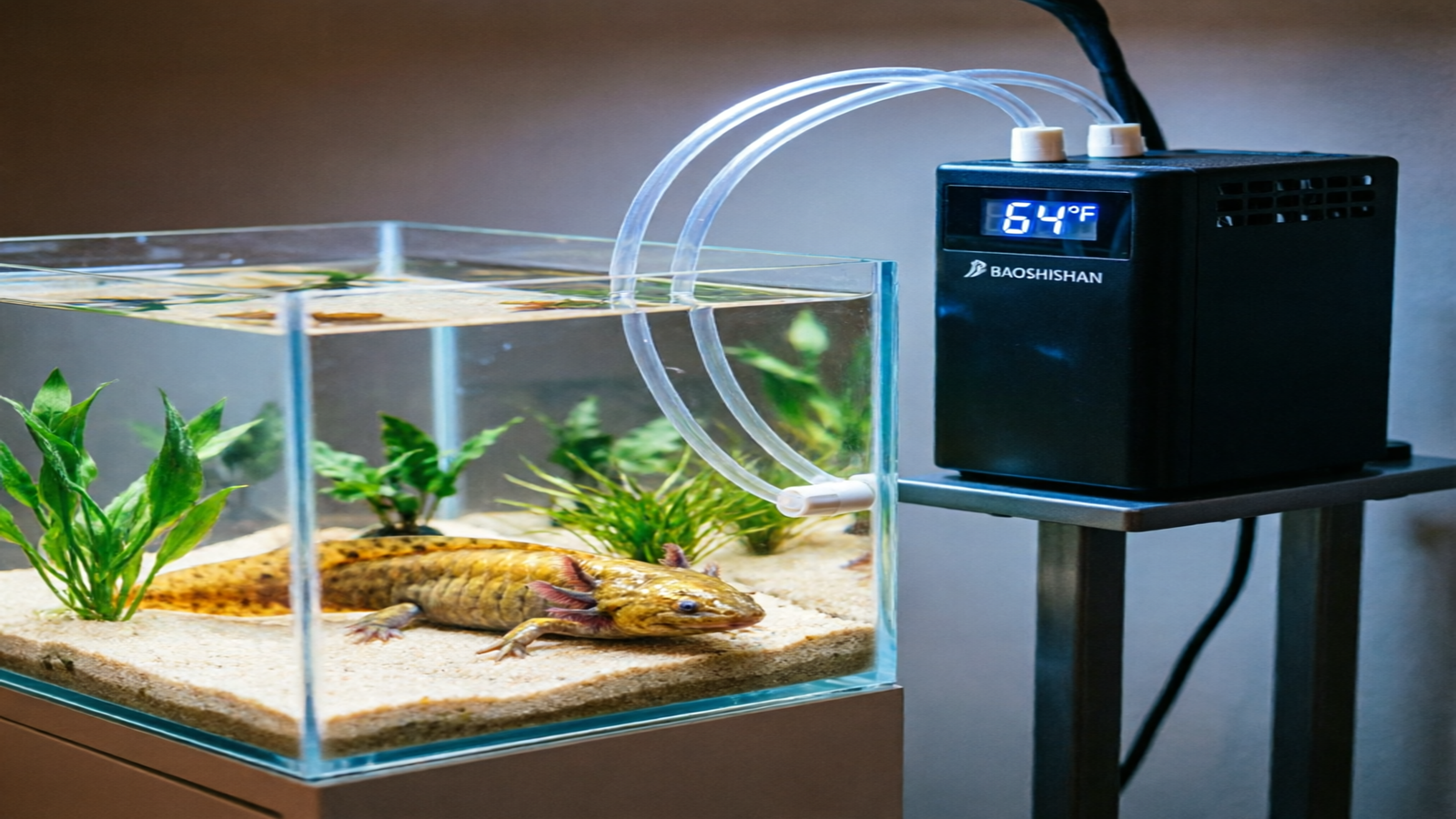
BAOSHISHAN 42gal 1/10 HP — Top Pick for Standard Tanks (20-40 Gallons)
This is the best axolotl chiller for the majority of keepers. The 1/10 HP compressor handles 20-40 gallon tanks — the standard range for a single adult axolotl — with comfortable cooling headroom even in warm rooms.
What we like: The 1/10 HP rating strikes the right balance between power and efficiency. It draws less electricity than larger models while still dropping water temperature 10-15°F below ambient. BAOSHISHAN has the most established track record in the budget chiller category, with consistent build quality across their product line. Community feedback on this specific model has been reliably positive.
What could be better: The documentation is generic — translated instructions that cover multiple models without axolotl-specific guidance. The standard evaporator is adequate for freshwater but not as durable as titanium alternatives. No WiFi or app-based temperature control, which some tech-savvy keepers might want.
Best for: Any keeper with a standard 20-40 gallon axolotl tank. This is the safe, proven choice.
Dreamtrue 42gal 1/10 HP — Best Budget Display Model
The Dreamtrue matches the BAOSHISHAN 42gal in every hardware specification — same 1/10 HP compressor, same 42-gallon capacity, similar price. Its selling point is the upgraded LED temperature display that shows set point and actual water temperature simultaneously.
What we like: The dual-temperature display is genuinely useful for monitoring whether the chiller is keeping up during hot afternoons. The manufacturer specifically mentions axolotl compatibility in the product listing, suggesting some awareness of the exotic pet market.
What could be better: Dreamtrue is a newer brand with a shorter track record than BAOSHISHAN. Long-term reliability data simply does not exist yet. The physical build quality looks similar but the warranty and support infrastructure may not match established brands.
Best for: Keepers who want a digital display upgrade over the base BAOSHISHAN at the same price point.
SDLOOL 42gal 1/10 HP — Quietest Option in This Class
The SDLOOL focuses on noise reduction as its primary differentiator. Same 1/10 HP compressor, same 42-gallon rating, but with design choices aimed at reducing compressor hum and vibration.
What we like: If your axolotl tank sits in a bedroom or office where compressor noise matters, the SDLOOL is worth considering. The quiet design does make a noticeable difference compared to the BAOSHISHAN at equivalent load. Broad compatibility claims — coral, shrimp, jellyfish, and axolotl — suggest versatile engineering.
What could be better: Beyond noise reduction, the SDLOOL offers no clear advantage over the BAOSHISHAN 42gal. The price sits slightly higher in the $150-220 range. Brand presence is smaller, which means fewer community reviews and less aggregate feedback to evaluate long-term performance.
Best for: Noise-sensitive environments where the tank shares a living or sleeping space.
Best Chillers for Larger Axolotl Setups (40-80+ Gallons)
Multi-axolotl tanks, breeding setups, and tanks in hot climates need more powerful cooling. These 1/3 HP units handle the job.
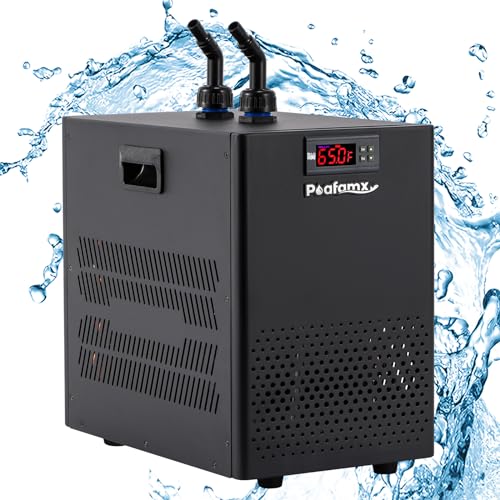
Poafamx 1/3 HP Titanium — Best for Multi-Tank Setups (40-80 Gallons)
The titanium evaporator sets this unit apart. Titanium resists corrosion better than standard copper or aluminum evaporators, which matters if you ever add salt to the tank for illness treatment or switch to a brackish setup.
What we like: The 1/3 HP motor provides serious cooling capacity — easily handling 40-80 gallon tanks even in rooms hitting 85°F. Energy-saving design reduces running costs compared to older 1/3 HP models. The titanium construction gives peace of mind for long-term durability.
What could be better: At $250-350, this is a significant step up in price. It is overkill for a single 20-gallon axolotl tank — the BAOSHISHAN 1/10 HP handles that at half the cost. The larger physical footprint requires dedicated floor space for your axolotl chiller next to the tank.
Best for: Keepers running 40+ gallon setups, breeding tanks, or multi-tank configurations.
VEVOR 110gal 1/3 HP — Maximum Capacity Option
The VEVOR boasts the highest tank capacity on this list at 110 gallons. This is a fish-room or large-display-tank chiller, not something most single-axolotl keepers need. But if you have a very large setup or live in an extremely hot climate, the extra capacity provides margin.
What we like: Complete fittings kit included — no extra trips to the hardware store for adapters. Fast cooling response due to the oversized compressor. VEVOR’s brand reputation in the aquarium equipment space provides some confidence in build quality.
What could be better: The $280-400 price range puts this at the top of the budget. For a standard axolotl tank, the cooling capacity is dramatically underutilized. The large physical size demands dedicated floor space and cannot be shelf-mounted like smaller units.
Best for: Large installations, fish rooms, or keepers in consistently hot climates above 85°F.
BAOSHISHAN 79gal 1/3 HP — Reliable Mid-Large Option
BAOSHISHAN scales up their proven design with this 79-gallon, 1/3 HP model. It keeps the familiar interface and build philosophy of their smaller chillers but adds the power needed for 40-80 gallon setups.
What we like: BAOSHISHAN brand consistency — if you trust their 42gal model, this is the logical step up. The integrated silent fan design reduces compressor noise compared to earlier 1/3 HP models. Fresh and saltwater compatibility adds versatility.
What could be better: No titanium evaporator at this price point, which is a miss when the Poafamx offers one in the same class. Documentation follows the same generic pattern as their smaller models. The $250-350 price competes directly with the titanium-equipped Poafamx.
Best for: Keepers who prefer the BAOSHISHAN brand and need to step up from their 42gal model.
Quick Comparison — All Chillers
| Product | Type | Tank Size | HP | Price | Best For |
|---|---|---|---|---|---|
| BAOSHISHAN 26gal 1/13 HP Top Nano | Compressor | 26 gal | 1/13 HP | $235.99-150 | Small tanks (10-20 gal) — mini chiller for axolotl setups |
| BAOSHISHAN 42gal 1/10 HP TOP PICK | Compressor | 42 gal | 1/10 HP | $299.99 | Standard tanks (20-40 gal) |
| Dreamtrue 42gal 1/10 HP | Compressor | 42 gal | 1/10 HP | $150-200 | Digital display preference |
| SDLOOL 42gal 1/10 HP | Compressor | 42 gal | 1/10 HP | $150-220 | Noise-sensitive setups |
| Poafamx 1/3 HP Titanium | Compressor | 40-80 gal | 1/3 HP | $250-350 | Multi-tank / durability |
| VEVOR 110gal 1/3 HP | Compressor | 110 gal | 1/3 HP | $280-400 | Maximum capacity |
| BAOSHISHAN 79gal 1/3 HP | Compressor | 79 gal | 1/3 HP | $250-350 | Brand loyalty upgrade |
Budget Alternative: Aquarium Cooling Fans
AQUASMITH Chiller Fan with Temperature Control
This fan clips to the tank rim and offers three speed modes with automatic temperature control. The built-in thermostat starts the fan when water hits the set point and stops it when the target is reached.
What we like: The auto on/off function is a significant upgrade over basic fans that run continuously. Three speed modes let you balance cooling against noise and evaporation. The $20-40 price is hard to beat — less than a quarter of a mini chiller for axolotl use.
What could be better: A 3-7°F cooling drop is meaningful but limited. If your room hits 78°F, the fan can bring a 10-gallon tank down to about 72°F — still above the axolotl safe zone. It cannot replace a compressor chiller in warm climates. The cooling effect drops further in humid environments.
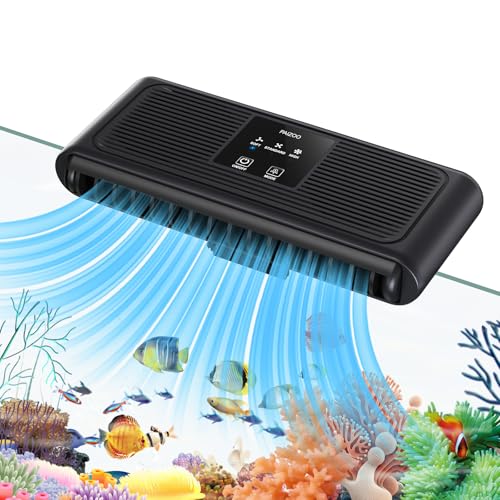
For an ultra-budget axolotl chiller alternative, the PAIZOO Aquarium Fan offers even simpler cooling at $15-30. However, it lacks automatic temperature control and runs at a fixed speed.
Best for: Keepers in moderate climates with tanks under 20 gallons.
For the price of two bags of axolotl pellets, the AQUASMITH fan is cheap insurance against summer heat spikes.
How to Set Up an Axolotl Tank Chiller
Placement and Positioning### Placement and Positioning
Place your axolotl chiller next to or below the tank — never above it. The chiller must sit at or below the water level of the tank to ensure gravity-fed flow through the heat exchanger. Most axolotl chiller compressors rely on a separate water pump or the tank’s filter to push water through the cooling coils.
Leave at least 6 inches of clearance on all sides for ventilation. Every axolotl chiller with a compressor exhausts heat into the surrounding air, and restricted airflow reduces cooling efficiency. Do not place the chiller inside a closed cabinet or aquarium stand with poor ventilation.
Plumbing Connections
Most axolotl chiller units use threaded inlet and outlet fittings — your axolotl chiller should come with included barbed adapters. Connect flexible tubing from your filter’s output to the chiller’s inlet, then from the chiller’s outlet back to the tank. The axolotl water chiller goes inline in the return path — water leaves the filter, passes through the chiller, and returns cooled to the tank.
Use hose clamps on every axolotl chiller connection. A disconnected axolotl chiller line can drain your tank in minutes. This happens in community groups more often than you would expect, and the results are stressful for both the keeper and the axolotl.
For detailed tank plumbing guidance, see our axolotl tank setup guide.
Temperature Controller Setup
Most axolotl chiller units have a built-in thermostat. Set the target to 64°F as a starting point — this gives you a 4-degree safety margin below the upper safe limit of 68°F. Let the chiller run for 24 hours and monitor the actual water temperature with a separate thermometer.
If the axolotl chiller overshoots by more than 2°F, reduce the set point by 1 degree. If it cannot reach the target, check flow rate — restricted flow is the most common axolotl chiller performance issue. Your axolotl chiller needs adequate water flow through the heat exchanger to transfer heat efficiently.
Flow Rate Considerations
Most compressor-based axolotl chiller models need 200-500 GPH flowing through them. Too much flow and the water passes through the axolotl chiller too fast to cool. Too little flow and the heat exchanger freezes up or the chiller shuts down on low-flow protection.
Most canister filters output 100-200 GPH, which works well with 1/10 HP chillers. Larger 1/3 HP models may need a dedicated pump. Check your chiller’s manual for the recommended flow range and adjust accordingly.
Axolotl Chiller Maintenance Tips
Monthly Cleaning
Clean your axolotl chiller heat exchanger coils monthly. Unplug the chiller and use a soft brush to remove dust and debris from the condenser fins on the back of the unit. Dust buildup acts as insulation and significantly reduces cooling efficiency over time.
Flush the axolotl chiller internal water path every two to three months. Disconnect the inlet and outlet tubing and run clean dechlorinated water through the chiller in both directions. This removes biofilm and mineral deposits that accumulate over time.
Seasonal Adjustments
In winter, your axolotl chiller may barely run — or not at all. Some keepers unplug the unit during cold months.
This is fine as long as you monitor tank temperature. A sudden warm spell can catch you off guard if the chiller is unplugged.
In summer, the chiller works harder and runs more frequently. Check the condenser fins weekly during peak heat.
Keep the room well-ventilated and consider running a room fan. Temperature management matters for all cold-blooded pets — hedgehog heat lamps follow a similar principle.
Troubleshooting Common Issues
Chiller runs but temperature does not drop: Check flow rate first. Restricted tubing, clogged filters, or a weak pump are the most common culprits. Verify that water is actually flowing through the chiller by feeling the inlet and outlet tubes — the outlet should be cooler.
Chiller makes loud noises: Rattling or buzzing from your axolotl chiller often indicates loose mounting screws or vibration against the surface it sits on. Place the chiller on a rubber mat to absorb vibration. Grinding or clicking sounds may indicate a compressor issue and require warranty service.
Temperature fluctuates rapidly: The thermostat sensor on your axolotl chiller may be positioned poorly. Ensure the sensor probe sits in flowing water, not in a dead zone. Large temperature swings of more than 2°F per cycle suggest the axolotl chiller is undersized for the tank or the room is too hot for the unit’s capacity.
Axolotl Chiller Do’s and Don’ts
** Safe Cooling Practices**
- Set chiller target to 64°F — This provides a 4-degree safety margin below the 68°F upper limit. (Merck Veterinary Manual)
- Leave 6 inches of clearance on all sides — Compressor chillers exhaust heat into surrounding air. Restricted airflow reduces cooling efficiency.
- Use hose clamps on every connection — A disconnected line can drain your tank in minutes.
- Check flow rate monthly — Restricted flow is the most common axolotl chiller performance issue.
- Clean condenser fins monthly — Dust buildup acts as insulation and reduces efficiency. Clean more often in summer.
- Monitor with a separate thermometer — Never rely solely on the chiller’s built-in display.
** Dangerous Cooling Mistakes**
- Placing the chiller above tank level — Gravity-fed flow requires the chiller at or below water level.
- Putting the chiller in a closed cabinet — Trapped heat creates a feedback loop that defeats cooling.
- Using ice packs as a long-term solution — Rapid 5-10°F temperature swings stress axolotls more than consistent warm water.
- Running a chiller with restricted flow — Can freeze the heat exchanger or trigger low-flow shutdown. (API Fish Care)
- Skipping maintenance during winter — A sudden warm spell can catch you off guard if the chiller is unplugged.
- Oversizing fans for large tanks — Cooling fans only drop 3-7°F. Above 80°F room temperature, fans alone cannot keep an axolotl safe.
Axolotl Chiller FAQ
Do axolotls really need a chiller?
Most axolotl owners need active cooling for their tank. The ideal range of 60-68°F is well below what most homes maintain in summer.
A compressor chiller is the most reliable solution for rooms that regularly exceed 75°F. In cooler climates or air-conditioned rooms that stay under 72°F year-round, you might skip one — but an axolotl cooling fan provides useful insurance as a cheap axolotl chiller alternative during heat waves.
Can I use ice packs instead of a chiller?
Ice packs cause rapid temperature swings of 5-10°F per hour. Axolotls handle stable warm water better than rapid temperature fluctuations. The sudden cold shock from an ice pack stresses the axolotl and can actually worsen immune function. Ice packs work as an emergency stopgap during a chiller failure — never as a long-term axolotl chiller replacement.
How much electricity does an aquarium chiller use?
A typical 1/10 HP compressor chiller draws 120-180W and costs roughly $8-15 per month depending on your electricity rate. Larger 1/3 HP models draw 250-350W and cost $15-25 monthly.
Cooling fans use only 5-10W and cost under $2 per month. The compressor only runs when actively cooling, so actual draw depends on the temperature gap between your room and the set point.
What temperature should my axolotl tank be?
The ideal range is 60-68°F (16-20°C). Target 64°F as your set point — this gives a safety buffer below the upper limit. Temperatures above 72°F cause progressive stress, appetite loss, and immune suppression. Prolonged exposure above 75°F significantly increases mortality risk.
Can I put a chiller in a closed cabinet?
Never place a compressor chiller in a closed cabinet or enclosed stand. The chiller removes heat from the water and exhausts it into the surrounding air.
A closed cabinet traps that heat, raises the ambient temperature, and creates a feedback loop. Leave at least 6 inches of clearance on all sides and ensure the chiller has access to room-temperature air.