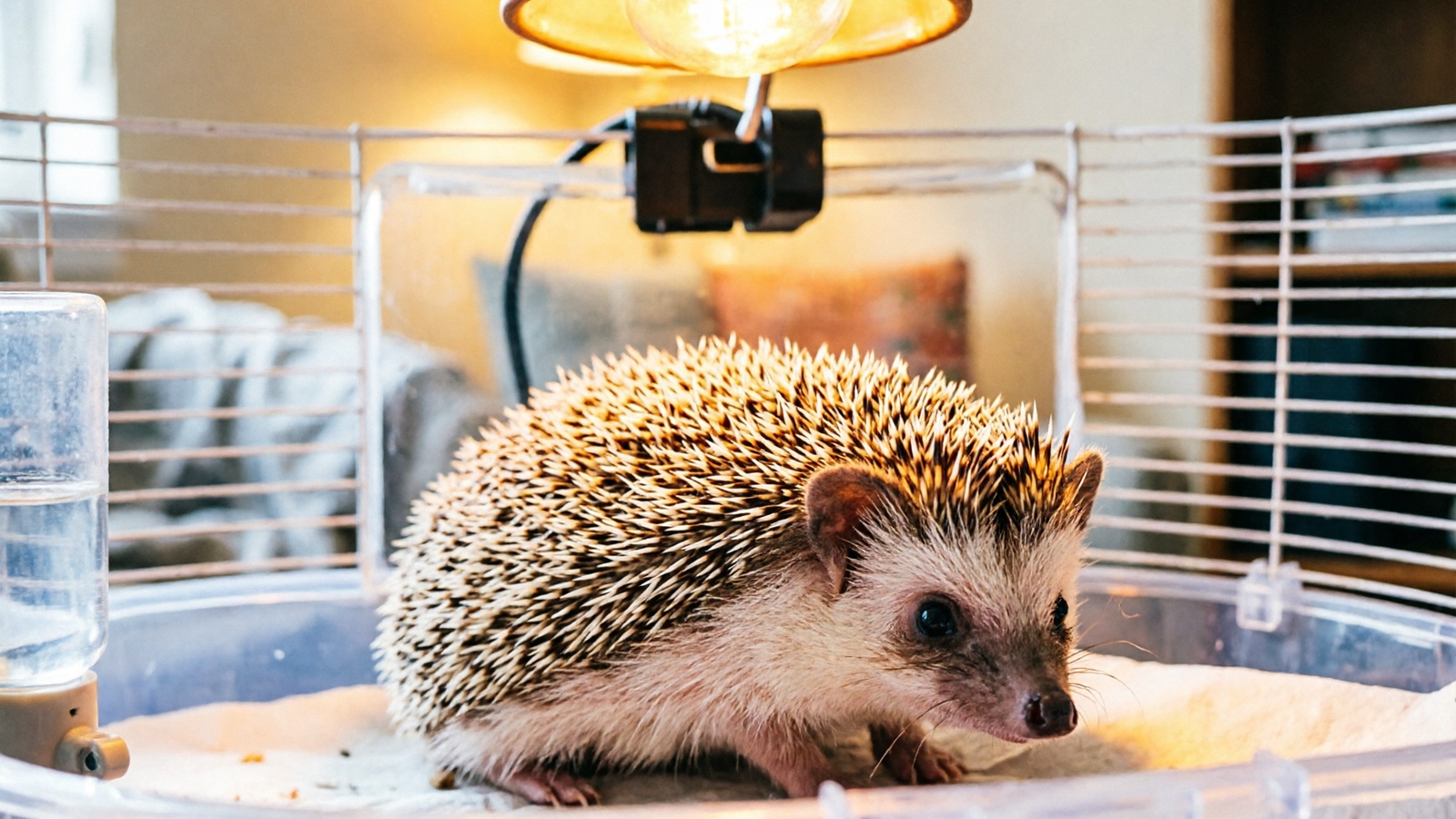
Why Hedgehogs Need a Heat Lamp (Not Just “Warm Enough”)
An ideal hedgehog heat lamp setup is a temperature-controlled overhead heating system that maintains 75-80°F (24-27°C) inside a hedgehog’s enclosure. The standard setup has three components: a Ceramic Heat Emitter (CHE) bulb producing infrared heat without visible light, a porcelain-socket clamp lamp dome directing heat downward, and a digital thermostat cycling the lamp on and off to hold target temperature.
The Merck Veterinary Manual recommends an ambient temperature of 75–85°F (24–29°C) as optimal for African Pygmy Hedgehogs, with 72°F as the lower safety boundary. (Merck Veterinary Manual — Management of Hedgehogs: “75°–85°F (24°–29°C) is optimal”; LafeberVet — Basic Information Sheet: African Pygmy Hedgehog: “Target environmental temperature, 75-85°F”)
Unlike heat pads, heat lamps warm the entire cage air — not just the surface. This matters because African Pygmy Hedgehogs cannot survive hibernation.
Temperatures below 72°F trigger a potentially fatal hibernation attempt within hours. Cold exposure is one of the most dangerous hedgehog health emergencies — and it is the number one cause of hedgehog death in captivity. According to Veterinary Partner (VIN), torpor occurred in most animals at environmental temperatures ≈68°F (20°C), meaning any temperature below 72°F should be treated as an emergency risk — another reason overhead heat is non-negotiable. (Veterinary Partner (VIN) — African Pygmy Hedgehogs: Husbandry and Clinical Considerations: “torpor occurred in most animals at environmental temperatures ≈68°F”)
Most first-time owners underestimate heating requirements. A proper heat lamp is not optional equipment — it is as essential as food and water.
CHE vs Night Heat Bulb vs Heat Pad: Which Is the Best Hedgehog Heat Lamp Method?
The right heating method depends on your setup — here is how each heating approach compares for hedgehog owners.
| Heating Method | Heat Output | Light Output | Warms Cage Air | Safety | Cost | Best For |
| Ceramic Heat Emitter | High (infrared) | Zero | ✅ Yes | High — 300°F surface | $15-28 | Primary heat for all hedgehogs |
| Night Heat Bulb | Medium | Dim moonlight glow | ✅ Yes, less efficient | Medium — glass shatters | $7-10 | Owners wanting dim night viewing |
| Heat Pad | Low, surface only | N/A | ❌ No | Low — burn risk | $25-40 | Backup only, never primary |
| Space Heater | High | N/A | ✅ Yes, entire room | Medium — fire risk | $30-80 | Cold room supplement |
The hedgehog community overwhelmingly agrees: when comparing ceramic heat emitter vs heat bulb options for hedgehogs, CHE is the clear winner for primary heating. This is why the ceramic heat emitter vs heat bulb hedgehog debate consistently favors CHE — zero light, deeper heat penetration, and longer lifespan.
Heat pads are unsafe as primary heat — documented burn cases and cage melting make them risky. Night bulbs emit light that disrupts nocturnal activity. Space heaters supplement but cannot replace overhead CHE as the primary heat source.
Temperature management is a cornerstone of hedgehog care — see our complete care guide for all essentials.
Best Ceramic Heat Emitter (CHE) Bulbs for Hedgehogs
Choosing the best hedgehog heat lamp starts with selecting the right CHE bulb — the gold standard for hedgehog heating. A hedgehog ceramic heat emitter outperforms every alternative for consistent overnight warmth.
They produce infrared heat with zero visible light, preserving your hedgehog’s nocturnal cycle. The ideal hedgehog heat lamp for most owners uses one of the two CHE bulbs below — the community favorite and the trusted brand option.
1. LUCKY HERP 150W Ceramic Heat Emitter (2-Pack) — Best Value CHE
$15.99 (2-pack) | 150W infrared | E26 base
A widely available CHE on Amazon. Two bulbs for under $16 works out to roughly $8 per bulb — unbeatable value for budget hedgehog heating. The 150W infrared heat output covers 2-4 square feet of warm zone with a thermostat.
Zero visible light means no disruption to your hedgehog’s nighttime activity. Hedgehogs become noticeably more active after switching from light-emitting bulbs to CHE.
The E26 standard base fits all porcelain clamp lamps.
LUCKY HERP 150W CHE 2-Pack on Amazon →
What we like:
Best value CHE available — two bulbs for the price of one Fluker’s, making it the top value pick. Infrared heat penetrates deeply for even cage warming. Rated for approximately 25,000 hours of use.
What could be better:
150W may overheat small cages under 2 square feet — 100W is often sufficient. Reviews are shared across the 75W, 100W, and 150W wattage variants, making specific feedback harder to find. Surface reaches roughly 300°F, requiring a strict 12-inch minimum distance from bedding.
What owners say:
“Best value ceramic heat emitter I’ve found. Two bulbs for under $16 is unbeatable. My hedgehog’s cage stays at a steady 78°F.”
Escape-proof rating: ⚠️ MEDIUM — 150W overpowers small cages. Use thermostat and verify temperature.
2. Fluker’s 100W Ceramic Heat Emitter — Trusted Brand CHE
$14.33 (single) | 100W infrared | E26 base
Fluker’s has been an established reptile brand since the 1950s. Their 100W CHE hits the sweet spot for most hedgehog enclosures between 2-4 square feet, making it a trusted choice for hedgehog heating setups. Vets specifically recommend this brand for consistent quality.
Zero light output preserves your hedgehog’s nocturnal schedule. The single-bulb packaging means no overbuying.
What we like:
100W is the ideal wattage for an overhead heat source — enough heat without the overheating risk of 150W. Brand reputation gives confidence in quality control. Vets recommend Fluker’s by name.
What could be better:
More expensive per bulb than the LUCKY HERP 2-pack. Only available as a single bulb with no multi-pack option. Same 300°F surface hazard requires 12-inch clearance.
What owners say:
“Fluker’s is the gold standard for ceramic heat emitters. 100W is the sweet spot for my 3-foot hedgehog cage. Connected to a thermostat, it maintains 76-78°F perfectly.”
TheTemperature rating: ✅ RECOMMENDED — 100W is the safest all-around wattage for an overhead heat source.
The clamp lamp is just as important as the CHE bulb. Using a plastic-socket lamp with a CHE is a fire hazard — the socket will melt.
You must use a porcelain or ceramic socket rated for your bulb’s wattage. A hedgehog heat lamp setup pairs a CHE bulb with one of the three clamp lamps below, compared across dome size, wattage capacity, and convenience.
3. Fluker’s 8.5” Repta-Clamp Lamp — Best Overall Clamp Lamp
$16.99 | 150W max | 8.5” dome | On/off switch
A widely available reptile clamp lamp on Amazon. The 150W max capacity handles all CHE bulbs from 60W through 150W — a key factor in solid hedgehog heating setups.
The broad 8.5-inch aluminum dome spreads heat evenly across standard cage sizes. UL/CUL safety listed. Porcelain socket rated for continuous high-wattage use.
UL/CUL safety listed. Porcelain socket rated for continuous high-wattage use. The on/off switch means no unplugging required for routine maintenance.
Fluker’s 8.5” Clamp Lamp on Amazon →
What we like:
150W capacity works with any wattage CHE — no need to match fixture to bulb for an overhead heat source. Broad dome creates a wider warm zone than compact alternatives. On/off switch is convenient for cage cleaning.
What could be better:
Dome surface gets very hot during use. Clamp grip can slip on smooth wire cage bars — add rubber padding. Six-foot power cord may require an extension cord for distant outlets.
What owners say:
“The standard for reptile clamp lamps. 150W capacity means it works with any CHE or heat bulb. The on/off switch is convenient.”
Durability rating: ✅ BEST CHOICE — 8.5” dome + 150W capacity covers every hedgehog setup.
4. Fluker’s 5.5” Repta-Clamp Lamp — Best Compact Clamp Lamp
$12.49 | 75W max | 5.5” dome | On/off switch
A compact clamp lamp with a 5.5-inch dome that fits smaller cages and tight spaces.
At $12.49, it is the cheapest quality clamp lamp available. The 75W maximum pairs perfectly with 60-75W CHE bulbs for small enclosures under 2 square feet.
The 75W maximum pairs perfectly with 60-75W CHE bulbs for small enclosures under 2 square feet.
Fluker’s 5.5” Clamp Lamp on Amazon →
What we like:
Cheapest quality option at $12.49 for a compact hedgehog heat lamp. Compact 5.5-inch dome fits 2-foot enclosures easily.
75W max is sufficient for most small cage setups with a thermostat.
What could be better:
75W max cannot use 100W or 150W CHE bulbs. Smaller dome concentrates heat into a narrower warm zone. If you upgrade to a larger cage or higher-wattage CHE, this fixture becomes useless.
What owners say:
“Perfect for small hedgehog cages. The 5.5-inch dome is compact enough for a 2-foot enclosure.”
Size rating: ⚠️ SMALL CAGES ONLY — 75W max limits future upgrades to higher-wattage CHE bulbs.
5. Zoo Med 5.5” Porcelain Clamp Lamp — No-Switch Reliability
$16.49 | Porcelain socket | 5.5” dome | No switch
Zoo Med is the most trusted reptile brand worldwide. This clamp lamp uses a porcelain socket with a deep dome design that focuses heat efficiently. The no-switch design means one fewer mechanical failure point for 24/7 thermostat-controlled setups.
The black porcelain-coated dome absorbs and re-radiates heat effectively.
Zoo Med Porcelain Clamp Lamp on Amazon →
What we like:
No switch eliminates a common failure point for continuous 24/7 operation — ideal for overhead heating running 24/7. Zoo Med brand carries strong vet recommendations. Porcelain socket handles high-wattage CHE safely.
What could be better:
No on/off switch means you must unplug to turn off — inconvenient for cage cleaning.
With fewer owner reviews, a much smaller sample than Fluker’s alternatives. Slightly more expensive than the Fluker’s 5.5” model despite lacking a switch.
What owners say:
“I prefer the no-switch design for 24/7 setups. One fewer thing to fail. Just plug it into a thermostat outlet.”
Reliability rating: ✅ SOLID — best for owners running setups through a thermostat who never need a manual switch.
All Hedgehog Heat Lamps Compared
| # | Product | Category | Key Spec | Price | Best For |
| 1 | LUCKY HERP CHE 2-Pack | CHE Bulb | 150W, 2-pack | $15.99 | Best CHE value |
| 2 | Fluker’s 100W CHE | CHE Bulb | 100W, single | $14.33 | Trusted brand |
| 3 | Fluker’s 8.5” Clamp Lamp | Fixture | 150W max, switch | $16.99 | Best overall lamp |
| 4 | Fluker’s 5.5” Clamp Lamp | Fixture | 75W max, switch | $12.49 | Small cages |
| 5 | Zoo Med 5.5” Clamp Lamp | Fixture | Porcelain, no switch | $16.49 | 24/7 setups |
| 6 | Exo Terra Night Heat Lamp 50w | Night Bulb | Nocturnal glow | $9.99 | Night viewing |
| 7 | Zoo Med ReptiTemp | Thermostat | 500W, safety shut-off | $47.69 | Essential control |
| 8 | TempPro TP50 | Thermometer | Temp + humidity | $10.99 | Budget monitoring |
Complete System Cost
| Setup | CHE | Clamp Lamp | Thermostat | Thermometer | Total |
| Premium | LUCKY HERP $15.99 | Fluker’s 8.5” $16.99 | Zoo Med $47.69 | TempPro $10.99 | ~$91 |
| Trusted Brand | Fluker’s $14.33 | Fluker’s 8.5” $16.99 | Zoo Med $47.69 | TempPro $10.99 | ~$90 |
| Budget | Fluker’s $14.33 | Fluker’s 5.5” $12.49 | Budget thermostat $28 | TempPro $10.99 | **$66** |
Essential Accessories: Wattage Guide, Night Bulb, Thermostat & Thermometer
Wattage Guide: How Many Watts Does Your Hedgehog Heat Lamp Need?
The best heating wattage depends on cage size and room temperature. Use this table to match your setup: | Room Temperature | Recommended CHE | Clamp Lamp |
| 2 sq ft (small bin) | 68-70°F | 60-75W | 5.5” dome, 75W max |
| 2-4 sq ft (standard) | 65-70°F | 100W | 5.5” or 8.5” dome |
| 4+ sq ft (large) | 60-68°F | 150W | 8.5” dome, 150W max |
| Any size | Below 60°F | 150W + space heater | 8.5” dome |
The wattage determines how quickly a hedgehog heat lamp heats the space. The thermostat regulates the final temperature. Start with 100W for most cages and adjust based on monitored readings.
6. Exo Terra Night Heat Lamp 50w — Best Night Viewing Bulb
$9.99 | 50W | Night heat
An affordable night heat option at $9.99. The Exo Terra Night Heat Lamp produces a subtle glow that allows nocturnal viewing without disrupting your hedgehog’s day-night cycle.
Standard A19 bulb shape fits any clamp lamp. Not recommended as primary heat — CHE is superior for hedgehogs in every way.
Not recommended as primary heat — CHE is superior for hedgehogs in every way. Reserve this for owners who specifically want to observe their hedgehog at night.
Exo Terra Night Heat Lamp on Amazon →
What we like:
Affordable night heat source at $9.99. Low-wattage 50W design provides gentle warmth without overheating smaller cages. Standard screw-in bulb fits any clamp lamp fixture.
What could be better:
50W may not be sufficient as a sole heat source in colder rooms — pair with a higher-wattage CHE for primary heat. Still emits some visible light, so position it where it minimizes disruption.
Recommendation: Use CHE as primary. Reserve night bulbs only if you need visual checks at night — a CHE-based heating instead.
7. Zoo Med ReptiTemp Digital Thermostat — Essential Temperature Controller
$47.69 | 500W max | Safety shut-off
This is not optional. A thermostat is mandatory for every hedgehog heating setup. Too many owners skip this component and their hedgehog suffers temperature shock.
Without a thermostat, cage temperature fluctuates with room conditions — overheating to 90°F or dropping below 72°F without warning.
The digital display shows exact temperature. The safety shut-off cuts power if temperature exceeds the safe range. A nighttime drop feature allows setting a 2-degree cooler target at night.
Zoo Med ReptiTemp Thermostat on Amazon →
What we like:
Safety shut-off is a critical feature — cuts power automatically if your heat lamp overheats. Nighttime drop simulates natural temperature cycles. Controls any heat source up to 500W, so it works with all CHE wattages.
What could be better:
Most expensive single component at $47.69. On/off cycling means the lamp clicks on and off throughout the day.
The probe wire is thin and can be chewed — route it outside the cage.
What owners say:
“Essential for hedgehog heating setups. Without a thermostat, you’re guessing the temperature. This keeps my hedgehog cage at exactly 78°F.”
For reptile owners who need a reptile thermostat for multiple enclosures, this unit handles the job well. If you are specifically shopping for a hedgehog thermostat for heat lamp setups, this Inkbird model is the most versatile option.
Priority rating: 🔴 MANDATORY — do not skip this component — it is the brain of your hedgehog heat lamp.
8. TempPro TP50 Digital Thermometer — Budget Temperature Monitor
$10.99 | Temp + humidity
A widely available thermometer on Amazon. Buy two units if you want one inside the cage and one outside to monitor the temperature differential. Every hedgehog heating setup needs this level of monitoring. Measures both temperature and humidity on a compact adhesive-mount display.
Mount at hedgehog floor level for accurate readings, away from direct CHE heat path.
What we like:
A compact TP50 at $10.99 is solid value — essential for any hedgehog heating setup. Humidity reading is a bonus — hedgehogs prefer 30-50% humidity. Compact adhesive-mount design fits inside any cage.
What could be better:
Adhesive may not stick to wire cage bars — use zip ties for the best thermometer placement. Battery powered with roughly 6-8 month life. Not waterproof — keep away from water bowls.
Value rating: ✅ BEST BUDGET PICK — every hedgehog cage needs at least one thermometer.
How to Set Up a Hedgehog Heat Lamp: Step-by-Step Guide
A hedgehog heat lamp setup follows these six steps to ensure safe, consistent temperature for your hedgehog.
Step 1: Position the Clamp Lamp
Attach the clamp lamp to the cage top or a nearby shelf to start setting up your hedgehog heat lamp. Aim it down over the sleeping area, not over the wheel. The CHE must be at least 12 inches from the hedgehog’s highest sleeping surface and 12 inches from any flammable bedding.
Step 2: Insert the CHE Bulb
Screw the CHE bulb into the porcelain socket by hand — the core component of your hedgehog heat lamp. Never touch the ceramic element with bare fingers — skin oils reduce bulb lifespan. Use a cloth or gloves.
Step 3: Connect the Thermostat
Plug the clamp lamp into the thermostat outlet — this completes the CHE control loop. Place the thermostat probe inside the cage at hedgehog floor level in the sleeping area.
Set the target temperature to 76-78°F. The thermostat will cycle the lamp on and off automatically.
Step 4: Add a Thermometer
Mount a digital thermometer at hedgehog level inside the cage to verify your heating performance, away from direct CHE heat. Cross-check thermostat probe readings with the thermometer display daily.
Step 5: Test for 24 Hours
Run the complete hedgehog heat lamp setup for 24 hours before placing your hedgehog in the cage. Monitor high and low readings. Adjust lamp distance if temperature exceeds 80°F or drops below 74°F.
Step 6: Establish a Backup Plan
Keep a spare CHE bulb in your cabinet — bulbs fail without warning. Know how to warm your hedgehog with body heat during power outages. Never rely on a single heating method without backup.
Heat lamp placement depends on your cage type — see our hedgehog cage setup guide for fixture compatibility details.
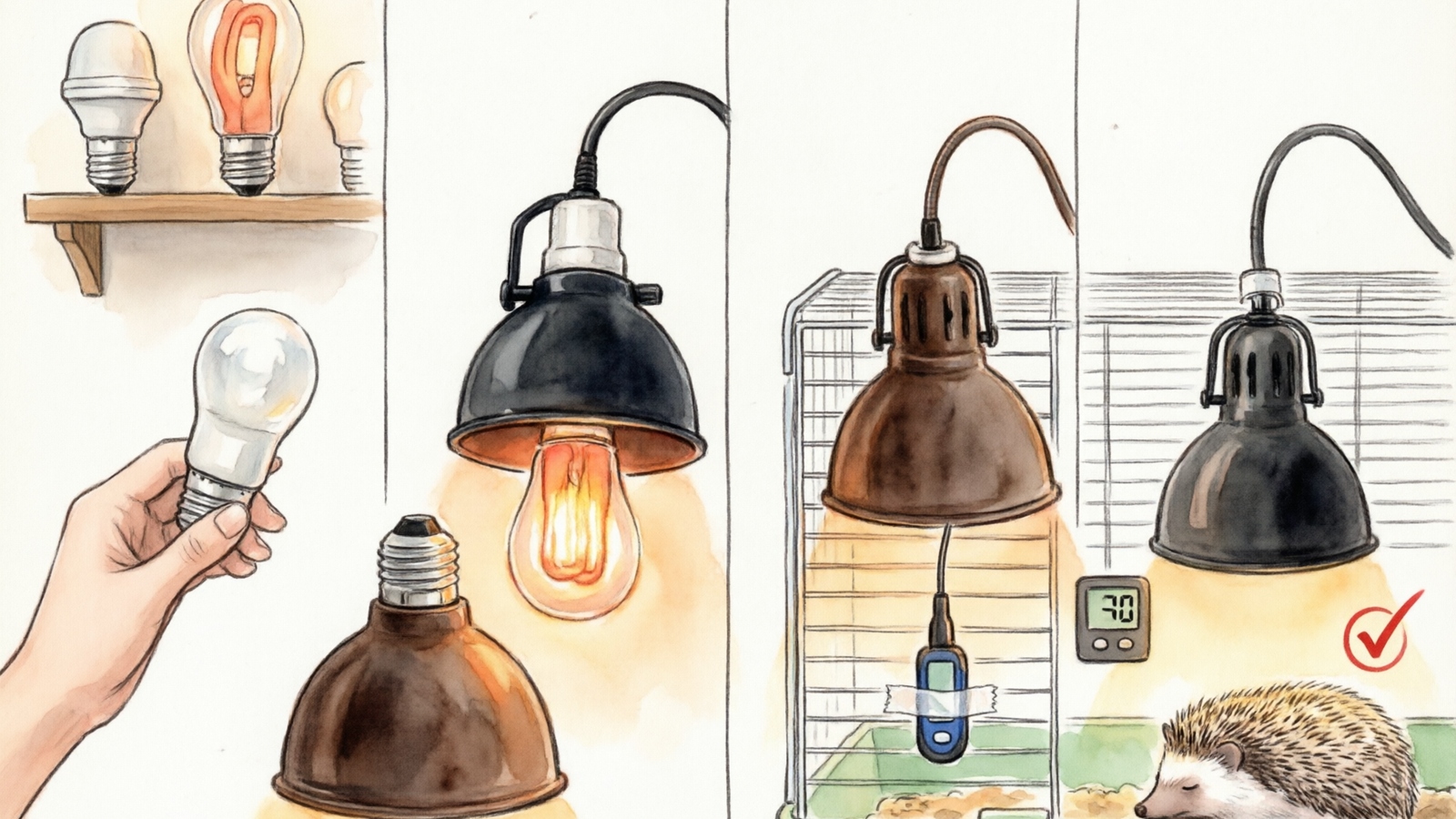
Heat Lamp Safety Checklist for Hedgehog Owners
| Safety Check | Why It Matters | How to Verify |
| ✅ Porcelain socket only | Plastic sockets melt with CHE bulbs — fire hazard | Check socket material before inserting bulb |
| ✅ CHE surface 12”+ from bedding | CHE surface reaches 300°F — ignition risk | Measure with ruler, adjust lamp height |
| ✅ Thermostat always connected | Without it, cage overheats or drops dangerously | Verify probe is inside cage at hedgehog level |
| ✅ Thermometer at hedgehog level | Air temperature varies by height in cage | Mount within 2 inches of cage floor |
| ✅ Lamp secured firmly | Wheel vibration can knock loose fixtures | Tighten clamp, add rubber padding, check weekly |
| ✅ Flammable bedding 12”+ away | Pine shavings and fleece can ignite near CHE | Rearrange bedding under lamp area |
| ✅ Smoke detector in room | Early fire warning | Test detector monthly |
| ✅ Spare CHE bulb on hand | Bulbs fail without warning — cold within hours | Keep one spare in a cabinet |
Some bedding materials are more fire-resistant near heat sources — see our best hedgehog bedding guide for safe options around heat lamps.
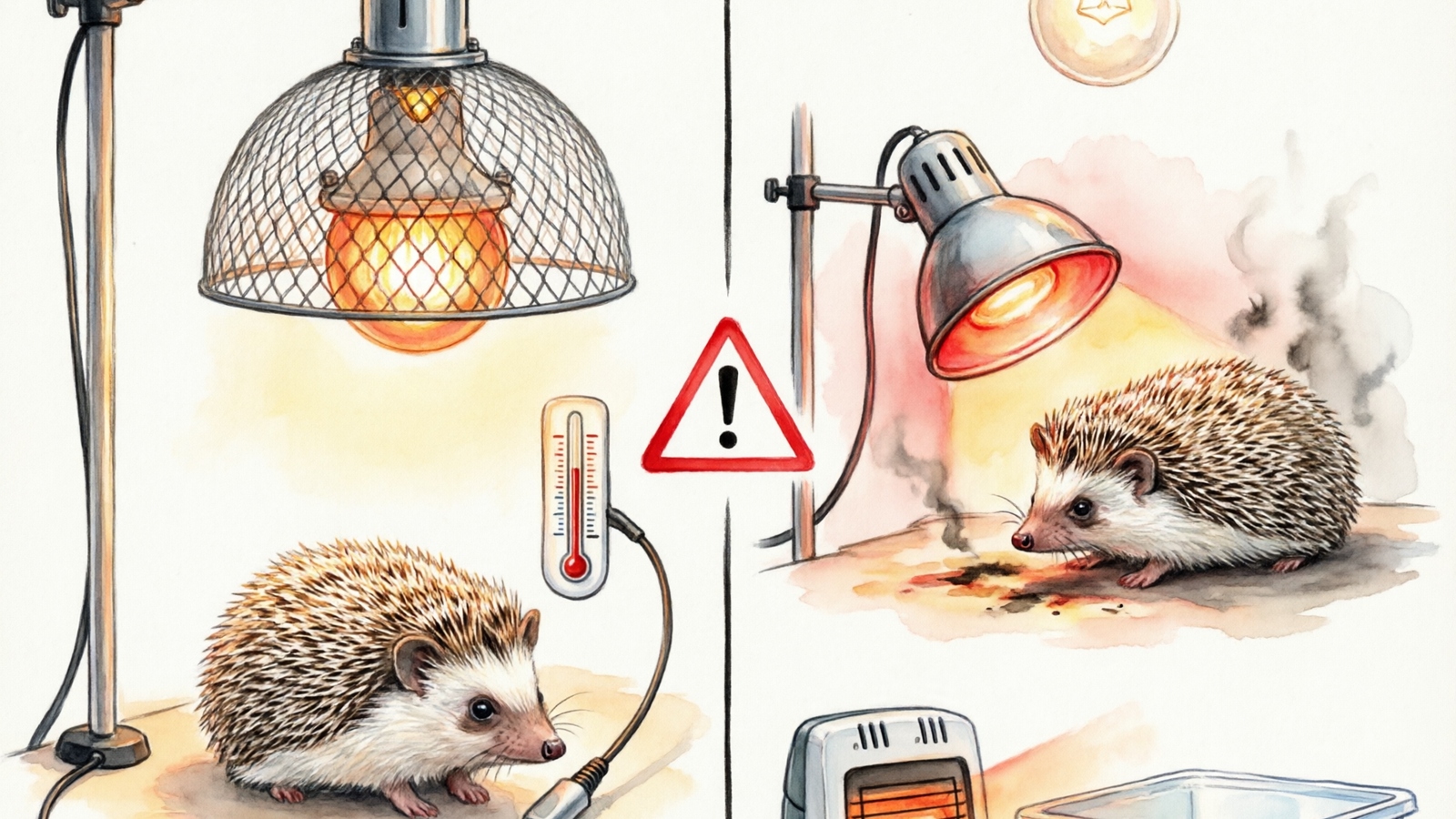
Hedgehog Heat Lamp Do’s and Don’ts
Use this quick-reference checklist before setting up or troubleshooting your hedgehog heat lamp.
✅ Correct Heat Lamp Practices
-
✅ Use a porcelain-socket clamp lamp rated for your CHE wattage — Plastic sockets melt under CHE heat. Always check the socket material and max wattage before inserting a bulb.
-
✅ Maintain CHE at 12+ inches from bedding and sleeping surfaces — CHE surface temperature reaches approximately 300°F. Anything closer risks ignition or burns.
-
✅ Always use a thermostat between the lamp and the power source — Without a thermostat, cage temperature swings dangerously (can overheat to 90°F+ or drop below 72°F).
-
✅ Place the thermostat probe at hedgehog floor level in the sleeping area — Air temperature varies by height in the cage. Floor-level readings reflect what your hedgehog actually experiences.
-
✅ Cross-check thermostat readings with a separate thermometer daily — Thermostat probes can drift. A second thermometer catches discrepancies before they become dangerous.
-
✅ Keep a spare CHE bulb in your cabinet — CHE bulbs fail without warning. Your hedgehog can get dangerously cold within hours of a bulb failure.
❌ Dangerous Heat Lamp Mistakes
-
❌ Using a heat pad as the primary heat source — Heat pads only warm the surface, not cage air. Hedgehog Headquarters and Millermeade Farm’s Critter Connection both document burn cases from malfunctioning pads.
-
❌ Using a plastic-socket lamp with any CHE bulb — The socket will melt, creating a fire hazard. Porcelain or ceramic sockets are the only safe option for CHE.
-
❌ Placing the CHE closer than 12 inches to bedding — CHE surface reaches 300°F. Pine shavings, fleece, and paper bedding can ignite at this temperature.
-
❌ Skipping the 24-hour test before introducing your hedgehog — Unverified setups can overheat to 90°F+ or fail to reach 75°F. Always test for 24 hours and verify stable readings.
-
❌ Using a red or black night bulb as primary heat — Night bulbs emit visible light that disrupts your hedgehog’s nocturnal activity cycle. They also shatter if water contacts the glass.
-
❌ Relying on a space heater alone without an overhead CHE — Space heaters warm the room but create uneven cage temperatures. A CHE provides direct, thermostat-controlled overhead heat.
Alternatives: Heat Pads, Space Heaters & Keeping Hedgehogs Warm at Night
Heat Pads — Backup Only, Never Primary
Heat pads only warm the surface they contact — unlike an overhead heat lamp which warms the entire cage. They do not heat ambient cage air, which is what hedgehogs need.
Documented cases of second and third degree burns exist in the hedgehog community — Hedgehog Headquarters reports that “sick and injured animals have been known to burn themselves on heating pads” and Millermeade Farm’s Critter Connection published photographs of hedgehog foot burns caused by a malfunctioning heating pad. Heat pads can also melt plastic cages and add moisture that promotes respiratory infections. (Hedgehog Headquarters — Keeping Your Hedgehog Warm: “Sick and injured animals have been known to burn themselves on heating pads”; Millermeade Farm’s Critter Connection — Heating Options: published photo of hedgehog foot burns from malfunctioning pad)
If used as backup, place under only one-third of the cage floor. Never as the primary heat source — always choose overhead CHE.
Space Heaters — Cold Room Supplement
Useful when room temperature drops below 65°F — as a supplement to overhead CHE, not a replacement. Choose a ceramic space heater with automatic shut-off.
Keep it away from the cage and regulate with a room thermostat. Space heaters significantly increase electricity costs.
Power Outage Protocol
Wrap the cage in thick blankets for temporary insulation while you restore your heating. Use body heat — place your hedgehog against your skin under your shirt for direct warmth. A SnuggleSafe microwavable heat disc stays warm for 8-12 hours as a reusable backup while you restore your best hedgehog heat lamp.
Temperature stress causes specific behavioral changes — see our hedgehog behavior guide for cold-stress signs to watch for.
For bearded dragon owners comparing heat lamp setups across species, our bearded dragon heating lamp guide covers similar equipment in a different context.
Hedgehog Heat Lamp FAQ: Common Questions Answered
What wattage heat lamp does a hedgehog need?
Most hedgehog cages need a 100W Ceramic Heat Emitter as the ideal heating choice. Use 60-75W for small bin cages under 2 square feet of warm zone and 150W for large enclosures over 4 square feet or cold rooms below 65°F.
Always pair with a thermostat. Wattage determines how quickly the CHE heats the space, but the thermostat regulates the final temperature. Start with 100W and adjust based on your monitored readings.
Can I use a heat pad instead of a heat lamp for my hedgehog?
No, not as the primary heat source. Unlike overhead heat lamps, heat pads only warm the surface they contact — they do not heat the ambient cage air that hedgehogs need.
Heat pads carry documented burn risks including second and third degree cases reported in the hedgehog community. They can melt plastic cages and add moisture that promotes upper respiratory infections.
Use a CHE heat lamp as primary and a heat pad only as supplemental backup under one-third of the cage floor.
How do I set up a hedgehog heat lamp?
The standard hedgehog heat lamp starts with clamping a porcelain-socket dome lamp to the cage top over the sleeping area. Use an 8.5-inch dome for most cages.
Next, screw in a CHE bulb — 100W for standard cages — without touching it with bare fingers. Then plug the lamp into a digital thermostat with the probe placed at hedgehog floor level.
Set the thermostat to 76-78°F. Add a thermometer at hedgehog level for cross-checking.
Maintain 12 inches minimum distance between CHE and bedding. Test the complete hedgehog heat lamp for 24 hours before introducing your hedgehog.
How to keep a hedgehog warm at night without a heat lamp?
A CHE running 24/7 with a thermostat is the safest overnight method for your hedgehog. CHE bulbs produce zero light and will not disturb your hedgehog’s nocturnal cycle.
If your heat lamp fails at night: wrap the cage in thick blankets for one to two hours of insulation, use body heat by placing your hedgehog under your shirt against your skin, or use a SnuggleSafe microwavable heat disc as a temporary backup.
Never rely on these emergency methods long-term. A working CHE plus thermostat setup is mandatory for safe hedgehog care.
What temperature should a hedgehog cage be?
75-80°F (24-27°C) is the safe range. The ideal target is 76-78°F.
Below 72°F triggers a dangerous hibernation attempt. African Pygmy Hedgehogs cannot survive hibernation and can die within hours of cold exposure. The Merck Veterinary Manual confirms the optimal range is 75-85°F with 72°F as the lower boundary, and torpor may occur if temperatures drop further. Above 80°F causes heat stress. Use both a thermostat to control heat output and a separate thermometer to verify actual readings at all times.
Can I use a red night heat bulb for my hedgehog?
CHE is better for your hedgehog heat lamp setup. Red and black night bulbs still emit some visible light that can disrupt your hedgehog’s nocturnal activity cycle. The hedgehog community strongly prefers CHE with zero light output over any light-emitting bulb.
Night bulbs also have shorter lifespans — roughly 2,000 hours versus roughly 25,000 for CHE. They can shatter if water contacts the glass surface.
Use CHE as your primary heat source. Reserve night bulbs only if you specifically need to visually check on your hedgehog at night.