Axolotl Care Guide: Everything You Need to Know (2026)
Axolotls have taken the pet world by storm — but axolotl care is more involved than most people realize. These adorable “walking fish” with their permanent smiles and feathery gills look like something out of a fantasy novel. But behind that cute exterior is a surprisingly delicate animal that needs specific water conditions, the right diet, and a properly set up tank to thrive.
The problem is that most new axolotl owners learn the hard way — proper axolotl care starts before you bring one home. Impaction from the wrong substrate, heat stress from warm tap water, ammonia spikes from an uncycled tank — these are the mistakes that send axolotls to the vet (or worse). I’ve seen too many avoidable losses because someone skipped the basics of axolotl care before bringing one home.
This guide covers every aspect of axolotl care, from tank setup and water temperature to diet, substrate, and filtration. Whether you’re researching before your first purchase or troubleshooting issues with an existing setup, everything you need is right here.
What Is an Axolotl?
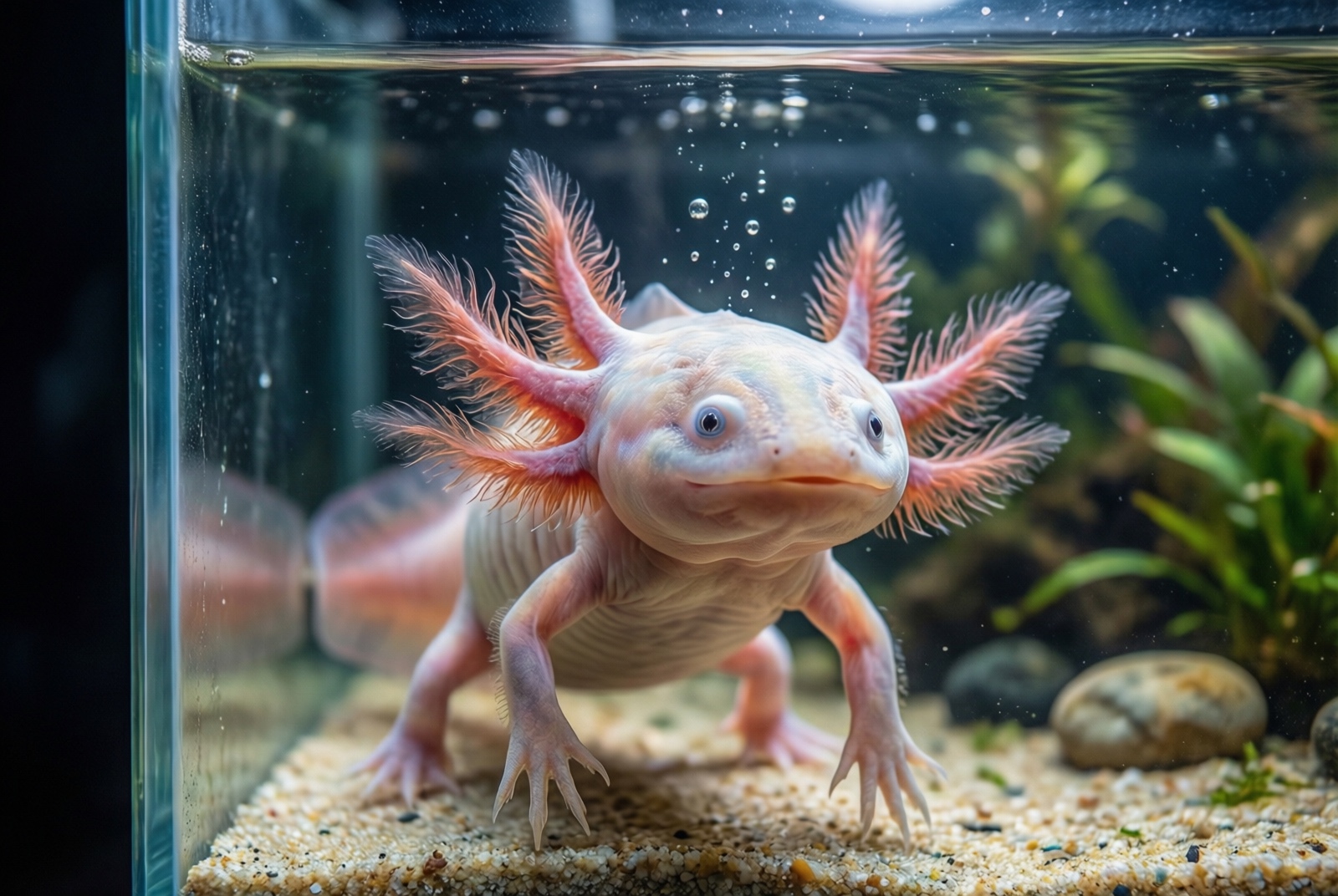
The axolotl (Ambystoma mexicanum) is a species of aquatic salamander native exclusively to Lake Xochimilco in Mexico City. Despite the common nickname “Mexican walking fish,” axolotls are amphibians, not fish. They belong to the same family as tiger salamanders, but with one critical difference: axolotls exhibit neoteny, meaning they retain their larval features — external gills, a fin-like tail, and a fully aquatic lifestyle — throughout their entire lives. Unlike other salamanders that metamorphose into land-dwelling adults, axolotls never leave the water.
In the wild, axolotls are critically endangered. Urban expansion, pollution, and introduced fish species have devastated their only natural habitat. The population in Lake Xochimilco is estimated at fewer than 100 individuals in recent surveys. Captive-bred axolotls, however, are widely available and completely legal to own in most US states, though a few states and cities have restrictions, so always check your local laws before purchasing.
What makes axolotls such compelling pets is their combination of unique appearance and relatively straightforward care requirements. They’re interactive — they learn to recognize their owners and will swim to the front of the tank at feeding time. They’re also famously long-lived, with an average lifespan of 10 to 15 years in captivity when properly cared for, and some individuals reaching 20 years. That’s a commitment on par with a dog or cat.
Good axolotl care extends beyond the tank — if you’re interested in other unique pets, our leopard gecko care guide and bearded dragon care articles cover two other popular reptile options that are quite different from axolotls in terms of habitat and handling needs.
Axolotl Care: Tank Setup & Size
Proper axolotl tank setup begins with choosing the right aquarium. Getting the tank right is the single most important part of axolotl care. A poor setup leads to stress, illness, and a shortened lifespan — the three consequences of skipping proper axolotl care fundamentals. Here’s what you need to know.
Tank size matters more than most new owners realize. The axolotl tank size you choose directly impacts your pet’s health. The absolute minimum for one adult axolotl is a 20-gallon long tank (30” × 12” × 12”). I’d strongly recommend going larger — a 29 to 40-gallon tank gives your axolotl more room to move and makes water parameters easier to maintain. The key is surface area, not height. Axolotls are bottom-dwellers that spend most of their time walking along the tank floor, so a long, wide tank is far better than a tall, narrow one.
Water depth should be 10 to 12 inches. Deep enough for the axolotl to swim freely, but shallow enough that they can easily reach the surface to gulp air. Axolotls have rudimentary lungs in addition to their gills, and they need to surface periodically. In water deeper than 14 to 16 inches, some axolotls struggle to reach the top without exhausting themselves.
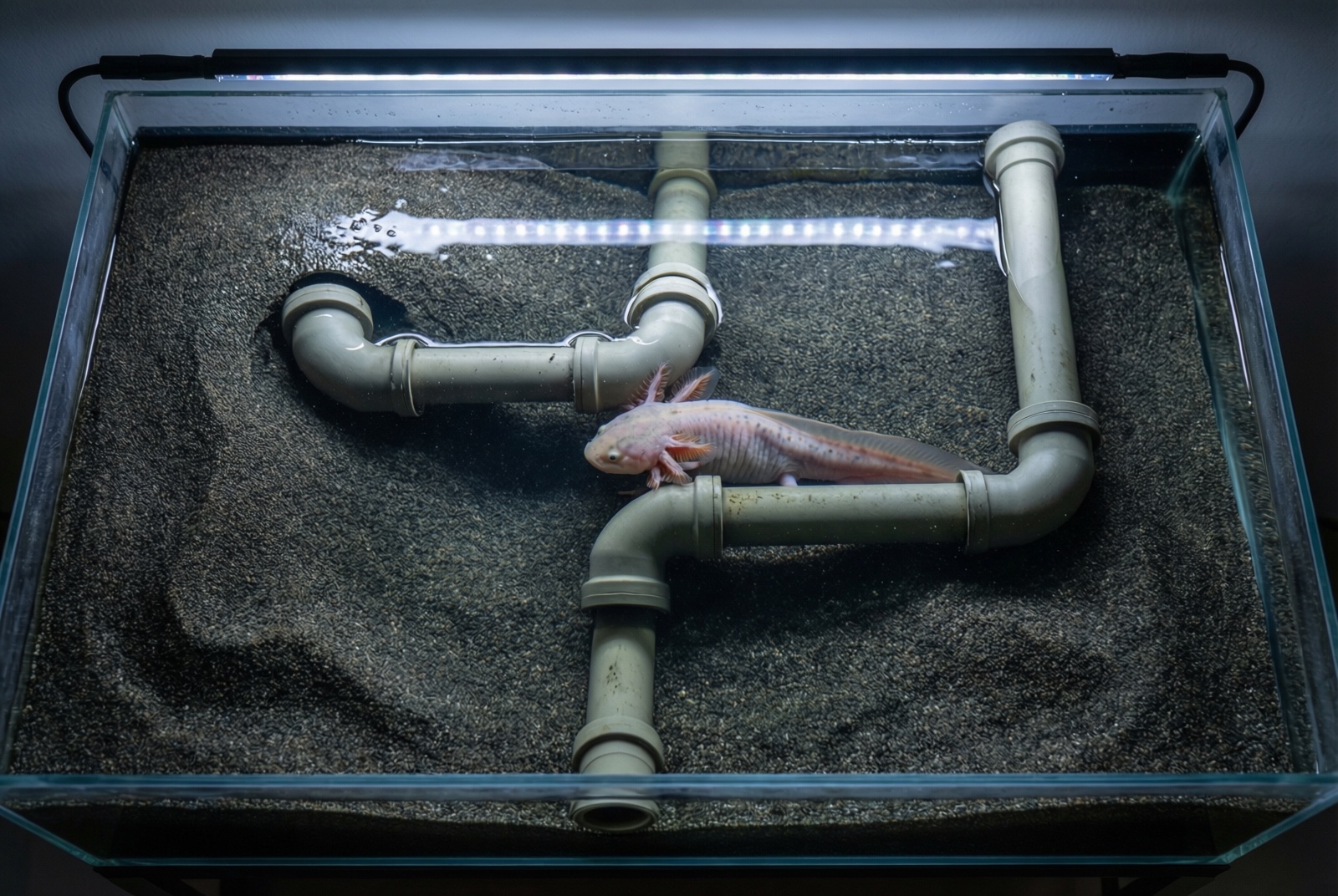
Hiding spots are essential. Axolotls are ambush predators that spend daylight hours hiding and waiting for prey. Without adequate cover, they become stressed. PVC pipes, terracotta pots (with smooth edges), and commercial caves all work well. Place at least two hides on opposite ends of the tank. Avoid anything with sharp edges or rough surfaces — axolotl skin and gills are easily damaged.
Lighting should be minimal. Axolotls have no eyelids and are sensitive to bright light. A low-intensity LED or ambient room lighting is sufficient. Direct sunlight causes algae blooms and temperature fluctuations, both of which are problematic.
A secure lid is non-negotiable. Axolotls can and do jump out of open tanks, especially at night. I’ve heard from multiple owners who found their axolotl on the floor after assuming the water was too low for jumping. A mesh or glass lid with ventilation prevents escapes.
Good axolotl care starts with understanding general principles of creating a healthy enclosure for exotic pets, our reptile habitat setup guide covers foundational concepts that apply broadly.
 —>
—>
Axolotl Water Temperature & Parameters
Water temperature is the number one killer of pet axolotls — and the most critical variable in axolotl care. These are cold-water animals from a high-altitude lake, and they cannot tolerate warm water. The ideal range is 60 to 68°F (16 to 20°C). That’s significantly cooler than most homes, which sit around 70 to 78°F.
When the water temperature rises above 74°F, axolotls enter a danger zone. Their metabolism accelerates, stress hormones spike, appetite disappears, and their immune system crashes. Bacterial and fungal infections that would be minor at cooler temperatures become lethal. Prolonged exposure to water above 76°F can be fatal within days. On the cold end, temperatures below 50°F slow their metabolism dramatically, making them lethargic and reducing their appetite, though this is far less dangerous than overheating.
Beyond temperature, you need to monitor several water parameters:
- Ammonia: 0 ppm — This is non-negotiable. Any detectable ammonia is toxic and burns their gills.
- Nitrite: 0 ppm — Also toxic. Your tank must be fully cycled before adding an axolotl.
- Nitrate: Below 20 ppm — Less immediately toxic but harmful at higher levels. Regular water changes keep this in check.
- pH: 6.5 to 8.0 — Axolotls tolerate a fairly wide pH range. Neutral (7.0) is ideal.
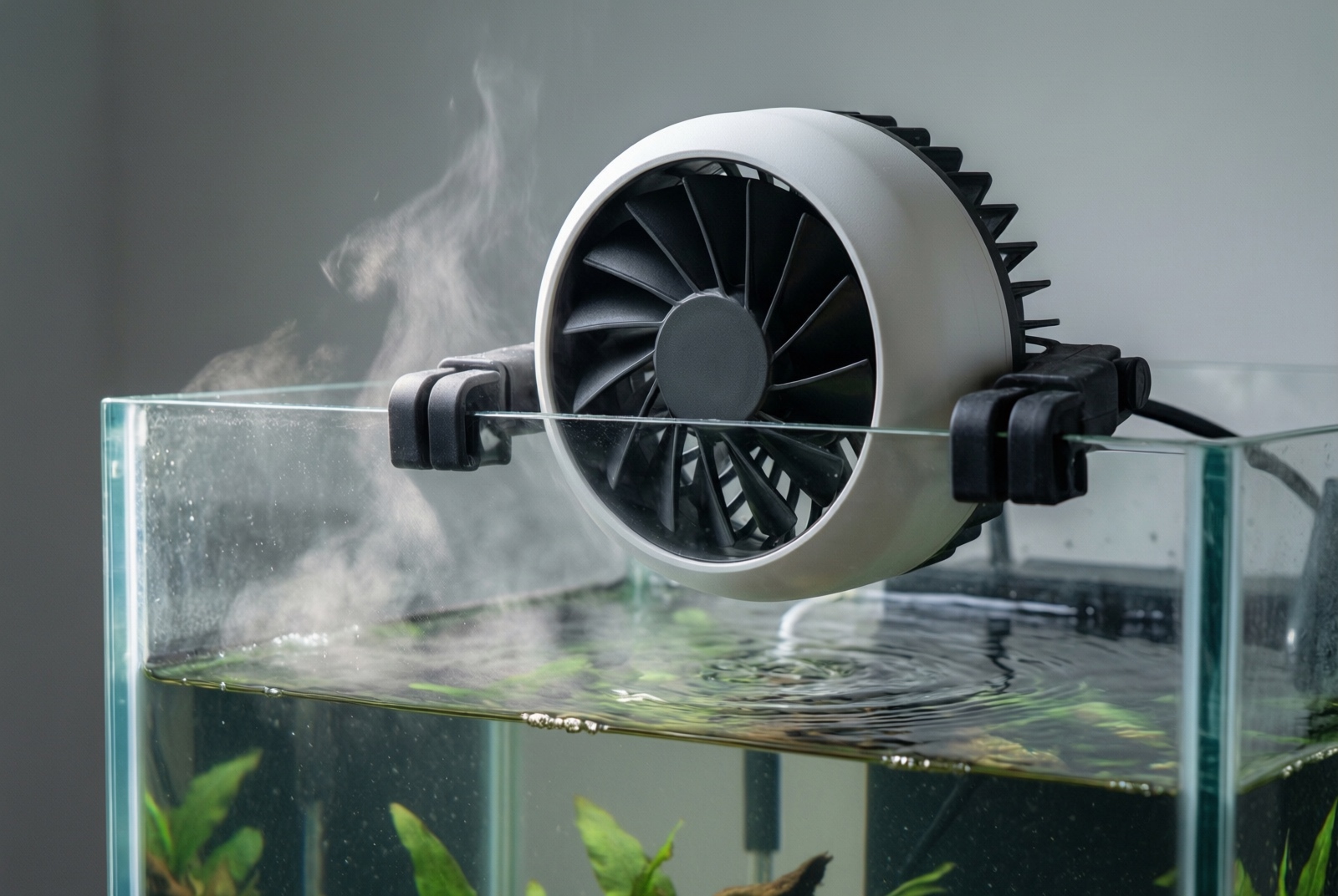
The most practical cooling solution for most owners is a chiller fan — a small clip-on fan that blows across the water surface, accelerating evaporative cooling. These typically drop the temperature by 4 to 8°F depending on room temperature and tank size, which is enough to bring most setups into the safe range.
The PAIZOO Aquarium Chiller Fan is a budget-friendly option at around $25. It offers three speed settings, operates quietly, and clips directly to the tank rim. Based on owner reviews, it can cool a 20-gallon tank from the upper 70s down to the mid-60s, which covers most situations. The main complaint is occasional power cord connection issues.
If you want something with built-in temperature control, the Aquarium Chiller Fan with Temperature Control runs about $39 and includes a temperature probe with auto mode. It can maintain water as low as 59°F and works for tanks up to 75 gallons. Several axolotl owners report that this single fan handles their 75-gallon setups without issue — a remarkable result for something that costs a fraction of a compressor-based chiller.
For comparison on managing environmental conditions in exotic pet habitats, our crested gecko care guide discusses temperature and humidity control from a different angle.
 —>
—>
What Do Axolotls Eat?
In the wild, axolotls are carnivorous ambush predators. They sit still on the bottom, wait for prey to wander within range, and then vacuum it up with a sudden gulp. Their natural diet consists of worms, small crustaceans, insect larvae, and occasionally tiny fish. In captivity, replicating this diet is straightforward once you know what works.
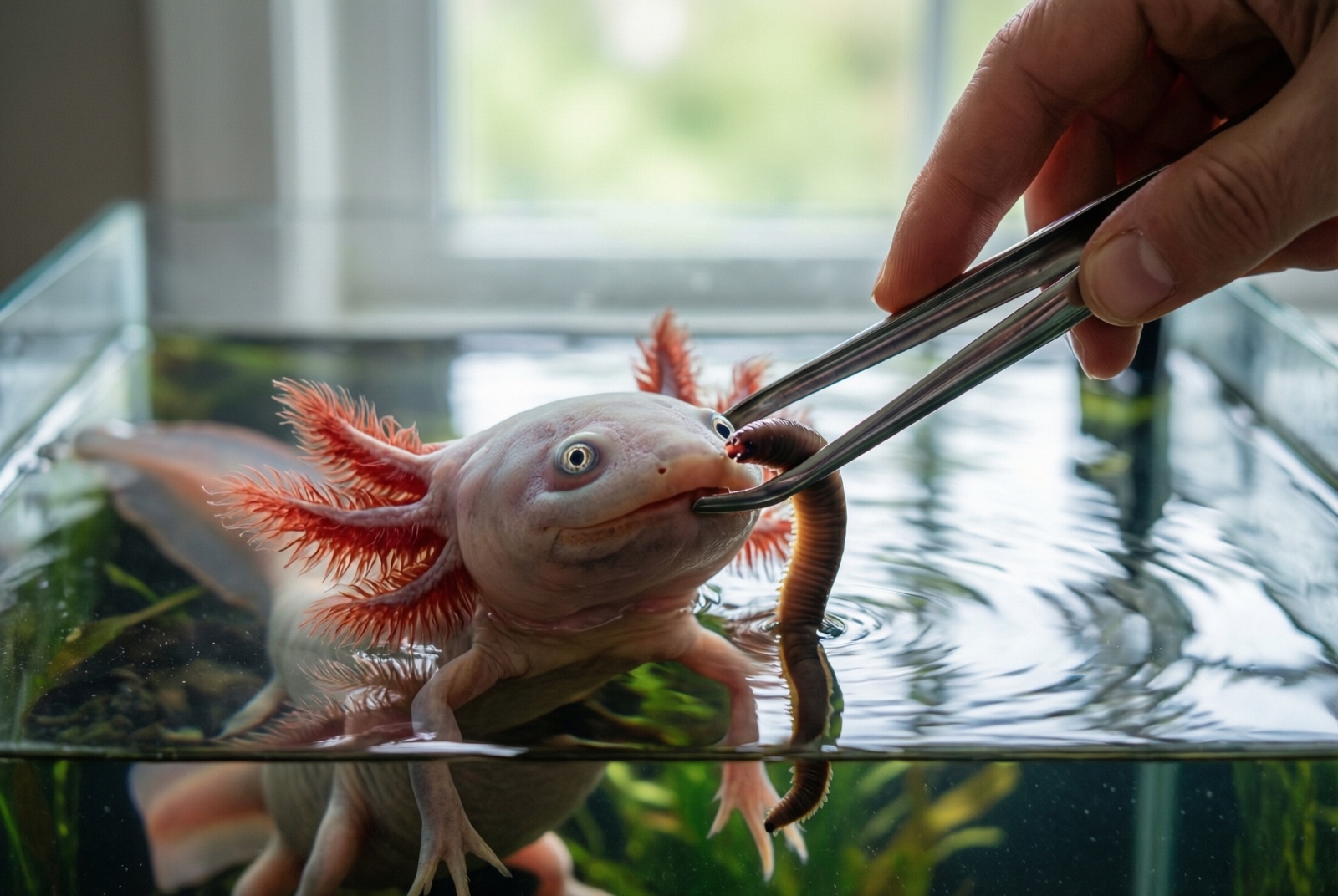
Earthworms (nightcrawlers) are the gold standard staple food. They’re nutritionally complete, appropriately sized, and readily accepted by virtually all axolotls. Canadian nightcrawlers from bait shops or online suppliers work well — just avoid worms collected from areas treated with pesticides or fertilizers. I’d recommend earthworms as the primary food for every feeding.
Bloodworms are an excellent supplemental food and a great treat. They’re high in protein and axolotls go absolutely nuts for them. Freeze-dried bloodworms are convenient because they don’t require refrigeration and have a long shelf life. The Tetra Freeze-Dried BloodWorms are widely trusted by freshwater keepers with over 15,000 reviews. They come in a convenient 2-pack and work well as a treat 2 to 3 times per week alongside earthworms. The main drawback is that freeze-dried bloodworms float initially — give them a minute to absorb water before feeding, or pre-soak them.
Sinking pellets are the most convenient staple food option for owners who prefer not to handle live or freeze-dried worms. Axolotls feed from the bottom, so sinking pellets are essential — floating pellets will go uneaten and pollute the water. The API Bottom Feeder Pellets are formulated with shrimp, which makes them appealing to axolotls, and they sink reliably to the bottom. With nearly 3,700 reviews and a 4.7-star rating, they’re the most popular sinking pellet option available. A mixed diet of earthworms as the staple, pellets as a convenient backup, and bloodworms as a treat covers all the nutritional bases.
The feeding schedule depends on age:
- Juveniles (under 6 inches): Feed once daily. Growing axolotls need more frequent meals.
- Adults (6 inches and up): Feed every 2 to 3 days. Overfeeding adults leads to obesity and fouled water.
- Timing: Feed in the evening. Axolotls are nocturnal and more likely to eat actively after lights out.
Use feeding tongs to offer food directly in front of the axolotl’s face. Remove any uneaten food after 15 minutes — leftover food breaks down quickly and spikes ammonia levels.
Foods to avoid entirely: mealworms (their hard exoskeletons cause impaction), live feeder fish (they carry parasites and diseases), waxworms (too fatty for regular feeding), and any mammal meat (chicken, beef, pork — axolotls cannot process it).
 —>
—>
Axolotl Care: Substrate Options
The right axolotl substrate prevents a deadly condition called impaction. Choosing the right substrate is one of the more consequential decisions in axolotl care. Axolotls feed by creating a suction — they open their mouths rapidly and vacuum in anything nearby, including mouthfuls of whatever is on the tank floor. If that substrate is gravel or small stones, they can swallow pieces that become lodged in their digestive tract, causing impaction. Impaction is painful, difficult to treat, and frequently fatal.
Fine sand is the best substrate option for axolotl tanks. The grains need to be smooth, rounded, and smaller than 0.5mm — small enough that if ingested, they pass through the digestive system without issue. A sand depth of 1 to 2 inches is sufficient.
The Aqua Natural Galaxy Sand is a solid choice — it comes in a 20-pound bag for about $25, has no sharp edges, and its deep black color makes axolotls and tank decorations really stand out. With 758 reviews and a 4.6-star rating, it’s well-established in the aquarium community. The main thing to know is that it requires thorough rinsing before adding to the tank to remove dust.
For a more natural look, the Exo Terra Riverbed Sand is natural riverbed sand with no added dyes or chemicals. It comes in a 10-pound bag for around $15, and the fine grain is ideal for axolotls. With over 1,100 reviews, it’s a trusted option from a brand well-known in the reptile and amphibian space. Like the Galaxy Sand, it needs thorough rinsing to avoid cloudy water.
Bare bottom tanks are the safest option and the easiest to clean, but they look stark and unnatural. If you’re a first-time owner, there’s nothing wrong with starting bare-bottom while you get the hang of water parameter management, then adding sand later.
Never use: gravel, pebbles, decorative stones small enough to swallow, colored glass gems, or marbles. These are the most common cause of fatal impaction in pet axolotls — and the most preventable mistake in axolotl care. Large, smooth river stones (too big to fit in an axolotl’s mouth) are the only stone-based substrate that’s safe, and even then, waste accumulates between them and makes cleaning difficult.
Do Axolotls Need a Filter?
In axolotl care, the short answer is: you should absolutely run a filter. While axolotls can survive in unfiltered tanks with frequent water changes, maintaining water quality manually is labor-intensive and leaves very little room for error. A single missed water change can send ammonia to toxic levels.
The critical requirement is low water flow. Axolotls are adapted to still water, and strong currents stress them out. A stressed axolotl stops eating, becomes more susceptible to disease, and develops curled gill tips (a visible sign of chronic stress). The filter needs to move and biologically process the water without creating noticeable current in the tank.
Sponge filters are the best choice for axolotl tanks. They provide excellent biological filtration through their porous surface area, produce minimal flow, are inexpensive, and have no moving parts to fail. The hygger Double Sponge Filter is one of the best options available. With nearly 2,700 reviews and a 4.4-star rating, it features a double sponge design with four biochemical sponges for heavy-duty biological filtration. It’s rated for tanks up to 55 gallons, so a 20 to 40-gallon axolotl tank is well within its capacity. The only real complaint is that the suction cups can be finicky — a minor issue that’s easily solved with a replacement.
Canister filters work well for larger setups if you use a spray bar to diffuse the output, but they’re significantly more expensive. Hang-on-back (HOB) filters can function but tend to create more surface disturbance than ideal. Avoid powerheads and any filter with a strong directional outflow pointed at the axolotl’s resting area.
If you choose to go filterless, plan on 100% water changes two to three times per week, using dechlorinated water matched to the tank’s temperature. This is viable for small temporary setups but becomes exhausting as a long-term routine.
Most importantly, cycle the tank before adding your axolotl. Running the filter for 4 to 6 weeks with a small ammonia source (fish food or pure ammonia) allows beneficial bacteria to colonize the filter media. These bacteria convert toxic ammonia into nitrite and then into relatively harmless nitrate. Adding an axolotl to an uncycled tank is the most common beginner mistake in axolotl care and often results in ammonia poisoning within the first week.
Axolotl Lifespan & Regeneration
Axolotls are a long-term commitment. In captivity, they typically live 10 to 15 years, with well-cared-for individuals occasionally reaching 20 years. That lifespan puts them in the same range as many dog breeds — something worth considering before bringing one home.
Several factors influence how long your axolotl lives — each one a pillar of good axolotl care:
- Water quality is the biggest factor. Consistent temperature, zero ammonia and nitrite, and low nitrates create the conditions for a long, healthy life.
- Diet quality matters. A varied diet based on earthworms with appropriate supplementation supports long-term health better than a pellet-only diet.
- Temperature directly affects metabolic rate. Cooler water within the safe range (60 to 64°F) slows aging compared to the warmer end of their range.
- Stress reduction — minimal handling, appropriate tank mates (ideally none), and consistent conditions all contribute to longevity.
Signs of aging in axolotls include lighter gill coloration, reduced activity levels, slower feeding response, and a generally thinner body condition. These changes are gradual and typically become noticeable after 8 to 10 years.
The answer to can axolotls regenerate is yes — and remarkably so. The regeneration ability that made axolotls famous in the scientific world is real and genuinely remarkable. Axolotls can regenerate limbs, tail, spinal cord tissue, jaw segments, heart tissue, and portions of their brain — without scarring. The process works through dedifferentiation: cells at the injury site revert to a stem-cell-like state and rebuild the lost structure over weeks to months.
This ability has made axolotls one of the most studied model organisms in regenerative medicine. Researchers are investigating the molecular mechanisms behind axolotl regeneration for potential applications in human wound healing, spinal cord injury treatment, and organ repair.
A common misconception is that axolotls are biologically immortal. They’re not. Their regenerative ability is impressive but finite — repeated injuries to the same area produce progressively poorer results, and poor water quality impairs the regeneration process. They simply heal better than most vertebrates, not infinitely.
If lifespan and long-term care planning is something you research across different pets, our ball python care guide covers another exotic pet with a similar 15 to 30-year commitment.
Frequently Asked Questions
One of the most common questions in axolotl care is about temperature control.
Do axolotls need a water chiller?
In most homes, yes. Standard room temperature (70 to 78°F) exceeds the axolotl’s safe range of 60 to 68°F. A chiller fan in the $25 to $40 range provides enough cooling for most setups and is far more affordable than a compressor-based chiller ($800+). If your home stays below 68°F naturally — a basement, air-conditioned room, or cool climate — you may not need one, but a thermometer for daily monitoring is still essential.
Can axolotls go on land?
No. Unlike other salamander species that undergo metamorphosis and develop lungs for terrestrial life, axolotls are neotenic. They retain their gills and remain fully aquatic throughout their entire lives. An axolotl removed from water can only survive for a few minutes before its gills begin to dry out and collapse. They should never be taken out of the tank except during necessary tank maintenance, and even then, transfer should be done with a container of tank water.
What substrate is safe for axolotls?
Fine sand with smooth, rounded grains smaller than 0.5mm is the safest and most popular option. Axolotls can pass sand through their digestive system without issue. Bare bottom tanks are the safest option overall and easiest to clean. Never use gravel, pebbles, small stones, or any substrate pieces small enough to swallow — these cause impaction, which is one of the leading causes of death in pet axolotls.
How often should I feed my axolotl?
Juveniles under 6 inches should be fed once daily to support rapid growth. Adults 6 inches and larger should be fed every 2 to 3 days. Earthworms should be the staple food, supplemented with bloodworms or sinking pellets. Remove any uneaten food after 15 minutes to prevent water quality issues. Overfeeding is a common mistake — a slightly hungry axolotl is healthier than an overfed one.
How big of a tank does an axolotl need?
The minimum is a 20-gallon long tank (30” × 12” × 12”) for a single adult. A 29 to 40-gallon tank is preferable. The tank should prioritize length and width over height, since axolotls are bottom-dwellers. Water depth of 10 to 12 inches allows easy access to the surface. For each additional axolotl, add at least 10 gallons of tank capacity.
What temperature do axolotls need?
60 to 68°F (16 to 20°C). Above 74°F, axolotls experience stress, appetite loss, immune suppression, and eventually death. Below 50°F, their metabolism slows significantly but this is far less dangerous. A chiller fan and daily thermometer checks are the most practical way to maintain safe temperatures year-round.
Can axolotls live with fish?
Generally, no. Most aquarium fish will nip at axolotl gills, causing stress and injury. Axolotls will also eat any fish small enough to fit in their mouths. The very few compatible tankmates — white cloud minnows, nerite snails — are exceptions that require specific conditions. For the vast majority of setups, keeping axolotls alone is the safest and simplest approach.
Can I hold my axolotl?
Minimally, and only when absolutely necessary. Axolotls have a delicate slime coat that protects their skin from infection. Handling with bare hands damages this coating and transfers oils, salts, and bacteria from your skin. If you need to move your axolotl — for tank maintenance or a health check — use a soft mesh net or a container filled with tank water. Brief, infrequent handling for health checks is acceptable, but regular handling for entertainment is stressful and harmful.