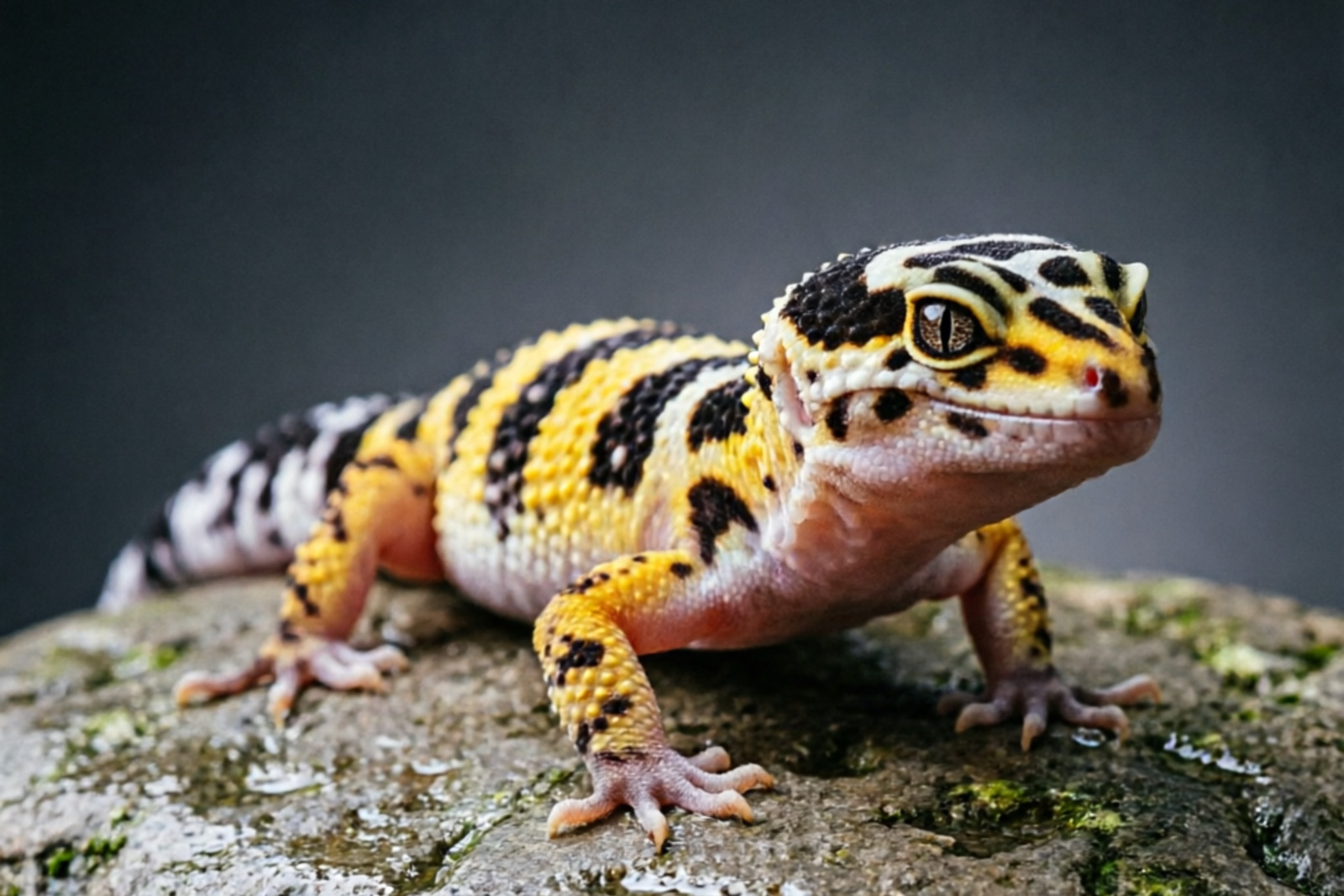
The Mack Snow leopard gecko is one of the most recognizable and widely kept morphs in the reptile hobby. First developed by John and Amy Mack of Reptiles by Mack in the early 2000s, this morph is defined by its striking reduction in yellow pigment, producing high-contrast black and white banding in hatchlings and a clean, pale pastel appearance in adults. Because the Mack Snow gene is incomplete dominant, it can be combined with virtually every other leopard gecko trait, making it a foundational building block for some of the most impressive multi-gene morphs available today.
If you are new to leopard geckos, the Mack Snow is an excellent entry point into the world of morphs. It is affordable, visually striking, and shares identical care requirements with normal leopard geckos — the gene affects only coloration, not health or behavior. This guide covers the history, genetics, appearance, care, and pricing of the Mack Snow leopard gecko morph.
Quick Facts
| Attribute | Details |
|---|---|
| Species | Eublepharis macularius |
| Morph Name | Mack Snow |
| Gene Type | Incomplete dominant |
| Origin | John and Amy Mack, Reptiles by Mack (early 2000s) |
| Adult Size | 8-11 inches (20-28 cm) |
| Weight | 45-80 grams |
| Lifespan | 15-20 years |
| Temperament | Docile, curious, easy to handle |
| Difficulty | Beginner-friendly |
| Availability | Common — one of the most widely available morphs |
History of the Mack Snow Morph
The Mack Snow morph originated from the breeding program of John and Amy Mack, who operate under the name Reptiles by Mack. According to MorphMarket’s Morphpedia, the Macks discovered hatchlings in their collection that looked like “Snow” hatchlings rather than normal yellow-banded babies. These unusual hatchlings displayed white bands in place of the typical yellow banding seen in normal leopard geckos.
The following breeding season, John and Amy bred those unusual hatchlings back to each other. In that pairing, they produced three distinct outcomes: Super Snows (the homozygous form), Mack Snows (the heterozygous form), and normal (non-Mack Snow) offspring. This result confirmed that the trait was incomplete dominant — a single copy of the gene produced the Mack Snow appearance, while two copies produced the dramatically different Super Snow.
Since its introduction to the market in the early 2000s, the Mack Snow has become one of the most popular and foundational morphs in leopard gecko breeding. Its ability to stack with other genes (albino strains, pattern traits, and color enhancers) has made it essential in virtually every serious breeder’s collection. The morph is categorized as “Common” in availability on MorphMarket, with over 320 listings at any given time.
Appearance
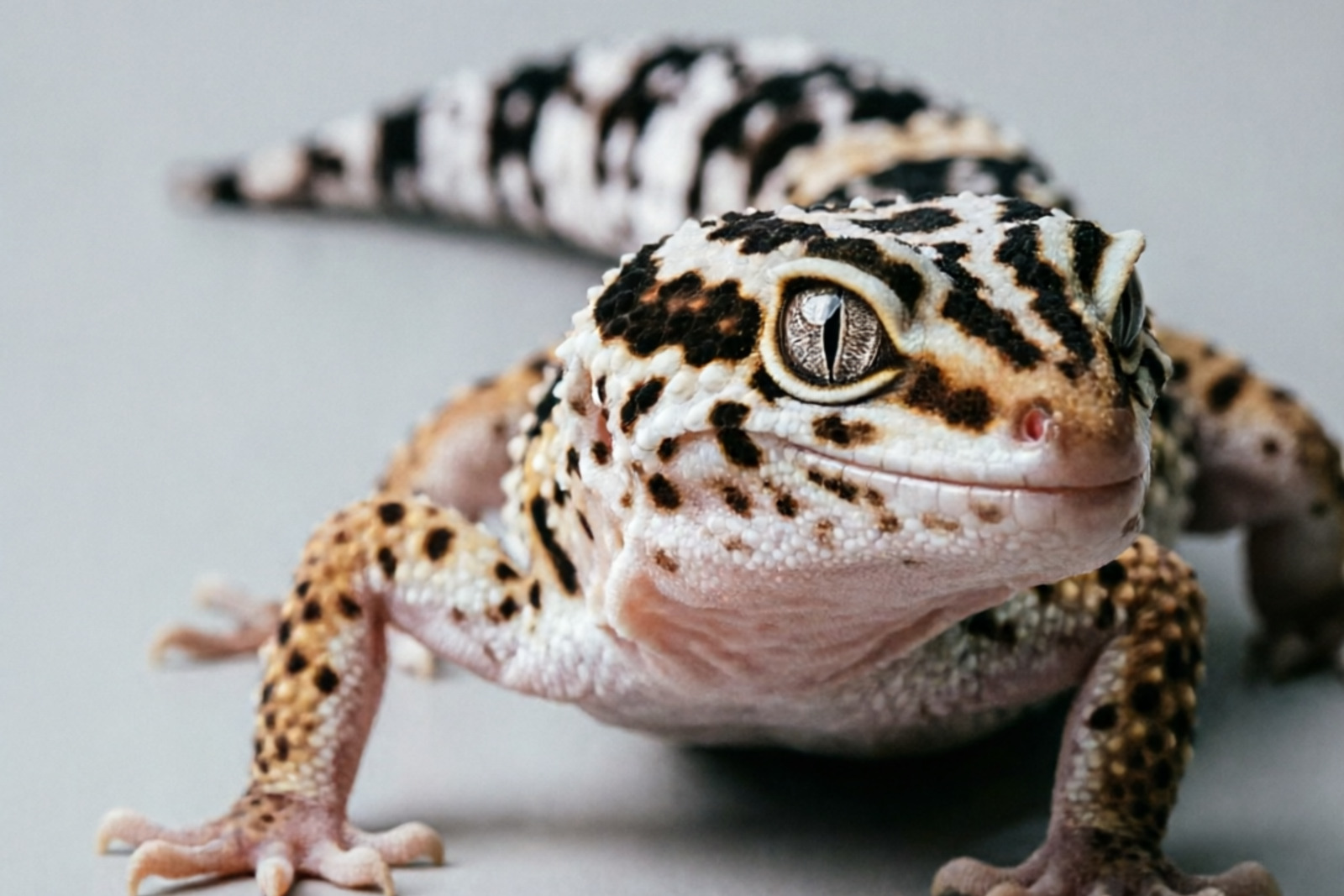
The Mack Snow morph is primarily a color mutation that reduces or eliminates the yellow pigment in a leopard gecko’s pattern. The visual impact is most dramatic in hatchlings and gradually softens as the gecko matures.
Hatchling Appearance
Mack Snow hatchlings are immediately identifiable. When they emerge from the egg, they display high-contrast black and white banding — the white bands replace the typical yellow bands seen in normal leopard geckos. The overall impression is a crisp, clean, black-and-white animal that looks noticeably different from a normal hatchling from day one.
Adult Appearance
As Mack Snows mature, some yellow pigment gradually develops, but significantly less than in normal leopard geckos. The adult background coloration is best described as a pale pastel yellow or cream, rather than the rich yellow of a normal gecko. The degree of color change varies between individuals:
- Lighter Mack Snows: Retain a predominantly white and gray appearance into adulthood with minimal yellow
- Warmer Mack Snows: Develop more noticeable pale yellow tones as they age
- Dark banded Mack Snows: Maintain visible dark bands against the lighter background
This natural variation means no two Mack Snows look exactly alike, which adds to the appeal of the morph.
Super Snow (Homozygous Form)
When a leopard gecko carries two copies of the Mack Snow gene, it is called a Super Snow. The visual difference between a Mack Snow and a Super Snow is dramatic:
| Feature | Mack Snow (1 gene) | Super Snow (2 genes) |
|---|---|---|
| Background color | Pale pastel yellow/cream | Near-solid white |
| Pattern | Reduced yellow, visible banding | Bold black and white, high contrast |
| Eyes | Normal (with visible pupil) | Solid black (no visible pupil) |
| Body pattern | Banded or spotted | Bold black bands or mottling on white |
Super Snows are one of the most visually striking leopard gecko morphs. Their solid black eyes and high-contrast black-and-white pattern make them instantly recognizable. As hatchlings, Super Snows display an almost entirely black body with white bands, and this dramatic appearance persists into adulthood.
Common Mack Snow Combinations
The Mack Snow gene is frequently combined with other traits to create named combination morphs. Some of the most popular include:
- Snow Glow: Mack Snow + Tremper Albino + Super Hypo + Tangerine + Carrot Tail — a bright white and orange combination
- Dreamsickle: Mack Snow + Tremper Albino + Enigma + Eclipse — white with orange tones and solid eyes
- Galaxy: Super Snow + Eclipse — solid black eyes with bold black-and-white pattern
- Creamsicle: Mack Snow + Super Hypo + Tangerine + Carrot Tail — pale with orange tail coloration
- Black Night Mack Snow: Mack Snow + Black Night — darker, more dramatic pattern
These multi-gene combinations are where the Mack Snow gene truly shines, as it provides a clean, light background that allows other color traits to stand out.
Genetics
Understanding the genetics behind the Mack Snow is essential for anyone interested in breeding leopard geckos. The Mack Snow is an incomplete dominant (also called co-dominant) trait. This means the gene has two visual forms depending on how many copies the gecko carries.
How Incomplete Dominance Works
| Parent 1 | Parent 2 | Offspring |
|---|---|---|
| Normal | Normal | 100% Normal |
| Mack Snow | Normal | 50% Mack Snow, 50% Normal |
| Mack Snow | Mack Snow | 25% Super Snow, 50% Mack Snow, 25% Normal |
| Super Snow | Normal | 100% Mack Snow |
| Super Snow | Mack Snow | 50% Super Snow, 50% Mack Snow |
| Super Snow | Super Snow | 100% Super Snow |
Key Genetic Notes
Visual identification: A Mack Snow (heterozygous) can be visually identified by its reduced yellow pigment, but the expression varies. Some Mack Snows look very similar to normals, especially as adults. A Super Snow (homozygous) is always visually obvious due to its solid black eyes and extreme black-and-white contrast.
No hidden carriers: Because the Mack Snow gene is dominant, there are no “hidden” carriers. A gecko either visually expresses the gene or it does not carry it at all.
Temperature sexing issue: Unlike other leopard gecko morphs, Mack Snows have not been consistently proven to follow standard temperature sex determination. Normally, leopard gecko eggs incubated at 80-83°F produce mostly females, 84-86°F produce a mix, and 87-89°F produce mostly males. With Mack Snows, these temperature ranges do not reliably predict sex ratios. This is documented as a known “issue” with the morph on MorphMarket’s Morphpedia.
Compatibility with TUG Snow: The TUG Snow is a separate, unrelated snow mutation. However, breeders have successfully produced Super Snows by crossing a TUG Snow with a Mack Snow, suggesting the two genes may be allelic (located at the same genetic locus).
Care Requirements
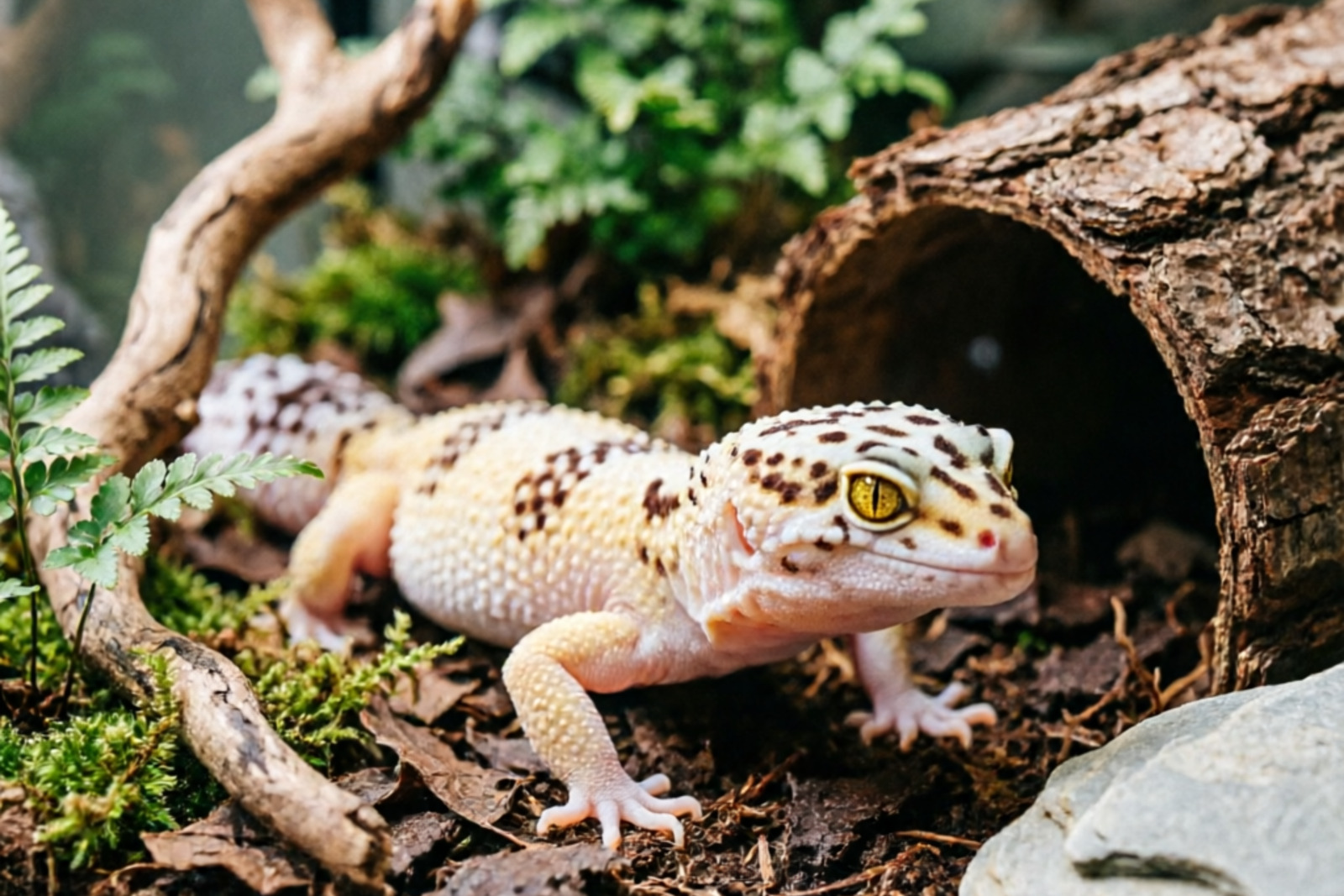
The Mack Snow gene is purely a color mutation. It does not affect the health, size, lifespan, or care requirements of the leopard gecko in any way. A Mack Snow has the exact same needs as a normal leopard gecko. For a complete care guide, see our leopard gecko care page.
Housing
| Requirement | Details |
|---|---|
| Minimum tank size | 20 gallons for adults (30” x 12” footprint) |
| Hot side temperature | 90-95°F (32-35°C) — under-tank heater with thermostat |
| Cool side temperature | 75-80°F (24-27°C) |
| Night temperature | 70-75°F (21-24°C) |
| Humidity | 30-40% ambient; 70-80% in humid hide |
| Substrate | Tile, reptile carpet, paper towels, or shelf liner |
A proper temperature gradient is essential for digestion and thermoregulation. The best leopard gecko terrarium setups use a front-opening glass tank with an under-tank heating pad controlled by a reliable reptile thermostat.
Diet
Mack Snow leopard geckos are strict insectivores, identical to normal leopard geckos in their dietary needs. They cannot eat fruits or vegetables — their digestive system handles only animal protein.
| Age | Feeding Frequency | Amount |
|---|---|---|
| Hatchling (0-3 months) | Daily | 5-7 small crickets or dubia roaches |
| Juvenile (3-6 months) | Daily | 7-10 small-medium insects |
| Subadult (6-12 months) | Every other day | 8-12 medium insects |
| Adult (12+ months) | Every 2-3 days | 10-15 medium-large insects |
Staple feeder insects include crickets, dubia roaches, mealworms, and black soldier fly larvae. All prey should be gut-loaded 24-48 hours before feeding and dusted with calcium (with and without D3) and a multivitamin supplement.
Humid Hide
A humid hide is essential for proper shedding. Mack Snow leopard geckos shed every 4-6 weeks as adults, and stuck shed can cause lost toes, eye damage, and infections. Fill a hide on the warm side with moist sphagnum moss to create a microclimate of 70-80% humidity.
Handling
Mack Snows have the same docile temperament as normal leopard geckos. They tolerate handling well and many become comfortable being held with regular, gentle interaction. Handle during evening hours when geckos are naturally active, support the entire body including the tail, and keep sessions to 10-15 minutes for adults.
Temperament & Behavior
The Mack Snow gene has no effect on temperament or behavior. These geckos share the same personality traits that make leopard geckos one of the best pet reptiles:
- Docile and calm: Most Mack Snows tolerate handling well after a brief taming period
- Curious: They explore their environment actively during evening hours
- Nocturnal: Most active after dark, sleeping during the day
- Solitary: Must be housed individually — like all leopard geckos, they are territorial
- Communicative: They vocalize with small chirps and squeaks, and wave their tails slowly when hunting or excited
Mack Snows are equally suitable for handling as normal leopard geckos. The morph does not introduce any behavioral quirks or temperament issues.
Health
Mack Snow leopard geckos are not more or less prone to health issues than any other leopard gecko morph. The gene affects only pigmentation, not physical health. The common health concerns are the same as for all leopard geckos:
- Metabolic Bone Disease (MBD): Caused by calcium and vitamin D3 deficiency. Prevented through proper supplementation and, optionally, low-level UVB lighting.
- Impaction: Caused by ingesting loose substrate. Prevented by using solid substrates (tile, carpet, paper towels).
- Stuck shed: Caused by insufficient humidity. Prevented by maintaining a proper humid hide.
- Respiratory infections: Caused by temperatures too low or humidity too high. Prevented by proper temperature gradient.
- Cryptosporidiosis: A parasitic infection that causes regurgitation and weight loss. There is no cure, so quarantine new geckos for 30-60 days.
A healthy Mack Snow should have bright, clear eyes (or solid black eyes in the case of Super Snows), a plump tail, clean vent, and an alert demeanor. If you notice lethargy, loss of appetite, weight loss, or abnormal stool, consult a reptile veterinarian.
Price Guide
Mack Snow leopard geckos are among the most affordable morphs, which is one reason they are so popular with beginners and breeders alike.
Current Market Prices (2026)
| Morph | Price Range | Source |
|---|---|---|
| Mack Snow (standard) | $75-$150 | Breeders, MorphMarket |
| Super Snow | $100-$175 | Breeders, MorphMarket |
| Mack Snow Albino (Tremper/Rainwater/Bell) | $150-$300 | Breeders |
| Mack Snow Eclipse | $150-$350 | Breeders |
| Super Snow Eclipse (“Galaxy”) | $120-$200 | MorphMarket |
| Snow Glow (multi-gene) | $200-$400 | Breeders |
| Dreamsickle (multi-gene) | $250-$500 | Breeders |
| Black Night Mack Snow | $150-$350 | Breeders, MorphMarket |
Based on MorphMarket listings from April 2026, basic Mack Snows start at approximately $55 for juvenile animals from hobbyist breeders, with show-quality or multi-gene adults reaching $500+. Shipping typically adds $25-$65 within the continental United States.
Where to Buy
- Reptile breeders (recommended): Offer health guarantees, genetic history, and care advice. Find breeders on MorphMarket, at reptile expos, or through local reptile clubs.
- Reptile expos: Allow you to see animals in person and talk directly with breeders. Prices are often competitive.
- Pet stores: Convenient but typically more expensive ($50-$100 markup) with less genetic information available.
Total Setup Cost
The Mack Snow morph does not change setup requirements. Expect to spend $130-$630 total for the initial setup:
| Item | Budget | Premium |
|---|---|---|
| Mack Snow gecko | $75-$150 | $200-$400 |
| Tank (20 gallon) | $60-$80 | $150-$170 |
| Heating pad + thermostat | $15-$50 | $40-$60 |
| Substrate | $7-$20 | $15-$30 |
| Hides and decor | $20-$30 | $50-$100 |
| Thermometer/hygrometer | $10-$15 | $15-$25 |
| Total | $190-$345 | $470-$785 |
Mack Snow vs Normal Leopard Gecko
| Feature | Normal (Wild Type) | Mack Snow | Super Snow |
|---|---|---|---|
| Hatchling bands | Yellow and black | White and black | White and black (bold) |
| Adult background | Yellow | Pale pastel yellow/cream | White |
| Yellow pigment | Full | Reduced | Absent |
| Eye color | Normal with pupil | Normal with pupil | Solid black |
| Gene type | N/A | Incomplete dominant (1 copy) | Homozygous (2 copies) |
| Price | $30-$50 | $75-$150 | $100-$175 |
| Care difficulty | Beginner | Beginner | Beginner |
| Temperature sexing | Predictable | Unpredictable | Unpredictable |
The primary difference is visual. A Mack Snow is a normal leopard gecko with reduced yellow pigment — same size, same temperament, same care, same lifespan.
Frequently Asked Questions
What is a Mack Snow leopard gecko?
A Mack Snow is a leopard gecko morph with reduced yellow pigment and high-contrast black and white banding. Discovered by John and Amy Mack of Reptiles by Mack in the early 2000s, it is caused by an incomplete dominant gene. Hatchlings emerge with striking white bands instead of the typical yellow, and adults display a pale pastel background color. The morph is one of the most popular and widely available leopard gecko morphs on the market.
How much does a Mack Snow leopard gecko cost?
A standard Mack Snow leopard gecko costs $75 to $150 from a breeder, while Super Snows (the homozygous form) range from $100 to $175. Multi-gene combinations like Mack Snow Eclipse, Mack Snow Albino, or Black Night Mack Snow sell for $150 to $500+. Prices on MorphMarket in 2026 range from $55 for basic Mack Snows up to $500 for premium multi-gene animals. Pet store prices are typically $50 to $100 higher than breeder prices.
What is the difference between Mack Snow and Super Snow?
The difference comes down to genetics. A Mack Snow has one copy of the Mack Snow gene (heterozygous) and shows reduced yellow pigment with black and white banding. A Super Snow has two copies (homozygous) and displays a dramatically different appearance — near-solid black and white with no yellow pigment at all. Super Snows also have completely solid black eyes. When you breed two Mack Snows together, you get approximately 25% Super Snows, 50% Mack Snows, and 25% normal offspring.
Are Mack Snow leopard geckos good for beginners?
Yes. Mack Snow leopard geckos have identical care requirements to normal leopard geckos, which are widely considered one of the best beginner reptiles. They need a 20-gallon tank, a temperature gradient of 90-95°F on the hot side and 75-80°F on the cool side, an insect-based diet, and a humid hide for shedding. The Mack Snow gene affects only coloration — it does not change temperament, health, or care needs in any way. For complete care instructions, see our leopard gecko care guide.
Can Mack Snow leopard geckos be temperature-sexed?
Mack Snow leopard geckos have not been consistently proven to follow the standard temperature sex determination rules that apply to other leopard gecko morphs. Normally, incubating eggs at 80-83°F produces mostly females, 84-86°F produces a mix, and 87-89°F produces mostly males. With Mack Snows, the results are less predictable. Breeders should be aware of this if sex ratio matters for their projects. This trait is noted on MorphMarket’s Morphpedia as an “issue” with the Mack Snow gene.
The Mack Snow is one of the most versatile and visually appealing leopard gecko morphs available. Whether you are a first-time keeper looking for a striking pet or a breeder building a multi-gene project, the Mack Snow delivers. Its combination of dramatic appearance, affordable pricing, straightforward care, and genetic compatibility with virtually every other trait makes it a cornerstone of the leopard gecko hobby.
For more information on general leopard gecko care, housing, and diet, visit our complete leopard gecko guide. If you are setting up a new enclosure, our best leopard gecko terrarium and reptile thermostat guides will help you get started.