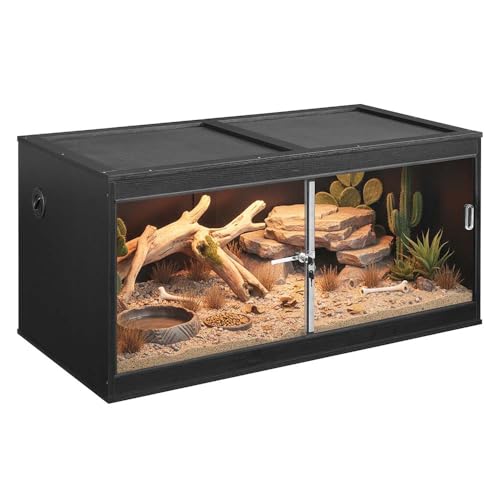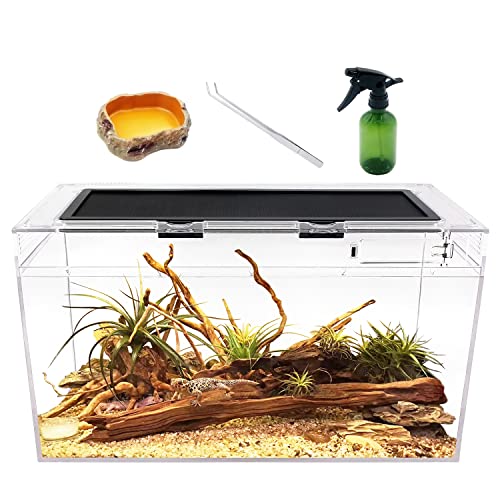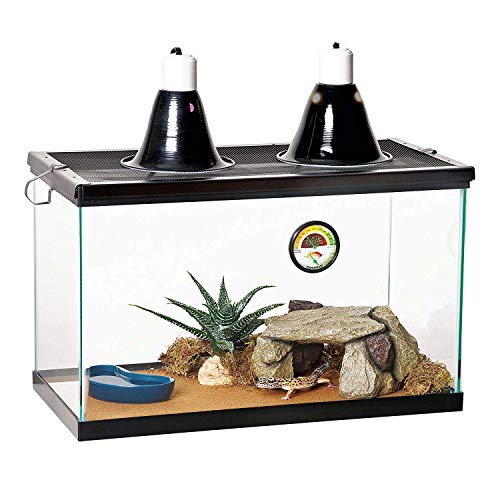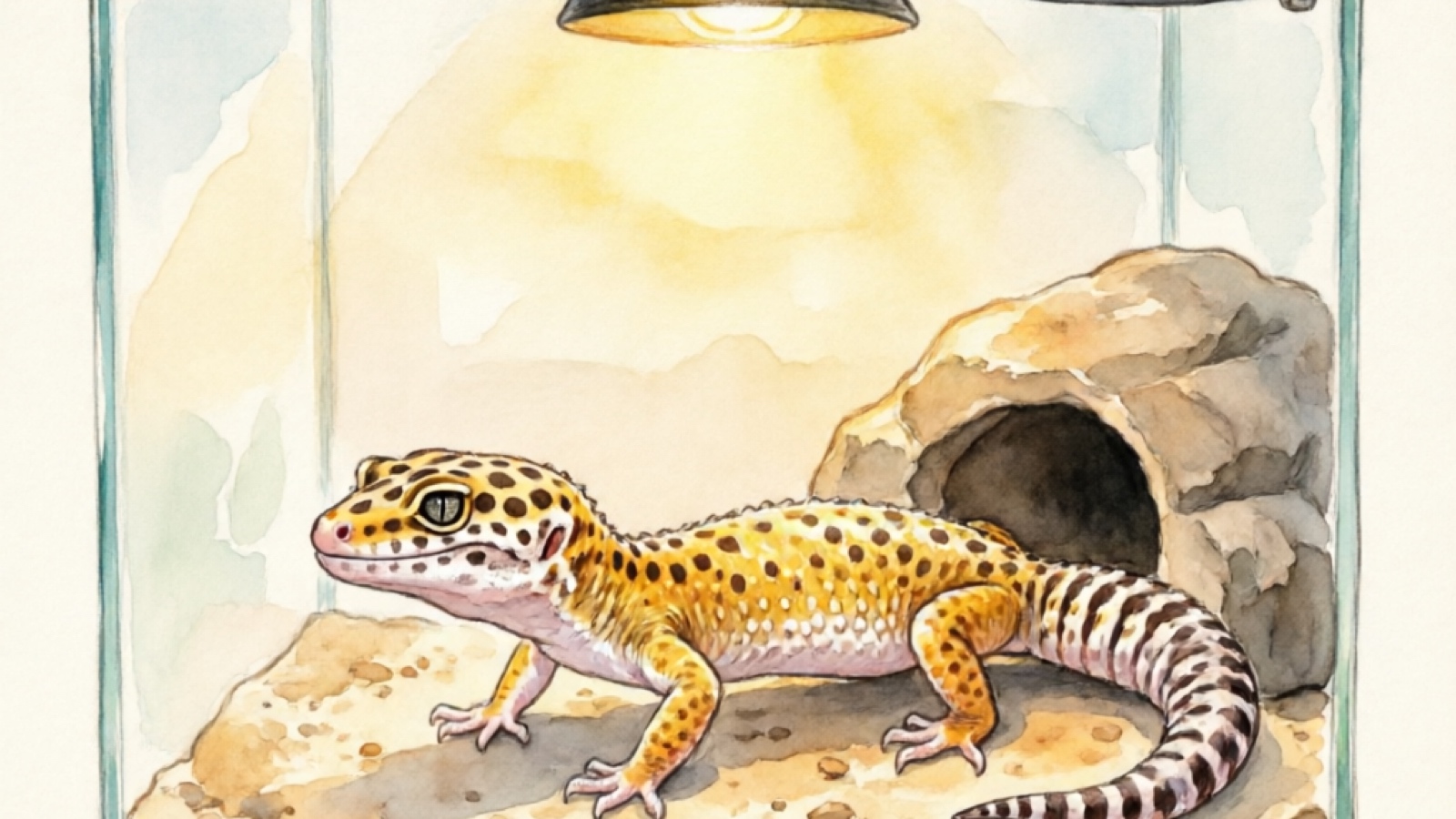
Choosing the best leopard gecko terrarium is the foundation of your gecko’s health. Too small, and your gecko can’t thermoregulate — shuttling between the warm hide and cool zone is how they digest food, shed properly, and maintain immune function. Wrong substrate, and you’re looking at impaction, a blockage in the digestive tract that can require surgery. Wrong heating, and metabolic bone disease develops within months.
I’ve kept leopard geckos across glass tanks, PVC enclosures, and even custom setups over the years. The enclosures on this list are the best leopard gecko terrarium options available on Amazon right now, filtered through real owner reviews and tested against the specific needs of leopard geckos: horizontal floor space, belly heat compatibility, secure latches, and escape-proof construction.
For species background, see our leopard gecko breed overview. For detailed care, see our leopard gecko care guide.
What Size Terrarium Does a Leopard Gecko Need?
Size is the most critical factor when selecting the best leopard gecko terrarium. Leopard geckos are ground-dwelling reptiles from arid rocky environments in Afghanistan, Pakistan, and India. They don’t climb — they walk, hunt, and thermoregulate horizontally. This means floor space matters far more than height.
Size Quick Reference
| Age | Length | Minimum Size | Recommended | Floor Footprint |
|---|---|---|---|---|
| Hatchling (0-6 months) | 3-4 inches | 10 gallon | 10-20 gallon | 20 × 10 inches |
| Juvenile (6-12 months) | 4-7 inches | 20 gallon | 20-30 gallon | 30 × 12 inches |
| Adult (12+ months) | 7-10 inches | 20 gallon | 30+ gallon | 36 × 12+ inches |
A 10-gallon tank is the most common mistake when shopping for the best leopard gecko terrarium — it works for hatchlings only. It’s acceptable for a hatchling, but an adult leopard gecko needs at minimum a 20-gallon enclosure with a 30 × 12 inch footprint. Anything smaller prevents a proper temperature gradient — the cool side ends up too warm because there isn’t enough distance between the heat source and the opposite wall.
Height is irrelevant when choosing the best leopard gecko terrarium. Leopard geckos don’t climb. A tall tank wastes space and can actually be dangerous if a gecko climbs a decor piece and falls. Always prioritize length and width. For natural habitat dimensions, see our leopard gecko breed overview.
Glass vs PVC — Which Enclosure Type?
Material Comparison
| Feature | Glass | PVC |
|---|---|---|
| Visibility | Excellent — crystal clear | Moderate — slightly opaque |
| Heat retention | Good | Excellent |
| Weight | Heavy (40-80 lbs for 20 gal) | Light (10-20 lbs) |
| Durability | Breakable | Nearly indestructible |
| Ventilation | Good with screen top | Needs added ventilation holes |
| Customization | Limited | Easy to drill, cut, modify |
| Price range | $100-240 | $150-300+ |
| Best for | Beginners, display setups | Experienced keepers, multi-tank racks |
For the best leopard gecko terrarium, glass is the standard for good reason — clear visibility, good heat retention, and wide availability. The main downsides are weight (40-80 lbs for a 20-gallon) and fragility. For first-time leopard gecko owners, glass is the safest choice.
For a rack-style best leopard gecko terrarium, PVC enclosures are favored by experienced keepers running multiple tanks. They’re lightweight, stackable, and offer superior heat insulation. The downside is reduced visibility. Brands like Vision Products and Animal Plastics dominate this space, though neither sells directly on Amazon.
For a broader comparison across reptile enclosure types, see our reptile habitat types guide. If you’re also considering a bearded dragon setup, our best bearded dragon terrarium guide covers the differences — bearded dragons need climbing space and UVB, while leopard geckos prioritize horizontal floor space and belly heat.
8 Best Leopard Gecko Terrariums (2026)
Quick Comparison
| Product | Price | Dimensions | Material | Best For |
|---|---|---|---|---|
| REPTI ZOO 20 Gallon | $149.99 | 24×18×12 | Glass | Best Overall |
| Exo Terra 12×12×12 Kit | $76.99 | 12×12×12 | Glass | Best Starter Kit |
| Phailozoo 50 Gallon | $239.99 | 36×18×18 | Glass | Multiple Geckos |
| New Age Pet ECOFLEX 24” | $149.99 | 24×18×24 | ECOFLEX | Furniture Style |
| Zilla 10 Gallon Desert Kit | $99.99 | 20×10×12 | Glass | Best Budget Kit |
| 18×12×12 Front Opening | $108.99 | 18×12×12 | Glass | Compact Glass |
| 20×12×10 Pre-Assembled | $99.99 | 20×12×10 | Glass | Best Budget Glass |
| Reptile Growth 10 Gallon | $65.99 | 20×10×11 | Glass | Ultra-Budget |
1. REPTI ZOO 20 Gallon — Best Overall
REPTI ZOO Full Glass 20 Gallon Reptile Tank — $149.99 | 24×18×12 |
The REPTI ZOO 20-gallon is the best leopard gecko terrarium for most owners. The 24×18 inch footprint provides 432 square inches — well above the 360-square-inch minimum. Front-opening double doors make this best leopard gecko terrarium easy for feeding and cleaning, and the screen lid allows proper ventilation.
Pros: Front-opening doors, 24×18 footprint exceeds minimums, screen top for ventilation and mounting
Cons: Requires assembly (instructions reported unclear by some), screen mesh can rust in humid setups
Best for: Most leopard gecko owners — this best leopard gecko terrarium is the standard recommendation for a single adult
2. Exo Terra 12×12×12 Glass Kit — Best Starter Kit
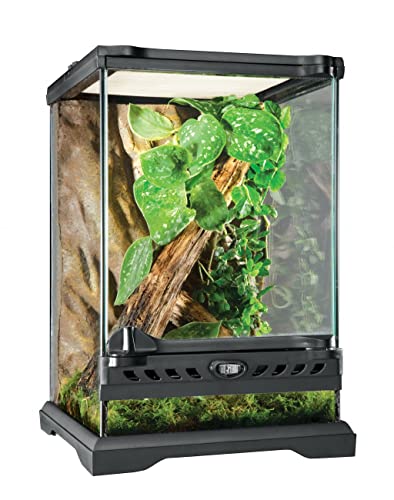
Exo Terra Glass Terrarium Kit — $76.99 | 12×12×12 |
Exo Terra is the most recognized brand in the best leopard gecko terrarium market. Their 12×12×12 Mini Wide includes basic accessories — background, feeding dish, water dish — reducing items a first-time owner needs separately.
The limitation of this best leopard gecko terrarium option is size. At 12×12 inches (144 sq in), this tank provides one-third the floor space an adult needs. It works for a hatchling but requires a 20-gallon upgrade within 6-8 months.
Pros: Most trusted brand, includes starter accessories, front-opening doors
Cons: 12×12 too small for adults, requires planned upgrade, occasional shipping damage
3. Phailozoo 50 Gallon — Best for Multiple Geckos
Phailozoo 50 Gallon Reptile Enclosure — $239.99 | 36×18×18 |
This best leopard gecko terrarium for multiple geckos provides 648 square inches of floor space — enough for two female leopard geckos (never house two males together). The 36-inch length creates a generous temperature gradient, and cable ports on the sides make wiring clean.
At $239.99, it’s overkill for a single gecko. Worth it for the best leopard gecko terrarium when planning multiple geckos or bioactive setups.
Pros: Massive 648 sq in floor space, sliding glass doors, cable ports
Cons: Expensive for a single gecko, sliding doors can be pushed open by larger reptiles
4. New Age Pet ECOFLEX 24” — Best Furniture Style
New Age Pet ECOFLEX Small 24” Reptile Habitat — $149.99 | 24×18×24 |
If you want the best leopard gecko terrarium that looks like furniture, the ECOFLEX is the answer. The wood-grain composite blends into living rooms. Assembly takes 20 minutes with no tools, and the material is waterproof and mold-resistant. Heat retention is excellent.
The 24-inch height is unnecessary for ground-dwelling geckos. The 24×18 footprint at 432 sq in is adequate, matching the REPTI ZOO.
Pros: Furniture-grade appearance, tool-free assembly, waterproof, excellent heat retention
Cons: 24” height is wasted space, ventilation weaker than glass, occasional shipping scratches
5. Zilla 10 Gallon Desert Starter Kit — Best Budget Kit
Zilla 10 Gallon Desert Starter Habitat Kit — $99.99 | 20×10×12 |
The Zilla Desert Kit is the cheapest best leopard gecko terrarium starter kit on this list. It includes a 10-gallon tank, a basking light fixture, two bulbs (daylight and basking), a thermometer, and a bedding liner — everything needed to get started at under $100.
Warning: The 10-gallon tank is only suitable for hatchlings under 6 months. Plan to upgrade by 6 inches in length. Multiple reviewers report included bulbs burn out quickly — budget $10-15 for replacements from day one.
Pros: Most affordable complete kit, includes heat lamp and thermometer
Cons: 10 gallons too small for adults, included bulbs burn out quickly
6. 18×12×12 Front Opening Glass — Best Compact Glass
18×12×12 Front Opening Glass Terrarium — $108.99 | 18×12×12 |
This front-opening best leopard gecko terrarium at 18×12 inches provides 216 sq in of floor space — below the 360 sq in minimum for adults but workable for juveniles. Pre-drilled cable ports simplify heater wiring.
The door gap is the main concern with this best leopard gecko terrarium — wide enough for crickets to escape. Feed in a separate container or place food away from doors.
Pros: Front-opening doors, pre-drilled cable ports, reasonable price
Cons: Door gap allows feeder insect escape, lowest on list, 18×12 too small for adults
7. 20×12×10 Pre-Assembled Glass — Best Budget Glass
Reptile Glass Tank 20×12×10 Pre-Assembled — $99.99 | 20×12×10 |
The main advantage of this best leopard gecko terrarium: arrives fully assembled — no instructions, no missing panels, no drying time. At $99.99, the most affordable 20-inch glass option.
The 10-inch height limits decor options and makes cleaning harder with large hands. Some reviewers note actual dimensions may be smaller than advertised.
Pros: No assembly required, affordable 20-inch glass
Cons: 10” height limits decor and cleaning access, dimension inaccuracies reported
8. Reptile Growth 10 Gallon — Best Ultra-Budget
Reptile Growth 10 Gallon Terrarium — $65.99 | 20×10×11 |
At $65.99, this is the cheapest best leopard gecko terrarium option on the list. The cross-ventilation design and rating suggest it’s a competent budget option. The 20×10 inch dimensions provide 200 square inches of floor space — adequate for a hatchling or temporary housing.
Warning: 10-gallon enclosures are temporary only. This tank doesn’t retain heat well, and there are reports of small escape gaps near cable ports. Use as quarantine, hospital, or temporary hatchling enclosure only.
Pros: Cheapest at $65.99, cross-ventilation design
Cons: 10 gallons hatchling only, poor heat retention, potential escape gaps, flimsy lid tabs
Leopard Gecko Substrate Guide
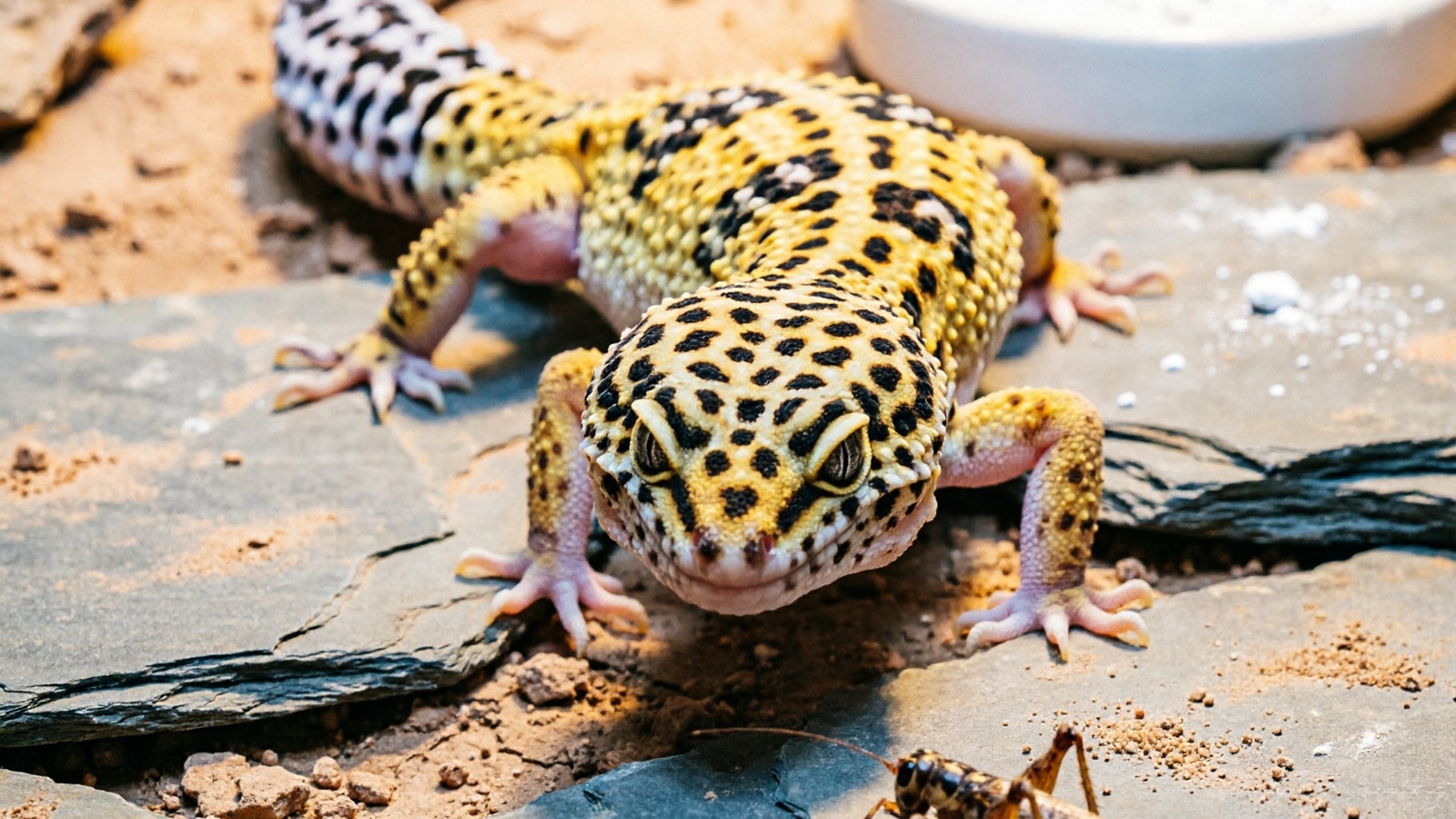
The best leopard gecko terrarium setup starts with the right substrate — arguably more important for leopard geckos than for most other pet reptiles. Leopard geckos hunt by lunging at moving prey on the ground — which means they routinely ingest whatever is on the surface. Loose substrates like sand can cause impaction, a potentially fatal intestinal blockage.
Safe Substrates
| Substrate | Pros | Cons | Difficulty |
|---|---|---|---|
| Ceramic tile | Permanent, easy to clean, retains heat, zero impaction risk | Can be slippery for juveniles | Beginner |
| Slate tile | Natural look, excellent heat retention, zero impaction | Heavy, requires cutting to fit | Beginner |
| Paper towels | Free, disposable, zero risk | Not aesthetically pleasing, requires frequent changes | Beginner |
| Reptile carpet | Washable, reusable | Nails can snag, harbors bacteria if not cleaned | Beginner |
| Shelf liner | Cheap, easy to replace | Can be chewed, not natural-looking | Beginner |
Unsafe Substrates
| Substrate | Risk Level | Why Dangerous |
|---|---|---|
| Loose sand | High | Ingested during hunting → impaction |
| Calcium sand | Very High | Marketed as “digestible” but clumps in gut |
| Wood shavings | High | Oils toxic, splinters cause injury |
| Bark chips | High | Sharp edges injure mouth, impaction risk |
| Gravel | Very High | Cannot be passed through digestive tract |
For the best leopard gecko terrarium, I recommend ceramic or slate tile for most keepers. It’s a one-time purchase that lasts the life of the enclosure, retains belly heat effectively, and has zero impaction risk. Cut tiles to fit the enclosure floor and lay them directly over the under-tank heater for optimal heat transfer. For more substrate details, see the leopard gecko care guide.
Leopard Gecko Tank Accessories & Decor
Essential Accessories Checklist
Every best leopard gecko terrarium needs these items regardless of enclosure type:
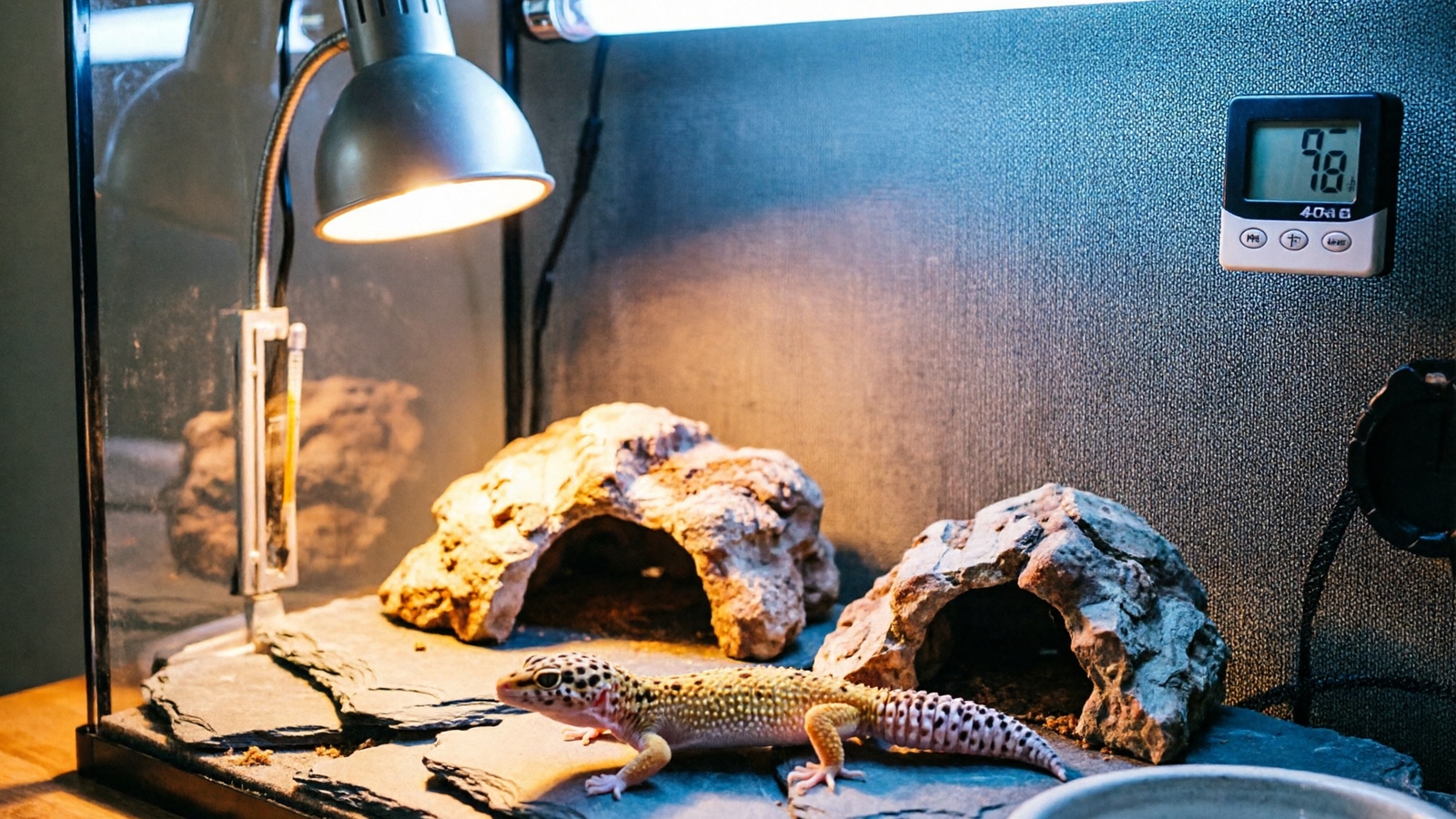
- Under-tank heater (UTH) + thermostat — The UTH provides belly heat (90-95°F on the warm side). A thermostat is non-negotiable — without it, the heater can reach 120°F+ and burn your gecko. Never use a heat mat without a thermostat.
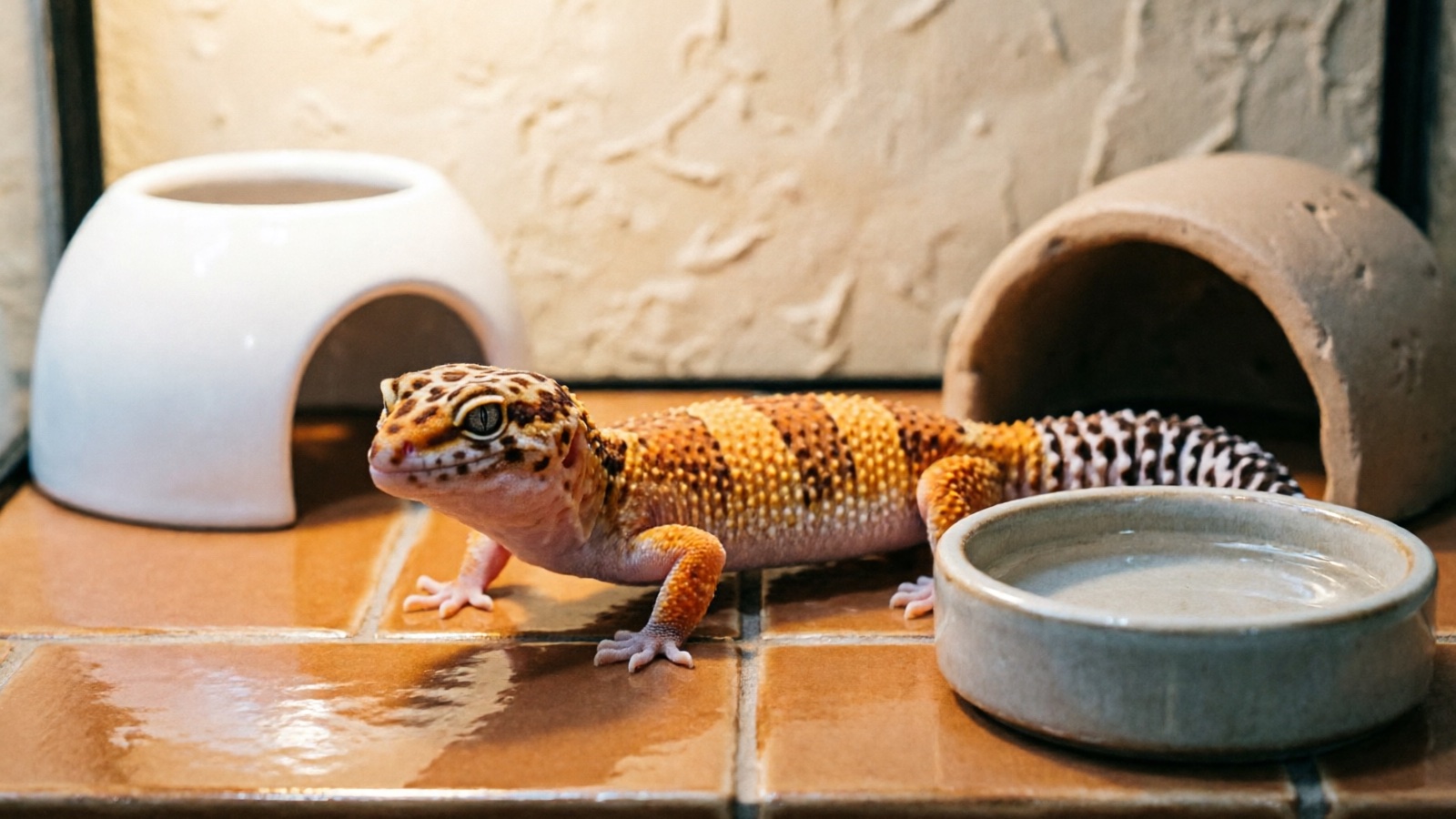
- Three hides — A warm hide (placed over the UTH), a cool hide (on the opposite end), and a humid hide (on the warm side, filled with damp sphagnum moss for shedding).
- Shallow water dish — Leopard geckos drink from standing water. Use a dish shallow enough that a hatchling can’t drown (1 inch depth maximum).
- Escape-proof food dish — Prevents mealworms and crickets from climbing out. Smooth-sided ceramic dishes work best.
- Two probe thermometers — One for the hot side surface temperature, one for the cool side. Gun-style infrared thermometers are inaccurate for reptile enclosures; use digital probe thermometers.
Optional Decor
Rocks and branches provide visual interest and hiding spots in the best leopard gecko terrarium. Artificial plants are safe and easy to clean — avoid any with sharp stems. A 3D foam background adds depth to the best leopard gecko terrarium and blocks the gecko from seeing room movement, which reduces stress. Natural rock or no background also works fine.
Leopard Gecko Terrarium Setup Guide
Step-by-Step Setup
Step 1: Position the enclosure. The best leopard gecko terrarium starts with proper placement — place the tank away from direct sunlight (causes overheating), air vents (causes temperature fluctuations), and high-traffic areas (causes stress). A stable, waist-height surface is ideal.
Step 2: Install substrate. Lay ceramic or slate tiles across the entire floor. If using tile, place the under-tank heater underneath the warm-side tiles before positioning them.
Step 3: Set up heating. Attach the UTH to the bottom of the warm-side glass (outside the tank, not inside). Connect it to a thermostat with the probe placed on the tile surface inside the warm hide. Set the thermostat to 92°F — this will maintain 90-95°F on the surface.
Step 4: Arrange hides. Place the warm hide directly over the heated area. Place the cool hide on the far opposite end. Place the humid hide on the warm side (near but not directly over the heater), filled with damp sphagnum moss.
Temperature Setup
| Zone | Temperature | Purpose |
|---|---|---|
| Hot side surface | 90-95°F | Digestion, thermoregulation |
| Cool side surface | 75-80°F | Resting, sleeping |
| Nighttime (both sides) | 70-75°F | Natural temperature drop |
Always measure surface temperature with a probe thermometer pressed against the substrate. Air temperature readings are significantly lower than surface temperature and will give you a false sense of security. A gun-style infrared thermometer pointed at the glass from outside is also unreliable.
Humidity Control
Ambient humidity in the enclosure should be 30-40% — leopard geckos are from arid environments. The humid hide is the exception: keep it at 70-80% by refreshing damp sphagnum moss every 2-3 days. High ambient humidity (above 50%) causes respiratory infections. If your room is naturally humid, increase ventilation or use a dehumidifier.
Step 5: Add water and food dishes. Place the water dish on the cool side. Place the food dish in the middle zone — not directly on the hot side (live feeders will die from heat) and not in a hide.
Step 6: Add thermometers. Place one probe thermometer on the warm hide floor (directly above the UTH). Place the second on the cool side floor. Check both readings after 2 hours to confirm the gradient is established.
Step 7: Add decor (optional). Rocks, branches, and artificial plants provide enrichment and hiding spots. Avoid anything tall enough that a gecko could climb and fall.
Bioactive Setup
A bioactive best leopard gecko terrarium is possible but challenging. You’ll need arid-climate plants (snake plants, aloe vera, jade, succulents), a desert isopod cleanup crew, and a drainage layer beneath the substrate. Bioactive setups require UVB lighting for the plants, which is optional for the gecko itself. Start with a standard tile-based enclosure before attempting bioactive.
Setup Checklist
- Enclosure positioned away from sunlight and vents
- Substrate installed (tile recommended)
- UTH connected to thermostat, probe on warm-side surface
- Three hides placed (warm, cool, humid)
- Water dish on cool side, food dish in middle zone
- Two probe thermometers installed and reading correctly
- Temperature gradient confirmed (90-95°F warm / 75-80°F cool)
- Ambient humidity 30-40%
- No sharp edges on decor
For a complete reptile habitat reference, see our reptile habitat basics guide. For detailed care beyond enclosure setup, see our leopard gecko care guide.
Conclusion
A 20-gallon front-opening glass terrarium is the best leopard gecko terrarium choice for most owners. The REPTI ZOO 20 Gallon at $149.99 provides the ideal combination of floor space, accessibility, and heat retention. Budget $150-250 for a complete setup including heater, thermostat, hides, substrate, and thermometers.
Three things that matter more than which best leopard gecko terrarium you buy: use tile substrate instead of sand (zero impaction risk), always pair your heat mat with a thermostat (prevents burns), and provide three hides — warm, cool, and humid. Get these right and your gecko will thrive in any of the enclosures on this list.
For the full picture on the best leopard gecko terrarium and leopard gecko husbandry, see our leopard gecko care guide. For species background and natural history, visit our leopard gecko breed guide.