I’ve kept leopard geckos for seven years. My first gecko nearly died from impaction because I used calcium sand — the pet store employee told me it was safe and even beneficial. It wasn’t. Three vet visits and $800 in surgery bills later, my gecko survived, but I’ll never forget how preventable that whole ordeal was. That experience drove me to learn everything I could about proper leopard gecko care, and it’s why I wrote this leopard gecko care guide — so you can avoid the mistakes I made.
This leopard gecko care guide covers everything from initial setup and daily feeding to emergency health situations that most guides gloss over. Whether you’re choosing your first reptile or you’ve already brought a gecko home and want to make sure you’re doing it right, the information here is what I wish someone had given me seven years ago — a truly complete leopard gecko care guide.
Quick Start: Leopard Gecko Care at a Glance
Leopard geckos (Eublepharis macularius) are the most popular beginner reptile for good reason: they’re docile, small (8-11 inches), quiet, and have simple leopard gecko care requirements. A proper leopard gecko care guide starts with the essentials — they need a 20-gallon tank with a temperature gradient (88-92°F warm side, 75-80°F cool side), a diet of gut-loaded live insects dusted with calcium, a humid hide for shedding, and a calcium supplement with D3. They live 15-20 years with proper leopard gecko care — a long-term commitment The three biggest killers — the main reason leopard gecko care matters so much — are — impaction (wrong substrate), MBD (calcium deficiency), and thermal burns (unregulated heat mats) — are all 100% preventable.
Quick-reference leopard gecko care sheet:
| Category | Requirement | Details |
|---|---|---|
| Tank size | 20-gallon long (min) | 30-40 gallon preferred for adults |
| Temperature | 88-92°F warm / 75-80°F cool | Under-tank heat mat + thermostat |
| Substrate | Tile, paper towel, or slate | Avoid loose sand (impaction risk) |
| Diet | Live insects only | Crickets, dubia roaches, mealworms |
| Supplements | Calcium + D3 + multivitamin | Every feeding (calcium) / 2x week (multi) |
| Humid hide | Required | Moist moss or paper towels in enclosed container |
| Water | Fresh daily | Shallow dish, dechlorinated |
| Handling | 10-15 min/day | Support body, never grab tail |
| Lifespan | 15-20 years | Females shorter if bred |
| Cost | $200-400 setup / $20-40/month | $3,500-6,000 lifetime |
For general reptile habitat principles that complement this leopard gecko care guide, see our reptile habitat setup guide. For another popular beginner reptile, see our crested gecko care guide.
Leopard Gecko Care for Beginners
If you’re considering your first reptile, leopard gecko care is one of the easiest to learn — a leopard gecko is the best starting point — which is why this guide exists. No comprehensive leopard gecko care guide would be complete without explaining why — and what makes them different from other popular reptiles in terms of leopard gecko care.
Why leopard geckos are great first reptiles:
- Docile temperament — they rarely bite and tolerate handling well
- Small size — 8-11 inches fully grown, they don’t need massive enclosures
- No UVB strictly required — simpler lighting setup than bearded dragons
- Insectivore diet — feed crickets and dubia roaches, no complex omnivore diet
- No special humidity — unlike tropical reptiles, they prefer dry conditions
- Long lifespan — 15-20 years of companionship
- Quiet and odorless — perfectly apartment-friendly
How they compare to other beginner reptiles:
| Feature | Leopard Gecko | Bearded Dragon | Crested Gecko | Ball Python |
|---|---|---|---|---|
| Size | 8-11 in | 18-24 in | 7-9 in | 3-5 ft |
| Diet | Insects | Insects + veg | Fruit + insects | Frozen mice |
| Heat source | Heat mat (belly) | Heat lamp (above) | Room temp | Heat mat |
| UVB | Optional | Required | Optional | Optional |
| Humidity | Low (20-40%) | Low (30-40%) | High (60-80%) | Moderate (50-60%) |
| Handling | Easy | Easy | Moderate | Easy |
| Lifespan | 15-20 yr | 10-15 yr | 10-15 yr | 20-30 yr |
Leopard geckos stand out because they absorb heat through their bellies rather than basking under a heat lamp — a key distinction that simplifies leopard gecko care setup significantly. For leopard gecko care comparisons beyond this guide, see our bearded dragon care guide, ball python care guide, and corn snake care guide.
Leopard Gecko Care Requirements: What You Need
Don’t bring a gecko home until you have these leopard gecko care essentials set up. Every reputable source will tell you the same thing — having everything ready before your gecko arrives reduces stress for both of you — a core goal of good leopard gecko care.
| # | Item | Why It’s Essential | Budget |
|---|---|---|---|
| 1 | 20-gallon tank (min) | Floor space for exercise and temperature gradient | $40-80 |
| 2 | Under-tank heat mat + thermostat | Digestion requires 88-92°F belly heat | $30-50 |
| 3 | Digital thermometer (2 probes) | Monitor both warm and cool sides accurately | $15-25 |
| 4 | Safe substrate (tile/paper) | Prevents impaction — this is non-negotiable | $10-20 |
| 5 | 3 hides (warm, cool, humid) | Security, shedding, and thermoregulation | $20-40 |
| 6 | Water dish (shallow) | Fresh water always available | $5-10 |
| 7 | Calcium + D3 powder | Prevents MBD (Metabolic Bone Disease) | $12-20 |
| 8 | Multivitamin powder | Weekly supplement for overall health | $10-15 |
| 9 | Feeder insects (crickets/dubia) | Staple diet | $10-15/week |
| 10 | Gut-load food | Nutrition passed to gecko via insects | $8-12 |
Total initial setup: $160-290
Leopard Gecko Tank Setup
The tank is your gecko’s entire world. Getting the leopard gecko care setup right from day one is what separates good setups from bad ones — and it prevents most of the health problems that send geckos to the vet.
Leopard Gecko Substrate
Substrate choice is one of the most critical decisions you’ll make because wrong substrate causes impaction — a blocked digestive tract that can be fatal. Right substrate keeps your gecko safe and makes cleaning easy.
| Substrate | Safety | Cost | Pros | Cons |
|---|---|---|---|---|
| Slate/ceramic tile | Safest | $10-20 (one-time) | Easy to clean, looks natural, conducts belly heat well | Heavy, can chip |
| Paper towel | Safest | $3/month | Cheapest option, easy to replace, perfect for quarantine | Not aesthetically pleasing |
| Reptile carpet | Safe | $10-15 | Looks decent, reusable | Claws can snag, harder to clean |
| Shelf liner | Safe | $5-10 | Cheap, easy to wipe clean | Not natural-looking |
| Play sand | Risky | $5-10 | Natural appearance, cheap | Impaction risk if ingested |
| Loose sand | Unsafe | $5-15 | Looks best | High impaction risk — avoid for juveniles |
My recommendation based on seven years of experience — and what I’d emphasize to any new owner: Use tile or paper towel for babies and juveniles without exception. Adults can go on tile or reptile carpet. If you absolutely must use sand, only with adult geckos over 12 months and 50 grams, mixed 50/50 with topsoil. Never use pure calcium sand — it clumps when wet and caused my first gecko’s impaction. For substrate in the humid hide specifically, Zoo Med Eco Earth coconut fiber ($10, 4.8 stars, 5,037 reviews) is ideal — it holds moisture perfectly for shedding and is safe if accidentally ingested.
Leopard Gecko Enclosure Ideas
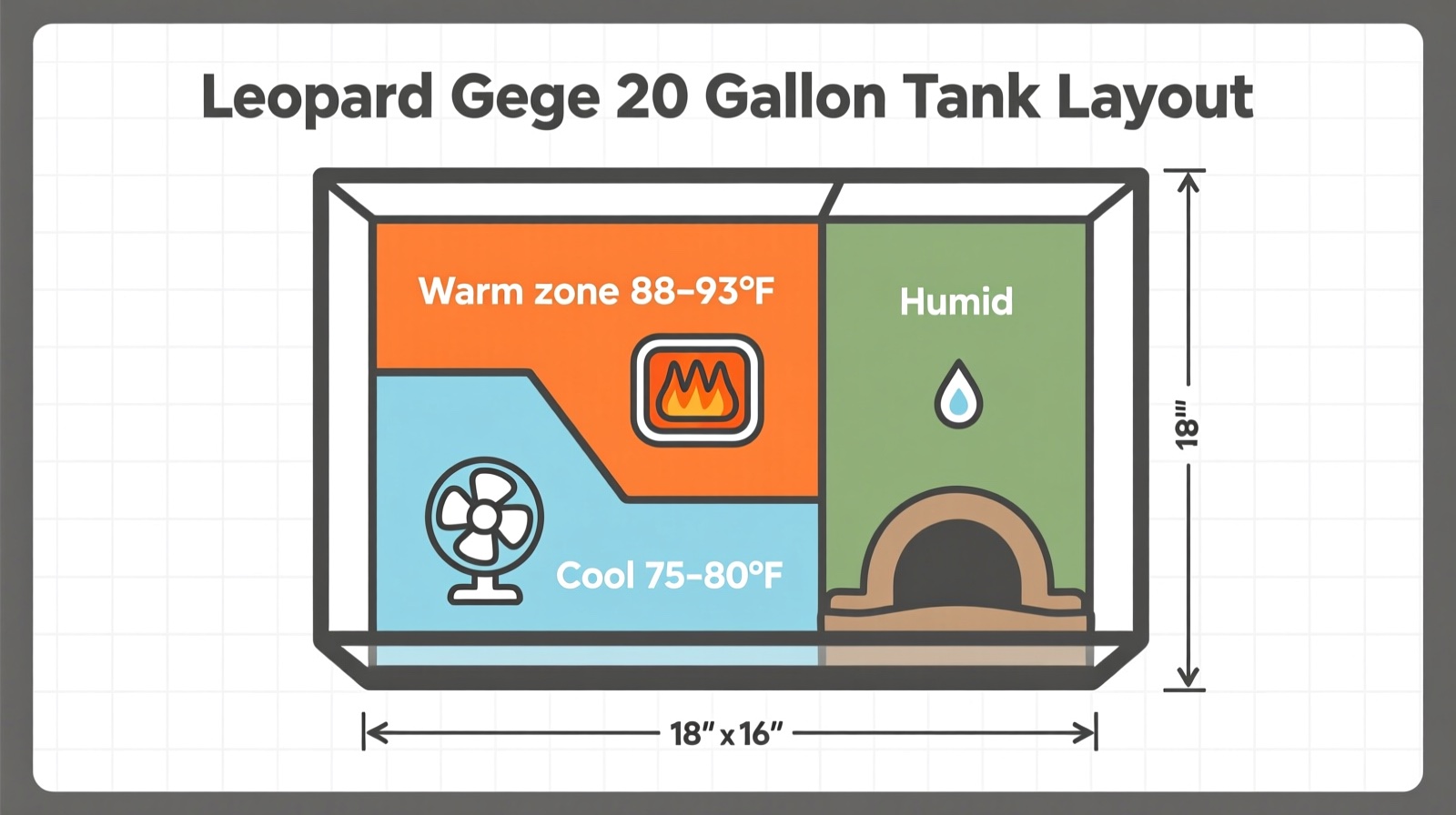
Divide the tank into 3 zones:
| Zone | Temperature | What Goes Here |
|---|---|---|
| Warm zone (1/3) | 88-92°F | Warm hide over heat mat, water dish |
| Cool zone (1/3) | 75-80°F | Cool hide, food dish |
| Middle zone (1/3) | 80-85°F | Open floor space, humid hide, enrichment |
For hides, I use LEOTERRA Reptile Hide caves ($13, 4.7 stars, 2,029 reviews) — one on the warm side and one on the cool side. They have a natural rock appearance, a stable base that won’t tip over, and the resin material is easy to clean. You need at least two; three is better if you add a humid hide.
Enrichment ideas — a topic often overlooked in a basic guide but important for mental stimulation: Cork bark climbs (leopard geckos climb more than most people realize), fake plants for cover, smooth rocks for basking spots, and a shallow dig box with clean play sand for adults only.
Leopard Gecko Humid Hide DIY
The humid hide is not optional — and any guide that treats it as optional is simply wrong — it’s essential for proper shedding. Without it, shed skin sticks to toes, tail tip, and eyes, causing injury and potentially infection. Every guide should emphasize this because stuck shed is one of the most common problems new owners face.
DIY humid hide instructions (5 minutes, $5):
- Container: Get a plastic Tupperware with lid (6” x 4” x 4” minimum)
- Cut entrance: Cut a 2” x 2” hole in one side, sand the edges smooth
- Substrate: Fill with Zoo Med Eco Earth coconut fiber or damp paper towels
- Moisture level: Squeeze the substrate — it should be damp, not dripping wet
- Placement: Put on the warm side (85-90°F) — the higher temperature increases humidity inside the container
- Maintenance: Re-moisten every 2-3 days, replace substrate weekly
Heating and Temperature
Leopard Gecko Temperature Gradient
The temperature gradient is the single most important aspect of leopard gecko care and the foundation of proper care. They need a warm side and a cool side so they can self-regulate their body temperature by moving between zones.
Temperature ranges:
| Zone | Temperature | How to Measure | Purpose |
|---|---|---|---|
| Warm side floor | 88-92°F (31-33°C) | Probe thermometer on substrate | Digestion and basking |
| Warm side air | 85-88°F (29-31°C) | Digital thermometer at 2” height | Ambient warmth |
| Cool side | 75-80°F (24-27°C) | Probe thermometer on substrate | Cooling and sleeping |
| Nighttime | 70-75°F (21-24°C) | Either side | Natural temperature drop |
For the heating setup, I recommend the same product I’ve used for years: the BN-LINK Durable Reptile Heating Pad with Digital Thermostat ($31, 4.4 stars, 1,356 reviews). The 8” x 12” size covers one-third of a standard 20-gallon tank floor perfectly. The digital thermostat with probe lets you set the exact temperature, and the probe placement on the substrate surface is critical — placing it on the glass under the tank gives a false reading that can be 10-15°F lower than the actual surface temperature, leading to burns.
For monitoring temperatures quickly, I also use an Etekcity Infrared Thermometer ($9.48, 4.6 stars, 47,673 reviews) — an inexpensive tool I consider essential for spot-checking surface temperatures across the tank without disturbing the gecko. It gives instant readings with a laser pointer for precise targeting.
Never use heat rocks — they cause severe thermal burns. The surface temperature of heat rocks is unpredictable and can spike well past 120°F. Stick with under-tank heat mats controlled by a thermostat.
Diet and Nutrition
Leopard Gecko Feeding Schedule by Age
Feeding is a core part of leopard gecko care and varies significantly by age — babies need daily meals while adults eat every other day. Getting the feeding schedule right is a crucial part of leopard gecko care — a topic every leopard gecko care guide should cover in detail because underfeeding causes stunted growth and overfeeding causes obesity, both of which shorten lifespan.
| Age | Frequency | Insect Size | Count Per Feeding | Insect Types |
|---|---|---|---|---|
| Hatchling (0-2 months) | Daily | Small crickets (1/8”) | 5-7 | Crickets only (easiest to digest) |
| Baby (2-4 months) | Daily | Small-medium crickets | 5-8 | Crickets + small mealworms |
| Juvenile (4-8 months) | Daily | Medium crickets/dubia | 6-10 | Crickets + dubia + mealworms |
| Sub-adult (8-12 months) | Every 2 days | Medium-large | 6-8 | All types + occasional worms |
| Adult (12+ months) | Every 2-3 days | Large crickets/dubia | 6-10 | Varied diet, limit fatty worms |
The golden rule for insect size — something every guide should mention: never feed an insect wider than the space between the gecko’s eyes. Too-large prey causes choking and impaction.
Gut-loading: A practice every experienced keeper recommends — feed your feeder insects nutritious food (cricket feed, carrots, sweet potato, leafy greens) for 24 hours before offering them to your gecko. The nutrients in the insect’s gut pass directly to your gecko.
Water: Always provide a shallow dish of fresh, dechlorinated water. Change it daily. The dish should be shallow enough that a baby gecko can climb out — half an inch deep maximum.
Leopard Gecko Supplement Schedule
Proper supplementation prevents MBD — the single most important health topic (Metabolic Bone Disease) — the number one preventable killer of captive reptiles. I cannot overstate how important this is.
| Supplement | Frequency | How | Notes |
|---|---|---|---|
| Calcium + D3 | Every feeding | Lightly dust insects | Alternate with plain calcium every other feeding |
| Plain calcium (no D3) | Every other feeding | Leave small dish in tank | Free-choice calcium dish lets gecko self-regulate |
| Multivitamin | 2x per week | Dust insects | Repashy Supervite or similar |
| Vitamin A | 1x every 2 weeks | Light dust | Important for eye health, don’t overdo |
I also keep a Zoo Med Dr.Turtle Slow-Release Calcium Block ($9.24, 4.6 stars, 867 reviews) on the cool side of the tank as an additional calcium source. It’s a slow-release block that provides continuous calcium availability. While calcium dusting on insects is the primary method, having a block available gives your gecko a self-serve option.
Baby Leopard Gecko Care
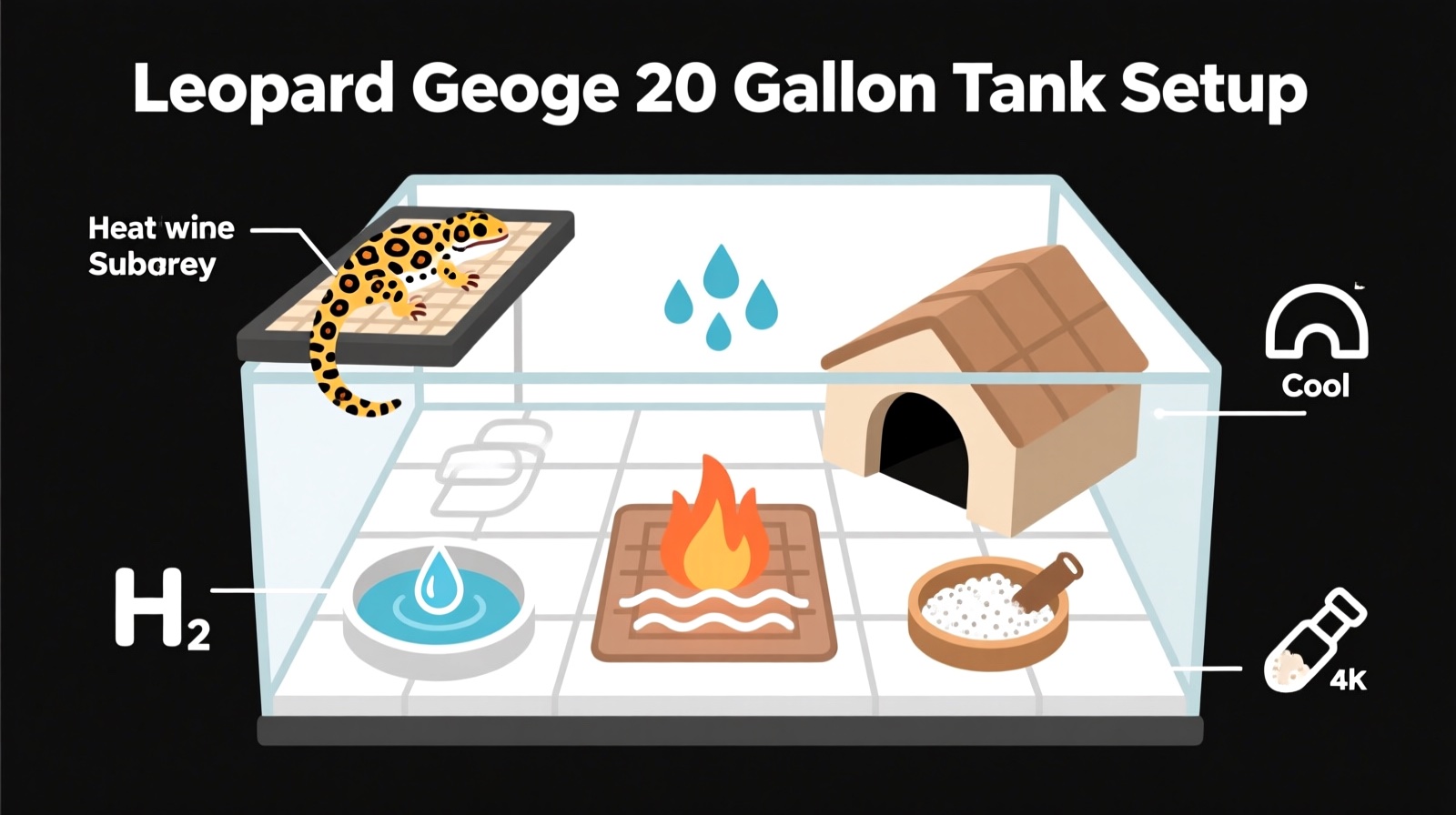
Baby leopard gecko care requires more attention than adult care — baby geckos (0-6 months) are fragile, fast, and significantly more prone to health problems. Many guides skip this section entirely, which is a mistake in any leopard gecko care guide — baby geckos have different needs than adults.
Housing for babies:
- Start in a 10-gallon tank — upgrade to 20-gallon at 6 months
- Use paper towel substrate only — impaction risk is highest for babies
- Keep the humid hide especially moist because babies shed every 1-2 weeks
- Minimize decorations — babies hide a lot and need to find food easily
- No loose substrate, no sand, no loose moss in the main enclosure
Feeding babies:
- Feed daily at the same time each day to establish a routine
- Offer 5-8 appropriately sized crickets — no wider than the space between the gecko’s eyes
- Dust every feeding with calcium + D3 (babies need more calcium than adults because they’re growing)
- Remove uneaten crickets after 15 minutes — crickets nibble on sleeping geckos
- Provide a small calcium dish in the tank at all times
Handling babies:
- Wait 1-2 weeks after bringing them home before handling — let them settle in
- Start with 3-5 minutes, gradually increase to 10 minutes
- Babies are jumpy and fast — handle over a soft surface like a bed or couch
- Support the entire body, never grab from above
- If they drop their tail, don’t panic — see the tail drop care section below
Common baby gecko problems:
- Not eating for the first 3-5 days after bringing home is completely normal — it’s stress from the move
- Not eating for 7+ days is not normal — check temperature first, then see a reptile vet
- Stuck shed on toes means you need to increase humidity and soak the gecko in warm shallow water for 10 minutes
- Wobbly walking or rubbery jaws may indicate MBD (calcium deficiency) — this is a vet emergency, do not wait
Shedding
Leopard Gecko Shedding Issues
Shedding management is an important part of leopard gecko care. Normal shedding happens every 4-6 weeks for adults and every 1-2 weeks for babies. The entire process takes 24-48 hours. Before shedding, their skin turns dull and grayish-white, they become less active, and they eat the shed skin afterward — this is completely normal leopard gecko care behavior that recycles nutrients.
Shedding problems that need your attention:
- Stuck shed on toes: The most common issue. Constricted skin can cut off blood flow and cause toe loss. Soak the gecko in shallow warm water (80-85°F, 1 inch deep) for 10-15 minutes, then gently rub the affected toes with a cotton swab.
- Stuck shed on tail tip: Can cut off circulation and cause the tail tip to die. Use the same warm soak treatment.
- Stuck shed on eyes: Your gecko may keep its eyes closed. If a warm soak doesn’t resolve it within 24 hours, see a reptile vet.
- Incomplete shed: Increase humidity in the humid hide and consider adding a second humid hide temporarily.
Prevention: Keep the humid hide consistently moist, maintain proper temperatures (shedding requires adequate warmth), and ensure your gecko is well-hydrated.
Handling and Bonding
Handling is a gentle aspect of leopard gecko care. Leopard geckos tolerate handling better than most reptiles, but they’re not affectionate pets — something every leopard gecko care guide should be honest about upfront. They won’t seek you out; they tolerate being held. The bonding process is the social side of leopard gecko care — it’s about building trust gradually.
Proper handling technique:
- Approach from the side, not from above — approaching from above looks like a predator
- Gently scoop under the belly with your palm
- Support all four feet and the tail base
- Keep them close to your body — they feel more secure against you
- Limit sessions to 10-15 minutes for adults, 5-10 minutes for babies
Never grab the tail — it will detach as a defense mechanism. Once dropped, it won’t look the same when it regrows.
Leopard Gecko Tail Drop Care
Tail autotomy is a defense mechanism that alarms many new owners. When grabbed by the tail, extremely stressed, or handled roughly, the gecko detaches its tail. The detached tail twitches for several minutes to distract predators, and the gecko does not feel pain during the drop.
Tail drop care protocol:
- Isolate the gecko — the open wound is vulnerable to infection
- Clean the wound with diluted betadine solution (available at any pharmacy)
- Switch to paper towel substrate until the wound heals completely (1-2 weeks)
- Feed more frequently — the tail stores fat reserves that the gecko has now lost
- Spot clean daily — keep the enclosure clean while the wound is open
- Regrowth takes 6-8 weeks, but the new tail will be shorter, smoother, and a different color
- See a vet if the wound shows redness, swelling, or hasn’t closed within 1 week
Disclaimer: The health information in this section is for educational purposes only and is not a substitute for professional veterinary advice. If your leopard gecko shows signs of illness, consult a reptile veterinarian — early treatment is a critical part of emergency leopard gecko care — it often makes the difference between a full recovery and a tragic outcome.
Health and Common Problems
Leopard Gecko Impaction Signs
Impaction means the digestive tract is blocked. I’m covering impaction in detail because it’s the most common result of poor leopard gecko care — it’s caused by ingesting loose substrate, eating prey that’s too large, or inadequate hydration, and is almost entirely preventable with proper substrate choice — a core principle of leopard gecko care.
Impaction signs checklist:
| Sign | Severity | Details |
|---|---|---|
| Decreased appetite | Early | Eating less than usual or refusing food |
| Smaller or infrequent poop | Early | Poop is thin, small, or absent for 3+ days |
| Swollen belly | Moderate | Lower abdomen looks distended or bloated |
| Lethargy | Moderate | Sleeping more, less active at night |
| Dark discoloration on belly | Severe | Visible through the skin — blockage shadow |
| Hind leg paralysis | Severe | Pressure on spinal nerves from blockage |
| Regurgitation | Severe | Vomiting food or clear fluid |
Treatment by severity:
- Mild: Warm soaks in shallow water (85°F) for 15 minutes twice daily. Gently massage the belly toward the vent. Offer a drop or two of mineral oil by mouth.
- Moderate: Continue warm soaks plus syringe-feed a reptile electrolyte solution. See a reptile vet within 24-48 hours.
- Severe: Vet immediately. X-ray to locate the blockage. May require an enema or surgery — this is what my first gecko went through, and it cost $800.
Prevention: Use safe substrate (tile or paper towel), feed appropriately sized insects, keep your gecko hydrated, and provide warm soaks weekly as a preventative measure.
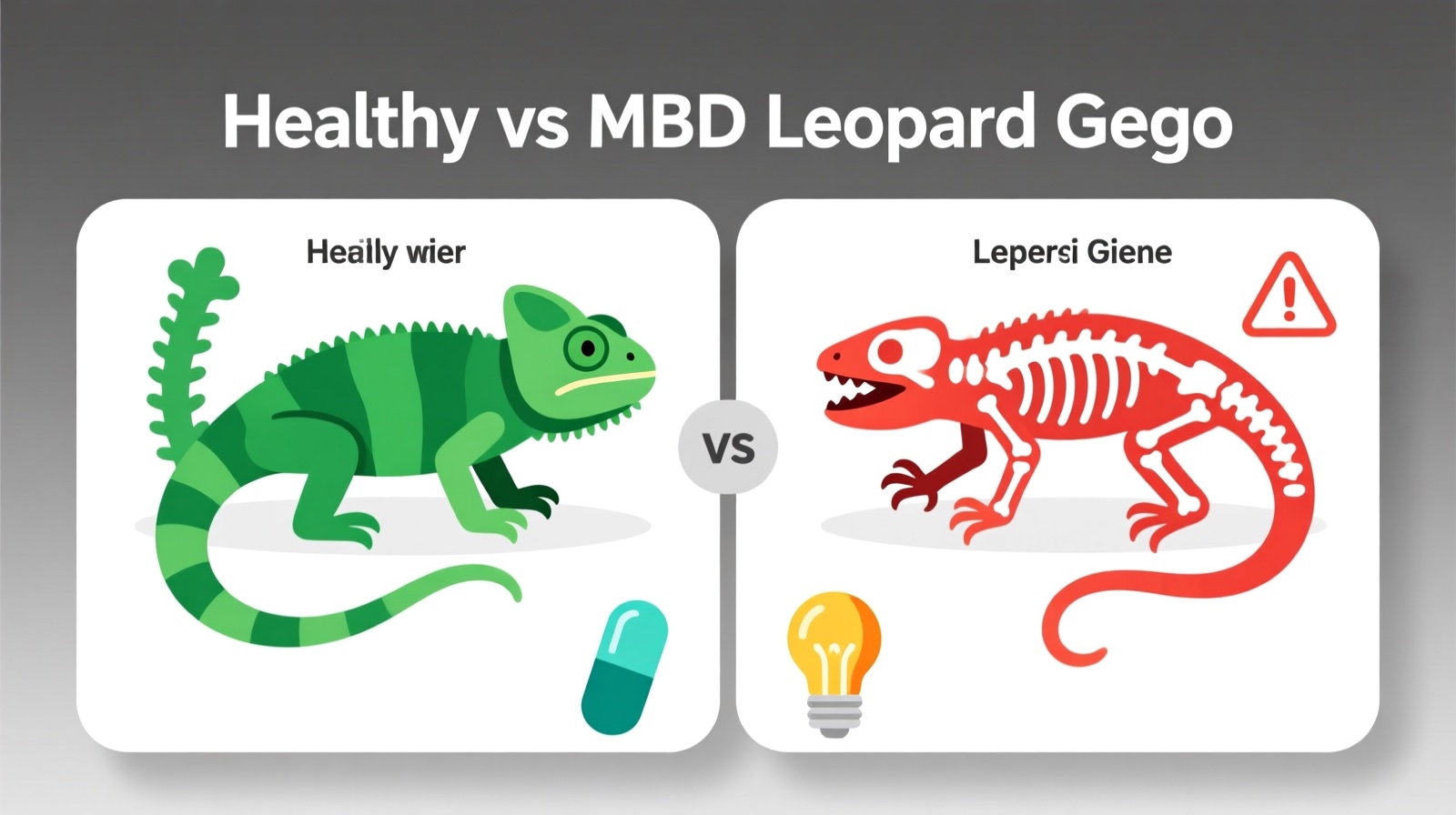
Leopard Gecko Calcium Deficiency Symptoms (MBD)
Metabolic Bone Disease (MBD) is the result of calcium deficiency and incorrect calcium-to-phosphorus ratio. It’s the most preventable and most devastating disease in captive reptiles. Without adequate calcium, the gecko’s body leaches calcium from its own bones, causing them to become soft, weak, and deformed.
MBD progression and symptoms:
| Stage | Symptoms | Reversibility |
|---|---|---|
| Early | Lethargy, decreased appetite, tremors (especially in legs) | Reversible with proper supplementation |
| Moderate | Rubbery jaw (fibrous osteodystrophy), swollen limbs, difficulty walking, wobbling | Partially reversible with vet treatment |
| Severe | Deformed bones, paralysis, multiple fractures, seizures | Permanent damage, may be fatal |
Prevention protocol — non-negotiable:
- Dust every feeding with calcium + D3 powder, alternating with plain calcium
- Keep a calcium dish (without D3) in the tank at all times for free-choice access
- Feed gut-loaded insects with a calcium-rich diet
- Use UVB lighting (even low-level helps with D3 synthesis)
- Don’t over-supplement D3 — toxicity is real, balance is key
- When feeding phosphorus-heavy insects like crickets, always dust with calcium
Treatment: Early MBD requires corrected supplementation plus UVB plus vet-guided calcium injections. Advanced MBD requires intensive veterinary care and often involves permanent damage.
Leopard Gecko Brumation
Brumation is the reptile equivalent of hibernation. This section explains when brumation is normal and when it’s a red flag. In the wild, leopard geckos brumate during cooler months (November through February) when food is scarce. In captivity, brumation is optional — most pet geckos don’t need to brumate and will remain active year-round with consistent heating and feeding.
Should you let your gecko brumate?
- Adults: It’s optional. Some geckos naturally slow down in winter even with consistent heating. If they eat less and sleep more but otherwise seem healthy, it’s fine to let them have a lighter schedule.
- Babies and juveniles: Never. Growing geckos need consistent feeding and warmth. Brumation can stunt growth and be fatal to young geckos.
If your gecko starts brumating naturally:
- Don’t force-feed — offer food but don’t worry if it’s refused
- Maintain minimum 70°F — don’t let the temperature drop too low
- Reduce handling to a minimum
- Provide fresh water weekly
- Brumation typically lasts 4-8 weeks
- Weight should not drop more than 10-15%
Don’t confuse brumation with illness: Brumation is a gradual slowdown in fall or winter with the gecko otherwise appearing healthy. Illness is sudden appetite loss, weight loss, and lethargy at any time of year. If you’re unsure whether your gecko is brumating or sick, see a reptile vet — it’s always better to check and be wrong than to wait and be too late.
UVB Lighting: The Current Debate
UVB lighting is a newer topic in leopard gecko care. Historically, leopard geckos were classified as nocturnal and UVB lighting was deemed unnecessary. Current understanding from veterinary research has shifted — they’re actually crepuscular (active at dawn and dusk) — an important detail for leopard gecko care — and do benefit from low-level UVB exposure — a modern update to leopard gecko care standards for natural vitamin D3 synthesis and better calcium absorption.
Recommendations for leopard gecko UVB lighting:
- Minimum: No UVB if you’re consistently supplementing with calcium + D3
- Best practice: Low-level UVB (2-5% output) for optimal health
- Position: 6-8 inches above the basking area
- Duration: 10-12 hours on, matching a natural light cycle
- Provide hides on both sides so the gecko can escape the light when it wants to
I use the LUCKY HERP UVA UVB Reptile Light 10.0 ($15, 4.4 stars, 2,859 reviews) — it provides UVB 10.0 output specifically designed for desert species, fits standard dome fixtures, and at $15 it’s affordable to replace every 6-12 months as the UVB output degrades over time.
Replace your UVB bulb every 6-12 months. I’m including this reminder because it’s the most commonly forgotten maintenance task even if it still lights up — the UVB output diminishes long before the bulb burns out. A bulb that looks fine may be producing zero UVB.
Leopard Gecko Setup Cost
Leopard Gecko Care Cost Per Month
Budgeting is the practical side of leopard gecko care. Be honest about costs before committing — any leopard gecko care guide that skips this is doing you a disservice. Too many people buy a leopard gecko on impulse without budgeting for ongoing expenses.
| Category | Initial Cost | Monthly Cost | Annual Cost |
|---|---|---|---|
| Tank (20-gallon) | $40-80 | — | — |
| Heat mat + thermostat | $30-50 | — | — |
| Substrate | $10-20 | $3-5 (replacement) | $36-60 |
| 3 hides | $20-40 | — | — |
| Thermometers | $15-25 | — | — |
| Calcium + D3 + multivitamins | $20-30 | $5-8 (reorder) | $60-96 |
| Feeder insects | $10 | $15-25 | $180-300 |
| Electricity (heat mat) | — | $3-5 | $36-60 |
| Annual vet check | — | — | $80-150 |
| Emergency vet fund | $200-500 | — | — |
| Total | $345-755 | $26-43 | $392-666 |
Over a 15-year lifespan: $3,700-10,500 total. The emergency vet fund is not optional — reptile emergencies happen and they’re always more expensive than expected. My gecko’s impaction surgery cost $800 alone — which is why I’m so emphatic about safe substrate choice.
For temperature monitoring principles that apply across reptile species and complement this guide, see our axolotl tank temperature guide.