What Is a Bearded Dragon?
The bearded dragon (Pogona vitticeps) is a medium-sized agamid lizard native to the arid regions of Australia. Named for the spiny “beard” under their chin that puffs up during territorial displays and courtship, they have become one of the most popular pet reptiles worldwide.
The name “beardie” is the universal nickname among keepers. When threatened or during mating displays, the lizard expands the spiny pouch under its jaw and opens its mouth wide — a behavior called “bearding” that makes the lizard appear larger and more intimidating. In a relaxed state, the beard lays flat against the chin.
They belong to the genus Pogona, which contains eight recognized species. Among the most popular pet reptiles, they share beginner-friendly status with leopard gecko care requirements, ball python care, and corn snake care. Unlike geckos and snakes, however, they are active during the day — a major reason for their popularity. For a complete box turtle comparison as another diurnal reptile option, see our turtle care guide.
For the complete husbandry guide covering diet, enclosure setup, lighting, and health, see our care guide.
| Attribute | Detail |
|---|---|
| Scientific name | Pogona vitticeps (Central Bearded Dragon) |
| Common name | Beardie |
| Adult size | 18-24 inches (45-60 cm) |
| Adult weight | 300-600 grams |
| Lifespan | 8-12 years (captivity), 5-8 years (wild) |
| Activity pattern | Diurnal (active during daytime) |
| Native range | Eastern and central Australia |
| Temperament | Docile, curious, handles well |
The 8 Bearded Dragon Species
FCALIVV Humid Hideout is a quality option worth considering for your setup.
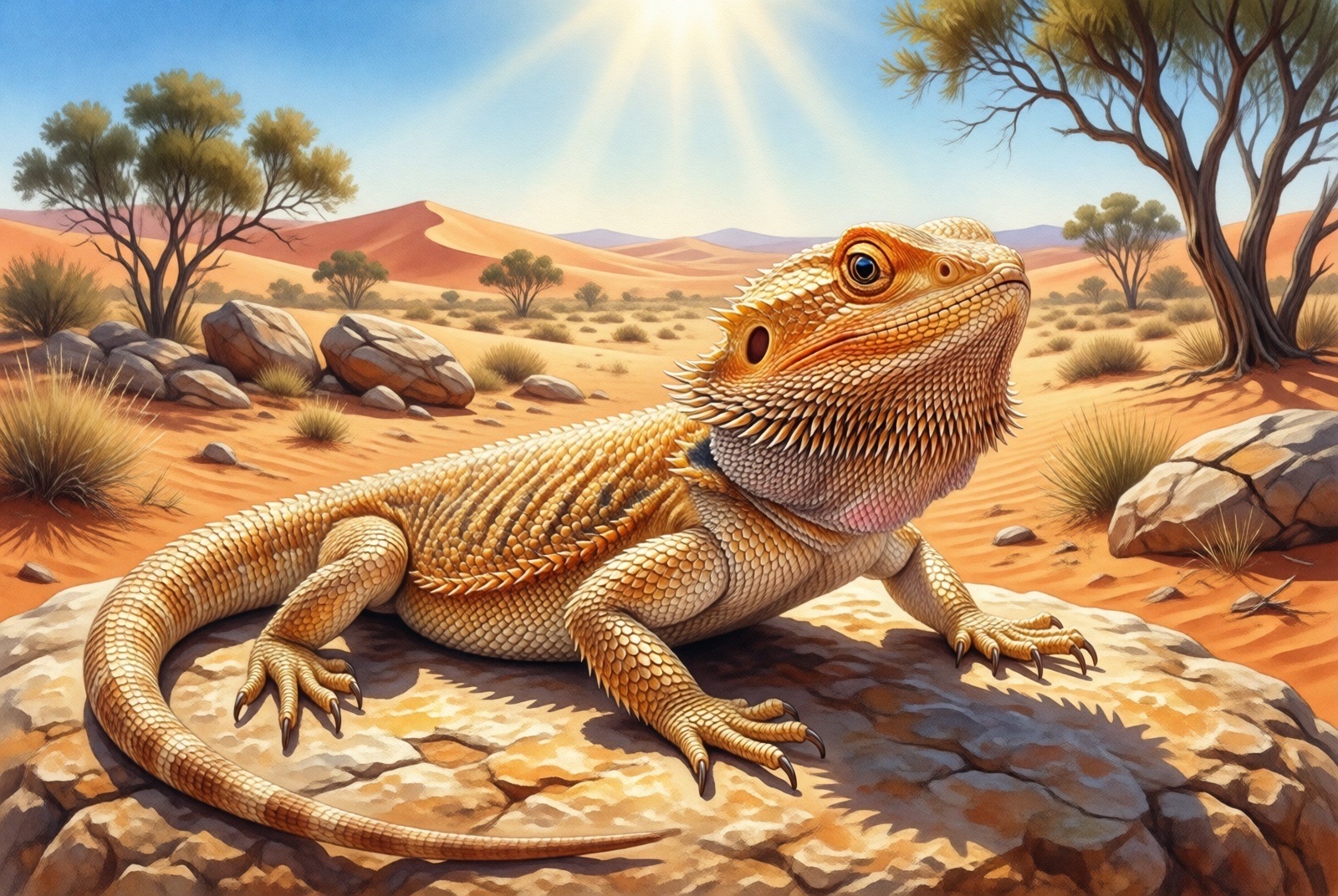
The Pogona genus contains eight recognized species, each native to different regions of Australia. Understanding these species helps clarify what makes the Central — the standard pet — unique.
Central Bearded Dragon (Pogona Vitticeps)
The central bearded dragon is the species virtually every pet belongs to. Native to eastern and central Australia, Pogona vitticeps is the largest and most robust of the eight species, reaching 18-24 inches as an adult. Its calm temperament, hardiness, and willingness to tolerate handling make it the ideal pet reptile. Every specimen sold in the pet trade — whether a normal wild-type or a rare designer morph — is P. vitticeps.
Pogona barbata inhabits the eastern coastal regions of Australia, from Queensland through New South Wales and Victoria. Slightly larger than the Central species, Eastern specimens are more arboreal and rarely available outside Australia.
Western/Dwarf Bearded Dragon (Pogona Minor)
The dwarf species P. minor reaches only 10-14 inches and is found in arid western Australia. It is less social and essentially unavailable internationally.
Nullarbor Bearded Dragon (Pogona Nullarbor)
Restricted to the Nullarbor Plain in southern Australia, P. nullarbor is one of the least studied species and not available in the pet trade.
Rankin’s Dragon (Pogona Henrylawsoni)
Also called the Dumpy Dragon, P. henrylawsoni is found in Queensland. Reaching 10-12 inches, it is compact with a shorter snout. Occasionally available in specialist collections and recommended for keepers with limited space.
Kimberley Bearded Dragon (Pogona Microlepidota)
One of the rarest species, found only in the Kimberley region of Western Australia. Very little is known about its wild behavior. Not available in the pet trade.
Mitchell’s Bearded Dragon (Pogona Minor Mitchelli)
A subspecies found in Western Australia and the Northern Territory, reaching 12-14 inches. Adapted to rocky outcrops and dry woodlands. Not available outside Australia.
Vittikins (Pogona Vitticeps × Barbata)
A natural hybrid between Central and Eastern species, occurring where the two species overlap in eastern Australia. Occasionally found in the Australian pet trade but uncommon internationally.
| Species | Common Name | Size | Distribution | Pet Availability |
|---|---|---|---|---|
| P. vitticeps | Central Bearded Dragon | 18-24” | Eastern/Central AU | ✅ Most common |
| P. barbata | Eastern/Coastal | 18-26” | Eastern coastal AU | ❌ Rare (AU only) |
| P. minor | Western/Dwarf | 10-14” | Western AU | ❌ Rare (AU only) |
| P. nullarbor | Nullarbor | 12-14” | Southern AU | ❌ Not available |
| P. henrylawsoni | Rankin’s/Dumpy | 10-12” | Queensland | ⚠️ Specialist only |
| P. microlepidota | Kimberley | 12-14” | Western AU | ❌ Not available |
| P. minor mitchelli | Mitchell’s | 12-14” | WA/Northern Territory | ❌ Rare (AU only) |
| P. vitticeps × barbata | Vittikins | 16-20” | Eastern AU overlap | ⚠️ Rare |
Bearded Dragon Size & Growth
Many owners find that Zoo Med ReptiBreeze Open Air Screen Cage, Large works well for their pet’s needs.
Adult Size
The bearded dragon size full grown is 18-24 inches (45-60 cm) in total length from snout to tail tip, with adults weighing 300-600 grams. Males typically grow slightly larger and heavier than females, though individual variation is significant. The tail accounts for roughly 40% of total length. For healthy growth, proper diet and UVB lighting are essential — see our care guide for detailed nutritional and lighting requirements.
Size Chart by Age
Growth is most rapid during the first 12 months. The bearded dragon size chart by age below shows how a dragon develops from hatchling to adult. The remaining growth occurs gradually through months 12-24.
| Age | Length | Weight | Growth Phase |
|---|---|---|---|
| Hatchling | 3-4” (8-10 cm) | 4-6 g | Rapid growth begins |
| 1 month | 4-5” (10-13 cm) | 10-15 g | Fastest growth period |
| 3 months | 8-10” (20-25 cm) | 40-70 g | Growth rate peaks |
| 6 months | 12-16” (30-40 cm) | 100-200 g | Slowing but steady |
| 12 months | 16-20” (40-50 cm) | 250-350 g | Near-adult size |
| 18-24 months | 18-24” (45-60 cm) | 300-600 g | Full adult size |
Weight Milestones
A healthy adult should weigh 300-600 grams. You should feel the ribs with gentle pressure without them being visibly protruding. Sudden weight loss often signals illness, while excessive weight gain indicates overfeeding with fatty insects.
Bearded Dragon Lifespan
For this purpose, Repashy SuperCal LoD 6 oz → is a popular choice among pet owners.
The lifespan in captivity is 8-12 years with proper husbandry, compared to 5-8 years in the wild. The oldest recorded specimen lived over 15 years. Key lifespan factors include UVB lighting quality (critical for calcium metabolism), diet balance (proper calcium-to-phosphorus ratio), temperature regulation, and regular veterinary care. Metabolic bone disease from insufficient UVB remains the most preventable cause of premature death.
| Species | Average Lifespan | Maximum Recorded |
|---|---|---|
| Bearded Dragon (P. vitticeps) | 8-12 years | 15+ years |
| Leopard Gecko (Eublepharis macularius) | 15-20 years | 25+ years |
| Crested Gecko (Correlophus ciliatus) | 10-15 years | 20 years |
| Blue-Tongue Skink (Tiliqua scincoides) | 15-20 years | 25+ years |
For a leopard gecko lifespan comparison, note that leopard geckos significantly outlive them on average — a factor worth considering when choosing between these two beginner reptiles.
Bearded Dragon Morphs & Colors
Understanding Morphs
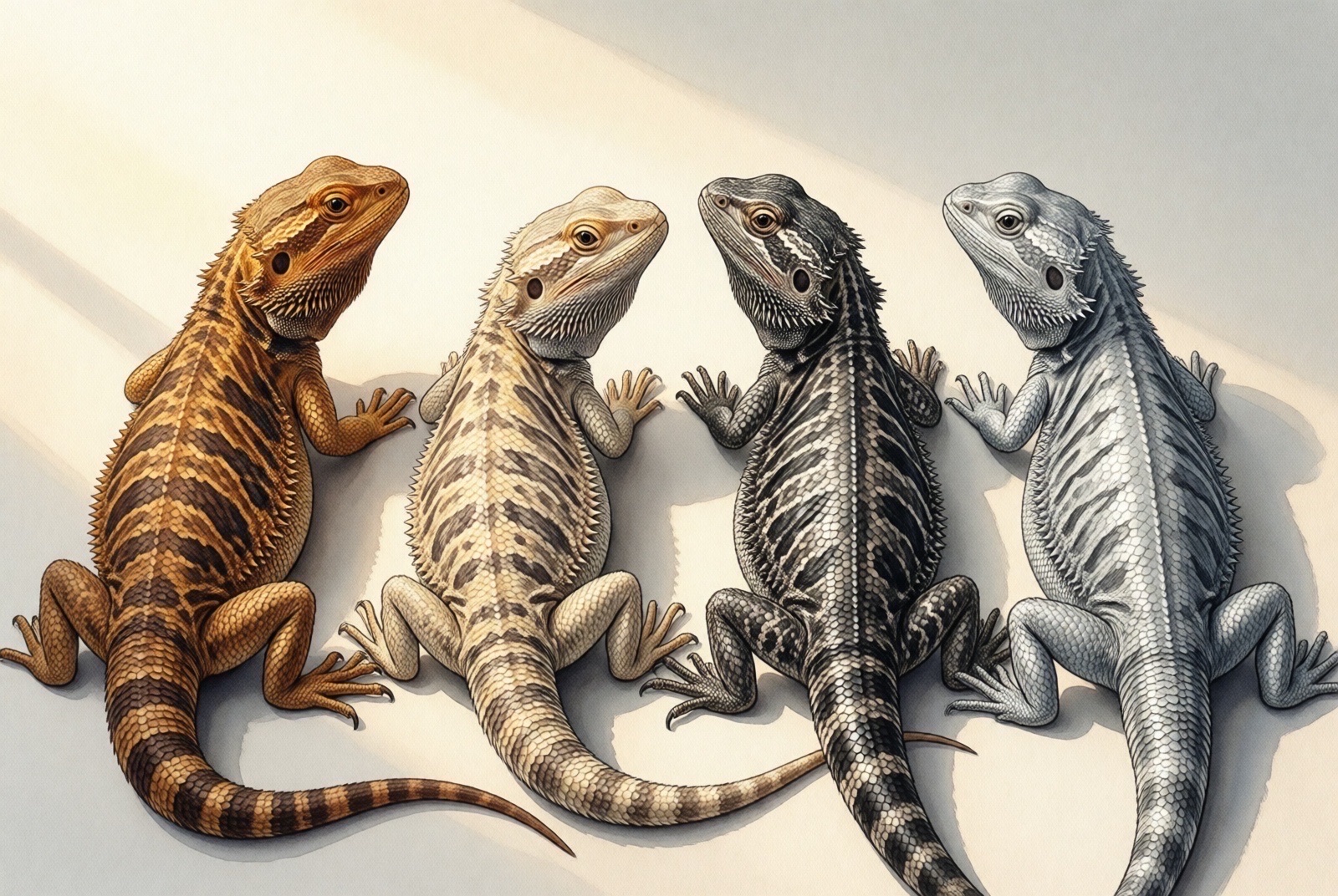
Bearded dragon morphs explained simply: a morph is a genetic variation that alters the lizard’s appearance — its color, pattern, scale texture, or body structure. Unlike separate species, morphs are all Pogona vitticeps with different visual traits caused by selective breeding of recessive or dominant genes. A “Hypo” morph is the exact same species as a normal wild-type; it simply carries genes that reduce dark pigmentation.
Common Color Morphs
The bearded dragon colors chart below covers the most common morphs available in the pet trade. Over three decades of selective breeding have produced dozens of variations, and new combinations appear regularly.
Normal/Wild Type — The natural coloration: brown-yellow base with darker bands and markings. This is what the species looks like in the wild. The most affordable and widely available morph.
Hypo (Hypomelanistic) — Reduced dark pigmentation (melanin) results in a lighter, cleaner appearance with fewer dark markings. Hypo dragons have clear nails instead of the dark nails seen in normal dragons.
Translucent — Semi-transparent scales, especially visible on the belly where internal coloring shows through. Hatchlings often have blue-tinted eyes that darken with age. A visually striking morph.
Leatherback — Reduced and smoothed dorsal scales create a softer, leather-like texture. Leatherbacks have fewer spikes and a smoother feel. One of the most popular morphs due to both appearance and texture.
Silkback — The extreme version of the Leatherback gene. Silkbacks have virtually no scales, resulting in a smooth, almost rubbery skin. This makes them strikingly unique but requires special care — they are more prone to skin injuries, dehydration, and shedding difficulties. Not recommended for first-time keepers.
German Giant — A larger morph that can exceed 24 inches and 600 grams. German Giants are bred for size rather than color, making them popular with keepers who want an impressive, substantial lizard.
Zero — Completely patternless with a solid, uniform color. Zero dragons can range from silver to dark charcoal. The lack of pattern creates a clean, modern aesthetic that commands premium prices.
Witblits — A patternless morph similar to Zero but with warm yellow-to-orange tones instead of gray. “Witblits” is Afrikaans for “white blaze.” A relatively newer morph that has gained popularity quickly.
Dunner — Irregular, conical scales arranged in a disorganized pattern rather than neat rows. Dunner dragons have a rougher, more textured appearance and distinctive zigzag patterns.
Paradox — Perhaps the most visually unusual morph — patches of color appear randomly, as if splashed or painted onto the dragon. No two Paradox dragons look alike. The genetics behind Paradox coloring are not fully understood.
| Morph | Appearance | Rarity | Price Range | Special Care |
|---|---|---|---|---|
| Normal/Wild | Brown-yellow + dark markings | Common | $30-60 | None |
| Hypo | Lighter, fewer dark markings | Common | $50-100 | None |
| Translucent | Semi-transparent scales | Moderate | $75-200 | Handle gently |
| Leatherback | Smooth dorsal scales | Common | $75-150 | None |
| Silkback | Scaleless, rubbery skin | Moderate | $100-300 | Moisture, skin care |
| German Giant | Oversized 24”+ | Uncommon | $100-250 | Larger enclosure |
| Zero | Patternless solid color | Moderate | $150-400 | None |
| Witblits | Patternless warm tones | Uncommon | $150-400 | None |
| Dunner | Irregular scale pattern | Uncommon | $100-250 | None |
| Paradox | Random color patches | Rare | $200-500+ | Varies |
Natural Habitat
Natural Habitat
The bearded dragon habitat in the wild spans the arid and semi-arid regions of eastern and central Australia. These lizards inhabit dry sclerophyll forests, scrublands, rocky outcrops, and desert edges across Queensland, New South Wales, Victoria, South Australia, and the Northern Territory.
The climate in their native range is characterized by hot, dry summers and mild winters. Daytime temperatures during summer regularly reach 95-105°F (35-40°C), while nighttime temperatures drop to 60-75°F (15-24°C). Humidity is consistently low. This temperature swing between day and night is critical to their biology — they thermoregulate by shuttling between sun-exposed basking spots and shaded cool areas.
In the wild, they are opportunistic omnivores. They spend mornings basking on elevated perches — rocks, fence posts, fallen trees — watching for insect prey. Afternoons are spent foraging for vegetation, flowers, and smaller prey. When threatened, they flatten their bodies against the ground, puff their beard, and open their darkened mouth in a threat display.
A critical fact for prospective owners: Australia banned the export of all native wildlife in the 1970s. Every specimen sold as a pet anywhere in the world is captive-bred, many generations removed from wild-caught ancestors. For reptile habitat setup guidance for captive care, see our habitat guide.
Bearded Dragon Behavior & Temperament
Their personality is one of their biggest selling points. Among pet reptiles, few species are as consistently engaging and interactive. Their diurnal activity pattern (active during daylight hours) aligns with most owners’ schedules, unlike nocturnal species that sleep all day and become active when you are trying to sleep.
Signature Behaviors
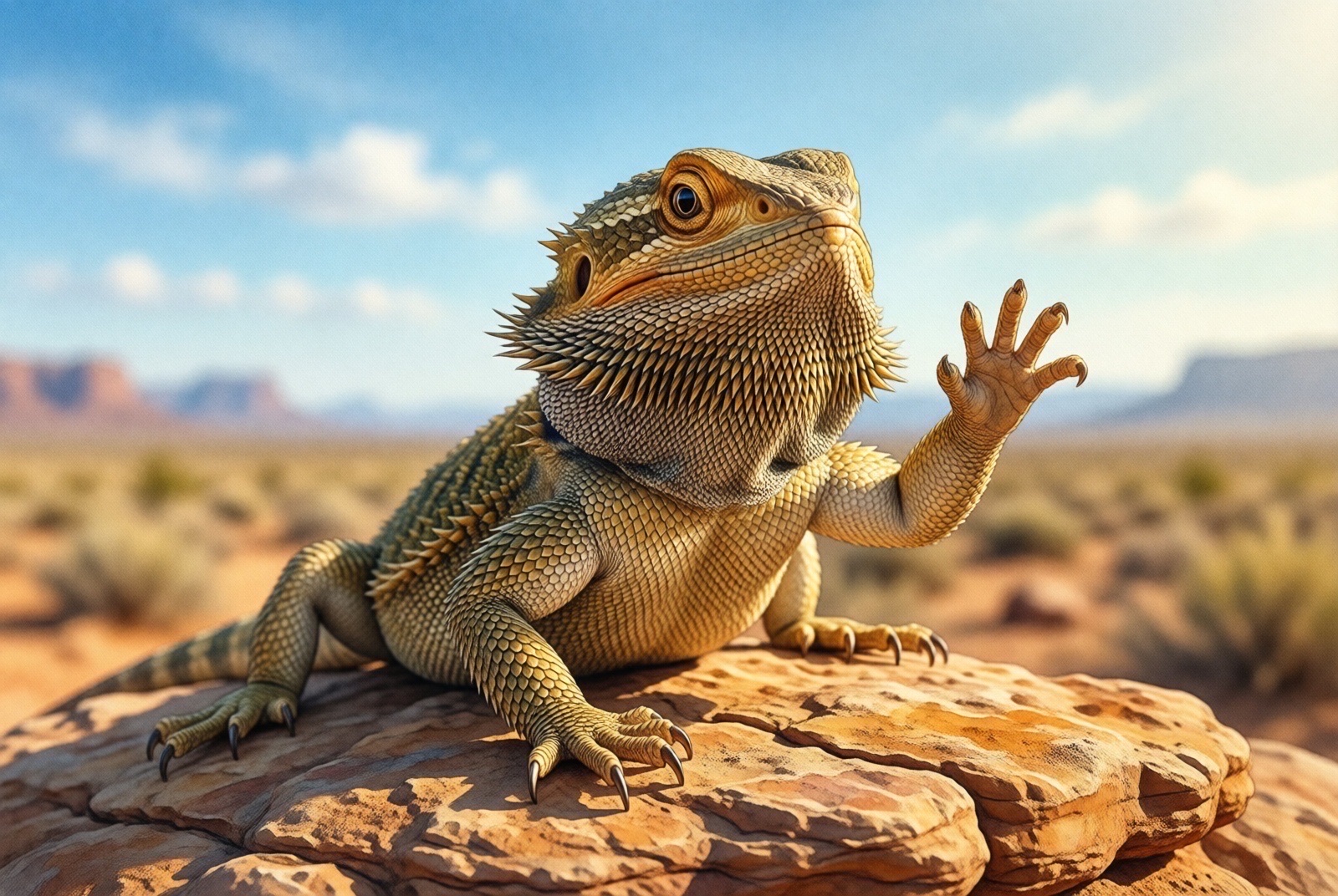
Bearded dragons communicate through a repertoire of distinct body language signals that, once learned, make it easy to understand their mood and intentions.
Arm waving — A slow, circular wave of one front arm. This is a submissive or appeasement gesture, often seen in juveniles toward larger dragons or when a dragon feels uncertain. It essentially means “I’m not a threat.”
Head bobbing — Rapid up-and-down head movement, usually by males. This signals territorial assertion or courtship interest. A faster, more aggressive bob communicates dominance, while a slower bob is part of mating behavior.
Beard puffing — The defining behavior: the dragon darkens its throat beard and puffs it outward. This signals stress, territorial defense, or excitement. Males beard more frequently and more dramatically than females. A very dark, almost black beard indicates high stress or aggression.
Mouth gaping — The dragon holds its mouth open for extended periods. This is most often thermoregulation — the reptilian equivalent of a dog panting. When basking temperatures get too warm, gaping helps cool the dragon through evaporative heat loss. If gaping occurs away from the basking spot, it may indicate respiratory distress.
Temperament
With consistent, gentle handling from a young age, they become remarkably tame. They often climb onto their owner’s hand voluntarily, ride on shoulders, and show recognition of familiar people. Compared to other popular pet reptiles, they are more interactive than leopard geckos as an alternative (which tend to be more hands-off) and more predictable than crested geckos (which are fast and delicate).
Male vs Female
Male vs Female
The bearded dragon male vs female differences are subtle when young but become more apparent as the dragon matures.
Physical differences: Males develop broader heads, thicker tail bases, and more prominent beards. The most reliable identifiers are hemipenal bulges at the base of the tail (present in males) and pre-femoral pores on the inner thighs (larger and more pronounced in males). Females are generally slightly smaller and have narrower heads and tails.
Behavioral differences: Males display more head bobbing and territorial behavior. Females tend to be calmer, though individual personality varies enormously.
Determining sex: Hemipenal probing by an experienced handler is the most accurate method for juveniles. Visual inspection of hemipenal bulges becomes reliable at 4-6 months.
Practical implication: Females can develop eggs even without mating (oviposition). Gravid females need an egg-laying site and extra calcium. Egg-binding is a life-threatening emergency.
Cost Overview
Cost Overview
The cost extends well beyond the purchase price. Understanding the full financial commitment helps prevent impulse purchases.
| Expense | Normal Type | Common Morph | Rare/Designer Morph |
|---|---|---|---|
| Purchase | $30-60 | $50-150 | $200-500+ |
| Enclosure (4ft tank) | $150-300 | $150-300 | $150-300 |
| UVB lighting | $40-80 | $40-80 | $40-80 |
| Heating | $30-60 | $30-60 | $30-60 |
| Accessories | $50-150 | $50-150 | $50-150 |
| Initial setup total | $300-650 | $320-740 | $470-1,090+ |
| Monthly maintenance | $20-50 | $20-50 | $20-50 |
The initial setup is the largest expense, particularly the enclosure and UVB lighting system. A 4-foot (120 cm) tank is the minimum recommended enclosure size for an adult. Ongoing monthly costs cover live insects (crickets, dubia roaches), fresh vegetables, UVB bulb replacement (every 6-12 months), and substrate. For complete setup requirements, see our care guide.
Bearded Dragon Fun Facts
A few facts that make this species even more interesting:
Third eye — They have a parietal eye on top of their head that detects changes in light intensity. It helps sense overhead predators and regulate circadian rhythms. Never shine a bright light directly downward onto a dragon’s head.
Continuous tooth replacement — Unlike most lizards, they are polyphyodont, continuously replacing their teeth throughout their lives. New teeth grow beneath old ones and push them out.
Diet shift with age — Juveniles are 70-80% insectivorous, while adults shift to 75-80% plant-based. Feeding an adult like a juvenile leads to obesity and fatty liver disease.
Brumation — In the wild, they undergo brumation (reptilian hibernation) during cooler months. Pet specimens may or may not brumate depending on lighting and temperature conditions.
They can swim — Despite being desert animals, they are capable swimmers who hold their breath and paddle with all four legs. Some enjoy shallow warm baths for hydration and shedding assistance.
For a completely different reptile experience, see our crested gecko care as a smaller, arboreal option.
Conclusion
This species is one of the most rewarding pet reptiles available. Its combination of diurnal activity, calm temperament, and willingness to interact with owners makes it far more engaging than most people expect from a reptile. The eight Pogona species are fascinating in their diversity, though only the Central Bearded Dragon (Pogona vitticeps) is widely kept as a pet. Understanding the species — its natural habitat, growth patterns, behavior signals, and morph variations — is the foundation of responsible ownership.
Ready to bring one home? Start with our care guide for enclosure setup, diet plans, and health management. Want to compare with leopard gecko as an alternative? Our leopard gecko breed page covers another excellent beginner reptile. For a completely different reptile experience, see our crested gecko care as a smaller, arboreal option.