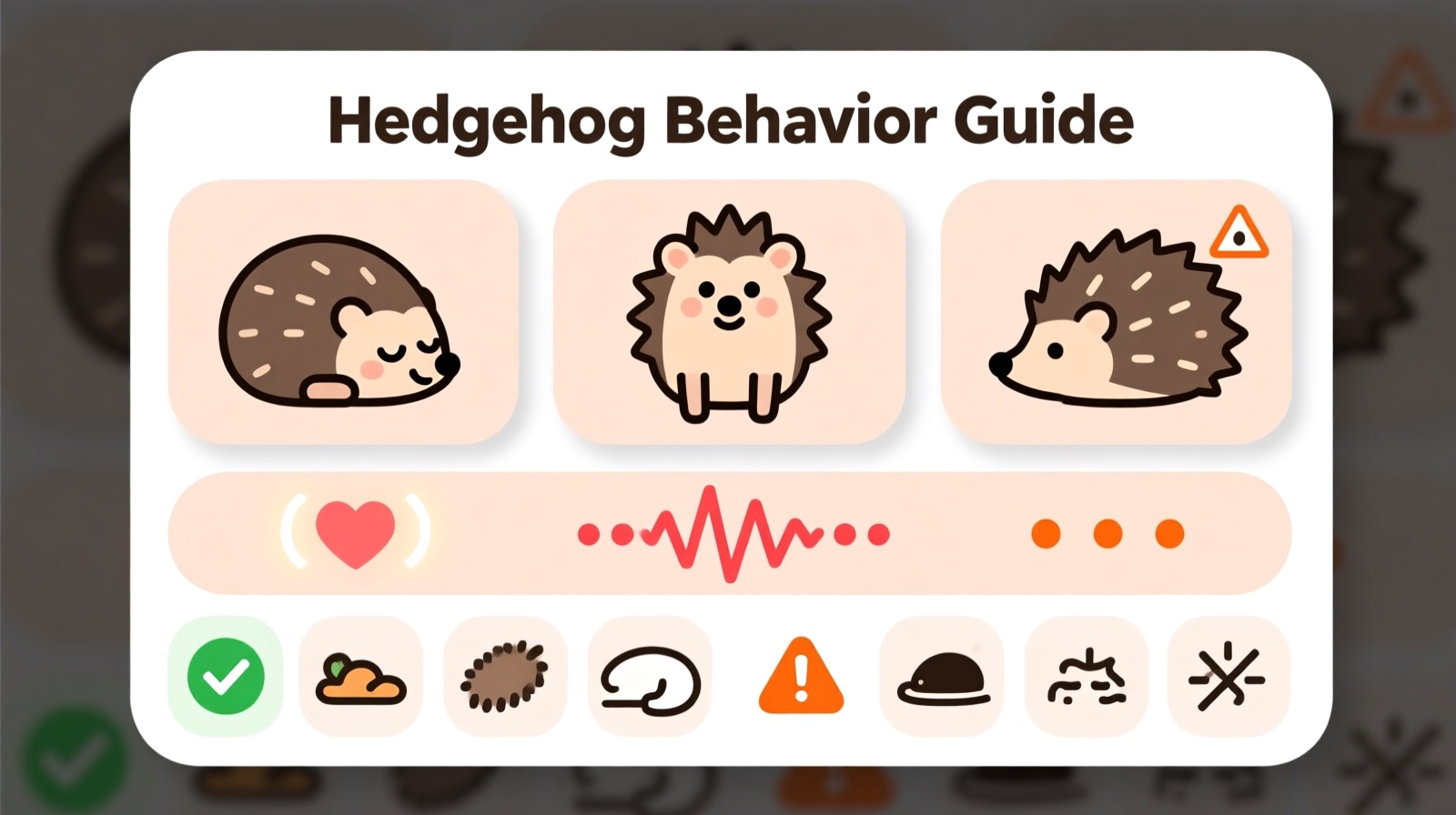
Your hedgehog is hissing, balling up, and refusing to unroll. You’re wondering if something is wrong — or if this is just normal hedgehog behavior. The answer depends on context, age, and how long you’ve had them.
I’ve been through this with every hedgehog I’ve worked with: the first two weeks are a blur of defensive sounds, tight balls, and what looks like pure hostility. Then gradually, the quills flatten, the exploring starts, and you realize all that drama was just a scared baby figuring out you’re not a predator.
This guide covers every hedgehog behavior you’ll encounter — what’s normal, what’s not, and exactly when to worry. I’ve organized it as a quick-reference format so you can come back whenever something weird happens at 2 AM.
Quick Reference: Hedgehog Body Language Chart
Use this table to quickly identify any hedgehog behavior and decide what to do. The key question throughout this guide: Is this behavior new? A sudden change in an established hedgehog is more concerning than the same behavior in one that’s still adjusting.
| Behavior | What It Looks Like | Meaning | Normal? | Action |
|---|---|---|---|---|
| Quills flat, relaxed | Smooth back, quills lying down | Content, comfortable | Normal | None — enjoy! |
| Quills raised | Quills standing up, crossed over face | Scared, defensive | Normal (new hedgehogs) | Give space, approach slowly |
| Balling up | Tight ball, only quills visible | Defense mechanism | Normal | Wait for them to relax |
| Hissing | Sharp exhale sound | Warning, fear | Normal | Don’t pick up yet |
| Popping | Louder, more forceful than hissing | Stronger warning | Normal | Back off |
| Self-anointing | Chewing → frothing → spreading on quills | Scent exploration | Normal | Let them finish (messy but safe) |
| Snuffling | Sniffing while walking, nose to ground | Exploring, foraging | Normal | Healthy hedgehog behavior |
| Splooting | Lying flat, legs stretched out | Completely relaxed | Normal | Your hedgehog trusts you |
| Shaking (brief) | Quick tremor while sniffing new things | Scent/taste sampling | Normal | Normal exploration |
| Shaking (constant) | Trembling while stationary | Too cold, pain, or illness | Abnormal | Check temp, see vet |
| Wobbly walking | Unsteady gait, head tilt | Neurological issue, WHS | Abnormal | Vet immediately |
| Scratching constantly | Excessive scratching, bald spots | Mites or skin infection | Abnormal | Vet treatment needed |
| Not eating + lethargic | Hiding, refusing food, hunched posture | Illness, pain | Abnormal | Vet within 24h |
| Screaming | Loud, prolonged distress call | Severe pain or terror | Abnormal | Vet immediately |
Normal Hedgehog Behavior: What to Expect
Hedgehogs are solitary, nocturnal, and naturally shy animals. They are not cuddly by nature — they’re prey animals with an elaborate set of defensive behaviors designed to keep them alive in the wild. Understanding what’s normal hedgehog behavior prevents a lot of unnecessary worry and helps you recognize when something is actually wrong.
Typical daily pattern:
- Sleep most of the day (12–14 hours is normal)
- Become active at dusk and throughout the night
- Run on their wheel (3–5 miles per night is healthy exercise)
- Snuffle and explore their enclosure, nose to the ground
- Self-anoint when they encounter new smells
- May hiss or pop when first woken up — they don’t like being startled from sleep
Personality changes by age:
Baby hedgehogs (4–12 weeks) are extremely defensive. Constant hissing, balling up, and even biting are completely normal at this age — it’s the quilling period, and their gums are sore. Don’t judge their adult personality during this phase. I’ve seen hedgehogs that were absolute terrors at 8 weeks turn into relaxed, friendly adults by 6 months.
Juveniles (3–6 months) start to settle down. Their personality begins emerging — you’ll see them explore more, accept handling with less protest, and develop individual quirks. Some will always be shy, others become surprisingly bold.
Adults (6+ months) have established personalities. Some become genuinely friendly and will explore on your hands. Others remain cautious but tolerant. Both extremes are normal hedgehog behavior — there’s no “wrong” personality.
Seniors (3+ years) may slow down, sleep more, and become less active on their wheel. This gradual change is normal. Sudden lethargy in a senior hedgehog is not — see a vet. For more on life stages, see our hedgehog lifespan guide.
Normal territorial behavior: Hedgehogs are strictly solitary. They don’t need or want a companion. Two hedgehogs housed together will fight — sometimes severely. One hedgehog, one cage, always. For comprehensive care information, see our hedgehog care guide.
Hedgehog Body Language: Reading the Quills
A hedgehog’s quills are their primary communication tool. Quill position tells you everything about their emotional state at any given moment. Learning to read hedgehog body language through quill posture is the single most useful skill for understanding hedgehog behavior.
Relaxed Quills (Happy/Comfortable)
Quills lying flat against the body, smooth and even, with no visible muscle tension along the back. The hedgehog will move freely, explore without hesitation, and may unroll completely on your hand. This is the state you’re working toward through bonding — it means your hedgehog trusts you and feels safe in their environment.
When you see relaxed quills, your hedgehog is comfortable. They may snuffle around, investigate their surroundings, and move with a relaxed, waddling gait. This is baseline comfortable hedgehog behavior.
Raised Quills (Alert/Concerned)
Quills standing partially up, creating a slightly bristled appearance. The muscles along the back are tense but not fully contracted. This is an in-between state — the hedgehog has noticed something new or potentially concerning but hasn’t committed to full defense mode yet.
Raised quills often transition one way or the other: either the hedgehog determines the stimulus is safe (quills relax) or decides it’s a threat (full defensive posture). Wait and see — don’t force interaction when quills are raised.
Fully Deployed Quills (Scared/Defensive)
All quills raised and crossed over the face, creating an impenetrable barrier of spikes. This is maximum defense — the hedgehog’s equivalent of “back off, I’m scared.” The muscles along the entire back are fully contracted. Accompanied by hissing, popping, or clicking sounds.
Never try to pry open a fully deployed hedgehog. Wait. Speak softly. Place your flat hand nearby and let them decide you’re safe. Patience is the only effective approach here.
Ear Position Signals
Ears provide additional hedgehog body language cues. Forward-facing ears indicate curiosity and alertness — the hedgehog is interested in something. Flat or pinned-back ears signal fear and stress. One ear up and one down usually means the hedgehog is relaxed and in a casual mood. Ear position combined with quill posture gives you a complete picture of their emotional state.
Eye Signals
Normal round eyes indicate a calm hedgehog. Squinting eyes suggest annoyance or sleepiness. Wide, bulging eyes mean the hedgehog is frightened — this often accompanies raised quills. Half-closed eyes while exploring signal relaxation and focus on their environment.
Understanding Hedgehog Sounds
Hedgehogs are surprisingly vocal animals. Each sound has a specific meaning, and learning to distinguish between them helps you respond appropriately to your hedgehog’s behavior. Here’s the complete hedgehog sounds reference:
| Sound | Description | Meaning | When to Worry |
|---|---|---|---|
| Hissing | Sharp, snake-like exhale | ”I’m scared, back off” | Normal for new hedgehogs |
| Popping | Louder, more forceful hissing | ”I’m really upset” | Normal if triggered; constant = stress |
| Squeaking | High-pitched, brief | Discomfort or mild pain | Constant squeaking = vet |
| Clicking | Soft clicking while exploring | Content, relaxed | Never a concern |
| Snorting/Snuffling | Heavy nose breathing | Exploring, foraging | Never a concern |
| Screaming | Loud, prolonged distress call | Extreme pain or terror | Immediate vet |
| Chirping | Bird-like sound (rare) | Mating call or contentment | Only in breeding season |
| Whistling | Soft, wheezy sound | Respiratory distress | Vet — possible URI |
Hissing and Popping (Defensive Sounds)
Hedgehog hissing and popping are the most common sounds new owners hear, and the ones that cause the most concern. Both sounds are defensive — the hedgehog is telling you they feel threatened. This is not aggression. A hissing hedgehog doesn’t want to fight; they want you to leave them alone.
Normal triggers include being picked up, sudden movements, loud noises, unfamiliar smells, and being woken up abruptly. In new hedgehogs, these sounds are constant for the first 1–2 weeks.
What to do: Stay calm, hold still, and let them settle. Avoid picking up a hissing hedgehog from above — approach from the side or use a scoop.
When it’s abnormal: If an established hedgehog that previously never hissed suddenly starts hissing constantly, this may indicate pain. Check for other illness signs and see a vet if it persists.
Screaming (Emergency Sound)
A hedgehog scream is unmistakable — it’s a loud, high-pitched distress call. Causes include severe pain, internal blockage, or extreme terror. If you hear screaming, check immediately and see a vet.
Self-Anointing: The Weird Behavior That’s Completely Normal
The first time I saw a hedgehog self-anoint, I thought something was seriously wrong. The hedgehog was chewing on a piece of new fleece, then suddenly started contorting its body into positions I didn’t think were physically possible, spreading white foam all over its quills. It looked alarming — but hedgehog self-anointing is one of the most normal (and entertaining) hedgehog behaviors you’ll witness. Understanding which behaviors are normal vs. abnormal is the key to confident hedgehog ownership.
What it looks like: The hedgehog chews on something with a new or strong smell — food, a toy, your shirt, a new type of bedding. Then they create a frothy saliva mixture in their mouth and contort their body to spread the foam over their quills and back. The whole process takes a few minutes and can look disturbing.
Why they do it: The exact reason is still debated among researchers, but leading theories include:
- Camouflage: Masking their own scent from predators by coating themselves with environmental scents
- Defense: Applying mild irritants from the chewed material to their quills, making themselves less palatable to predators
- Scent communication: Sharing information about their environment through scent marking
How often: Some hedgehogs self-anoint weekly, others do it rarely. It’s more common with strong-smelling substances — citrus fruits, certain plastics, new fabrics, and aromatic treats. There’s no “normal” frequency; each hedgehog has their own pattern.
What to do: Nothing — it’s completely healthy hedgehog behavior. Don’t interrupt them or try to wipe off the foam. Self-anointing is a sign of a healthy, curious hedgehog.
Balling Up: The Hedgehog Defense Mechanism
Balling up is controlled by a muscle called the orbicularis panniculi — when it contracts, it pulls the quills over the face, belly, and legs, creating a tight ball of spikes. In the wild, most predators give up on a balled-up hedgehog.
Normal triggers: New hedgehogs ball up constantly for the first 1–2 weeks. Loud noises, sudden movements, being picked up from above (predator approach), and unfamiliar environments all trigger it.
How to help them relax:
- Place your flat palm in the cage and wait
- Scoop from underneath, never from above
- Hold against your body — warmth and heartbeat are calming
- Be patient — bonding takes time
Hedgehog balling up is only abnormal when an established, bonded hedgehog suddenly does it constantly and refuses to unroll. This can indicate pain or illness — see a vet. Consistent, defensive hedgehog behavior in a new pet, however, is just part of the bonding process. For more handling tips, see our hedgehog care guide.
Biting: Why It Happens and How to Stop It
Hedgehog biting is relatively uncommon but it does happen, and understanding why helps you prevent it. Most hedgehog bites are minor — they’re exploring with their mouths, not attacking. Biting is one of the most concerning hedgehog behaviors for new owners, but it’s usually easy to resolve once you identify the trigger.
| Cause | How to Identify | Solution |
|---|---|---|
| Food smell on hands | Most common cause. Bites fingers. | Wash hands before handling |
| Fear/defense | Happens when startled or picked up incorrectly | Use scoop method, be gentle |
| Quilling discomfort | Age 4–12 weeks, gums sore from growing quills | Gentle handling, offer soft food |
| Exploration/tasting | Light nibble, not aggressive | They’re checking you out — normal |
| Pain/illness | Sudden new biting in an established hedgehog | Vet visit needed |
How to respond when your hedgehog bites you:
- Don’t react — no yelling, no pulling away (pulling makes them bite harder)
- Blow gently on their face — a harmless deterrent they dislike
- Wash your hands and try again
- If persistent, offer a treat to redirect
Never: Flick, tap on the nose, or punish — this destroys trust and makes hedgehog behavior worse.
Quilling: The Stressful Growing Phase
Quilling is the process of losing baby quills and growing adult ones. It’s the hedgehog equivalent of teething, and it has a significant impact on hedgehog behavior during specific age ranges.
| Quilling Stage | Age | Duration | Behavioral Impact |
|---|---|---|---|
| First quilling | 4–6 weeks | 2–3 weeks | Mild irritability |
| Major quilling | 7–12 weeks | 3–4 weeks | Hissing, biting, reduced appetite, very cranky |
| Adult quilling | 4–6 months | 1–2 weeks | Mild discomfort |
| Occasional | Throughout life | A few days | Barely noticeable |
During major quilling (7–12 weeks), expect significantly worse hedgehog behavior. Your previously manageable baby may suddenly hiss constantly, bite when handled, eat less due to sore gums, and be less active on their wheel. You’ll find quills everywhere — in bedding, on the wheel, on your clothes. This is normal.
How to help a quilling hedgehog:
- Add a few drops of olive oil to their food (soothes skin where new quills push through)
- Offer soft food — scrambled egg, Tiki Cat Born Carnivore wet food, or Fancy Feast Poultry are gentler on sore gums
- Keep handling gentle but consistent — don’t stop bonding during quilling
Quilling vs Mites — How to Tell the Difference:
This is one of the most common diagnostic questions in hedgehog behavior. Both cause quill loss, but the pattern is completely different.
| Sign | Quilling | Mites |
|---|---|---|
| Quill loss pattern | Even, symmetrical, all over the body | Patchy, especially behind ears and at base |
| Scratching | Minimal to none | Constant, frantic, obsessive |
| Skin appearance | Normal, maybe slightly dry | Red, crusty, irritated, scabby |
| Age | 4–12 weeks (baby), 4–6 months (adult) | Any age |
| Duration | 2–4 weeks, then resolves on its own | Won’t resolve without treatment |
| Behavior | Cranky but otherwise normal | Increasingly distressed, losing weight |
If you’re unsure whether it’s quilling or mites, see a vet. Mites require medication; quilling resolves on its own. For dietary support during quilling, see our best hedgehog food and hedgehog soft food guides.
Abnormal Hedgehog Behavior: When to See a Vet
Some hedgehog behavior changes signal medical emergencies. Knowing the difference between “my hedgehog is adjusting” and “my hedgehog needs a vet right now” can be the difference between life and death. When in doubt about any hedgehog behavior that seems off, always err on the side of caution.
| Abnormal Behavior | Possible Cause | Urgency |
|---|---|---|
| Wobbly walking / head tilt | Wobbly Hedgehog Syndrome (WHS), neurological issue | Warning: Vet immediately |
| Screaming | Severe pain, internal blockage | Warning: Vet immediately |
| Not eating for 24+ hours | Dental issues, internal blockage, infection | Warning: Vet within 24h |
| Constant scratching | Mites, fungal infection | 🟠 Vet same week |
| Lethargic, hunched, not active at night | Infection, organ issue | 🟠 Vet same week |
| Whistling/wheezing breathing | Respiratory infection (URI) | 🟠 Vet same week |
| Green or bloody stool | Bacterial infection, parasites | 🟠 Vet same week |
| Sudden aggression in bonded hedgehog | Pain (dental, internal) | 🟠 Vet same week |
| Dragging one side of body | Stroke, injury, neurological | Warning: Vet immediately |
| Constant circling in one direction | Ear infection, neurological | 🟠 Vet same week |
The most critical rule: A hedgehog not eating and lethargic for more than 24 hours needs veterinary attention. Hedgehogs deteriorate quickly — don’t wait to see if they improve. Unusual hedgehog behavior that persists beyond a day or two should always prompt a vet visit.
Temperature emergency: Hedgehogs kept below 72°F (22°C) will attempt hibernation, which is fatal for African pygmy hedgehogs. If your hedgehog is lethargic and cold to the touch, warm them gradually with a blanket and get the ambient temperature to 74–80°F immediately. See our hedgehog cage setup guide for setup details.
For health emergencies, see our hedgehog health guide.
Environmental Factors That Affect Hedgehog Behavior
Your hedgehog’s environment directly impacts their behavior. Problems in the cage often show up as behavioral changes before they become physical health issues. Monitoring your hedgehog’s environment is the first step in preventing problem hedgehog behavior.
Temperature: This is the single most important environmental factor. Below 72°F triggers hibernation attempts (dangerous and potentially fatal). Above 85°F causes heat stress and lethargy. The ideal range is 74–80°F. I recommend keeping a digital thermometer with probe in the cage to monitor conditions accurately. Temperature-related hedgehog behavior changes are common and often mistaken for illness.
Cage size: Too small = stressed hedgehog. Stressed hedgehogs pace, exhibit repetitive behaviors (like constant bar rubbing), and become more defensive. Minimum cage size is 4 square feet; I recommend 6–8 square feet for healthy hedgehog behavior. See our best hedgehog cage guide for specific recommendations.
Bedding: Dusty or aromatic bedding irritates hedgehog skin and respiratory systems, causing scratching, sneezing, and self-anointing triggered by the bedding smell. Low-dust paper bedding like Oxbow Pure Comfort or Small Pet Select paper bedding works well. For bedding options, see our hedgehog bedding guide.
Lighting: Hedgehogs need 12–14 hours of consistent light daily to maintain a healthy circadian rhythm. Too little light can cause depression and reduced appetite. A desk lamp on a timer near (not inside) the cage is a simple solution.
Noise: Sudden loud noises trigger defensive hedgehog behavior — hissing, balling up, and jumping. Keep the cage in a calm area away from TVs, speakers, and high-traffic zones.
Bonding With Your Hedgehog: A Realistic Timeline
Bonding is a gradual process that shapes your hedgehog’s behavior toward you. There’s no shortcut — it takes consistent, patient daily handling. Here’s what to expect at each stage:
| Time | What to Expect | What to Do |
|---|---|---|
| Day 1–3 | Hissing, balling up, won’t unroll at all | Sit near cage, talk softly, don’t force handling |
| Week 1 | May unroll briefly, still very defensive | Daily 15-minute handling sessions, use a fleece blanket |
| Week 2–3 | Starting to explore on you, less hissing | Offer treats (mealworms, dried black soldier fly larvae), hold against body |
| Week 4 | Recognizing your scent, noticeably calmer | Normal handling, start building a consistent routine |
| Month 2–3 | Established bond, personality showing | Regular interaction, some hedgehogs become surprisingly cuddly |
| Month 3+ | Full personality expressed | Maintenance handling, enjoy your hedgehog |
Enrichment during bonding: Providing a silent exercise wheel, tunnels, and a foraging mat gives your hedgehog healthy outlets for natural behaviors. For more ideas, see our hedgehog toys guide.
The most important bonding advice: be patient and consistent. Skip a day and you lose progress. Some hedgehogs bond in 2 weeks; others take 2 months. Both timelines are normal. For dietary guidance, see our hedgehog diet guide.
Frequently Asked Questions
Why is my hedgehog hissing at me?
Hissing is a hedgehog’s primary defense sound — it means “I’m scared or threatened.” New hedgehogs hiss constantly during the first 1–2 weeks as they adjust. Other triggers include sudden movements, loud noises, unfamiliar smells, or being woken up. Let them calm down, approach slowly from the side, and avoid picking them up from above. Hissing is normal defensive hedgehog behavior, not aggression.
Why is my hedgehog shaking?
Brief shaking (1–3 seconds) while exploring is normal hedgehog behavior — it’s how they sample their environment through scent and taste. However, constant trembling or shaking while stationary can indicate being too cold (below 72°F), illness, pain, or neurological issues. If the shaking is continuous and the hedgehog isn’t actively exploring, check the temperature first, then see a vet if it persists after warming.
Why do hedgehogs self-anoint?
Self-anointing is when a hedgehog chews on something new or strong-smelling, then creates a frothy saliva mixture and spreads it over their quills. It’s completely normal hedgehog behavior and believed to be a defense mechanism — possibly to camouflage their scent from predators or to apply mild toxins from the chewed material. It looks alarming but is actually a sign of a healthy, curious hedgehog.
Is it normal for hedgehogs to ball up?
Yes — balling up is the hedgehog’s primary defense mechanism. They roll into a tight ball when startled, scared, or handled by unfamiliar people. New hedgehogs do this constantly. As your hedgehog bonds with you, balling up should decrease significantly, though they may still do it when startled. It’s only abnormal if an established, bonded hedgehog suddenly starts balling up constantly, which could indicate illness or pain.
Why does my hedgehog bite me?
Hedgehogs bite for several reasons: smelling something tasty on your hands (most common cause), feeling threatened or scared, teething during quilling periods (4–12 weeks), pain or illness, or accidentally while tasting your fingers. Wash your hands before handling. If biting is new and persistent in an established hedgehog, check for signs of illness — loss of appetite, lethargy, hunched posture.
How do I know if my hedgehog is happy?
Signs of a happy hedgehog include relaxed body with quills laid flat (not raised), exploring actively, snuffling and sniffing while walking, accepting handling without balling up, running on their wheel at night, eating and drinking normally, and self-anointing (a sign of curiosity). A content hedgehog may also “sploot” — lying flat with legs stretched out when they feel completely safe and trust their environment.
Why is my hedgehog squeaking?
Squeaking in hedgehogs usually means discomfort or mild pain. Common causes include being handled too roughly, quilling discomfort (4–12 weeks old), nail trimming, skin irritation, or mites. A brief squeak during handling is normal hedgehog behavior. Continuous squeaking, especially when not being touched, needs vet attention — it can indicate internal pain or illness.
Do hedgehogs like to be held?
Most hedgehogs tolerate handling but don’t actively seek it out like dogs or cats. Bonding takes 2–4 weeks of daily 15–30 minute handling sessions. Once bonded, many hedgehogs will relax, unroll, and explore on you. Some never become cuddly — that’s normal for the species. They’re solitary, independent animals by nature. The goal is trust and tolerance, not affection in the traditional sense.