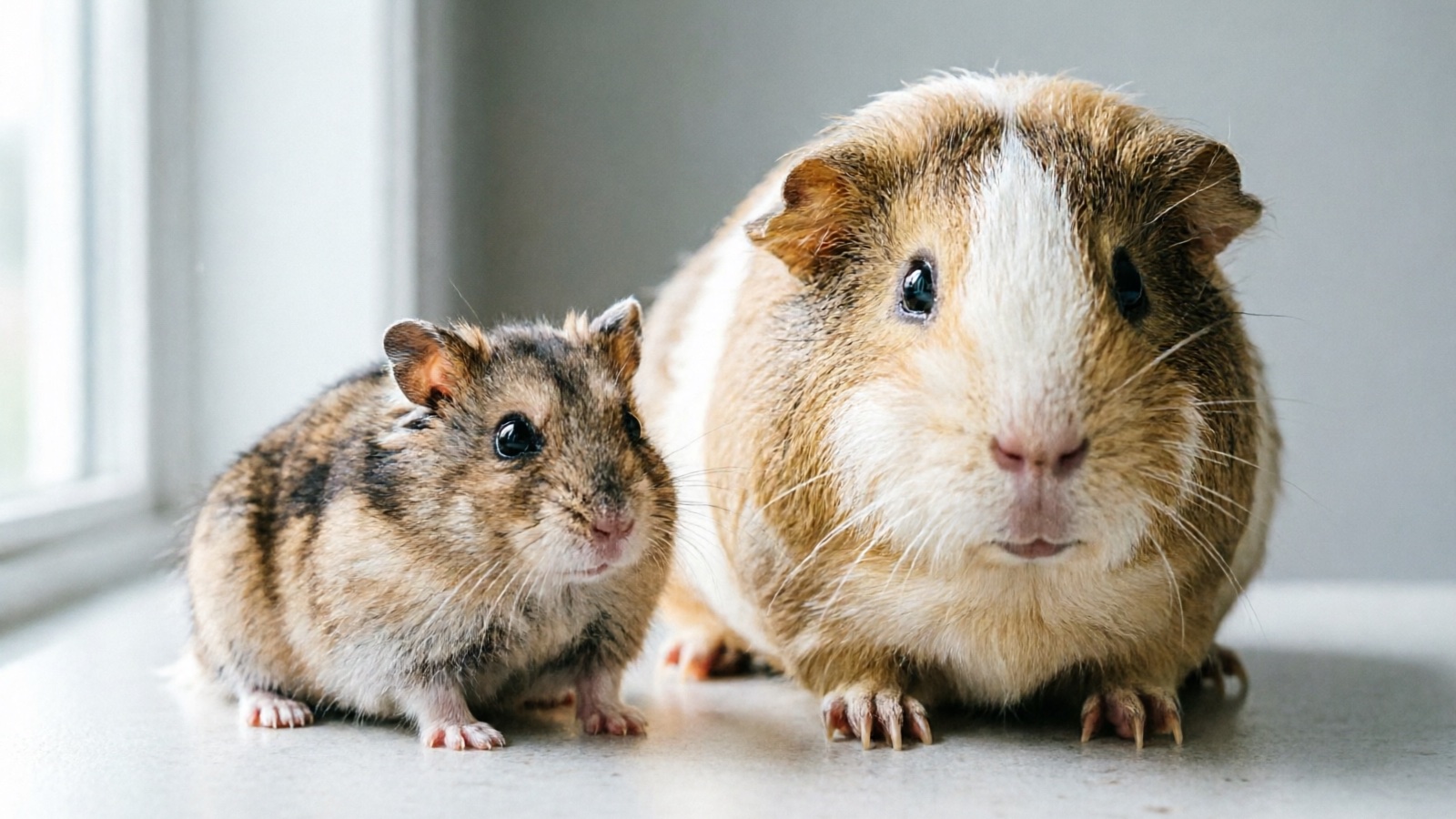
Quick Comparison at a Glance
Here’s the hamster vs guinea pig comparison in one table. I’ve kept both species, and honestly they’re completely different experiences.
| Feature | Hamster | Guinea Pig | Winner |
|---|---|---|---|
| Lifespan | 2-3 years | 5-7 years | 🐹 Guinea Pig |
| Adult Weight | 25-200g | 700-1,200g | Depends on preference |
| Cage Size (minimum) | 600 sq in | 7.5 sq ft (per pig) | 🐹 Hamster (less space) |
| Initial Cost | $80-200 | $150-300 | 🐹 Hamster |
| Monthly Cost | $15-30 | $40-80 | 🐹 Hamster |
| Social Needs | Solitary | Needs a friend | 🐹 Hamster (easier) |
| Active Time | Night | Day | 🐹 Guinea Pig (daytime) |
| Child-Friendly | 8+ years | 5+ years | 🐹 Guinea Pig |
| Handling | Can bite if startled | Rarely bites | 🐹 Guinea Pig |
| Noise Level | Wheel squeaking (night) | Wheeking (day) | Depends |
| Vet Costs | $40-80/visit | $50-100/visit | 🐹 Hamster (lower) |
💡 TL;DR: Choose a hamster if you want a low-maintenance, solitary pet with a smaller budget. Choose a guinea pig if you want a social, interactive companion that’s awake during the day — and you have more space and a higher budget.
My hamster was my late-night companion; my guinea pigs were my daytime entertainment. The right choice depends entirely on your lifestyle, not which animal is “better.”
Size and Space Requirements
How Big Do They Get?
| Hamster | Guinea Pig |
|---|---|
| Weight | 25-200g (breed dependent) |
| Length | 4-7 inches |
| Syrian hamster | 120-200g, 6-7 inches |
| Dwarf hamster | 25-45g, 4-5 inches |
Guinea pigs are 5-10x heavier than even the largest hamster. For the smallest hamster breed, the Roborovski Dwarf Hamster weighs just 20-30g. This size difference matters for handling, cage requirements, and — critically — it’s why they can never live together.
Space Requirements
| Hamster | Guinea Pig |
|---|---|
| Minimum floor space | 600 sq in (24x30 in) |
| Recommended | 800+ sq in |
| Pair housing | No — solitary |
| Total for pair | N/A |
Guinea pigs need roughly 3-4x more floor space than hamsters. If you live in a small apartment, a hamster is the more practical choice. For a guinea pig pair, you need a footprint roughly equivalent to a small dining table.
For detailed hamster cage setup, see our hamster cage setup guide.
Cost Comparison: Hamster vs Guinea Pig
The hamster vs guinea pig cost difference is significant — not just upfront, but month after month.
Initial Setup Costs
| Item | Hamster | Guinea Pig |
|---|---|---|
| Cage/enclosure | $50-120 | $80-150 |
| Bedding (first bag) | $15-20 | $15-20 |
| Food bowl + water bottle | $10-15 | $15-20 |
| Wheel (hamster only) | $15-25 | N/A |
| Hideout | $8-15 | $10-15 |
| Hay rack (guinea pig) | N/A | $10-15 |
| Starter food | $8-12 | $10-15 |
| Total Initial | $106-207 | $140-245 |
The hamster vs guinea pig initial cost gap is about $30-50, mostly driven by the larger cage and hay accessories guinea pigs need.
Monthly Ongoing Costs
| Item | Hamster | Guinea Pig |
|---|---|---|
| Food mix | $5-8 | $5-8 |
| Hay (guinea pig staple) | N/A | $15-25 |
| Fresh vegetables | $3-5 | $8-15 |
| Bedding refill | $8-15 | $12-20 |
| Treats/enrichment | $3-5 | $3-5 |
| Total Monthly | $19-33 | $43-73 |
The biggest ongoing hamster vs guinea pig cost difference is hay. Guinea pigs need unlimited timothy hay — it’s 80% of their diet. Hamsters eat seed/grain mixes, which cost a fraction of that.
1-Year Total Cost Estimate
- Hamster: $300-600
- Guinea pig pair: $700-1,100
That’s roughly 2-3x more expensive for guinea pigs over the first year. The gap widens with each additional year due to the monthly hay and vegetable costs.
Lifespan and Commitment
| Hamster | Guinea Pig |
|---|---|
| Syrian hamster | 2-3 years |
| Dwarf hamster | 1.5-2 years |
| Guinea pig | — |
| Oldest recorded | 4.5 years |
This hamster vs guinea pig lifespan difference is one of the most overlooked factors. A guinea pig is a 5+ year commitment — comparable to a dog’s senior years. A hamster is shorter, which can be an advantage (less long-term responsibility) or a disappointment (you’ll say goodbye sooner).
For children: hamsters may not survive a child’s entire elementary school years. Guinea pigs will likely be with the family through middle school. See our hamster lifespan guide for breed-specific details.
Diet and Nutrition
| Hamster | Guinea Pig |
|---|---|
| Diet type | Omnivore |
| Staple food | Seed/grain mix (15-20g/day) |
| Pellets | Yes (supplemental) |
| Fresh vegetables | 1-2x/week |
| Fruit | Occasionally |
| Protein (eggs, mealworms) | Weekly |
| Vitamin C | Synthesizes own |
| Toxic foods | Citrus, onion, chocolate |
The most critical dietary difference: guinea pigs cannot synthesize vitamin C and will develop scurvy without supplementation. Daily vitamin C-rich vegetables (bell peppers, kale) or a vitamin C supplement are non-negotiable. Hamsters don’t have this requirement — their bodies produce vitamin C naturally.
Hamsters are omnivores, meaning they need some animal protein. A piece of hard-boiled egg once a week or a mealworm fills this need. Guinea pigs should never eat animal protein.
Social Needs and Behavior
| Hamster | Guinea Pig |
|---|---|
| Social structure | Solitary |
| Can live alone? | Yes — prefers it |
| Same-sex pairs? | No (will fight) |
| Bonding time | 15-30 min/day |
| Biting risk | Moderate (startled) |
| Enjoy handling? | Varies by individual |
| Noise | Wheel running (night) |
The biggest misconception in the hamster vs guinea pig debate: many people think hamsters need friends. Syrian hamsters will actually fight to the death if housed together. Dwarf hamsters can sometimes coexist in very large enclosures, but even then it’s risky. See our Syrian vs Dwarf hamster comparison for breed-specific behavior details.
Guinea pigs genuinely need companionship — in Switzerland it’s actually illegal to keep just one. If you can only have one pet, a hamster is the ethical choice.
Hamster vs Guinea Pig for Kids
| Factor | Hamster | Guinea Pig | Better for Kids |
|---|---|---|---|
| Age recommendation | 8+ years | 5+ years | 🐹 Guinea Pig |
| Size (fragility) | Very fragile | Sturdier | 🐹 Guinea Pig |
| Biting risk | Moderate | Very low | 🐹 Guinea Pig |
| Active time | Night | Day | 🐹 Guinea Pig |
| Handling tolerance | Low-moderate | High | 🐹 Guinea Pig |
| Maintenance | Low | Moderate | 🐹 Hamster (easier) |
| Entertainment value | Watch in cage | Interactive play | 🐹 Guinea Pig |
For the hamster vs guinea pig for kids question, guinea pigs win almost every category. They’re awake during the day when kids want to interact, much harder to accidentally injure, and genuinely enjoy being held. Hamsters are nocturnal — your child’s hamster will be sleeping when they want to play and running on a wheel at 2 AM.
My recommendation: for children under 8, guinea pigs are clearly the safer choice. For older children (8+) who can be gentle and respect a nocturnal schedule, hamsters are a good introduction to pet responsibility. See guinea pigs for kids for a full breakdown.
Housing and Setup
Cage Type
| Hamster | Guinea Pig |
|---|---|
| Best cage type | Glass tank or bin cage |
| Bar spacing | ≤ 1/2 inch |
| Minimum height | 12+ inches |
| Ventilation | Good (tank needs mesh lid) |
Hamsters need height for deep bedding and climbing. Guinea pigs need floor space — they’re ground-dwellers and don’t climb. A tall guinea pig cage is wasted space; a flat hamster cage is too small.
Bedding
Both species need safe, absorbent bedding. I recommend:
Kaytee Clean & Cozy Natural Paper Bedding (100L) — works well for both hamsters and guinea pigs. 99.9% dust-free and absorbs 6x its weight in liquid. Buy on Amazon →
Avoid: pine/cedar shavings (phenols cause respiratory issues), cotton wool (impaction risk). This applies to both species equally.
Exercise and Enrichment
| Hamster | Guinea Pig |
|---|---|
| Primary exercise | Running wheel (8+ inch) |
| Wheel needed? | Yes — mandatory |
| Tunnels | Loves tunnels |
| Chew toys | Yes (teeth never stop growing) |
| Floor time | Optional (nocturnal) |
The key difference: hamsters get most exercise from a wheel. Guinea pigs can’t use wheels — their spine doesn’t bend that way — and need supervised floor time instead. A hamster without a wheel is like a dog without a walk.
Common Health Issues
| Issue | Hamster | Guinea Pig |
|---|---|---|
| Wet tail | Common, often fatal | Rare |
| Respiratory infection | Common | Very common |
| Dental problems | Overgrown teeth | Malocclusion |
| Vitamin C deficiency | N/A | Scurvy (unique risk) |
| Diabetes | Dwarf breeds at risk | Rare |
| Mites/lice | Common | Common |
| Bumblefoot | Occasional | Common |
Both species are prone to respiratory infections, especially with poor bedding choices or inadequate ventilation. Hamsters have the added risk of wet tail — a bacterial infection that can kill within 48 hours. Dwarf hamsters face diabetes risk that guinea pigs don’t share. Guinea pigs are uniquely vulnerable to scurvy without vitamin C supplementation, and bumblefoot is more common in guinea pigs due to their heavier weight on wire or hard surfaces.
See our hamster health guide for detailed hamster-specific conditions.
Treats and Bonding
For both species, treats are one of the best bonding tools. One product that works for both:
Oxbow Simple Rewards Apple Banana Treats — Timothy hay-based, vet-recommended, safe for hamsters and guinea pigs alike. from 2. Buy on Amazon →
Offering treats by hand is the fastest way to build trust with either species. Guinea pigs typically learn to approach faster because they’re diurnal and more food-motivated during the day. Hamsters may take a few days to accept hand-feeding, especially if they’re new to your home.
The Verdict: Which Should You Choose?
Choose a Hamster If:
- You have limited space (apartment, dorm room)
- You’re on a tighter budget (~$300-600/year)
- You’re away during the day and available at night
- You want a solitary, low-maintenance pet
- You want a shorter commitment (2-3 years)
- You’re an older child or adult who respects nocturnal schedules
Choose a Guinea Pig If:
- You have more space (minimum 10.5 sq ft)
- You can budget $700-1,100/year
- You want a pet that’s awake during the day
- You want an interactive, social companion
- You have children under 8
- You’re ready for a 5-7 year commitment
- You can adopt at least two
There’s no wrong answer in the hamster vs guinea pig debate — only the right answer for your situation. Both make wonderful pets for the right owner.
Frequently Asked Questions
Which is better, a hamster or a guinea pig?
It depends on your lifestyle. Hamsters are better if you want a solitary, low-maintenance pet that needs less space and costs less per month. Guinea pigs are better if you want a social, interactive pet that’s awake during the day and you have more space and budget. Neither is objectively superior.
Is a hamster or guinea pig better for kids?
Guinea pigs are generally better for children over 5 — they’re larger, awake during the day, rarely bite, and enjoy being held. Hamsters are nocturnal, more fragile, and can bite when startled, making them better suited for older children (8+) who understand gentle handling.
Do hamsters or guinea pigs live longer?
Guinea pigs live significantly longer — 5 to 7 years on average compared to 2 to 3 years for hamsters. Some guinea pigs reach 8 years with excellent care. Syrian hamsters average 2-3 years, while dwarf hamsters average 1.5-2 years.
Are guinea pigs bigger than hamsters?
Yes, much bigger. Guinea pigs weigh 700-1,200g compared to hamsters at 25-200g depending on breed. Syrian hamsters are the largest hamster breed at 120-200g, while dwarf hamsters are only 25-45g. Guinea pigs also need 3-4x more cage space.
Can hamsters and guinea pigs live together?
No — never house them together. They have completely different dietary needs, different sleep schedules (nocturnal vs diurnal), and different social structures. A guinea pig could easily injure or kill a hamster due to the 5-10x size difference. They also carry different bacteria that could make each other sick.
What costs more, a hamster or a guinea pig?
Guinea pigs cost more in every category. Initial setup: $150-300 for a guinea pig vs $80-200 for a hamster. Monthly costs: $40-80 for a guinea pig (hay is the biggest ongoing expense at $15-25/month) vs $15-30 for a hamster. Over one year, expect $700-1,100 for a guinea pig pair vs $300-600 for a hamster.
Are guinea pigs louder than hamsters?
Both make noise, but differently. Guinea pigs are vocal during the day — they wheek, purr, and rumble, which can be heard from another room. Hamsters are mostly silent but run on exercise wheels at night, creating a persistent squeaking sound that can disturb light sleepers. Whether one is “louder” depends on whether you’re bothered more by daytime vocalizing or nighttime wheel-running.
Do guinea pigs need a friend?
Yes — guinea pigs are herd animals and should always live in pairs or small groups. A lone guinea pig will become depressed and stressed. In Switzerland, it’s actually illegal to keep a single guinea pig. Hamsters, on the other hand, are solitary and prefer to live alone. Housing two Syrian hamsters together is dangerous — they will fight.