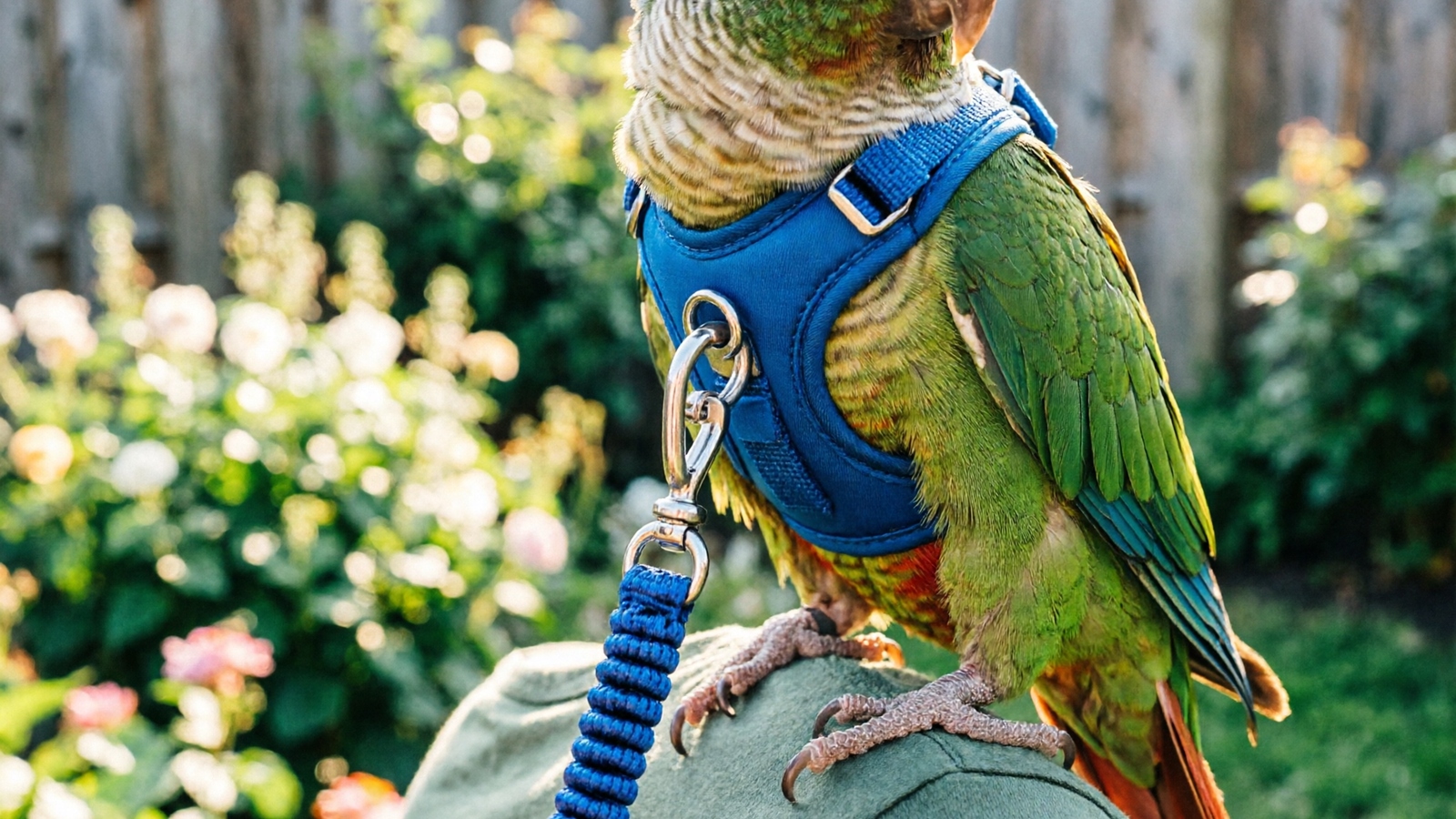
Why Your Bird Needs a Harness (And Which Type Is Safest)
A harness is a wearable restraint system that attaches a leash to your bird’s body, allowing supervised outdoor time without the risk of escape. There are three main types: one-piece slide-on harnesses (like the Aviator — the safest design with no clips or buckles), clip/buckle harnesses (easier to put on but escape-prone for clever parrots), and leather harnesses (softest material but handmade and non-standardized — ideal for pin-feathered birds).
The Aviator Bird Harness by Parrot University is the industry standard. Made by Parrot University, it features one-piece escape-proof construction and an elastic bungee leash that absorbs shock if your bird takes flight suddenly. The Aviator is the most widely recommended harness among bird owners.
Birds can fly. A startled parrot at shoulder height reaches 20+ mph in 2 seconds flat. Without a quality harness, one loud noise equals a lost bird forever.
Supervised outdoor enrichment — sunlight for vitamin D synthesis, socialization, and mental stimulation. According to LafeberVet, companion birds housed indoors commonly develop hypovitaminosis D, and supervised outdoor exposure to natural UV light is an effective preventative measure. (LafeberVet — Vitamin A Deficiency in Birds: birds require natural UV exposure for vitamin D3 synthesis, which indoor lighting often fails to provide)
Warning: Safety Warning: No harness is 100% escape-proof. Always supervise your bird when wearing a harness. Never use near predatory birds like hawks or crows — the MSPCA-Angell Animal Medical Center notes that free-roaming outdoor birds are at high risk from raptor attacks, even in suburban areas. (MSPCA-Angell — Outdoor Safety for Pet Birds: predatory birds recognize caged/restrained parrots as vulnerable prey). Check the fit before every use.
Harness training builds on foundational bird training basics — master step-up and target training before introducing harness work. A harness is only effective when your bird trusts the training process.
Aviator vs JMK vs Leathers4Feathers: Which Brand Is Right for Your Bird?
The best parrot harness depends on your bird’s size, temperament, and your training commitment. When researching the best parrot harness, the key factors are safety, ease of use, and species fit. This comparison covers the four main harness categories to help you choose the right harness for your situation.
| Feature | Aviator (Parrot University) | JMK Harness | Leathers4Feathers | Clip-Based |
|---|---|---|---|---|
| Construction | One-piece slide-on | One-piece slide-on | Handmade leather | Clip/buckle |
| Escape Safety | 5/5 (no clips to manipulate) | 5/5 (similar to Aviator) | 4/5 (soft but no clips) | 2/5 (clips chewable) |
| Ease of Putting On | 2/5 (2-4 week training needed) | 4/5 (easier per Reddit) | 4/5 (no head loop — less stressful) | 4/5 (easiest — clips) |
| Material | Nylon webbing | Nylon webbing | Real leather (softest for pin feathers) | Nylon/cloth |
| Leash | Elastic bungee (shock-absorbing) | Fixed leash | Fixed leash | Fixed leash |
| Sizes | 6 (55g budgie to 700g+ macaw) | 5 sizes | Custom handmade | Varies by brand |
| Price | $25-45 | $20-35 | $25-40 | $10-20 |
| Where to Buy | Amazon, Chewy, AviatorHarnes.com | jmkbird.com only | Etsy, leathers4feathers.com | Amazon |
| Best For | All birds — widely recommended standard | Reddit favorite for easier use | Pin-feathered birds, head-loop haters | Training practice only |
| Key Drawback | Difficult to put on | Not on major retailers | Long lead time (handmade) | Escape risk for flighted birds |
The Aviator vs JMK harness debate — the classic Aviator vs JMK bird harness comparison — comes down to safety versus convenience when selecting the safest option. Aviator is the gold standard — the best parrot harness. JMK is the Reddit community favorite for easier application.
Leathers4Feathers is the top choice for pin-feathered birds or birds that hate the head loop — real leather is the softest harness material available. Budget clip-based harnesses are training tools only, not safe for outdoor use — the safest option — and the best parrot harness choice — is always one-piece for flighted birds.
Choosing a harness is only half the equation — harness training requires high-value treats for positive reinforcement. See our best conure food guide for treat recommendations that work during training sessions.
Quick Comparison — 6 Best Bird Harnesses
| # | Harness | Price | Best For |
|---|---|---|---|
| 1 | Aviator Pet Bird Harness (Petite) | $25-45 | Best for Small Birds |
| 2 | Aviator Pet Bird Harness (Small) | $25-45 | Best for Medium-Small Parrots |
| 3 | VANFAVORI Adjustable Bird Harness | $13 | Best Budget Overall |
| 4 | Dnoifne Bird Harness with Wing Design | $12 | Best Budget Design |
| 5 | Barn Eleven Bird Harness | $10 | Cheapest Entry Point |
| 6 | ASOCEA Bird Harness | $15 | Best for Large Parrots (Budget) |
Best Bird Harnesses on Amazon
We researched 6 harnesses available through major retailers to evaluate harnesses in each category — 2 Aviator sizes (the industry standard) and 4 budget options for training and casual use.
Important: JMK, Leathers4Feathers, and Feather Tether are NOT available through major retailers. We recommend them as alternatives with direct purchase links below.
1. Aviator Pet Bird Harness — Petite (Best for Small Birds)
The Aviator Pet Bird Harness — Petite Blue is the industry standard for small birds. It is a widely available and frequently purchased option on Amazon.
The one-piece slide-on design has no buckles, clips, or velcro — the safest construction for escape prevention and the top reason this design is preferred. The elastic bungee leash self-adjusts and absorbs shock if your bird spooks.
Designed for Petite (55-75g), it fits cockatiels, lovebirds, parrotlets, and larger budgies — the right petite size for this weight class. Six color options are available. Aviator recommends weighing your bird before ordering.
What we like: One-piece design. Elastic leash prevents injury during sudden flights. Six sizes cover budgie through macaw. Proven by thousands of owners.
What could be better: Difficult to put on — budget 2-4 weeks of daily desensitization. Head loop stressful for some birds. Standard leash only 4-5 feet. Not chew-proof.
User feedback: “The ONLY harness I trust. My bird escaped from a clip-on harness in 10 seconds flat — Aviator never failed in 3 years.” | “Petite fits my cockatiel at 72g. Took 3 weeks of daily training.” | “My sun conure chewed through in 6 months. Aviator is NOT chew-proof.”
The Aviator Petite is the best bird harness for cockatiel owners willing to invest in training time.
The safest small bird harness for supervised outdoor enrichment.
2. Aviator Pet Bird Harness — Small (Best for Medium-Small Parrots)
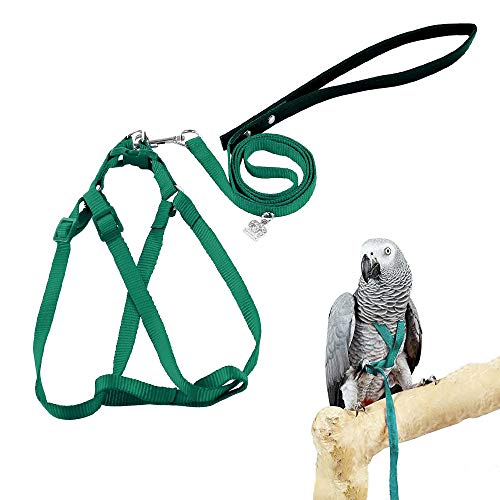
The Aviator Pet Bird Harness — Small Green uses the same trusted one-piece design — the best parrot harness for this weight class — in Small (75-110g), covering the most popular pet bird species.
Green cheek conures, sun conures, quaker parrots, Indian ringnecks, and larger cockatiels all fall in this weight range — the small size covers the most popular species. The Small size leash is slightly longer than Petite (5 feet vs 4 feet).
Same escape-proof construction and elastic bungee leash. Shares the parent listing with thousands of reviews. Six color options: green, black, pink, blue, red, and purple.
What we like: Same proven Aviator safety. Covers the most popular pet bird weight range. Elastic leash gives conures room to explore. Color options for visibility.
What could be better: Same training difficulty as Petite. Only covers up to 110g — too small for African Greys or Amazons. Same chew vulnerability.
User feedback: “Small perfect for my green cheek at 95g. Took 2 weeks to train. Now she walks to it for outside time.” | “My conure backed out of head loop first week — retrained more carefully.”
The top pick — and the best parrot harness for conure owners — who prioritize safety over convenience.
3. VANFAVORI Adjustable Bird Harness — Best Budget Overall
VANFAVORI Adjustable Bird Harness with 80 Inch Leash is a popular budget harness and only $15.99.
The 80-inch leash is significantly longer than Aviator’s standard 4-5 feet — the best budget option for range. One-piece design at this price point is rare — exceptional budget value — most sub-$20 harnesses use clip/buckle mechanisms. Four sizes from S through XL.
What we like: Half the price of Aviator. 80-inch leash gives birds more range. One-piece design better than clip-based at this price. Good training harness before upgrading.
What could be better: Some escape incidents have been reported. Fixed leash has no shock absorption — dangerous if bird spooks. Material thinner than Aviator. Not for unsupervised outdoor use with flighted birds.
User feedback: “Best budget option at $16. Bought as training harness before Aviator — smart move.” | “My conure escaped twice in one month.” | “Fixed leash is dangerous — no elasticity.”
Starting with a budget harness before upgrading to Aviator is a smart strategy — a smart approach for first-time buyers. The recommended training approach is to start cheap, prove the concept, then upgrade to Aviator for real outdoor safety.
A solid training harness at the best price point.
4. Dnoifne Bird Harness with Wing Design — Best Budget Design
Dnoifne Pet Parrot Bird Harness with Wing Design has strong community feedback among budget options.
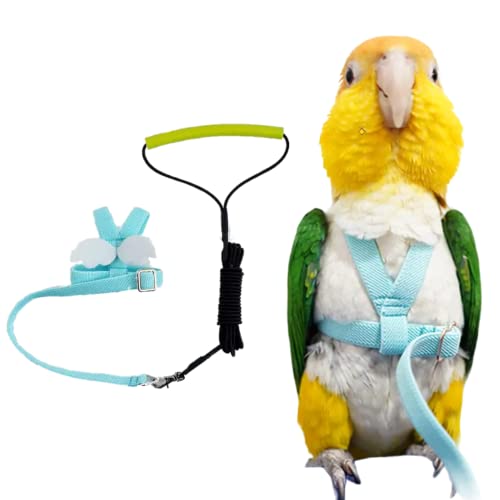
The wing decoration reduces resistance — the best budget design for birds that resist plain harnesses. Anti-bite nylon is slightly tougher than standard materials. Chest measurement sizing (M: 24-51cm) is intuitive.
What we like: Wing design helps with acceptance. Chest measurement sizing more precise. Anti-bite nylon for durability.
What could be better: Clip/buckle mechanism is less secure than one-piece designs. Wing decoration can fray and become a chewing hazard. Fixed leash. Unknown brand with no official website.
User feedback: “Wing design adorable — my conure accepted faster.” | “Wing decoration frayed in first week — chewing hazard.” | “My mini macaw escaped from clip in under 5 seconds.”
The small bird harness for budgie and conure owners — a fun training option with personality, and a solid bird harness for conure owners who want something different.
5. Barn Eleven Bird Harness — Cheapest Entry Point
Barn Eleven Pet Parrot Bird Harness Leash is the cheapest quality option at $12.99 with 6 size options (Petite through XXL).
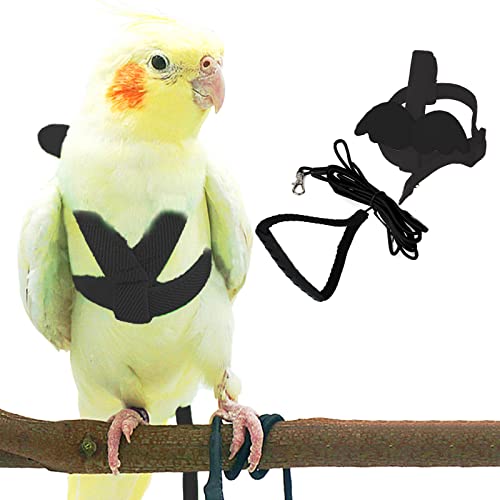
At under $13, this is the lowest-risk way to introduce your bird to the concept. The widest size range on Amazon at this price point. Wing decoration helps with initial acceptance.
What we like: Cheapest at $12.99. Six sizes available — widest range in this price bracket. Wing design aids acceptance. Adjustable straps for customizable fit.
What could be better: Limited track record. Clip-based with inherent escape risk. Thin nylon material. Disposable training tool, not a permanent solution.
User feedback: “At $13, cheapest way to desensitize budgie before buying Aviator.” | “Cockatiel escaped from buckle clip in 3 seconds.” | “Nylon noticeably thinner than VANFAVORI.”
The cheapest disposable training tool — ideal for initial desensitization on a budget.
6. ASOCEA Bird Harness — Best for Large Parrots (Budget)
ASOCEA Adjustable Bird Harness and Leash covers medium-large parrots with chest measurement sizing (S: 26-40cm).
The XL size fits umbrella cockatoos — the best budget option that goes large enough. Four sizes cover small through large parrots. At $18.99, it is the only budget option for cockatoo and Amazon owners.
What we like: XL size fits cockatoos. Chest measurement sizing more precise. Adjustable straps within each size. Fills a gap for large bird owners on a budget.
What could be better: Lowest overall rating in our selection. Clip mechanism fundamentally insecure for large parrots with powerful beaks. Fixed leash. Some owners report sizing runs large.
User feedback: “Chest sizing most reliable for my African Grey at 38cm.” | “Cockatoo dismantled clip mechanism in 30 seconds.” | “At $19, VANFAVORI at $16 is better value.”
A budget option for large parrots — the best budget pick for cockatoos, but clip-based designs are risky with strong-beaked birds.
Non-Amazon Alternatives
Three important harness brands are not sold through major retailers. Veteran bird rescue worker Patty Jourgensen of BirdTricks, who has worked with rescue parrots since 1987, warned that clip-based harnesses like Feather Tether have “altogether too many buckles and metal parts” that parrots can easily manipulate open.
JMK Harness ($20-35, jmkbird.com): The top alternative for easier application and the Reddit community favorite. Similar one-piece slide-on design to Aviator but reported as easier to put on. Highly recommended on r/Conures and r/parrots. Not available through major retailers.
Leathers4Feathers ($25-40, Etsy and leathers4feathers.com): Handmade real leather harness — the ideal choice for pin-feathered birds. The softest material available — ideal for pin-feathered birds or birds with sensitive skin. No head loop design means less stressful application. Customizable sizing.
Feather Tether ($15-20, possibly discontinued): Was the first harness brand but not the safest choice by modern safety standards. Budget clip-based design that a veteran bird rescue worker described as having “altogether too many buckles and metal parts.” Possibly discontinued from major pet retailers.
Which Harness Size Fits Your Bird?
Choosing the right harness size is critical for proper fit — too loose means escape risk, too tight means breathing difficulty. Always weigh your bird before ordering.
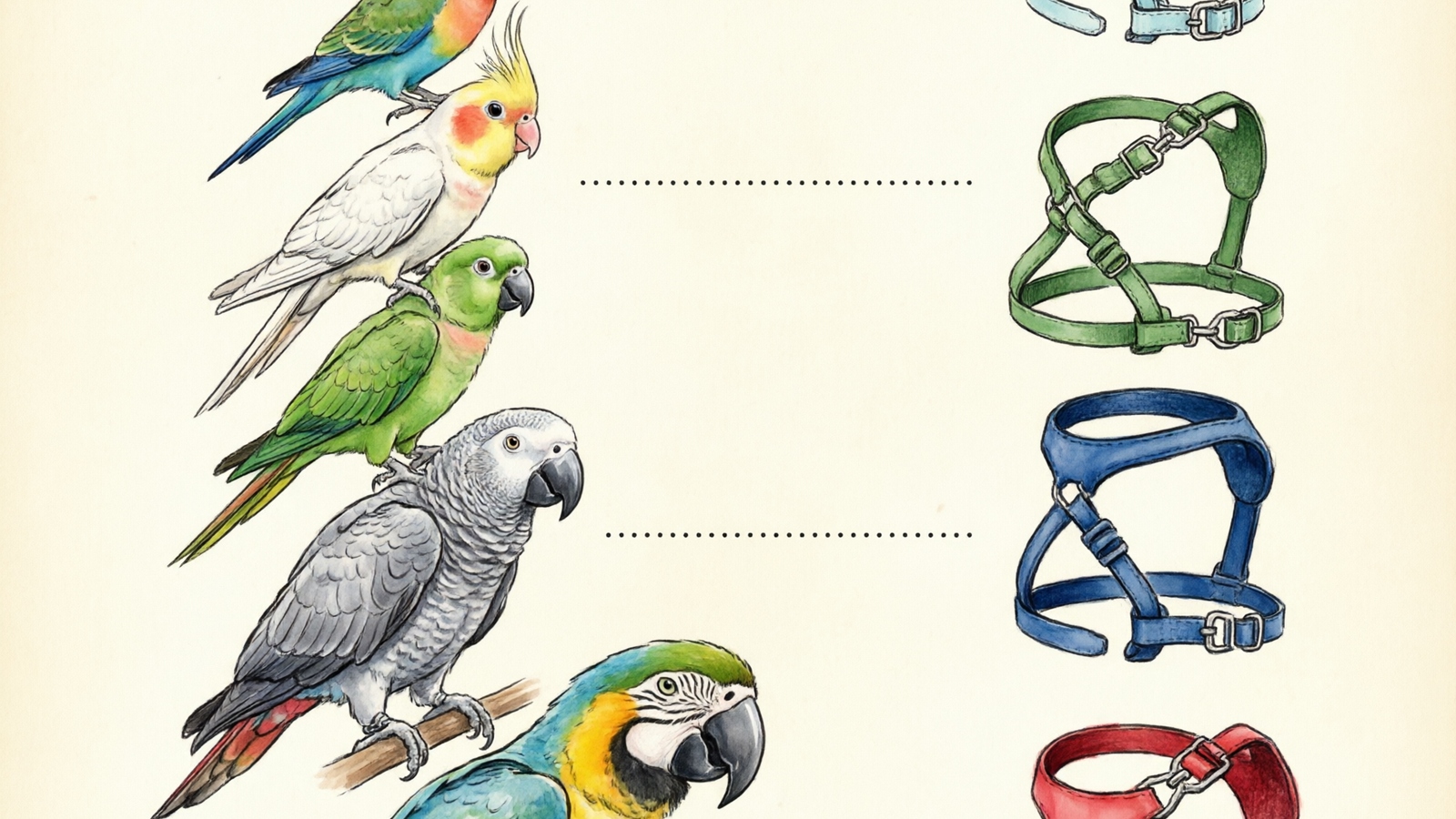
| Bird Species | Typical Weight | Aviator Size | Alternative | Notes |
|---|---|---|---|---|
| Budgie/Parakeet | 25-40g | Petite (55-75g) — may be large | Barn Eleven Petite/S | Petite may be loose on budgies under 35g |
| Lovebird | 40-60g | Petite | Barn Eleven Petite/S | Good fit in Petite range |
| Parrotlet | 25-35g | Petite — may be large | Barn Eleven Petite/S | Very small — Petite may swim |
| Cockatiel | 75-120g | Petite or Small | VANFAVORI S | Measure weight — between sizes |
| Green Cheek Conure | 60-100g | Petite or Small | VANFAVORI S | Small if 85g+, Petite if under 75g |
| Sun Conure | 100-130g | Small | VANFAVORI S | Small is the right fit |
| Quaker/Monk Parakeet | 90-130g | Small | VANFAVORI S | Small recommended |
| Indian Ringneck | 110-140g | Small or Medium | VANFAVORI M | Small if under 110g |
| African Grey | 350-500g | Large | ASOCEA XL | Large is the standard |
| Amazon | 350-500g | Large | ASOCEA XL | Large recommended |
| Cockatoo | 300-700g | X-Large or XXL | ASOCEA XL | XL+ for umbrella cockatoo |
| Macaw | 500-1500g | XX-Large | JMK Macaw | XXL only |
When between sizes, always size up — the safest principle. A slightly loose harness is safer than one that restricts breathing. Re-measure after molting since weight can change significantly — proper fit requires updated measurements.
Cockatiel owners should check our cockatiel habitat setup guide for ideal weight range to help pick the right harness size. The best bird harness for conure owners depends on whether your bird is a green cheek (60-100g) or sun conure (100-130g) — this weight difference determines Petite versus Small.
How to Put a Harness on a Bird: Training Guide
A harness is only effective with proper training. Putting a harness on a bird requires patience. Never force a harness onto your bird — this damages trust and makes future training much harder. Follow these five steps over 3-4 weeks. Positive reinforcement training is the standard methodology recommended by the Association of Avian Veterinarians (AAV) for all companion bird husbandry procedures, including harness training. (AAV — Companion Bird Behavior Guidelines: positive reinforcement builds trust and reduces stress in avian patients)
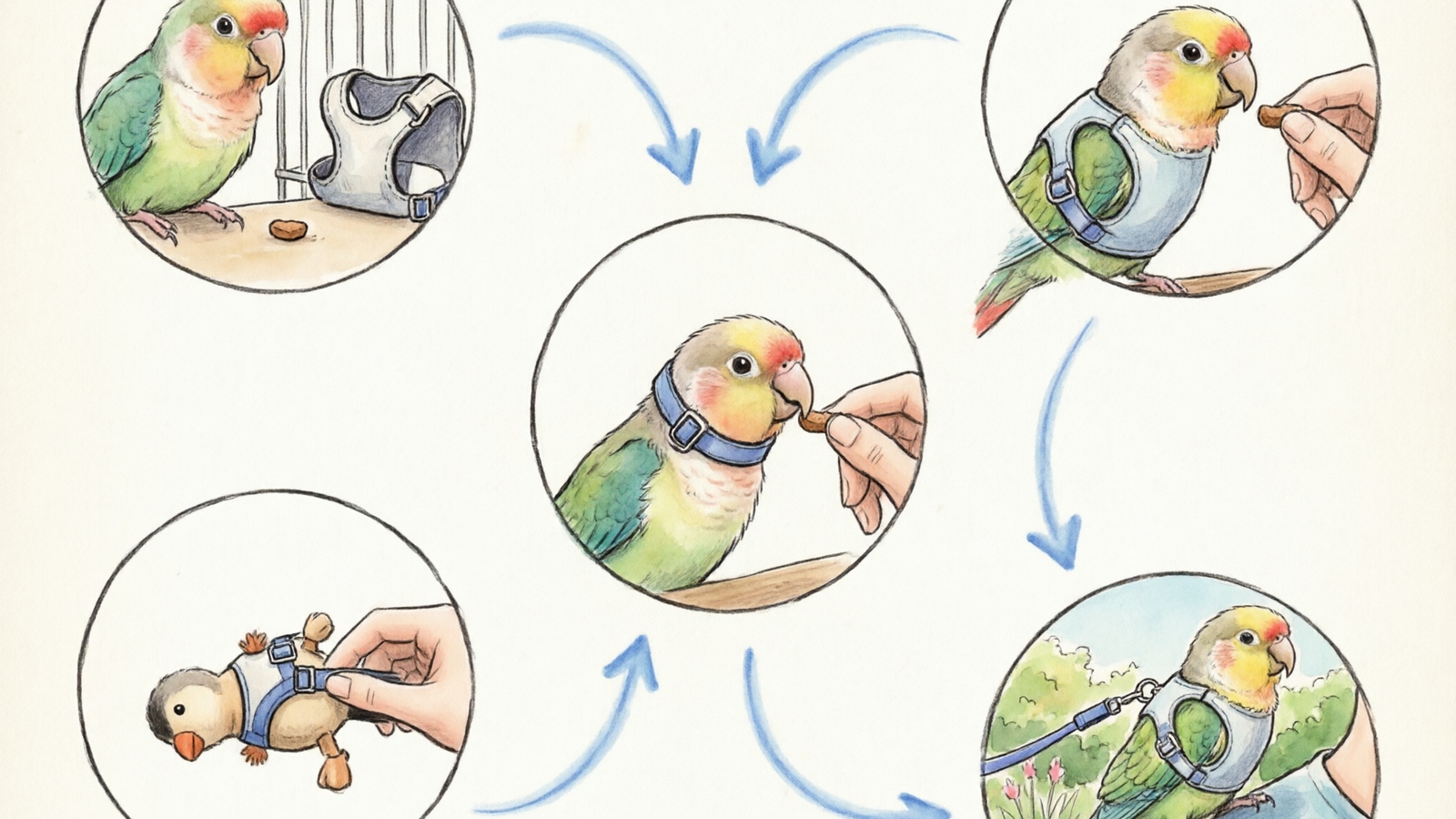
Step 1: Desensitize to the harness (Days 1-3)
Place the harness near your bird’s cage. Let them see and approach it on their terms. Reward calm behavior with a high-value treat — millet for budgies, safflower seed for conures, a nut for larger parrots.
Do not let your bird chew on the harness. It is not a toy. Move the harness closer each session until your bird shows no fear response.
Step 2: Practice on a stuffed animal (Days 3-5)
Buy a stuffed bird of similar size to yours. Practice the technique until you can do it in under 10 seconds. This builds your confidence — birds sense hesitation and will resist more if you seem unsure.
Step 3: Head loop introduction (Days 5-10)
Open the harness and hold a treat on the other side of the head loop. Your bird reaches for the treat, and their head passes through the loop. Reward immediately.
Repeat until your bird voluntarily puts their head through without hesitation. Never force the head loop — forcing creates fear that takes weeks to undo.
Step 4: Full harness placement (Days 10-20)
With your bird calm, slide one wing through the wing slot, then the other. Tighten the slide adjuster and immediately offer a high-value treat with praise.
Start with 30-second sessions indoors. Gradually increase duration. Remove the harness after each successful session.
Step 5: Outdoor introduction (Week 3-4)
Your first outdoor session should be 5 minutes in a quiet backyard. Scan the sky for predatory birds before stepping outside.
If your bird panics outdoors, crouch down immediately and offer cover. Never take your bird to noisy or crowded areas until fully comfortable with the harness.
For parakeet owners, start harness training indoors first using the same room as their cage for familiarity. See our parakeet travel setup guide for environment tips.
Bird Harness Do’s and Don’ts
** Correct Harness Practices**
- Weigh your bird before ordering — A harness that is too loose is an escape risk, too tight restricts breathing. Re-measure after molting.
- Start with desensitization indoors — Let your bird approach the harness on their terms for 3-5 days before any physical contact.
- Use a stuffed animal to practice — Build your own confidence first. Birds sense hesitation and will resist more.
- Reward every step with high-value treats — Millet for budgies, safflower seed for conures, nuts for large parrots. Positive reinforcement builds trust.
- Check fit before every single use — Slide one finger between harness and bird’s body. If loose, tighten. If tight, size up.
- Use the elastic leash option — Elastic bungee leashes absorb shock if your bird spooks, preventing wing injury from sudden leash tension.
** Dangerous Harness Mistakes**
- Using clip-based harnesses outdoors with flighted birds — Parrots can open clips and buckles in seconds.
- Forcing the head loop onto a panicked bird — This destroys trust and creates a fear response that takes weeks to undo. Always let the bird volunteer.
- Skipping indoor training before going outside — An untrained bird will panic outdoors. A minimum 2-4 weeks of indoor desensitization is non-negotiable.
- Taking your bird outside near predatory birds — Hawks and crows recognize restrained parrots as vulnerable prey. Always scan the sky before stepping outside.
- Letting your bird chew on the harness — It is not a toy. Chewed nylon can fray, creating strands that wrap around toes or beaks.
- Using a harness that has been chewed or damaged — Even minor damage compromises the escape-proof design. Replace immediately.
Caring for your bird’s environment matters beyond just harness training. A clean, well-sized cage from a quality hamster cage or guinea pig cage provides the same security and enrichment principles that make harness training easier for any small pet.
Bird Harness FAQ
What is the best harness for a bird?
The Aviator Bird Harness by Parrot University is the safest and most trusted option. Its one-piece slide-on design has no buckles or clips for clever parrots to manipulate open.
The elastic bungee leash absorbs shock if your bird takes flight suddenly. The Aviator is widely recommended among bird owners.
Aviator vs JMK — which bird harness brand is better?
Aviator is the more widely recommended option. JMK is easier to put on and the Reddit community favorite for birds that resist the head loop.
Both use one-piece slide-on designs. If your bird accepts the head loop, go with Aviator. If your bird panics at the head loop, try JMK.
Note that JMK is sold only through jmkbird.com.
Are bird harnesses safe?
Harnesses are safe when used correctly. No harness is 100% escape-proof. Always supervise your bird when wearing a harness.
Never use near predatory birds. Check the fit before every use. Train indoors for 2-4 weeks before outdoor use.
Replace chewed or damaged harnesses immediately. Budget clip-based harnesses have higher escape risk — avoid for flighted birds.
Can you put a harness on a budgie?
Yes, but with extra caution. Budgies weigh only 25-40g, and most harnesses are designed for larger birds. The Aviator Petite fits 55-75g, which may be loose on small budgies under 35g.
The Barn Eleven Petite at $12.99 may fit smaller budgies better. Start with the cheapest option for training, then upgrade once your budgie accepts the concept.
Training budgies takes extra patience — they are more skittish than conures.
What harness do vets recommend?
The Aviator Bird Harness by Parrot University is widely recommended among bird owners. Made by Parrot University and refined over years of production, its one-piece escape-proof design and elastic bungee leash set the safety standard.