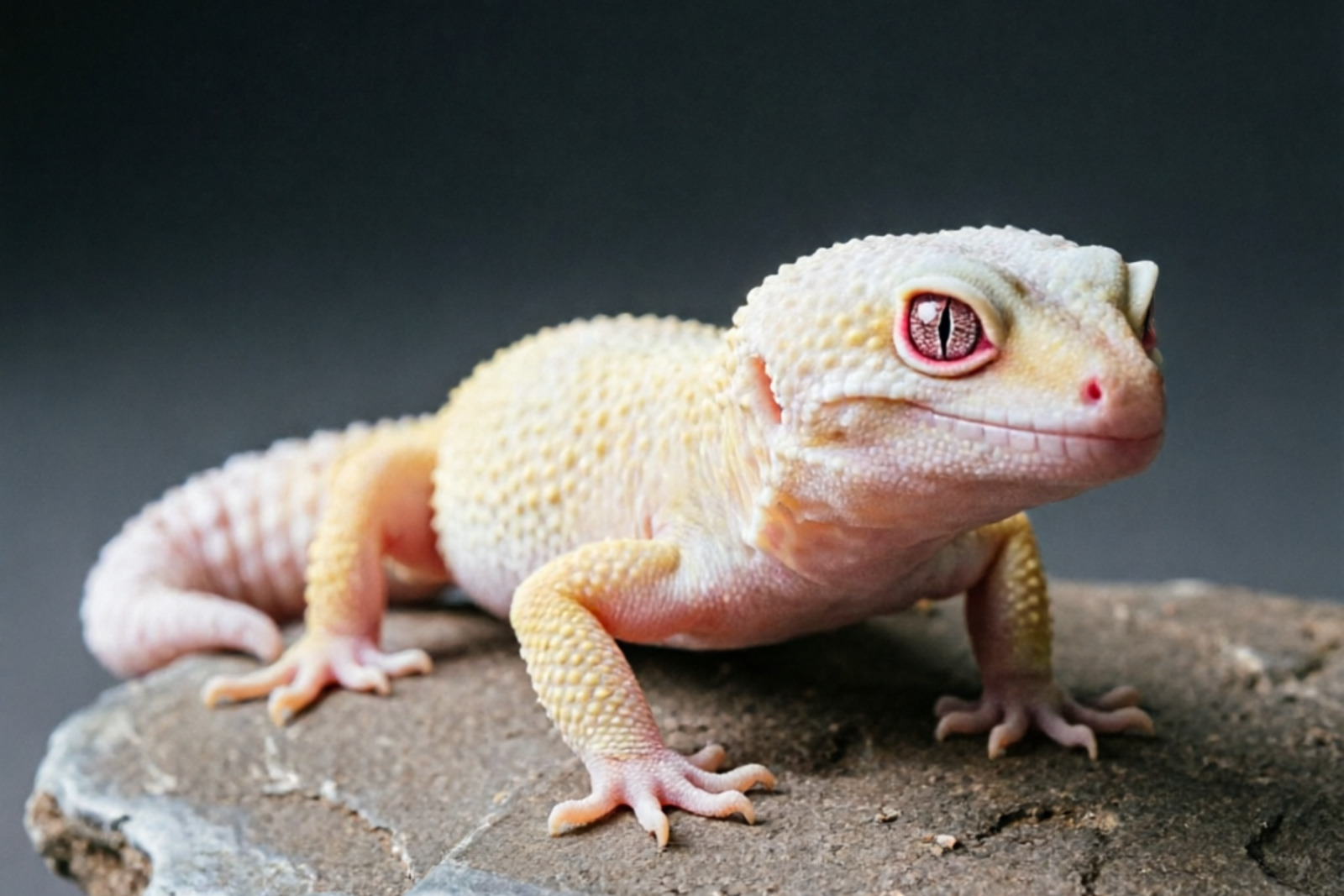
The Albino leopard gecko is one of the foundational morphs in the leopard gecko hobby. Unlike most morphs that involve a single gene or mutation, there are actually three distinct albino strains — each discovered independently by different breeders, each residing on a different gene, and each producing a subtly different appearance. When you hear “albino leopard gecko,” you could be looking at a Tremper Albino, a Rainwater (Las Cruces) Albino, or a Bell Albino. All three are visually striking, all three share the same straightforward care requirements, and all three are among the most affordable morphs available.
The albino trait is recessive, meaning a leopard gecko must inherit two copies of the gene — one from each parent — to visually express the albino appearance. This is fundamentally different from co-dominant traits like Mack Snow or Enigma, where a single copy is enough to produce a visible effect. The recessive nature of albinism makes breeding projects more strategic and requires careful planning.
If you are new to leopard geckos, any of the three albino strains is an excellent choice. They are affordable, visually stunning, and share identical care requirements with normal leopard geckos. This guide covers the history of each strain, the genetics behind albinism, appearance differences between the three strains, care, temperament, health, and pricing.
Quick Facts
| Attribute | Details |
|---|---|
| Species | Eublepharis macularius |
| Morph Name | Albino (Tremper / Rainwater / Bell) |
| Gene Type | Recessive |
| Number of Strains | 3 (genetically distinct) |
| Adult Size | 8-11 inches (20-28 cm) |
| Weight | 45-80 grams |
| Lifespan | 15-20 years |
| Temperament | Docile, easy to handle |
| Difficulty | Beginner-friendly |
| Availability | Common — widely available across all three strains |
History: Three Independent Discoveries
The story of albino leopard geckos is not a single discovery but three independent events that happened over roughly a decade. Each breeder stumbled upon an albino animal in their collection and, through careful breeding, established a distinct line.
Tremper Albino (1989)
The first albino leopard gecko was discovered by Dick Tremper in 1989. Tremper, an experienced reptile breeder based in the United States, noticed a hatchling in his collection that lacked the dark melanin pigment characteristic of normal leopard geckos. Instead of the typical dark brown or black spots on a yellow background, this hatchling displayed pale, lavender-toned spots on a light background.
Tremper recognized the significance of this mutation and began a selective breeding program to establish a stable line. By breeding albino animals together, he confirmed that the trait was recessive — two normal-looking leopard geckos that each carried one copy of the albino gene (het albinos) could produce albino offspring in approximately 25% of their clutch. The Tremper Albino became the first commercially available albino leopard gecko morph and remains the most widely recognized albino strain today.
Rainwater Albino (1997)
The second strain, known as the Rainwater Albino or Las Cruces Albino, was discovered by John Rainwater in Las Cruces, New Mexico, in 1997. Rainwater found an albino hatchling in his collection that looked slightly different from the Tremper Albino — it had darker, richer brown spotting and a heavier overall pattern.
Subsequent genetic testing and breeding experiments confirmed that the Rainwater Albino was a separate mutation on a different gene from the Tremper Albino. When a Tremper Albino was bred to a Rainwater Albino, the offspring were visually normal — proving that the two mutations were not allelic (not at the same genetic locus). The Rainwater Albino line was stabilized and made available to the hobby, where it gained a following among breeders who preferred its darker, more heavily patterned appearance.
Bell Albino (1990s)
The third strain, the Bell Albino, was discovered by Mark Bell in the mid-1990s (approximately 1994-1995). Bell’s albino line was notable for its exceptionally clean, bright white background and bold, well-defined markings. Like the other two strains, the Bell Albino was confirmed to be a separate recessive mutation on yet another gene.
When Bell Albinos were bred to Tremper or Rainwater Albinos, the results were the same — visually normal offspring carrying both genes. This confirmed that the three albino strains represent three independent mutations that each disrupt melanin production through different genetic pathways.
Appearance: Comparing the Three Strains
All three albino strains share the defining characteristic of reduced melanin pigment, but they differ noticeably in body color, spot coloration, and overall pattern intensity.
Tremper Albino
The Tremper Albino is generally the lightest of the three strains:
- Background color: Pale lavender or pinkish-white, often with a subtle wash of pale yellow
- Spot color: Very light brown or grayish-pink spots that can appear almost translucent
- Pattern intensity: Softer, more diffuse spotting compared to normals
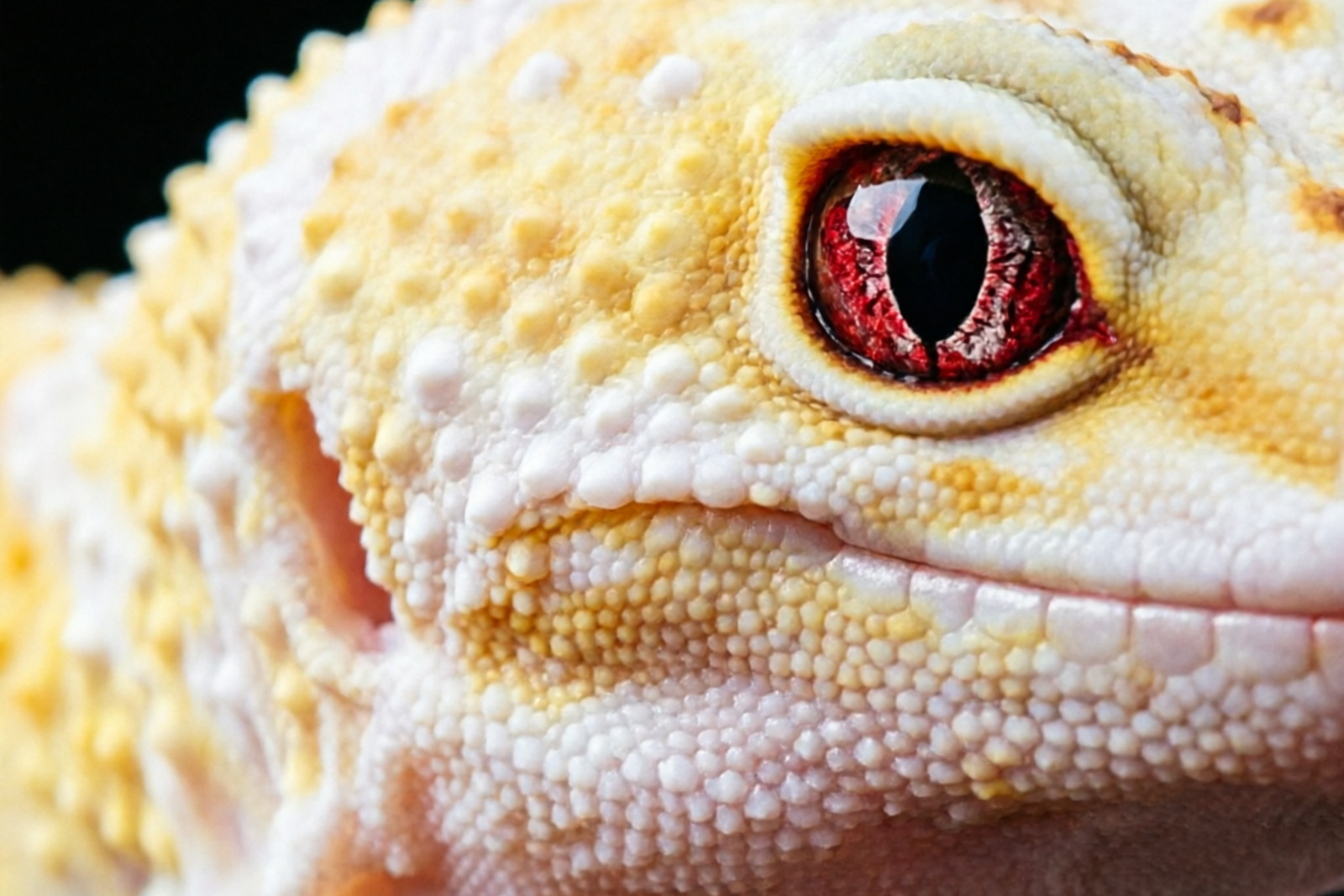
- Eye color: Ruby-red or deep pink (characteristic of albinism)
- Hatchling appearance: Very pale with light gray or lavender spots; the albino appearance is clear from hatching
Tremper Albinos tend to develop a slight yellow tint as they age, particularly along the back and tail. The overall impression is of a delicate, pastel-colored gecko.
Rainwater (Las Cruces) Albino
The Rainwater Albino is the darkest of the three strains:
- Background color: Pale white to light gray, with less pink or lavender than the Tremper
- Spot color: Rich, dark brown spots — noticeably darker than Tremper Albino spots
- Pattern intensity: Heavier, more pronounced pattern; spots are larger and more densely packed
- Eye color: Ruby-red or deep pink
- Hatchling appearance: Darker spots on a pale background; the contrast is more striking than in Tremper hatchlings
Rainwater Albinos also tend to be slightly smaller as adults than the other two strains, though the difference is subtle. The heavier pattern and darker spot coloration give the Rainwater a more “normal-looking” appearance at a distance, up close the reduced melanin is obvious.
Bell Albino
The Bell Albino is often considered the cleanest and brightest of the three:
- Background color: Bright, clean white — the whitest background of all three strains
- Spot color: Medium brown, well-defined spots with sharp edges
- Pattern intensity: Bold, high-contrast pattern against the bright white background
- Eye color: Ruby-red or deep pink
- Hatchling appearance: Very bright with clear brown spots on a white background; immediately identifiable as albino
The Bell Albino’s combination of bright white background and clean, bold markings makes it one of the most visually striking leopard gecko morphs. Many breeders consider it the most aesthetically pleasing of the three albino strains.
Side-by-Side Comparison
| Feature | Tremper Albino | Rainwater Albino | Bell Albino |
|---|---|---|---|
| Background color | Lavender/pinkish-white | Light gray/white | Bright white |
| Spot color | Very light brown/pink | Dark brown | Medium brown |
| Pattern | Soft, diffuse | Heavy, dense | Bold, clean |
| Adult size | Standard (8-11 in) | Slightly smaller | Standard (8-11 in) |
| Eye color | Ruby-red | Ruby-red | Ruby-red |
| Availability | Most common | Moderate | Moderate to common |
| Typical price | $25-$300+ | $25-$150+ | $50-$450+ |
Genetics
All three albino strains are recessive traits. This means a leopard gecko must carry two copies of the albino gene (one from each parent) to visually express the albino appearance. A gecko with only one copy is called a “het” (heterozygous) albino — it looks completely normal but carries the gene and can pass it to offspring.
How Recessive Inheritance Works
| Parent 1 | Parent 2 | Offspring |
|---|---|---|
| Normal | Normal | 100% Normal |
| Het Albino | Normal | 50% Het Albino, 50% Normal |
| Het Albino | Het Albino | 25% Visual Albino, 50% Het Albino, 25% Normal |
| Visual Albino | Normal | 100% Het Albino |
| Visual Albino | Het Albino | 50% Visual Albino, 50% Het Albino |
| Visual Albino | Visual Albino | 100% Visual Albino |
Key Genetic Concepts
Visual identification: A visual albino (homozygous) is immediately recognizable by its reduced melanin, red eyes, and pale coloration. A het albino looks exactly like a normal leopard gecko and cannot be visually identified — it can only be confirmed through breeding or genetic testing.
Three separate genes: The Tremper, Rainwater, and Bell albino mutations are on three different genes. This means a single gecko can theoretically carry all three albino strains simultaneously. When a gecko carries two different albino strains (e.g., het Tremper + het Rainwater), it looks completely normal because neither gene is homozygous.
Double het breeding: When you breed a het Tremper Albino to a het Rainwater Albino, the offspring will be visually normal. However, if you then breed two of those offspring together (both het Tremper + het Rainwater), you can get a complex distribution: approximately 6.25% visual Tremper Albino, 6.25% visual Rainwater Albino, and various het combinations. This is how advanced breeders create multi-strain albino projects.
Breeding different strains together: Breeding a visual Tremper Albino to a visual Rainwater Albino produces 100% visually normal offspring that are het for both strains. These “double het” animals are valuable breeding stock because they carry two albino genes and can be used to produce either strain in future generations.
Care Requirements
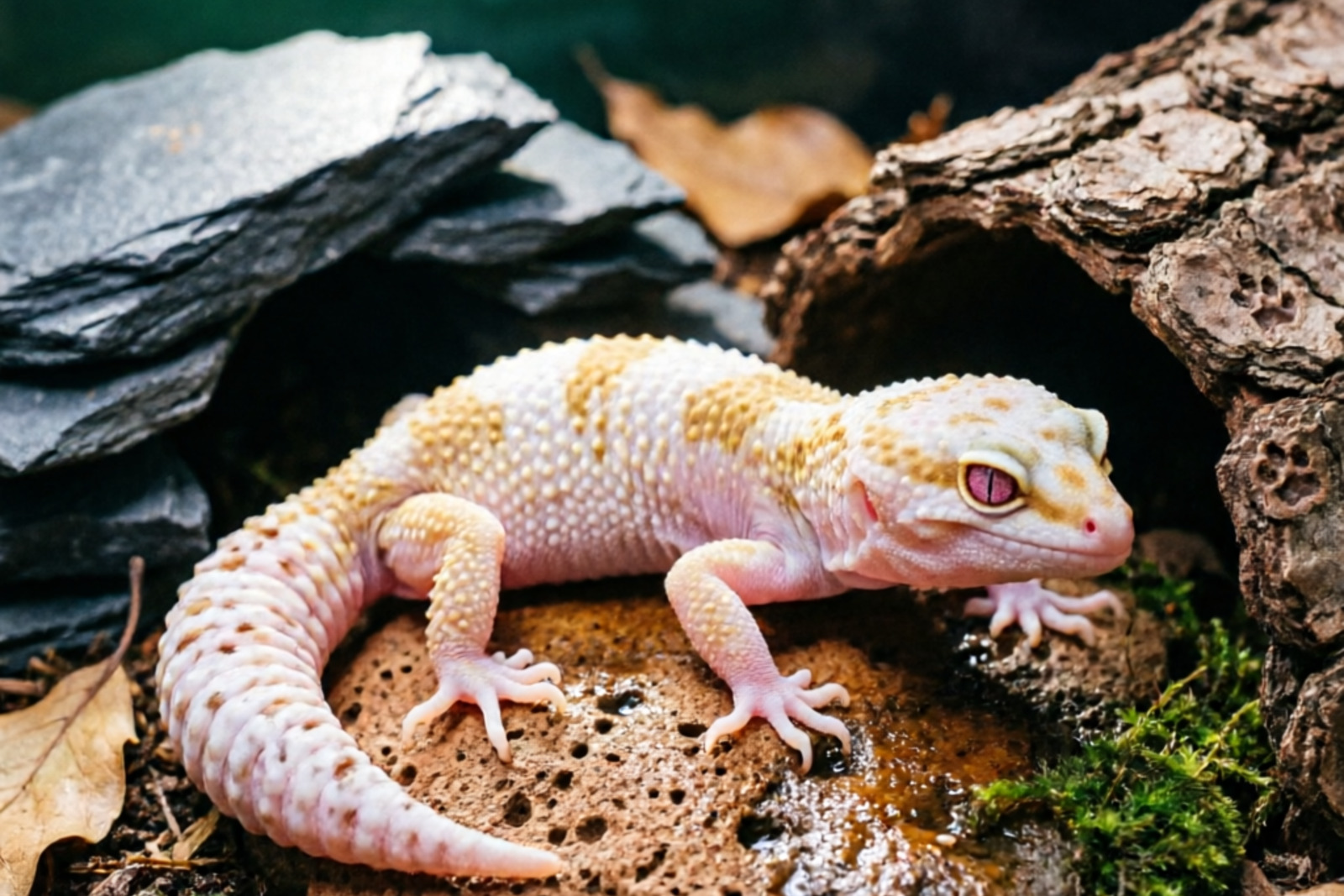
The albino gene is purely a color mutation. It does not affect the health, size, lifespan, or care requirements of the leopard gecko in any way. An albino leopard gecko has the exact same needs as a normal leopard gecko. For a complete care guide, see our leopard gecko care page.
Housing
| Requirement | Details |
|---|---|
| Minimum tank size | 20 gallons for adults (30” x 12” footprint) |
| Hot side temperature | 90-95°F (32-35°C) — under-tank heater with thermostat |
| Cool side temperature | 75-80°F (24-27°C) |
| Night temperature | 70-75°F (21-24°C) |
| Humidity | 30-40% ambient; 70-80% in humid hide |
| Substrate | Tile, reptile carpet, paper towels, or shelf liner |
A proper temperature gradient is essential for digestion and thermoregulation. The best leopard gecko terrarium setups use a front-opening glass tank with an under-tank heating pad controlled by a reliable reptile thermostat.
Light Sensitivity Note
Because albino leopard geckos lack melanin pigment in their eyes, they may be slightly more sensitive to bright light than normal leopard geckos. This is a minor consideration but worth noting:
- Provide multiple hides (at least one on each temperature zone) so your gecko can retreat from light
- Avoid intense overhead lighting directly over the enclosure
- If using UVB lighting (optional for leopard geckos), use a low-output bulb (2.5% or 5%) and ensure plenty of shaded areas
- Normal leopard gecko ambient room lighting is perfectly fine
Most albino leopard geckos adapt well to standard lighting conditions and show no signs of light sensitivity beyond the normal preference for dim, nocturnal environments.
Diet
Albino leopard geckos are strict insectivores, identical to normal leopard geckos in their dietary needs. They cannot eat fruits or vegetables — their digestive system handles only animal protein.
| Age | Feeding Frequency | Amount |
|---|---|---|
| Hatchling (0-3 months) | Daily | 5-7 small crickets or dubia roaches |
| Juvenile (3-6 months) | Daily | 7-10 small-medium insects |
| Subadult (6-12 months) | Every other day | 8-12 medium insects |
| Adult (12+ months) | Every 2-3 days | 10-15 medium-large insects |
Staple feeder insects include crickets, dubia roaches, mealworms, and black soldier fly larvae. All prey should be gut-loaded 24-48 hours before feeding and dusted with calcium (with and without D3) and a multivitamin supplement.
Humid Hide
A humid hide is essential for proper shedding. Albino leopard geckos shed every 4-6 weeks as adults, and stuck shed can cause lost toes, eye damage, and infections. Fill a hide on the warm side with moist sphagnum moss to create a microclimate of 70-80% humidity.
Handling
Albino leopard geckos have the same docile temperament as normal leopard geckos. They tolerate handling well and many become comfortable being held with regular, gentle interaction. Handle during evening hours when geckos are naturally active, support the entire body including the tail, and keep sessions to 10-15 minutes for adults.
Temperament & Behavior
The albino gene has no effect on temperament or behavior. These geckos share the same personality traits that make leopard geckos one of the best pet reptiles:
- Docile and calm: Most albino leopard geckos tolerate handling well after a brief taming period
- Curious: They explore their environment actively during evening hours
- Nocturnal: Most active after dark, sleeping during the day
- Solitary: Must be housed individually — like all leopard geckos, they are territorial
- Communicative: They vocalize with small chirps and squeaks, and wave their tails slowly when hunting or excited
Albino leopard geckos are equally suitable for handling as normal leopard geckos. The morph does not introduce any behavioral quirks or temperament issues. Some owners report that their albinos are slightly more cautious with bright light, seeking hides more readily — but this is a minor preference, not a behavioral problem.
Health
Albino leopard geckos are not more or less prone to health issues than any other leopard gecko morph. The gene affects only pigmentation, not physical health. The common health concerns are the same as for all leopard geckos:
- Metabolic Bone Disease (MBD): Caused by calcium and vitamin D3 deficiency. Prevented through proper supplementation and, optionally, low-level UVB lighting.
- Impaction: Caused by ingesting loose substrate. Prevented by using solid substrates (tile, carpet, paper towels).
- Stuck shed: Caused by insufficient humidity. Prevented by maintaining a proper humid hide.
- Respiratory infections: Caused by temperatures too low or humidity too high. Prevented by proper temperature gradient.
- Cryptosporidiosis: A parasitic infection that causes regurgitation and weight loss. There is no cure, so quarantine new geckos for 30-60 days.
Albino-Specific Considerations
The only health consideration unique to albino leopard geckos relates to their reduced melanin:
- Eye health: Albino geckos have ruby-red eyes due to the lack of pigment in the iris. This does not cause vision problems, but the eyes may be slightly more sensitive to bright light. Ensure adequate hiding spots and avoid direct, intense lighting.
- Sunburn risk: In the wild, reduced melanin could theoretically increase sunburn risk. In captivity, this is not a concern as long as the gecko is kept indoors with appropriate temperature gradients and hiding spots.
A healthy albino leopard gecko should have bright, clear ruby-red eyes, a plump tail, clean vent, and an alert demeanor. If you notice lethargy, loss of appetite, weight loss, or abnormal stool, consult a reptile veterinarian.
Price Guide
Albino leopard geckos are among the most affordable morphs, which is one reason they are so popular with beginners and breeders alike. Pricing varies by strain, quality, and whether the animal is combined with other genes.
Current Market Prices (2026)
Based on MorphMarket listings from April 2026:
| Morph | Price Range | Source |
|---|---|---|
| Tremper Albino (standard) | $25-$300+ | Breeders, MorphMarket |
| Rainwater Albino (standard) | $25-$150+ | Breeders, MorphMarket |
| Bell Albino (standard) | $50-$450+ | Breeders, MorphMarket |
| Het Albino (normal-looking carrier) | $15-$40 | Breeders, MorphMarket |
| Tremper Albino + Eclipse | $80-$250 | Breeders |
| Bell Albino + Mack Snow | $100-$350 | Breeders |
| Tremper Albino + Super Hypo | $60-$200 | Breeders |
| Rainwater Albino + Tangerine | $75-$250 | Breeders |
| Triple albino het (het Tremper + het Rainwater + het Bell) | $40-$100 | Breeders |
Multi-gene combinations involving albino strains plus other popular traits (Eclipse, Super Hypo, Tangerine, Mack Snow, Enigma) can reach $500+ for show-quality animals.
Strain Availability on MorphMarket
- Tremper Albino: The most widely available strain, with hundreds of listings at any given time. Prices start as low as $25 for juvenile animals from hobbyist breeders.
- Rainwater Albino: Moderately available, typically with fewer listings than Tremper. Prices are competitive, often starting at $25-$35 for basic animals.
- Bell Albino: Less common than Tremper but more common than some designer morphs. Prices tend to be slightly higher, starting around $50 for basic animals, with premium specimens reaching $450+.
Where to Buy
- Reptile breeders (recommended): Offer health guarantees, genetic history, and care advice. Find breeders on MorphMarket, at reptile expos, or through local reptile clubs.
- Reptile expos: Allow you to see animals in person and talk directly with breeders. Prices are often competitive.
- Pet stores: Convenient but typically more expensive ($50-$100 markup) with less genetic information available. Most pet stores do not distinguish between albino strains.
Total Setup Cost
The albino morph does not change setup requirements. Expect to spend $130-$630 total for the initial setup:
| Item | Budget | Premium |
|---|---|---|
| Albino gecko | $25-$150 | $200-$400 |
| Tank (20 gallon) | $60-$80 | $150-$170 |
| Heating pad + thermostat | $15-$50 | $40-$60 |
| Substrate | $7-$20 | $15-$30 |
| Hides and decor | $20-$30 | $50-$100 |
| Thermometer/hygrometer | $10-$15 | $15-$25 |
| Total | $137-$345 | $470-$785 |
Albino vs Normal Leopard Gecko
| Feature | Normal (Wild Type) | Albino (Any Strain) |
|---|---|---|
| Background color | Yellow | White, lavender, or pale |
| Spot color | Dark brown/black | Light to medium brown |
| Eye color | Normal (with visible pupil) | Ruby-red |
| Melanin | Full | Reduced or absent |
| Gene type | N/A | Recessive |
| Price | $30-$50 | $25-$450+ |
| Care difficulty | Beginner | Beginner |
| Lifespan | 15-20 years | 15-20 years |
The primary difference is visual. An albino leopard gecko is a normal leopard gecko with reduced melanin pigment — same size, same temperament, same care, same lifespan.
Frequently Asked Questions
What is an albino leopard gecko?
An albino leopard gecko is a morph that lacks melanin pigment due to a recessive gene. There are three separate albino strains — Tremper Albino (discovered by Dick Tremper in 1989), Rainwater Albino (discovered by John Rainwater in 1997), and Bell Albino (discovered by Mark Bell in the 1990s). All three are recessive traits, meaning a gecko must inherit two copies of the gene to visually express the albino appearance. The strains are genetically distinct and produce normal-looking offspring when bred together.
How much does an albino leopard gecko cost?
Prices vary by strain and quality in 2026. Tremper Albinos range from $25 to $300+, Rainwater Albinos from $25 to $150+, and Bell Albinos from $50 to $450+. Multi-gene combinations (e.g., Tremper Albino + Mack Snow + Eclipse) can reach $500+. Basic albino het animals (carriers without visual expression) sell for $15 to $40. MorphMarket is the primary marketplace for all three strains.
What is the difference between Tremper, Rainwater, and Bell albino leopard geckos?
The three strains differ in appearance and genetics. Tremper Albinos typically have the lightest body color with a lavender or pinkish background and pale spots. Rainwater Albinos are the darkest of the three, with rich brown spots and a heavier pattern, and they tend to be slightly smaller as adults. Bell Albinos have a bright white background with clean, bold markings and are often considered the most visually striking of the three. All three are recessive, and they are mutations on different genes.
Are albino leopard geckos healthy?
Yes. Albino leopard geckos have the same health profile, lifespan (15-20 years), and care requirements as normal leopard geckos. The albino gene affects only pigmentation, not overall health. However, the reduced melanin may make albinos slightly more sensitive to bright light, so providing adequate hides and avoiding intense overhead lighting is recommended.
Can you breed two different albino strains together?
Yes, and the result is genetically interesting. When you breed a Tremper Albino to a Rainwater Albino (or any two different albino strains), the offspring will be visually normal but carry both albino genes (double het). These geckos look normal because the mutations are on different genes and are recessive. However, when you breed two double-het animals together, you can get complex combinations in the offspring, including the possibility of producing visual albinos of either strain.
The Albino leopard gecko is one of the most accessible and visually rewarding morphs in the hobby. Whether you choose a Tremper, Rainwater, or Bell Albino, you are getting a gecko with the same easy-care requirements, docile temperament, and 15-20 year lifespan that make leopard geckos one of the best pet reptiles for beginners and experienced keepers alike.
For more information on general leopard gecko care, housing, and diet, visit our complete leopard gecko guide. If you are setting up a new enclosure, our best leopard gecko terrarium and reptile thermostat guides will help you get started.