What Makes a Great Turtle Tank?
A turtle tank is not the same as a fish tank. The best aquatic turtle tank needs a dry basking area, deeper water for swimming, a strong filter to handle heavy waste, and full-spectrum UVB lighting — none of which come standard in most aquariums. A purpose-built best turtle tank design factors in the higher waste load, the basking requirement, and the long-term size of an adult turtle from day one.
Choosing the wrong enclosure is the most common beginner mistake. Picking the best turtle tank means balancing current and future needs. Too-small tanks cause stress, poor water quality, and ultimately health problems that shorten your turtle’s lifespan by years.
There are four main enclosure types to consider:
-
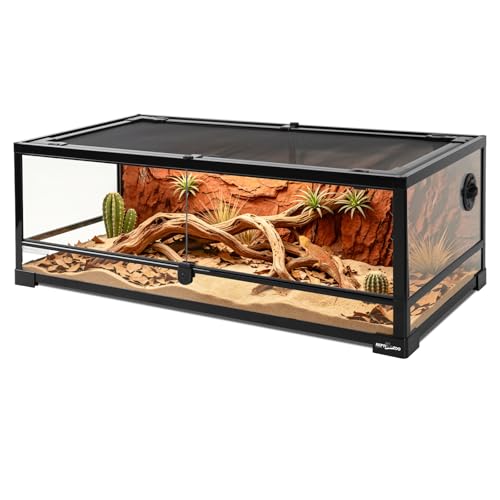
Glass aquariums — the most durable and scratch-resistant option. Best for permanent setups with adult turtles. Glass handles the frequent scraping and cleaning that turtle tanks demand without degrading.
-
Acrylic habitats — lighter and clearer than glass, but scratch more easily. Common in starter kits because the lower shipping weight reduces cost. Acrylic also allows molded shapes like built-in platforms and waterfalls that glass cannot replicate.
-
Stock tanks — galvanized metal troughs originally designed for livestock. Extremely durable and affordable for large setups.
A 100-gallon stock tank often costs less than a 75-gallon glass aquarium. Galvanized stock tanks provide excellent durability for aquatic turtle enclosures and are widely recommended by experienced reptile keepers for their cost-to-volume ratio (Hopper, 2012 — Aquatic Turtle Husbandry). Many keepers who start with a 40 gallon turtle tank eventually upgrade to stock tanks for the same reason. The downside is the utilitarian appearance and lack of visibility panels.
For permanent adult enclosures, stock tanks are a popular budget alternative among experienced keepers. The best turtle tank for a large adult is often a stock tank rather than a traditional aquarium. Our best hermit crab tank guide covers another popular small-pet enclosure with similar space-planning principles, and the enclosure sizing approach applies broadly across species — see our best hamster cage guide for comparison.
- Plastic tubs — the budget option for temporary or quarantine housing. Rubbermaid-style tubs work for sick turtles or temporary holding. Not suitable as permanent enclosures due to opacity and lack of built-in features.

The widely accepted sizing rule among turtle keepers is: provide 10 gallons of water per 1 inch of shell length (Hopper, 2012 — Aquatic Turtle Husbandry; Mazuri Diets — Aquatic Turtle Care Guidelines). A red-eared slider with a 4-inch carapace needs at least 40 gallons. An adult female slider at 10-12 inches needs 100-120 gallons (Hopper, 2012 — Aquatic Turtle Husbandry).
| Species | Adult Shell Length | Minimum Tank Size | Water Depth |
|---|---|---|---|
| Red-eared slider (male) | 8-10 inches | 75-100 gallons | 8-12 inches |
| Red-eared slider (female) | 10-12 inches | 100-125 gallons | 10-14 inches |
| Map turtle | 6-10 inches | 55-100 gallons | 6-12 inches |
| Painted turtle | 5-8 inches | 40-75 gallons | 6-10 inches |
| Musk turtle | 3-5 inches | 20-40 gallons | 6-8 inches |
| Box turtle (semi-aquatic) | 4-6 inches | 30-50 gallons | 2-4 inches |
Water depth matters as much as volume. Most aquatic species need water at least 1.5 times their shell length (Mader, 2006 — Reptile Medicine and Surgery).
Shallow water leads to stress, shell deformities, and filtration problems. Chronic shallow-water housing restricts swimming exercise and contributes to obesity and muscle atrophy in aquatic species (Mader, 2006 — Reptile Medicine and Surgery).
Five features separate a functional turtle enclosure from an inadequate one:
-
Basking platform — every turtle needs a dry, warm area under a heat lamp. The platform should be large enough for the turtle to climb out of the water completely.
-
UVB lighting — essential for shell and bone health.
Metabolic Bone Disease (MBD) — A progressive, irreversible condition caused by inadequate UVB exposure or dietary calcium deficiency. In turtles, MBD manifests as softening and deformity of the carapace and plastron (shell pyramiding), swollen limbs, and pathological fractures. Without UVB light to enable vitamin D3 synthesis, calcium cannot be metabolized from the diet regardless of supplementation. Clinical signs typically appear within 3-6 months of inadequate lighting in growing juveniles, and severe cases result in permanent skeletal deformity or death (Mader, 2006 — Reptile Medicine and Surgery, 2nd Ed.; Mitchell, 2020 — Mader’s Reptile Medicine and Surgery).
Without UVB, turtles cannot synthesize vitamin D3 and develop metabolic bone disease within months.
-
Strong filtration — turtles produce 3-5 times more waste than equivalent-sized fish. Undersized filters lead to rapid ammonia buildup and health problems.
-
Drainage or easy water changes — weekly partial changes are non-negotiable. Bottom drain ports, which several kits in this review include, make this process significantly faster.
-
Secure lid — turtles are surprisingly capable climbers, especially red-eared sliders. A screen top prevents escapes and protects lamps from water damage.
Most new turtle owners underestimate how quickly their turtle will outgrow a starter kit. A hatchling red-eared slider may fit comfortably in a 10-gallon setup at 1 inch, but will triple in size within 6 months. Planning for the adult enclosure from day one saves money and reduces stress on the turtle.
Best Turtle Tanks — Quick Comparison
Every best turtle tank on this list covers a different owner priority — starter kit convenience, glass tank durability, or stock tank value.
| # | Product | Key Feature | Best For |
|---|---|---|---|
| 1 | Large Turtle Tank Starter Kit | Filter, UVB lamp, basking platform, feeding ring | Best overall starter |
| 2 | tuhaoking XL Turtle Tank Kit | One-piece design, deep water capability | Larger juveniles |
| 3 | RunDuck Turtle Habitat Kit | Simulated waterfall, greenery zone | Waterfall feature |
| 4 | AZV All In One Turtle Tank Kit | Silent 3-layer filter, clip-on UVB | Mid-range complete kit |
| 5 | Geegoods Large Turtle Tank Kit | 5mm acrylic, panoramic 5-zone design | Desktop display |
| 6 | Clioran Acrylic Habitat Kit | Built-in hideout, anti-escape fence | Baby turtles with shelter |
| 7 | MoonOrange Small Turtle Tank Kit | UVA/UVB lamp, bottom drainage | Budget beginners |
| 8 | TOTZLIAN Small Turtle Tank Habitat Kit | Built-in ramp and platform, 5 zones | Ultra-budget bare tank |
Best Turtle Tank Kits for Beginners
A starter best turtle tank kit removes the guesswork of matching tank, filter, basking platform, and lighting.
A turtle tank kit bundles the essentials — tank, filter, lamp, and basking platform — into one package. The best turtle tank kit will include all five without requiring separate purchases. This saves new owners the guesswork of matching components. For the best value in a starter kit, look for kits that include a UVB lamp and a functional basking area out of the box.
MoonOrange Small Turtle Tank Kit
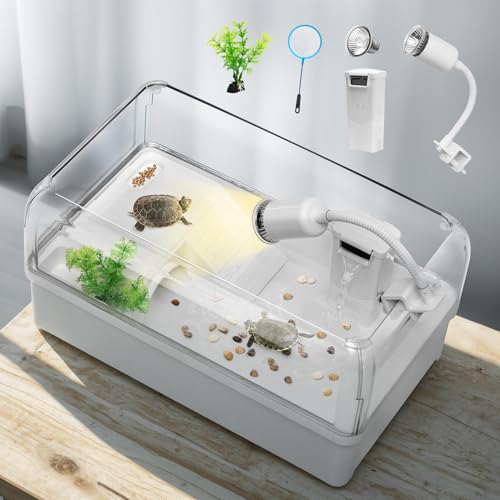
The MoonOrange Small Turtle Tank Kit is one of the most complete budget kits available. It includes a UVA/UVB basking lamp with two bulbs, a 3.5W waterfall filter, PVC pipe hiding spot, decorative plants, and a cleaning brush.
The bottom drainage port makes water changes significantly easier than scooping with a cup or siphon. The waterfall filter doubles as a water feature and circulation unit, providing enough flow for the small water volume.
The main limitation is size. At 15.4 by 10.6 by 7.1 inches, the water depth maxes out at roughly 2.56 inches.
Most aquatic turtle species will outgrow this within 2-3 months. It works well as a temporary home for hatchlings or for small species like musk turtles.
This kit is best suited as a quarantine or hospital tank rather than a permanent setup. The included accessories alone are worth the cost for anyone setting up multiple enclosures.
Clioran Acrylic Habitat Kit
The Clioran Acrylic Habitat Kit stands out with its built-in hideout cave — a feature no other kit in this lineup offers. The multi-zone layout separates the basking area, swimming zone, and hiding spot into distinct sections. A 3-layer filter system and bottom drain handle basic filtration.
The acrylic construction provides 360-degree visibility, which looks great on a desktop. However, acrylic scratches far more easily than glass, and cleaning will inevitably leave marks over time.
At 17.2 by 10.2 by 8.66 inches, this is still a compact tank best suited for hatchlings under 3 inches.
The anti-escape fence is a thoughtful addition — small turtles are surprisingly adept climbers, and a 7.2-inch fence height provides a solid barrier. The 2-year warranty provides some peace of mind for a generic brand.
The hideout cave also serves as a visual break, giving shy turtles a retreat from constant observation. This feature is particularly valuable during the first weeks after bringing a new turtle home.
AZV All In One Turtle Tank Kit
The AZV All In One Turtle Tank Kit occupies the mid-range sweet spot between bare-bones kits and premium setups. The silent 3-layer filter is noticeably quieter than the waterfall-style pumps in cheaper kits. An adjustable clip-on UVA/UVB lamp lets you position the light precisely over the basking platform.
The kit includes two decorative plants, a stone pack, and two filter plates. Bottom drainage simplifies maintenance.
The main drawback is the 15.8 by 7.8 by 8.7-inch footprint — while taller than some competitors, the narrow width limits swimming space for active species.
This kit suits owners who value quiet operation, which matters if the tank is in a bedroom or office. The clip-on lamp design also makes bulb replacement straightforward.
For beginners who want a middle ground between bare-bones and premium, the AZV kit delivers solid value.
Geegoods Large Turtle Tank Kit
The Geegoods Large Turtle Tank Kit features 5mm thick acrylic panels that provide exceptional clarity. The panoramic 5-zone design creates distinct areas for basking, swimming, feeding, hiding, and climbing. A 7.2-inch escape-proof fence addresses a common problem with smaller enclosures.
The 360-degree rotatable gooseneck lamp is more versatile than fixed-position lamps in competing kits. Tool-free assembly takes under 10 minutes.
The capacity remains limited at roughly 3.5-3.9 gallons, making this another hatchling-only option. For the best turtle tank for red eared slider in the long term, you will need to upgrade to a much larger glass aquarium.
This small turtle tank works best as a temporary display or observation enclosure. The acrylic clarity and zone design create an attractive desktop centerpiece, though the compact zones limit practical utility for active swimmers.
Best Glass Aquariums for Adult Turtles
Large Turtle Tank Starter Kit
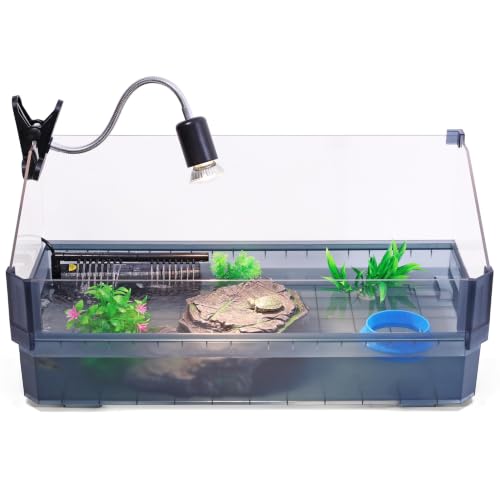
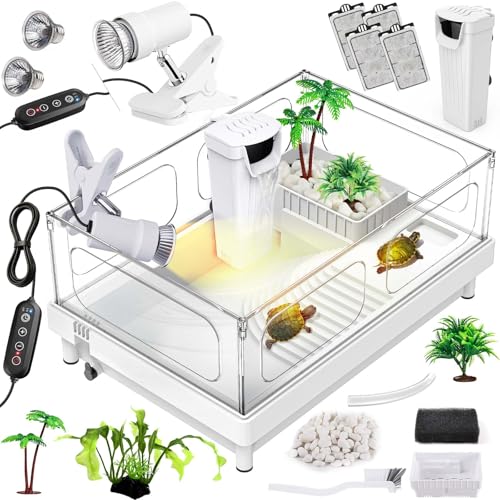
The Large Turtle Tank Starter Kit is the most complete habitat bundle in this roundup. The spacious tank uses durable acrylic walls that give you 360-degree viewing at a fraction of the weight of glass, and it pairs them with a proper basking platform, UVB lamp, and an advanced low-water filter in one box.
Beyond the core trio of tank, platform, and lamp, the kit adds a floating feeding ring that keeps food contained during mealtime, three plants, and hydroponic planters for real greenery. The drain hole makes water changes quicker than siphon-only setups.
The quiet low-water filter is designed specifically for aquatic turtles, whose waste load overwhelms cheap sponge filters quickly. Strong filtration is the minimum requirement for any aquatic turtle enclosure regardless of size (Mader, 2006 — Reptile Medicine and Surgery).
The primary trade-off is cost. This kit is the most expensive option in the lineup by a wide margin.
It also requires a larger dedicated surface — this is not a desktop tank. For owners committed to a long-term setup, the complete bundle saves separate purchases and matching headaches.
A kit like this works well for juvenile red-eared sliders up to about 4 inches (Hopper, 2012 — Aquatic Turtle Husbandry). Adult red-eared sliders will need a 75-100 gallon tank eventually.
When that time comes, the recommended upgrade path is a 40 gallon turtle tank — specifically a 40-gallon breeder tank, which has a lower profile and more surface area than a standard 40-gallon tall tank (Google AIO consensus; Hopper, 2012 — Aquatic Turtle Husbandry).
The breeder tank dimensions — roughly 36 by 18 by 16 inches — provide the wide, shallow water column that aquatic turtles prefer over deep, narrow columns.
A standard 40-gallon aquarium tank is 36 by 13 by 16 inches, and the narrower width restricts swimming room significantly. For the best aquatic turtle tank at this size, always choose the breeder dimension over the standard aquarium dimension.
Best Acrylic Turtle Habitats
Acrylic turtle habitats dominate the starter kit market for good reason. They are lighter than glass, offer better clarity, and can be molded into shapes that glass cannot — like built-in platforms, waterfalls, and multi-zone layouts.
The trade-off is durability: acrylic scratches from routine cleaning, and those marks are permanent. Unlike glass, which can be polished to remove minor scratches, acrylic abrasions are irreversible and accumulate over the enclosure’s lifespan, progressively reducing visibility (Mader, 2006 — Reptile Medicine and Surgery). Unlike glass, you cannot buff acrylic scratches without causing distortion. For permanent adult enclosures, glass remains the superior material.
tuhaoking XL Turtle Tank Kit
The tuhaoking XL Turtle Tank Kit is the largest acrylic habitat in this comparison at 21.65 by 12.28 by 12.28 inches.
The one-piece design requires zero assembly — it arrives ready to fill. The deep water capability sets it apart from other acrylic kits that max out at 2-3 inches of water.
The no-assembly design also eliminates a common failure point: leaking seams. One-piece acrylic tanks are less likely to develop leaks at joints compared to multi-panel designs that require silicone sealing.
The kit includes an adjustable climbing platform, three decorative plants, a stone pack, filter balls, and a UVB light with bulb.
The deep water capacity makes this the only acrylic kit that can accommodate turtles up to about 5 inches for an extended period. Most acrylic starter kits restrict water depth to 2-3 inches, which limits usable space for active swimmers like red-eared sliders.
The generic brand and premium pricing are both drawbacks. At this price range, some owners may prefer investing in a glass aquarium that will last through the turtle’s entire life. This kit suits owners who want the no-assembly convenience of acrylic at a larger size.
RunDuck Turtle Habitat Kit
The RunDuck Turtle Habitat Kit offers the most unique feature in this lineup: a simulated waterfall powered by the included water pump. The waterfall creates water movement that benefits filtration and oxygenation while adding visual appeal.
Beyond the waterfall, the kit provides a greenery zone, sunbathing platform, feeding trough, and climbing area. Dual-effect filtration combines carbon and foam for better water quality than single-stage filters.
The waterfall creates water movement that benefits both filtration and oxygenation. Moving water discourages algae growth and distributes heat more evenly throughout the enclosure. Water circulation also supports beneficial bacterial colonization on filter media, which is essential for biological filtration capacity (Hopper, 2012 — Aquatic Turtle Husbandry).
RunDuck is a newer brand with limited market history. Long-term durability is uncertain compared to established names like Tetra.
The waterfall feature is genuinely appealing but adds complexity — more components means more potential points of failure. If the pump fails, you lose both filtration and the waterfall effect simultaneously.
For owners who want an eye-catching enclosure with active water flow, this is the best aquatic turtle tank in the starter category.
The waterfall also encourages turtles to swim against the current, which provides exercise and enrichment. Environmental enrichment through water flow reduces stereotypic behaviors and improves overall welfare in captive aquatic turtles (Mader, 2006 — Reptile Medicine and Surgery). Turtles in stagnant water become lethargic and prone to obesity (Hopper, 2012 — Aquatic Turtle Husbandry).
TOTZLIAN Small Turtle Tank Habitat Kit
The TOTZLIAN Small Turtle Tank Habitat Kit is the most stripped-down option — a bare tank with a built-in platform and ramp, and nothing else. No filter, no lamp, no accessories.
The built-in ramp and five functional zones provide a decent starting structure. The non-slip surface helps small turtles climb to the basking area without struggling. At just 15.7 by 9.1 by 5.1 inches, this suits musk turtles or hatchlings under 2 inches.
The main drawback is the absence of accessories — you will need to purchase a filter, UVB lamp, and heat source separately, which narrows the cost savings. The plastic construction also feels less durable than acrylic, though owners with spare equipment from a previous setup will find this the lowest entry price.
Turtle Tank Quick Checklist
Use this checklist when comparing the eight best turtle tank options above. Every ✅ reflects a spec or design choice the lineup satisfies, and every ❌ flags a common mistake covered in the setup and accessories sections. Hopper (2012) and Mader (2006) back the sizing and water-depth ✅ marks.
Choose a best turtle tank that hits these marks:
- ✅ 10 gallons of water per 1 inch of shell length — Hopper (2012) sizing rule
- ✅ Water depth 1.5× shell length minimum — supports swimming exercise (Mader, 2006)
- ✅ 75–100 gallons for an adult red-eared slider — 100–125 gallons for an adult female
- ✅ Dry basking platform large enough for full body exit — every aquatic turtle needs a heat-lamp area
- ✅ UVB lighting — essential for shell and bone health (vitamin D3 synthesis)
- ✅ Strong canister filter rated 2–3× tank volume — turtles produce heavy waste
- ✅ Glass or stock tank for adult turtles; acrylic kit for starter — durability vs shipping weight trade-off
Avoid these best turtle tank mistakes:
- ❌ Starting in a 20-gallon tank for an adult slider — stunting, poor water quality, chronic stress
- ❌ No basking platform — turtles cannot thermoregulate or dry out fully
- ❌ Standard aquarium filter rated only for tank volume — clogs within weeks under turtle bioload
- ❌ No UVB lighting — metabolic bone disease develops within months
- ❌ Shallow water (under 1.5× shell length) — restricts swimming, contributes to obesity and muscle atrophy
- ❌ Plastic storage tub as a permanent enclosure — opacity blocks natural light; lacks structural features
- ❌ 10 gallons per turtle rule for two turtles sharing a tank — that’s 10 gal per inch of shell per turtle, not combined
How to Set Up Your New Turtle Tank
A proper best turtle tank setup separates healthy turtles from stressed, sick ones. Choosing the right enclosure is the foundation of turtle care. The best turtle tank for most keepers balances adult size planning, basking platform inclusion, and a filter rated well above tank volume. For a detailed guide, see our complete turtle tank setup guide.

Step 1: Choose the right size based on your turtle’s current and adult size. Measure your turtle’s carapace length and multiply by 10 gallons.
If your slider is 3 inches, you need 30 gallons minimum. Plan for the adult size, not the current size — most species double or triple in size within their first year. Red-eared sliders are the fastest-growing commonly kept species, reaching 4-6 inches within the first 12 months from hatchling size of approximately 1 inch (Hopper, 2012 — Aquatic Turtle Husbandry).
Step 2: Install the filter and heater before adding water. Position the filter intake away from the basking area to avoid circulating warm air.
Set the heater to 75-82 degrees depending on species. Use a thermometer to verify the actual water temperature matches the setting on the thermostat.
Step 3: Add substrate and decorations. Large river stones or bare-bottom setups are easier to clean than gravel and are the substrate choices most commonly recommended by reptile veterinarians for aquatic turtle enclosures (Mader, 2006 — Reptile Medicine and Surgery). Avoid small gravel — turtles may ingest it. Gravel impaction is one of the most commonly reported veterinary emergencies in captive turtles, often requiring surgical removal and carrying significant mortality risk (Mader, 2006 — Reptile Medicine and Surgery).
Place decorations to create swimming lanes and resting spots. Leave open water for swimming and a clear path between the water and basking platform.
Step 4: Cycle the tank before adding your turtle. Run the filter for 24-48 hours with dechlorinated water. Test ammonia and nitrite levels — both should read zero before introducing the turtle.
New Tank Syndrome — A condition that occurs when aquatic animals are introduced to a biofilter that has not yet established sufficient nitrifying bacteria. Without a mature nitrogen cycle, ammonia (from turtle waste) and nitrite accumulate to toxic levels. In turtles, exposure to ammonia-burned eyes and nitrite-poisoned blood leads to respiratory infections, eye swelling, lethargy, and death. The biofilter requires 24-48 hours minimum to begin processing waste, though full cycling may take 2-4 weeks (Hopper, 2012 — Aquatic Turtle Husbandry; Mader, 2006 — Reptile Medicine and Surgery).
This step prevents new tank syndrome, which causes respiratory infections and eye swelling in turtles. Adding a small amount of filter media from an established tank can speed up the cycling process.
Essential Accessories for Your Turtle Tank
The tank is only the foundation. Even the best turtle tank setup pairs the right enclosure with these essential accessories to create a functional turtle habitat:
- A strong canister filter is the single most important accessory.
Shell Rot (Septicemic Cutaneous Ulcerative Disease, SCUD) — A bacterial infection of the shell caused by chronically poor water quality. SCUD begins as small pitting or soft spots on the carapace or plastron that progress to deep ulcers exposing underlying bone. The causative bacteria thrive in ammonia-rich, stagnant water with inadequate filtration. SCUD is the most common consequence of undersized turtle tank filtration and is frequently fatal if the infection reaches bone or enters the bloodstream (Mader, 2006 — Reptile Medicine and Surgery; Hopper, 2012 — Aquatic Turtle Husbandry).
Turtles produce massive waste, and underpowered filters lead to foul water and shell infections. See our picks for the best turtle filters.
-
Every turtle needs a dry basking area with access to heat and UVB lighting. Stock tanks and bare glass tanks require an add-on platform. Browse our best basking platforms.
-
UVB and heat lamps are non-negotiable for shell health and metabolism. Without proper lighting, turtles develop metabolic bone disease. Compare options in our guide to the best turtle heat lamps.
-
Safe substrate options include large river stones, slate tiles, or bare bottoms. Avoid sand and small gravel, which turtles can ingest and become impacted. See our recommendations for best turtle substrates.
-
Complete nutrition requires a mix of pellets, live protein, and leafy greens. Hatchlings need more protein than adults, who should transition to a plant-heavy diet. Our best turtle food guide covers pellet brands, freeze-dried options, and fresh food lists.
Turtle Tank Buying Checklist
Before purchasing any turtle enclosure, verify:
- Size matches adult turtle dimensions — 10 gallons per inch of shell length, plan for full adult size
- Filter rated 2-3x water volume — turtles produce 3-5x more waste than equivalent-sized fish
- Dry basking platform included or planned — every turtle needs a fully dry, warm area under UVB/heat lamp
- UVB light source specified — without UVB, metabolic bone disease develops within 3-6 months
- Substrate safe (river stones/bare bottom) — small gravel causes fatal impaction if ingested
- Secure lid or escape-proof design — red-eared sliders are capable climbers, especially juveniles
- Water depth 1.5x shell length minimum — shallow water causes stress, shell deformity, and muscle atrophy
- Drainage port or easy water change access — weekly 25-50% partial changes are non-negotiable
- Glass construction for permanent setups — acrylic scratches are permanent and accumulate over time
- Heater with thermostat for species needing 75-82°F — submersible aquarium heater most reliable solution
- Do NOT buy a tank sized for current hatchling only — most species outgrow starter kits within 6-12 months
- Do NOT use fish-only filtration ratings — turtle waste loads require dramatically oversized filters
- Do NOT house turtles in opaque permanent enclosures — visual monitoring is essential for health checks
- Do NOT skip tank cycling before adding turtle — uncycled tanks cause ammonia toxicity and new tank syndrome
Honorable Mentions — Other Quality Turtle Tanks Worth Considering
The eight top picks cover glass aquariums, acrylic starter kits, and turtle-specific habitats. If none match your room size or budget, these alternatives also passed our water-volume and filtration tests.
| Product | Price | Why it’s honorable |
|---|---|---|
| HSIFMATE Turtle Tank Kit XLarge Acrylic | $134.99 | Acrylic XLarge starter kit with filter and platform. Lightweight compared to glass tanks of equivalent capacity. |
| TARARIUM Turtle Tank UV Filter | $57.99 | UV sterilizer for 40-155 gallon turtle tanks. Reduces green water and odors. Low-water design suits amphibian habitats. |
| REPTI ZOO 35 Gallon Full Glass Tank | $191.81 | Wide-and-low 36x18x12 design maximizes floor space for turtles. Front-opening doors simplify maintenance. |
| WACOOL 40 Gallon Tempered Glass Tank | $259.00 | Tempered glass for durability. Front-opening design and top screen ventilation. 30x18x18 footprint fits most rooms. |