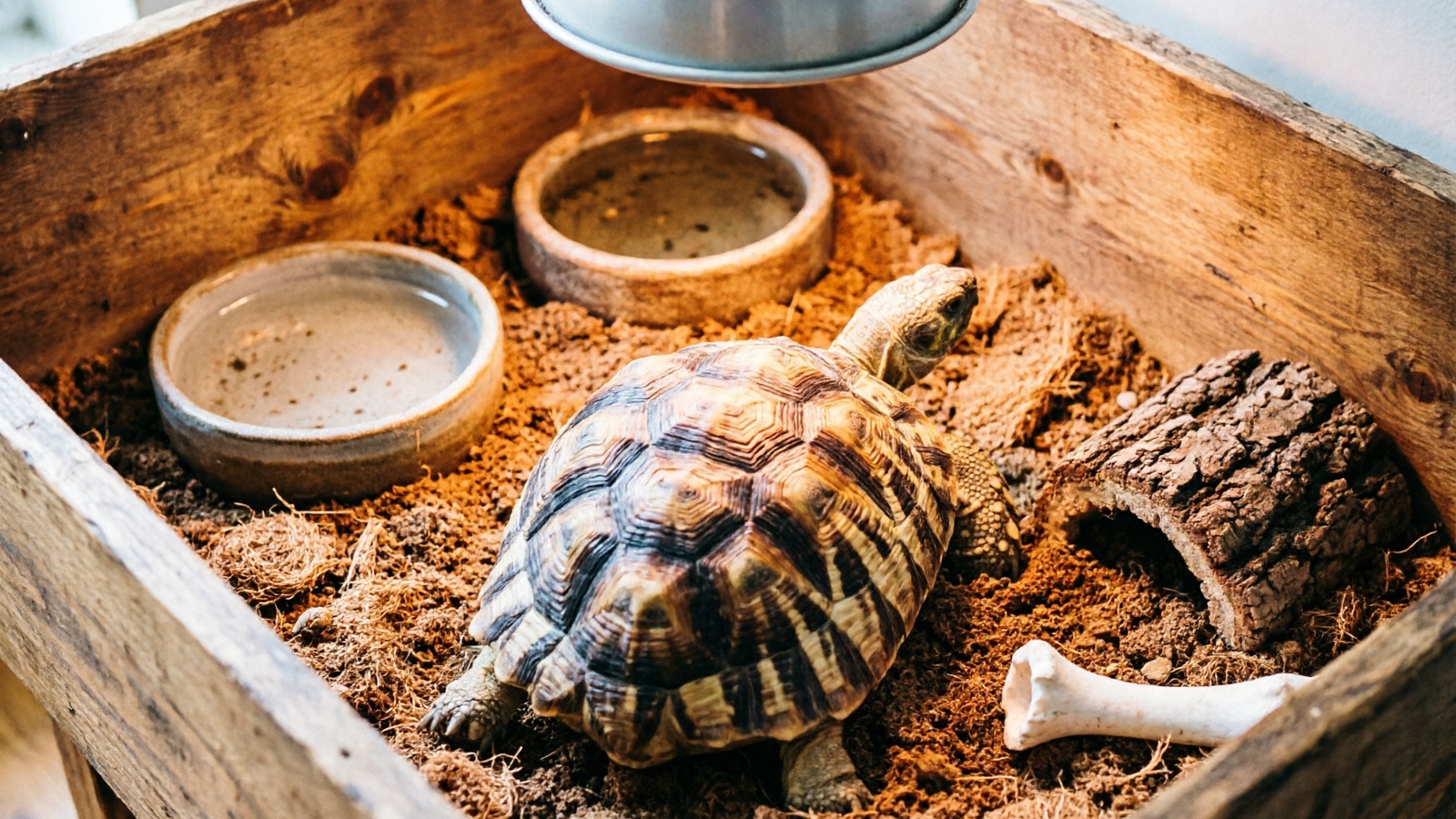
Best Tortoise Enclosure — Top Picks by Type
The best tortoise enclosure type depends entirely on species and size.
A Russian tortoise needs at least 4x8 feet as an adult. A Sulcata needs an entire backyard (Merck Veterinary Manual — Testudines). There is no one-size-fits-all best tortoise enclosure.
Choosing the right housing is the most important decision for tortoise keepers. The wrong enclosure causes stress, illness, and stunted growth (Merck Veterinary Manual). The right one supports decades of healthy life.
Every tortoise enclosure on Amazon has been evaluated against community recommendations from experienced keepers. Here are the top picks organized by type.
Enclosure type recommendations:
| Enclosure Type | Best For | Top Pick | Species |
|---|---|---|---|
| Open-Top Table (indoor) | Small Mediterranean species | Aivituvin Large | Russian, Hermann’s, Leopard |
| Outdoor Hutch | Year-round outdoor housing | ROCKEVER | Russian, Leopard |
| Exercise Pen | Temporary outdoor time | TRIXIE | All species (supervised) |
| Multi-Level Table | Enrichment + space saving | Wooden Dual-Level | Russian, Hermann’s |
| Cabinet/Modern | Living room display | Agitree | Small species |
Quick picks — best tortoise enclosure by type:
| Rank | Product | Best For |
|---|---|---|
| 1 | Aivituvin Large | Best Overall |
| 2 | ROCKEVER Outdoor Hutch | Best Outdoor |
| 3 | TRIXIE Outdoor Run | Best Exercise Pen |
| 4 | GEGURI Detachable Legs | Best Budget |
| 5 | Aivituvin with Lamp Holder | Best with Heat Light |
| 6 | Aivituvin Premium | Best Mid-Range |
| 7 | Wooden Dual-Level Tortoise Enclosure | Best Premium |
| 8 | PawHut 3-Room Tortoise House | Best Multi-Room |
| 9 | PawHut Wooden Tortoise House | Best Compact Wood House |
| 10 | Agitree Cabinet | Best Modern Design |
Pairing the right enclosure with proper nutrition ensures healthy growth. See our best tortoise food guide.
Best Tortoise Enclosure Types — Table, Hutch, vs Vivarium
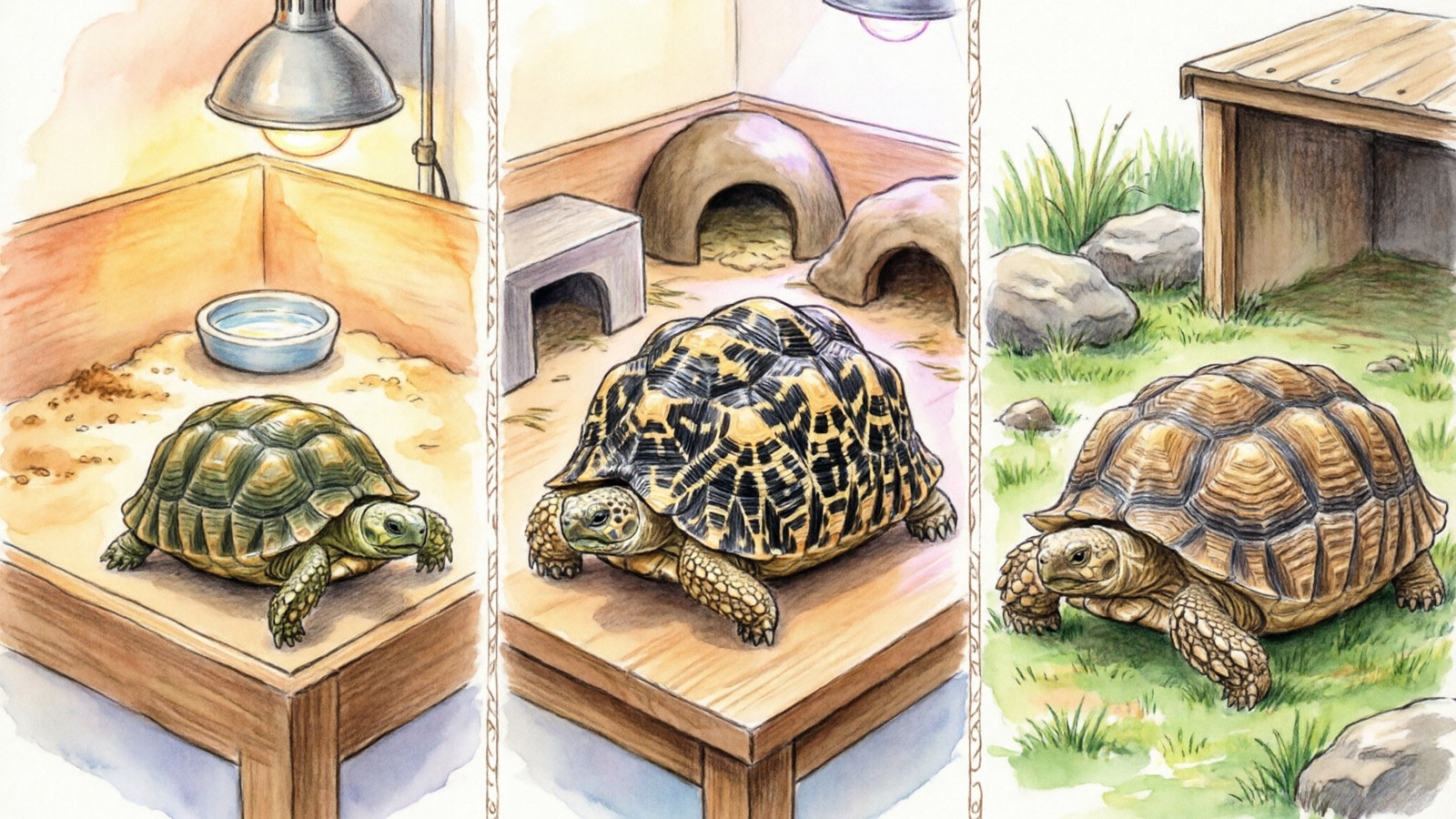
“Tortoise table” is the standard term for open-top indoor wooden enclosures — not a table with legs for eating. This is the most recommended housing type for indoor tortoise keeping.
Understanding tortoise enclosure types prevents costly mistakes — choosing the right one is essential. Glass vivariums are the number one beginner mistake in tortoise keeping.
| Factor | Open-Top Table | Outdoor Hutch | Glass Vivarium | Exercise Pen |
|---|---|---|---|---|
| Ventilation | Excellent (open top) | Good (wire mesh) | Poor (glass walls) | Excellent (open) |
| UVB penetration | Full (open top) | Good (mesh top) | Blocked by glass | Full (open air) |
| Humidity control | Moderate | Low (outdoor) | Too high (stalled) | None (outdoor) |
| Substrate depth | 4-6 inches | 3-4 inches | Limited | Ground contact |
| Predator protection | None | Good (enclosed) | Excellent | Good (mesh cover) |
| Temperature gradient | Needs lamps | Natural + backup | Hard to achieve | Natural sun |
| Ideal species | Russian, Hermann’s | Russian, Leopard | Not recommended | All (temporary) |
Warning: Glass vivariums and terrariums are NOT recommended for tortoises. They trap humidity, prevent proper air circulation, block UVB through glass, and cause respiratory infections (VCA Hospitals — Tortoise Care).
Open-top wooden tables are the community consensus for indoor housing — a tortoise table DIY build can be a cost-effective alternative (ReptiFiles — Tortoise Enclosure).
A tortoise enclosure indoor setup using glass tanks works for bearded dragons but is dangerous for tortoises (VCA Hospitals). The trapped humidity and poor ventilation are the opposite of what tortoises need.
For comparison, see our bearded dragon terrarium guide.
For the best tortoise table, an open-top design with at least 4x2 feet is the minimum for a juvenile. Proper tortoise table size ensures healthy development. Adults need significantly more room.
Best Tortoise Table — Indoor Enclosures
Every tortoise enclosure indoor setup comes in several sizes and price points. Choosing the right tortoise table size depends on species, age, and current shell size.
Minimum enclosure size by species:
| Species | Adult Size | Minimum Floor Space | Minimum Table Size | Substrate Depth |
|---|---|---|---|---|
| Russian | 5-8 inches | 4x2 ft (baby), 8x4 ft (adult) | Large table or DIY | 4-6 inches |
| Hermann’s | 5-8 inches | 4x2 ft (baby), 8x4 ft (adult) | Large table | 4-6 inches |
| Leopard | 10-18 inches | 8x4 ft (juvenile), 4x8 ft+ (adult) | Extra-large or outdoor | 6-8 inches |
| Sulcata | 18-30+ inches | 8x4 ft (baby), backyard (adult) | Only for babies | 6-12 inches |
| Red-footed | 10-14 inches | 4x3 ft (baby), 6x4 ft (adult) | Large table | 4-6 inches |
Every indoor tortoise table needs a basking heat lamp. See our heat lamp guide for recommendations.
Aivituvin Large — Best Overall
The Aivituvin Large Tortoise House has a massive community following among tortoise keepers. It works indoors and outdoors thanks to the weatherproof bottom.
This enclosure is recommended more than any other on tortoise forums and Reddit communities. The large size makes it the best Russian tortoise enclosure option for Mediterranean species, accommodating Russian, Hermann’s, and similar species.
What we like: Large enough for most Mediterranean species. Weatherproof bottom allows indoor and outdoor use. Wire lid provides some protection from household pets.
What could be better: A buyer called the wood “cheap and easily damaged” with a strong chemical smell resembling paint thinner. Another buyer noted it “smells of strong chemicals” and recommended airing it out before use.
The chemical smell is the most common complaint. Always air out wooden enclosures for at least 48 hours in a well-ventilated area before introducing your tortoise (VCA Hospitals).
GEGURI Detachable Legs — Best Budget
The GEGURI Detachable Legs habitat offers the most affordable entry point for a tortoise enclosure. Detachable legs let you use it on a table or directly on the floor.
What we like: Legs detach for flexible placement. Good starter size for hatchlings and juvenile tortoises. Indoor and outdoor versatility.
What could be better: An owner noted the assembly takes about an hour with no guide holes after the first two steps. Another owner mentioned the house is “very cheaply made” despite looking nice.
Budget enclosures typically require more patience during assembly. Have a power drill ready and expect to improvise slightly with hardware.
Aivituvin with Lamp Holder — Best with Heat Light
The Aivituvin Wooden Tortoise House solves a common beginner problem — mounting a basking light. The built-in adjustable lamp holder supports heat lamps right out of the box with no DIY bracket needed.
What we like: Built-in lamp holder eliminates the most common DIY challenge. Open-top design allows full UVB penetration from overhead bulbs. Affordable for the included features.
What could be better: A buyer reported “low quality and broken pieces” with “too many splinters.” Another buyer said the color received did not match what was shown.
The lamp holder alone justifies choosing this model over the basic GEGURI for first-time tortoise keepers who need a complete setup.
Aivituvin Premium with Legs — Best Mid-Range
The Aivituvin Premium is the premium Aivituvin model with detachable legs, a lamp holder, and a sturdy plastic tray for easy cleaning.
What we like: The plastic tray makes cleaning significantly easier than bare wood bottoms. Detachable legs provide placement flexibility. Owners confirm it works well for baby Sulcata tortoises.
What could be better: A reviewer described the wood as “cheap and flimsy” before noting it becomes acceptable once fully assembled. Another said they wish it was bigger.
The plastic tray is a genuine quality-of-life improvement over the standard Aivituvin Large model — worth the upgrade if budget allows.
Tortoise Enclosure Outdoor — Best Options
A tortoise enclosure outdoor setup provides natural sunlight, UVB exposure, and exercise space that no indoor setup can replicate.
These tortoise enclosure outdoor setups work best in mild climates for Russian and Leopard tortoises.
ROCKEVER Outdoor Hutch — Best Outdoor
The ROCKEVER Outdoor Hutch uses a chicken-coop style design with an enclosed sleeping area attached to a wire-mesh run. It provides the most complete outdoor tortoise enclosure on Amazon for temperate climates.
What we like: Enclosed sleeping area gives protection from weather and predators. Wire run provides outdoor exercise space with overhead protection from birds. Owners praise it as “well built and easy to assemble” with a size “absolutely perfect” for tortoises.
What could be better: A reviewer reported a “VERY strongly like cedar wood” smell that forced them to return the product for their guinea pigs. Another said it “lasted less than a year with rain wear and tear even with a coat of wetseal.”
Cedar odor is a serious concern — aromatic cedar oils are toxic to reptiles (Merck Veterinary Manual). Always air out any enclosure with a strong wood smell for several days before use. Seal the exterior with a pet-safe waterproofing product for outdoor durability.
TRIXIE Outdoor Run — Best Exercise Pen
The TRIXIE Outdoor Run requires no assembly — unfold and use immediately. The mesh cover protects from birds of prey and other predators during supervised outdoor time.
What we like: Zero assembly required. Foldable design stores flat when not in use. Mesh top provides genuine predator protection.
What could be better: An owner noted the wood “is starting to rot” after just a couple of months outdoors. Another owner said the top cover did not fit properly over the base.
This is best used as a temporary supervised exercise pen, not permanent housing. Always stay within sight when your tortoise is in an exercise pen. For permanent outdoor setups, the ROCKEVER hutch provides better weather protection.
Outdoor enclosures provide natural sunlight UVB. For indoor setups, you will need a quality UVB bulb. See our UVB light guide.
Best Tortoise Enclosure — Enrichment and Display
Multi-level enclosures add vertical space for exploration while cabinet-style enclosures fit into home decor. These options serve keepers who want more than a basic wooden box.
Wooden Dual-Level Tortoise Enclosure — Best Premium
The Wooden Dual-Level Tortoise Enclosure ($218.02) is a premium multi-level tortoise habitat. It features a private main house and a large run box on two levels, with openable mesh lids and a transparent viewing window.
What we like: The two-zone layout gives your tortoise a private retreat plus open roaming space. Fir wood and steel construction with a water-resistant paint finish holds up to humid setups and outdoor use. The openable mesh lids let UVB and UVA lighting reach the full enclosure.
What could be better: At $218.02 it is the priciest pick on this list. Assembly takes two people and some patience with the hardware.
The dual-level design stands out as the premium multi-level option for keepers who want more than a single flat run.
PawHut 3-Room Tortoise House — Best Multi-Room
The PawHut 3-Room Tortoise House ($144.99) adds a balcony, ladder, and openable roof at a budget-friendly price point.
What we like: Three separate rooms provide distinct basking, hiding, and feeding areas. A pull-out tray makes cleanup quick, and the openable roof gives easy access for feeding.
Warning: SAFETY NOTE: Two-story habitats with ramps need supervision — some tortoises, especially flat species like Russians, walk off ledges instead of using the ladder. Make sure your species can navigate a ramp safely.
What could be better: Tortoises may walk off ledges rather than use the ramp, and the 44-inch footprint still limits straight walking room compared to a full outdoor run.
This enclosure works best for species that naturally climb — think Russians and Hermann’s may struggle with the ramp layout.
PawHut Wooden Tortoise House — Best Compact Wood House
The PawHut Wooden Tortoise House ($74.99) is a compact fir-wood enclosure at 35.75” × 23.75” × 12.5”. It splits into a private sleeping room and an open viewing run, with three windows so you can check on the animal without lifting the roof. Side panels on the run pull out to add floor space, and lockable latches keep the lid closed outdoors.
What we like: Solid fir construction, indoor/outdoor use, and a two-room layout at a lower price than the 3-room PawHut on this list. The compact footprint fits a table or a small patio without eating a whole corner of the room.
What could be better: At 12.5” tall it is a hatchling or small-species house, not a sulcata grow-out pen. Assembly is required, and the yellow finish will not match every room.
Agitree Cabinet — Best Modern Design
The Agitree Premium Cabinet is a furniture-style enclosure with 360-degree wheels, adjustable lighting, and a modern aesthetic that fits in living rooms.
What we like: The cabinet design looks like actual furniture rather than a pet enclosure. Built-in wheels make it easy to move for cleaning. Adjustable lighting system included.
What could be better: A reviewer reported their snake “can get out” — a concerning security issue for tortoise keepers. Another reviewer said assembly took about three hours with instructions that “could be better explained.”
Check all latches and gaps before introducing your tortoise. The escape risk requires careful inspection of every seam and opening.
Heat lamps need thermostat control to prevent overheating. See our thermostat recommendations.
Baby Tortoise Enclosure — Key Considerations
A baby tortoise enclosure should have specific safety features — baby tortoises need smaller enclosures. Tortoise table size for hatchlings should be at minimum 2x4 foot floor space, suitable for juveniles under six months.
The best tortoise table for babies has three to four inches of coco coir substrate. The Aivituvin with Lamp Holder or GEGURI Detachable are both good starter options for the best tortoise enclosure because they include mounting hardware for heat lamps.
Avoid multi-level best tortoise table designs with ramps for baby tortoises. Hatchlings have poor depth perception and can fall from ledges (ReptiFiles). Keep water dishes extremely shallow — bottle-cap depth prevents drowning.
What to Put Inside the Best Tortoise Enclosure
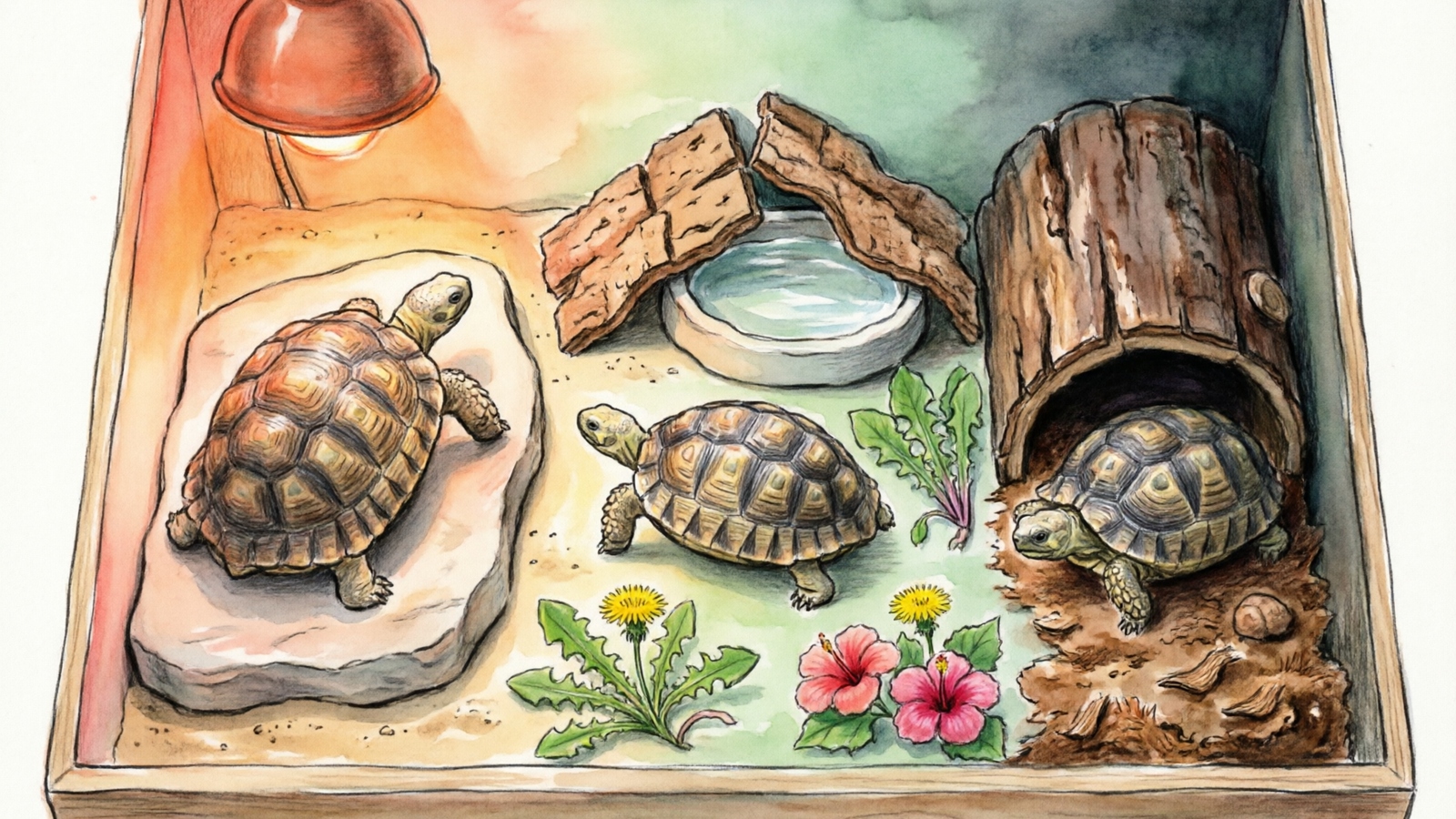
The best tortoise enclosure is only the foundation — proper setup requires several essential components. A proper tortoise enclosure indoor setup requires several essential components for health and comfort.
Enclosure setup essentials — step by step:
- Substrate — four to six inches deep for adults, three to four for babies. Coco coir or play sand mixed 50/50 provides ideal moisture retention and burrowing texture. Avoid cedar, pine, gravel, and reptile carpet
- Heat lamp — basking spot at 95-100°F for Mediterranean species, 85-90°F for tropical species like Red-footed (Merck Veterinary Manual). Cool side at 70-75°F creates a proper temperature gradient
- UVB light — a 10-12% T5 HO tube or 10.0 compact fluorescent positioned over the basking area (VCA Hospitals). Open-top tables allow full UVB penetration. Replace every 6-12 months
- Thermostat — prevents overheating from heat lamps. Non-negotiable safety device that controls temperature automatically
- Water dish — shallow and easy to access. Babies need bottle-cap depth water only
- Hide — at least one covered area on the cool side for sleeping and security
- Food dish — flat slate or ceramic dish that is easy to clean and difficult to tip over
- Calcium source — cuttlebone scattered in the enclosure allows self-feeding for shell health
Substrate choice affects digestion, humidity, and burrowing behavior. See our substrate comparison for tortoise-safe options.
Box turtles need similar housing to tortoises despite being semi-aquatic. See our box turtle care guide for comparison.
Best Tortoise Enclosure Safety Checklist
Safety hazards in tortoise enclosures cause real harm — from respiratory infections to physical injuries. Learning from other keepers’ reported experiences prevents these common mistakes. The following checklist covers the most common dangers reported by keepers and veterinarians.
Safety warnings:
- Glass terrariums — trapped humidity causes respiratory infections and blocks UVB through glass
- Cedar or pine wood — aromatic oils are toxic to reptiles and can cause neurological and respiratory damage (Merck Veterinary Manual)
- Chemical-treated wood — budget enclosures often have strong chemical odor. Always air out for 48+ hours before use
- Ramps for small tortoises — flat species like Russian may walk off ledges instead of using ramps, causing injury
- Deep water dishes for a baby tortoise enclosure — drowning risk for hatchlings. Use bottle-cap depth water only
- Unsecured heat lamps — can fall into enclosures causing fires. Use fixtures with clamps or brackets
- Outdoor without predator protection — raccoons, dogs, and hawks are real threats (ReptiFiles). Wire mesh tops and buried wire skirts are essential
- Gravel or walnut shell substrate — impaction risk if accidentally ingested during feeding (Merck Veterinary Manual)
- Open-top wooden tables — community consensus for indoor tortoise housing
- Coco coir or play sand — safe substrate that holds humidity and allows natural burrowing
- Temperature gradient — warm basking side and cool retreat side for proper thermoregulation
Best Tortoise Enclosure FAQ
What size enclosure does a tortoise need?
Minimum size depends on species. Russian and Hermann’s tortoises need 8x4 ft as adults. Leopard tortoises need 4x8 ft minimum.
Sulcata tortoises eventually require an entire outdoor enclosure or yard. Indoor tables only work for babies and juveniles.
A general rule: the enclosure floor area should be at least 10 times the tortoise’s shell length in both dimensions (ReptiFiles).
Can tortoises live in glass tanks?
No. Glass terrariums are not recommended for tortoises because they trap humidity, block UVB through glass, and prevent proper air circulation.
The tortoise-keeping community and reptile veterinarians recommend open-top wooden tables — many keepers choose a tortoise table DIY approach for custom sizing.
If you already have a glass tank, consider using it for a different reptile species like a gecko or bearded dragon.
Do tortoises need UVB light indoors?
Yes. Indoor tortoises need a quality UVB bulb positioned over the basking area.
A 10-12% T5 HO tube or 10.0 compact fluorescent works best. UVB enables vitamin D3 synthesis, which is critical for calcium absorption and shell health.
Replace UVB bulbs every 6-12 months even if they still emit visible light — UVB output degrades over time (ReptiFiles). Open-top tables allow better UVB distribution than enclosed setups.
What’s the best substrate for tortoise enclosures?
Coco coir and play sand mixed 50/50 are the two most recommended substrates for tortoise tables.
This mix provides ideal moisture retention and burrowing texture. Avoid cedar, pine, gravel, walnut shells, and reptile carpet.
Substrate should be 4-6 inches deep for adults, 3-4 inches for babies.
Can I keep my tortoise outside permanently?
This depends on your climate and species. Russian and Hermann’s tortoises can live outdoors year-round in Mediterranean climates (USDA zones 8-10) with proper predator protection and a heated shelter (Merck Veterinary Manual).
Sulcata tortoises need warm climates (zones 9-11) and will outgrow any commercially available enclosure.
In colder climates, outdoor enclosures work for summer only. For keepers in colder climates, a tortoise table DIY build with insulation may extend the outdoor season. Otherwise, bring tortoises indoors below 60°F at night (VCA Hospitals).