The best ball python heat lamp isn’t the same as the best heat lamp for a bearded dragon or leopard gecko. That distinction matters more than most new keepers realize.
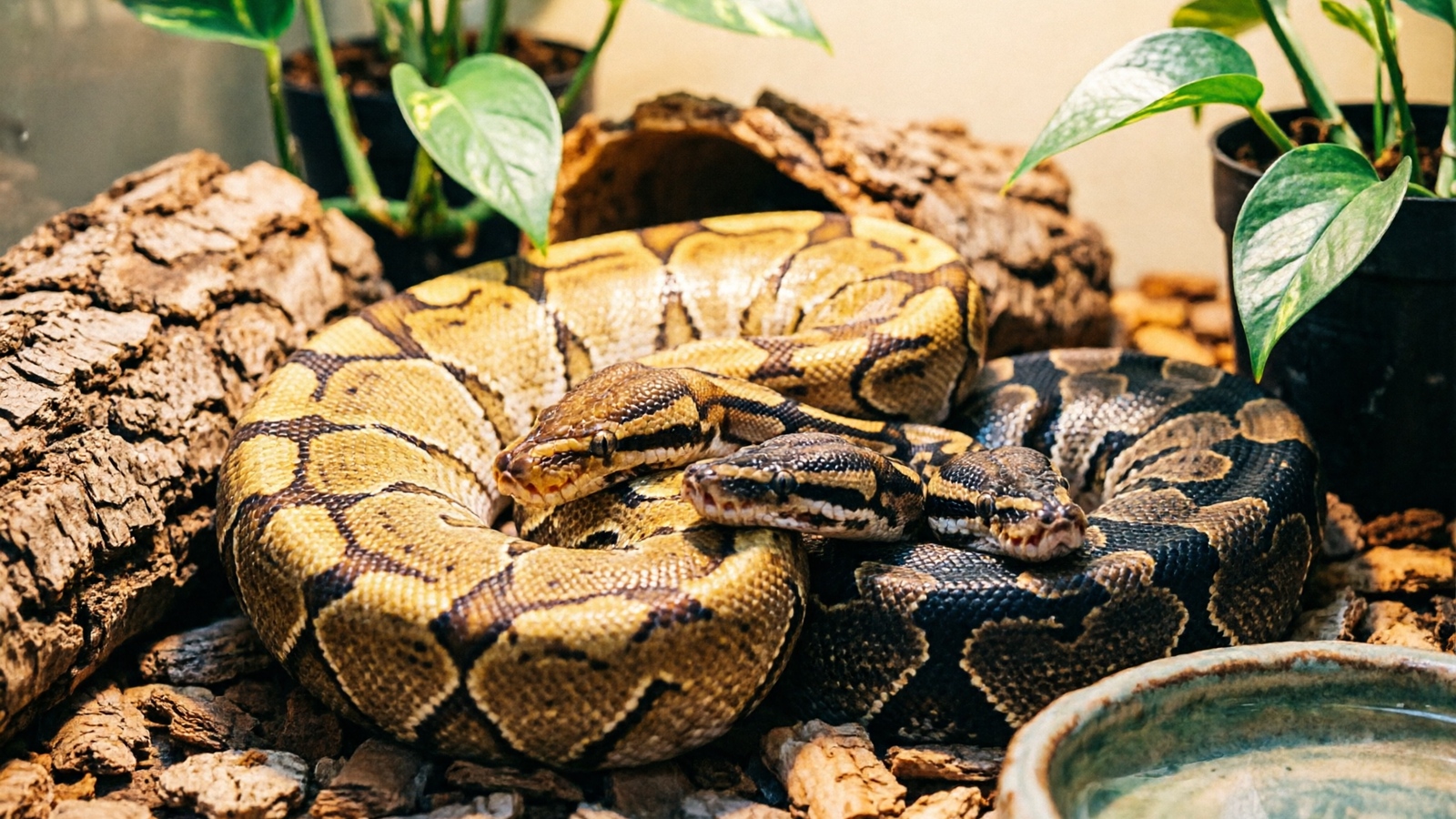
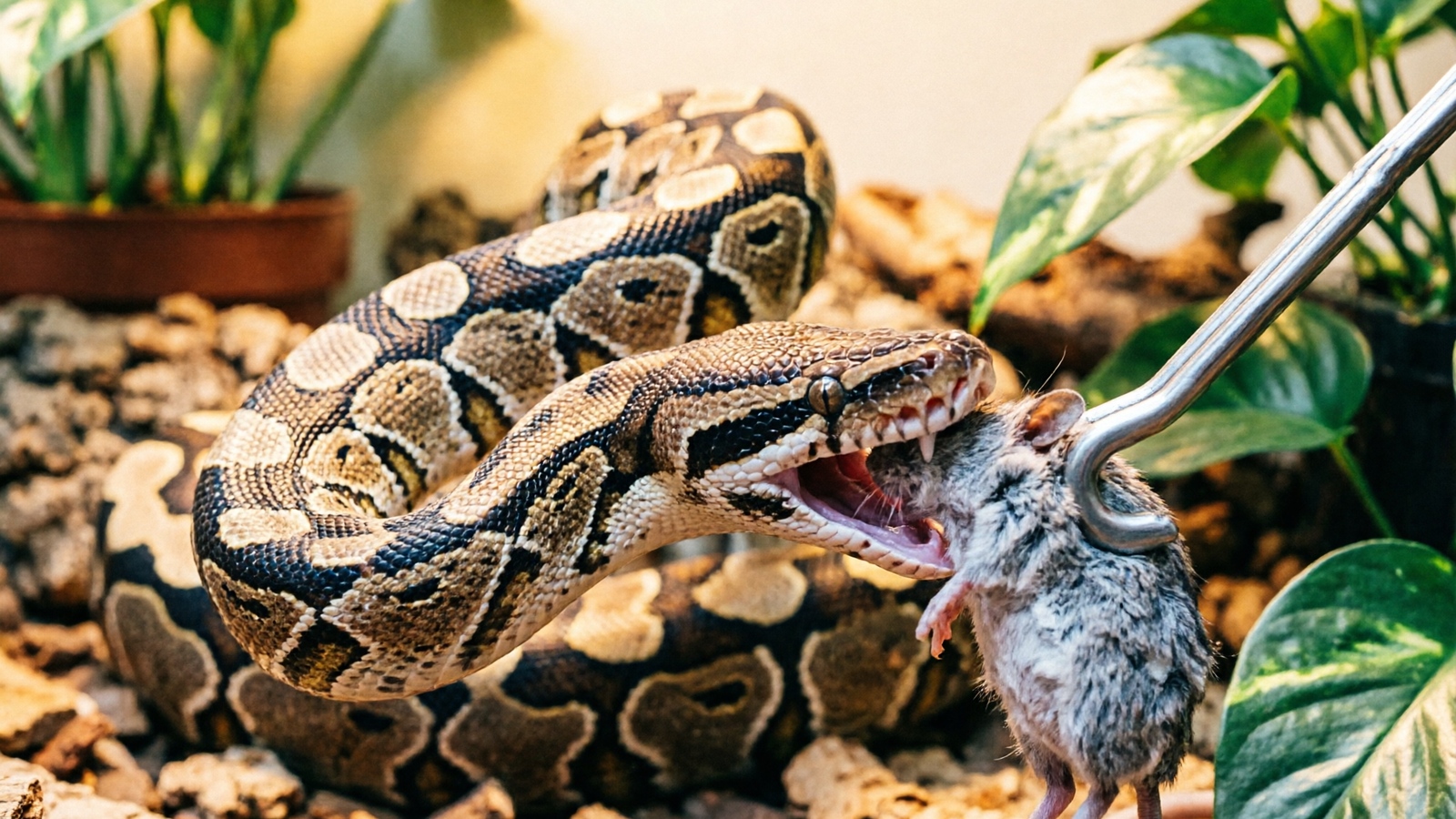
Ball pythons are nocturnal snakes from West and Central Africa that absorb warmth from surfaces their bodies contact — rocks, branches, and substrate gently warmed by ambient overhead heat. This fundamental behavior difference means the best heat source for ball python enclosures prioritizes gentle, ambient warmth over intense basking spots.
Do Ball Pythons Need Heat Lamps?
Yes — ball pythons need overhead heat, but the type matters significantly. The r/ballpython community consensus is clear: a halogen bulb paired with a deep heat projector provides the ideal combination (Facebook Ball Python Lovers, 30+ comments). The AI Overview confirms this split approach: halogen flood lamps for daytime, CHE or DHP for nighttime.
Ball python heating requirements: Ball pythons require a warm side of 88-92°F (31-33°C) and a cool side of 75-80°F (24-27°C). Unlike diurnal reptiles that actively bask, ball pythons prefer gentle, ambient warmth. The best heat sources are halogen bulbs (daytime, for subtle surface warming) and Ceramic Heat Emitters (CHE) or Deep Heat Projectors (DHP) (24/7, with no visible light).
This makes the ball python overhead heat approach different from what you’d use for a bearded dragon — a bright 100W incandescent basking lamp designed for desert reptiles creates unnecessary light stress for a nocturnal snake. The number one mistake new ball python owners make is using a diurnal reptile setup for a species that evolved to avoid both. This mistake appears repeatedly in online forums: new keepers asking why their ball python spends all day hiding and refusing to eat, when the answer is almost always that the enclosure is too bright and too hot at the basking surface.
UTH vs overhead debate: The ball python community increasingly prefers overhead heating (CHE, DHP, or halogen) over Under Tank Heaters because overhead heat creates a more natural top-down thermal gradient. UTH provides belly heat which can confuse thermoregulation — the snake sits on a hot surface but does not experience the warm ambient air that triggers natural behavior patterns. The Reddit r/ballpython top answer on this topic warns that dual dome fixtures shouldn’t be used for ball pythons, as manufacturers don’t recommend two heating elements in a single dome.
For UVB and full lighting recommendations, see our ball python lighting guide. Heating is one pillar of ball python husbandry — our complete care guide covers humidity, diet, and handling. For how heat interacts with humidity requirements, our ball python humidity guide explains the balance.
Types of Ball Python Heat Sources
Understanding the four heat source types helps you choose the right combination. Each produces heat differently, and the best ball python heat lamp setup uses them strategically.
| Type | Light? | Best For | Wattage | Lifespan |
|---|---|---|---|---|
| Halogen Bulb | Yes (warm white) | Daytime surface warmth | 50-100W | 2-3 months |
| Ceramic Heat Emitter (CHE) | No | 24/7 heating | 50-150W | 6-12 months |
| Deep Heat Projector (DHP) | Minimal (barely visible) | 24/7 ambient warmth | 50-100W | 1-2 years |
| Incandescent Bulb | Yes (yellow/warm) | Budget daytime only | 50-100W | 1-2 months |
Halogen vs CHE vs DHP — when to use which:
A ball python halogen bulb provides daytime heat with UVA light and deep-penetrating infrared (IR-A and IR-B wavelengths). This promotes better digestion and muscle warming — the AI Overview specifically notes that halogen’s “deeply penetrating infrared heat promotes better digestion and muscle warming.” Ball pythons kept with halogen daytime heat show noticeably better feeding responses than those under plain CHE-only setups, likely because the subtle UVA light and surface warming simulate natural thermal conditions. Pair a halogen with a CHE or DHP for nighttime coverage.
A ceramic heat emitter ball python setup is the most popular 24/7 background heat option — CHEs produce no visible light and work around the clock without disturbing the snake’s day/night cycle. They’re the most affordable no-light option, and the community request on Facebook Everything Ball Pythons sums it up: “I don’t want one that has a light. Just the heat.”
A deep heat projector ball python is the premium 24/7 upgrade over CHE — DHPs use carbon fiber infrared technology (IR-A/B wavelengths vs CHE’s IR-C) that penetrates deeper than ceramic emitters. They produce virtually no visible light, work best with a pulse-proportional thermostat, and the deeper tissue penetration genuinely makes a difference for species that absorb heat through contact rather than direct basking.
Best Ball Python Heat Lamps — Product Picks
| # | Product | Type | Price | Best For |
|---|---|---|---|---|
| 1 | LUCKY HERP 150W CHE 2-Pack | CHE | $15.99 | TOP PICK CHE |
| 2 | Fluker’s Deep Heat Projector | DHP | $22.92 | TOP PICK DHP |
| 3 | REPTI ZOO Halogen 100W 2-Pack | Halogen | $11.99 | TOP PICK HALOGEN |
| 4 | REPTI ZOO CHE 100W 2-Pack | CHE | $15.99 | Alternative CHE |
| 5 | Zoo Med Incandescent 50W 3-Pack | Incandescent | $29.94 | Budget 3-Pack |
| 6 | Exo Terra Halogen 50W | Halogen | $18.99 | Premium Halogen |
Warning: Thermostat is NON-NEGOTIABLE: Every CHE, DHP, and halogen bulb MUST be connected to a thermostat. Without one, a 150W CHE in a 20-gallon tank will reach lethal temperatures. See our thermostat guide.
Warning: Fire safety: All ceramic-style bulbs reach 300°F+ surface temperatures. Use ceramic socket fixtures only — plastic fixtures WILL melt. Keep flammable materials 12+ inches away.
Best Ceramic Heat Emitters and Deep Heat Projectors
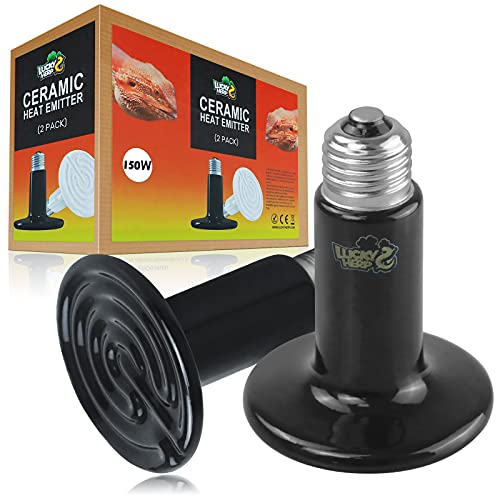
#1. LUCKY HERP 150W Ceramic Heat Emitter 2-Pack — Top Pick CHE ($15.99)
The most proven ceramic heat emitter ball python option with the largest review pool of any competing CHE by a wide margin. At $15.99 for a 2-pack ($7.99 per bulb), it’s the most affordable way to provide 24/7 no-light heat. The 150W output easily achieves the 88-92°F basking temperature that ball pythons need.
What we like: Zero light emission won’t disturb your snake’s day/night cycle, 150W handles most standard 4-foot enclosures without straining, 2-pack value means you always have a backup, and E26/E27 standard socket fits most dome fixtures.
“These things get HOT! Perfect for my ball python enclosure.” — Customer review
What could be better: Surface temperature exceeds 300°F — ceramic socket fixtures are mandatory, not plastic. Quality consistency is a concern — some owners report the first bulb failing after 3 weeks while the second lasted 6 months — and the 30-day warranty is shorter than ideal for a product that should last 6-12 months.
“First bulb burned out after 3 weeks, second one still going after 6 months.” — Customer review
Best for: The default CHE choice for most ball python keepers. Unbeatable value at $7.99 per bulb with the largest review pool validating long-term reliability.
#2. Fluker’s Deep Heat Projector — Top Pick DHP ($22.92)
The premium deep heat projector ball python option using carbon fiber infrared technology that penetrates deeper than standard CHE bulbs. While a CHE primarily emits IR-C (far infrared that heats surfaces), DHPs emit IR-A and IR-B wavelengths (near and mid infrared) that penetrate tissue more effectively — the same wavelengths found in natural sunlight.
What we like: Deeper heat penetration that warms the snake more effectively than surface-only CHE heat, virtually no visible light output (even less than some CHEs), works best with a pulse-proportional thermostat for precise temperature control, and represents the cutting edge of reptile heating technology.
“Heat penetration is noticeably deeper than ceramic emitters. Almost no visible light — my ball python is more active with this.” — Customer review
What could be better: At $22.92 for a single bulb, it is more than 2.5x the per-bulb cost of the LUCKY HERP CHE, and the smaller review pool means less long-term durability data. The focused heat distribution requires careful positioning — too close overshoots temperatures, too far and the benefit diminishes. DHPs work best in enclosures with at least 18 inches between the fixture and the basking surface.
“More expensive than CHE options. Newer technology — long-term durability is still being proven.” — Customer review
Best for: Keepers who want the most advanced heating technology for their ball python and are willing to pay the premium. The ball python nighttime heat provided by DHP is superior to CHE for light-sensitive snakes.
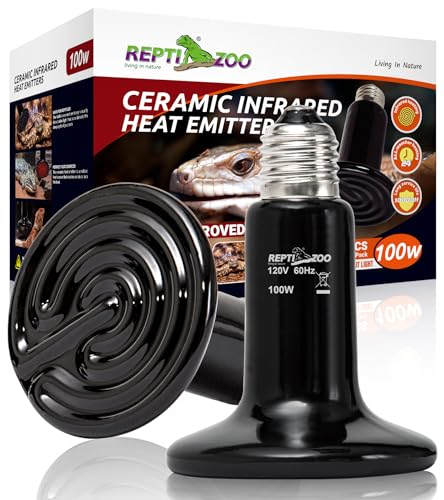
#4. REPTI ZOO 100W Ceramic Heat Emitter 2-Pack — Alternative CHE ($15.99)
A solid alternative CHE from REPTI ZOO — an established reptile brand with a track record across multiple product categories. The 100W output makes this the better choice for smaller enclosures (20-40 gallon) where the 150W LUCKY HERP would create too much heat.
What we like: 100W is correctly sized for the most common ball python enclosure sizes (20-40 gallon), REPTI ZOO brand quality with a substantial review pool validating reliability, same $7.99 per-bulb value as the LUCKY HERP option, and standard E26 socket compatibility.
“100W is perfect — 150W was too much for my smaller enclosure.” — Customer review
What could be better: Some owners report receiving cracked bulbs on arrival due to packaging issues. Measured heat output falls slightly below the rated 100W according to some reviews, and the socket exterior gets extremely hot — exercise caution when adjusting fixture position.
“One of the two bulbs arrived cracked — packaging needs improvement.” — Customer review
Best for: Keepers with 20-40 gallon enclosures where 150W would overheat the space, or those who prefer the REPTI ZOO brand over LUCKY HERP.
Best Halogen and Incandescent Bulbs
#3. REPTI ZOO 100W Halogen Basking Spot 2-Pack — Top Pick Halogen ($11.99)
The most reviewed ball python halogen bulb with thousands of reviews validating the 2nd generation design. At $11.99 for a 2-pack ($5.99 per bulb), it’s the cheapest way to provide daytime heat with UVA light and deep-penetrating infrared warmth.
What we like: Simulated natural sunlight spectrum provides the IR-A/B wavelengths that promote digestion, 2nd generation design improved over the original’s lifespan issues, creates a natural basking gradient in 40-gallon enclosures, and the warm white light isn’t as harsh as incandescent alternatives.
“Great basking spot heat for my ball python — reaches 90°F easily.” — Customer review
What could be better: Emits visible light that prevents 24/7 use — you must turn it off at night. Lifespan remains limited at approximately 2-3 months per bulb based on community reports, and the light has a slightly yellow tint compared to natural sunlight.
“Bulbs burn out faster than expected — about 2-3 months each.” — Customer review
Best for: Daytime heat paired with a CHE or DHP for nighttime. At $5.99 per bulb, replacement cost is minimal even with frequent changes.
#5. Zoo Med Incandescent 50W 3-Pack — Budget 3-Pack ($29.94)
Zoo Med is the most recognized brand in reptile heating, and this 3-pack provides 50W incandescent bulbs with neodymium coating that enhances natural colors. At $9.98 per bulb, the value is reasonable for the brand reputation.
What we like: Trusted Zoo Med brand with decades of reptile product experience, 50W is appropriate for juvenile ball python setups in smaller enclosures, neodymium coating enhances both heat output and color rendering, and having 3 bulbs means you’re covered for months.
“50W is perfect for my juvenile ball python’s smaller enclosure.” — Customer review
What could be better: Incandescent technology is outdated compared to halogen — shorter lifespan and less efficient heat production. At $9.98 per bulb, the cost is significantly higher than the REPTI ZOO halogen at $5.99 per bulb, and 50W may not produce enough heat for adult ball python enclosures.
“These are incandescent, not halogen — shorter lifespan. Price per bulb is higher than REPTI ZOO.” — Customer review
Best for: Keepers who want the Zoo Med brand name and are setting up smaller juvenile enclosures where 50W is sufficient.
#6. Exo Terra Halogen 50W — Premium Halogen ($18.99)
A premium European halogen from Exo Terra with a focused tight beam designed to create a precise basking spot. The 50W output suits smaller enclosures where you want a defined warm zone without overheating the entire space.
What we like: European build quality with consistent manufacturing standards, tight focused beam creates a clearly defined basking area, broad-spectrum halogen light enhances natural snake coloration, and the low 50W output is safer for smaller enclosures.
“The light spectrum is excellent — really brings out my snake’s colors.” — Customer review
What could be better: The lowest review score and volume in our comparison. At $18.99 per bulb with no multi-pack option, the per-unit cost is the highest here — and 50W may not produce enough heat for standard adult ball python enclosures.
“Limited community feedback. 50W may not be sufficient for adult enclosures.” — Customer review
Best for: Keepers with smaller enclosures who prioritize color enhancement and precise basking spot definition.
Also Consider — More Heat Lamp Options Worth Knowing
The six picks above cover the mainstream CHE, DHP, and halogen categories across budget and premium tiers. For keepers who want more options, these six additional heat sources round out the field — each one excels in a specific niche, from premium European DHPs to budget CHE 2-packs and a dual-source combo pack. Together with the main picks, they bring the total reviewed to twelve.
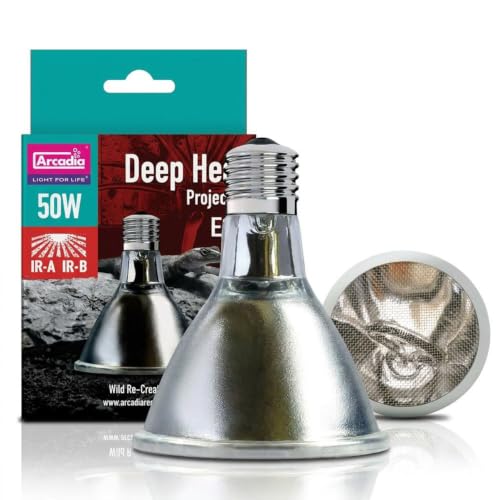
#7. Arcadia Deep Heat Emitter 50W — Premium Compact DHP ($27.02)
The Arcadia 50W DHP is a premium-grade deep heat projector from a UK reptile brand with decades of herp lighting experience. Unlike most generic DHPs sold under Chinese private labels, Arcadia builds to consistent tolerances and publishes verified spectral data — keepers know exactly what infrared wavelengths they’re delivering. The 50W output is sized for 20-30 gallon enclosures and works in tandem with a pulse-proportional thermostat.
What we like: Arcadia brand reputation with verified infrared output specs, 50W is the right size for sub-adult ball python enclosures, virtually no visible light for true 24/7 use, premium build quality means longer real-world lifespan than budget DHPs.
What to watch for: Premium pricing — at $27.02, it costs more than the Fluker’s Deep Heat Projector main pick. The 50W output is too small for adult 40+ gallon enclosures without a secondary heat source. The smaller review pool (4.0 stars across 71 ratings) reflects the brand’s narrower US distribution.
Best for: Keepers who want verified European build quality and have a smaller enclosure where 50W is sufficient. Pair with a quality ball python thermostat for pulse-proportional control.
#8. Fluker’s Heavy Duty Splash Proof Halogen 75W — Waterproof Halogen ($11.29)
The only halogen in this comparison rated for water-based terrarium use. The heavy-duty splash-proof construction handles the humidity spikes common in ball python enclosures, and the 75W output covers the most common 20-40 gallon adult ball python setup. At $11.29, it’s also the cheapest 75W halogen reviewed.
What we like: Splash-proof rating survives the daily misting routine without cracking, 4.5 stars across 114 ratings with consistent long-term reliability reports, 75W covers the standard adult ball python enclosure wattage target, E26 standard socket fits most dome fixtures.
What to watch for: Halogen lifespan still runs 2-3 months at typical use — keep spares on hand. Heavier bulb weight means you need a ceramic socket fixture rated for the load. Less focused beam than the Exo Terra premium halogen, so the basking spot is broader but slightly less intense.
Best for: Keepers who mist heavily and want a halogen that won’t shatter from the humidity cycles. The durability is a meaningful upgrade over the standard 75W halogen at half the price.
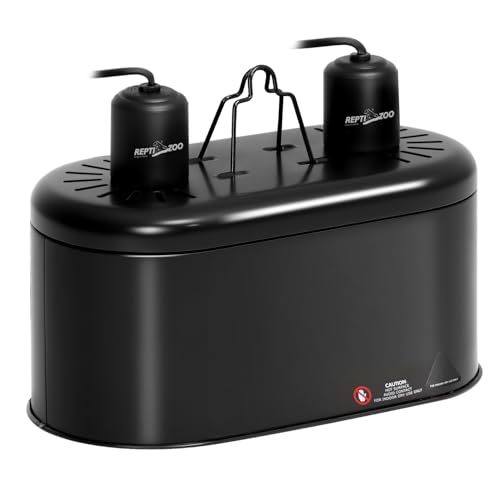
#9. REPTI ZOO Dual Reptile Light Fixture — Dual-Socket Dome Fixture for CHE/DHP/Halogen ($26.01)
The REPTI ZOO dual-socket dome fixture lets you run two heat sources from a single fixture — pairing a CHE for nighttime with a halogen for daytime, or stacking two DHPs for a 40+ gallon adult ball python enclosure. The ceramic sockets handle 150W+ bulbs without heat damage, and the polished aluminum reflectors direct the infrared output downward to the basking surface. At 4.6 stars across 1,800+ ratings, it’s the most validated dual fixture in this price range.
What we like: Two E26 ceramic sockets rated for 150W+ bulbs each (300W total), polished aluminum reflectors boost effective output 20-30% vs. open bulbs, independent on/off switches per socket simplify day/night setups, sturdy frame handles the weight of two CHEs without sagging.
What to watch for: 27.38 is mid-range — cheaper dual fixtures exist but use plastic sockets that melt under CHE heat. No integrated thermostat — you still need a separate pulse-proportional thermostat for safety. The dome is large; measure your screen top to confirm clearance for the basking distance.
Best for: Ball python keepers running a dual-source setup (halogen day + CHE/DHP night) who want one fixture for both bulbs. The dual-socket design is the cleanest way to wire a day-night heat cycle without two separate lamp stands crowding the enclosure.
#10. LUCKY HERP 100W Ceramic Heat Emitter 2-Pack — Mid-Wattage CHE Backup ($16.99)
The 100W counterpart to the 150W LUCKY HERP main pick — same build quality, same E26 socket, same zero-light design, but right-sized for 20-40 gallon enclosures where 150W would overheat the space. The 4.7 stars rating across 1,138 reviews makes it one of the most validated CHE options in this entire comparison.
What we like: 100W output is correctly sized for the most common ball python enclosure size (20-40 gallon), 4.7 stars across 1,138 reviews is among the highest validation rates reviewed, $8.50 per bulb in the 2-pack beats most budget alternatives on price, 10,000-hour rated lifespan matches the 150W version.
What to watch for: Same ceramic fixture requirement as the 150W CHE — plastic fixtures will melt. Quality consistency complaints mirror the 150W version (occasional early failure). Some packages arrive with one cracked bulb — check on arrival.
Best for: Keepers with 20-40 gallon enclosures who want the LUCKY HERP reliability at the right wattage for their setup. The 2-pack format means you always have a backup on hand.
#11. DOMICA 150W Ceramic Heat Emitter 2-Pack — Budget CHE 2-Pack ($9.99)
The cheapest CHE 2-pack in the entire comparison at $5.00 per bulb. The DOMICA 150W is a budget alternative for keepers running multiple enclosures or who need backup bulbs on a tight budget. At 4.4 stars across 515 reviews, it delivers enough reliability for non-critical use.
What we like: Lowest per-bulb price of any CHE 2-pack reviewed ($5.00/bulb), 150W output is appropriate for 40+ gallon enclosures, E26 standard socket matches every other CHE in this comparison, 2-pack format covers a full year of typical use for a single enclosure.
What to watch for: Budget build quality — lifespan is shorter than the LUCKY HERP or REPTI ZOO main picks. Some owners report inconsistent heat output between the two bulbs in the pack. No brand-name reputation for warranty support if a bulb fails early.
Best for: Budget-conscious keepers running a rack system with multiple enclosures, or as a backup pack to keep in storage. For a primary CHE in a single pet’s enclosure, the LUCKY HERP or REPTI ZOO is a better long-term value.
#12. REPTI ZOO 75W Heat Lamp 2-Pack — Budget Halogen for Ceramic Sockets ($16.99)
A 75W halogen 2-pack from REPTI ZOO designed for E26 ceramic-socket fixtures — a meaningful safety feature given the heat output of halogen bulbs. It’s the most affordable ceramic-socket-rated halogen reviewed here and works well for keepers transitioning from incandescent setups.
What we like: Two 75W bulbs in one pack so you have a spare on the shelf, 75W is the standard target for adult ball python halogen setups, $16.99 2-pack pricing undercuts buying singles, infrared UVA output matches the more expensive halogen options.
What to watch for: Budget-pack lifespan is shorter than the LUCKY HERP or Arcadia picks. Some owners report inconsistent heat output between the two bulbs. No brand-name warranty support if a bulb fails early.
Best for: Keepers who need a ceramic-socket-rated halogen at a moderate price point. The 2-pack format is the real selling point for ball python setups where plastic fixtures are a known fire risk.

Ball Python Heat Lamp Wattage Guide
Choosing the right wattage depends on your enclosure size, room temperature, and the distance between the fixture and the basking surface. The question “Is 150 watts too much for a ball python?” appears directly in Google’s People Also Ask — it’s a common concern for new keepers.
| Tank Size | CHE/DHP Wattage | Halogen Wattage | Notes |
|---|---|---|---|
| 10-20 gallon (juvenile) | 50-75W | 50W | Smaller thermal gradient |
| 20-40 gallon (sub-adult) | 75-100W | 75-100W | Most common BP enclosure |
| 40+ gallon (adult) | 100-150W | 100W | Larger gradient, higher ceiling |
| Rack system (tub) | UTH or RHP | N/A | Overhead not practical |
Key factors that affect wattage selection:
Room temperature makes the biggest practical difference. If your reptile room stays at 70°F, you need less supplemental wattage than a room that drops to 60°F. Room temperature alone can swing the required wattage by 25-50W — a factor many new keepers underestimate when following generic wattage charts.
Enclosure material matters — glass tanks lose heat faster than PVC or wood enclosures. If you’re using a glass tank, you may need 10-25W more than the table suggests to maintain temperatures.
Fixture height is critical — measure temperature at the snake’s level, not at the bulb. A 100W CHE positioned 6 inches from the surface produces dramatically different temperatures than the same bulb at 18 inches. For proper fixture placement, our enclosure setup guide covers heat source positioning for common enclosure types.
Thermostat use makes wattage less critical — a good thermostat regulates actual heat output, so if 100W overshoots your target by 5°F, the thermostat compensates. Without one, wattage selection becomes a guessing game that can be lethal if wrong. A pulse-proportional thermostat is ideal for CHE and DHP setups — it cycles power smoothly rather than on/off snapping, which extends bulb life and maintains more stable temperatures.
For a ball python heat lamp 40 gallon tank — the most common adult enclosure size — 100W CHE or 100W halogen is the standard starting point. Measure the basking spot after 2 hours of operation and adjust: below 88°F, increase wattage by 25W; above 95°F, decrease by 25W or raise the fixture height.
The importance of measuring at the snake’s level cannot be overstated — a wall-mounted thermometer at eye level may read 85°F while the substrate surface directly below the fixture reads 100°F, a 15-degree difference between healthy and dangerous. Always use a probe thermometer placed on the basking surface; probe models cost under $10 and provide accurate readings where they actually matter.
The best ball python heat lamp setup ultimately combines the right wattage with a reliable thermostat and proper fixture positioning. Start with the wattage recommendations in this table, measure actual temperatures at the snake’s level, and adjust from there. A $30 digital thermometer with a probe takes the guesswork out of the process and provides peace of mind that your ball python’s thermal gradient is within the safe range.

Frequently Asked Questions
The right combination of a halogen bulb for daytime warmth and a CHE or DHP for nighttime heat coverage gives your ball python a comfortable, natural thermal environment. Ball pythons kept on this dual-source setup tend to show better feeding responses, more consistent shedding, and more natural activity patterns compared to single-source setups.