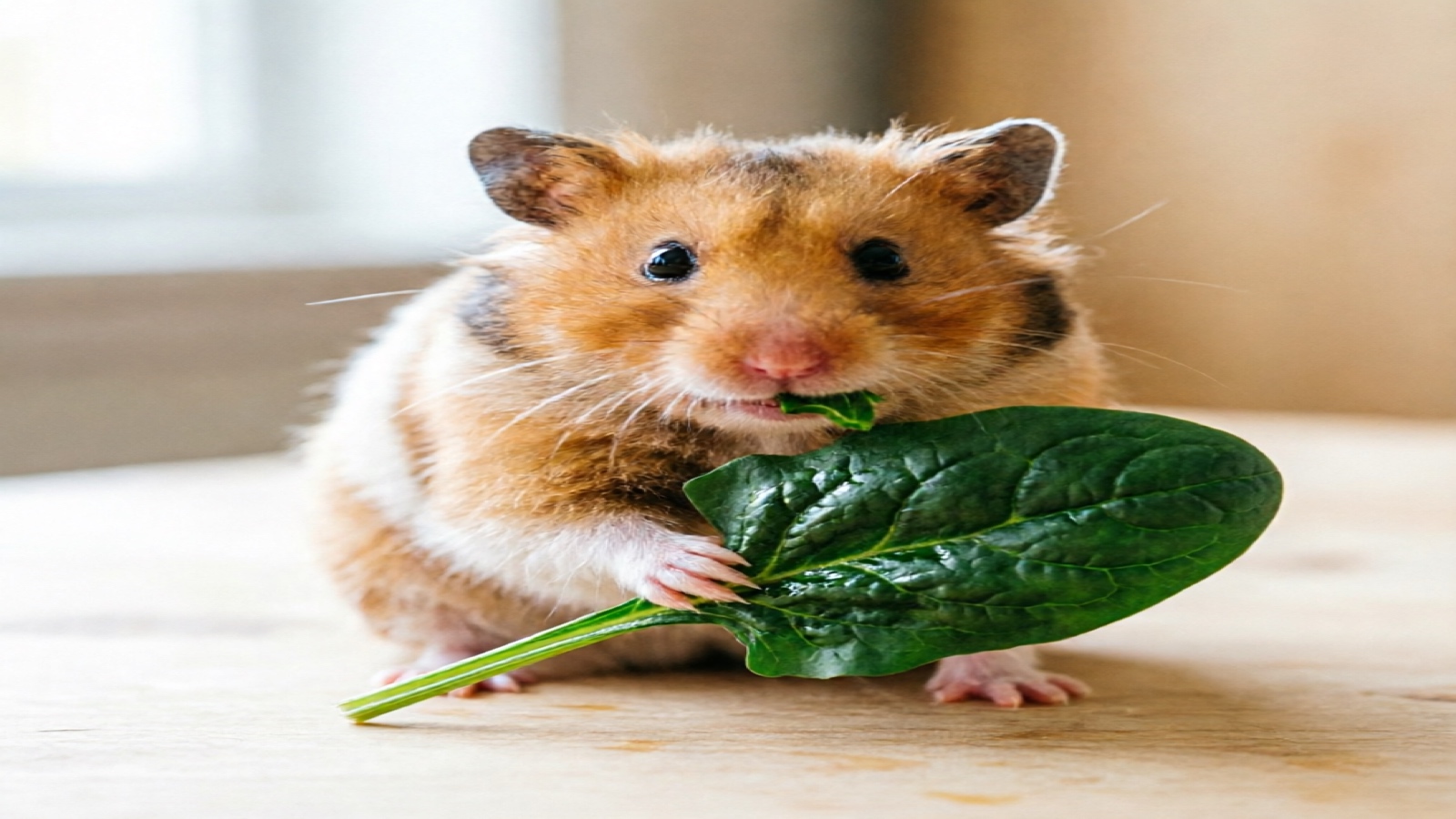
Quick Answer: Can Hamsters Eat Spinach?
Yes — hamsters can eat spinach, but only in small, infrequent amounts. The catch is oxalates.
💡 TL;DR: Feed 1 small baby spinach leaf once a week for Syrians, ½ leaf every two weeks for dwarfs. Baby spinach is preferred (lower oxalate). Never cook spinach. Never feed daily — oxalates accumulate and can cause calcium deficiency and kidney stones.
Spinach is one of the most nutritious vegetables on earth, and that’s exactly why it needs careful handling with hamsters. The same iron and calcium that make it a superfood for humans also come packaged with oxalates that work against those benefits in a tiny animal. I’ve always taken a “less is more” approach with spinach — a tiny amount gives the nutritional upside without the oxalate downside. It’s not that spinach is dangerous. It’s that a 40-gram hamster processes compounds very differently than a 70-kilogram human, and the margin for error is simply smaller. For your hamster’s overall hamster diet, spinach is a weekly treat at most — not a daily staple.
Nutritional Value of Spinach for Hamsters
Key Nutrients
Raw spinach nutritional data from the USDA USDA FoodData Central — Spinach, raw:
| Nutrient | Per 100g Spinach | Per 1 Small Leaf (~3g) | Benefit for Hamsters |
|---|---|---|---|
| Calories | 23 kcal | ~0.7 kcal | Very low calorie |
| Protein | 2.9g | ~0.09g | Good for a vegetable |
| Iron | 2.7 mg | ~0.08 mg | Blood health |
| Vitamin A | 9,377 IU | ~281 IU | Eye health and immune |
| Vitamin C | 28.1 mg | ~0.84 mg | Immune support |
| Vitamin K | 483 mcg | ~14.5 mcg | Blood clotting and bones |
| Calcium | 99 mg | ~3 mg | Bones and teeth |
| Folate | 194 mcg | ~5.8 mcg | Cell function |
| Oxalate | 750-970 mg | ~22-29 mg | Binds calcium — risk |
| Water | ~91% | ~2.7g | Moderate hydration |
| Fiber | 2.2g | ~0.07g | Digestive aid |
The oxalate number is the one that matters most. At 750-970mg per 100g, spinach has one of the highest oxalate concentrations among common vegetables. For comparison: broccoli has 3-10mg, cucumber has 2-5mg, and romaine lettuce has 1-3mg per 100g. Spinach is in a completely different league.
Spinach vs Other Safe Vegetables
| Vegetable | Oxalate (mg/100g) | Vitamin A (IU) | Iron (mg) | Overall Verdict |
|---|---|---|---|---|
| Spinach | 750-970 | 9,377 | 2.7 | High nutrition, high oxalate |
| Kale | 20-150 | 9,990 | 1.6 | High nutrition, low oxalate |
| Broccoli | 3-10 | 623 | 0.7 | Good nutrition, safe |
| Romaine lettuce | 1-3 | 8,710 | 0.5 | Good nutrition, safe |
| Cucumber | 2-5 | 105 | 0.3 | Low nutrition, very safe |
| Carrots | 5-10 | 16,706 | 0.3 | Good nutrition, safe |
Key insight: spinach and kale have similar vitamin A levels, but spinach has 5-50x more oxalates. If you want the nutrition without the risk, kale is arguably the better choice — though some hamsters dislike its bitter taste.
Oxalates: The Hidden Risk in Spinach
This is the most important section in this article. Understanding oxalates is what separates informed hamster owners from those who accidentally overfeed spinach and wonder why their pet develops health problems months later.
What Are Oxalates?
Oxalates (or oxalic acid) are naturally occurring compounds found in many plants, serving as a defense mechanism against pests. In the digestive system, oxalates bind to calcium to form calcium oxalate — an insoluble compound the body cannot absorb. This causes three problems:
- Calcium from food gets blocked — oxalates “steal” calcium from whatever your hamster eats alongside the spinach
- Calcium deficiency develops over time — weak bones, brittle teeth, poor muscle function
- Calcium oxalate crystals can form — accumulating in kidneys and the urinary tract as stones
This mechanism is well-documented in veterinary nutrition. A hamster’s calcium needs are already finely balanced — their skeleton is tiny, and their food needs to supply just enough without excess. Spinach disrupts that balance by simultaneously providing calcium (99mg per 100g) and blocking its absorption through oxalates.
Oxalate Levels in Different Foods
| Food | Oxalate (mg/100g) | Risk Level |
|---|---|---|
| Spinach (mature) | 750-970 | Very high |
| Spinach (baby) | 400-600 | High |
| Kale | 20-150 | Low |
| Broccoli | 3-10 | Very low |
| Cucumber | 2-5 | Very low |
| Carrots | 5-10 | Very low |
| Romaine lettuce | 1-3 | Very low |
Note: oxalate values vary by source, growing conditions, and measurement method. Ranges above are commonly cited in nutritional databases.
What This Means for Your Hamster
A Syrian hamster weighs roughly 120-200g, a dwarf just 25-45g. A single baby spinach leaf (~3g) delivers roughly 12-18mg of oxalate. For a 40g dwarf, that’s a significant relative dose — but not dangerous if fed occasionally.
The problem is accumulation. Oxalates don’t cause immediate harm from a single feeding. The risk builds from regular, repeated exposure over weeks or months. If you notice signs of calcium deficiency — lethargy, weak grip, or poor coat — discontinue spinach and consult your vet. See our hamster health guide for more background.
Baby Spinach vs Regular Spinach
Baby spinach is the better choice for hamsters. This distinction matters more than most owners realize.
| Characteristic | Baby Spinach | Mature Spinach |
|---|---|---|
| Oxalate content | 400-600 mg/100g | 750-970 mg/100g |
| Leaf size | Small (2-4cm) | Large (10-30cm) |
| Texture | Tender, soft | Tougher, fibrous |
| Stem thickness | Thin, edible | Thick, should remove |
| Portion control | Natural — 1 leaf = 1 serving | Need to cut or tear |
| Bitterness | Mild | More pronounced |
| Availability | Most supermarkets | Most supermarkets |
If you have a choice at the store, always reach for the baby spinach container. The lower oxalate content, built-in portion control, and gentler texture make it the clear winner for hamster feeding.
Can Syrian Hamsters Eat Spinach?
Yes — 1 baby spinach leaf once a week.
Syrian hamsters (120-200g) handle oxalates better than dwarfs due to their larger body mass. A single baby spinach leaf represents a much smaller relative oxalate dose for a 160g Syrian than it does for a 40g dwarf. Once a week provides the nutritional benefits — vitamin A, iron, folate — without oxalate accumulation becoming a concern.
Recommended Serving for Syrians
- Variety: Baby spinach preferred
- Amount: 1 small leaf (~3g)
- Frequency: Once per week
- Preparation: Raw, washed, stems removed, room temperature
If this is your Syrian’s first time with spinach, start with half a leaf and observe for 24 hours before offering the full amount. I’ve never personally had a Syrian react badly to a single baby spinach leaf, but every hamster is different.
Can Dwarf Hamsters Eat Spinach?
Yes, but very sparingly — ½ baby spinach leaf every two weeks.
Dwarf hamsters (Winter White, Campbell’s, Chinese) are significantly more vulnerable to oxalate-related issues. Their small size means a given amount of oxalate represents a much larger relative dose. Their faster metabolism also means calcium depletion happens more quickly if absorption is being blocked.
Recommended Serving for Dwarf Hamsters
- Variety: Baby spinach only (lower oxalate)
- Amount: ½ small leaf (~1.5g)
- Frequency: Once every two weeks
- Extra caution: If your dwarf shows any signs of calcium deficiency — weak grip when climbing, lethargy, or brittle nails — discontinue spinach entirely and consult a vet
Roborovski hamsters (20-25g, the smallest commonly kept species) deserve an even more conservative approach. I’d recommend ½ leaf once every three weeks for robos, or simply choosing lower-oxalate greens like broccoli instead. The nutritional upside of spinach for a 20g animal simply doesn’t justify the oxalate load.
How to Prepare Spinach for Your Hamster
Step 1: Choose Baby Spinach
Baby spinach is preferred for lower oxalate, natural portion size, and tender texture. Select fresh, vibrant green leaves with no yellowing, wilting, or slimy spots. Organic is preferred since spinach appears on the EWG’s “Dirty Dozen” list for pesticide residue.
Step 2: Wash Thoroughly
Rinse each leaf under cool running water for 15-20 seconds, paying attention to crevices where soil collects. For extra assurance, use a vinegar-water solution (1:3), soak briefly, then rinse clean. Pat dry with a paper towel.
Step 3: Remove Stems
Stems have higher oxalate concentrations than the leafy portion and a tough, fibrous texture that small hamsters struggle to chew. Pinch or cut the stem off at the base of each leaf. Feed only the leafy green part.
Step 4: Tear or Leave Whole
Baby spinach leaves are already the right size for a Syrian hamster — serve them whole. If you’re using mature spinach, tear leaves into bite-sized pieces roughly the size of your hamster’s paw.
Step 5: Serve at Room Temperature
Cold spinach straight from the refrigerator can cause digestive upset. Let it sit at room temperature for 5-10 minutes before offering.
Step 6: Remove Uneaten Spinach After 2 Hours
Wilted spinach spoils quickly in warm enclosures. Check hiding spots too — hamsters are notorious hoarders, and a pocketful of decaying spinach in the bedding creates bacteria and odor. Remove anything your hamster hasn’t eaten within two hours.
How Often Can Hamsters Eat Spinach?
| Breed | Frequency | Serving Size | Notes |
|---|---|---|---|
| Syrian Hamster | 1x per week | 1 baby spinach leaf | Well tolerated |
| Dwarf Hamster (WW/CC) | 1x per 2 weeks | ½ baby spinach leaf | Higher oxalate sensitivity |
| Roborovski | 1x per 3 weeks | ½ baby spinach leaf | Smallest species, most cautious |
| Chinese Hamster | 1x per 2 weeks | ½ baby spinach leaf | Similar to dwarf guidelines |
Never feed spinach on consecutive days, and avoid pairing it with other high-oxalate foods (like kale) on the same day. Rotate with safer vegetables throughout the week.
Spinach vs Kale vs Broccoli: Which Leafy Green Is Best?
| Factor | Spinach | Kale | Broccoli |
|---|---|---|---|
| Oxalate | 750-970 mg | 20-150 mg | 3-10 mg |
| Vitamin A | 9,377 IU | 9,990 IU | 623 IU |
| Vitamin C | 28.1 mg | 120 mg | 89.2 mg |
| Iron | 2.7 mg | 1.6 mg | 0.7 mg |
| Calcium | 99 mg | 254 mg | 47 mg |
| Gas risk | None | None | Yes (if overfed) |
| Diarrhea risk | Low | Low | Low |
| Best for | Occasional treat | Regular feeding | Regular feeding |
My recommendation: use broccoli as the everyday green — it has the lowest oxalate content, good nutrition, and most hamsters enjoy it. Spinach serves as a once-a-week nutrient boost for its iron and vitamin A content. Kale is a solid alternative if your hamster tolerates its slightly bitter taste, and it offers the highest vitamin C of the three.
If I had to pick just one leafy green for a hamster, it would be broccoli. But spinach has its place — once a week, in the right amount, it adds nutritional variety that benefits your hamster.
Signs Your Hamster Ate Too Much Spinach
Oxalate overload develops gradually over weeks or months of excessive spinach consumption:
- Lethargy and weakness — calcium deficiency affects muscle function
- Difficulty climbing or gripping — weak bones and muscles
- Brittle nails or dental problems — calcium depletion
- Increased urination — kidneys working harder to process oxalate
- Blood in urine — advanced sign of possible kidney stone formation
What to do: immediately stop all spinach and high-oxalate foods. Provide calcium-rich alternatives like broccoli florets. If symptoms persist beyond a few days or you see blood in urine, contact an exotic vet — kidney stones may require medical treatment.
Safe Leafy Green Alternatives
If spinach feels too risky, or your hamster has shown sensitivity, these lower-oxalate alternatives work well:
- Broccoli — 3-10mg oxalate per 100g, excellent vitamin C, the safest everyday green
- Romaine lettuce — 1-3mg oxalate, high vitamin A, gentle on digestion
- Cucumber — 2-5mg oxalate, very safe hydrating treat
- Kale — 20-150mg oxalate, high vitamin A and C, significantly safer than spinach
- Carrots — 5-10mg oxalate, high vitamin A, good crunch for dental health
Other Foods Your Hamster Can Eat
Each link leads to a full safety guide with breed-specific serving recommendations.
Vegetables
- Can Hamsters Eat Broccoli?
- Can Hamsters Eat Carrots?
- Can Hamsters Eat Cucumbers?
- Can Hamsters Eat Tomatoes?
- Can Hamsters Eat Lettuce?
Fruits
- Can Hamsters Eat Grapes?
- Can Hamsters Eat Strawberries?
- Can Hamsters Eat Blueberries?
- Can Hamsters Eat Bananas?
Proteins and Treats
Frequently Asked Questions
Can hamsters eat spinach?
Yes, in small amounts. Spinach is nutritionally dense — high in vitamin A, vitamin C, iron, and calcium — but also contains 750-970mg of oxalates per 100g, which bind to calcium and block absorption. A single baby spinach leaf once a week for Syrians, or once every two weeks for dwarfs, provides benefits without oxalate accumulation.
Can hamsters eat baby spinach?
Yes — and it’s the better choice. Baby spinach contains lower oxalates (400-600mg per 100g vs 750-970mg for mature leaves), has a milder flavor that hamsters prefer, and the leaf size naturally matches a Syrian’s serving. One baby leaf = one serving, no cutting required.
Can hamsters eat spinach every day?
No. Oxalates accumulate over time. Daily feeding leads to calcium deficiency, weak bones, and kidney stone risk. Syrians: max once per week. Dwarfs: once every two weeks. The gap between feedings lets your hamster’s body process and eliminate oxalates.
Can hamsters eat raw spinach?
Yes — raw is the only safe form. Never cook spinach. Cooking removes water weight and concentrates oxalates, making the oxalate-to-nutrient ratio worse. Serve raw, fresh, room-temperature leaves after washing.
Can hamsters eat spinach stems?
Safe but not ideal. Stems have higher oxalate concentrations and a tough texture small hamsters struggle to chew. Remove stems and feed only the leafy portion. If your hamster eats a stem accidentally, it’s not dangerous — just suboptimal.
Can hamsters eat spinach and kale together?
Not in the same meal or on the same day. Both are high-oxalate greens, and combining them doubles the oxalate load. Feed spinach one week, kale a different week, or stick with broccoli as your everyday green and rotate spinach as an occasional treat.
How much spinach can a hamster eat?
Syrians: 1 baby spinach leaf once a week. Dwarfs: ½ leaf once every two weeks. Roborovskis: ½ leaf once every three weeks. Always raw, fresh, washed, stems removed. Start with half the recommended amount for first-time feeders.
Why is spinach bad for hamsters?
Spinach isn’t bad — it requires moderation. Oxalates bind to calcium in the gut, preventing absorption. Over time this causes calcium deficiency (weak bones, brittle teeth, lethargy) and can form kidney stones from calcium oxalate crystals. Small, infrequent portions are safe.
Can dwarf hamsters eat spinach?
Yes, very small amounts — ½ baby leaf every two weeks. Dwarfs (25-45g) are more vulnerable to oxalate-related calcium issues than Syrians (120-200g) due to their smaller size and faster metabolism. Use baby spinach only and watch for calcium deficiency signs. When in doubt, choose broccoli instead.
Can hamsters eat frozen spinach?
No. Freezing damages cell walls — thawed spinach becomes soggy and unappetizing. Commercially frozen spinach is also blanched before freezing, which alters nutrients and concentrates oxalates. Always use fresh, raw baby spinach.