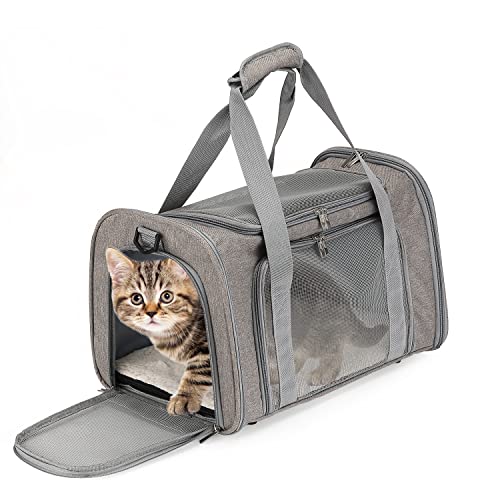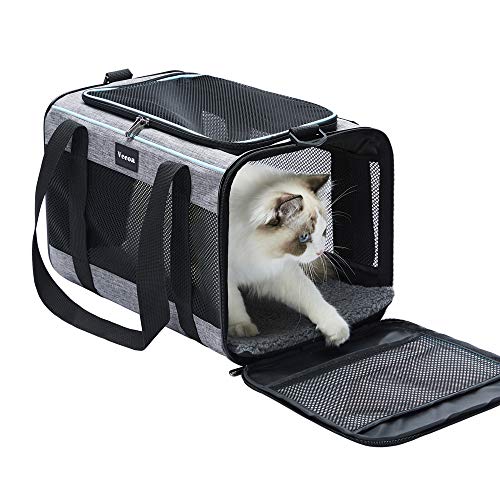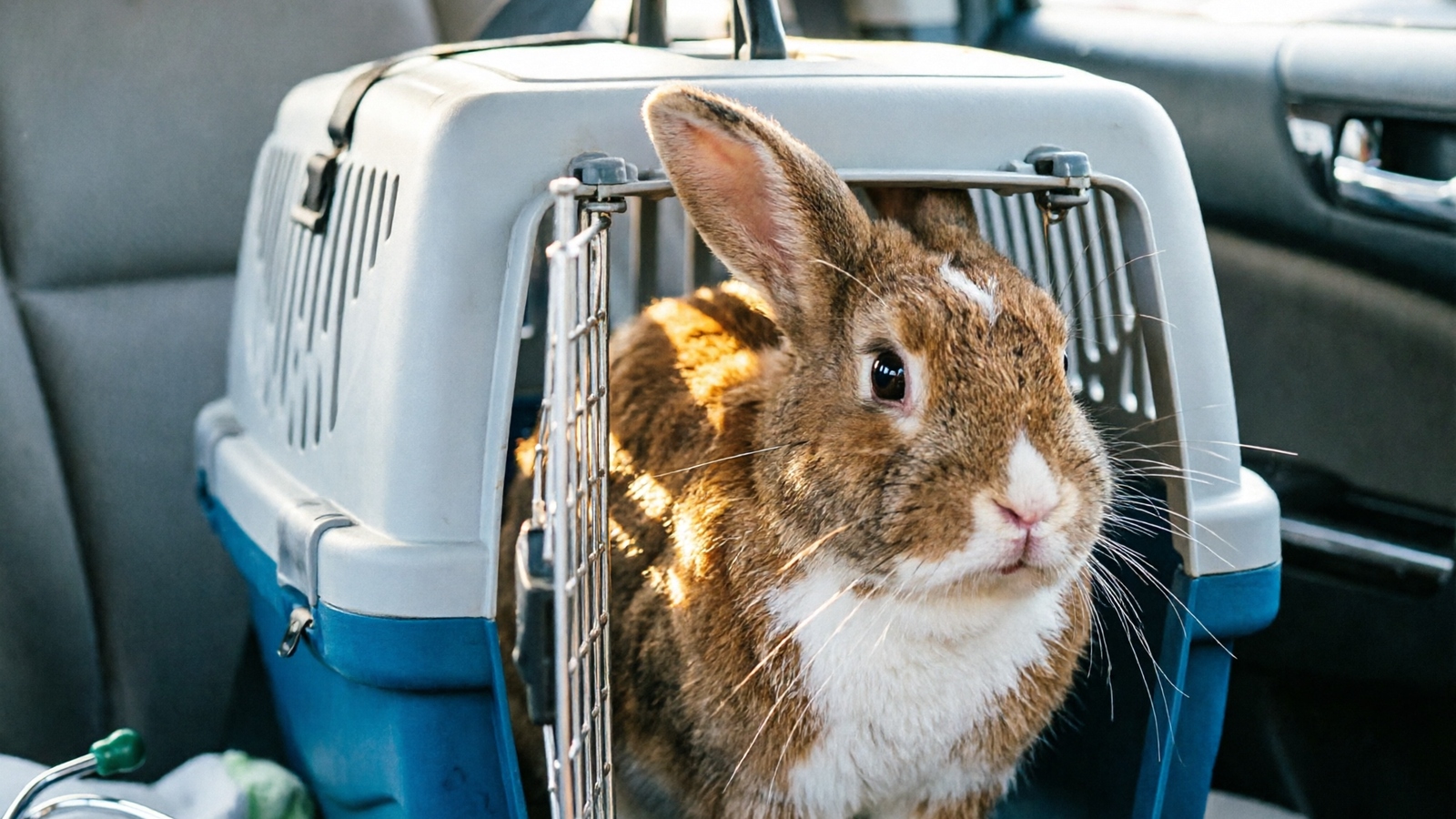
The average rabbit needs at least one vet visit per year — more for dental checks, nail trims, or illness. Getting a panicked rabbit into a carrier for rabbit transport that’s too small, poorly ventilated, or easy to chew through turns a 20-minute trip into a stressful ordeal for both of you.
Most search results for rabbit carrier options point to cat carriers that are too tall and narrow, or soft-sided bags that rabbits chew through in minutes. After reviewing 8 carriers across hard-sided, soft-sided, and backpack styles, the best rabbit carrier depends on your rabbit’s size, temperament, and how far you need to travel.
For outdoor excursions beyond vet visits, a rabbit harness pairs naturally with a carrier for a complete travel setup. Our guide to the best rabbit harness covers walking-specific options.
What to Look for in a Rabbit Carrier
A rabbit carrier is a secure, ventilated enclosure designed to safely transport rabbits to vet appointments, grooming visits, or during travel. Unlike cat carriers, rabbit carriers should prioritize horizontal space since rabbits stay low to the ground and don’t need tall enclosures. (PMC9449994, Nielsen 2022, 44 citations: EFSA identified handling stress, motion stress, heat stress, and sensory overstimulation as highly relevant welfare consequences for rabbits during container transport.)
A rabbit travel carrier must handle the specific challenges rabbits present: chewing strength, escape ability, and sensitivity to heat and stress. Here are the six features that matter most:
| Feature | Why It Matters for Rabbits | What to Look For |
|---|---|---|
| Secure latches | Rabbits are escape artists that push doors open | Metal clips or locking zippers |
| Good ventilation | Rabbits overheat easily in enclosed spaces | Mesh panels or ventilation slots on multiple sides |
| Easy to clean | Urine accidents happen during stressful trips | Removable bottom tray or wipeable plastic surface |
| Chew-resistant | Rabbits destroy mesh, fabric, and soft plastic | Hard plastic shell or thick reinforced canvas |
| Horizontal space | Rabbits stay low — tall carriers waste space | Wide and long interior, not tall |
| Snug fit for car | Prevents sliding and bouncing during transport | Slightly snug for vet trips, secure on car seat |
Rabbit Carrier Types Compared
Choosing the right rabbit carrier for vet trips comes down to three main types, each with distinct tradeoffs:
| Type | Best For | Pros | Cons | Price Range |
|---|---|---|---|---|
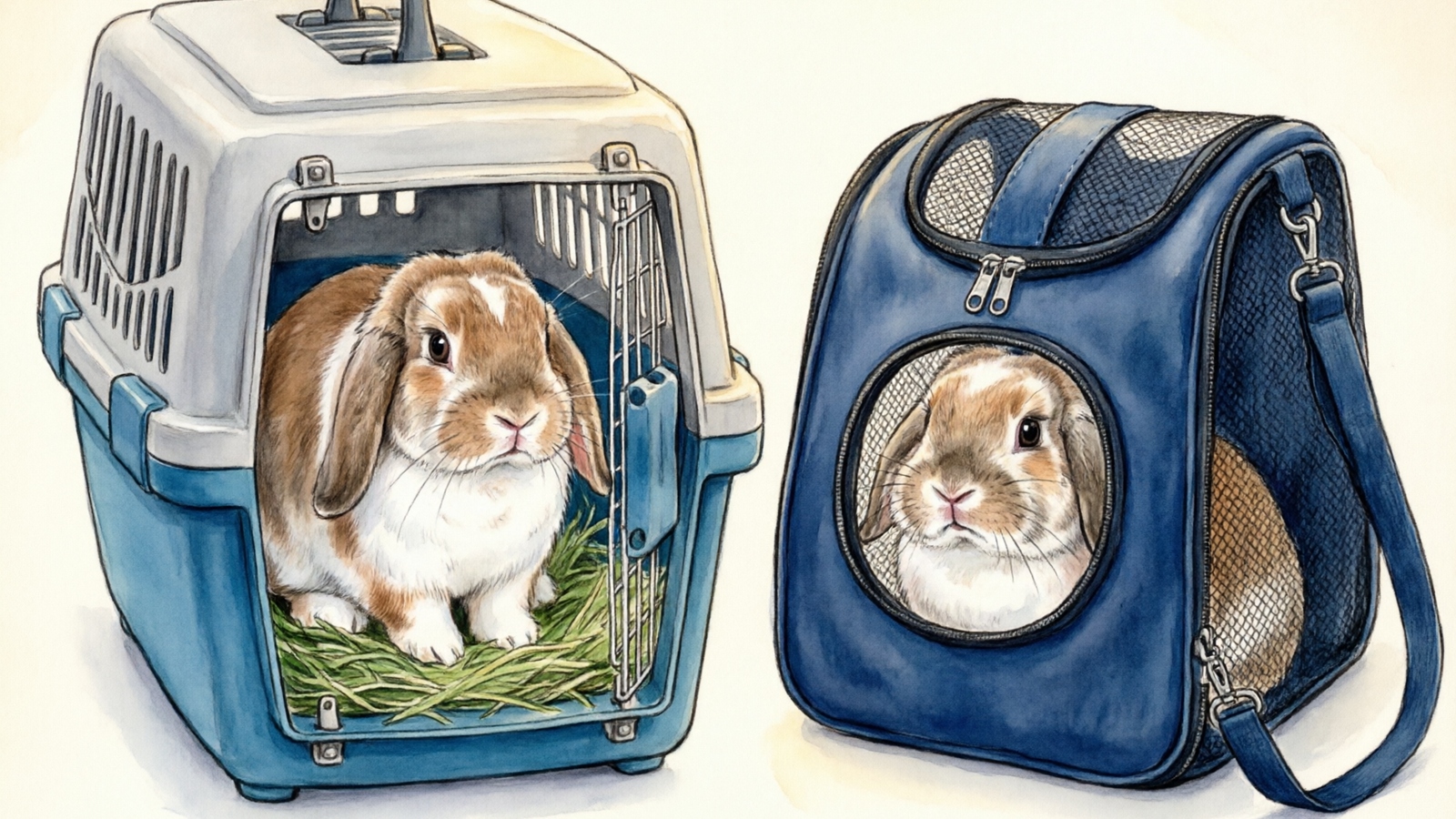
| Hard-sided | Vet trips, anxious rabbits, large breeds | Most secure, escape-proof, easy to clean, durable | Heavier, bulkier to store, less padded | $23-36 |
| Soft-sided | Short calm rides, small calm breeds | Lightweight, padded interior, foldable for storage | Chew risk, less secure, fabric tears | $18-20 |
| Backpack | Walking to nearby vet, very small rabbits | Hands-free, rabbit can see out through window | Weight limit 12-16 lbs, severe chew risk | $16-20 |
Warning: Chew Risk Warning: Rabbits are powerful chewers that can destroy soft mesh and fabric within minutes. If your rabbit is a chewer, hard-sided is the only safe option for any rabbit travel carrier.
A rabbit carrier is strictly for transport — not a permanent home. For your rabbit’s daily living space, see our guide to the best rabbit cage for proper enclosure recommendations.
Rabbit Carrier Size Guide by Breed
Finding the right small rabbit carrier or full-sized option depends entirely on your rabbit’s breed and weight. Too small and your rabbit can’t turn around; too large and they slide around during car rides.
| Breed Size | Example Breeds | Weight | Minimum Carrier Dimensions | Recommended Type |
|---|---|---|---|---|
| Small (dwarf) | Netherland Dwarf, Holland Lop, Lionhead | 2-4 lbs | 16”L x 10”W x 10”H | Soft-sided or backpack |
| Medium | Mini Lop, Mini Rex, Dutch | 4-6 lbs | 18”L x 11”W x 11”H | Soft-sided or small hard-sided |
| Large | New Zealand, Californian, Standard Rex | 8-12 lbs | 22”L x 15”W x 13”H | Hard-sided only |
| Giant | Flemish Giant, Continental Giant | 12-14+ lbs | 24”L x 16”W x 16”H | Hard-sided (Petmate 24”) |
Flemish Giant owners should budget for the largest carriers — these gentle giants need the Petmate 24-inch at minimum. For breed-specific care, our Flemish Giant rabbit guide covers their unique size requirements in detail. On the other end, Netherland Dwarf rabbit owners can comfortably use smaller soft-sided options since these tiny rabbits weigh just 2-4 pounds.
Quick Comparison — All 8 Rabbit Carriers
| # | Product | Type | Price | Best For |
|---|---|---|---|---|
| 1 | Amazon Basics 2-Door | Hard-Sided | $23.48 | TOP PICK |
| 2 | Petmate 2-Door 24” | Hard-Sided | $35.66 | Large Breeds |
| 3 | Vceoa 17.5x11x11 | Soft-Sided | $19.99 | Soft-Sided TOP PICK |
| 4 | Mr. Pen Inner Leash | Soft-Sided | $17.85 | Safety Pick |
| 5 | LAIRIES Bubble Backpack | Backpack | $15.99 | Small Breeds |
| 6 | WEVONIGU Rabbit Carrier | Soft-Sided | $18.28 | Rabbit-Specific |
| 7 | Ware Twist-N-Go | Soft-Sided | $17.53 | Foldable Storage |
| 8 | Trixie Pico | Small Pet | $16.99 | Budget Chew-Resistant |
Best Rabbit Carrier — Hard-Sided Reviews
Warning: Chew Risk Warning: Soft-sided carriers are NOT recommended for rabbits prone to chewing. Rabbits can destroy mesh in minutes and escape during transport. Hard-sided carriers are the safest choice for vet trips.
1. Amazon Basics 2-Door Hard-Sided (TOP PICK) — $23.48
The most proven hard shell rabbit carrier available. The two-door design (top loading + front access) makes getting your rabbit in and out significantly easier than front-only carriers. At 22.8”L x 15”W x 13”H, it fits medium and large rabbits comfortably while still being car-seat friendly.
Key positives: Secure two-door access for stress-free loading, affordable at $23.48, includes metal bolts for sturdy assembly, proven by tens of thousands of pet owners.
“My big guy, 25 pounds, annihilated my old carrier. This one is a little bigger and is sturdier.” — Customer review
Honest downsides: Some owners report the top cracking near the handle after less than a year of use. Missing assembly parts (side clips) appear in some shipments. Arrives in a thin plastic bag — inspect for damage immediately upon delivery.
“After less than 1 year of light use the top cracked near the handle so we can’t use it anymore.” — Customer review
Best for: Medium to large rabbits (4-10 lbs). The default best rabbit carrier for most owners — unbeatable value at this price point.
2. Petmate Two Door 24” (Large Breeds) — $35.66
A made-in-USA rabbit carrier from Petmate, one of the most recognized pet transport brands. The 24-inch length makes this the best option for large breeds and Flemish Giants that don’t fit in standard 22-inch carriers. Top and side door access provides flexibility for loading.
Key positives: Trusted brand with decades of track record, 24-inch size fits large rabbits, top and side loading doors.
“Good quality. Has stayed together over 14 years, even carrying 15+ pound cat in it. Would definitely recommend and buy again.” — Customer review
Honest downsides: Inaccurate dimensions in product listing — height and width may be swapped. Some units arrive with undrilled holes making assembly difficult. The top door doesn’t stay open on its own, requiring two people to load a rabbit. Tips over when loading from the side door.
“Top door does not stay open so it requires two people to use.” — Customer review
Best for: Large rabbits (8-14+ lbs) and Flemish Giant owners who need extra length. Worth the premium over the Amazon Basics for bigger breeds.
Best Rabbit Carrier — Soft-Sided & Backpack Reviews
Warning: Critical Safety Warning: Multiple reviewers report rabbits chewing through mesh, zippers, and fabric within minutes. If your rabbit is a chewer, use hard-sided ONLY. Soft-sided carriers are only appropriate for calm rabbits on short trips.
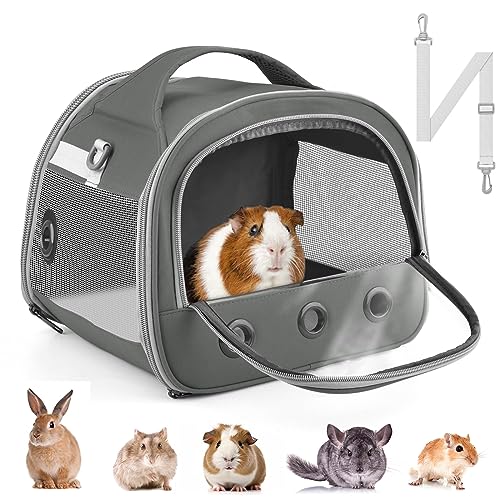
3. Vceoa 17.5x11x11 (Soft-Sided TOP PICK) — $19.99
The highest-rated soft sided rabbit carrier in its category. TSA airline approved for travel, collapsible for easy closet storage, and includes both a removable fleece pad and a hard floor insert for stability. At $19.99, it’s one of the most affordable options reviewed.
Key positives: Highest rating in its category, collapses flat for storage, includes dual floor options, breathable mesh on all sides.
“It comes with so much care honestly — it’s very breathable and there’s two types of flooring, a hard part and then a comfy soft mat.” — Customer review
Honest downsides: Shoulder strap broke within 10 minutes for an owner. Interior space is smaller than exterior dimensions suggest. The fabric is thin and some units ripped after a single use. Not suitable for rabbits over 6-7 pounds.
“Very small interior and not stable. The fabric is very thin and itchy. Not worth it for a nervous pet.” — Customer review
Best for: Small to medium rabbits (2-6 lbs) on short, calm rides. Store folded in a closet when not in use. Not for chewers under any circumstances.
4. Mr. Pen Inner Leash (Safety Pick) — $17.85
The only carrier for rabbit transport with a built-in safety leash that prevents escape during loading — a genuine innovation other soft-sided carriers don’t offer. At 17.5”L x 11.2”W x 11.5”H, it fits small rabbits with a side pocket for hay and treats during transport.
Key positives: Built-in safety leash prevents escape during the critical loading moment, side pocket for supplies, padded shoulder strap.
“Easy to get cat in and out. Sturdy but zippers were difficult to use.” — Customer review
Honest downsides: A cat broke through the zipper in 5 minutes during transport. Support rod popped out on some units. Seam gaps reported — one unit arrived with holes large enough for a cat to escape through. Durability is a real concern for repeated use.
“Cat broke through the zipper in 5 minutes. I had to pull over and retrain him. Not a great trip to the vet.” — Customer review
Best for: Small rabbits (2-5 lbs) where the inner leash provides critical escape prevention during vet loading. Inspect seams and zippers before every use.
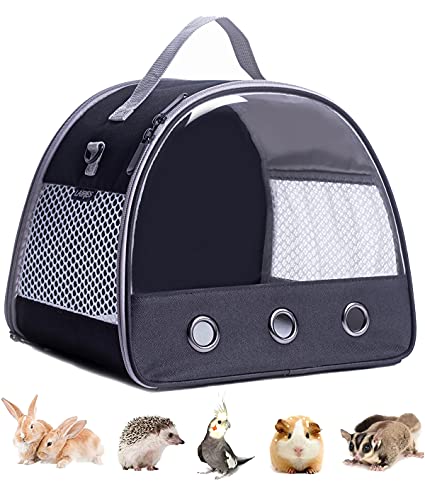
5. LAIRIES Bubble Window Backpack — $15.99
The most affordable rabbit carrier reviewed at just $15.99, with a clear bubble window that lets your rabbit see out during walks — reducing stress for confident, calm rabbits. Multiple reviewers with Mini Rex rabbits confirm it works well at this price point for very small breeds.
Key positives: Cheapest option reviewed, bubble window provides visual enrichment, hands-free for walking to nearby vet.
“Perfect size to carry my Mini Rex rabbit in. Enough space for him to be comfortable but not jostling about.” — Customer review
Honest downsides: Severe chew risk — this is the most frequently destroyed carrier in reviews. A rabbit ate through the door and mesh. Rats chewed through the mesh in under an hour. A hamster died after chewing out and falling. The zipper design is misleading compared to product photos.
“My rabbit ate the door and the mesh on the other side. Do not buy for rabbits — they are chewers.” — Customer review
Best for: Very small, calm rabbits (2-5 lbs) for short walks to a nearby vet. Inspect mesh integrity before every single use. Hard-sided is strongly preferred over this for rabbits.
6. WEVONIGU Rabbit Carrier — $18.28
The only carrier in this comparison specifically named for rabbits in the product title. The side panel unzips fully for wide-open loading access — easier than top-only carriers for rabbits that resist going in. At $18.28, it’s priced competitively with other soft-sided options.
Key positives: Specifically designed and named for rabbits, side unzip opens wide for easy loading, good build quality for the price.
“This is well made for the price. It has a small zipper door, and then on the side it unzips for more access. Great quality.” — Customer review
Honest downsides: Mesh is too easy to chew through — a rat escaped within a day. A unit arrived without the handle sewn on, making it unusable for a vet appointment the next day. Only suitable for very small pets regardless of the rabbit branding.
“The mesh is way too easy to chew through. I didn’t have it for even a day before my rat chewed right through and got out.” — Customer review
Best for: Small rabbits (2-4 lbs) wanting a rabbit-branded option. Similar concept to the Vceoa but slightly smaller interior.
7. Ware Twist-N-Go (Foldable) — $17.53
A dedicated small pet brand option from Ware Manufacturing with a unique twist-to-fold design for compact storage. Washable and fast-drying, this carrier appeals to owners who want something easy to clean between infrequent vet trips.
Key positives: Dedicated small pet brand, unique twist-fold design for storage, lightweight and washable.
“Lightweight and very safe. The birds are always calm during travel, they are washable and dry fast.” — Customer review
Honest downsides: Significantly smaller than product description states — one small animal couldn’t turn around inside. Multiple owners report rats and hamsters chewing through the mesh almost instantly. Fabric is too thin for any pet prone to chewing.
“Way smaller than description says. One small animal can’t even turn around or move comfortably inside.” — Customer review
Best for: Very small rabbits (2-3 lbs) only. Primarily designed for hamsters and guinea pigs — consider the Trixie Pico instead for better chew resistance.
8. Trixie Pico (Budget Chew-Resistant) — $16.99
A respected German small pet brand with a hard plastic shell — making it the most chew-resistant option among the non-hard-sided carriers reviewed. Ventilation holes throughout ensure airflow, and the solid plastic construction means rabbits can’t chew through it like mesh carriers.
Key positives: Hard plastic shell resists chewing, German brand with decades of small pet expertise, good ventilation, easy to wipe clean.
“A lot of holes so I know she’s getting enough air but she’ll not be able to get out. Convenient to clean.” — Customer review
Honest downsides: The closing mechanism requires both hands and is difficult to coordinate. A hinge piece broke within 3 uses for some owners. A reviewer reported it broke on the very first trip to the vet. The same products appear in our best hedgehog carrier and best hamster carrier guides for other small pet transport needs.
“Save your money. Broke first trip to the vet. Waste of money.” — Customer review
Best for: Small rabbits (2-5 lbs) wanting a chew-resistant alternative to fabric carriers. German brand reliability at a budget-friendly price.
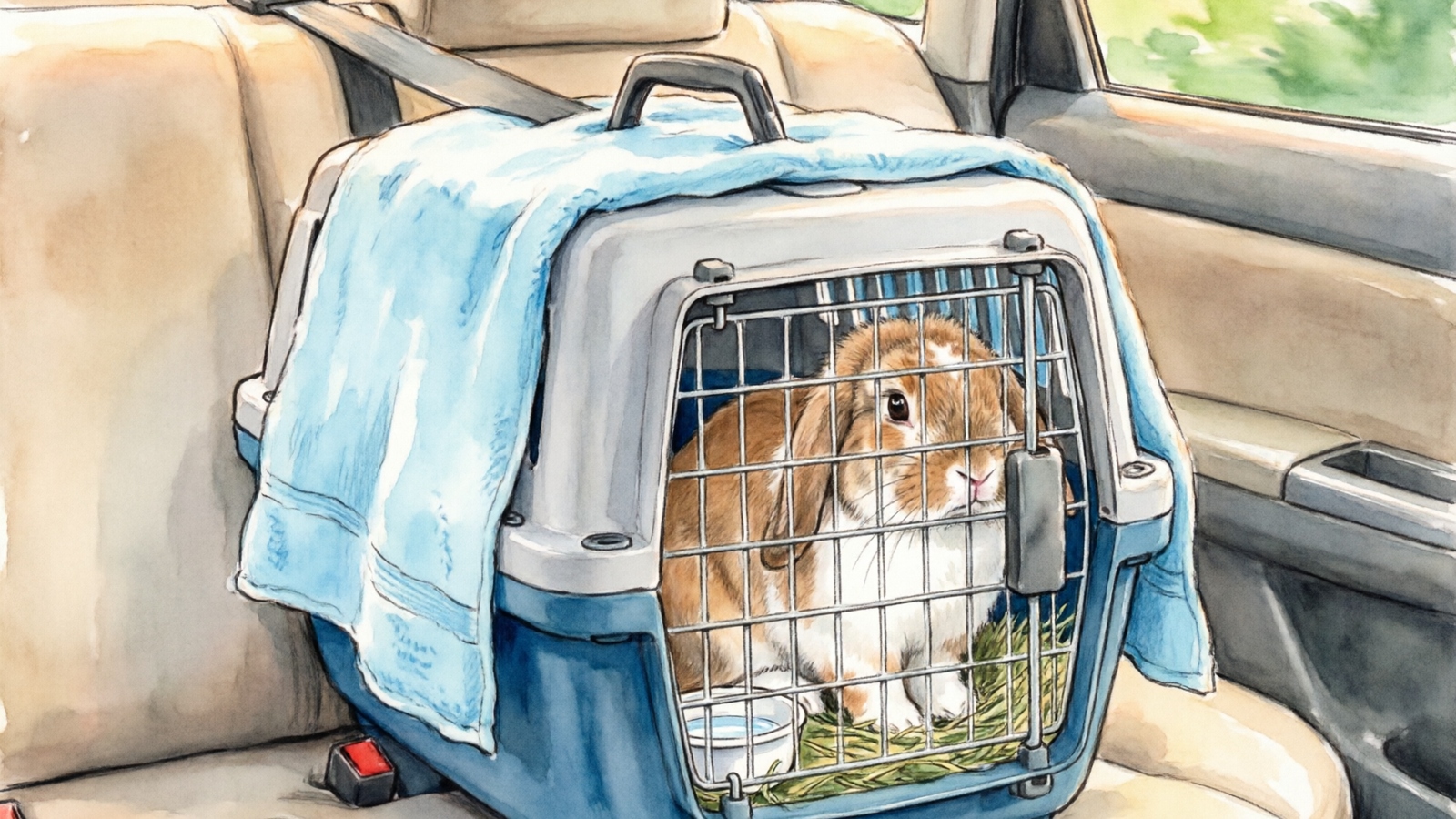
Vet Trip Safety Checklist
A proper rabbit carrier for vet trips is only half the equation — how you use it matters just as much. Follow this checklist for stress-free transport:
Before the Trip:
- Acclimate your rabbit to the carrier at home — leave it open in their living space 2-3 days before the vet visit
- Line the carrier bottom with newspaper and a handful of hay (RWAF: “Make sure there is something non-slip in the carrier, like a vet bed, a towel, or newspaper and hay.”) — absorbs urine and provides a familiar scent that reduces stress
- Place a favorite treat inside the carrier to create positive association
- Cover the carrier with a towel or light blanket during the car ride — reduced visual stimulation keeps rabbits calmer
During Car Travel:
- Secure the carrier with a seatbelt threaded through the top handle (RWAF: “Strap the carrier safely into the vehicle and secure using a seat belt through the handle. Never put the carry case in the boot.”) — never leave it unsecured on the seat
- Never place the carrier on a lap or loose on the seat — it becomes a dangerous projectile during sudden stops
- Keep car temperature comfortable — rabbits overheat quickly above 80°F and cannot sweat
- Drive smoothly — avoid sudden braking and sharp turns that slide your rabbit around inside
- Never leave your rabbit in a parked car — interior temperatures become lethal within minutes, even on mild days
At the Vet:
- Open the carrier inside the exam room rather than the waiting area — fewer stress triggers
- Use a top-opening carrier to remove your rabbit — never tilt or dump them out
- Keep the carrier covered with a towel in the waiting room if dogs or cats are nearby
Regular vet visits are essential for your rabbit’s long-term health. For more on why routine care matters, our rabbit lifespan guide explains how preventive veterinary care directly extends your rabbit’s life expectancy.
Rabbit Carrier Do’s and Don’ts
** Safe Carrier Practices**
- Use a hard-sided carrier for vet trips — Solid, non-collapsible, and escape-proof. (Merck Veterinary Manual; Vet4Life)
- Secure with a seatbelt through the handle — Prevents the carrier from becoming a projectile during sudden stops. (RWAF)
- Add non-slip padding — Vet bed, towel, or newspaper over the slippery plastic bottom to prevent limb or spine fractures. (MediRabbit)
- Place hay inside for familiar scent — Reduces stress and helps prevent GI stasis during transport. (RWAF)
- Cover with a towel during car rides — Reduced visual stimulation keeps rabbits calmer.
- Choose front + top opening carrier — Top access lets you remove your rabbit safely at the vet without them bolting. (MediRabbit)
- Keep car temperature below 80°F — Rabbits cannot sweat and are extremely heat-sensitive. (Merck Veterinary Manual)
- Feed before and during travel — Never starve rabbits before transport; their sensitive digestive systems need continuous food. (Vet4Life)
** Dangerous Carrier Mistakes**
- Using cardboard boxes for transport — Rabbits chew through cardboard easily, and it becomes unsafe if damp from urine or rain. (Vet4Life)
- Using fabric/nylon carriers for chewers — Rabbits destroy mesh and fabric within minutes, creating escape risk during transport. (MediRabbit)
- Placing the carrier in the car boot — Rabbits cannot be monitored, exhaust fumes enter, and it bounces unrestrained. (RWAF)
- Leaving rabbits in a parked car — Interior temperatures become lethal within minutes. Heat index above 90°F risks fatal heat stroke. (House Rabbit Network)
- Starving rabbits before vet visits — Unlike cats and dogs, rabbits must never be fasted. Their GI tract needs constant food to prevent stasis. (Vet4Life)
- Using carriers without non-slip flooring — Slippery plastic bottoms cause falls, leading to limb or spinal fractures during transport. (MediRabbit)
- Transporting only one of a bonded pair — The returning rabbit smells different and risks rejection. Always transport bonded rabbits together. (RWAF)
- Tilting or dumping rabbit out of carrier — Causes panic, scratching, biting, and spinal injury from improper handling. (MediRabbit)
Frequently Asked Questions
What is the best rabbit carrier for vet trips?
The Amazon Basics 2-Door Hard-Sided Carrier is the best rabbit carrier for vet trips. It’s secure, escape-proof, and proven by tens of thousands of pet owners. At $23.48, it’s affordable for most budgets. Hard-sided carriers protect rabbits during car transport better than any soft-sided alternative because they can’t be chewed through and don’t collapse during sudden stops.
What size carrier does a rabbit need?
Small rabbits weighing 2-4 lbs like Netherland Dwarfs need a minimum of 16”L x 10”W x 10”H. Medium rabbits at 4-6 lbs need 18”L x 11”W x 11”H. Large rabbits at 8-12 lbs require 22”L x 15”W x 13”H. Flemish Giants at 12-14+ pounds need the largest small rabbit carrier won’t work — you need a 24”L hard-sided carrier minimum.
Can rabbits chew through soft-sided carriers?
Yes — and they do it fast. Multiple rabbit owners in reviews report their rabbits chewing through mesh panels, fabric seams, and zippers within minutes of being placed in soft carriers. A soft sided rabbit carrier is only appropriate for rabbits that have been verified as non-chewers on very short trips. For most rabbits, a hard shell rabbit carrier is the safer and more responsible choice.
How to get a scared rabbit into a carrier?
Leave the carrier for rabbit transport open in their living space for 2-3 days before the appointment. Place hay and a favorite treat inside so they investigate voluntarily. On vet day, gently herd them toward the carrier opening rather than picking them up and dropping them in. Cover the carrier with a towel once they’re inside — darkness reduces stress hormones during the car ride.
Do rabbits need a carrier for car rides?
Absolutely. An unrestrained rabbit in a car becomes a projectile during sudden stops or accidents. A secure rabbit travel carrier protects your rabbit and lets you focus on driving. Always thread the seatbelt through the carrier’s top handle and buckle it. Never hold a rabbit on your lap during car travel.
The right best rabbit carrier comes down to your rabbit’s size and chewing habits. The Amazon Basics 2-Door at $23.48 is the safest all-around choice for most rabbit owners — secure, proven by tens of thousands of owners, and affordable. For Flemish Giants, step up to the Petmate 24-inch. For very small, calm, non-chewing rabbits on short trips, the Vceoa soft-sided offers lightweight convenience at just $19.99. Whatever you choose, a proper rabbit carrier makes vet visits safer and less stressful for both of you.