Rabbits are fascinating creatures with a rich vocabulary of behaviors — but they communicate very differently from dogs or cats. As prey animals, rabbits evolved to hide signs of pain and distress, making it critical for owners to understand their subtle body language.
This guide decodes key rabbit behavior signs — everything your rabbit is telling you: common rabbit behaviors like binkying, warning signs like thumping and teeth grinding, natural instincts like digging and chewing, and what to do when behavior changes signal health problems. Sudden behavior changes often indicate underlying rabbit health problems — learning to read these signals early can save your rabbit’s life. For proper housing that supports natural behaviors, see our rabbit setup guide.
Understanding Rabbit Body Language
Why Rabbits Communicate Differently
Rabbits are prey animals. In the wild, showing weakness or distress attracts predators. This survival instinct means rabbits are subtle communicators — they rarely vocalize pain or fear the way a dog would. Instead, they use body posture, ear position, movement patterns, and a handful of sounds to express themselves.
Learning to “read” your rabbit is one of the most valuable skills you can develop as an owner. Small changes in posture, ear angle, or activity level often carry important information about how your rabbit is feeling. I’ve found that the biggest mistake new rabbit owners make is assuming their rabbit is “just being weird” when it’s actually trying to tell them something important.
Three Categories of Rabbit Behavior
| Category | Meaning | Signal Strength |
|---|---|---|
| Happy / Relaxed | Rabbit feels safe and content | ✅ Positive |
| Warning / Uneasy | Rabbit feels threatened or uncomfortable | ⚠️ Needs attention |
| Natural Instinct | Digging, chewing, marking | ℹ️ Normal but needs guidance |
Happy Rabbit Behaviors — What They Mean
Binkying — The Rabbit Happy Dance
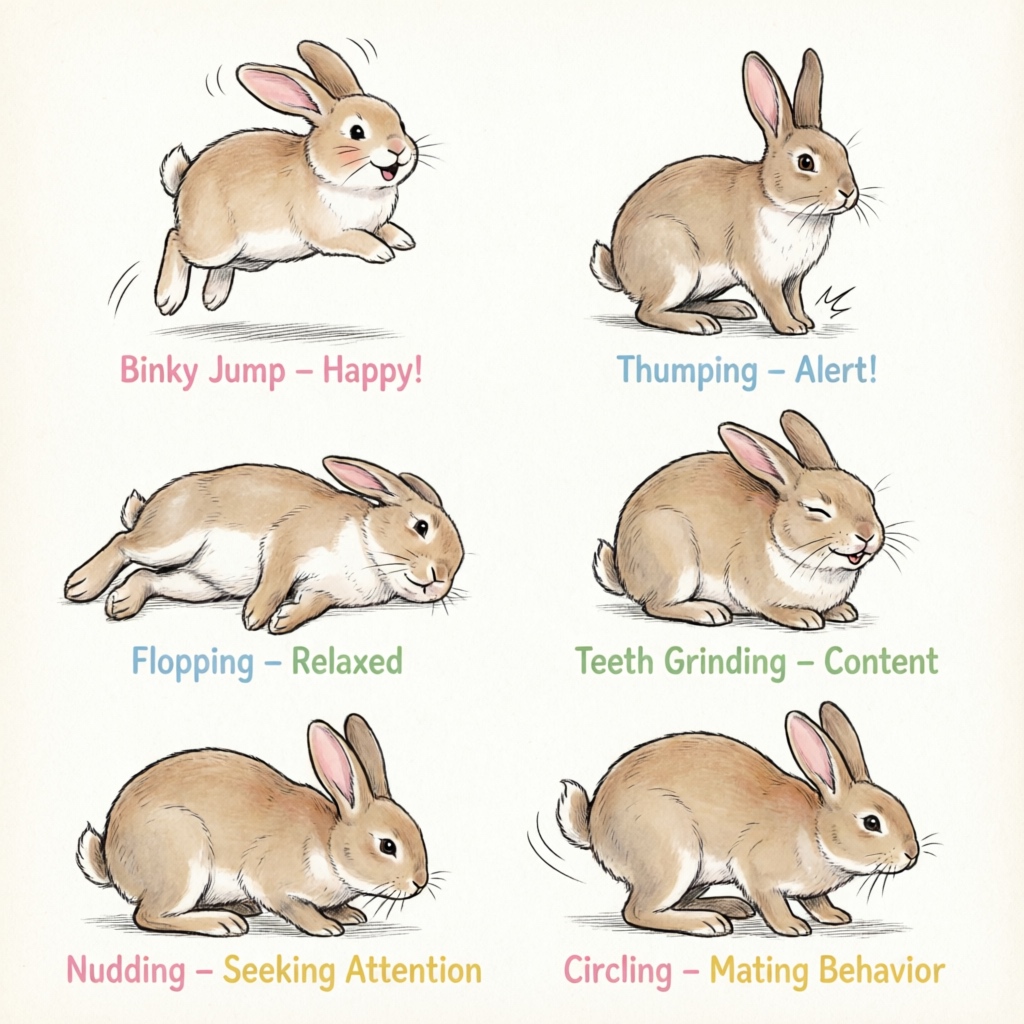
If you’re wondering why do rabbits binky, it’s the unmistakable sign of a happy rabbit. Your rabbit will jump into the air, twist their body mid-flight, kick their feet out, and shake their head. It’s an explosive burst of pure joy.
Binkies happen when your rabbit feels completely safe and excited. Common triggers include free-roam time, getting a favorite treat, or exploring a new rabbit toy. If your rabbit never binkies, it may indicate stress, an environment that’s too small, or a lack of enrichment.
One of the most common misconceptions I see from new owners is mistaking a binky for a seizure. A binky is quick, joyful, and the rabbit lands on its feet ready to keep playing. A seizure is sustained, uncoordinated, and the rabbit will appear dazed or disoriented afterward. If you’re ever unsure, film it — your vet can help you tell the difference.
Flopping — Dramatic Relaxation
Your rabbit suddenly throws themselves onto their side, looking for all the world like they’ve collapsed. New owners often panic the first time they see this — but a flop means your rabbit feels completely relaxed and trusts their environment. It’s one of the highest compliments a rabbit can give.
Purring — Contentment Grinding
Gentle, soft teeth grinding (sometimes called “tooth purring”) means your rabbit is content and comfortable. You’ll often feel or hear it when you’re petting your rabbit. It’s similar to a cat’s purr and is always a positive sign.
This is distinctly different from loud teeth grinding, which indicates pain (covered in the next section).
Nudging — “Pay Attention to Me”
When your rabbit nudges you with their nose, they’re asking for something: food, petting, or for you to move out of their way. Context matters — if they nudge your hand and lower their head, they want to be petted. If they nudge your ankle repeatedly during free-roam time, they might want you to follow them.
Circling Your Feet
Your rabbit runs circles around your feet when they’re excited or want your attention. In unspayed rabbits, this can also be a courtship behavior. If your fixed rabbit circles your feet and binkies, they’re simply showing enthusiasm.
Chin Rubbing — “This Is Mine”
Rabbits have scent glands under their chin. When they rub their chin on objects (or you), they’re marking territory. It’s a normal social behavior — your rabbit is saying “this belongs to me.”
Warning Signs — Thumping, Teeth Grinding & Fear
Thumping — “Danger! I’m Scared!”
Thumping is one of the most recognizable rabbit behaviors. Your rabbit will slam their hind legs against the ground, producing a loud “thump” that can be surprisingly loud. This behavior serves two purposes in the wild: warning other rabbits of danger and startling predators.
Common triggers include sudden loud noises, unfamiliar animals, a new environment, or even a strange smell. If your rabbit thumps, identify and remove the perceived threat. Speak softly, move slowly, and don’t reach for them until they’ve calmed down.
Persistent thumping without an obvious cause may mean your rabbit detects something you can’t. Check the environment carefully — it could be a predator outside, a strange animal nearby, or something that smells wrong.
Loud Teeth Grinding — Pain Signal
This is one of the most important warning signs to recognize. Loud teeth grinding is always a pain signal. Unlike the soft, rhythmic purring of a content rabbit, pain grinding is louder, more forceful, and often accompanied by other signs of distress: hunched posture, reluctance to move, loss of appetite, or hiding.
If you hear loud teeth grinding, contact your veterinarian immediately. Rabbits hide pain instinctively — by the time they show obvious signs, the problem may be serious. Possible causes include dental disease, gastrointestinal issues, injuries, or infections.
Growling & Lunging
A rabbit that growls, lunges, or boxes at you with their front paws is feeling threatened. This is rabbit aggressive behavior — defensive aggression, most commonly triggered by feeling cornered, having their territory invaded, or being approached from above (which mimics a predator attack).
Freezing & Flattening
When a rabbit freezes completely, presses their body flat against the ground, and lays their ears back, they’re experiencing extreme fear. This is the “if I don’t move, the predator won’t see me” response. Stop whatever you’re doing, speak softly, and slowly back away. Never chase or force interaction with a frozen rabbit.
A rabbit that frequently shows fear behaviors may need a more secure environment. Providing a proper rabbit setup with safe hiding spaces helps reduce anxiety.
Rabbit Aggression — Causes & Solutions
Aggression in rabbits is almost always a response to something, not a personality trait. Understanding the root cause is the first step to solving it.
4 Common Causes of Aggression
| Cause | Signs | Solution |
|---|---|---|
| Fear / Self-defense | Biting, lunging when approached | Build trust slowly; never approach from above |
| Hormones (not spayed/neutered) | Territorial aggression, spraying | Spay/neuter surgery |
| Territorial behavior | Protecting cage, food bowl | Provide more space; don’t reach into cage |
| Pain | Sudden aggression, won’t let you touch them | Veterinary examination |
How to Handle an Aggressive Rabbit
- Never punish — Rabbits do not understand punishment. It damages trust and increases fear.
- Find the root cause — Most aggression has a specific trigger. Is it territorial? Hormonal? Fear-based?
- Spay or neuter — This alone resolves approximately 80% of aggression cases. It also extends rabbit lifespan by reducing reproductive cancer risk.
- Interact at ground level — Approach from the side, not from above. Sit on the floor and let your rabbit come to you.
- Provide hiding spaces — A secure retreat reduces defensive aggression.
- Sudden aggression in a normally gentle rabbit — This is a red flag for pain. See rabbit health problems and schedule a vet visit.
Regular grooming, including nail trimming, reduces the damage from occasional nips. See our rabbit grooming guide for proper technique.
Natural Rabbit Behaviors — Digging, Chewing & Marking
Digging — Instinct to Burrow
Wild rabbits live in underground burrow systems. Your domestic rabbit still carries this powerful instinct. Digging at carpets, blankets, and cage floors is completely natural — not misbehavior.
I always tell new owners: don’t try to stop your rabbit from digging — redirect it. If you only say “no” without offering an alternative, you’ll end up with a frustrated rabbit and ruined carpet. A dedicated digging box filled with crumpled paper or a fabric tunnel works wonders. The BWOGUE Bunny Tunnel Bed ($34.99, 5.0⭐, 🔥) is one I’d recommend to any new owner — it doubles as a cozy hideout and a tunnel that satisfies that burrowing itch. The removable fleece mat means you can toss it in the wash when it gets soiled. It’s on the pricier side, but it holds up well and rabbits genuinely love it. I’d skip this only if you’re working with a very tight budget or a compact space — the 2-in-1 design does take up more room than a simple tunnel.
Chewing — Dental Health Need
Rabbit teeth grow continuously — approximately 4-5 inches per year. They must chew to wear their teeth down. Without adequate chewing material, teeth overgrow, causing painful dental problems and making eating difficult.
This is non-negotiable. Every rabbit needs unlimited timothy hay as their primary chew source, supplemented with safe wood and chew toys. I’ve seen too many owners bring their rabbits to the vet with overgrown molars because they thought a handful of wood sticks was enough. Hay does the heavy lifting — everything else is supplementary.
For variety beyond hay, the Grddaef 20 PCS Bunny Chew Toys ($9.99, 4.5⭐, 🔥) is the set I’d suggest starting with. At under $10 for 20 pieces, it gives your rabbit a mix of apple wood sticks and timothy grass balls to explore. The variety matters — rabbits get bored with the same texture, and having different shapes keeps them interested. The one caveat: some of the smaller pieces are better suited to dwarf breeds. If you have a large rabbit like a Flemish Giant, they may tear through the smaller sticks in minutes and need something chunkier.
For more on creating a rabbit-friendly space, see our rabbit food and diet guide — proper nutrition supports healthy chewing and digging behavior.
Marking — Territory Communication
Unspayed rabbits mark territory by spraying urine, chin-rubbing, and leaving droppings in specific areas. Spaying/neutering reduces marking behavior by approximately 90%. For already-fixed rabbits that still mark, clean marked areas thoroughly with white vinegar to remove scent, then place litter boxes or food bowls in those spots.
Rabbit Communication Sounds & Noises
Rabbits are generally quiet animals, but the sounds they do make carry clear meaning:
| Sound | Meaning | Severity |
|---|---|---|
| Soft teeth grinding | Contentment, comfort | ✅ Normal |
| Loud teeth grinding | Pain, discomfort | ❌ See vet immediately |
| Growling / low grunt | Fear, anger | ⚠️ Needs attention |
| Scream / squeal | Extreme fear or severe pain | ❌ Emergency |
| Honking / oinking | Excitement (sometimes courtship) | ℹ️ Normal |
| Snorting | Mild annoyance | ℹ️ Normal |
When Silence Is a Warning
Rabbits are most active at dawn and dusk. If your normally active rabbit suddenly becomes very quiet, stops eating, hides in a corner, or seems withdrawn, this may indicate a serious health problem. Prey animals instinctively hide pain — silence can be a sign that something is very wrong.
When Behavior Changes Mean Health Problems
5 Behavior Changes That Need a Vet
-
Stopped eating for 12+ hours — This is a GI stasis emergency. Rabbits cannot safely fast — their digestive system must keep moving. After 12 hours without food, the gut begins to slow dangerously.
-
Smaller or fewer droppings — Indicates digestive slowdown, potentially early GI stasis.
-
Suddenly aggressive when normally gentle — Pain is the most common cause of sudden personality changes in rabbits.
-
Excessive grooming or fur pulling — Can indicate skin parasites, allergies, or severe stress.
-
Head tilt or circling — May indicate Encephalitozoon cuniculi, a parasitic infection that affects the brain. Requires urgent veterinary treatment.
GI Stasis — The Silent Killer
Gastrointestinal stasis is the leading cause of death in domestic rabbits. The digestive system slows or stops completely, often triggered by insufficient fiber, dehydration, stress, or pain.
Symptoms: Not eating, reduced or absent droppings, hunched posture, loud teeth grinding, bloated abdomen.
Prevention: Unlimited timothy hay is the single most effective prevention. A proper rabbit diet with 80%+ hay keeps the gut moving. Ensure constant access to fresh water and regular exercise.
Common Behavior Problems & Solutions
Problem-Solution Table
| Problem | Cause | Solution |
|---|---|---|
| Chewing wires | Chewing instinct + curiosity | Wire protectors + chew toy alternatives |
| Not using litter box | Territorial marking / not spayed | Spay/neuter + proper litter training |
| Nighttime activity | Crepuscular nature (dawn/dusk active) | More daytime interaction to tire them out |
| Digging at carpets | Burrowing instinct | Digging box, tunnel, or digging mat |
| Spraying urine | Not spayed / territorial | Spay/neuter + clean with white vinegar |
| Bar chewing | Boredom / too small enclosure | Larger space, more toys, more free-roam time |
Enrichment Is the Best Medicine
Most behavior problems stem from boredom or an inadequate environment. Rabbits need:
- At least 1 hour of free-roam time daily outside their enclosure
- A variety of toys rotated regularly to maintain interest
- Hiding spaces where they can retreat when they want solitude
- Digging and chewing outlets to satisfy natural instincts
The Mechpia Rabbit Tunnel & Chew Toy Set ($11.99, 4.6⭐, 🔥) is a solid budget pick that covers two behavioral needs at once — the collapsible tunnel satisfies burrowing instincts and the included apple wood sticks keep teeth in check. At under $12, it’s the starter kit I’d point any first-time rabbit owner toward. Just keep in mind the tunnel fabric isn’t as rugged as the BWOGUE option above, so enthusiastic chewers may destroy it faster than you’d like.
For mental stimulation, a foraging mat like the OVMKOV Rabbit Foraging Mat ($6.99, 4.3⭐, 🔥) turns treat time into an actual activity. You hide pellets or small treats in the fabric folds and your rabbit has to sniff and dig them out. It’s dead simple, but it works — I’ve seen bored rabbits light up the first time they figure out how to use one. At under $7, it’s hard to argue with. The only thing to watch for: some rabbits will try to eat the mat itself, so supervise during the first few sessions until you know how yours handles it.
The andwe Rolling Activity Balls ($13.99, 4.6⭐, 🔥) are another option for rabbits that like to nudge and toss things around. They come in a variety of shapes and sizes, which encourages natural play behaviors. These are hit-or-miss though — some rabbits will push them around for hours, while others sniff once and walk away. If your rabbit isn’t a natural nudger, you might want to skip these and put that money toward a treat-dispensing ball instead.
Bonding & Social Behavior
Do Rabbits Need a Friend?
Rabbits are social animals that live in groups in the wild. A bonded pair is generally happier and healthier than a single rabbit. However, bonding requires patience and proper introduction.
- Same-sex pairs: Female-female bonds have the highest success rate
- Mixed-sex pairs: Both must be spayed/neutered before introduction
- Single rabbits: Need 1-2 hours of dedicated owner interaction daily
Signs Your Rabbit Trusts You
- Binkying when they see you
- Approaching you voluntarily and climbing on your lap
- Flopping near you
- Licking you (mutual grooming is a social bonding behavior in rabbits)
- Presenting their head for petting (lowering their head in front of you)
FAQ: Rabbit Behavior Questions
Why does my rabbit thump?
Thumping means your rabbit perceives a threat or is expressing strong displeasure. Check for sudden noises, unfamiliar animals, or environmental changes. Remove the trigger and speak calmly. Occasional thumping is normal; persistent thumping needs investigation.
Why is my rabbit grinding its teeth?
Soft, gentle grinding means contentment — your rabbit is happy and relaxed. Loud, forceful grinding means pain and requires immediate veterinary attention. The difference is easy to distinguish once you’ve heard both.
What does it mean when a rabbit binkys?
A binky is a happy dance — your rabbit jumps, twists, and kicks in the air out of pure joy. It means they feel safe and excited. If your rabbit never binkys, evaluate their environment for sources of stress or lack of enrichment.
Why does my rabbit nudge me?
Nudging is your rabbit’s way of getting your attention. They may want food, petting, or simply want you to move. If they lower their head while nudging, they’re asking to be petted.
Why is my rabbit aggressive?
The four most common causes are fear, hormones (not spayed/neutered), territorial behavior, and pain. Spaying/neutering resolves most aggression. If a normally gentle rabbit suddenly becomes aggressive, suspect pain and consult a vet.
How do rabbits show they are happy?
Happy rabbits binky, flop onto their sides, purr (soft teeth grinding), nudge you for attention, circle your feet when excited, and lick you as a sign of bonding.
Why does my rabbit circle my feet?
Circling is an expression of excitement and desire for attention. In unspayed rabbits, it can also be a courtship behavior. If your fixed rabbit circles your feet and binkies, they’re simply showing enthusiasm and affection.
This guide represents current best practices in rabbit care based on veterinary guidance and verified owner experiences. Always consult with a rabbit-savvy veterinarian for specific health or behavior concerns.