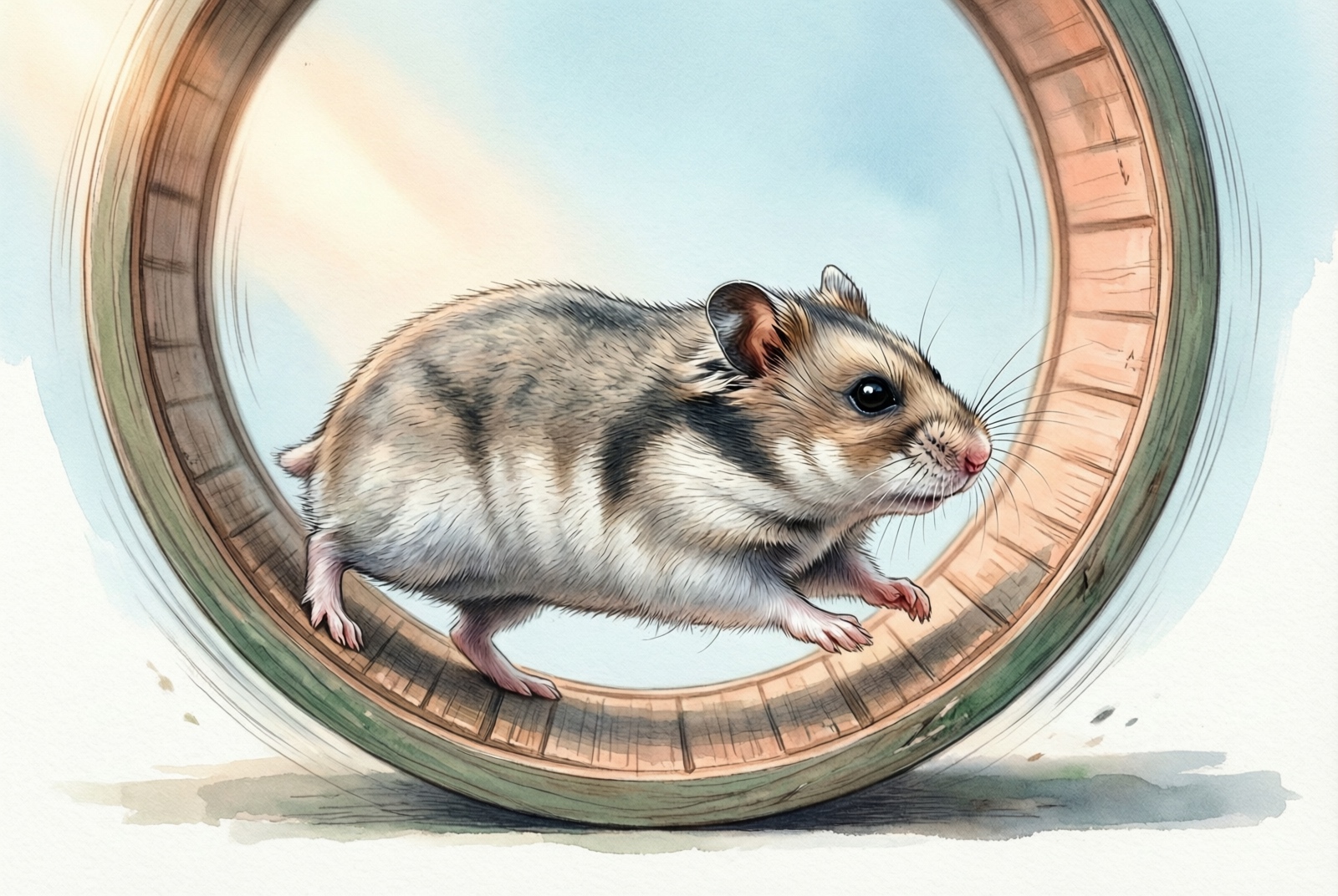
A hamster running on a wheel that’s too small is one of the most common sizing mistakes I see from new owners. It looks normal at first glance, but watch closely and you’ll see their spine curling into an unnatural arch with every stride. Over weeks and months, that constant bending causes real damage: compressed vertebrae, chronic back pain, and eventually mobility problems that can shorten your hamster’s life.
The good news is that choosing the right hamster wheel size is straightforward once you know the numbers. This complete guide covers everything: breed-specific size charts, health consequences of wrong sizing, how to spot the warning signs, and the best wheels available right now for every hamster species. I’ve tested and researched dozens of options over the years. If you are wondering what size wheel you need, I’ll walk you through exactly what to look for and what to avoid.
For a broader look at how wheels fit into your hamster’s overall exercise routine, check out our hamster exercise guide.
Why Hamster Wheel Size Matters
Hamsters in the wild cover up to 5 miles per night foraging, patrolling territory, and escaping predators [source: RSPCA]. In captivity, a wheel is the single most important piece of enrichment you can provide — it replaces that nightly mileage and keeps your hamster physically and mentally healthy.
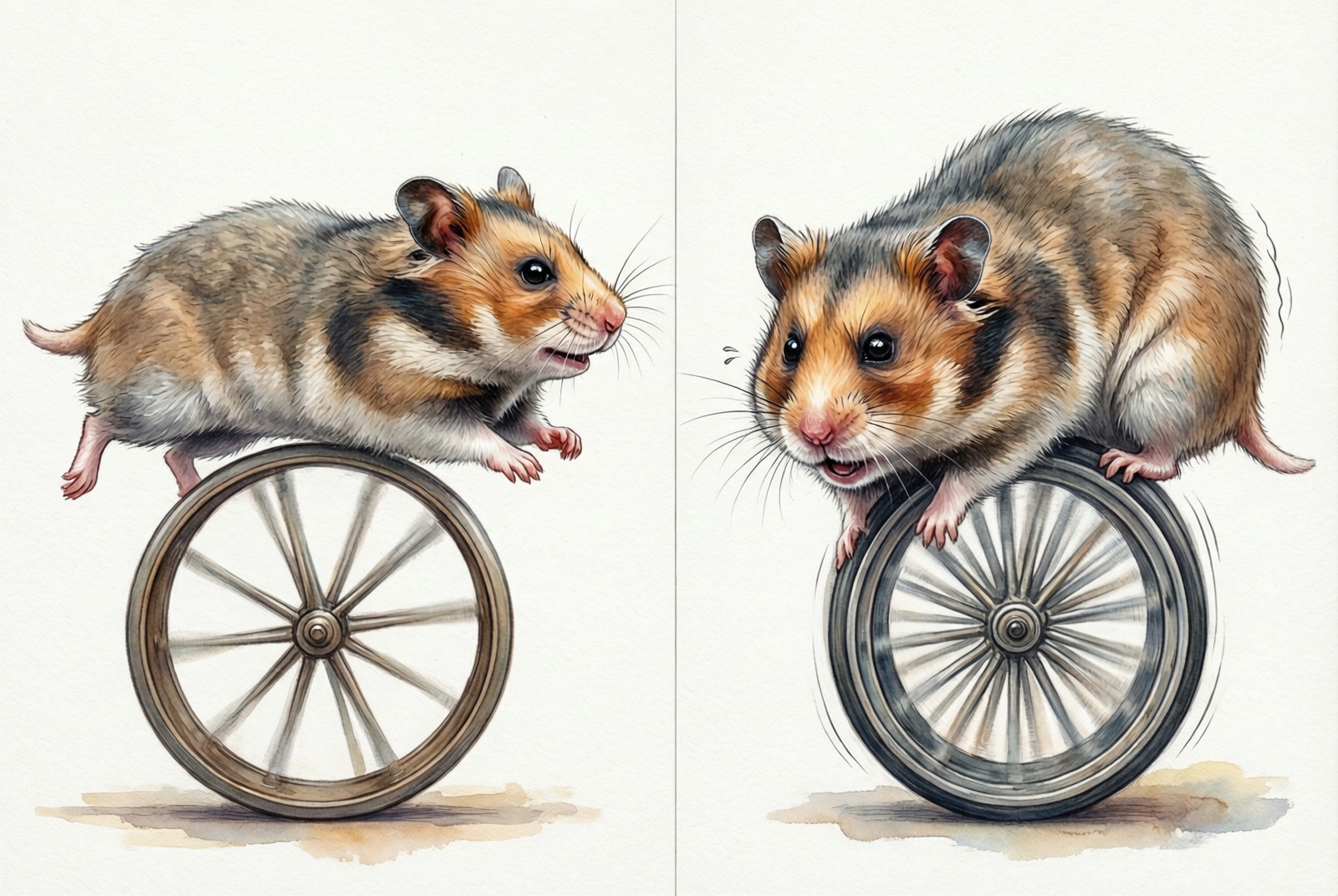
But here’s what most people don’t realize: the wheel diameter directly affects your hamster’s posture while running. When a wheel is too small, the hamster has to curve their spine to fit on the running surface. That curved-back running position from wrong sizing is the root cause of several serious health problems.
Back arching and spinal damage: This is the big one. A wrong hamster wheel size forces your hamster’s back into a U-shape with every revolution. Over time, the constant unnatural curvature compresses vertebrae, strains spinal muscles, and can cause permanent damage. I’ve seen hamsters that developed a visible hunch and lost coordination after months on undersized wheels — and the damage is largely irreversible.
Bumblefoot (pododermatitis): Running on a wheel that’s too small changes your hamster’s gait. Instead of a smooth, even stride, they take short, choppy steps that concentrate pressure on specific points of their feet. That uneven pressure causes inflammation, calluses, and bacterial infections in the foot pads — a painful condition called bumblefoot that requires veterinary treatment. Getting the hamster wheel size right is the first step to preventing this.
Behavioral stress: When a hamster wheel size is wrong — too small to run comfortably or too big to start — hamsters often develop stress behaviors. I’ve noticed hamsters in undersized wheels will sometimes run for shorter periods, bar-bite more frequently, or become lethargic. The wheel that’s supposed to relieve stress ends up causing it.
Obesity: If the wheel is uncomfortable to use, your hamster simply runs less. Combined with a sedentary cage environment, that reduced exercise leads to weight gain and all the health problems that come with it. Proper hamster wheel size selection directly impacts daily exercise volume.
The fundamental rule is simple: the correct wheel diameter must be large enough that your hamster can run with a completely flat back. No arching, no curving, no bending — just a natural, horizontal running posture.
Hamster Wheel Size Chart by Breed
Different hamster species have dramatically different body sizes, which means there’s no such thing as a one-size-fits-all hamster wheel size. A wheel that’s perfect for a Roborovski dwarf would be dangerously small for a Syrian. Here’s the complete breakdown:
| Breed | Minimum Diameter | Recommended Diameter | Running Surface Width | Wheel Type |
|---|---|---|---|---|
| Syrian Hamster | 8.5 inches (21.5 cm) | 10-12 inches (25-30 cm) | 3-4 inches (7.5-10 cm) | Standing wheel |
| Winter White Dwarf | 6.5 inches (16.5 cm) | 7-8 inches (18-20 cm) | 2.5-3 inches (6.5-7.5 cm) | Standing or saucer |
| Campbell’s Dwarf | 6.5 inches (16.5 cm) | 7-8 inches (18-20 cm) | 2.5-3 inches (6.5-7.5 cm) | Standing or saucer |
| Chinese Hamster | 6.5 inches (16.5 cm) | 7-8 inches (18-20 cm) | 2.5-3 inches (6.5-7.5 cm) | Standing wheel |
| Roborovski | 6 inches (15 cm) | 6.5-7 inches (16.5-18 cm) | 2-2.5 inches (5-6.5 cm) | Standing or saucer |
The hamster wheel diameter is everything. The width of the running surface is part of the sizing equation (it prevents your hamster from slipping off the side), but diameter is the non-negotiable measurement. A 6-inch wheel for a Syrian hamster isn’t “a bit small” — it’s a health hazard, regardless of how wide the running surface is.
With wheels, bigger is always better. There’s no upper limit on wheel size for hamsters (with the rare exception of tiny Roborovskis on extremely heavy acrylic wheels). If you have the cage space, going one or two sizes up from the minimum is always the safer choice. A dwarf hamster on an 8-inch wheel will run just as happily as one on a 6.5-inch wheel — but with significantly less spinal strain.
For Syrian hamsters, the requirements are the most demanding. At 6-7 inches in body length, Syrians are the largest domestic hamster species. They also have the longest stride, which means they need proportionally larger wheel diameters. I’d consider a 10-inch wheel the absolute minimum for a Syrian, with 11-12 inches being the sweet spot.
Measure the inside diameter. This is a mistake I see constantly. A wheel marketed as “8-inch” might have an 8-inch outside diameter but only 6.5 inches of actual running surface inside. Always measure from the inside edge to the opposite inside edge — that’s the diameter your hamster actually experiences.
Pet store options are almost always too small. Those colorful 5-6 inch wheels sold in the hamster aisle? They’re inappropriate for every hamster species. Even the smallest Roborovski needs 6 inches minimum. I’d recommend buying your wheel online from the options below rather than relying on whatever your local pet shop stocks.
For more on sizing accessories and enclosure dimensions, see our Syrian hamster cage size guide and dwarf hamster cage guide.

Best Hamster Wheel Size for Syrian Hamsters
Syrian hamsters are the most popular pet hamster species, and they’re also the most demanding when it comes to wheel sizing. At 6-7 inches long with a powerful running stride, they need a minimum of 8.5 inches of diameter — and honestly, I wouldn’t put a Syrian on anything smaller than 10 inches. Here are the best hamster wheel size options I’ve found for Syrians:
Niteangel Super-Silent Hamster Wheel — This is the hamster wheel size I recommend most often to Syrian owners, and for good reason. With a from over 🔥 reviewers on Amazon, it’s the most tested hamster wheel available. The dual ball bearing design is genuinely quiet — I’ve had mine running next to my bed without issues. It comes in sizes from 6.5 inches up to 12 inches, and for Syrians I’d go with the 10-inch or 12-inch option. The package includes anti-slip track tape and a sturdy standing base. One caveat: don’t get the spinning mechanism wet when cleaning, as a few owners have reported squeaking after water exposure.
Niteangel Super-Silent Hamster Wheel on Amazon
Silent Runner 12” Regular — If floor space is tight in your cage, this is the one to get. The 12-inch diameter is ideal for Syrians, and it comes with a cage wall attachment bracket that mounts the wheel vertically — freeing up the entire floor area underneath. With 🔥 reviews and a , it’s well-tested. The fully disassembling design makes cleaning straightforward. I’ve found that the one-sided attachment can become slightly lopsided over time, so check the tightness of the mounting bracket periodically.
Silent Runner 12” Regular on Amazon
BUCATSTATE 12.5” Acrylic Wheel — For owners who want something visually striking in their setup, this full transparent acrylic wheel is hard to beat. The 12.5-inch diameter gives even large Syrians extra room, and the dual-bearing mechanism runs quietly. At $59.99 it’s the most expensive option here, but the build quality and aesthetics justify the price if budget allows. I’d note that acrylic does scratch over time from your hamster’s nails, and a few owners have reported hardware issues after several months of heavy use.
BUCATSTATE 12.5” Acrylic Wheel on Amazon
For cages that can accommodate these larger wheels, our best hamster cage guide covers enclosures with enough floor space and vertical clearance. And if you’re setting up a new habitat, our hamster cage setup guide has tips on wheel placement and positioning.
My Syrian-specific advice: Always choose 10 inches minimum, 12 inches preferred. Avoid wheels with crossbars, wire mesh running surfaces, or gaps between the wheel and the support — a Syrian’s long tail can get caught in any of these. If you’re choosing between a floor-standing and a cage-mountable wheel, I’d go cage-mountable for Syrians since they need large enclosures and every inch of floor space counts.
Best Hamster Wheel Size for Dwarf & Roborovski
Dwarf hamsters are smaller (2-4 inches depending on species) but they still need properly sized wheels. In fact, because dwarf species are such fast, energetic runners — Roborovskis in particular can clock some impressive speeds — hamster wheel size matters just as much as quality for these little athletes.
Quiet 10.2” Dual-Bearing Wheel — I’d recommend this as an excellent all-around wheel choice for dwarf hamsters. At 10.2 inches, it’s well above the 6.5-inch minimum for any dwarf species, which means your hamster will have plenty of room and a completely flat running posture. The dual-bearing design keeps it quiet, and the adjustable height stand lets you customize the fit. With 🔥 reviews and a at $34.19, it’s a solid middle-ground option. One thing to watch: some owners have reported that the grooved running surface can potentially contribute to bumblefoot in sensitive individuals, so inspect your hamster’s feet regularly if you choose this one.
Quiet 10.2” Dual-Bearing Wheel on Amazon
Hermit Crab / Small Animal Wheel — At just $8.99 with 🔥 reviewers, this is the most affordable option that still meets quality standards. It’s a simple, small wheel that works well for dwarf hamsters and mice. I’d be careful with the sizing though — despite being marketed for hamsters, several reviewers have noted it’s extremely small and may be too tight even for some dwarf species. If your dwarf is on the larger side (especially Campbell’s or Chinese hamsters), I’d size up instead. The metal axle can also rust in humid environments, so keep it dry.
Hermit Crab / Small Animal Wheel on Amazon
The Niteangel Super-Silent from the Syrian section above also comes in 6.5-inch and 8-inch sizes, which makes it a great option if you have both dwarf and Syrian hamsters in your household and prefer to stick with one brand. For dwarf hamster enclosure sizing, see our dwarf hamster cage guide.
Breed-specific notes: Winter Whites and Campbell’s dwarfs need similar wheel sizing and both do well with 6.5-8 inch wheels. Both species can also use flying saucer wheels as an alternative or supplement. Chinese hamsters need a larger wheel due to their elongated body, mouse-like body shape, so I’d lean toward the larger end of their range (7-8 inches) and prioritize a smooth running surface. Roborovskis are the smallest species but the fastest runners — they need a smooth, well-balanced wheel for their speed and can use either standing wheels or saucers.
Best Budget & Saucer Hamster Wheels
Not every hamster owner wants to spend $35-60 on a wheel, and there are legitimate budget options that work well for the right hamster. Flying saucers — which spin horizontally — are also worth considering as an alternative to traditional standing wheels.
Flying Saucer Silent Running Wheel — At $8.99 with 🔥 reviews and a , this is the most affordable option on Amazon. It’s completely silent in operation and provides a fun, different type of running motion compared to standing wheels. However, I’d be honest about its limitation: the plastic quality is on the thinner side, some units arrive with missing parts, and it’s too small for Syrian hamsters. I’d only recommend this for dwarf hamsters or as a secondary enrichment item in a large cage.
Flying Saucer Silent Running Wheel on Amazon
Ware Manufacturing Flying Saucer 7.25” — Ware is a trusted name in small pet supplies, and this 7.25-inch saucer has earned 🔥 reviews with a. The angled running surface encourages a natural running posture, and it’s well-suited for dwarf hamsters. At $9.99 it’s affordable, but I should note that some owners find it noisier than expected — one reviewer compared this saucer to a generic disc that was actually quieter. Some units also arrive with cracked bases. If you get a good one, it can last a long time; one touching review mentioned their hamster used it every single night until the day he passed.
Ware Manufacturing Flying Saucer 7.25” on Amazon
Niteangel Acrylic Silent Wheel — On the premium end of this section, this full transparent acrylic wheel from Niteangel is the highest-rated option on Amazon, period. Atfrom 🔥 reviews, it’s nearly flawless in customer satisfaction. The transparent design lets you watch your hamster run from any angle, and the dual-bearing mechanism is genuinely silent. At $56.99 it’s an investment, but if you want the best-looking, quietest wheel available and your budget allows, this is it. A few owners have reported cracking after extended use, and one mentioned the spindle catching fur — so inspect it regularly.
Niteangel Acrylic Silent Wheel on Amazon
For more on wheel placement and integrating exercise equipment into your setup, see our hamster cage setup guide.

Signs Your Hamster Wheel Size Is Wrong
If you already have a wheel and aren’t sure whether it’s the right hamster wheel size, here’s how to check. This is one of those things where catching the problem early can prevent permanent health damage — so it’s worth taking a few minutes to observe your hamster.
The back arching test (the gold standard):
- Wait until your hamster is actively running on the wheel
- Position yourself so you can see their profile from the side
- Watch their back — is it completely flat, or does it curve upward?
- If the back forms any visible arch (U-shape), the wheel is too small
- A very slight, natural downward curve of the neck is normal — the concern is arching in the mid-to-lower back
This is the single most reliable test. I’d recommend filming your hamster running in slow motion if you can’t tell in real time — phone cameras at 60fps or 120fps make it easy to spot even subtle arching.
Other signs the wheel is too small:
- Your hamster runs with their head tilted upward or to one side
- They seem reluctant to use the wheel and prefer running along the cage floor
- They frequently fall off the wheel mid-run
- Their running gait looks awkward, slow, or jerky rather than smooth and circular
- The wheel spins extremely fast — a smaller diameter means higher RPM, which can be hard for the hamster to control
Signs the wheel might be too big:
This is rare, but it does happen — usually with tiny Roborovski hamsters on very heavy acrylic wheels. Signs include: the hamster can’t generate enough momentum to start the wheel spinning, the wheel is so heavy it barely moves, or the hamster avoids it entirely. If you suspect this, try a lighter wheel with a smaller diameter.
What to do:
- Measure the inside diameter of your current wheel (edge to edge on the running surface)
- Compare it to the breed chart in the section above
- If it’s too small, upgrade immediately — spinal damage from back arching is cumulative and irreversible
- If it’s too big, switch to a lighter wheel or one with less bearing resistance
For a complete overview of hamster health issues related to poor housing and equipment, our hamster health problems guide covers the most common conditions and when to see a vet.
Standing Wheel vs Flying Saucer — Which Is Better?
This is a question I get asked a lot, and the answer depends on your hamster’s species, your cage setup, and your personal preferences. Both types have legitimate strengths and weaknesses when it comes to hamster wheel size.
| Feature | Standing Wheel | Flying Saucer |
|---|---|---|
| Running posture | Natural upright position | Angled, tilted position |
| Back health | Better — encourages flat back | Slight arch possible on some models |
| Space needed | Tall — needs vertical clearance | Low profile — sits flat |
| Floor space | Small footprint | Larger diameter needed |
| Noise level | Varies by bearing quality | Generally quieter |
| Size range | 6-12+ inches available | 6-8 inches (limited options) |
| Breed suitability | All hamster species | Best for dwarfs and Robos |
| Cage mounting | Some models support it | No — free-standing only |
| Durability | Bearings can fail over time | Simpler mechanics, fewer failure points |
| Price range | $8-60 | $8-15 |
My recommendation for most owners: Get a standing wheel as the primary exercise wheel. Standing wheels allow a more natural running posture, come in a wider range of sizes, and work for all hamster species including Syrians (saucers are generally too small for Syrians). The cage-mountable standing wheels also save valuable floor space.
When a saucer makes sense: Flying saucers are a great supplement or alternative for dwarf hamsters and Roborovskis. Many dwarf hamster owners I’ve spoken with provide both a standing wheel and a saucer in a large cage, and their hamsters use both throughout the night. Saucers are also quieter (no bearing mechanism to squeak) and have no tail-catching risk since there’s no center axle.
The ideal setup for dwarf hamsters: One standing wheel (7-8 inches) as the primary wheel, plus one flying saucer as a secondary option. This gives your hamster variety and engages different muscle groups. For Syrian hamsters, I’d stick with a standing wheel only — saucers don’t come in large enough sizes.
For more enrichment ideas beyond wheels, see our hamster toys guide and cage enrichment tips.

Hamster Wheel Size: FAQ
What size wheel does a Syrian hamster need?
Minimum 8.5 inches (21.5 cm), but I’d strongly recommend 10-12 inches (25-30 cm). Syrian hamsters are the largest domestic breed at 6-7 inches in body length, and anything smaller forces their spine into an unnatural arch while running. When choosing your hamster wheel size, the Niteangel Super-Silent in the 10-inch or 12-inch size and the Silent Runner 12-inch are both solid choices that give Syrians plenty of room.
What size wheel does a dwarf hamster need?
Minimum 6.5 inches (16.5 cm), ideally 7-8 inches (18-20 cm). This applies to Winter White, Campbell’s, and Chinese hamsters. Roborovskis can technically use a 6-inch wheel but 6.5 inches is better for their long-term back health. The Quiet 10.2-inch Dual-Bearing Wheel works for all dwarf species and gives them generous running space — it’s a safe hamster wheel size choice for any dwarf owner.
Can a hamster wheel be too big?
It’s very rare. The only real scenario is a tiny Roborovski on a very heavy acrylic wheel they can’t spin. For Syrian and standard dwarf hamsters, bigger is always better — a 12-inch hamster wheel size for a dwarf hamster is perfectly fine and healthier than a minimum-size 6.5-inch wheel. The only downside of a larger wheel is the space it takes up in the cage.
How do I know if my hamster’s wheel is too small?
Watch them run from the side. If their back arches into a U-shape, the wheel is too small — it’s that simple. Other warning signs include running with a tilted head, falling off frequently, reluctance to use the wheel, or an awkward slow gait. The back should be completely flat or have only a very slight natural curve. If you see any arching, upgrade the wheel immediately. The spinal damage from prolonged back arching is cumulative and can’t be reversed.
Are silent hamster wheels worth it?
Absolutely, especially if your hamster’s cage is in or near a bedroom. Hamsters run 4-6 miles per night, and a squeaky wheel at 2 AM will quickly become unbearable. Silent wheels use ball bearings instead of simple axle pins, which eliminates the high-pitched squeaking that plagues cheaper wheels. The Niteangel Super-Silent and Niteangel Acrylic are the quietest hamster wheel size options I’ve tested. That said, keep in mind that even “silent” wheels can develop squeaks after a few months as bearings wear down — a drop of safe lubricant on the bearing usually fixes it.
Why does my hamster’s back arch on the wheel?
Back arching means the wheel diameter is too small for your hamster’s body length. When the wheel is too small, they have to bend their spine into an unnatural curve to fit on the running surface. Over time this causes spinal compression, chronic pain, and loss of mobility. The fix is straightforward: get a larger wheel. For Syrians, upgrade to at least 10-12 inches. For dwarfs, upgrade to at least 7-8 inches.
Can two hamsters share one wheel?
I wouldn’t recommend it. Syrian hamsters are strictly solitary and can never share a cage or equipment. Dwarf hamsters can live in same-sex pairs, but sharing a wheel often leads to territorial disputes — one hamster may guard the wheel and block the other from using it. If you have a pair of dwarf hamsters, the best setup is one wheel per hamster in a large enough cage. In practice, this usually means a 40-gallon bin cage or larger.
How far do hamsters run on their wheel each night?
A healthy adult hamster runs 4-6 miles (6-10 km) per night. Some particularly active individuals reach up to 8 miles. This is exactly why wheel size and quality matter so much — your hamster spends several hours every single night on this one piece of equipment. A wheel that’s too small, too noisy, or uncomfortable to use directly impacts their daily physical and mental health. It’s worth investing in a good one.