What Are Hermit Crabs? — Species, Lifespan, and Behavior
Land hermit crabs (family Coenobitidae) are crustaceans that live on land but require access to both freshwater and saltwater (Smithsonian National Museum of Natural History — Crustaceans). Unlike true crabs, hermit crabs have soft, vulnerable abdomens and protect themselves by occupying empty gastropod shells. They grow throughout their lives, periodically shedding their exoskeleton in a process called molting.
The three species most commonly sold as pets each have distinct traits that affect hermit crab care requirements. Understanding how to care for hermit crabs begins with choosing the right species.
| Species | Common Name | Shell Preference | Activity Level | Humidity Need |
|---|---|---|---|---|
| C. clypeatus | Caribbean / Purple Pincher | Round openings | Docile, slower | 75-80% |
| C. compressus | Ecuadorian | Oval openings | Active, fast | 70-80% |
| C. perlatus | Strawberry | Mixed | Most active, outgoing | 80-85% |
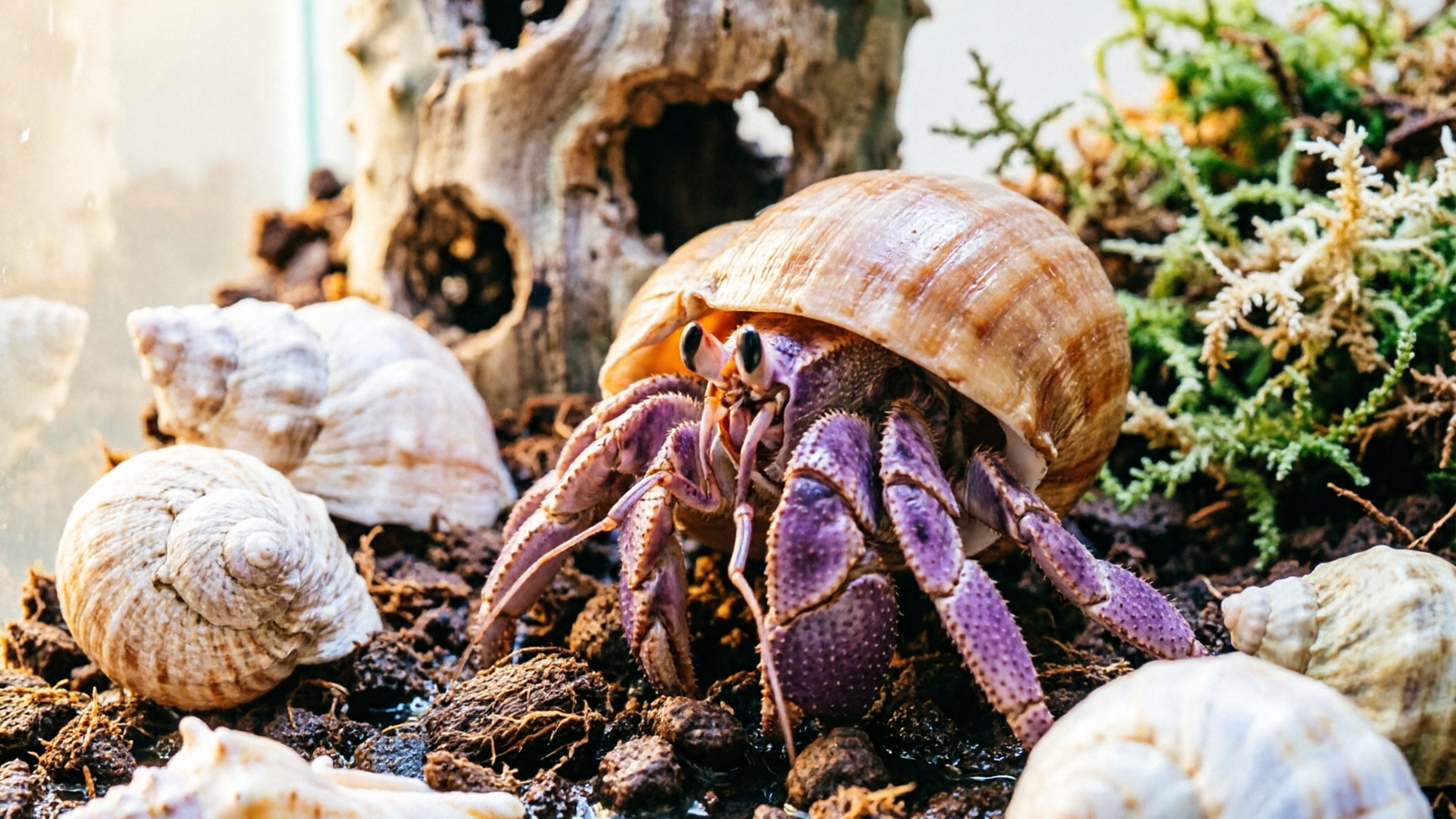
The Caribbean or Purple Pincher is the most common species in pet stores and the hardiest for beginners. Ecuadorians are faster and more active but slightly less humidity-tolerant. Strawberry hermit crabs are the most demanding — they need higher humidity and are prone to stress in captivity.
With proper care, land hermit crabs live ten to fifteen years (University of Florida IFAS Extension). Most premature deaths result from poor humidity or inadequate molting conditions. These are not short-lived throwaway pets — they require specific humidity, temperature, substrate depth, and social interaction for over a decade.
Hermit crabs are social animals that live in colonies of up to 100 individuals in the wild (Animal Diversity Web — Coenobitidae). A single crab becomes stressed and inactive. Keep at least two to three together for natural behavior.
Choose the right tank to house your hermit crab colony — 20 gallons before you add a second crab, not a 10-gallon critter keeper.
Hermit Crab Habitat Setup — Tank, Substrate, and Climbing
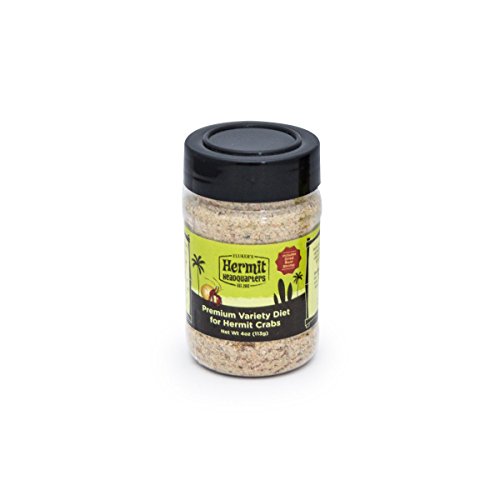
Fluker’s Premium Variety Diet is a quality option worth considering for your setup.
Learning how to care for hermit crabs starts with proper hermit crab habitat setup. This hermit crab care guide covers everything from tank setup to molting. The minimum tank size is ten gallons for two crabs, with five gallons per additional crab (ReptiFiles).
Glass aquariums with solid lids work best — mesh lids allow humidity to escape through the gaps.
Substrate choice is the most important decision for your crab’s long-term health. Coconut fiber (eco earth) holds moisture better than sand alone and allows crabs to construct stable burrows (ReptiFiles — Hermit Crab Substrate). A mix of coconut fiber and playsand is the community-preferred combination.
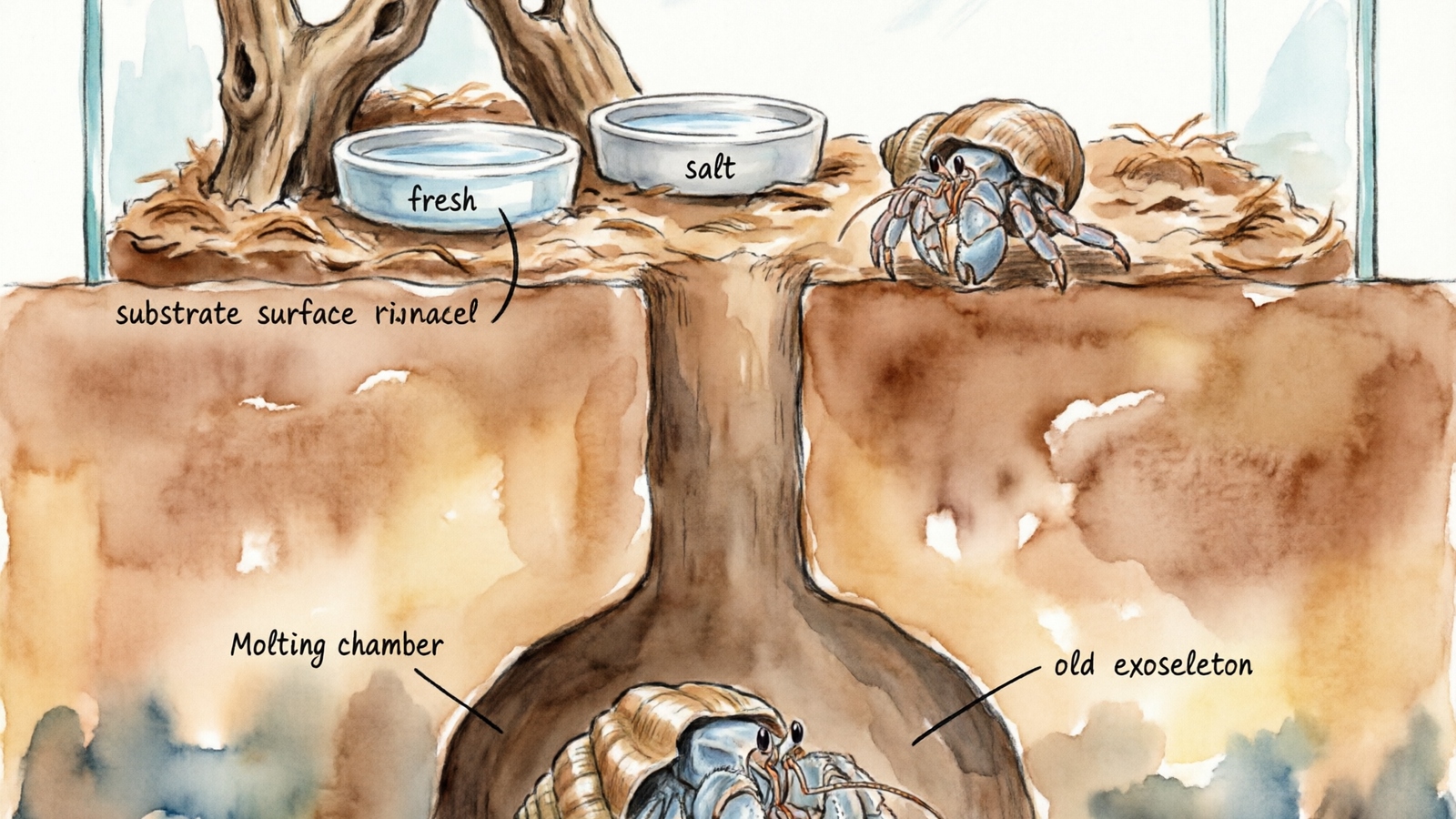
Substrate depth must be three times the tallest crab’s height. This is non-negotiable — hermit crabs molt underground and need enough depth to burrow completely below the surface. Shallow substrate forces surface molts, which are dangerous.
Substrate Essentials
- Depth must be 3x tallest crab’s height (for underground molting)
- Coconut fiber holds moisture better than sand alone
- Playsand must be pesticide-free and rinsed — check for a silica-free label
- Never use gravel, cedar, or pine — toxic to hermit crabs
- Substrate should be sand-castle consistency (moist enough to hold a burrow, not dripping)
Climbing structures keep hermit crabs active and reduce stress. Natural cholla wood, cork bark, and driftwood provide grip surfaces.
Half-coconut hides offer secure sleeping spots. Avoid any painted surfaces — paint chips are toxic if ingested.
Add climbing structures to enrich your crab’s environment. See our hermit crab climbing toys guide for safe options. Substrate choice directly impacts molting success — see our hermit crab substrate guide for detailed material comparisons.
Temperature and Humidity — The Non-Negotiables
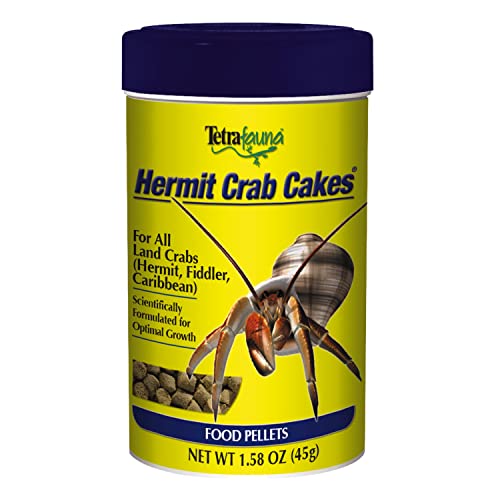
Many owners find that TetraFauna Hermit Crab Cakes works well for their pet’s needs.
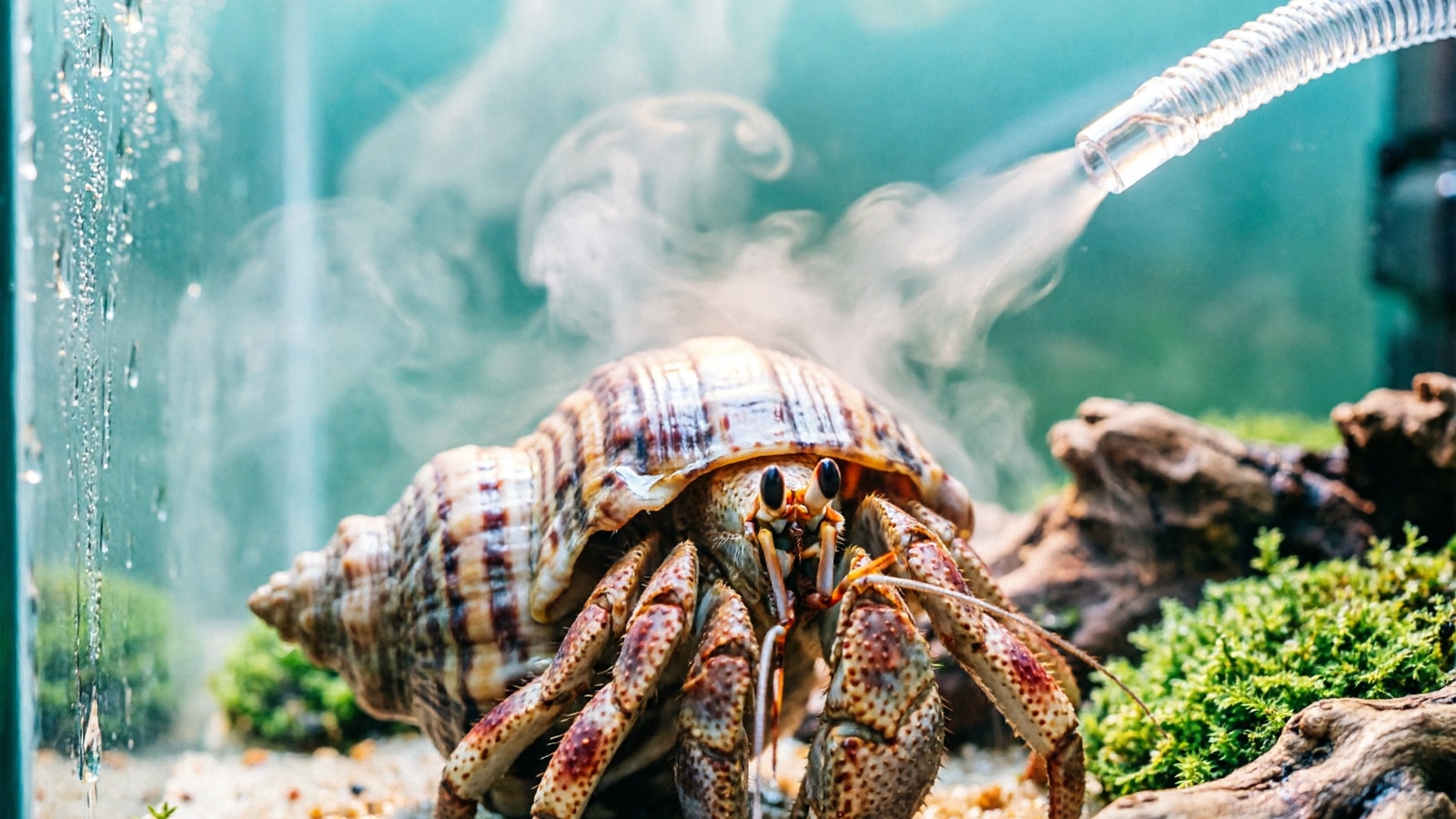
Hermit crabs breathe through modified gills called branchiostegal lungs — specialized organs that function as both gill and lung (NOAA Ocean Exploration). Unlike fish gills, these must remain moist to extract oxygen from air.
Below sixty percent humidity, hermit crabs slowly suffocate. This is the single most common cause of premature death in captive hermit crabs (VCA Hospitals — Hermit Crab Care).
Temperature: Maintain 75-85°F (24-29°C) at all times. Proper hermit crab temperature is critical for survival.
Use an under-tank heater on one side to create a warm-to-cool hermit crab temperature gradient.
Never use heat lamps — they dry out the tank and lower humidity to dangerous levels (VCA Hospitals). A digital thermometer at substrate level is essential.
Humidity: Proper hermit crab humidity means maintaining 75-85% relative humidity in the tank. A digital hygrometer placed at substrate level gives the most accurate hermit crab humidity reading (ReptiFiles).
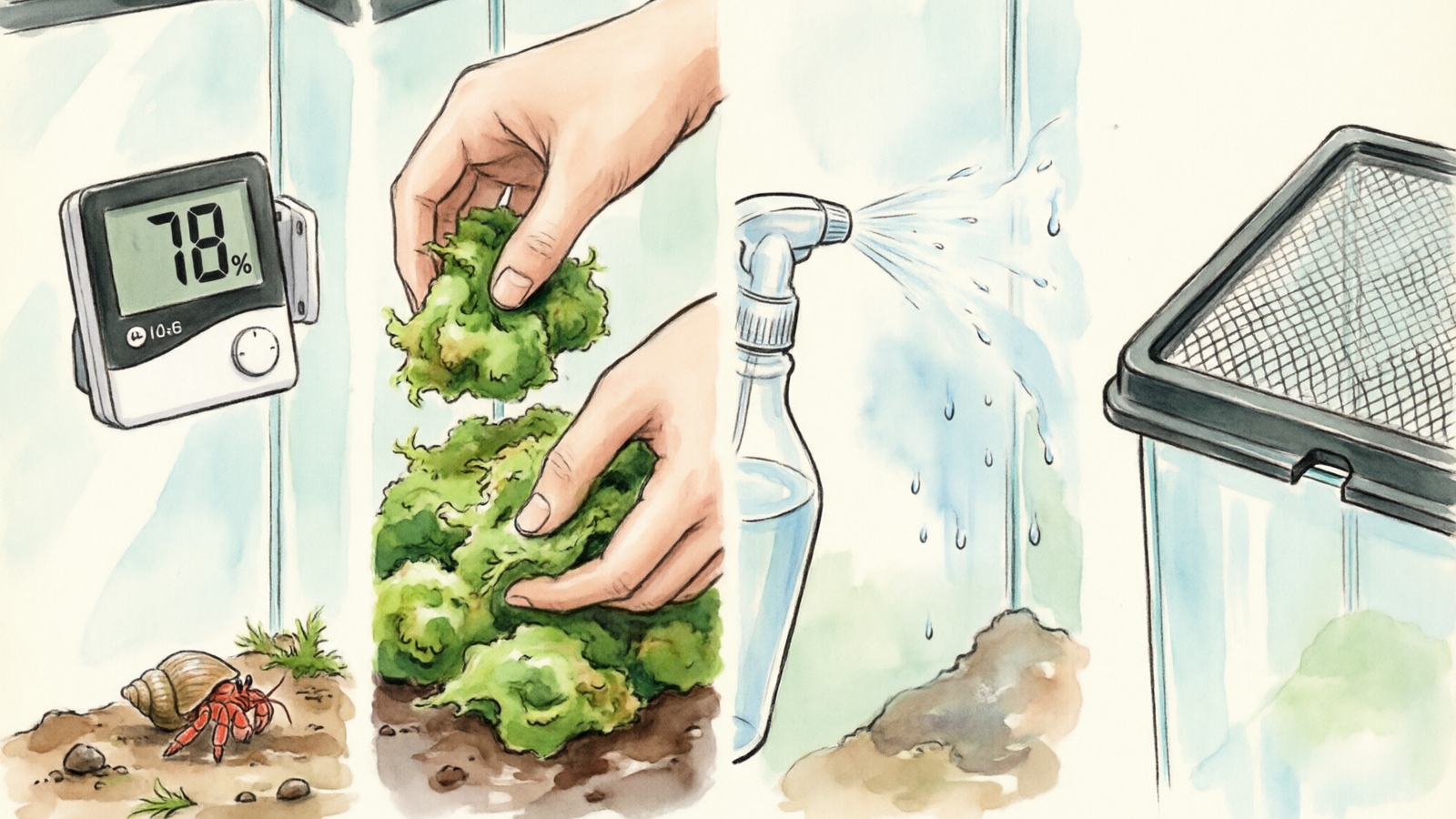
Humidity maintenance steps:
| Step | Action | Details |
|---|---|---|
| 1 | Install hygrometer | Digital hygrometer at substrate level, not near water dishes (ReptiFiles) |
| 2 | Check substrate | Maintain sand-castle consistency — moist enough to hold a burrow, not dripping |
| 3 | Add sphagnum moss | Place in corners to boost ambient humidity naturally |
| 4 | Mist if needed | Lightly mist tank walls with dechlorinated water if humidity drops below 70% |
| 5 | Seal the lid | Use glass or acrylic lid — mesh lids allow humidity to escape (VCA Hospitals) |
Both freshwater and saltwater dishes are required. Each dish must be deep enough for crabs to submerge their bodies completely (VCA Hospitals).
Use marine aquarium salt (not table salt — anti-caking agents contain sodium ferrocyanide and are toxic to crustaceans). Dechlorinate all water by boiling or using a reptile water conditioner (Merck Veterinary Manual).
For tanks that struggle to maintain humidity, a fogger system can help. See our hermit crab humidifier guide for product recommendations.
Hermit Crab Diet — What to Feed Your Crab
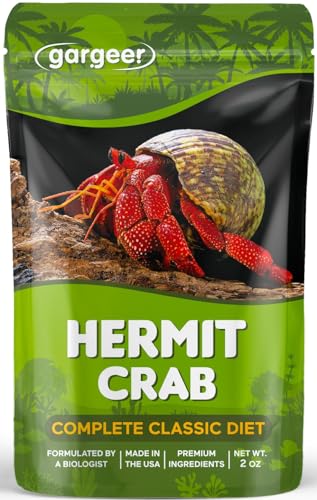
For this purpose, Gargeer Complete Diet is a popular choice among pet owners.
A healthy hermit crab diet mirrors what these omnivorous scavengers eat in the wild — variety is the key to their nutritional health. In the wild, they eat fallen fruit, decaying wood, leaf litter, dead animals, and carrion — they are opportunistic omnivorous scavengers (NOAA — Hermit Crab Natural History). Captive diets should replicate this diversity.
Base diet: High-quality commercial hermit crab food pellets supplemented with daily fresh foods.
Protein sources: Shrimp, freeze-dried krill, bloodworms, cooked unseasoned chicken, hard-boiled eggs, and crushed boiled eggshells for calcium.
Fruits: Apples, bananas, grapes, mango, papaya, strawberries, coconut, and pineapple. Remove all seeds and pits. Wash thoroughly to remove pesticide residue.
Vegetables: Carrots, spinach, broccoli, and sweet potato.
Foods to avoid: Anything from the Allium family (onion, garlic, chives). Processed, salty, or sugary human food. Some keepers avoid citrus entirely, while others offer it occasionally — the community is divided on this point.
Feeding Rules
- Change food daily — hermit crabs bury uneaten food which causes mold
- Provide cuttlebone or crushed eggshells for calcium in your hermit crab diet
- Rotate foods to prevent nutritional deficiencies
- Never use seasoned, marinated, or salted human food
- Remove any moldy food immediately
- Feed at night — hermit crabs are nocturnal and most active after dark
Offer food in the evening and remove uneaten portions the following morning. Place food in a shallow dish to prevent substrate contamination.
For commercial food options and supplement recommendations, see our hermit crab food guide.
Hermit Crab Molting — The Most Critical Time in Your Crab’s Life
Understanding hermit crab molting is essential for proper hermit crab care — molting is the process where a hermit crab sheds its entire exoskeleton to grow. The crab digs underground, sheds its old shell, and waits while the new exoskeleton hardens.
Molts can take up to ten weeks. During this time, the crab consumes its old exoskeleton for the calcium needed to harden the new one (Merck Veterinary Manual).
Pre-molt warning signs: Lethargy, decreased appetite, excessive digging, cloudy eyes, water-gorging, and occasionally leaving the shell entirely. If your crab suddenly buries itself and stays underground for days or weeks, it is almost certainly molting.
Molting care steps:
| Step | Action | Details |
|---|---|---|
| 1 | Do NOT dig up | Stress can kill a molting crab — leave buried crabs completely alone (Merck) |
| 2 | Cover if exposed | If accidentally uncovered, gently re-cover and do not handle |
| 3 | Maintain conditions | Humidity above 80% and temperature 75-85°F throughout molt (ReptiFiles) |
| 4 | Leave exoskeleton | The crab eats its shed exoskeleton for calcium — do not remove it (Merck) |
| 5 | Post-molt care | Provide extra shells and calcium-rich food when crab surfaces |
| 6 | No handling | Do not handle for 1-2 weeks post-molt — new exoskeleton is soft and fragile (VCA Hospitals) |
Surface molt during hermit crab care (sometimes called a “bad molt”) occurs when a crab sheds above ground instead of underground. This is often caused by insufficient substrate depth or extreme stress. Surface-molting crabs are extremely vulnerable to cannibalism from tankmates (ReptiFiles).
For surface molts, set up an ISO (isolation) tank — a small container with deep substrate, food, water dishes, and a hiding spot. Keep it in a dark, quiet location away from the main tank. Transfer the molting crab gently and leave it completely undisturbed.
Hermit Crab Shells — Selection and Shell Changes
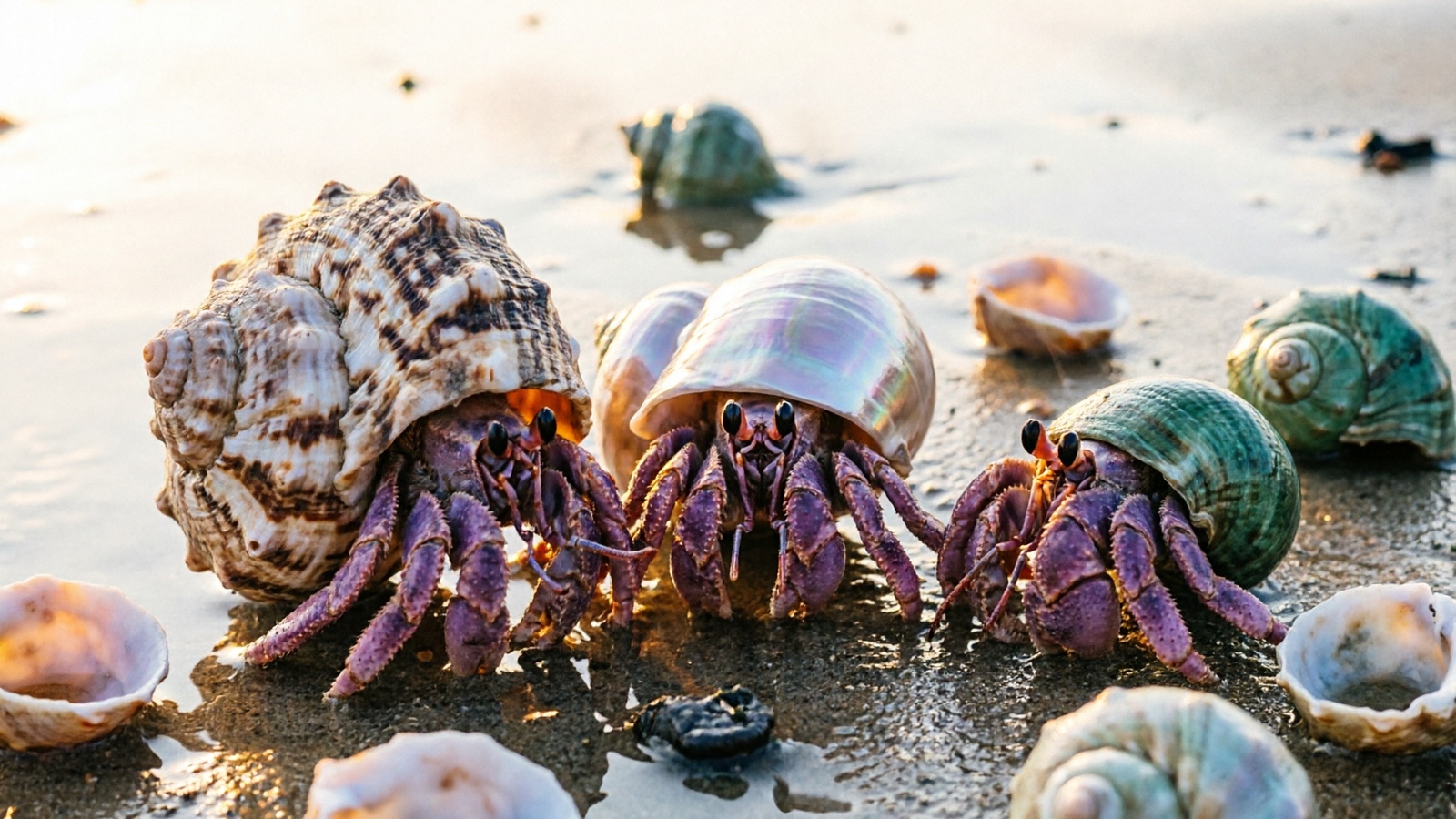
A hermit crab’s shell is its mobile home and primary defense. As the crab grows, it must find a larger shell to move into. Shell selection is one of the most important aspects of hermit crab care — proper shell availability directly impacts your crab’s survival.
Always provide three to five extra hermit crab shells per crab, in sizes slightly larger than the current shell. Rotate shells monthly to maintain the crab’s interest. Natural turbo shells, murex shells, and babylonia shells are all excellent choices. Sterilize every shell by boiling it for ten minutes before adding it to the tank (Merck Veterinary Manual).
Never use painted shells. Paint chips are toxic when ingested and responsible for countless premature hermit crab deaths (Smithsonian — Marine Conservation). This is the single most controversial hermit crab product — and for good reason. Natural, unpainted shells only.
Shell opening shape matters by species. Purple Pincher crabs prefer round openings that match their rounder abdomen.
Ecuadorian crabs prefer oval openings suited to their flatter body shape. Offering the correct opening shape encourages natural shell changes.
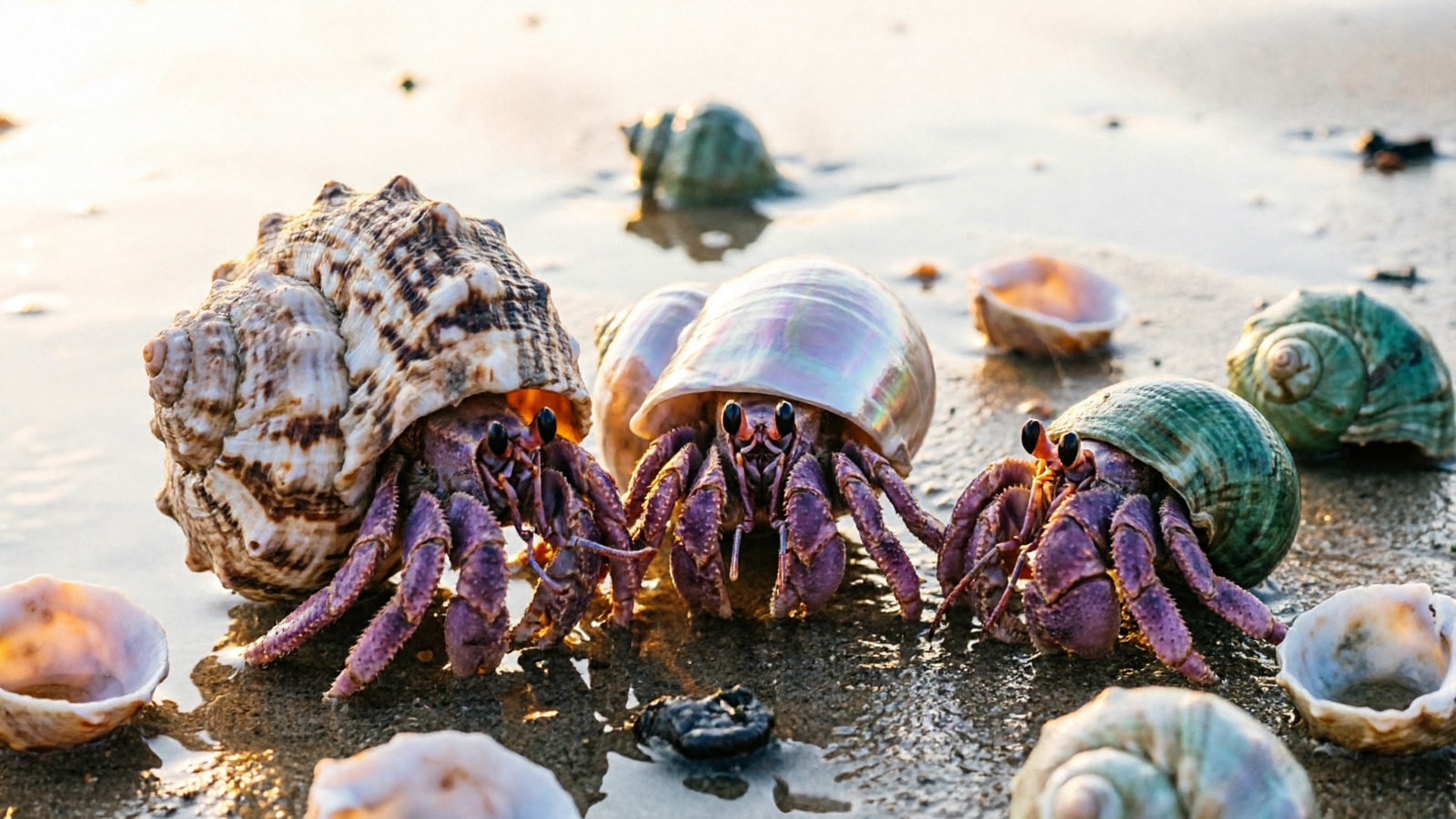
The shell-change process is fascinating to watch. The crab inspects available shells by tapping and rotating them with its claws.
It tests each candidate by inserting its abdomen to check the fit. If the shell allows full retraction with a snug fit, the crab switches in seconds.
Sometimes multiple crabs queue up for a popular shell, creating a chain reaction of shell exchanges.
Shell Rules
- Always provide 3-5 extra shells per crab
- Natural, unpainted shells only
- Sterilize by boiling for 10 minutes before introducing to tank
- Include sizes slightly larger than current shell
- Match shell opening shape to species (round for Purple Pincher, oval for Ecuadorian)
- Never force a crab out of its shell — let it change naturally
For specific shell recommendations and buying guide, see our hermit crab shells guide.
Hermit Crab Safety Checklist
Before setting up your hermit crab habitat and during ongoing hermit crab care, verify these items:
Maintain 75-85% humidity at all times — below 60% crabs slowly suffocate (VCA Hospitals)
Keep temperature 75-85°F with an under-tank heater creating a gradient (Merck)
Substrate depth = 3× tallest crab’s height (minimum 6 inches for adults) (ReptiFiles)
Use coconut fiber or coconut fiber/playsand mix at sand-castle consistency (ReptiFiles)
Provide both freshwater and saltwater dishes deep enough for full submersion (VCA Hospitals)
Use marine aquarium salt only — never table salt (Merck)
Dechlorinate all water by boiling or using water conditioner
Keep at least 3-5 extra natural shells per crab (unpainted only) (Smithsonian)
Sterilize all shells by boiling for 10 minutes before adding to tank (Merck)
Provide calcium sources: cuttlebone, crushed eggshells, or shrimp
Keep at least 2-3 crabs together — they are social colony animals (Animal Diversity Web)
Use glass or acrylic lid — mesh lids allow humidity to escape (ReptiFiles)
Feed at night — crabs are nocturnal and eat most actively after dark
Remove uneaten food daily to prevent mold growth (VCA Hospitals)
Never use heat lamps — they dry out the tank and lower humidity to dangerous levels (VCA Hospitals)
Never use painted shells — paint chips are toxic when ingested (Smithsonian)
Never use gravel, cedar, or pine as substrate — toxic to hermit crabs
Never use table salt — anti-caking agents (sodium ferrocyanide) are toxic to crustaceans (Merck)
Never dig up a buried crab — stress can be fatal during molting (Merck)
Never keep a single hermit crab — they are social and become stressed alone (Animal Diversity Web)
Never feed seasoned, marinated, salty, or processed human food
Never use painted decor — paint chips are toxic if ingested
Never handle a freshly molted crab — new exoskeleton is fragile for 1-2 weeks (VCA Hospitals)
Never release hermit crabs outdoors — they are tropical and cannot survive in temperate climates
Never use mesh lids for permanent housing — humidity loss is continuous (ReptiFiles)
Common Health Issues and FAQ
Metabolic Bone Disease (MBD): Caused by calcium deficiency. Symptoms include lethargy, softening limbs, and inability to hold onto the shell (VCA Hospitals — Hermit Crab Diseases). Prevention is straightforward — provide calcium-rich foods (cuttlebone, crushed eggshells, shrimp) and maintain proper UV-exposed lighting or vitamin D supplementation.
Mites: Tiny parasites that appear as small moving dots on a crab’s body or in the substrate (Merck Veterinary Manual). Isolate the affected crab immediately. Replace all substrate and sterilize the tank and decorations with boiling water.
Dehydration: Caused by humidity dropping below sixty percent. Symptoms include lethargy, dull color, and shriveled limbs. Increase humidity immediately and offer a shallow freshwater dish deep enough for the crab to submerge.
Purchase and Post-Purchase Shock (PPS): New crabs from pet stores arrive severely stressed from overcrowding, low humidity, and rough handling (VCA Hospitals). Symptoms include hiding, refusing food, lethargy, and dropping limbs. Treatment requires a dark, quiet tank with stable conditions and zero handling for two to four weeks. Most PPS deaths occur within the first month — patience during acclimation saves lives.
How long do hermit crabs live?
With proper care, land hermit crabs live ten to fifteen years. In poor conditions with low humidity and no molting space, most die within one to two years.
Lifespan is almost entirely determined by habitat quality. The difference between a crab living two months and twelve years comes down to humidity, substrate depth, temperature, and diet. Most premature deaths are preventable with correct setup from day one.
Do hermit crabs need heat?
Yes. Tank temperature must stay between 75-85°F at all times.
Use an under-tank heater on one side to create a warm-to-cool hermit crab temperature gradient. The cool side should not drop below seventy degrees.
Never use heat lamps — they dry out the tank and lower humidity to dangerous levels. A digital thermometer at substrate level prevents guessing.
Can hermit crabs live alone? — A hermit crab care essential question
Technically yes, but they should not. Hermit crabs are social animals that live in colonies in the wild.
A single crab will become stressed and less active. Keep at least two to three together for natural social behavior. Crabs in groups are more active, explore more, and molt more successfully than isolated crabs.
Why is my hermit crab hiding all the time?
Understanding nocturnal behavior is part of proper hermit crab care — crabs naturally spend daylight hours hiding.
New crabs may hide for two to four weeks during acclimation. This is normal post-purchase stress response.
If a crab digs under substrate and stays for weeks, it is likely molting underground. Do not disturb a buried crab — digging one up during a molt can be fatal.
How often do hermit crabs molt?
It depends on age and size. Young crabs may molt every few months.
Adult crabs typically molt once every twelve to eighteen months. A large crab can take up to three months to complete a single molt underground. The entire process is invisible — the crab burrows down, sheds, and surfaces weeks later looking noticeably larger.