Why Hedgehogs Need Toys
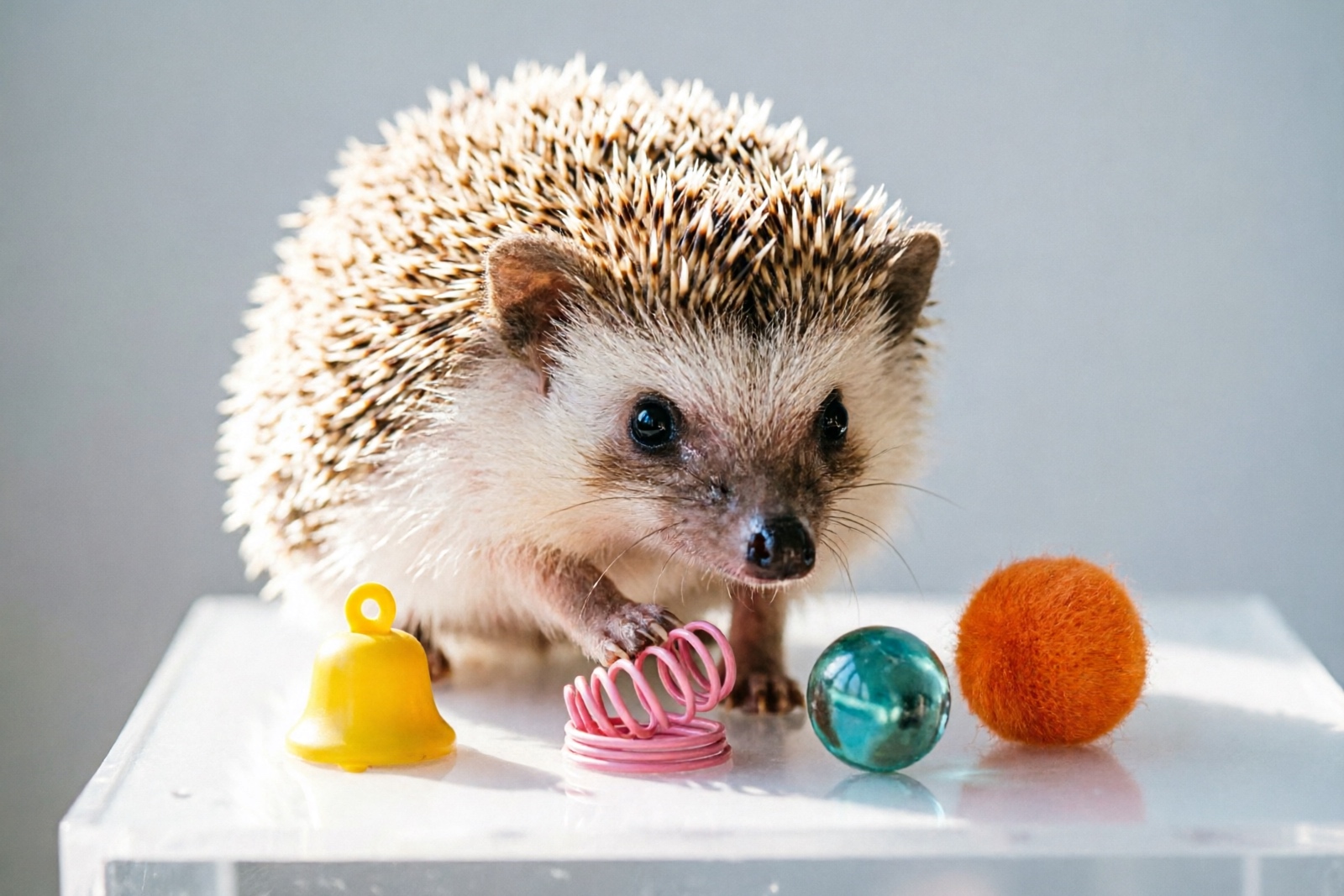
In the wild, hedgehogs travel several miles each night foraging for food. This natural behavior doesn’t disappear in captivity — a pet hedgehog still has the instinct to roam, explore, and solve problems. Without adequate stimulation, confined hedgehogs develop serious problems.
A hedgehog without toys will often show signs of boredom and stress: repetitive pacing (stereotypic behavior), overeating leading to obesity, lethargy, and even depression. In severe cases, chronically understimulated hedgehogs may self-barber (pull out their own quills) or refuse to eat. Providing the right toys isn’t a luxury — it’s essential for your hedgehog’s physical and mental health.
Studies on captive small mammals consistently show that environmental enrichment reduces stress hormones, increases natural behaviors, and improves overall welfare. The best hedgehog enrichment toys combine multiple stimulation types. For hedgehogs specifically, the most impactful enrichment combines physical exercise (wheels), cognitive challenges (foraging toys), and security features (hideouts and tunnels). A well-enriched hedgehog is more active, more curious, and more bonded to their owner.
Hedgehog toys fall into four main categories:
- Exercise toys — wheels and exercise balls for physical activity
- Exploration toys — tunnels and hideouts that satisfy natural curiosity
- Enrichment toys — foraging puzzles and treat dispensers for mental stimulation
- Chew toys — safe gnawing items for dental health
This guide covers the essential toys across all categories, plus free DIY alternatives and a complete safety guide. For a broader look at hedgehog care, see our complete hedgehog care guide.
Hedgehog Wheels — The Single Most Important Toy
A proper exercise wheel is the one thing every hedgehog cage absolutely needs. It’s the only way for a caged hedgehog to get the miles of nightly running they require. Without a wheel, hedgehogs become obese and develop behavioral problems. If you buy only one toy, make it a wheel.
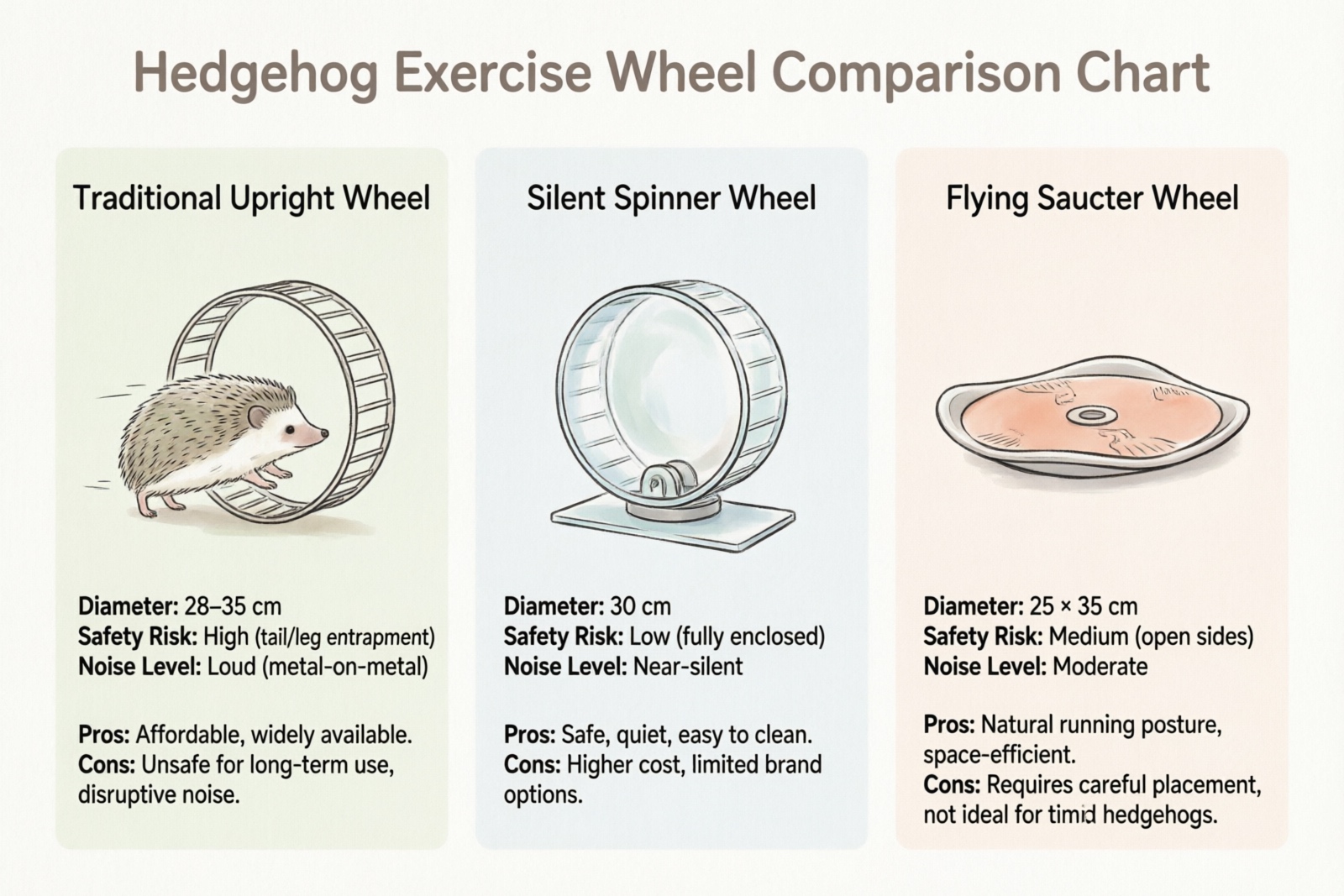
Choosing the Right Hedgehog Wheel
There are a few non-negotiable requirements for a hedgehog wheel:
- Diameter: Minimum 12 inches. Anything smaller forces the hedgehog to run with an arched back, which causes spinal problems over time
- Axle design: Axle-free preferred. Center axles can catch legs, toes, or quills — I’ve seen hedgehogs get minor scrapes from exposed axle bolts, and in worst cases, trapped limbs
- Surface: Smooth and solid. Wire or mesh running surfaces catch toes and nails, causing injuries and sometimes amputations
- Noise: Dual-bearing construction. Your hedgehog runs at night, and a squeaky wheel will keep you awake
| Feature | Recommendation | Why It Matters |
|---|---|---|
| Diameter | Minimum 12 inches | Prevents back arching during running |
| Axle design | Axle-free preferred | Prevents leg and quill entanglement |
| Noise | Dual bearing | Quiet operation for nighttime use |
| Surface | Smooth, solid | Wire bars can trap toes and nails |
For cage setup tips including wheel placement, see our hedgehog cage setup guide.
A Wheel I’d Recommend
After testing several options, I keep coming back to the Exotic Nutrition Silent Runner 12” Regular Wheel ($33.99, 4.5 stars). The axle-free design eliminates the biggest safety concern — no center bolt means nothing for quills or toes to catch on. The 12-inch diameter fits adult hedgehogs of all sizes, and the solid running surface has no gaps or wire bars.
It does require a bit more effort to take apart for cleaning compared to simpler wheels, and some owners report occasional squeaking after months of heavy use. But I’d personally choose a slightly harder-to-clean wheel over one with an exposed axle any day. Safety comes first.
A quick note on smaller wheels: you’ll see 8.2-inch options marketed for hedgehogs. These can work for juveniles or hedgehogs under 300g, but once your hedgehog reaches adult weight, the diameter is too small. I’d recommend starting with a 12-inch wheel even for babies — they’ll grow into it quickly, and buying once is cheaper than upgrading later.
Hedgehog Exercise Balls — Useful With Caution
Exercise balls let your hedgehog explore outside their cage safely. They’re a decent supplement to wheel-based exercise, but they come with important limitations that every owner should understand.
I’ve used exercise balls with several hedgehogs over the years, and I’ve found that reactions vary a lot. Some hedgehogs genuinely enjoy rolling around the room; others panic, tip the ball over, or just lie still inside waiting to be let out. It’s worth trying, but don’t force it if your hedgehog clearly dislikes the experience.
Kaytee 13” Exercise Ball
The Kaytee 13” Clear Run-About Exercise Ball ($34.24, 4.4 stars) is a straightforward option for supervised exploration. The 13-inch diameter suits most adult hedgehogs, and the clear design lets you see what your pet is doing inside.
Quality varies between units, though — I’ve heard from owners who received balls with loose closures that allowed escapes, and others who found the plastic cracked after extended use. Always check the closure mechanism before each session. For very small hedgehogs (under 300g), the gap around the door can be too large, so I’d skip the exercise ball entirely until your hedgehog reaches adult size.
Exercise Ball Safety Rules
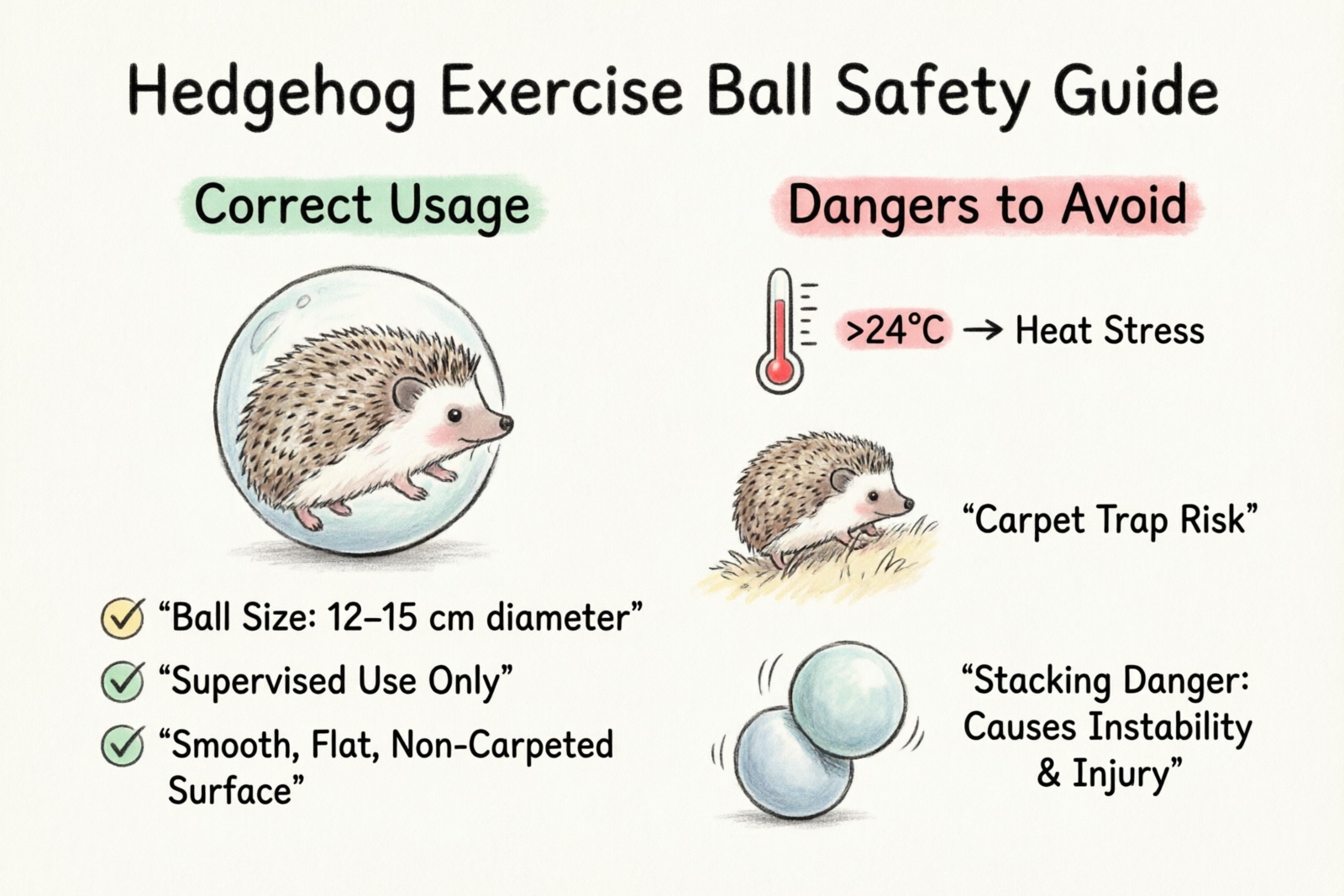
If you decide to use an exercise ball, these rules are non-negotiable:
- Maximum 15–20 minutes per session — hedgehogs can overheat quickly inside the enclosed ball
- Always use on flat, safe surfaces
- Constant supervision required — never leave unattended
- Never use in direct sunlight — the ball acts like a greenhouse, and temperatures above 80°F (27°C) can trigger heatstroke
- Never use near stairs — a fall from even a few steps can cause serious spinal injury
- Stop immediately if your hedgehog is struggling — some hedgehogs simply don’t tolerate exercise balls
- Never use on carpeted surfaces — the ball can catch on fibers and flip over, potentially trapping your hedgehog upside down
Heat stress is a serious concern with exercise balls. For more on hedgehog health risks, see our hedgehog health guide.
Hedgehog Tunnels & Hideouts
Quality tunnel toys serve a dual purpose: they provide a path for exploration and a safe, enclosed space for hiding. In the wild, hedgehogs navigate through underbrush and narrow passages — tunnels replicate this natural behavior. Most hedgehogs I’ve kept have loved having at least one tunnel in their cage, and many use it as their primary sleeping spot during the day.
ORZECHKO 3-Way Collapsible Tunnel
The ORZECHKO 3-Way Collapsible Small Animal Tunnel ($15.99, 4.4 stars) offers three interconnected tunnel paths, which I like because it gives hedgehogs options — they can choose different routes rather than running through the same straight tube. The peek-through holes let your hedgehog observe surroundings while still feeling protected.
It’s collapsible for easy storage, which is handy during cage cleaning. The fabric is reasonably durable, though I wouldn’t recommend it for heavy chewers. At $15.99, it’s affordable enough to replace when it wears out. For smaller hedgehogs especially, this tunnel provides a lot of exploration value for the price.
If you’re on a tight budget, a simple washable tunnel with curtains (around $12) works well too — the curtained end doubles as a hideout, which hedgehogs that value hiding spots over running space tend to appreciate.
Hedgehog Enrichment & Foraging Toys
Enrichment toys engage your hedgehog’s brain, simulating the problem-solving they’d do while foraging in the wild. Mental stimulation is just as important as physical exercise for preventing boredom and stereotypic behaviors.
I’ve had mixed results with commercial foraging toys for hedgehogs specifically. Some hedgehogs figure them out quickly and stay engaged; others lose interest after a day or two. The key is patience — most hedgehogs need training to understand that manipulating the toy releases treats.
Foraging Mat — My Top Pick for Mental Stimulation
The Foraging Mat for Hedgehog Enrichment ($14.99, 4.6 stars) is a fleece mat where you hide food in the fabric strips for your hedgehog to sniff out. I like this approach better than rigid puzzle toys for a few reasons: it’s more intuitive (hedgehogs naturally root through bedding), it slows down eating (beneficial for digestion), and it works with any small treat — dried mealworms, insect pieces, or small kibble bits.
The mat is washable, which matters because it will get soiled. Start by hiding strongly scented treats (dried mealworms work well) in easy-to-find locations, then gradually increase difficulty as your hedgehog learns the concept. Some hedgehogs need a week or two of training before they engage with it consistently.
For dietary guidance on what treats to use, see our hedgehog diet guide.
What About Chew Toys?
Hedgehogs aren’t natural chewers the way hamsters or rabbits are. They don’t need chew toys for dental health — their teeth don’t continuously grow like rodent teeth. That said, some hedgehogs do enjoy occasional chewing, and safe chew items can serve as supplementary enrichment.
Safe chewing options include natural apple wood sticks, unbleached cardboard (toilet paper rolls, cut open lengthwise), and natural cork bark. Avoid anything with dyes, glues, or treated wood. Pine and cedar are toxic to hedgehogs — the aromatic oils damage their respiratory systems. I’d keep chew toys as optional extras rather than essential purchases. If your hedgehog shows no interest in chewing, don’t worry about it.
Safe vs Unsafe Materials
Safe Materials
- Food-grade plastic — smooth, non-toxic, and easy to clean
- Natural hardwood — apple wood, birch, and willow are safe for chewing
- Unbleached cardboard — toilet paper rolls and egg cartons (when properly prepared)
- Cotton and fleece fabric — soft, safe, and machine washable
- Stainless steel — for durable, chew-proof components
Unsafe Materials — Never Use
- Lead-based paint or finishes — toxic if ingested through chewing
- Pine and cedar wood — emit aromatic oils that damage hedgehog respiratory systems
- Foam and sponge materials — pose serious choking and blockage risks if ingested
- String, yarn, or thread — can wrap around legs and internal organs
- Glued-toy parts — glue is toxic and joints can break into choking hazards
- Toys with small removable parts — bells, beads, and buttons are choking hazards
Always inspect new toys before giving them to your hedgehog. Remove any loose parts, sharp edges, or suspicious coatings. Monitor your hedgehog during first use to ensure they interact with the toy safely.
DIY Hedgehog Toys — Easy & Budget-Friendly
You don’t need to spend a fortune on hedgehog enrichment. These DIY toys use household items and cost almost nothing. I’ve found that some hedgehogs actually prefer DIY toys over store-bought ones — there’s something about the texture and smell of natural materials that seems to appeal to their foraging instincts.
Toilet Paper Roll Treat Tube
The simplest hedgehog toy costs nothing. Take an empty toilet paper roll, cut it lengthwise and flatten it (this prevents your hedgehog’s head from getting stuck), fold one end closed, fill with treats, and fold the other end. Your hedgehog will rip it open to get the food — engaging both physical and mental activity.
Critical safety note: Always cut the tube open lengthwise before giving it to your hedgehog. An uncut tube is a serious entrapment hazard.
Crinkled Paper Digging Box
Take a shallow cardboard box, fill it with unbleached crumpled paper or paper shreds, and hide treats or dried insects throughout. Your hedgehog will root through the paper to find the rewards — simulating natural foraging behavior. This is one of the easiest DIY projects, and in my experience, hedgehogs that are food-motivated go absolutely wild for it.
PVC Pipe Tunnels
A 4-inch diameter PVC pipe from any hardware store makes an excellent, indestructible tunnel. It’s cheaper than fabric tunnels, easier to clean (just rinse with warm water), and cannot be chewed apart. Connect multiple sections with elbow joints to create a tunnel maze. A 10-foot section of 4-inch PVC pipe typically costs under $5 — far less than any store-bought tunnel.
Egg Carton Puzzle Feeder
Take a clean cardboard egg carton, place a small treat or piece of dried mealworm in each compartment, and close the lid. Your hedgehog has to figure out how to open each section — a low-cost foraging puzzle. For added difficulty, tape the compartments shut with small pieces of paper tape. Replace the carton every few days as it becomes soiled or chewed.
Cardboard Castle
Stack multiple cardboard boxes of different sizes, cut holes in the sides to connect them, and you’ve created a multi-level exploration environment. This provides hours of complex exploration and can be replaced cheaply when it gets soiled. Add crumpled paper or fleece scraps inside the boxes for extra comfort. You can rebuild the castle in different configurations each time to keep the environment novel and interesting.
Toys to Avoid for Hedgehogs
Some commonly available small pet toys are dangerous for hedgehogs. Always evaluate new toys against the safety criteria above before introducing them to your hedgehog’s environment.
- Wheels with wire/mesh running surfaces — toes and nails get caught in the gaps. This is one of the most common causes of hedgehog foot injuries
- Small marbles or glass balls — easily swallowed, causing intestinal blockage that requires emergency surgery
- Plush/stuffed toys — thread can wrap around legs and cut off circulation; filling material causes fatal intestinal blockage if ingested
- Dyed or treated wood — chemical dyes and preservatives are toxic when chewed
- Cat wands with bells — small metal parts and string pose serious choking and entanglement hazards
- Pine or cedar wood products — aromatic oils cause respiratory damage and long-term liver problems
- Mirrors or reflective surfaces — hedgehogs may attack their reflection, causing stress and quill damage
- Electric or motorized toys — wires, batteries, and moving parts all pose serious safety risks
How Many Toys Does a Hedgehog Need?
You don’t need to fill the cage with toys. In my experience, 3-5 items at a time is plenty — a wheel (essential), a tunnel or hideout, and one or two enrichment items. More toys doesn’t mean more enrichment; it usually just means a cluttered cage with less open running space. I’d recommend keeping at least 60% of the cage floor open so your hedgehog can move freely.
What works better than having many toys is rotating them. Every 1-2 weeks, swap out one or two items for something different. A tunnel that was ignored for a week becomes interesting again after being removed and reintroduced. This simple rotation strategy maintains novelty without requiring constant purchases.
Enrichment for Different Hedgehog Personalities
Not every hedgehog responds the same way to enrichment. Over the years I’ve noticed that hedgehog personalities fall into a few broad categories, and tailoring toy selection to your hedgehog’s temperament makes a big difference.
The Explorer — These hedgehogs are constantly on the move, investigating every new item you add to the cage. Explorers do best with tunnels, multi-path structures, and frequent toy rotation. They’re the easiest to enrich because almost anything new captures their attention.
The Foodie — Motivated entirely by treats, these hedgehogs will work through any puzzle if there’s a mealworm at the end. Foraging mats, treat-dispensing toys, and scatter feeding are ideal. Start with easy puzzles and increase difficulty as they learn — I’ve seen foodie hedgehogs become remarkably good problem solvers over time.
The Couch Potato — Some hedgehogs are naturally less active. They may ignore wheels, avoid tunnels, and sleep through most enrichment opportunities. For these hedgehogs, I’d focus on passive enrichment: varied bedding textures, scent enrichment (placing safe herbs near their hideout), and simply ensuring the cage has enough space for whatever small amount of activity they do engage in.
The Nervous Hedgehog — Newly acquired or naturally skittish hedgehogs may be too stressed by novel objects. I’d recommend introducing one new item at a time, placed away from the primary sleeping area, and allowing several days for the hedgehog to investigate at their own pace. Never force interaction with a new toy — let your hedgehog approach it on their terms.
Common Questions About Hedgehog Toys (FAQ)
What toys do hedgehogs like best?
A properly sized wheel (12 inches, axle-free) is the number one essential. Beyond that, most hedgehogs enjoy tunnels for hiding and exploring, and food-motivated hedgehogs respond well to foraging toys like snuffle mats.
Do hedgehogs need a wheel?
Yes. A wheel is not optional — it’s a necessity. Hedgehogs in the wild travel 3–5 miles per night. A wheel is the only way for a caged hedgehog to achieve this level of physical activity. Without one, obesity and behavioral problems are almost inevitable.
Are toilet paper rolls safe for hedgehogs?
Only when cut open lengthwise. An uncut toilet paper roll is an entrapment hazard — hedgehogs can get their head stuck and suffocate. Always flatten the roll before giving it to your hedgehog.
Do hedgehogs like tunnels?
Most hedgehogs love tunnels. They satisfy the natural instinct to navigate through enclosed spaces, and many hedgehogs will use a tunnel as their primary sleeping spot during the day. Start with a simple cardboard box tunnel and observe — if your hedgehog uses it eagerly, consider upgrading to a fabric tunnel for longer durability.
How much exercise does a hedgehog need?
A hedgehog should run 3–5 miles per night, which is achieved through wheel use. This is why a properly sized, safe wheel is the single most important investment for your hedgehog’s health.
Can hedgehogs use hamster toys?
Some hamster toys work for hedgehogs, but not all. Wheels and tunnels often transfer well if appropriately sized (12-inch minimum for wheels, 4-inch minimum diameter for tunnels). However, avoid hamster-specific items with small parts, and always check materials against the safe/unsafe list above.
Conclusion
The right toys make a dramatic difference in your hedgehog’s quality of life. Here’s what I’d prioritize:
- Essential: A 12-inch, axle-free wheel — this is non-negotiable
- Highly recommended: A tunnel for exploration and hiding
- Optional but beneficial: Foraging toys for mental stimulation
- Use with caution: Exercise balls — 15–20 minutes maximum, always supervised
- Budget-friendly: DIY toys from household items provide excellent enrichment at no cost
My starter picks:
- Exotic Nutrition Silent Runner 12” Regular Wheel ($33.99) — the safest essential
- ORZECHKO 3-Way Collapsible Tunnel ($15.99) — exploration and hiding
- Foraging Mat ($14.99) — mental stimulation
- Toilet paper roll treat tubes — free DIY enrichment
Safety always comes first. Inspect every toy, supervise new interactions, and remove anything that shows signs of damage. With the right toys and proper safety awareness, you’ll keep your hedgehog active, engaged, and healthy for years to come.