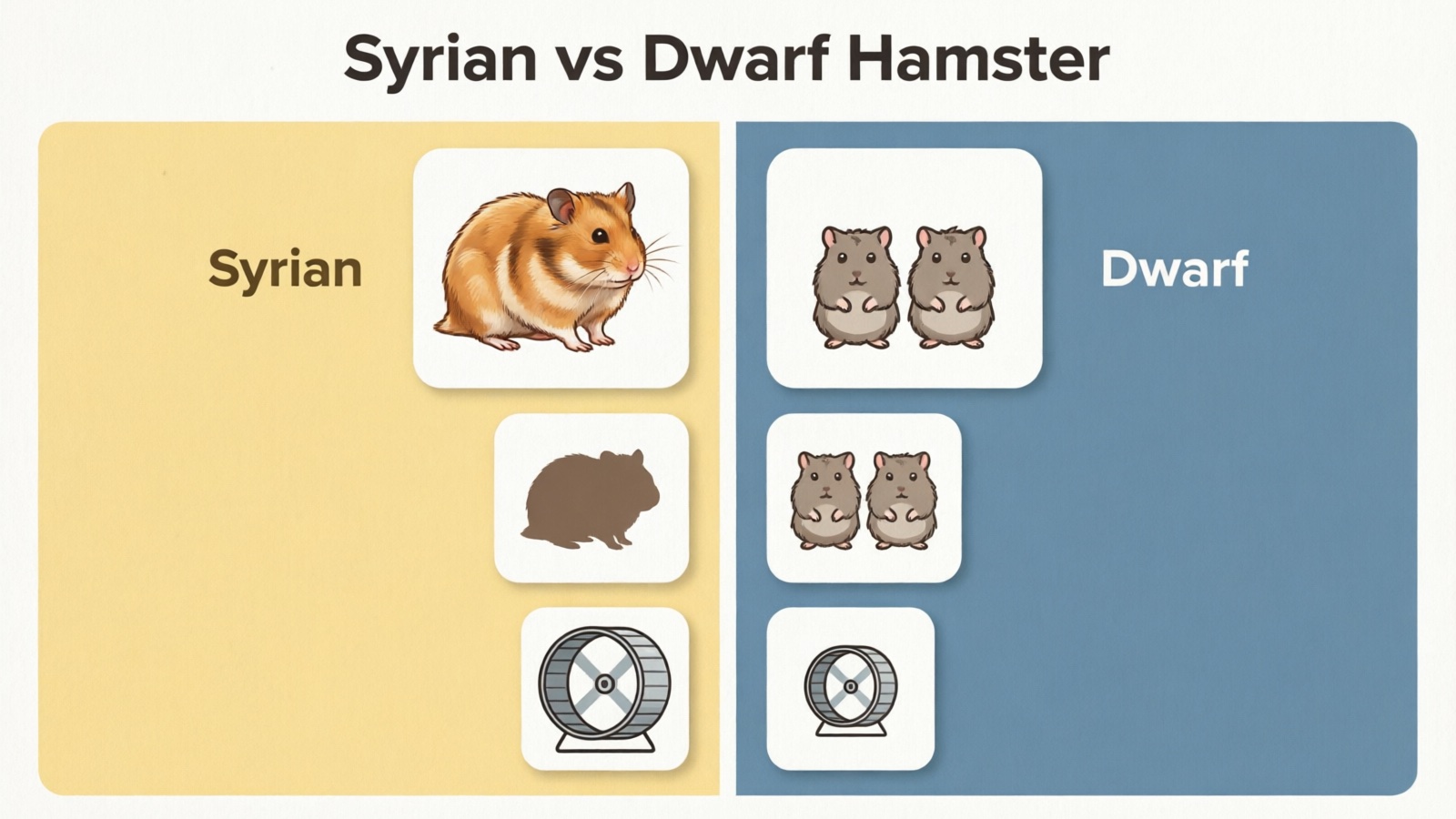
Syrian vs Dwarf Hamster — What’s the Difference?
Walk into any pet store and you’ll see two groups of hamsters: the larger, golden-colored Syrians and the tiny, fast-moving dwarfs. They look like they belong to the same family — and they do — but the differences between them run deeper than size. The species you pick determines your cage setup, your daily routine, and the kind of relationship you’ll have with your pet.
Syrian hamsters (Mesocricetus auratus) are the largest and most common hamster species kept as pets. They’re what most people picture when they think “hamster” — golden fur, round body, about the size of a potato. Syrians are solitary, relatively slow-moving, and generally tolerate handling well.
Dwarf hamsters aren’t a single species — the term covers four smaller species grouped together: Campbell’s dwarf, Winter White dwarf, Roborovski dwarf, and Chinese hamster. They range from 2 to 4 inches long, move at impressive speed, and some species can live in pairs.
The syrian vs dwarf hamster decision affects everything from your cage budget to your bedtime routine. Here’s a quick navigation if you want to jump ahead:
- Size & Appearance — how big do they get?
- Lifespan & Health — how long do they live?
- Temperament & Behavior — which is friendlier?
- Housing & Cage Requirements — what do they need?
- Dwarf Hamster Types — the four species explained
- Diet Differences — what do they eat?
- Which Is Right for You? — decision guide
Size & Appearance Comparison
The most obvious difference is size. A Syrian hamster is roughly the size of a baked potato — 6 to 7 inches long and weighing 5 to 7 ounces. You can comfortably hold one in your palm. A dwarf hamster, by comparison, fits on your fingertips — 2 to 4 inches long and weighing just 1 to 2 ounces.
This syrian vs dwarf hamster size comparison matters more than you might think. The size difference affects how you handle them, what cage equipment they need, and how easily you can find them when they escape (and dwarfs escape more often — they can squeeze through gaps that Syrians can’t).
| Feature | Syrian Hamster | Dwarf Hamster (average) |
|---|---|---|
| Body length | 6-7 inches (15-18 cm) | 2-4 inches (5-10 cm) |
| Weight | 5-7 oz (140-200 g) | 1-2 oz (30-60 g) |
| Hand feel | Fills your palm | Fits on fingertips |
| Coat varieties | Longhair, shorthair, hairless; wide color range | Colorful; some with special patterns |
| Tail length | Very short | Extremely short (Chinese hamster exception) |
| Speed | Moderate | Fast to very fast |
Coat variety is where Syrians really shine. They come in longhair (“teddy bear”) and shorthair varieties, plus hairless mutations. Colors range from the classic golden to black, cream, cinnamon, and banded patterns. Dwarf hamsters also come in multiple colors — Winter Whites can change their coat to white in winter — but the variety is narrower and the longhair option doesn’t exist in most dwarf species.
One thing that surprises new owners: Syrian hamsters actually look more proportional and “hamster-shaped” than dwarfs. Dwarf hamsters, especially Campbell’s and Winter Whites, have a more rounded, almost bean-like body. Roborovskis look like tiny fuzzy balls with legs.
Lifespan & Health
Hamsters are not long-lived pets regardless of species, but there’s a meaningful difference between Syrians and dwarfs.
Syrian hamsters live 2 to 3 years on average. Some reach 3.5 years with excellent care, but that’s uncommon. The most common health problems I’ve seen in Syrians are wet tail (a severe bacterial diarrhea that’s often fatal in young hamsters), tumors (especially in older females), and dental problems from overgrown teeth.
Dwarf hamsters average 1.5 to 2 years, though this varies by species. Roborovskis are the exception — they can reach 3 to 3.5 years, making them the longest-lived hamster species. The big health concern with dwarfs, particularly Campbell’s, is diabetes. Campbell’s dwarf hamsters are genetically predisposed to diabetes, and even small amounts of sugar in their diet can trigger the disease.
This syrian vs dwarf hamster lifespan difference matters when you’re thinking about the emotional commitment. A Syrian gives you roughly 6 to 12 more months with your pet compared to the average dwarf. For children who are experiencing their first pet loss, those extra months can feel significant.
Veterinary costs are roughly similar for both species, though dwarf hamsters can be harder to examine and treat simply because of their size. Finding an exotic vet who works with hamsters at all is the bigger challenge — many small animal clinics don’t treat hamsters.
Temperament & Behavior
This is where the syrian vs dwarf hamster which is more friendly question gets answered, and the answer is usually clear.
Syrian hamsters are the more docile species. They’re slower-moving, less easily startled, and generally more comfortable being held. Most Syrians will climb onto your hand willingly once they trust you, and they rarely bite unless they feel threatened. I’ve found that Syrians settle into a handling routine within a week or two of consistent, gentle interaction.
They’re also creatures of habit. My Syrians have always had distinct personalities — some were active explorers, others preferred sitting in my hood or pocket. But they all responded well to routine. Same time each day, same approach, and they’d be waiting at the cage door.
Dwarf hamsters are faster, more skittish, and more easily startled. This doesn’t mean they’re unfriendly — it means they’re prey animals in a tiny, fast body. When you reach into a dwarf hamster’s cage, the instinct is to bolt, not to climb onto your hand. Handling takes more patience. Some dwarfs never fully tame down, and even tame ones can be difficult to catch if they don’t want to be held.
Roborovskis are the extreme case. They’re the smallest, the fastest, and the hardest to handle. I’ve known experienced hamster owners who kept Robos for years without ever successfully holding them. They’re entertaining to watch — they run, jump, and climb with incredible energy — but they’re essentially display animals.
Activity patterns are similar between species (both are crepuscular, active around dawn and dusk), but dwarfs tend to be more active throughout the night. If your hamster’s cage is in your bedroom, a dwarf’s nighttime wheel-running is more likely to keep you awake.

Housing & Cage Requirements
Cage requirements differ significantly between species, and this is where your budget gets affected the most.
Syrian hamsters need larger cages. The minimum I’d recommend is 450 square inches of uninterrupted floor space (roughly 30 by 15 inches), though 600+ square inches is better. Syrians need large exercise wheels — 8 to 12 inches in diameter is the right range. A wheel that’s too small forces the hamster to arch its back while running, which causes spinal problems over time. For specific Syrian cage dimensions, see our Syrian hamster cage size guide.
Dwarf hamsters can use slightly smaller cages — 360 square inches minimum — but they need deeper bedding. Dwarfs are natural tunnelers and will create elaborate burrow systems if given enough substrate. I’d recommend at least 6 inches of bedding depth for dwarfs, compared to 3-4 inches for Syrians who don’t burrow as enthusiastically. Dwarf wheels should be 6 to 8 inches in diameter. For more on appropriate wheel sizing, our hamster wheel size guide breaks it down by species.
Can Syrian and dwarf hamsters live together? No. This question comes up constantly, and the answer is absolute. Syrians are strictly territorial — they will fight with and likely kill any hamster, dwarf or Syrian, placed in their cage. Syrians must live alone, one per cage, always.
Some dwarf species can live in same-sex pairs — Campbell’s and Winter Whites, specifically — but even this isn’t guaranteed. Pairs raised together from birth have the best chance. Introduce two adult dwarfs and fighting is common. If you go the pair route, you need an even larger cage (at least double the minimum) and two of everything — two wheels, two food bowls, two hideouts, two water sources. If one dwarf claims all the resources, the other gets stressed, sick, or attacked.
For a complete breakdown of cage setup for both species, see our hamster cage setup guide. We also have a dedicated dwarf hamster cage guide that covers the specific needs of smaller enclosures.

Understanding Dwarf Hamster Types
One of the most common points of confusion is that “dwarf hamster” isn’t one species. It’s a category that covers four distinct species, each with different traits. The syrian vs russian dwarf hamsters comparison is especially common because Campbell’s and Winter Whites are both sold as “Russian dwarfs” in many pet stores.
Campbell’s Dwarf Hamster (Phodopus campbelli) The most common dwarf in pet stores, often just labeled “Russian dwarf hamster.” Campbell’s are 3 to 4 inches long, live about 2 years, and come in a wide range of colors. They can potentially live in same-sex pairs if raised together. The major health concern is diabetes — Campbell’s are genetically susceptible, and their diet needs to be strictly low-sugar. Avoid fruits, honey sticks, and sugary treats entirely. In my experience, Campbell’s are the most likely dwarf to bite, especially when startled. They’re curious and active but need more patience to tame than Winter Whites.
Winter White Dwarf Hamster (Phodopus sungorus) Also called the Siberian dwarf. Same size as Campbell’s (3-4 inches), but with a remarkable trait: their coat turns white or mostly white during winter months when daylight hours decrease. In captivity, where artificial lighting keeps days long, this color change may not happen. Winter Whites are the most docile dwarf species — closest to a Syrian in terms of temperament. They’re calm, rarely bite, and can be tamed to accept handling with patience. They can also live in same-sex pairs. For a full breakdown of all hamster species, see our hamster breeds guide.
Roborovski Dwarf Hamster (Phodopus roborovskii) The smallest hamster species at just 2 inches long. Robos are also the longest-lived — 3 to 3.5 years with good care. They’re the fastest, the most active, and by far the hardest to handle. I’d describe them as entertainment pets: incredibly fun to watch as they race around their cage, but not for owners who want a hands-on relationship. Their tiny size means they need appropriately sized accessories — a 6-inch wheel, small hideouts, and narrow water bottle spouts.
Chinese Hamster (Cricetulus griseus) Technically not a true dwarf (they belong to a different genus), but they’re the same size and are almost always grouped with dwarfs. Chinese hamsters are 4 inches long with a notably longer tail than other hamsters — they look somewhat mouse-like. They’re solitary like Syrians and must live alone. Chinese hamsters sit in a middle ground temperament-wise: more handleable than Robos and Campbell’s, but not as calm as Winter Whites or Syrians.
Diet Differences
The foundation of hamster diet is the same across all species: a high-quality commercial hamster mix supplemented with fresh vegetables and occasional protein. But there are important differences in portion size and sugar sensitivity.
Syrian hamsters eat more — roughly 1 to 2 tablespoons of dry mix per day, plus a teaspoon-sized serving of vegetables 2-3 times per week. Their larger size means they burn more calories, so they need a slightly higher fat content in their food (around 5-7% is ideal). Syrians are less sensitive to sugar than dwarfs, so small amounts of fruit as treats are generally fine.
Dwarf hamsters eat less — about 1 tablespoon of dry mix daily — but their diet requires more attention. Campbell’s dwarfs need strictly low-sugar food to minimize diabetes risk. This means avoiding mixes that contain dried fruit, molasses, or honey-coated seeds. Even natural sugars from fruit should be limited or eliminated. Winter Whites and Robos are less diabetes-prone than Campbell’s but still benefit from a low-sugar diet.
For both species, the best diet approach is a plain pellet-based mix supplemented with occasional fresh foods. Seed mixes are popular but encourage selective eating — hamsters pick out the tasty seeds and leave the nutritious pellets. For detailed feeding recommendations, our hamster diet guide covers safe foods, portion sizes, and feeding schedules for all hamster species.
Which Hamster Is Right for You?
If you’re asking “syrian or dwarf hamster what should i get,” here’s a practical decision framework based on what matters most to you.
Step 1: How much space do you have? If you’re working with a small apartment or a tight budget, a dwarf hamster needs a slightly smaller cage (360 sq in minimum vs 450+ for Syrians). However, the bedding depth requirement for dwarfs offsets some of that savings. Either way, both need more space than most pet store cages provide.
Step 2: Do you want to hold your hamster? If you want a pet you can hold, pet, and interact with directly, get a Syrian. They’re calmer, slower, and more receptive to handling. If you’re happy watching your pet run, climb, and burrow from outside the cage, dwarf hamsters — especially Roborovskis — are incredibly entertaining.
Step 3: Is this your first hamster? For a first-time hamster owner, I’d recommend a Syrian every time. They’re more forgiving of handling mistakes, easier to tame, and their solitary nature means you don’t have to worry about pair compatibility. See our first-time hamster owner guide for a complete beginner setup checklist.
Step 4: Are there young children in the house? For children under 8, a Syrian is the safer choice. They’re bigger, harder to accidentally drop, and more resilient to clumsy handling. Children over 8 can do well with either species, provided an adult supervises handling and is responsible for cage maintenance. Our hamster handling guide covers safe techniques for all ages.
Step 5: What’s your budget? Syrians have slightly higher upfront costs (larger cage, larger wheel, more bedding per change). Dwarf hamsters cost less to house initially but can rack up veterinary costs if diabetes develops. Ongoing costs are similar for both — food, bedding, and occasional replacement accessories.
Quick summary:
| Your priority | Better choice |
|---|---|
| Handling and interaction | Syrian |
| Watching active, fast behavior | Dwarf (especially Robo) |
| First-time owner | Syrian |
| Children under 8 | Syrian |
| Limited space | Dwarf |
| Multiple hamsters in one cage | Dwarf (same-sex pair, species-dependent) |
| Longest possible lifespan | Roborovski dwarf |

Frequently Asked Questions
Can Syrian and dwarf hamsters live together?
No. Syrian hamsters are strictly territorial and will attack or kill any other hamster in their cage, regardless of species or size. This isn’t a matter of temperament — it’s hardwired behavior. Syrians must always live alone, one per cage, no exceptions. Some dwarf species can share a cage with a same-sex sibling, but Syrians cannot.
Which is easier to care for, Syrian or dwarf?
Syrian hamsters are generally easier for beginners. They’re larger (easier to handle and harder to lose), slower (less likely to escape during handling), and their solitary nature eliminates the complexity of pair housing. Dwarf hamsters, especially Campbell’s, require stricter dietary management and more patience during the taming process.
Do Syrian hamsters get lonely?
No. Syrian hamsters are naturally solitary — in the wild, they only encounter other hamsters to mate. They don’t need companionship and are genuinely happier alone. A Syrian with a cage mate will become stressed, aggressive, or both. Provide enrichment through a large cage, deep bedding, tunnels, and a proper wheel instead.
Can dwarf hamsters live alone?
Yes, and many do perfectly well as solitary pets. Campbell’s and Winter White dwarfs can live in same-sex pairs if raised together from birth, but even bonded pairs sometimes need separation due to fighting. Roborovski and Chinese hamsters should always be housed alone. A single dwarf with a well-enriched cage is a happy dwarf.
Which hamster type lives the longest?
Roborovski dwarf hamsters have the longest lifespan at 3 to 3.5 years. Syrians average 2 to 3 years. Campbell’s, Winter White, and Chinese hamsters typically live 1.5 to 2 years. Keep in mind these are averages — individual lifespan depends heavily on genetics, diet quality, and living conditions.
Are Syrian hamsters more friendly than dwarfs?
Generally yes. Syrians are slower, calmer, and more comfortable being held, which most people experience as “friendlier.” They’ll climb onto your hand and sit in your lap. Dwarf hamsters are more skittish and tend to squirm or bolt. The exception is Winter Whites, which are nearly as calm as Syrians once tamed.
Do dwarf hamsters bite more than Syrians?
Not necessarily more often, but dwarfs are faster and more easily startled, which leads to more bites during handling attempts. When a dwarf gets spooked and you’re trying to catch it, fingers can look like food or threats. Campbell’s are the most bite-prone dwarf species. Syrians rarely bite once they trust you, though any hamster will nip if woken suddenly or handled roughly.
Conclusion
The syrian vs dwarf hamster decision comes down to what you want from the experience. Syrians are the better choice for handling, for first-time owners, and for households with children — they’re docile, predictable, and genuinely enjoy human interaction. Dwarf hamsters are better if you want to watch lively, energetic behavior and don’t mind a hands-off relationship.
If I had to give one recommendation: start with a Syrian if this is your first hamster. They’re more forgiving, easier to bond with, and the larger size makes everything from cage setup to health monitoring more manageable. Dwarf hamsters are rewarding pets — I’ve kept both and enjoyed them for different reasons — but they demand more patience and attention to detail.
Once you’ve decided on your species, check out our hamster cage setup guide for everything you need to get your new hamster’s home ready before bringing them home.