
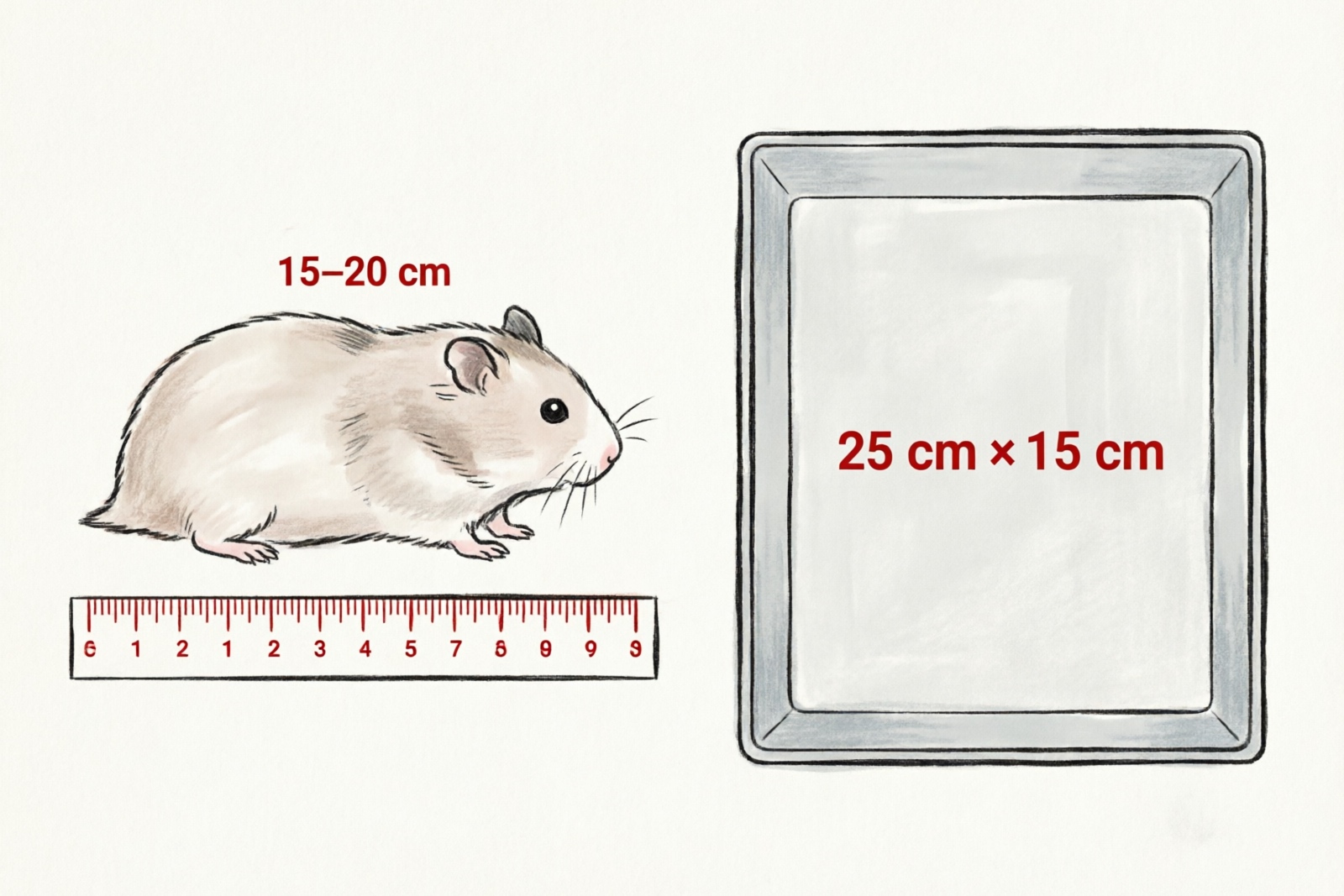
The Syrian hamster cage size you choose directly affects your pet’s health, behavior, and lifespan. Syrian hamsters are the largest domestic hamster breed (15-20cm body length), and they need significantly more space than most pet stores lead you to believe.
In the wild, a Syrian hamster travels 5-8 miles every night foraging for food. While no cage can replicate that range, providing adequate floor space allows natural behaviors like running, burrowing, and exploring. A cage that’s too small leads to stress, obesity, and serious behavioral problems.
This guide covers everything you need to know: evidence-based minimums, unit conversions, the best cages that actually meet standards, and the real consequences of housing your hamster in an undersized enclosure. For a complete cage setup guide including bedding, temperature, and accessories, see our hamster cage setup guide. For a full breakdown of what makes a proper hamster enclosure, including substrate depth and enrichment requirements, see our dedicated enclosure guide.
Why Cage Size Matters for Syrian Hamsters
Syrian hamsters are not suited to small cages. At 15-20cm (6-8 inches) long, they’re roughly twice the size of dwarf hamster species. This larger body means they need bigger wheels, deeper bedding, and — critically — more floor space to move naturally.
The biggest problem facing new Syrian hamster owners is the pet store cage. Most cages sold in pet shops provide 1,000-2,000 cm² of floor space — roughly one-fifth to one-third of the minimum recommended size. These cages are marketed as “hamster habitats” but are fundamentally inadequate for a Syrian’s needs.
A Syrian hamster’s natural behaviors require specific amounts of space:
- A 21cm+ diameter running wheel takes up significant floor area
- 10-15cm deep bedding for burrowing reduces usable height
- A sand bath, hideout, food bowl, and water source all compete for space
- Foraging and exploring require open floor area, not just accessories
When these elements are crammed into a tiny cage, the hamster can’t perform any of them properly. The result is a stressed, unhealthy animal that may live a significantly shorter life.
Minimum Cage Size for Syrian Hamsters (With Evidence)
The minimum cage size for a Syrian hamster is 100cm x 50cm (39.4” x 19.7”) of continuous, unbroken floor space. This is not a casual suggestion — it’s backed by veterinary research, animal welfare organizations, and in several countries, the law.
The Evidence
Multiple authoritative sources independently arrived at similar minimums:
| Standard | Size (cm) | Size (inches) | Size (feet) | Source |
|---|---|---|---|---|
| Minimum requirement | 100 x 50 | 39.4 x 19.7 | 3.3 x 1.6 | Hamster Welfare UK [hamsterwelfare.com] |
| Recommended size | 120 x 50+ | 47.2 x 20+ | 3.9 x 1.7+ | Expert consensus |
| German legal minimum | 150 x 50 | 59 x 19.7 | 4.9 x 1.6 | German Animal Welfare Act (TierSchG) |
| Swiss legal minimum | 100 x 50 | 39.4 x 19.7 | 3.3 x 1.6 | Swiss Animal Protection Ordinance (TSchV) |
Germany and Switzerland have some of the strictest animal welfare laws in the world. The fact that their legal minimums align with expert recommendations from Hamster Welfare UK and veterinary professionals should tell you everything about how seriously this standard should be taken.
When searching Syrian hamster cage size Reddit threads, you’ll find overwhelming community consensus on these numbers. Experienced owners and breeders on Reddit’s hamster communities almost universally recommend 100cm x 50cm as the absolute floor, with many advocating for 120cm+ when space allows.
Why This Much Space?
A 100cm x 50cm cage (5,000 cm²) isn’t excessive — it’s the minimum needed to fit essential items without crowding:
- Running wheel (21cm diameter) — Syrian hamsters must have a wheel this large to run without arching their back. Smaller wheels cause spinal damage over time. See our hamster wheel size requirements for details.
- Sand bath (20cm x 15cm minimum) — Essential for coat health
- Hideout (at least 15cm diameter entrance) — Syrian hamsters need a dark, enclosed sleeping area
- Food and water station — Needs separation from the sleeping area
- Open floor space — For foraging, exploring, and natural movement
- Deep bedding area — 10-15cm of substrate for burrowing
When you add up these essential elements, 5,000 cm² fills up quickly. Anything smaller means compromising on one or more of your hamster’s basic needs.
Syrian Hamster Cage Size Conversions (cm / inches / feet)
Search queries about hamster cage dimensions use different measurement units depending on where you live. Here’s a quick reference table covering all common conversions:
| Standard | cm | inches | sq inches | sq cm |
|---|---|---|---|---|
| Minimum | 100 x 50 | 39.4 x 19.7 | 776 | 5,000 |
| Recommended | 120 x 50 | 47.2 x 19.7 | 930 | 6,000 |
| Large | 150 x 50 | 59 x 19.7 | 1,163 | 7,500 |
| IKEA Detolf | 163 x 43 | 64.2 x 16.9 | 1,085 | 7,009 |
Cage Size in Feet
For those more comfortable thinking in feet:
- Minimum: 3.3 x 1.6 feet
- Recommended: 3.9 x 1.7+ feet
- German legal standard: 4.9 x 1.6 feet
- IKEA Detolf: 5.3 x 1.4 feet
The cage size in feet matters because it helps visualize the actual footprint in your room. A 3.3 x 1.6 foot cage takes up roughly the same floor space as a small coffee table — manageable in most rooms, but not negligible.
How to Measure Your Cage Correctly
Measuring cage size sounds simple, but it’s easy to make mistakes:
Measure continuous floor space — This means one single, unbroken area at the base of the cage. If your cage has multiple levels connected by tubes or ramps, only measure the largest single level. Tubes, ladders, and elevated platforms do not count toward floor space because hamsters don’t use them the same way they use flat ground.
Don’t measure total area — A multi-level cage with three 40cm x 20cm shelves does NOT have 2,400 cm² of usable floor space. It has 800 cm² — the size of one shelf. The vertical space between levels is not equivalent to horizontal floor space.
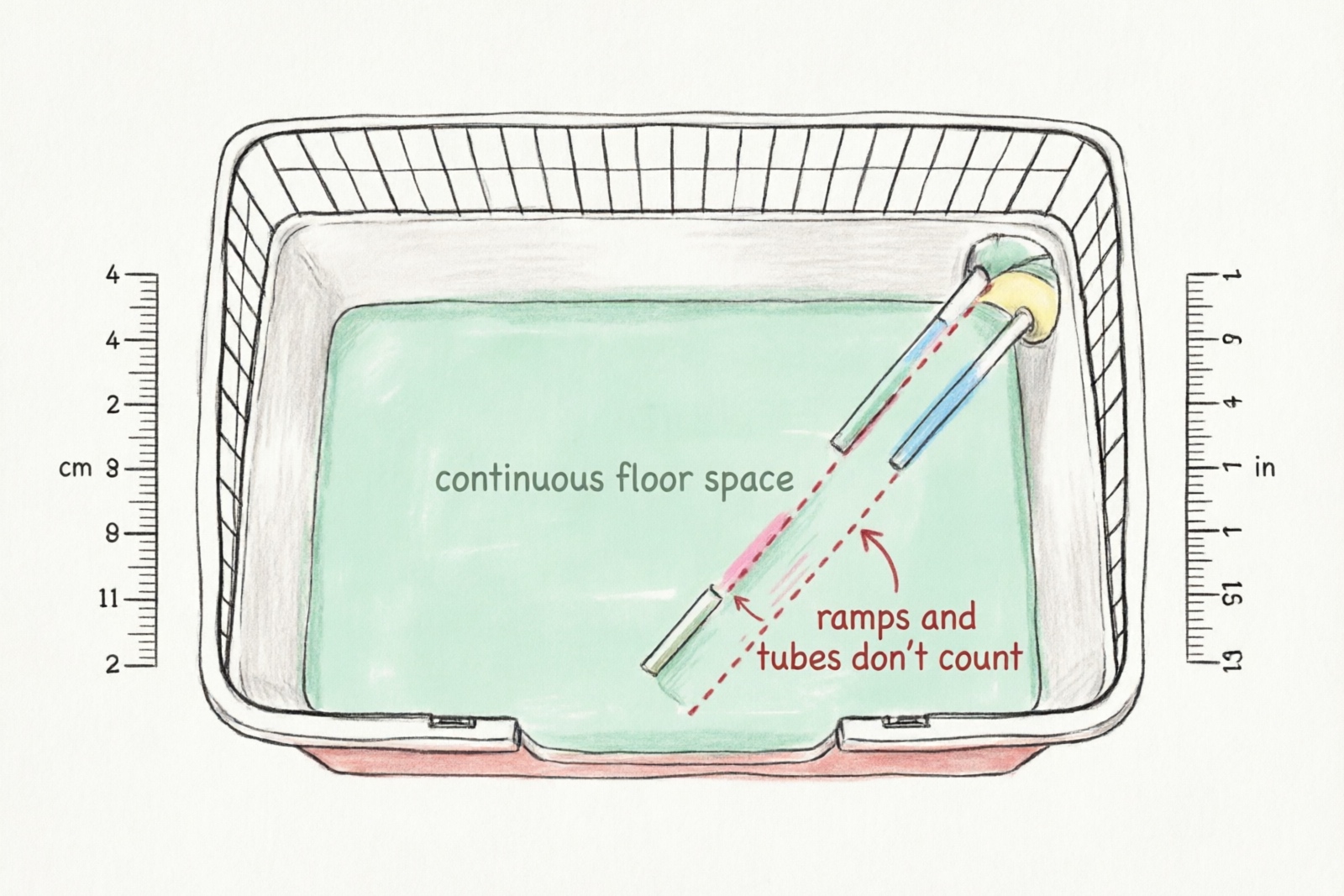
Common measurement errors:
- Counting multiple levels as additional floor space
- Measuring the outer dimensions including the frame (measure inside)
- Measuring total cage height instead of floor dimensions
- Forgetting to subtract space taken up by fixed accessories
Syrian vs Dwarf Hamster Cage Size
While this guide focuses on Syrian hamsters, it’s helpful to understand how their space requirements differ from dwarf species:
| Feature | Syrian Hamster | Dwarf Hamster |
|---|---|---|
| Body size | 15-20cm | 8-12cm |
| Minimum floor area | 100 x 50cm | 80 x 50cm |
| Minimum wheel diameter | 21cm+ | 17cm+ |
| Social behavior | Strictly solitary | Can live in pairs (needs more space) |
| Bedding depth | 10-15cm | 8-12cm |
| Natural range | 5-8 miles/night | 3-5 miles/night |
The most important difference is that Syrian hamsters must always live alone. They are strictly solitary and will fight — often fatally — if housed together. This means a single Syrian needs a full 100cm x 50cm cage to itself, while a pair of dwarf hamsters would need an even larger enclosure (at least 120cm x 50cm) to coexist peacefully.
If you’re setting up for a dwarf hamster instead, our hamster cage setup guide covers species-specific requirements for all hamster types.
Best Large Cages for Syrian Hamsters (2026)
Finding a cage that meets the 100cm x 50cm minimum is harder than it should be. Most commercially available cages fall short. After analyzing dozens of products, here are the best options that actually meet adequate size requirements.
Best Metal Cages (Chew-Proof)
Metal cages are the most durable option. Syrian hamsters are moderate chewers, and metal construction eliminates the risk of them gnawing through walls.
BUCATSTATE Hamster Cage Metal 2.0 — $137.69 | ⭐4.4 The BUCATSTATE Metal 2.0 measures 31.4” x 17.6” x 20” (552 sq inches of floor space) and is our top metal pick. With a stackable design, it’s the most proven chew-proof cage on the market. The metal top opens fully for easy access, and assembly takes roughly 15 minutes. Some owners report lid warping over time, but customer support typically replaces affected units.
Prolee Hamster Cage Chewproof — $119.99 | ⭐4.6 The Prolee Chewproof features a deep base that’s ideal for Syrian hamsters who love to burrow. With acrylic side panels and a chew-proof metal frame, it offers visibility and durability. Owners consistently praise the deep bedding capacity — one reviewer upgraded from a 50-gallon bin and reported their Syrian showed “extreme” improvement in behavior.
Prolee Hamster Cage Chewproof 32” — $105.99 | ⭐5.0 The most affordable chew-proof option with a perfect 5.0 rating. At $105.99, it provides the same Prolee build quality in a slightly more compact form. The best value choice if you want metal construction without the BUCATSTATE price.
Best Wooden Cages
Wooden cages blend naturally with home decor and typically offer better visibility than metal wire cages.
Niteangel Hamster Cage — $175.95 | ⭐4.0 The Niteangel is the premium wooden option at 30” x 15” x 17.7”. Multiple reviewers switched from IKEA Detolf setups and reported their Syrians became noticeably happier with the extra width and depth. The furniture-grade design looks like a display cabinet rather than a pet cage. Assembly is straightforward if you follow the labeled pieces.
Wooden Hamster Cage 32”x16” — $103.99 | ⭐5.0 A perfect 5.0 rating with included washable liners. At $103.99, it’s the best value wooden option. Reviewers love the aesthetic appeal and the fact that cats can observe through the acrylic panels without reaching the hamster.
Wooden Hamster Cabinet 32”Lx16Wx16H — $88.99 | ⭐4.2 The most budget-friendly option at under $90. The cabinet-style design includes a storage shelf underneath. Some owners report minor issues with lid opening range and mat fit, but overall it’s a solid budget pick. For hamster cage enrichment ideas to fill this space, see our dedicated guide.
Extra Large & Specialty Cages
MidWest Hamster Nation Jumbo Cage — $167.02 | ⭐4.6 MidWest Homes for Pets is a trusted name in small animal housing. The Jumbo measures 38.2” x 22.6” and provides 676 sq inches of usable unbroken floor space — close to the 100cm x 50cm minimum. Assembly is reportedly difficult and the plastic base is fragile, but the size and brand reputation make it a reliable choice for owners who prefer established manufacturers.
Prolee Hamster Cage with Legs — $129.99 | ⭐4.6 The elevated design raises the cage to a comfortable viewing height and provides storage space underneath. At 32” x 16” x 40”, it’s a stylish option that looks great in living spaces. Assembly takes about 5 minutes according to most reviewers.
DIY Option: IKEA Detolf
The IKEA Detolf glass cabinet (163cm x 43cm) is the hamster community’s most popular DIY cage. At roughly $69.99 plus a mesh lid ($15-30), it provides 7,009 cm² of floor space — well above the minimum.
The Detolf offers massive floor space at a low price, and the glass sides give you excellent visibility. I know several owners who love this setup. The downsides are that you need to modify it (install a mesh lid), glass can break, and the 43cm width is narrower than ideal for some enrichment setups.
Hamster Welfare UK explicitly recommends the Detolf as a suitable enclosure for Syrian hamsters. If you’re handy and want the most space per dollar, this is the way to go.
Cage Comparison Summary
| Cage | Price | Rating | Floor Space | Best For |
|---|---|---|---|---|
| BUCATSTATE Metal 2.0 | $137.69 | 4.4⭐ (780) | 552 sq in | ⭐ Best value metal |
| Prolee Chewproof | $119.99 | 4.6⭐ (512) | Deep base | Deep burrowing |
| Niteangel | $175.95 | 4.0⭐ (523) | 30”x15” | ⭐ Premium wooden |
| MidWest Jumbo | $167.02 | 4.6⭐ (40) | 676 sq in | Trusted brand |
| Prolee with Legs | $129.99 | 4.6⭐ (70) | 32”x16” | Elevated design |
| Prolee 32” | $105.99 | 5.0⭐ (512) | 32” | ⭐ Best budget |
| Wooden 32”x16” | $103.99 | 5.0⭐ (60) | 32”x16” | Budget wooden |
| Wooden Cabinet | $88.99 | 4.2⭐ (126) | 32”x16” | Most affordable |
| IKEA Detolf | ~$70+ | N/A | 7,009 cm² | ⭐ Most space/$ |
Multi-Level Cages: Do They Count?
This is one of the most misunderstood topics in hamster care. Vertical space does NOT replace floor space. A tall, narrow cage with five levels is not equivalent to a wide, single-level cage — not even close.
Why Multi-Level Cages Fall Short
Hamsters are ground-dwellers. In the wild, they run horizontally, dig horizontally, and forage horizontally. They do not naturally climb. When forced to navigate vertical tubes, ramps, and ladders in a multi-level cage, several problems arise:
- Fall risk — Syrian hamsters are bulky and not agile climbers. A fall from a high platform can cause serious injury, including broken bones and internal bleeding.
- Tubes are not enrichment — Squeezing through a plastic tube is not the same as natural exploration. Many Syrian hamsters avoid tubes entirely, leaving upper levels unused.
- Floor space is what matters — Syrian hamster exercise needs prioritize horizontal movement over vertical climbing. A 5-level cage with 30cm x 20cm per level has only 600 cm² of usable floor — well below the 5,000 cm² minimum.
When Multi-Level Is Acceptable
Multi-level designs can work if they meet these conditions:
- Each level provides adequate floor space (not narrow shelves)
- Levels are connected by ramps or stairs, not vertical tubes
- No more than 2 levels total
- The base level alone meets or approaches the minimum floor space
The 5-Floors Twin Tower: Why We Don’t Recommend It
The 5-Floors Twin Tower ($59.68) looks impressive with its five floors and connecting tubes, but it fails the floor space test. Each individual level is far too small, and the connecting tubes pose fall and escape hazards. At 4.1 stars, reviewers note flimsy plastic floors, difficult assembly, and poor instructions. Despite the “Syrian hamster” in the product name, the floor space is inadequate for a Syrian.
What Happens If the Cage Is Too Small?
The consequences of an undersized cage aren’t always immediately visible, but they’re serious and well-documented.
Behavioral Problems
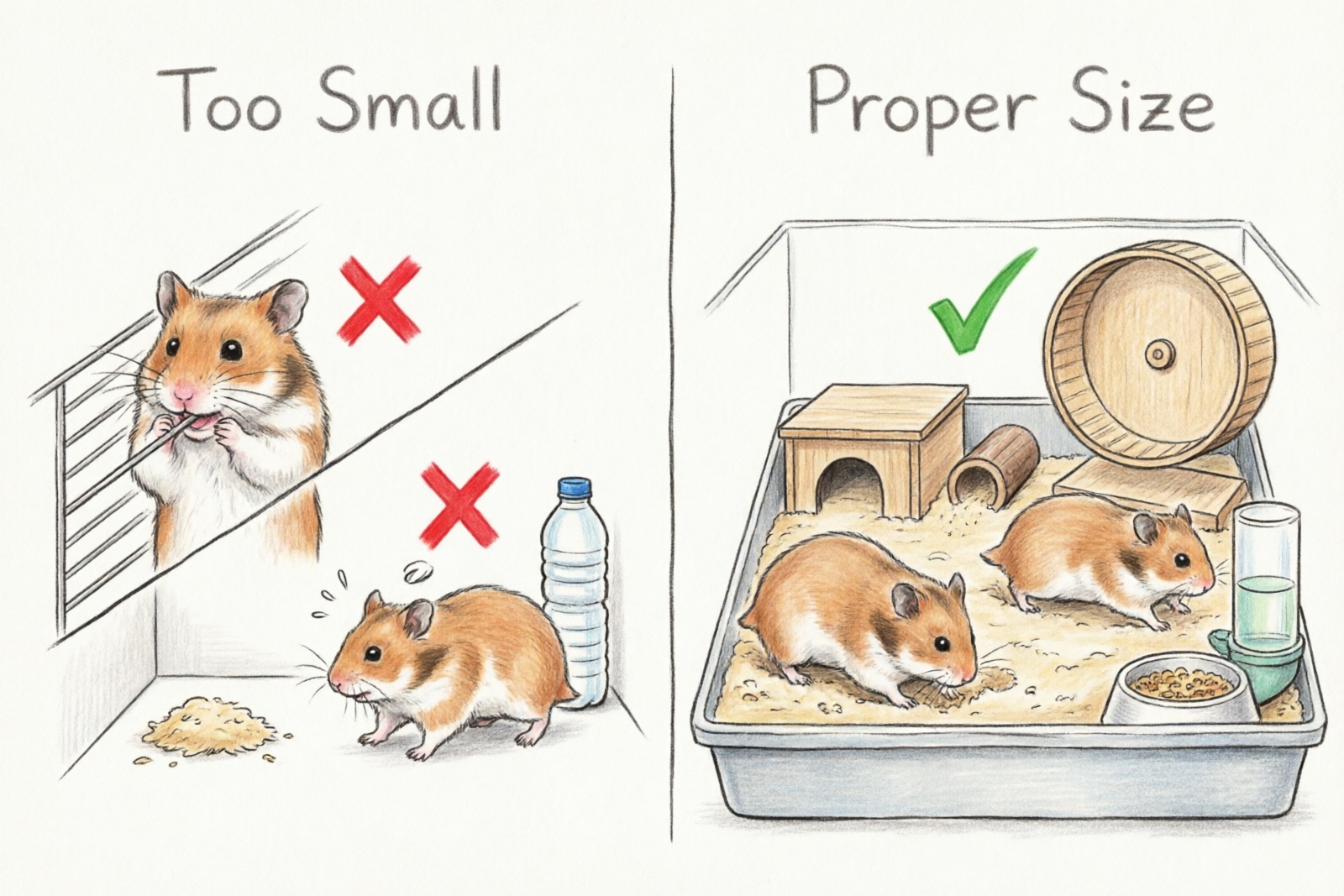
Bar biting is the most common sign of cage-induced stress. The hamster repeatedly bites the cage bars, often wearing down their teeth and causing mouth injuries. This isn’t normal behavior — it’s a cry for more space.
Pacing and route-tracing — The hamster walks the same path along the cage walls repeatedly, like a pacing tiger in a zoo enclosure. This stereotypic behavior indicates severe frustration and is almost impossible to reverse once established.
Increased aggression — Syrian hamsters in small cages become territorial and defensive. They may bite more frequently when handled and react aggressively to any disturbance of their tiny space.
Health Problems
Obesity — Without adequate space to run and explore, Syrian hamsters become sedentary. Combined with an improper diet, this leads to obesity, which shortens lifespan and increases the risk of diabetes, heart disease, and joint problems.
Stress-related illness — Chronic stress suppresses the immune system, making hamsters more vulnerable to infections. One of the most dangerous stress-related conditions is wet tail in hamsters, a rapidly fatal bacterial infection that primarily affects young, stressed hamsters.
Weakened muscles and bone density — Lack of movement leads to muscle atrophy and reduced bone density, making injuries more likely.
Common Misconceptions
- “The pet store sold it as a hamster cage, so it must be big enough.” — Pet stores prioritize profit over animal welfare. Most commercially sold hamster cages are far below minimum standards.
- “My hamster seems happy in their small cage.” — Hamsters adapt to poor conditions. They don’t have the ability to communicate their needs or choose a better home. Surviving is not the same as thriving.
For more on how housing affects health, see our guide to hamster health problems and hamster behavior issues.
FAQ: Syrian Hamster Cage Size Questions
What is the minimum cage size for a Syrian hamster?
100cm x 50cm (39.4” x 19.7”) of continuous, unbroken floor space. This is supported by Hamster Welfare UK, German and Swiss law, and veterinary consensus. Anything smaller compromises your hamster’s welfare.
How big should a Syrian hamster cage be in inches?
At minimum, 39.4 inches x 19.7 inches. The recommended size is 47.2+ inches x 20+ inches. Always measure the inside floor space, not the outer dimensions including the frame.
Can Syrian hamsters live in multi-level cages?
Yes, but only if the base level meets the minimum floor space requirement. Vertical levels are bonus space — they don’t count toward the 100cm x 50cm minimum. See our section on multi-level cages above.
Is the IKEA Detolf good for Syrian hamsters?
Yes. At 163cm x 43cm, it exceeds the minimum floor space and is explicitly recommended by Hamster Welfare UK. You’ll need to add a secure mesh lid (~$15-30). The main downside is the narrow 43cm width, which limits some setup options.
What size wheel does a Syrian hamster need?
A minimum of 21cm (8.5 inches) in diameter. Smaller wheels force the hamster to arch their back while running, which causes spinal problems over time. For full details on wheel sizing and other exercise needs, see our hamster wheel size requirements.
How much bedding does a Syrian hamster need?
At least 10-15cm (4-6 inches) deep. Syrian hamsters are natural burrowers and need deep substrate to create tunnel systems. This is another reason why cage height matters — you need enough vertical clearance to accommodate both deep bedding and a wheel. Our hamster cage setup guide covers bedding types and depths in detail.
Conclusion: Choose the Right Cage for Your Syrian
The right Syrian hamster cage size is non-negotiable: 100cm x 50cm minimum, 120cm+ recommended. This isn’t an arbitrary number — it’s backed by animal welfare science, veterinary professionals, and the legal standards of countries with the world’s strictest animal protection laws.
Quick recommendations by budget:
- Budget pick: IKEA Detolf (~$70 + lid) — most space per dollar, requires DIY modification
- Best value metal: BUCATSTATE Metal 2.0 ($137.69) — chew-proof and durable
- Best premium wooden: Niteangel ($175.95) — furniture-grade design
- Best overall value: Prolee Chewproof 32” ($105.99) — perfect 5.0 rating.
Once you have the right cage, proper setup makes all the difference. Learn how to create an enriching environment with our hamster cage setup guide and hamster cage enrichment ideas.