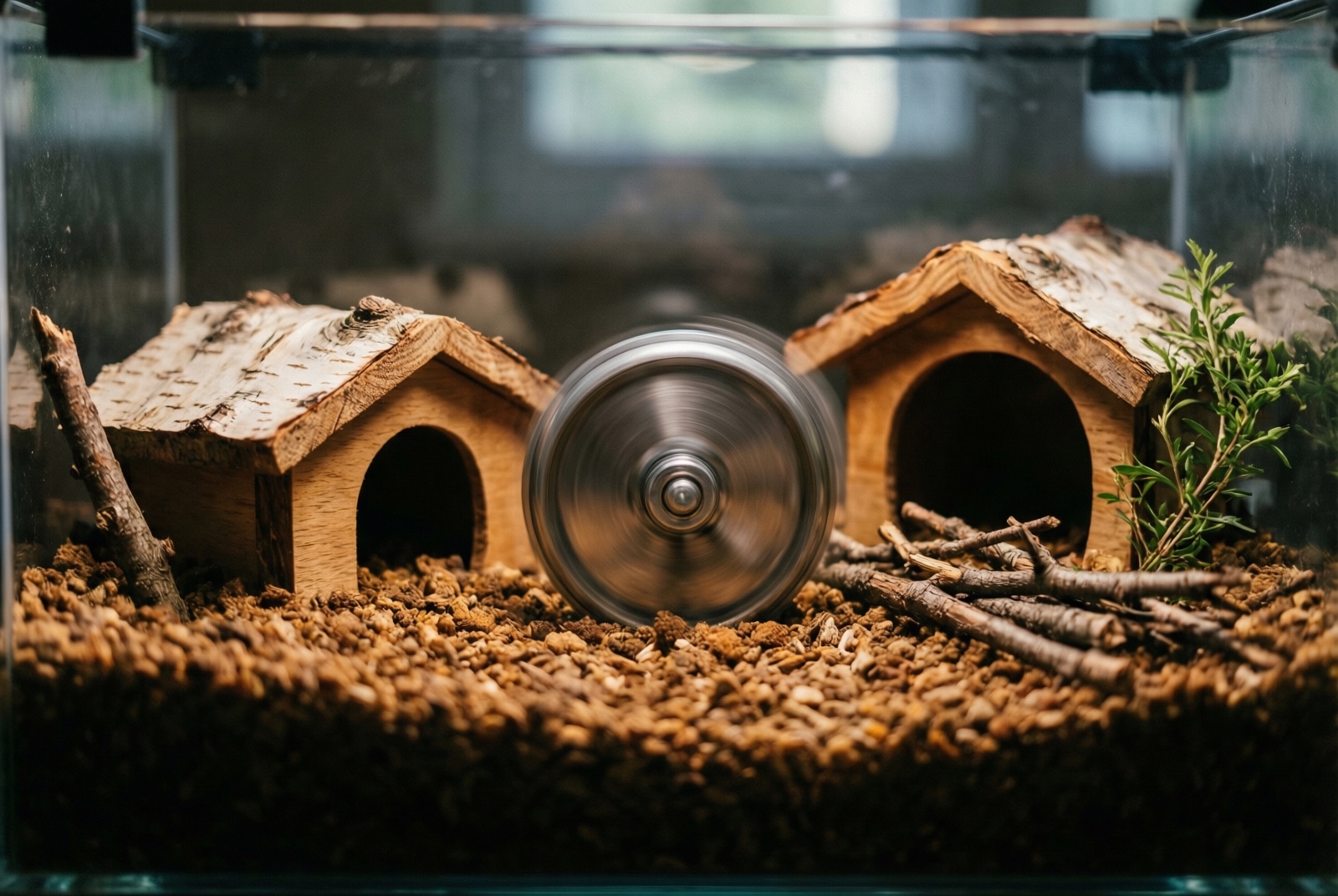
The proper hamster enclosure you choose is the single most important factor in your hamster’s quality of life. Not the food, not the wheel, not the toys — the enclosure. A hamster in a properly sized, well-set-up enclosure will burrow, forage, run, and display natural behaviors. The same hamster in a tiny pet store cage will pace, bar chew, and develop chronic stress that shortens their life.
I have seen this difference firsthand. The upgrade from a standard pet store cage to a proper hamster cage is not a small improvement — it is a completely different animal. This guide covers everything you need to know about proper hamster enclosure requirements: size standards, enclosure types, substrate depth, enrichment essentials, and the specific products that work.
Why a Proper Hamster Enclosure Matters
In the wild, hamsters travel several miles every night searching for food, patrolling territory, and digging complex burrow systems. The typical pet store cage provides a fraction of the space they need. Most commercially sold hamster cages offer only 200 to 400 square inches of floor space — well below any scientifically backed minimum.
A cramped enclosure causes predictable problems. Bar chewing, compulsive pacing, back-flipping, and repetitive circling are all stereotypic behaviors caused by inadequate space. These are not normal behaviors — they are signs of chronic stress. A proper hamster enclosure eliminates most of these issues by providing enough room for natural behaviors: burrowing, foraging, running, and exploring.
The investment in a proper hamster enclosure pays for itself in fewer vet visits and a longer-lived, healthier hamster. For detailed species-specific sizing, see our Syrian hamster cage size guide.
Proper Hamster Enclosure Size Requirements
Minimum Floor Space by Species
The minimum enclosure size depends on your hamster’s species. Syrian hamsters are the largest and need the most space. Dwarf hamsters are smaller but still need significantly more room than most people realize.
| Species | Minimum Floor Space | Recommended Floor Space |
|---|---|---|
| Syrian hamster | 600 sq in (3,875 sq cm) | 1,000+ sq in |
| Dwarf hamster (Winter White, Campbell) | 450 sq in (2,900 sq cm) | 600+ sq in |
| Roborovski dwarf | 450 sq in (2,900 sq cm) | 600+ sq in |
These are minimums, not goals. More space is always better.
Cage Size Reference Table
The minimum hamster cage size depends on your setup goals:
| Size Category | Dimensions | Floor Space | Suitable For |
|---|---|---|---|
| Too small | 24” × 12” | 288 sq in | None |
| Minimum (dwarf) | 30” × 15” | 450 sq in | Dwarf hamsters |
| Minimum (Syrian) | 36” × 18” | 648 sq in | Syrian (barely) |
| Recommended | 48” × 24” | 1,152 sq in | Syrian (ideal) |
| Excellent | 60” × 18”+ | 1,080+ sq in | Any species |
Why Height Does Not Replace Floor Space
Understanding proper hamster enclosure design means knowing this is one of the most common misconceptions I encounter. A tall, narrow cage with multiple platforms does not compensate for insufficient floor space. Hamsters are ground-dwelling animals — they need horizontal space for running and foraging, not vertical stacking. Ramps between levels do not count toward floor space requirements. A 12-square-foot single-level enclosure is always better than an 8-square-foot three-level cage.
In my experience, the cages that look tallest on store shelves are almost always the worst choices. They prioritize shelf space efficiency over the animal’s actual needs.
Minimum Height
You do need some height, but for a different reason: deep bedding. Syrian hamsters need 10+ inches of substrate depth for burrowing, and dwarf hamsters need at least 6 inches. Your enclosure should be tall enough to accommodate this bedding depth while still leaving headroom above. A height of 16 to 20 inches works well for most setups.
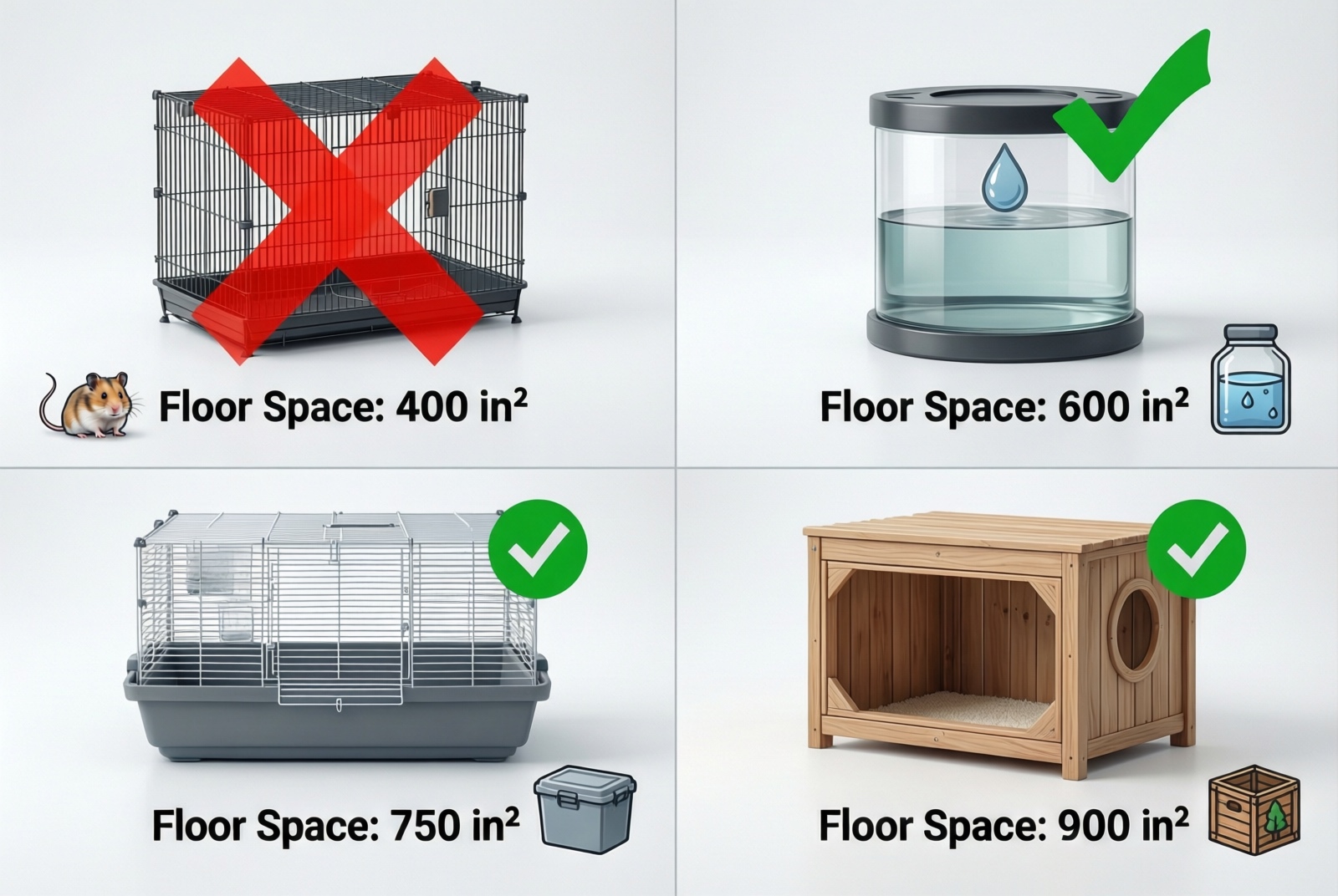
Hamster Tank vs Cage vs Bin: Which Is Best?
Why Wire Cages Are Bad for Hamsters (Not Recommended)
I would avoid wire cages for hamsters entirely. The problems are fundamental: most wire cages have inadequate floor space, bar spacing that can cause injury or allow escape, and drafts from all sides. Bar chewing is one of the most common stress behaviors I see in hamsters kept in wire cages — and it can cause dental damage over time. Wire floors are even worse, causing a painful foot condition called bumblefoot.
Wire cages were designed for a different era of hamster care. Modern standards require significantly more space and better conditions than any wire cage provides.
Glass Tanks and Aquariums
Glass tanks are one of the best options available. They allow deep bedding, eliminate bar chewing entirely, provide excellent visibility, and are completely draft-free. The main trade-off is weight — a 40-gallon glass tank is heavy and difficult to move — and limited ventilation, which means you need a screen top.
A 40-gallon breeder tank (36” × 18” × 16”) is the standard recommendation. It provides 648 square inches of continuous floor space, which meets the Syrian hamster minimum. For converting a glass tank into a proper hamster enclosure, you need a screen lid sized to match your tank. Zilla makes the Fresh Air Screen Cover in multiple sizes — the version shown here (20×10 inches) has over 15,000 reviews and a 4.7-star rating. For a 40-gallon breeder tank (36×18), select the matching 36×18 inch size. All-metal construction provides essential ventilation while keeping your hamster secure.
Bin Cages (Budget Option)
A bin cage is a large plastic storage bin modified with a mesh lid for ventilation. A 110-quart storage bin provides roughly 600+ square inches of floor space and costs only $15 to $25. I have built several bin cages and they work remarkably well for the price — they just are not the most attractive option. For a complete DIY guide, see our DIY bin cage guide.
Wooden and Acrylic Enclosures
Modern wooden and acrylic enclosures offer the best balance of space, aesthetics, and function. The Prolee Chewproof Large Hamster Cage is one of the better options I have found — it uses chewproof acrylic panels so your hamster cannot gnaw through the walls, has an openable top for easy access, and a waterproof laminated wood base. At $105.99, it is more expensive than a bin cage but provides a much cleaner look. One owner reported it as a massive upgrade from a 50-gallon bin, with their Syrian thriving in the larger space.
For a more budget-friendly wooden option, the Wooden Hamster Cage 32” × 16” × 16” provides solid wood construction with adjustable ventilation panels and two washable liners included. At $88.99, it is reasonable value. The main downside owners report is that the lids do not open fully, making it harder to arrange items inside during setup.
Best Hamster Enclosures to Buy
For Syrian Hamsters
Syrian hamsters need at least 600 square inches, and I would recommend 1,000+ for ideal conditions. The Prolee Chewproof Cage mentioned above is the best ready-made option I have found for Syrian hamsters. It provides ample floor space for deep bedding and enrichment.
For Dwarf Hamsters
Dwarf hamsters can get by with 450 square inches minimum, though more is always better. A 20-gallon glass tank is the most affordable starting point — the Mini Reptile Glass Terrarium is a sturdy glass enclosure at $42.99 with a screen top and lock mechanism. I would use this for dwarf hamsters only — it is too small for a Syrian as a permanent home.
For a modern, transparent option, the GuineaLoft Acrylic Cage Model-P3 offers a clean acrylic design at $37.91. It is only 2 × 1 feet, so I would recommend it for dwarf hamsters or as a temporary enclosure. Assembly takes 20 to 30 minutes — the brackets go inside the panels, which confuses some owners at first, but once assembled it looks sharp and provides good visibility.
DIY Hamster Enclosure Ideas
Building a DIY hamster enclosure is one of the best ways to maximize space for your budget. For owners willing to put in some effort, DIY options often provide the most space for the least money:
- IKEA Detolf turned sideways: Remove the shelves, lay it on its side, add a mesh top — you get 575 square inches of floor space for about $60
- Storage bin cage: A 110-quart bin plus hardware cloth lid gives 600+ square inches for under $30
- Custom wooden enclosure: Build to your exact dimensions — ideal if you have specific space constraints
For detailed setup steps, see our hamster cage setup guide. For more creative options, check out our dinosaur hamster cage article for unique enclosure ideas.
Common Hamster Enclosure Mistakes
These are the proper hamster enclosure mistakes I see most often — and most of them come down to following outdated pet store advice.
Cage too small. This is by far the most common problem. Most pet store cages are well below the minimum requirements. If your hamster’s cage fits on a shelf, it is almost certainly too small.
Not enough bedding depth. Hamsters are burrowers. Without 6 to 10+ inches of substrate, they cannot perform their most natural behavior. Shallow bedding causes stress and eliminates an essential enrichment activity. For more on creating a stimulating environment, see our cage enrichment tips.
Wire floors. Wire-bottom cages cause bumblefoot, a painful bacterial infection of the foot pads. Always use a solid bottom.
Cotton or fluffy bedding. Soft, fluffy bedding material can wrap around limbs, cause impaction if ingested, and is a genuine hazard. Use paper-based bedding, aspen, or coconut fiber instead.
No wheel or wrong-size wheel. Syrian hamsters need a 10 to 12-inch wheel minimum. Dwarf hamsters need an 8 to 9-inch wheel. A wheel that is too small forces the hamster to run with an arched back, causing spinal problems over time. See our hamster toys guide for wheel recommendations.
Poor placement. Keep the enclosure away from direct sunlight, drafts, loud appliances, and high-traffic areas. Hamsters are sensitive to temperature fluctuations and noise — a quiet, climate-stable room is ideal. Stress from poor placement can contribute to hamster health problems over time.
No hiding spot. Hamsters need at least one dark, enclosed space to sleep during the day. Without a hide, they feel exposed and vulnerable, which causes chronic stress. I have seen hamsters sleep in their food bowls or wedge themselves into tight corners when no proper hide is provided — a clear sign they feel unsafe.
Proper Hamster Enclosure: Substrate & Bedding
Minimum Bedding Depth
Syrian hamsters need 10+ inches of bedding. Dwarf hamsters need at least 6 inches. This is not excessive — it is what they need to create burrow systems, which is their primary natural behavior. In the wild, hamster burrows can extend several feet underground with multiple chambers for sleeping, storing food, and eliminating.
Best Substrate Options
Paper-based bedding is the most popular choice. It is safe, dust-free, absorbent, and allows tunneling. BUCATSTATE 70L Paper Bedding comes compressed in a 70-liter package that expands significantly. At $24.99, the volume is generous. It is 99% dust-free, which is important for respiratory health — some owners have reported chemical smells when first opening compressed bedding, so airing it out before use is a good idea.
Coconut fiber and cork create a more natural look and hold tunnel structures better than paper. Niteangel Natural Coco/Cork Hamster Bedding is the highest-rated hamster bedding on Amazon at 4.8 stars across 1,366 reviews. It combines cork pieces with coconut fiber for a texture that hamsters love to dig through. I have used it in dig boxes and as a top layer over a paper bedding base — the combination works well.
What to Avoid
Pine and cedar shavings contain aromatic oils that cause respiratory problems and liver damage. Cotton or fluffy bedding is an impaction and entanglement hazard. Sawdust is too dusty and irritates the respiratory system.
Maintenance
Spot clean daily by removing soiled areas. Do a full bedding change every 3 to 4 weeks, but always leave a handful of old bedding to preserve familiar scent — this reduces stress during the change. When doing a full change, clean the enclosure base with mild soap and water, rinse thoroughly, and dry completely before adding fresh bedding.
Bedding Strategy
I have found that a layered approach works best: a base layer of paper-based bedding for absorption and volume, topped with coconut fiber and cork for texture and tunnel-holding ability. Make the bedding deepest in the corners — hamsters naturally build their burrow entrances against walls. A flat, uniform layer of bedding does not encourage burrowing the way varying depths do.
Essential Enclosure Features Checklist
Use this checklist to evaluate any proper hamster enclosure. Every item on this list matters.
- Floor space: 600+ sq in for Syrians, 450+ sq in for dwarfs
- Deep bedding: 6–10+ inches of safe substrate
- Running wheel: 10–12” for Syrians, 8–9” for dwarfs, solid surface (not wire mesh)
- Hides: at least two — one for sleeping, one near the food area
- Water source: bottle or heavy ceramic bowl (they tip light bowls)
- Food dish: ceramic or heavy material
- Chew toys: apple wood, willow, or cork sticks
- Sand bath: chinchilla sand (not dust) in a small container
- Temperature: 65–75°F (18–24°C), stable and consistent
- Location: quiet room, away from drafts and direct sunlight
Optional but recommended: a dig box filled with coco fiber or cork pieces, scatter feeding areas to encourage foraging, and varied substrate depth (deeper in corners for burrowing).
Can an Enclosure Be Too Big?
No. I have never seen a hamster with too much space. Larger enclosures allow deeper burrowing, more enrichment options, and significantly reduce stress-related behaviors. The only practical limit is your available space and budget. For exercise needs beyond your proper hamster enclosure, see our hamster exercise guide. For feeding recommendations, check out our hamster diet guide.
Frequently Asked Questions
What size enclosure does a hamster need?
Minimum 600 square inches (3,875 sq cm) for Syrian hamsters and 450 square inches for dwarf hamsters. These are minimums — I would recommend 1,000+ square inches for Syrians whenever possible. Height should accommodate 6 to 10+ inches of bedding.
Are tanks or cages better for hamsters?
Glass tanks are generally better. They allow deep bedding, eliminate bar chewing, and are draft-free. Wire cages have inadequate floor space, promote bar chewing, and expose hamsters to drafts. For most owners, a glass tank or wooden enclosure is the better choice.
Why are small cages bad for hamsters?
Small cages cause chronic stress, which leads to stereotypic behaviors like bar chewing, pacing, and back-flipping. Stressed hamsters have weaker immune systems and shorter lifespans. In the wild, hamsters travel miles each night — confining them to a space smaller than a sheet of paper is physically and psychologically harmful.
Can hamsters live in glass tanks?
Yes — glass tanks are excellent hamster enclosures. A 40-gallon breeder tank (36” × 18” × 16”) is the standard recommendation. You will need a screen lid for ventilation. Glass tanks allow deep bedding, provide clear viewing, and eliminate bar chewing.
What should a hamster enclosure have?
Deep bedding (6–10+ inches), an appropriately sized wheel, at least two hides, a water source, a food dish, chew toys, and a sand bath. The enclosure should be in a quiet location with stable temperature between 65 and 75°F.
How much floor space does a Syrian hamster need?
Minimum 600 square inches of continuous, unbroken floor space on a single level. Ramps and platforms do not count toward this total. I would recommend 1,000+ square inches for ideal conditions. Vertical space does not compensate for insufficient horizontal floor space.
What bedding is best for a hamster enclosure?
Paper-based bedding, aspen shavings, or coconut fiber are the safest options. Provide 6 to 10+ inches of depth. Avoid pine, cedar, cotton, and sawdust. For the best burrowing experience, I recommend a paper bedding base with a coconut fiber and cork top layer.
Can hamster enclosures be too big?
No. Hamsters benefit from as much space as you can provide. Larger enclosures support deeper burrowing, more enrichment options, and reduce stress behaviors. The only limit is your available space and budget.