
Taming your hamster is one of the most rewarding aspects of hamster ownership. A tame hamster is a joy to interact with, easier to health-check, and forms a genuine bond with you. However, hamsters are prey animals with strong survival instincts—they don’t automatically trust humans. This guide provides a proven step-by-step method to tame your hamster safely and effectively.
New to hamsters? Read our Complete Beginner’s Guide for everything you need to know before bringing your hamster home. Start with a proper hamster cage setup, and explore hamster toys for enrichment during taming sessions. Know the signs of illness with our hamster health guide.
Why Taming Matters
Benefits of a Tame Hamster
For Your Hamster:
- ✅ Reduced stress: Comfortable with human interaction
- ✅ Better health monitoring: Easy to check for problems
- ✅ Enrichment: Out-of-cage time and interaction
- ✅ Quality of life: Social interaction (with you)
For You:
- ✅ Bonding: Genuine relationship with your pet
- ✅ Easier care: Health checks, cage cleaning
- ✅ Enjoyment: Interaction is fun, not stressful
- ✅ Safety: Less risk of bites
Why Hamsters Need Taming
Prey Animal Instincts:
- Hamsters are food for many predators
- Survival instinct: Fear of large animals (like humans)
- Defense mechanism: Biting when threatened
- Hiding behavior: Avoid detection
Result: New hamsters are naturally fearful and may bite when handled.
Good News: Hamsters are intelligent and can learn to trust humans with patience and proper technique. Most can be tamed in 1-2 weeks with consistent effort.
Before You Start: Prerequisites
1. Give Your Hamster Time to Settle (Days 1-3)
Don’t start taming immediately!
Why wait:
- Moving to a new home is extremely stressful
- Hamster needs to establish territory and feel secure
- Handling too early causes fear and bites
What to do instead:
- Day 1-2: Complete privacy. Don’t handle at all.
- Day 2-3: Talk softly near cage, let hamster get used to your voice and presence
- Day 3-4: Offer treat from your hand through bars (don’t reach in yet)
Signs hamster is settled:
- ✅ Eating and drinking normally
- ✅ Exploring cage during active hours
- ✅ Building nest
- ✅ Using wheel
- ✅ Coming to cage front to investigate you
Patience in the first few days = faster taming later. Rushing now creates setbacks.
2. Understand Hamster Body Language
Before handling, learn to read your hamster:
Relaxed Hamster (Good time to interact):
- Ears forward and relaxed
- Moving slowly, grooming
- Coming toward you curiously
- Taking treats from your hand
Stressed/Fearful Hamster (Back off):
- Ears flattened back
- Freezing in place
- Hissing or chattering teeth
- Biting cage bars
- Running away frantically
- Biting or attempting to bite
Read body language first: See our Hamster Behavior Guide for detailed body language interpretation.
3. Prepare Your Supplies
What you need:
- Treats: Sunflower seeds, small pieces of vegetable, mealworms
- Towel or glove (optional, for nervous handlers initially)
- Small container or carrier (for safe transport)
- Playpen or safe enclosed area (for out-of-cage time)
Treat Tips:
- High-value treats work best for taming (sunflower seeds, pumpkin seeds)
- Use tiny pieces (training treats should be small)
- Reserve special treats for taming only (not daily diet)
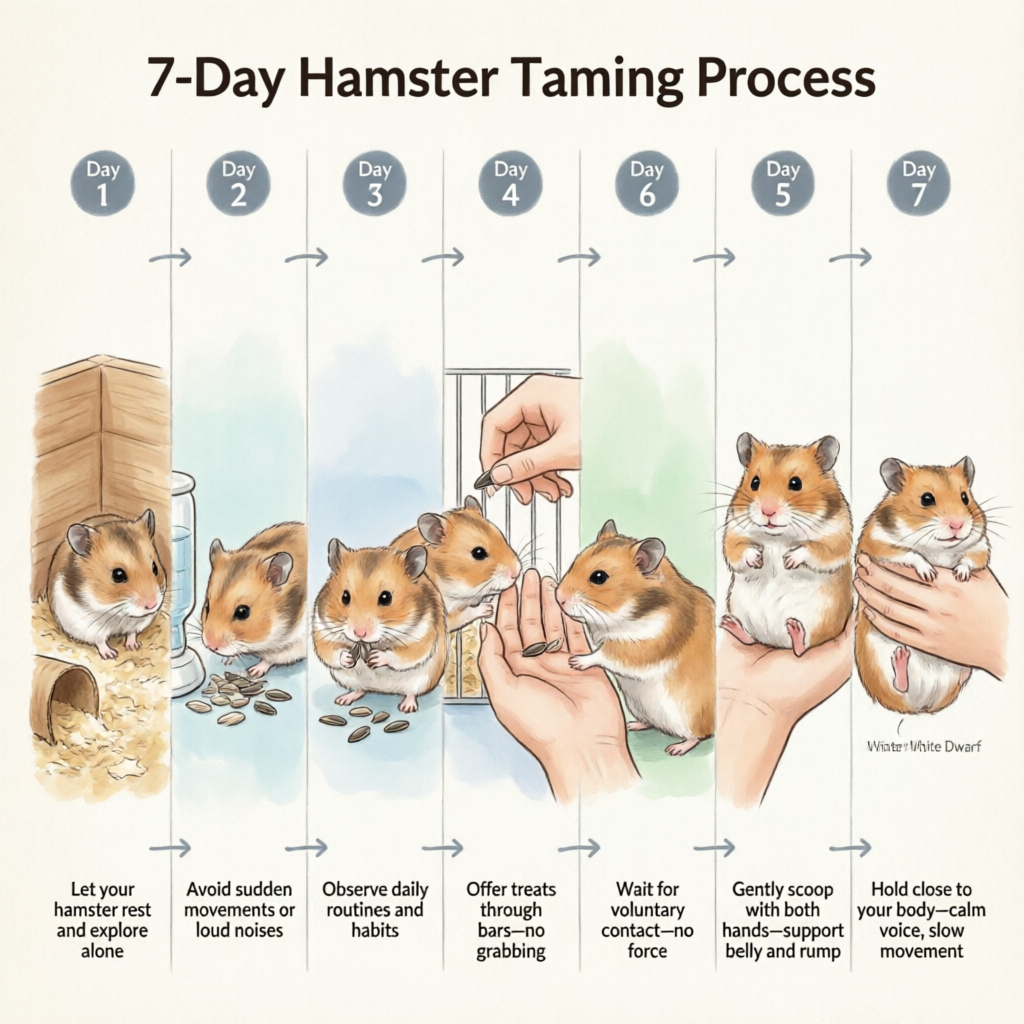
The 7-Day Taming Method
Day 1: Hand in Cage (No Touching)
Goal: Hamster accepts your hand in cage without fear
What to Do:
- Wash hands (remove food smells that might cause biting)
- Open cage quietly
- Place flat hand in cage, palm up, on cage floor
- Hold completely still
- Wait 2-5 minutes
- If hamster approaches, sniff, or climbs on hand = Great! Don’t move yet.
- If hamster ignores hand or runs away = Normal. Try again later.
- Remove hand slowly and close cage
What NOT to Do:
- ❌ Chase hamster with your hand
- ❌ Grab or touch hamster
- ❌ Make sudden movements
- ❌ Force interaction
Duration: 5-10 minutes, 2-3 times per day
Success Sign: Hamster approaches hand voluntarily, sniffs, or touches hand
Day 2: Treats from Hand (Still No Touching)
Goal: Hamster takes treats from your hand
What to Do:
- Place hand in cage (flat, palm up)
- Place treat in palm (sunflower seed, small veggie piece)
- Hold completely still
- Wait for hamster to approach and take treat
- Don’t move while hamster takes treat
- Repeat 3-5 times
What to Expect:
- Some hamsters take treats immediately
- Others need time to approach
- Some may grab treat and run away to eat it (normal)
Duration: 5-10 minutes, 2-3 times per day
Success Sign: Hamster takes treat from hand (even if quickly)
Pro Tip: High-value treats (sunflower seeds) work best. If hamster won’t take treat, try a more desirable one.
Day 3: Brief Touch While Treating
Goal: Hamster accepts brief touch while taking treat
What to Do:
- Offer treat from hand
- As hamster takes treat, gently stroke back with one finger
- Stroke from shoulders to hips (avoid head—prey animals dislike head touching)
- Keep touch brief (1-2 seconds)
- Don’t grab or hold—just a gentle stroke
What to Expect:
- Hamster may flinch or pause (normal)
- May continue eating treat = Good sign!
- May drop treat and back away = Back off, try again later
Duration: 5-10 minutes, 2-3 times per day
Success Sign: Hamster accepts touch while eating treat
If Hamster Bites:
- Don’t yell or drop hamster
- Gently withdraw hand
- End session
- Go back to Day 2 (treats without touching)
- Try Day 3 again tomorrow
Day 4: Scooping Practice (Not Lifting Yet)
Goal: Hamster allows hand to scoop around them (without lifting)
What to Do:
- Place hand flat in cage
- Let hamster approach (offer treat if needed)
- Slowly curve hand around hamster’s body (both hands)
- Form a “scoop” around hamster, but don’t lift yet
- Hold position 5-10 seconds
- Release slowly
Technique:
- Cup hands on either side of hamster
- Fingers curve under hamster’s body
- Thumbs gently over back (not pressing)
- Hamster sits in the “bowl” of your hands
What to Expect:
- Hamster may try to walk away (let them)
- May freeze (normal fear response)
- May nibble your hand (testing)—don’t pull away suddenly
Duration: 5-10 minutes, 2-3 times per day
Success Sign: Hamster sits calmly in scooped hands for 5+ seconds
Day 5: First Lift (Very Brief)
Goal: Hamster accepts being lifted briefly
What to Do:
- Scoop hamster as practiced on Day 4
- Gently lift 1-2 inches off cage floor
- Hold for 5-10 seconds
- Lower back down slowly
- Offer treat and praise (“Good hamster!”)
Technique:
- Support entire body (don’t dangle)
- Keep hamster close to cage floor initially
- Stay calm and breathe slowly (hamsters sense tension)
- Keep sessions short!
What to Expect:
- Hamster may struggle or try to jump (lower immediately)
- May freeze (normal)
- May be calm = Excellent!
Duration: 5 minutes max, 2-3 times per day
Success Sign: Hamster tolerates brief lift without panicking
Safety: If hamster struggles or panics, lower immediately. Forcing creates setbacks.
Day 6: Extended Handling
Goal: Hamster accepts longer handling sessions
What to Do:
- Scoop and lift hamster
- Hold for 30-60 seconds
- Let hamster walk from hand to hand (hand-over-hand)
- Offer treats during handling
- Talk softly to hamster
- Return to cage before hamster becomes stressed
Technique:
- Keep hamster over soft surface (bedding, towel, your lap) in case of jump
- Let hamster move—they like to walk and explore
- Support body at all times
- Watch for stress signs (ears back, struggling, biting)
Duration: 5-10 minutes, 2 times per day
Success Sign: Hamster explores your hands voluntarily, takes treats while held
Day 7: Out-of-Cage Time (Supervised)
Goal: Hamster explores outside cage with you
What to Do:
- Set up playpen or hamster-proofed area
- Scoop hamster and place in play area
- Sit in play area with hamster
- Let hamster explore, offer treats
- Hamster may climb on you voluntarily!
- Supervise entire time (no escape, no other pets)
Safety:
- Block all escape routes
- Remove other pets from room
- Supervise constantly
- No wires or dangerous items
- Session should be 15-30 minutes max
Success Sign: Hamster explores confidently, may approach you voluntarily
Milestone: If hamster voluntarily climbs onto your hand or lap, congratulations! Your hamster trusts you.
Correct Handling Technique
How to Pick Up Your Hamster
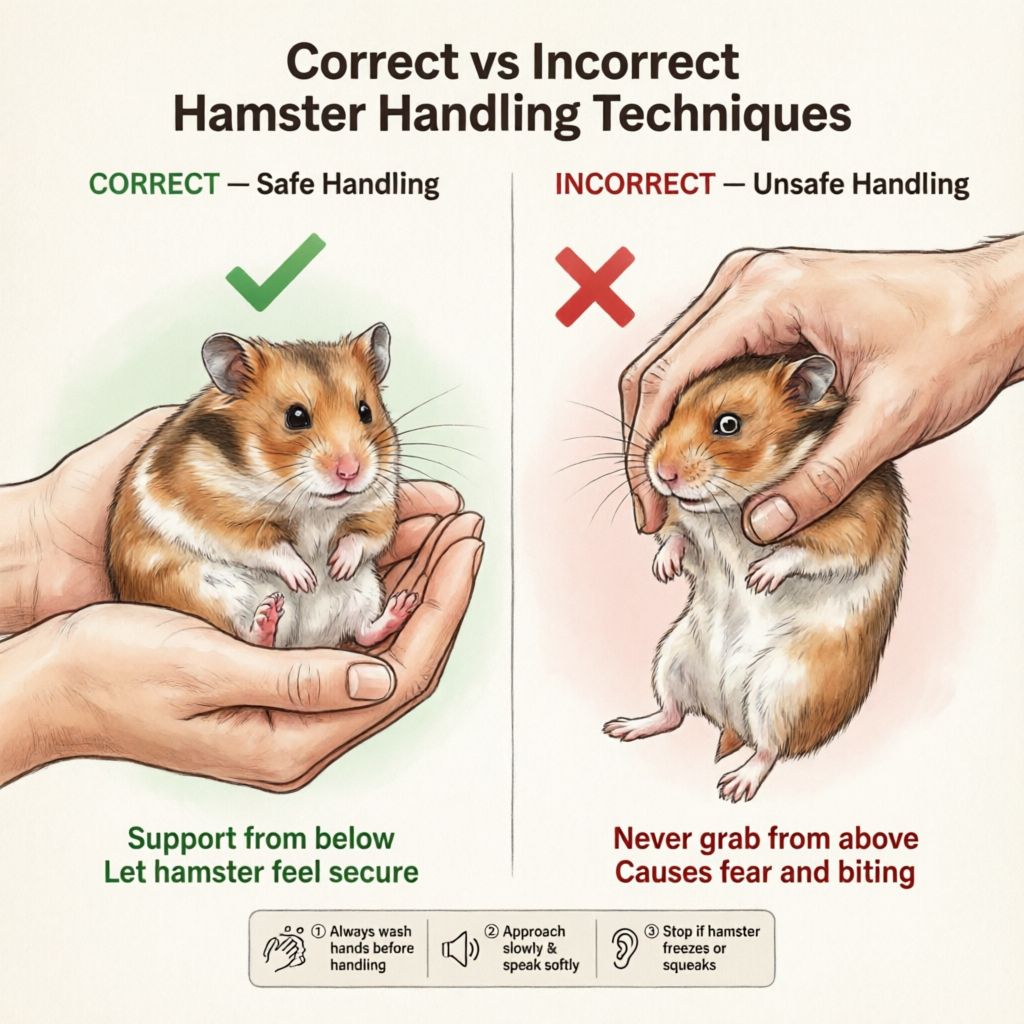
The Scoop Method (Recommended):
- Place both hands in cage
- Cup hands on either side of hamster
- Gently curve fingers under hamster’s body
- Scoop up, supporting entire body
- Keep close to your body or surface (in case of jump)
Why This Works:
- Hamster feels supported, not grabbed
- Prey animals fear being grabbed from above (predator attack)
- Scooping from below or side is less threatening
How NOT to Pick Up Your Hamster
- ❌ Grabbing from above (predator attack simulation—very scary)
- ❌ By the tail (NEVER—causes serious injury)
- ❌ By the scruff (neck skin—not recommended, causes stress)
- ❌ By one leg or arm (obviously dangerous)
- ❌ Suddenly (always move slowly)
Holding Your Hamster
Correct Hold:
- Hamster sits in palm or crook of hand
- Support entire body
- Thumb gently over back (optional, for security)
- Keep close to surface or body
- Let hamster move somewhat (don’t squeeze)
Duration:
- Newly tamed: 5-10 minutes max
- Well-tamed hamster: 15-20 minutes (or until hamster wants down)
- Watch for stress signs: Return to cage if struggling, biting, or ears back
Tip: Some hamsters love handling, others tolerate it. Respect your individual hamster’s personality.
For Children
Children should:
- Sit on the floor (not stand—falling risk)
- Hold hamster over lap or towel
- Have adult supervision
- Keep sessions short (5 minutes)
- Be taught gentle touch
Never:
- Leave child alone with hamster
- Allow squeezing or rough handling
- Let child walk around holding hamster
- Force interaction
Troubleshooting Common Problems
Problem 1: Hamster Bites During Taming
Why It Happens:
- Fear (not yet tamed)
- Surprised (sudden movement)
- Hand smells like food
- Pain or illness
- Territorial (cage aggression)
What to Do:
- Don’t react dramatically (no yelling, no dropping)
- Gently place hamster back in cage
- Wash wound with soap and water
- Assess cause: Were you moving too fast? Did you surprise them?
- Go back a step in taming process
- If hamster was tame and suddenly bites → see vet (pain check)
Don’t Give Up: Biting is normal early in taming. Most hamsters stop biting once they trust you.
Problem 2: Hamster Won’t Take Treats
Possible Causes:
- Too scared (go back to earlier steps)
- Treat not desirable (try sunflower seeds, mealworms)
- Full (taming after mealtime)
- Sick (not eating in general)
What to Do:
- Try higher-value treats (seeds, favorite veggies)
- Taming before mealtime (hungrier = more motivated)
- Check if hamster is eating normally otherwise
- Be patient—some hamsters take longer
Problem 3: Hamster Runs Away Every Time
Why This Happens:
- Still fearful (need more time at current step)
- Moving too fast (literally—slow down)
- Cage too open (no hides—hamsters need security)
What to Do:
- Slow down all movements
- Spend more time at current taming step
- Offer treats through cage bars initially
- Give hamster more settling time
- Don’t chase—let hamster come to you
Problem 4: Hamster Freezes When Handled
What It Means:
- Fear response (tonic immobility)
- “Playing dead” as defense mechanism
- Not relaxed—terrified
What to Do:
- This is not “calm”—hamster is scared
- Return to cage immediately
- Go back to earlier taming steps
- Move more slowly, give more time
- Shorter sessions with more treats
Misconception: A frozen hamster is not a relaxed hamster. Freezing = fear.
Problem 5: Hamster Always Wants to Escape
Why This Happens:
- Prey instinct (desire to hide)
- Not yet comfortable with handling
- Session too long
- Environment not secure enough
What to Do:
- Keep sessions shorter
- Hold over enclosed area (playpen, bin)
- Don’t restrain—let hamster explore your hands
- Be patient—comfort increases with time
Problem 6: Tamed Hamster Suddenly Bites
Possible Causes:
- Pain or illness (most common—see vet!)
- Startled (woken suddenly, surprised)
- Hormonal (intact animal, seasonal)
- Territorial (reaching into cage vs. outside cage)
What to Do:
- See vet to rule out health issue
- If healthy, assess situation (were you reaching into cage? Woke them?)
- Rebuild trust with treats and gentle handling
- For cage aggression, let hamster come to you or scoop from outside cage
Red Flag: Sudden aggression in a previously tame hamster often indicates pain or illness.
Taming Variations by Species
Syrian Hamsters
Characteristics:
- Generally easier to tame
- Solitary (all attention is on you)
- Larger size (easier to handle)
Tips:
- Often tame in 7-14 days
- Usually become very friendly once tamed
- Some are naturally calmer than others
Dwarf Hamsters (Campbell’s, Winter White, Roborovski)
Characteristics:
- Can be faster and more skittish
- Smaller size (more fragile, quicker)
- Some can be housed together (attention divided)
Tips:
- May take longer (2-3 weeks)
- Move extra slowly (they’re fast!)
- Offer smaller treats
- Some never become “lap hamsters” but tolerate handling
Chinese Hamsters
Characteristics:
- Longer tail (don’t grab by tail!)
- Good climbers
- Can be more mouse-like in behavior
Tips:
- Let them climb and explore
- Longer taming process sometimes needed
- Very rewarding once tamed
Advanced Bonding
Once Your Hamster Is Tame
Building Deeper Bond:
- Daily interaction: Handle or interact every day
- Out-of-cage time: Regular playpen time
- Treats from hand: Continue rewarding interaction
- Talk to hamster: They learn your voice
- Respect personality: Some are lap hamsters, some are independent
Signs of Strong Bond
- ✅ Hamster comes to cage front when you approach
- ✅ Takes treats gently from fingers
- ✅ Climbs onto your hand voluntarily
- ✅ Relaxed body language during handling
- ✅ Doesn’t bite (unless surprised or in pain)
- ✅ May fall asleep on you (ultimate trust!)
Safety Reminders
Always
- ✅ Wash hands before handling (remove food smells)
- ✅ Move slowly and calmly
- ✅ Support entire body when lifting
- ✅ Keep close to surface (in case of jump)
- ✅ Supervise children
- ✅ Watch for stress signs
Never
- ❌ Wake sleeping hamster suddenly
- ❌ Grab from above
- ❌ Squeeze or restrain tightly
- ❌ Drop or throw
- ❌ Leave unsupervised with children
- ❌ Handle if hamster is sick or injured (unless necessary)
Taming Timeline Summary
| Day | Activity | Duration | Success Sign |
|---|---|---|---|
| 1 | Hand in cage (no touch) | 5-10 min, 2-3x/day | Hamster approaches hand |
| 2 | Treats from hand | 5-10 min, 2-3x/day | Hamster takes treat |
| 3 | Brief touch while treating | 5-10 min, 2-3x/day | Accepts touch while eating |
| 4 | Scooping (no lift) | 5-10 min, 2-3x/day | Sits in scooped hands |
| 5 | First brief lift | 5 min, 2-3x/day | Tolerates brief lift |
| 6 | Extended handling | 5-10 min, 2x/day | Explores hands voluntarily |
| 7 | Out-of-cage time | 15-30 min | Explores confidently |
Note: Timeline varies by individual. Some hamsters take 5 days, others 3 weeks. Patience and consistency are key.
Frequently Asked Questions (FAQ)
1. How long does it take to tame a hamster?
1-3 weeks for most hamsters. Some tame in days, others take a month. Consistency is more important than speed.
2. What if my hamster bites me?
Don’t give up! Go back a step in taming, move slower, and try again. Biting decreases as trust builds.
3. Can I tame an older hamster?
Yes! Older hamsters may take longer but can definitely be tamed. Be patient and gentle.
4. Why does my hamster freeze when I hold it?
Fear response. Freezing = terror, not relaxation. Put hamster back and go slower.
5. Should I use gloves for taming?
Not recommended. Gloves reduce dexterity and may scare hamster more. If you’re very nervous, use a thin towel initially, but graduate to bare hands quickly.
6. How often should I handle my hamster?
Daily once tamed. 10-20 minutes per session is plenty. Quality over quantity.
7. Why does my hamster bite when I put my hand in the cage?
Cage aggression/territorial behavior. Let hamster come to you, or scoop from outside cage (remove hide house and let hamster walk onto hand).
8. Can I wake my hamster to handle them?
Not recommended. Waking a sleeping hamster startles them (bite risk). Wait for natural waking time (evening/night).
9. What’s the best treat for taming?
Sunflower seeds (in shell or shelled), pumpkin seeds, small pieces of favorite vegetable. High-value treats motivate best.
10. My hamster was tame but now bites. What happened?
See vet first (pain is most common cause). If healthy, you may have surprised them or need to rebuild trust. Go back to earlier taming steps.