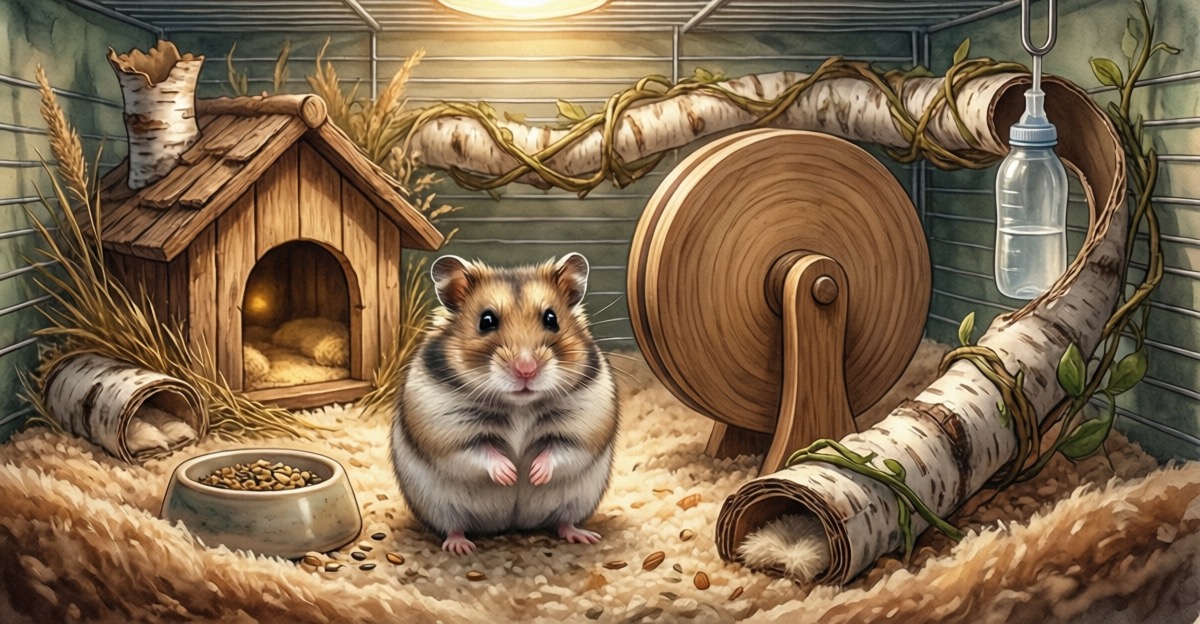
I’ve seen way too many dwarf hamsters crammed into cages the size of a shoebox, and it breaks my heart every time. The pet store told the owner it was fine. It is not fine. Finding the right dwarf hamster cage is the single most important decision you will make as a new owner, and it affects everything from their lifespan to their daily behavior. This guide covers exactly what size your dwarf hamster needs, which bar spacing keeps them safe, and which cages I would actually trust with my own pets. I have kept dwarf hamsters for years, and I have learned the hard way what works and what does not.
Dwarf Hamster Cage Size Requirements
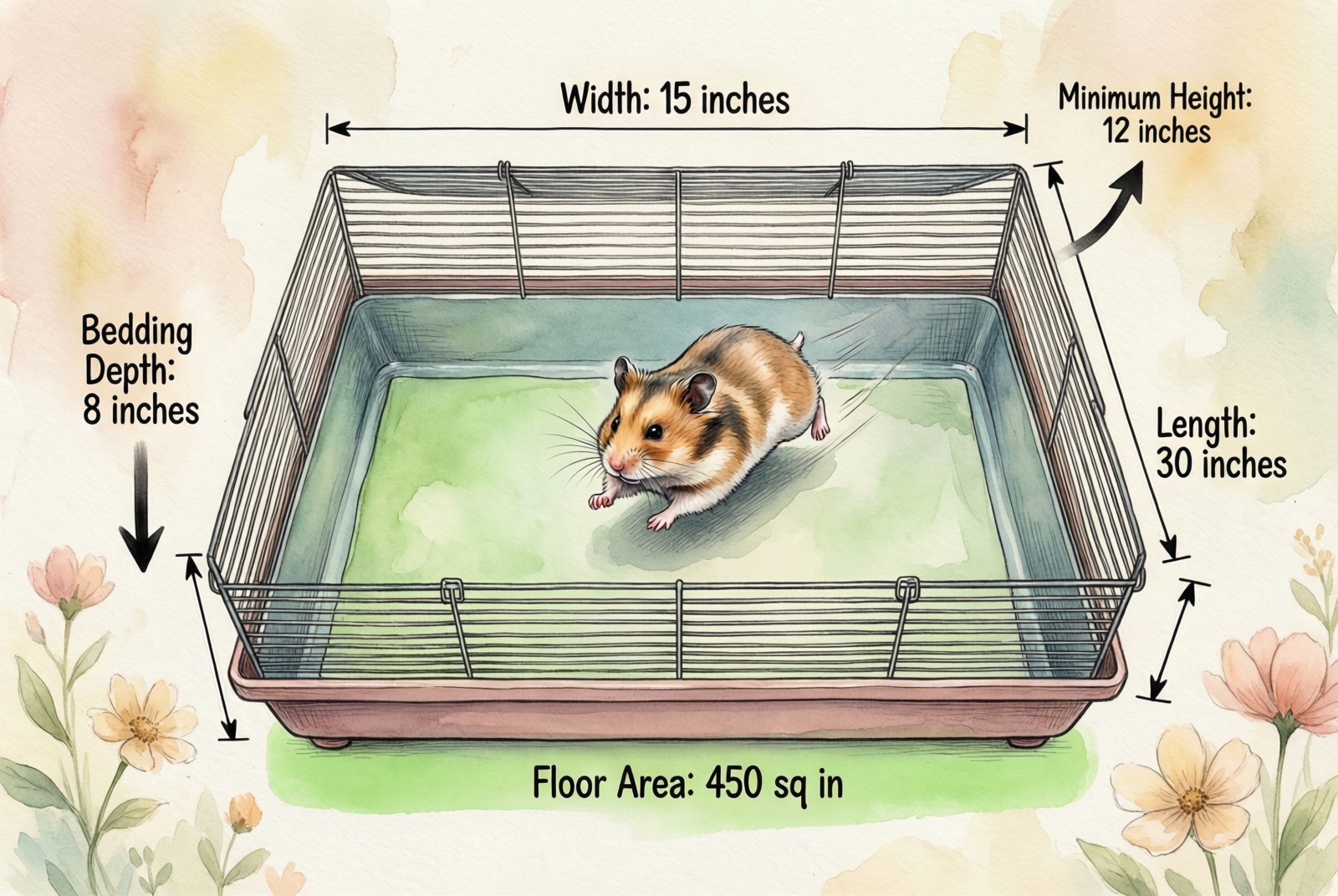
The minimum cage size for a dwarf hamster is 450 square inches of continuous floor space, which works out to roughly 30 inches by 15 inches. This recommendation comes from HamsterWelfare and the RSPCA, two of the most respected voices in small animal welfare. I know 450 square inches sounds generous compared to the tiny cages sold in most pet stores, but dwarf hamsters are active little animals that cover several miles of ground every single night in the wild. They need room to run, dig, forage, and explore. When you are shopping for a hamster cage, this floor space number is the one spec you should prioritize above everything else.
Floor space matters far more than height. Dwarf hamsters are ground-dwellers by nature. They do not climb the way Syrian hamsters sometimes do, so a tall cage with a tiny footprint is essentially wasted space. What your dwarf needs is a wide, low enclosure where they can sprint across the floor and burrow into deep bedding. I always tell people to think of the cage as a horizontal playground, not a vertical tower.
That said, you do need at least 12 inches of height to accommodate six or more inches of bedding. Dwarf hamsters are natural burrowers, and shallow bedding leads to stress and repetitive behaviors like bar biting and pacing. In my experience, a cage that holds at least eight inches of bedding is ideal. Your hamster will tunnel through it, create sleeping chambers, and stash food underground, which is exactly what they are supposed to do.
So what happens when a dwarf hamster lives in a cage that is too small? The signs are disturbing. Bar biting is one of the most common indicators. Your hamster will gnaw on the wires obsessively, sometimes until their teeth bleed. Pacing back and forth along the same path is another red flag. These are stereotypic behaviors, the animal equivalent of a human rocking in a corner, and they indicate chronic stress. Over time, cramped living conditions can shorten your hamster’s lifespan and weaken their immune system. For a more detailed look at cage dimensions and setup principles, check out our hamster cage setup guide, and if you want to dig deeper into the science behind enclosure requirements, our article on the proper hamster enclosure covers the evidence in full.
Bigger is always better when it comes to cage size. If you have the space and budget for something larger than the minimum, your hamster will thank you for it with more natural behaviors and a calmer temperament. A larger dwarf hamster cage also means you can add more enrichment items like tunnels, extra hides, and a larger wheel, all of which contribute to a happier, healthier pet.
Wire Bar Spacing: Why It Matters for Dwarf Hamsters
Bar spacing is a safety issue that many new dwarf hamster owners completely overlook, and it can be dangerous. The safe dwarf hamster cage bar spacing is 0.5 inches or less, which is about 1.27 centimeters. Anything wider and you are gambling with your hamster’s safety.
Here is why this matters so much. Dwarf hamsters are tiny, typically only three to four inches long. Syrian hamsters, by comparison, are six to seven inches. A cage that is perfectly safe for a Syrian can be a getaway vehicle for a dwarf. I have heard too many stories of owners waking up to find their dwarf hamster missing because the bar spacing was just a fraction too wide. These little animals can flatten their bodies and squeeze through gaps that seem impossibly small.
If the bars are too wide, two things can happen. Your hamster escapes, which often ends badly since loose hamsters are extremely difficult to catch and face dangers like other pets, electrical cords, and falls. Or worse, your hamster gets partway through the bars and gets stuck, which can cause serious injuries. The pencil test is a simple way to check: if a standard pencil fits between the bars, the spacing is too wide for a dwarf.
Wire cages are not the only culprit. Avoid any cage design with narrow tubes or tunnels. Dwarf hamsters can get wedged inside tight tubes, and the results can be fatal. Glass tanks and bin cages eliminate the bar spacing concern entirely, which is one of the reasons I often recommend them for dwarf hamster owners. If you want to understand how bar spacing requirements differ between dwarf and Syrian hamsters, our guide on Syrian hamster cage size breaks down the differences clearly.
Best Dwarf Hamster Cages — Top 5 Picks
After testing and researching dozens of options, these are the five cages I would recommend to a friend. I have looked at build quality, safety for dwarf hamsters, floor space, and overall value. Each one serves a different need and budget.
The Prevue Pet Products Universal Small Animal Home is the cage I recommend most often to new owners, and for good reason. At around $117, it delivers solid value with a 4.7-star rating 🔥 on Amazon. This is a classic wire cage with excellent ventilation, and it has been a staple in the hamster community for years. The one thing I want to flag for dwarf hamster owners is the bar spacing. You will want to measure it yourself or add a mesh cover if the gaps are wider than half an inch. I have seen owners do this successfully with hardware cloth and zip ties, and it takes about twenty minutes. If you want something reliable without spending a fortune, this is it. You can find it here.
If budget is not a constraint and you want the absolute best living space for your dwarf, the Niteangel Vista Hamster Cage in the large size is worth every penny. At $309.95, it is a serious investment, but the floor space is enormous at 47.1 inches wide by 22.7 inches deep. That is well over a thousand square inches of continuous floor area, more than double the minimum requirement. Niteangel is a professional hamster brand, and the build quality shows. The MDF wood frame with clear acrylic panels gives you excellent visibility while eliminating bar spacing concerns entirely. The oblique-opening door is a thoughtful touch that makes feeding and cleaning much easier. In my experience, Niteangel products hold up well over years of use. This is the cage I would choose for my own hamster if I had the space for it. You can check it out here.
For owners who need something that looks good in a living room and doubles as furniture, the GDLF Hamster Cage with Storage Cabinet is a smart pick. It features clear acrylic panels for easy viewing and a built-in storage cabinet underneath for all your hamster supplies. At $174.99 with a 4.5-star rating 🔥, it hits a nice middle ground between budget and premium. I like that it is compatible with Niteangel accessories, so you are not locked into one ecosystem. If you are short on floor space and want something aesthetically pleasing, this cabinet-style cage delivers. You can find it here.
The BUCATSTATE Hamster Cage 3.0 is the one I would pick if I were keeping multiple small animals. This metal stackable cage at $279.99 is built with a chew-proof metal frame, which is a huge advantage if your hamster is a determined gnawer. The top-access design makes it easy to reach in, and the adjustable shelves let you customize the layout. It is rated for dwarf hamsters, Syrian hamsters, degus, and chinchillas, so if your small pet family grows, this cage grows with it. The 4.5-star rating 🔥 suggests it is well-received by the community. You can see it here.
The PawHut Large Hamster Cage with Deep Glass Bottom is the option I recommend for dwarf hamster owners who want the safety of glass without the weight of a full aquarium. The tempered glass base holds deep bedding beautifully, and the three-tier design gives your hamster levels to explore. At $139.99, it is reasonably priced for what you get. Since the bottom is solid glass, there is zero bar spacing concern at the base level, which gives me peace of mind for dwarf hamsters in particular. You can grab one here.
Once you have the cage sorted, you will want to fill it with engaging accessories. Our guide to the best hamster toys covers enrichment options, and our hamster diet guide helps you plan nutrition for life inside the dwarf hamster cage.
Glass Tank vs Wire Cage vs Bin Cage
Every dwarf hamster owner faces the same three options when choosing a dwarf hamster cage, and each one has real trade-offs. I have tried all three over the years, and my preference has shifted as I learned more about what dwarf hamsters actually need.
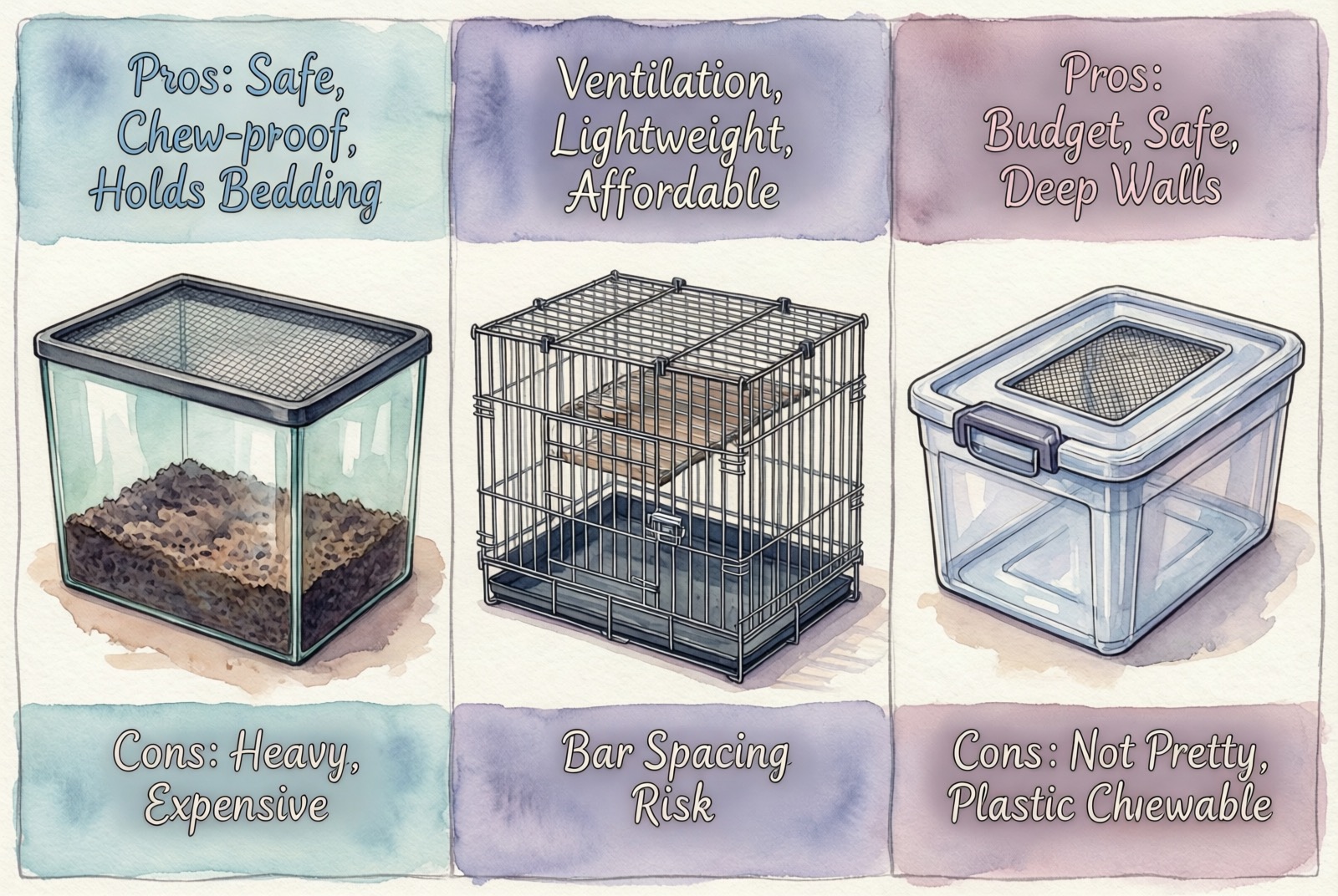
Glass tanks are the safest option for dwarf hamsters. There are no bars to worry about, no escape gaps, and the solid walls hold deep bedding without any mess spilling over the sides. Visibility is excellent, and glass is completely chew-proof. If you are considering a dwarf hamster tank setup, a 40-gallon breeder tank is a strong starting point for your dwarf hamster cage. The downsides are weight and price. A proper glass tank is heavy to move and expensive to buy. Ventilation can also be an issue if the tank does not have a mesh lid, so you need to make sure there is adequate airflow. I have found that a 40-gallon breeder tank works beautifully for a single dwarf hamster, though it will cost more than most wire cages. If budget is tight, a bin cage is a solid alternative dwarf hamster cage that still meets the minimum space requirements.
Wire cages offer the best ventilation by far, which helps control odor and humidity. They are lightweight and usually the most affordable option. The problem, as I discussed earlier, is bar spacing. For dwarf hamsters, you need to be extremely careful about wire cage selection. I have seen cages advertised as hamster cages that would be escape-proof for a Syrian but are dangerously wide for a dwarf. If you go with a wire dwarf hamster cage, measure the bar spacing yourself before you set anything up inside it.
Bin cages are the budget champion. A large clear storage bin of 110 quarts or more, fitted with a mesh ventilation panel on the lid, gives you a functional dwarf hamster cage for fifteen to twenty-five dollars. There are no bar spacing concerns, and the deep walls hold bedding perfectly. The trade-offs are aesthetic and practical. Bin cages do not look great in a living room, and plastic sides can be chewed over time. I consider bin cages a great starter option or a temporary solution while you save up for something better. For step-by-step instructions on building one, our DIY bin cage guide walks you through the entire process. If you want to explore other unusual cage designs, our article on the dinosaur hamster cage shows another creative approach.
My honest recommendation for dwarf hamster owners is to go with a glass tank or a wooden cage like the Niteangel. Both options eliminate bar spacing concerns entirely, and that peace of mind is worth the extra cost.
Dwarf Hamster Bin Cage and IKEA Detolf Setup
Building a bin cage is straightforward, and I think every dwarf hamster owner should know how to do it, even if you eventually upgrade to a commercial dwarf hamster cage. You need a clear storage bin of at least 110 quarts, a sheet of hardware cloth or mesh for ventilation, bolts and washers to secure the mesh, and basic tools like a drill and wire cutters. The process involves cutting a large window in the lid of the bin, attaching the mesh securely over the opening, and filling the bin with six or more inches of bedding. The entire dwarf hamster cage project takes about an hour and costs under thirty dollars in most cases.
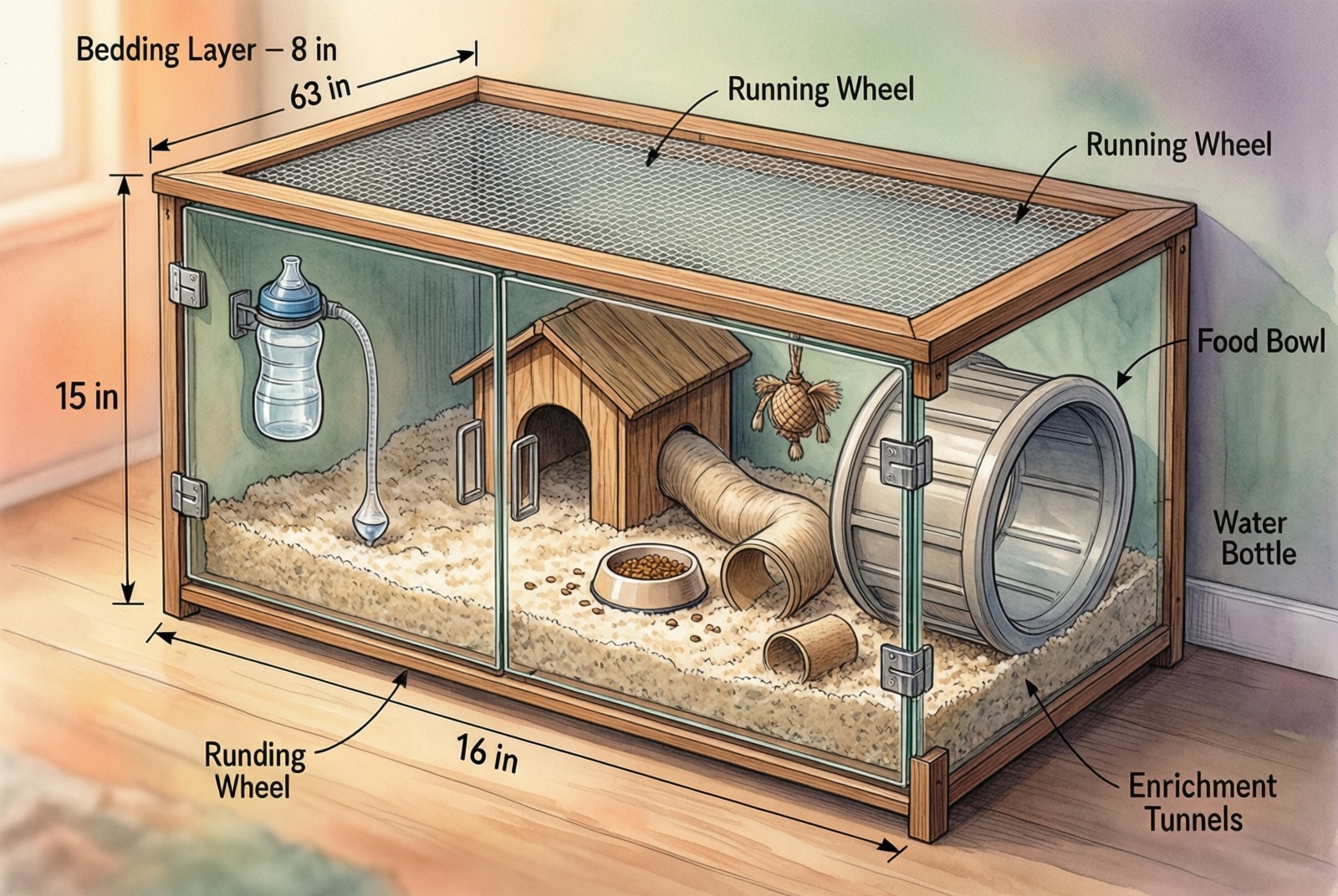
The IKEA Detolf is a legendary option in the hamster community, and I understand why people love it. This ikea detolf dwarf hamster cage setup uses a glass shelf unit measuring 63 inches long by 16 inches deep by 15 inches tall, giving you roughly 1,008 square inches of floor space. That is more than double the minimum requirement, and at around sixty to seventy dollars, it is one of the most cost-effective ways to give your dwarf hamster a spacious home. You do need to modify it by adding a backing panel, securing the doors, and ensuring proper ventilation through the top. IKEA availability varies significantly by region, so this dwarf hamster cage option is not guaranteed to be in stock near you. In hamster forums, the Detolf has been a community favorite for years, and the enthusiasm is well-deserved for those who can find one. Our DIY bin cage guide covers both bin cages and the Detolf conversion in detail.
Essential Cage Setup and Accessories
The cage itself is just the beginning. What you put inside it determines whether your dwarf hamster thrives or just survives. I have refined my dwarf hamster cage setup over many hamsters, and these are the essentials I would never skip.
A running wheel is non-negotiable. Dwarf hamsters run five or more miles every night in the wild, and a wheel is the primary way they burn that energy indoors. The minimum diameter for a dwarf hamster is 6.5 inches, though I prefer 8 inches because it forces a healthier running posture. Always choose a solid-surface wheel for your dwarf hamster cage. Wire wheels cause a painful condition called bumblefoot, where sores develop on the pads from running on bare wire. For more on exercise requirements, our hamster exercise guide covers everything from wheels to free-roaming.
Bedding depth is something many owners underestimate. Six inches is the bare minimum, and I use eight to ten inches in my own cages. Paper-based bedding like Carefresh or aspen shavings are the safest choices for any dwarf hamster cage. Avoid pine and cedar entirely because the aromatic oils are toxic to small animals. Cotton and wool bedding pose an entanglement risk and should never be used. A sand bath filled with chinchilla sand, not dust, gives your dwarf a way to groom themselves naturally.
Your hamster needs at least two hiding spots, one for sleeping and one for food storage. Dwarf hamsters are hoarders by nature and will happily stuff a hide full of sunflower seeds. A small, heavy ceramic food bowl prevents tipping, and either a mounted water bottle or a shallow dish works for hydration inside the dwarf hamster cage.
Cage placement matters more than people realize. Keep the dwarf hamster cage in a quiet room away from direct sunlight and drafts. Stable temperatures between 65 and 75 degrees Fahrenheit are ideal. Dwarf hamsters are sensitive to temperature fluctuations, and extreme heat or cold can be dangerous. Spot clean the cage daily by removing soiled bedding, and do a full clean every three to four weeks. Never remove all the bedding at once, because your hamster relies on scent markers to feel secure in their dwarf hamster cage. For ideas on making the cage more engaging, our cage enrichment guide has plenty of inspiration, and if you are just starting out, our first-time hamster owner guide walks you through everything from day one.
Frequently Asked Questions
What is the minimum cage size for a dwarf hamster? The minimum cage size for dwarf hamsters is 450 square inches of continuous, unbroken floor space according to HamsterWelfare and RSPCA guidelines. That translates to roughly 30 inches by 15 inches of floor area. The height should be at least 12 inches to accommodate six or more inches of burrowing material. I would encourage you to go larger if you can, because dwarf hamsters are highly active and benefit from every extra inch of space in their dwarf hamster cage.
What bar spacing is safe for dwarf hamsters? The maximum safe bar spacing is 0.5 inches, or 1.27 centimeters. Dwarf hamsters are only three to four inches long and can compress their bodies to squeeze through surprisingly small gaps. Use the pencil test: if a pencil fits between the bars, the spacing is too wide. Glass tanks and bin cages eliminate this concern completely, which is why I often recommend them for dwarf owners.
Can dwarf hamsters live together in one cage? Generally, no. While some dwarf species like Campbell’s and Winter Whites can cohabitate when introduced as young siblings, it is risky. Fights can break out even between hamsters that have lived together peacefully for months, and the results can be severe. One hamster often dominates food and resources while the other suffers. Syrian hamsters must always live alone without exception. For beginners, I strongly recommend one hamster per dwarf hamster cage. It is safer and simpler.
Do dwarf hamsters need a wheel? Absolutely. Running is the primary form of exercise for a dwarf hamster, and they will cover five or more miles on a wheel each night. The minimum wheel diameter is 6.5 inches, though 8 inches is better for their posture. Use a solid-surface wheel to prevent bumblefoot, and place it in a quiet corner of the dwarf hamster cage where your hamster feels safe running.
What is the best bedding for dwarf hamsters? Paper-based bedding such as Carefresh or Kaytee Clean and Cozy, or aspen shavings, are the best options for any dwarf hamster cage. Provide at least six inches of depth for burrowing, though eight to ten inches is better. Avoid pine and cedar shavings because the natural oils cause respiratory problems. Skip cotton and wool bedding because hamsters can get tangled in the fibers and injure themselves. A sand bath with chinchilla sand provides a natural grooming option.
Can dwarf hamsters live in a bin cage? Yes, bin cages are a popular and functional option for dwarf hamsters. Use a clear storage bin of 110 quarts or larger with a mesh ventilation panel secured to the lid. They provide deep bedding space, no bar spacing concerns, and cost as little as fifteen to twenty-five dollars. They are not as visually appealing as a commercial dwarf hamster cage, but your hamster does not care about aesthetics. For a complete tutorial, our DIY bin cage guide covers everything you need.